Decoding the Panji of Mithila · Volume IV · Chapter 59
Rajanpura-Kaivalakh, Shivipatti, Kanhouli, Navani, Ratauli, and Bhatsimari-Tharhi: Entries (486)-(497)
Chapter 59. Rajanpura-Kaivalakh, Shivipatti,
Kanhouli, Navani, Ratauli, and Bhatsimari-
Tharhi: Entries (486)-(497)
   This chapter continues the Rajanpura register from the
point where the previous chapter stopped. It begins with the
Rajanpura-Kaivalakh continuation at entry (486), passes
through the Shivipatti and Ranti branches, follows the
Kanhouli and Navani extensions, and then turns to the
Ratauli-Darihara material. The coverage is deliberately limited
to entries (486)-(497). Entry (498), which opens a fresh Ratauli-
to-Dhadhi sequence, is left for the next chapter so that the
Ratauli material is not divided carelessly in the middle of a
new register heading.
   The source here is marked by repeated shifts of territorial
control. Rajanpura is the dominant point of entry in entries
(486)-(494), but the lines repeatedly move outward by
marriage and recorded descent into Kaivalakh, Shivipatti,
Ranti, Kanhouli, Navani, Amerkila in Rajasthan, and several
older nodes such as Alay, Soderpur, Pali, Babhaniam, Oini, and
Khaual. From entry (495), the control changes to Ratauli-
Darihara, and the chapter closes at the Tharhi continuation of
the Ratauli-Bhatsimari line. The genealogical value of these
entries lies not only in father-son succession but also in the
way the Panji records migration, affinity, occupational title,
learned status, and apara-side branching.

Entry (486): Rajanpura to Kaivalakh
  Entry (486) is headed Rajanpura to Kaivalakh. It resumes a
Rajanpura cluster through Revatinath, Amritnath, Gokulnath,
and the Bokna line. The first part is typical of a continuation
entry: it does not reset the whole family from a remote
ancestor but attaches the current branch to the earlier
Rajanpura structure. Revatinath is connected through Sarisab

and the Jaydatt route to Sakararhi-Jaydatt; Amritnath is tied
through Pali and the Jaydatt-Rohan route to Baliyas-
Dharmadatt; and Gokulnath is carried toward Pandua and
Achyut. These are not separate biographies; they are route-
and-descent markers, each preserving a chain of recognized
relationship.
  The central body moves through Gokulnath to Bokna and
then into several apara branches. Bokna is followed by a Raja
branch; Jaynidhi is attached through Takbal-Bachha-Ravinath
and Mandar-Kaladhar-Nandipati; Babulal is followed by
Shridhar and Musai; and a Manai branch is separately
preserved     through     Soderpur-Harpati-Janakinath    and
Karmaha-Soni-Rudranath. The line also keeps the older
formula of kasthut for points where a relationship is
remembered but not fully expanded. This is important
because kasthut marks a validated but compressed
genealogical node rather than an omission by the compiler.
   The latter portion of the entry is organized around Gidru or
Dharmadatt and the Jhau group. Gidru/Dharmadatt leads to
Baburaiya, Shankardatt, Hari, and Shammu; Jhau generates
Luchai or Babunath, Thothan, Jamahir, Dhodhan, and the
Maharaj-Prema line. The apara clauses show several parallel
social routes: Pali-Purushottam-Bhaiya, Belauch-Bhavnath-
Judaudan, Ghusaut-Janakinath-Poshan, Hariamb-Chhatrapati-
Parashmani, and Sarisab-Prannath-Kamaladatt. The entry
ends by keeping Shaktinath under Maharaj and Prema under
Naraun-Hridaydatt-Girju and Mandar-Nanu. Thus entry (486)
is a compact but highly branched Kaivalakh register, anchored
in Rajanpura but distributed through multiple village and
marriage circuits.

Entries (487)-(488): Rajanpura to Shivipatti and
Shivipatti-Ranti
   Entry (487) opens with the Rajanpura-to-Shivipatti heading
and a strikingly compressed notice: Mahendra is linked
through       Alay-Harikant-Devkant       and     Pandua-Pandit
Ramkrishna. The body then turns to Shridatt and presents an
unusually wide set of sons and apara sons. Nanu, Jhalhu,
Brajnath, Modnarayan, Bhaiya, Bhola, Kashinath, Vidyanath,
Jaynath, Kirtinath, Chandidatt, and Thadu are all preserved in
a single field of descent. This is the kind of Panji entry where
the grammar of succession is more important than narrative;
each name marks a valid branch, while the village routes
specify how the branch was recognized and where it was
linked.
   Nanu is developed through Lal, Faturi, and Tufani. Lal
produces Vanshidhar and Nandakumar; Vanshidhar leads to
Nena, Keshav, and Dharadhar; Nena then gives Lakshmikant
and Sushil Chandra. Govind produces Baidyanath and
Jagannath; Nandakumar gives Raghuvir and Jagdish. These
modern or semi-modern names do not erase the older Panji
structure. Instead, they show how the same register continues
into a later period while retaining the older idiom of routes:
Ghusaut, Jajival, Kodariya, Mandar, Bhadual, and other nodes
remain active.
   Entry (488) continues the Shivipatti section but adds Ranti.
It begins with Mahavir, Ahil-Hariamb, Tufani, and Dhan, and
then passes through Kanhaiyalal and Virbhad. The Jyotishi
Jhalhu line is especially significant because it shows a
professional title inserted inside a descent structure, not as a
separate honorific note. Brajnath produces Grihimani,
Yogmani, and Rajmani; Grihimani leads to Hiramani;
Hiramani produces Umanath, Shashinath, and Shyamsundar;
Shashinath produces Ghananand, Gunanand, and Punyanand;

Shyamsundar produces Ramanand, Vedanand, Kirtyanand,
Nityanand, and Jayanand. Vedanand’s line reaches M.M. Dr.
Umesh, showing the continuation of the learned-title tradition
inside a modern learned branch.
  The same entry also carries Mukund, Parshi, Bhaylal,
Narsingh, and Triloknath. These appear after several apara
and kasthut clauses. The editor should read the dots and
suspended portions not as lost meaning but as deliberate
compression: the Panji often records the connection and route
while leaving the secondary branch incomplete because the
principal purpose is to prove the link, not to narrate every
descendant.

Entries (489)-(491): Rajanpura-Kaivalakh, Kanhouli,
and the open Rajanpura continuation
   Entry (489) returns to Rajanpura-Kaivalakh. It begins with
the Kira line and then passes through Ishwardatt, Kanhai, and
Babunath. The structure again works by parallel listing:
Ishwardatt produces Banmali and Faturi; Kanhai is followed
by Dharanidhar and Avanidhar; Babunath gives Devanath,
Kishori, and Yadunath. The Devanath line is developed
through Gulab and Nena; Nena produces Bholi; Bholi leads to
Thakkan. A separate Devanath apara goes to Sakuri-Budhwal-
Gunanand, while the Dullah-Vishnudatt and Bhirwari sections
preserve another lateral branch. The entry closes with Manik,
Akali, Nanu, and Bhaylal, ending in the Dhohi-Chintamani-
Singheshwar cluster. The effect is that Kaivalakh is not treated
as a single straight line but as a multi-branch field with
several recognized apara channels.
   Entry (490), headed Rajanpur-Kanhouli, changes the
territorial focus without leaving the same family environment.
Bhavan produces Bachh, Devanath, and Keshavnath.
Devanath is linked with Pali-Bhavanidatt-Ramanath and
Soder-Vidwaneshwar, while the Keshavnath line gives

Dhodhai and Lalit. Dhodhai leads to Yadu; Yadu produces
Indrakant and Vishnukant; Indrakant produces Nandakumar.
The entry then turns to Manbodh and its extensions:
Grihinath, Vanshmani, Babue, Bhavan, Dullah, and other
apara branches. Here the Kanhouli line is not merely a locality
label; it functions as the point at which several older relations
are gathered and revalidated.
   Entry (491) is headed only Rajanpura, a sign that it
continues the preceding register without narrowing the
branch to a new village subtitle. Subodh produces Nidhipani
and Vedpani; Bhavadatt is held as another son. Nidhipani
gives several branches, including Fakir, Shrinath, and Thithar;
Shrinath gives Dhathur; Thithar gives Jhulan, and Jhulan gives
Yadav. Bhavadatt produces Kanhai, Ramani, Chandidatt, and
Taranidatt. Kanhai leads to Bachchu and then Ramchandra;
Chandidatt gives Hiramani and Tirthamani. The entry is
valuable because it preserves a Rajanpura continuation in
which the same family line is simultaneously connected with
Kudjuali, Pali, Soderpur, Ghusaut, Oini, Baliyas, and Sakararhi.

Entries (492)-(494): Rajanpura to Navani, Amerkila,
and the suspended Rajanpura marker
   Entry (492) is headed as Rajanpura to Navani and Amerkila
in Rajasthan, with Dausa district explicitly indicated. It is one
of the clearest examples in this section of the Panji registering
an outward movement beyond the immediate Mithila village
map while still maintaining the Mithila descent grammar. The
entry follows Mahesh through Meena, Dullah, and Toti. Meena
gives Bhaiya, Hiyan, and M.M. Parmeshwari Datt; Bhaiya leads
to Bhagirath, Raghuvar, and Devkinandan. Lala produces
Shaktidhar, and Shaktidhar produces Natwar. The later
Devkinandan line gives Babuji and Harinandan; Babuji
produces Srinandan; and Srinandan gives Shankaranand,
Acharya Bouanand, Shivanand, Chaturanand, and Mahanand.

The use of Acharya and M.M. here is not decorative: it records
learned distinction as part of the genealogical identity.
   Entry (493) continues Rajanpura to Navani. Hiyan produces
Shrikant and Manu. Shrikant produces Baidyanath, called
Duva, while the line also remembers M.M. Padhyaynath
Parmeshwari Datt. Nityanand, Lakshman, and Dullah-
Jagannaryan continue the branch, and the Toti-Bhavanidatt
line brings in further Pali, Jajival, and Soderpur routes. This
entry is followed by entry (494), which is only a Rajanpura
heading with no developed body. As in earlier chapters, a
heading-only entry should not be read as error. It is a
suspended marker: the scribe preserves the register point but
leaves the actual body to the surrounding or subsequent
entries.

Entries (495)-(497): Ratauli-Kakraud, Ratauli-
Bhatsimari-Tharhi, and the Tharhi continuation
   Entry (495) shifts the register to Ratauli-Kakraud and
explicitly begins the Ratauli-Darihara gramarambh. Bhagirath
produces Dharmapati, Madhan, and Adhari. Dharmapati
produces Ghananand; Ghananand produces Manik, Shivan,
Shambhu, and Yaddu. Manik gives Rudi; Rudi produces
Ramakant and Vishwanath; Ramakant gives Harshanath. The
Madhan branch leads to Vanshidhar and Kirtidhar;
Vanshidhar gives Hridaynath and Hema. The Hema side
preserves Raghunath, Prabhunath, Giridhari, Shaktinath, and
Muktinath. This entry is a strong example of the Panji’s
gramarambh function: the village heading is not ornamental
but marks the beginning of a local genealogical register tied to
a broader descent network.
  Entry (496) continues Ratauli toward Bhatsimari-Tharhi.
Kirtidhar produces Chengan and Jhontu; Jhontu produces
Udan; Udan leads to Ramkrishna; Ramkrishna produces
Nilakantha and Govardhan. The Govardhan and Raghunath

lines then divide into Vidyanath, Lekhnath, Buddhinath,
Bauku, Bomannu, Hemanath, Teknath, and others. Vidyanath
gives Prabhunath and Kailan, while the entry also preserves
Vishnudev, Jagannath, and related apara lines. This is a dense
continuation and should be read as a compact register rather
than a prose narrative.
   Entry (497) is headed simply Tharhi. It continues the
Ratauli-Bhatsimari material by developing the Shambhunath,
Shashinath, and Buddhinath lines. Buddhinath gives
Digambar and Latad; Digambar gives Vaiya Shivshankar,
Vaiya Harishankar, Nandlal, Shastri Vishnulal, and related
branches. Vaiya Shivshankar gives Vaiya Lambodar, and
Lambodar gives Narayan and Govind. Vaiya Harishankar
gives Professor Divakar and Vishwambhar; Professor Divakar
gives Hemkar, Jaykar, and Prabhakar. The entry closes with
Professor Chandradhar and associated routes. This chapter
therefore ends at the last fully developed Tharhi continuation
before the next register heading, entry (498), which begins
Ratauli to Dhadhi and should be treated separately.

Interpretive note on the chapter
   The logic of entries (486)-(497) is one of controlled
accumulation. Rajanpura, Kaivalakh, Shivipatti, Kanhouli,
Navani, Ratauli, Bhatsimari, and Tharhi do not replace one
another; they create layered reference points through which
the same descent universe is mapped. The repeated apara
clauses are therefore essential. They prevent the book from
reducing the register to a single eldest-son line and instead
preserve the side branches that carry marriage, migration,
scholarship, and local settlement history.
  The chapter also contains several learned and professional
markers: Jyotishi, Mahamahopadhyaya, Acharya, Shastri,
Professor, and modern academic titles. These titles should be
preserved because they show how the Panji records social

capital across time. The register is not only a chart of birth; it
is also a record of recognized learning, office, and prestige as
attached to families and routes.
   Finally, the blanks, dots, and kasthut references must
remain visible in interpretation. They mark compressed or
partially remembered connections, not disposable gaps. In this
chapter, the scribe frequently gives enough route information
to validate a relation while withholding a full descendant list.
That is why each entry has been explained as a genealogy of
controlled routes rather than as a modern narrative family
history.
Source structure and verification apparatus
Editorial source apparatus. This apparatus is descriptive, not interpretive. It records the source-controlled structure used to verify that this page corresponds to formal Chapter 59 of Decoding the Panji of Mithila — Volume IV. The chapter text above is preserved from PDF pp. 572-579; formal Chapter 59 in the commit-pinned authoritative source. It is not merged with a neighboring chapter, appendix, annexure, or independent front/back-matter unit. The internal headings below come from the repository’s source-heading inventory and are retained as navigational and audit evidence; showing them here does not turn those headings into separate publications or add claims that are absent from the source.
Internal source headings
- Entry (486): Rajanpura to Kaivalakh
- Entries (487)-(488): Rajanpura to Shivipatti and Shivipatti-Ranti
- Entries (489)-(491): Rajanpura-Kaivalakh, Kanhouli, and the open Rajanpura continuation
- Entries (492)-(494): Rajanpura to Navani, Amerkila, and the suspended Rajanpura marker
- Entries (495)-(497): Ratauli-Kakraud, Ratauli-Bhatsimari-Tharhi, and the Tharhi continuation
- Interpretive note on the chapter
Source-text concordance
Rajanpura-Kaivalakh · Shivipatti · Kanhouli · Navani · Ratauli · Bhatsimari · Tharhi · Entries · continues · Rajanpura · register · point · previous · stopped · begins · continuation · entry · passes · Ranti · branches · follows · extensions · turns · Ratauli-Darihara · material · coverage · deliberately · limited · opens · fresh · to-Dhadhi · sequence · left · next · divided · carelessly · middle · heading · marked · repeated · shifts · territorial · control · dominant · lines · repeatedly · move · outward · marriage · recorded · descent · Kaivalakh · Amerkila · Rajasthan · several · older · nodes · Alay · Soderpur · Pali · Babhaniam · Oini · Khaual · changes · Darihara · closes · Ratauli-Bhatsimari · line · genealogical · value · lies · father-son · succession · records · migration · affinity · occupational · title · learned · status
Boundary verification. In the formal sequence this chapter follows Volume IV Chapter 58, “Bhakhrauli-Ramnagar and the Rajanpura Cluster: Entries (475)-(485)” and precedes Volume IV Chapter 60, “Ratauli-Dhadhi, Dih-Darihara, Bargam-Pilkhwar, and Sihouli: Entries (498)- (508) Opening note”. The chapter extractor begins at the verified formal Chapter 59 marker and stops at the next verified formal chapter marker; for a final chapter it stops before recognized book-level back matter. The concordance above is generated only from distinct terms already present in this chapter’s preserved source text. It is provided for discovery, comparison, and audit, not as an automated judgment about persons, lineages, status, kinship, marriage eligibility, or historical truth.
Illustrated research apparatus
Mithila · Vajji · Anga
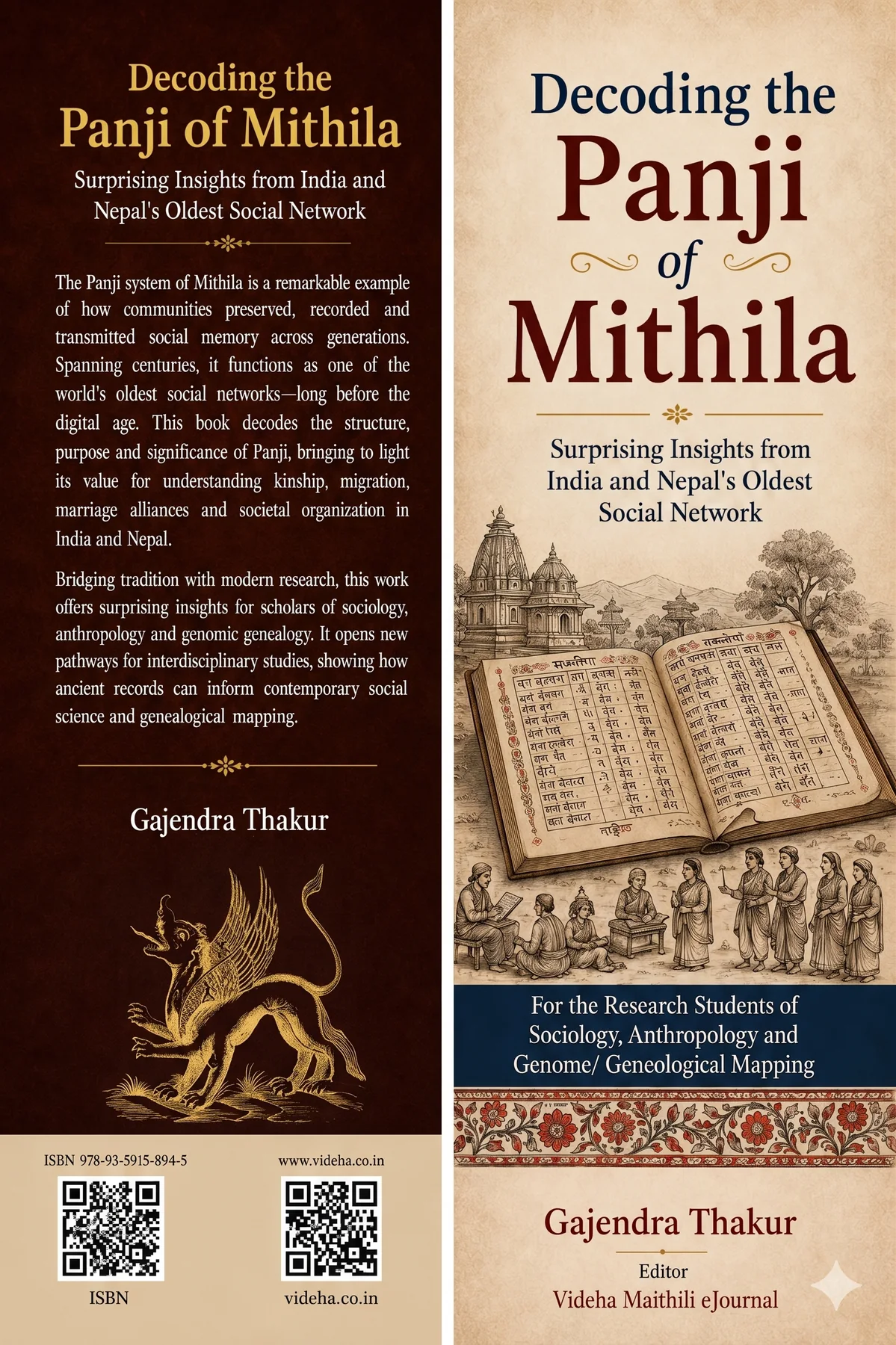
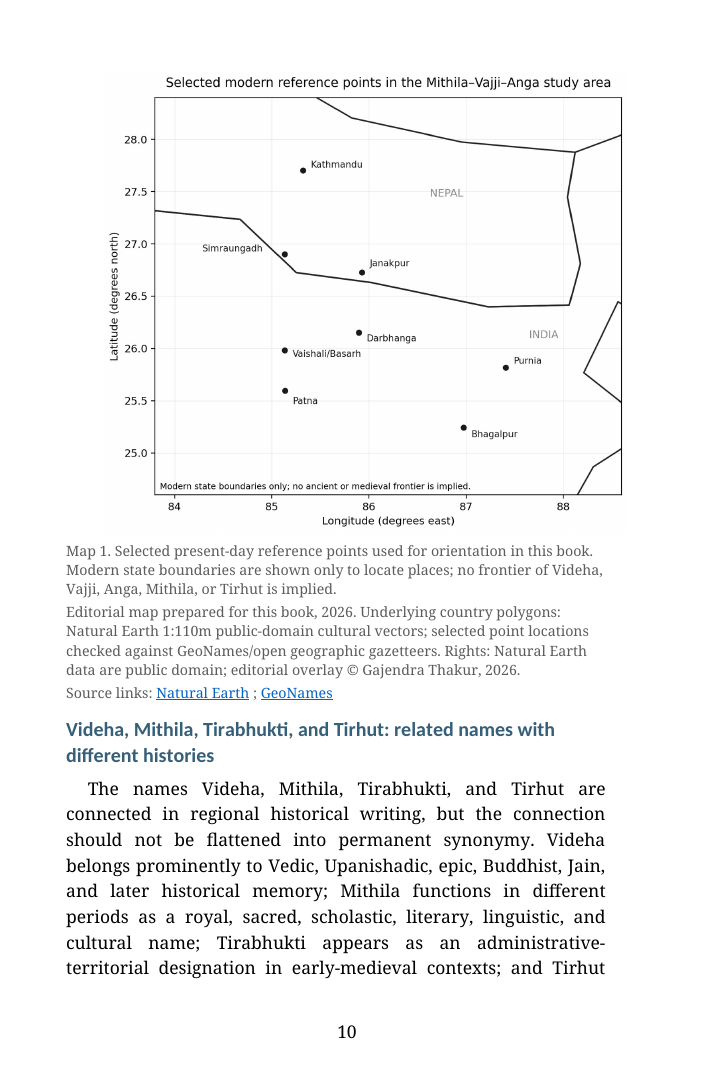
Chapter-specific source notes
- Primary chapter witness. Gajendra Thakur, Decoding the Panji of Mithila — Volume IV, formal Chapter 59, PDF pp. 572-579; formal Chapter 59. The HTML transcription is generated from the commit-pinned source PDF and retains the chapter boundary recorded in this edition.
- Internal structure. The repository source-heading inventory records 6 subordinate headings for this chapter: “Entry (486): Rajanpura to Kaivalakh”; “Entries (487)-(488): Rajanpura to Shivipatti and Shivipatti-Ranti”; “Entries (489)-(491): Rajanpura-Kaivalakh, Kanhouli, and the open Rajanpura continuation”; “Entries (492)-(494): Rajanpura to Navani, Amerkila, and the suspended Rajanpura marker”; “Entries (495)-(497): Ratauli-Kakraud, Ratauli-Bhatsimari-Tharhi, and the Tharhi continuation”; “Interpretive note on the chapter”.
- Digital editorial method. The page keeps the preserved source text distinct from generated navigational, concordance, visual, and provenance apparatus. The synthetic reconstruction is explanatory only and is not evidence for an individual lineage or a determination of social or marital status.