Decoding the Panji of Mithila · Volume IV · Chapter 72
Kasarauh-Ekhara, Sangram, Nahar-Shahpur and Ratipar-Mahesh: Entries (598)-(600)
Chapter 72. Kasarauh-Ekhara, Sangram,
Nahar-Shahpur and Ratipar-Mahesh: Entries
(598)-(600)
1. Where Chapter 72 begins
   Chapter 72 begins after the Khadka-Ekhara close of entry (597). The
source then moves to entry (598), headed “ ॐ कसरउहु सँ (३०४) संग्राम सँ .” The
new unit is not only a place shift. It first opens Kasarauh-Ekhara
through Ratipati and then immediately brings in the Sangram
gramaramabh, so the chapter must be read as an Ekhara-to-Sangram
movement rather than as an isolated family list.

2. Entry (598): Kasarauh-Ekhara
   Entry (598) opens “ath Kasarauh Ekhara gram” from Ratipati. Ratipati
gives Lakshmidhar and Mahidhar. Lakshmidhar is attached through
Jajival-Hardatt-Pitambar and Tankbal-Mohan; another Lakshmidhar
line is tied to Khaual-Shivram-Bagish and Narun-Ratnapati, and a
further Lakshmidhar connection goes through Darihara-Raghuram-
Khedu and Pali-Kashinath. The entry therefore begins by making
Kasarauh-Ekhara a junction of Jajival, Tankbal, Khaual, Narun, Darihara
and Pali lines.
   Mahidhar gives Shivanath, Durgadatt and Ramkrishna through
Satlakha-Gangaram-Pitambar and Jajival-Saday. Shivanath gives
Bhaynath and Jaynath through Alay-Bhora-Pranapati and Kujauli-
Bachharu. Shivanath also carries the Balha-Ghoghan-Rishika line
through Baheradhi-Ratidhar-Chitra and Karmah-Ballami-Gokulnath,
with Darihara-Kala at the end. The apara Shivanath line names
Narayandatt through Baliyas-Bhavesh-Bhaiyan and Sarisab-Narpati.

3. Entry (598): the Sangram gramaramabh
   The same entry then turns to “ath Sangram gramaramabh.” Jayshiv
gives Bhora, Ruchipati, Chandrapati, Kamalnayan and Manbodh. Bhora
is tied to Sundar-Andi and Khaual-Jayanand; another Bhora branch
gives Chedan, Shyamdatt and Mangaladatt through Darihara-Nilkanth-
Bhikhi and Pali-Revati Raman. Somdatt goes through Soderpur-Maddu-
Umai and Khaual-Dayaram.

   Mangaladatt gives Lal, Harravdatt, Chhotkani, Gulab and Kina
through Soderpur-Ghani-Shyam and Pali-Kala. Lal gives Santalal
through Baliyas-Muni-Girdhar and Jajival-Durmil. Apara Lal gives
Thithar and Faturi through Khaual-Bhavadatt-Vidyapati and Ekhara-
Vishwanath. Ruchipati, Bhramar, Khagesh, Vishwanath and their
associated routes keep Karmah, Jajival, Pali, Mandar, Gangoli, Darihara
and Panichobh in the same Sangram web.

4. Entry (599): Sangram to Nahar-Shahpur
  Entry (599), “ॐ सँग्राम सँ नाहर शाहपुर पु,” continues the Sangram field
into Nahar-Shahpur. Apara Vishwanath is linked through Pali-Mahi-
Bhavanidatt and Sakararhi-Pa Tarapati. Abhiram gives Nehal through
Pali-Bhavadatt-Vidyapati and Jajival-Bandi, while another branch moves
through Hariamb-Bachhai-Arjun and Soderpur-Buchan-Bodhu.
   Nehal gives Chandidatt, Girjadatt, Shankardatt, Mangaladatt and
Munika through Soderpur-Dharni-Kamalnayan and Pali-Sadashiv. The
entry then expands through Girjadatt, Shankardatt, Manbodh,
Buddhinath and the numbered B 381 line. Gujjar, Gunapati, Jungle,
Halas and Yaduka are tied through Narun-Damodar-Hridayram and
Khaual-Harai. The later portion preserves Gokulnath, Dwarikanath,
Ayodhyanath, Batuknath, Kalanath, Markandey, Murali, Janardan,
Yashodhar, Abhinanda, Jungle, Indrapati and Dandpani in a dense
Nahar-Shahpur continuation.

5. Entry (600): Ratipar to Maheshpur
   Entry (600) begins with the invocation to Kedarnath and the heading
“रतिपाड़ सँ महेशपुर पु (३०५).” It opens “ath Ratiwar gramaramabh” from
Mangu. Mangu gives Bhenai and Aniruddha through Alay-Kamal-Gopi
and Bhareha-Rishi. Bhenai gives Bhagirath, Bhuji, Madhav, Hari and
Bagisha through Sakona-Haridev-Kamal and Khaual-Babu. Bhagirath
gives Kamalakant and Dhireshwar through Baheradhi-Baidyanath-Ram,
Soderpur-Harihar-Shivdash and Budhwal-Pritanal.
   Bhuji gives Hemkar, Sudhakar and Gauripati through Mandar-
Raghudev-Purandar and Soderpur-Ramchandra. Sudhakar gives Bhola
and Kariya through Pali-Jaykrishna-Ghani, Soderpur-Krishnadatt-
Dharni and Baliyas-Purushottam. Gauripati gives Bahoran and Umadatt
through Soderpur-Raghuram-Duwari and Baheradhi-Chhitar. Apara
sons Bandhan and Mohanath move through Khaual-Keshav-Bhushan

and Belunch-Lakshmidhar. The chapter closes with Hari, Bagisha,
Aniruddha and their descendants, which carry Gangoli, Darihara,
Panichobh, Ekhara, Pali, Sakararhi, Alay, Hariamb, Digho and Satlakha
routes before the source shifts to Sudsuya in entry (601).

Chapter conclusion
   Entries (598)-(600) are a bridge from the earlier Ekhara body into the
next Sudsuya-Belaunch section. Entry (598) first opens Kasarauh-Ekhara
and then gives the Sangram gramaramabh; entry (599) extends Sangram
into Nahar-Shahpur; entry (600) opens Ratiwar/Ratipar toward
Maheshpur. The recurring grammar remains the same: names are read
through “suta” and “suta/suta” descent, “apara” collateral lines, and
place-routes such as Jajival, Tankbal, Khaual, Narun, Darihara, Pali,
Soderpur, Mandar, Karmah, Panichobh, Belunch, Hariamb and
Satlakha. The next chapter begins at entry (601), “ ॐ सुदसुय सँबानू छपरा,”
where the source announces the Sudsuya-Belaunch gramaramabh.
Source structure and verification apparatus
Editorial source apparatus. This apparatus is descriptive, not interpretive. It records the source-controlled structure used to verify that this page corresponds to formal Chapter 72 of Decoding the Panji of Mithila — Volume IV. The chapter text above is preserved from PDF pp. 688-690; formal Chapter 72 in the commit-pinned authoritative source. It is not merged with a neighboring chapter, appendix, annexure, or independent front/back-matter unit. The internal headings below come from the repository’s source-heading inventory and are retained as navigational and audit evidence; showing them here does not turn those headings into separate publications or add claims that are absent from the source.
Internal source headings
- 1. Where Chapter 72 begins
- 2. Entry (598): Kasarauh-Ekhara
- 3. Entry (598): the Sangram gramaramabh
- 4. Entry (599): Sangram to Nahar-Shahpur
- 5. Entry (600): Ratipar to Maheshpur
- Chapter conclusion
Source-text concordance
Kasarauh-Ekhara · Sangram · Nahar-Shahpur · Ratipar-Mahesh · Entries · begins · Khadka-Ekhara · close · entry · moves · headed · कसरउह · unit · place · shift · first · opens · Ratipati · immediately · brings · gramaramabh · must · read · Ekhara-to-Sangram · movement · rather · isolated · family · list · Kasarauh · Ekhara · gram · gives · Lakshmidhar · Mahidhar · attached · Jajival-Hardatt-Pitambar · Tankbal-Mohan · another · line · tied · Khaual-Shivram-Bagish · Narun-Ratnapati · connection · goes · Darihara-Raghuram · Khedu · Pali-Kashinath · therefore · making · junction · Jajival · Tankbal · Khaual · Narun · Darihara · Pali · lines · Shivanath · Durgadatt · Ramkrishna · Satlakha-Gangaram-Pitambar · Jajival-Saday · Bhaynath · Jaynath · Alay-Bhora-Pranapati · Kujauli · Bachharu · carries · Balha-Ghoghan-Rishika · Baheradhi-Ratidhar-Chitra · Karmah-Ballami-Gokulnath · Darihara-Kala · apara · names · Narayandatt · Baliyas-Bhavesh-Bhaiyan · Sarisab-Narpati · turns · Jayshiv
Boundary verification. In the formal sequence this chapter follows Volume IV Chapter 71, “Ruchauli-Ekhara, Oda-Ekhara and Khadka-Ekhara: Entries (589)-(597) This chapter begins after the Dadri-Panichobh and” and precedes Volume IV Chapter 73, “Sudsuya-Belaunch: Banu Chhapra, Badhudhpara, Samauli and Tharhi-Sagarpur: Entries (601)-(606)”. The chapter extractor begins at the verified formal Chapter 72 marker and stops at the next verified formal chapter marker; for a final chapter it stops before recognized book-level back matter. The concordance above is generated only from distinct terms already present in this chapter’s preserved source text. It is provided for discovery, comparison, and audit, not as an automated judgment about persons, lineages, status, kinship, marriage eligibility, or historical truth.
Illustrated research apparatus
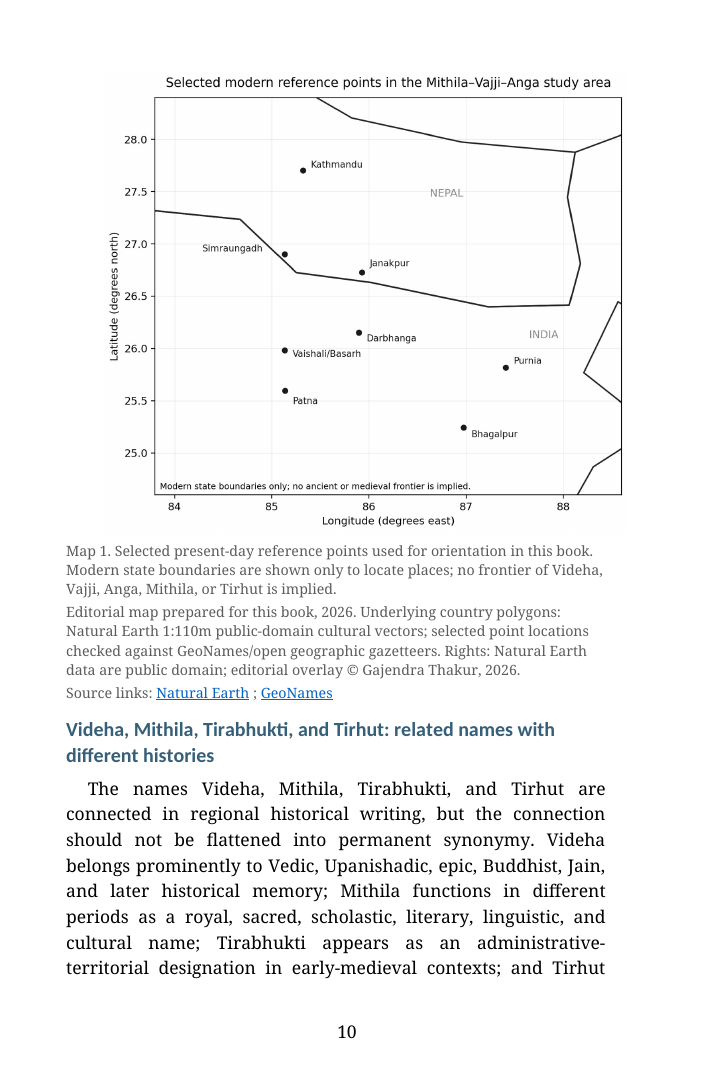
Mithila · Vajji · Anga
Chapter-specific source notes
- Primary chapter witness. Gajendra Thakur, Decoding the Panji of Mithila — Volume IV, formal Chapter 72, PDF pp. 688-690; formal Chapter 72. The HTML transcription is generated from the commit-pinned source PDF and retains the chapter boundary recorded in this edition.
- Internal structure. The repository source-heading inventory records 6 subordinate headings for this chapter: “1. Where Chapter 72 begins”; “2. Entry (598): Kasarauh-Ekhara”; “3. Entry (598): the Sangram gramaramabh”; “4. Entry (599): Sangram to Nahar-Shahpur”; “5. Entry (600): Ratipar to Maheshpur”; “Chapter conclusion”.
- Digital editorial method. The page keeps the preserved source text distinct from generated navigational, concordance, visual, and provenance apparatus. The synthetic reconstruction is explanatory only and is not evidence for an individual lineage or a determination of social or marital status.