Decoding the Panji of Mithila · Volume IV · Chapter 71
Ruchauli-Ekhara, Oda-Ekhara and Khadka-Ekhara: Entries (589)-(597) This chapter begins after the Dadri-Panichobh and
Chapter 71. Ruchauli-Ekhara, Oda-Ekhara and
Khadka-Ekhara: Entries (589)-(597)
  This chapter begins after the Dadri-Panichobh and
Brahmoli material and returns the register to the Ekhara-
controlled side of the Nagram corpus. The first movement is
the Ruchauli-Ekhara gramarambh, carried through Yamsam,
Kailakh, Rashady and Virsayar. The second movement shifts
to Oda-Ekhara, with a Shivipatti and Ramnagar-Khajuri
extension. The last numbered entry opens Khadka-Ekhara
under the heading Berma. The chapter deliberately stops
before the next Kasarauh-Sangram entry, because entry (598)
begins a different Ekhara sub-cluster.

Entries (589)-(593): Ruchauli-Ekhara, Kailakh,
Rashady and Virsayar
   Entry (589), under the invocation and the heading Ruchauli
to Yamsam, names Shashinath as a Kadhuwa resident and
then begins ath Ruchauli Ekhara gramarambh. The opening
line gives Haridash, whose son Girishwar is connected
through Soderpur-Abhinandan-Hari and through Darihara-
Abhinandan. Giridhar gives Babunath through Baheradhi-
Ratdhar-Chitra and Baliyas-Dhir. The line then expands
through Babunath into Panchuanand and Nityanand, linked
with    Mandar-Lakshminath-Vanshidhar         and   Hariamb-
Umanath.
   Panchu gives Narayan and Singheshwar through Sakararhi-
Gangadatt-Meghnath and Karmah-Gunapati. An apara Panchu
line gives Shashinath and Ramanath through Soderpur-
Harangi-Durgadatt and Baliyas-Raghuvir. Narayan is routed
by Hariamb-Lutan-Babu and Didho-Raghunath. Shashinath is
attached to Baheradhi-Sansardhar-Shivlal and Khaual-Faturi.
Ramanath is linked by Satlakha-Jaylal-Arjun and Soderpur-
Bachchu. The entry closes with Anand and Shatanjiv: Anand

goes through Pali-Vishnudatt-Gumani and Baliyas-Bahoran,
while Shatanjiv is tied to Pandua-Pa Ratnamani-Pa Umapati
and Pali-Murari Lal. The source therefore marks the Ruchauli
opening as an Ekhara gramarambh but immediately places it
in a wide network of Soderpur, Mandar, Hariamb, Baliyas,
Didho, Baheradhi, Khaual and Pali routes.
   Entry (590) carries Ruchauli to Kailakh and Rashady. It
opens with the sons of Mishra Bhatt: Bhagirath, Dharmapati,
Jyotishi Nandan and Lanhu. Their first route connects
Sakararhi-Ramabhadra-Panar Pati with Alay-Vibhakar.
Bhagirath gives Mahadev through Pali-Ramnath-Gaurinath
and Darihara-Nand; an apara line gives Lakshmidhar through
Darihara-Bhavaninath-Sadanand and Soderpur-Aniruddha.
Mahadev gives Chhakauri through Sakararhi-Purushottam-
Pitambar and Pali-Puchhai. Chhakauri gives Poshan and Soni
through Khandbala-Mahadev-Madhupati and Pali-Badli.
   The Poshan group brings in Bhavan, Sina, Janaki, Dukhiya
and Pakhiya, with Tankbal-Gangadhar-Bodhkrishna and
Jajival-Badlu. Bhavan is carried through Khaual-Digambar-
Dullah and Alay-Saheb. Sina gives Durgadatt and Thakurdatt
through Khaual-Garib-Bechan and Gangoli-Jibu; Thakurdatt is
connected with Pandua-Bhaiya-Loknath and Soderpur-Hiralal.
Pakhiya is linked both to Satlakha-Ranjan-Jagmohan and
Panichobh-Anath, and another Pakhiya line to Khaual-Bodh-
Bhaiya-Suwa, Ghusaut-Shambhunath and Ekhara-Bhikshuk.
Lakshmidhar is then taken through Baliyas-Purushottam-
Ghanshyam and Panichobh-Bhavesh.
  Dharmapati gives Bhushan through Narun-Harinath-Badli
and Mandar-Abhimanyu. Bhushan is further tied to
Panichobh-Shatanjiv-Babudi and to Bisfi-Mohan. The Jyotishi
Nandan line is specially marked: M.M. Pa. Jyotishi Harishwar
and Bhavesh are connected through Khaual-Nikar-Kamal and
Belaunch-Paramanand. From M.M. Pa. Jyotishi Harishwar

come M.M. Pa. Gunishwar, Sona, Tula and Lochan, through
Hariamb-Shivdas-Jagannath and Soderpur-Lal. The phrase
that Gunishwarnath writes or stands for the Shrotriya-kula
has been preserved as an internal scholarly marker rather
than reduced to a simple descent formula. Sona then gives
Giridhari, Bhavanidatt and Munidatt through Soderpur-Uttim-
Abhiram and Pandua-Krishnapati; Tula gives Chanan through
Karmah-Bhoranath-Bhikhari and Khaual-Jaykrishna.
   Entry (591) is another Ruchauli-Rashady continuation.
Chanan gives Parshamani and Vanshamani through Karmah-
Chhabnu-Chitradhar and Pandua-Pa Vanshidhar. Parshamani
gives Harshamani, Baggi and Nantu through Khandbala-Fakir-
Thaynu and Ghusaut-Jhauhu. Vanshamani gives Dharbharan
and Mohan through Ghusaut-Dullah-Lakshman and Pandua-
Pa Garib. Dharbharan gives Banmali by Khandbala-Madan-
Brajmohan and Baliyas-Amritnath; Banmali is attached to
Fanandah-Babua-Nanu and Soderpur-Phanilal. Mohan gives
Sugan and Damodar through Alay-Ratneshwar-Radhanath and
Darihara-Gokulnath, and Sugan is carried through Ghusaut-
Chandrashekhar-Kalishankar and Pabouli-Parshamani.
   Entry (592) sends Ruchauli to Virsayar. Lanhu gives Damu,
also called Indrapati, Purushi and Murali, through Darihara-
Bhavani-Sadanand and Soderpur-Aniruddha. Damu goes
through Khaual-Paramanand-Gatiram and Hariamb-Bachhai.
Purushi gives Haripani and Chengan through Darihara-Nand-
Dhani and Soderpur-Yadupati. Haripani gives Hridaymani
through Pali-Mahi-Bhavanidatt and Baliyas-Girish; an apara
Haripani line gives Khadgamani and Kamalamani through
Pandua-Pa Chhoti-Pa Manik and Hariamb-Ghani. Hridaymani
is connected through Budhwal-Brahmapati-Ghananand and
Baliyas-Jivi.
  The Khadgamani branch is the largest part of the Virsayar
entry. Khadgamani gives Jhumkalal, Yadunath, Jaynath and

Ratinath through Sarisab-Bhaiyan-Babunath and Baliyas-
Sukhni. Jhumkalal gives Paramanand, Yadadhar and
Kusheshwar through Baliyas-Kaladhar-Buddhinath and
Pabouli-Premnath. Paramanand gives Shobhanand and
Devanand through Pandua-Chhedi-Bhaiyan and Belaunch-
Keshav. Shobhanand is connected through Fanandah-
Chunchun-Manmohan and Pabouli-Chaturbhuj. Devanand
gives Amarnath through Alay-Nandlal-Shrikant and Sarisab-
Bammoli. Amarnath has a modern-looking route through
Singhwar and Sandpur-Didho to Chaudhary Kamalakant-
Shashikant, and to Alay-Shrinagar-Kumar Kanhaiya. Yadadhar
gives Mahanand, Shyamsundar, Yamunanand and Ganganand
through Alay-Bechan Lal-Ramchandra and Baliyas-Gudan;
Mahanand and Shyamsundar are then carried through
Pandua and Baliyas respectively. Kusheshwar gives
Suryanarayan through Khaual-Jani-Butur or Dashrath and
Soderpur-Baba or Dinanath. The entry ends by noting
Chengan through Hariamb-Bhaiya-Godan and Darihara-Kul.
   Entry (593) returns to Ruchauli-Rashady. Balli gives Panai
through Karmah-Balbhadra-Mohan and Mandar-Hadi. Panai
gives Bhaiyaram, Hiraram and Kalaram through Baheradhi-
Sundar-M.M. Bhikhi and Soderpur-Anath. Bhaiyaram gives
Babnu and Ramnu through Sarisab-Mahtha-Bhora and
Mandar-Chhatrapati. Babnu is routed through Pali-Bhikhari-
Hira and Baliyas-Hridaynandan, and an apara branch gives
Yognath      through    Kujouli-Bachharu-Krishnadatt      and
Baheradhi-Tejan. Yognath gives Budh, Chhitan and Shivnath
through Pali-Natha-Vacha-Nanu and Baliyas-Chilka-Kirtinath,
with a Jajival-Hemu connection. Ramnu is linked to Soderpur-
Vaiya Murali-Shivdatt and Ghusaut-Thakur Janakinath.
Hiraram goes through Soderpur-Ghani-Keshav and Darihara-
Bhairav. Kalaram gives Amritnath through Panichobh-
Vishnupati-Bhairav and Darihara-Nirmati; Amritnath closes

the Ruchauli set through Soderpur-Dhani-Keshav-Bhaiyan and
Baliyas-Hridaynandan.

Entries (594)-(596): Oda-Ekhara, Shivipatti, Mogalaha
and Ramnagar-Khajuri
  Entry (594), Oda to Shivipatti, opens a new Ekhara village
body: ath Oda Ekhara gram. Krishnanand gives Jivi and Hari
through Mandar-Ramabhadra-Lakshman and Karmah-
Chhotai. Jivi gives Bhavadatt through Sarisab-Lakshman-
Nandan and Panichobh-Bhavesh. Bhavadatt gives Bhaiyan
through Mandar-Purandar-Gonu and Khandbala-Dharu, with
Bhaiyan further tied to Gangoli-Kriparam-Sarvasva and
Darihara-Ghananand. The Hari line gives Devidatt through
Khaual-Ravant-Bhavanand and Pali-Gunanand. Devidatt gives
Chhatrapati through Karmah-Balla-Bachharu and Hariamb-
Badhai-Hari, with an Ekhara-Ram connection.
   Chhatrapati gives Thakurdatt and Chhotkani through
Pabouli-Chaturbhuj-Chandrapati    and    Karmah-Damodar.
Thakurdatt gives Bhaiyan through Darihara-Kul-Hirphul and
Alay-Chandrapati. Bhaiyan gives Bhagirath through Baliyas-
Bhavnath-Shobhanath and Karmah-Saule-Kanhai; Bhagirath
gives Sundar through Jalay-Mohan Singh-Chandranarayan
and Mandar-Shyamlal. The Jageti branch introduces Bahuri
and Babudi through Khandbala-Lakshman-Bhavdev and Bisfi-
Achyut. Bahuri gives Jude by Satlakha-Mohan-Devaki and
Narun-Bhavdev. Jude has Nakat and Paiku through Narun-
Keshi-Dukravi and Budhwal-Mohan; an apara Jude line gives
Kavi Jivan through Soderpur-Haridev-Lochan and Kujouli-
Murali; another Jude branch runs through Mahishi-Budhwal-
Andi-Harijiv and Soderpur-Janardan. Nakat gives Dharmadatt
and Thakurdatt through Hariamb-Chhawni-Saheb and
Soderpur-Harinandan. Babudi gives Ravanaj, Aniruddha,
Indrapati and Jaykrishna through Pandua-Raghudev-Pa
Bhagirath and Fanandah-Ramabhadra. Aniruddha gives

Sanphul; Sanphul gives Indramani through Budhwal-
Brahmapati-Dhananand and Baliyas-Jivi. The entry closes with
Indrapati-Babnu and several apara Mandar and Darihara
lines, including Premkar, Hemkar, Gunakar, Buddhikar,
Karunakar, Siddhikar and Chandrakar.
   Entry (595) is a difficult Oda-Mogalaha continuation whose
heading itself preserves several descent fragments. It names
Lilanand, Badrinath, Boan, Dayanand and Surendra, and then
an apara Bala line through Karmah-Mushal, Baharan-Anand
and Sakararhi-Nityanand-Dayanand. The main working body
begins with Dashrath. Dashrath gives Kalar through Pali-Ram-
Govinddas and Belaunch-Hari Govind. Apara Dashrath lines
give Chhotku and Mukund through Budhwal-Babuni-Jugai and
Pabouli-Ramanand; Thakurdatt through Satlakha-Jagdish-Ram
and Alay-Sadanand, with a Chaudhary Vanshi note; Purandar
through Uchati-Mahipani-Ramanand and Karmah-Bhagirath;
and another group, Bhramar, Mahinath, Gunanand and Bala,
through Alay-Balgopal-Lala and Soderpur-Pradyumna.
   Kalar gives Bhaju and Jayanandan through Satlakha-Naro-
Mahesh and Budhwal-Chaturbhuj. Bhaju gives Ramanath and
Thotha through Pabouli-Chaturbhuj-Paran and Karmah-Jagan.
Ramanath attaches to Khandbala-Sudi-Devidatt and Mandar-
Nandinath; Thotha links to Pandua-Pa Manik-Pa Nityanand
and Jajival-Aankhi. Jayanandan gives Lal through Hariamb-
Ghoghan-Toti and Belaunch-Yadav. Chhotku gives Bhairavdatt
and Devidatt through Pali-Judaaun-Nandan and Sakararhi-
Nenu. Devidatt gives Bhikhari, Bicha and Sanphul through
Pali-Shulpani-Bachharan and Sarisab-Shyamram. Bhikhari
gives Dharmanath through Khandbala-Brajbhushan-Gan and
Fanandah-Ravinath.
 The same Oda-Mogalaha entry then keeps Bhairavdatt and
Manik in view. Manik is connected through Panichobh-
Mahesh-Narayan and Khandbala-Madhurapati. Manik gives

Artinath through Narun-Ratnu-Loknath and Hariamb-Shubh.
Artinath gives Kirtinath through Sakuri-Pali-Jaynath-Shatanjiv
and Mandar-Jhotan. Kirtinath gives Jyotishi Vishwanath
through     Soderpur-Saburdatt-Musahadh        and    Kujouli-
Punyadatt, and Jyotishi Vishwanath is connected through
Didho-Khushihal Singh-Babujan and Khaual-Gopal. Sanphul
gives Manrakkhan through Karmah-Jagan-Mahapurush and
Soderpur-Vighneshwar. Manrakkhan gives Lilanand and
Haranand through Sakararhi-Gangadatt-Kanhai and Hariamb-
Thakurdatt. Lilanand gives Badrinath, whose named sons
include Narayan, Lakshman, Shyamanand and Professor Shri
Mohan; Professor Shri Mohan is later given with Murali
Manohar and a Gonouli line. Haranand gives Anand,
Vidyanand and Sharadanand through Hariamb-Gulbadan-
Babua Ji and Jajival-Babulal. Mukund closes the entry with
Mansukh and Huli through Soderpur-Shankar-Nanu and
Satlakha-Ruchai; Mansukh gives Kirtipati through Soderpur-
Abhiram-Bhaiyo and Pali-Harikrishna.
  Entry (596), Oda to Ramnagar-Khajuri, Madhyapura-Hat-
Parsa, is marked by a parenthetical note that itself preserves
collateral links: Chhoti gives Bhaynath through Darihara-
Rohini-Dullah and Baheradhi-Tejan; Bhola is also noted
through Ghusaut-Durlabh-Khadgapani and Satlakha-Gogu.
The main line begins with Dharani, whose sons are Nath and
Bandhu, linked through Mandar-Lotai-Gangesh and Karmah-
Purandar. Nath gives Khadgapani and Saheb through Khaual-
Paramanand-Gatiram and Hariamb-Bachhai; an apara Nath
branch gives Mansukh and Hridaysukh through Satlakha-
Devaki-Meghu and Babhaniam-Kamal. Nayansukh is linked
through Khaual-Bhangi-Kamalnayan and Hariamb-Badharu.
Khadgapani gives Hridaynandan through Karmah-Bandi-
Prannath and Khandbala-Madhurapati; Hridaynandan gives
Madhuranath through Tankbal-Bodhkrishna-Datt and Ekhara-
Hira.

   Bandhu gives Bhola, Saburdatt and Narayandatt through
Baheradhi-Bhavanand-Raghunath and Khaual-Dinaram, with
an apara Narun-Shankar-Gonor and Sarisab-Rajaram line.
Purandar gives Bachharu, Jiveshwar, Nityanand, Rameshwar
and Damodar through Raudh-Purakh-Lakshman and Sarisab-
Nandan. Bachharu gives Gangaram and Mahesh through
Panichobh-Jivanath-Balbhadra        and     Darihara-Narayan.
Mahesh gives Bhikshuk through Mandar-Rameshwar-
Shulpani and Tisaut-Mahipati. Bhikshuk gives Brajnath,
Ratinath, Vidyanath, Bhupnath and Gopal through Karmah-
Jivanath-Shambhunath and Sakararhi-Gujar. The branches
then move through Mandar, Karmah, Jajival, Hariamb,
Belaunch, Alay and Pabouli, with Badrinath, Sonalal, Raiya,
Jiveshwar, Lal, Bala, Nehal, Umanath and Baburaiya all held
as collateral descendants rather than compressed into a single
line. This entry therefore closes the Oda cluster by attaching
Oda to Ramnagar, Khajuri, Madhyapura, Hat and Parsa while
retaining Ekhara as the genealogical base.

Entry (597): Berma and the Khadka-Ekhara opening
   Entry (597), headed Berma, opens ath Khadka Ekhara gram.
The founding line begins from Gokulnath, whose sons are
Raghunath, Krishnadatt and Vishnudatt through Sakararhi-
Narayan-Vishwanath and Darihara-Bhagwan. Raghunath
gives Brajnath, Muralidhar, Vanshidhar, Girdhar and
Shashidhar through Sakararhi-Bhora-Jaykrishna and Jajival-
Achyut. Apara Raghunath lines give Haldhar, Manik and Hiri
through Babhaniam-Kamal-Murali and Satlakha-Sadanand.
Muralidhar gives Kaladhar and Mahidhar through Baheradhi-
Raghunath-Maherman and Soderpur-Ravem; Kaladhar is
linked to Pali-Manbodh-Shobhanath and Jajival-Hethu.
  Mahidhar gives Babulal and Mannu Lal through Baliyas-
Chilka-Kirtinath and Jajival-Henu. Babulal gives Yogdhar
through      Malichham-Baheradhi-Shivnath-Thithar    and

Soderpur-Rudradatt; Yogdhar then links to Pabouli-
Manranjan-Shridhar and to Pali-Buddhi-Banmali. Vanshidhar
is attached through Baliyas-Harijiv-Chilka and Soderpur-
Rameshwar. Shashidhar moves through Jajival-Shubhpati-
Durmil and Pali-Manbodh. Haldhar gives Teknath and Nandlal
through   Darihara-Harishankar-Loknath and Soderpur-
Bachhan. Teknath gives Gudar and Gethari through
Khandbala-Brajbhushan-Nidhi and Darihara-Rajnu. Gudar
gives Buchan through Baliyas-Pritam-Bhaiya-Bokan and
Soderpur-Bachkan; Gethari gives Nena and Muni through Pali-
Machal-Shyamlal-Phenk and Soderpur-Apuch-Fakir, with a
Karmah-Babue route.
  The last portion of entry (597) completes the Khadka-Ekhara
opening. Manik is tied to Baliyas-Ganapati-Devanand-
Medhakar and Budhwal-Rishi. Hiri is tied to Darihara-Nand-
Ramapati-Chhakauri and Panichobh-Pritam. Krishnadatt gives
Dharmadatt, Fakir and Parameshwaridatt through Soderpur-
Ratipati-Kamalakant and Ekhara-Umanand. Vishnudatt gives
Mitradatt, Kamaladatt, Bhavaditya and Jayaditya, also called
Babue, through Sakararhi-Umapati-Shivnandan and Belaunch-
Sudarshan. Kamaladatt has a Pali-Chhawa-Bhavanidatt and
Pabouli-Ramsinehi line. Mitradatt closes the preserved body
with a Narun-Girijadatt route. The chapter ends here, before
entry (598), where the source shifts to Kasarauh-Ekhara and
Sangram.

Chapter conclusion
  Entries (589)-(597) form a compact Ekhara chapter with
three movements. The first movement, entries (589)-(593), is
Ruchauli-Ekhara: it carries Haridash-Girishwar and Mishra
Bhatt lines through Yamsam, Kailakh, Rashady and Virsayar,
with strong Mandar, Soderpur, Darihara, Baliyas, Pali,
Panichobh, Pandua and Khaual cross-routes. The second
movement, entries (594)-(596), is Oda-Ekhara: it opens through

Krishnanand, Jivi and Hari, then moves through Shivipatti,
Mogalaha and Ramnagar-Khajuri-Madhyapura-Hat-Parsa. The
third movement, entry (597), opens Khadka-Ekhara under
Berma and gives the Gokulnath-Raghunath-Krishnadatt-
Vishnudatt structure. Blanks, apara branches, professional
markers such as Jyotishi, M.M. and Professor, and place-
movement phrases have all been preserved as part of the
genealogical evidence rather than treated as ornamental
details.
Source structure and verification apparatus
Editorial source apparatus. This apparatus is descriptive, not interpretive. It records the source-controlled structure used to verify that this page corresponds to formal Chapter 71 of Decoding the Panji of Mithila — Volume IV. The chapter text above is preserved from PDF pp. 678-687; formal Chapter 71 in the commit-pinned authoritative source. It is not merged with a neighboring chapter, appendix, annexure, or independent front/back-matter unit. The internal headings below come from the repository’s source-heading inventory and are retained as navigational and audit evidence; showing them here does not turn those headings into separate publications or add claims that are absent from the source.
Internal source headings
- Entries (589)-(593): Ruchauli-Ekhara, Kailakh, Rashady and Virsayar
- Entries (594)-(596): Oda-Ekhara, Shivipatti, Mogalaha and Ramnagar-Khajuri
- Entry (597): Berma and the Khadka-Ekhara opening
- Chapter conclusion
Source-text concordance
Ruchauli-Ekhara · Oda-Ekhara · Khadka-Ekhara · Entries · begins · Dadri-Panichobh · Brahmoli · material · returns · register · Ekhara · controlled · side · Nagram · corpus · first · movement · gramarambh · carried · Yamsam · Kailakh · Rashady · Virsayar · second · shifts · Shivipatti · Ramnagar-Khajuri · extension · last · numbered · entry · opens · heading · Berma · deliberately · stops · next · Kasarauh-Sangram · different · sub-cluster · invocation · Ruchauli · names · Shashinath · Kadhuwa · resident · opening · line · gives · Haridash · whose · Girishwar · connected · Soderpur-Abhinandan-Hari · Darihara · Abhinandan · Giridhar · Babunath · Baheradhi · Ratdhar-Chitra · Baliyas-Dhir · expands · Panchuanand · Nityanand · linked · Mandar-Lakshminath-Vanshidhar · Hariamb · Umanath · Panchu · Narayan · Singheshwar · Sakararhi · Gangadatt-Meghnath · Karmah-Gunapati · apara · Ramanath · Soderpur · Harangi-Durgadatt · Baliyas-Raghuvir · routed
Boundary verification. In the formal sequence this chapter follows Volume IV Chapter 70, “Dadri-Panichobh, Nanour- Parasarma, Brahmoli and the Birpur- Panichobh Notice: Entries (581)-(588)” and precedes Volume IV Chapter 72, “Kasarauh-Ekhara, Sangram, Nahar-Shahpur and Ratipar-Mahesh: Entries (598)-(600)”. The chapter extractor begins at the verified formal Chapter 71 marker and stops at the next verified formal chapter marker; for a final chapter it stops before recognized book-level back matter. The concordance above is generated only from distinct terms already present in this chapter’s preserved source text. It is provided for discovery, comparison, and audit, not as an automated judgment about persons, lineages, status, kinship, marriage eligibility, or historical truth.
Illustrated research apparatus
Mithila · Vajji · Anga
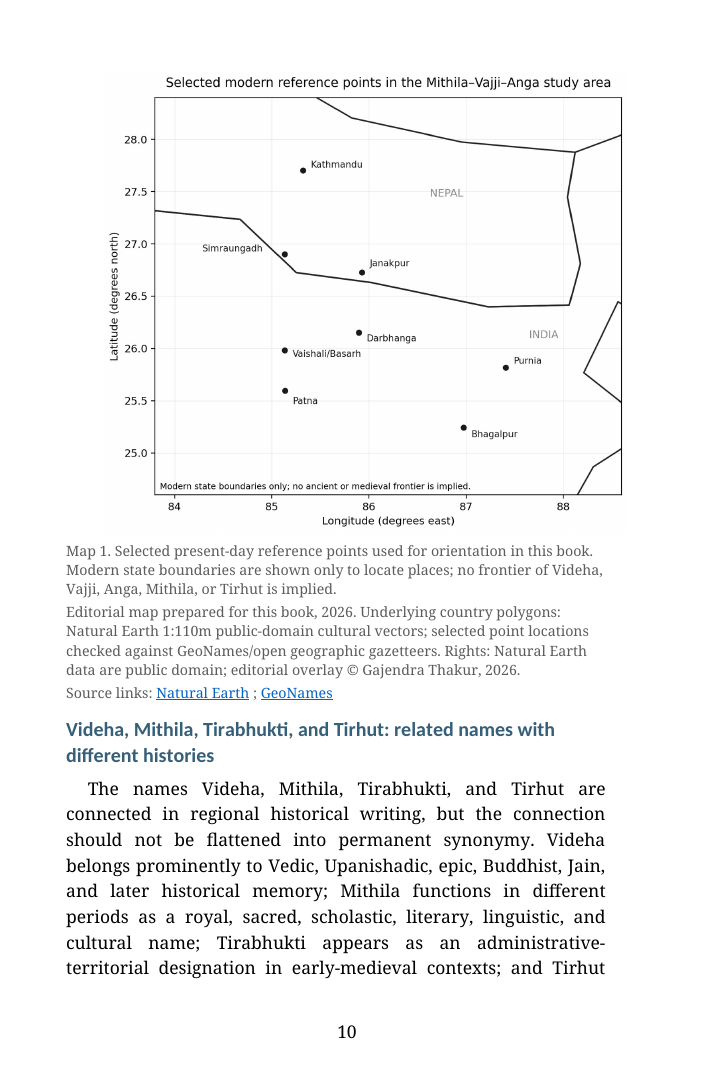
Chapter-specific source notes
- Primary chapter witness. Gajendra Thakur, Decoding the Panji of Mithila — Volume IV, formal Chapter 71, PDF pp. 678-687; formal Chapter 71. The HTML transcription is generated from the commit-pinned source PDF and retains the chapter boundary recorded in this edition.
- Internal structure. The repository source-heading inventory records 4 subordinate headings for this chapter: “Entries (589)-(593): Ruchauli-Ekhara, Kailakh, Rashady and Virsayar”; “Entries (594)-(596): Oda-Ekhara, Shivipatti, Mogalaha and Ramnagar-Khajuri”; “Entry (597): Berma and the Khadka-Ekhara opening”; “Chapter conclusion”.
- Digital editorial method. The page keeps the preserved source text distinct from generated navigational, concordance, visual, and provenance apparatus. The synthetic reconstruction is explanatory only and is not evidence for an individual lineage or a determination of social or marital status.