Decoding the Panji of Mithila · Volume IV · Chapter 74
Kako-Belaunch, Kako-Kailakh, Shivnagar-Banpura, Chanpura-Haripur-Vira- Ekma, Barha Nagram and Satlakha-Visauni- Jhauwa: Entries (607)-(614)
Chapter 74. Kako-Belaunch, Kako-Kailakh,
Shivnagar-Banpura, Chanpura-Haripur-Vira-
Ekma, Barha Nagram and Satlakha-Visauni-
Jhauwa: Entries (607)-(614)
1. Where Chapter 74 begins
  Chapter 74 begins at entry (607), where the source leaves the
Sudsuya-Belaunch frame and opens a new field with the invocation “ ॐ
अमरनाथाय नम:” and the heading “काको सँ अष्टजा पेकपाड़ रधुना धु थ पुर भड़ पु
गामा अररिया.” The first body line then states “ath Kako Belaunch gram.”
This is the new threshold after the Sudsuya chapter: the place field is
now Kako, and the chapter begins with a Kako-Belaunch grammar
before moving into Kako-Kailakh and other Kako-linked subfields.
   The natural boundary for this chapter is entries (607)-(614). Entry
(607) opens Kako-Belaunch; entries (608)-(610) move through Kako-
Kailakh and Pilkhwar; entry (611) adds Shivnagar and Chau Banpura;
entry (612) brings Chanpura, Haripur, Vira and Ekma; entry (613) turns
to Barha Nagram; and entry (614) closes the sequence with Satlakha,
Visauni and Jhauwa. Entry (615) begins a fresh invocation to Umapati
and a new Kako-Babu Chhapra-Dath field, so it is reserved for the next
chapter.

2. Entry (607): Kako-Belaunch and the Amarnath
invocation
   Entry (607) opens with an invocation to Amarnath and the Kako-
Belaunch gram. The line begins from Lamanhar. Lamanhar gives
Hardatt; the following Andi line is attached through Kusumal-
Gangaram-Saday and Nikuti-Chatur. Andi gives Gosain Pritam through
Panichobh-Pritinath-Purandar and Pabouli-Mahi. Gosain Pritam then
gives Amritesh, Amaresh and Mahesh through Panichobh-Sadanand-
Ram and Mandar-Santru. Amritesh gives Vanshmani through Mandar-
Babua-Nanu and Pali-Gauri.
   Vanshmani gives Babulal, Babuan and Mannulal through Narun-
Vanshidhar-Shashishekhar and Jajival-Babanu. Babuan is then tied
through Tatail-Sakararhi-Bacha-Babunandan and Khadka-Ekhara-
Mitradatt. The Amaresh line appears twice in the source, a sign that the

record is preserving a repeated or corrected path rather than presenting
a smooth modern paragraph. Amaresh gives Ravinath through Pabouli-
Ramakant-Bhaiyan and Budhwal-Pranbandhu; Ravinath is linked
through Fanandah-Ravinath and Baliyas/Raloni. Mahesh gives
Rohinidatt and Premnath through Sarisab-Jayshiv-Bhaiyan.
   A numbered branch, “B 79/2,” then brings in Kaushikidatt.
Kaushikidatt gives Bhavan, Devan and Pushpanath through Baliyas-
Indrapati-Raghunath and Pali-Harikrishna. Bhavan gives Bacha and
Nath through Khaual-Bodh-Bhaiya and Pabouli-Bhikhari. Bacha is
linked to Budhwal-Nilambar-Lal and Soderpur-Nidhi. Nath goes through
Karmah-Maniram-Badhari and Khaual-Jhadula. Devan gives Jagmohan,
Fakiran and Mathuranath through Satlakha-Rishi-Nenan and Soderpur-
Kuli. Jagmohan gives Bhagirath through Jajival-Durbhirav-Phani and
Pali-Durlabh, and Bhagirath then gives Raghuvar, Keval Krishna,
Yashodhar and Jaydev through Pali-Muna-Veni and Ekhara-Bhavan. The
entry closes with Shrikant, Anand/Balanand/Shoklanand/Jananand,
Jagdish, Kamalakant, Umakant, Tulakrishna, Satyanarayan, Ramesh and
Pushpanath, keeping Pali, Digho, Dhusaut, Hariamb, Pandua,
Malichham-Baheradhi, Satlakha, Gangoli and Budhwal inside the Kako-
Belaunch network.

3. Entry (608): Kako-Kailakh-Pilkhwar
  Entry (608) shifts the heading to “ काको सँ कै लख पिलखवाड़.” The
preserved marker “344/1” introduces Chaturbhuj. Chaturbhuj gives
Dharmadatt through Dhusaut-Hrishikesh-Thedhu and Mandar-
Krishnanand. Dharmadatt gives Dhairyanarayan and Bechan through
Bamaniyam-Balkrishna-Ratan and Satlakha-Ramakant. The apara
Dharmadatt line gives Medhan, Parashmani and Banika through
Karmah-Raghudev-Juraun and Ekhara-Lakshmidhar.
   Dhairyanarayan is linked to Panichobh-Lal-Krishna and Ekhara-
Jagni. Other Dhairyanarayan branches pass through Pali-Sadashiv-Hari
and Pandua-Kamalnayan, Sakararhi-Nitan-Madhurapati and Alay-
Dharadhar, and Uchati-Hiranand-Mana with Baliyas-Mahipati. Bechan
gives Sarvasvanarayan, Chhota, Ugranaryan and Lakshminarayan
through Pali-Sadashiv-Hari and Pandua-Kamalnayan. Apara Bechan is
linked    through    Soderpur-Indramani-Poshan      and    Alay-Aani.
Sarvasvanarayan gives Hansnarayan through Narun-Vanshidhar-Shashi
Shankar and Jajival-Bachan. Chhota gives Harinarayan and Ajit Narayan
through Soderpur-Mathuranath-Sukhari and Darihara-Jivanath. The

same entry also preserves the “kavi Gopal” and Jagatnarayan line
through Phooldaha-Pali-Bodh-Bhikshuk and Darihara-Rohini-Bhavan,
with Ekhara-Chhatrapati as an additional anchor.
   The later part of entry (608) builds out Ajit Narayan, Harinarayan,
Raghuvansh, Yaduvansh, Shiva, Jagatnarayan, Mukund, Gangadhar,
Medhan, Gosain, Hriday, Surav, Kunjbihari and Chhatradhari. It
includes Sabour-Gaul-Karmah, Hariamb, Saurath, Soderpur, Pali,
Satlakha, Khandbala, Budhwal, Jajival, Oini, Narun, Babhaniyam and
Sarisab. This entry is therefore not simply “Kailakh-Pilkhwar”; it is a
spread of Kako-Kailakh into a large marriage network.

4. Entries (609)-(610): the continuing Kako-Kailakh
body
   Entry (609) continues Kako-Kailakh from Parashmani. Parashmani
gives Bholanath and Gayadatt through Hariamb-Yadunandan-Kashinath
and Soderpur-Bhavanand. Apara Parashmani gives Muralidhar and
Rohiyalal through Sarisab-Shulpani-Bhavanidatt and Panichobh-
Prannath; another branch passes through Pabouli-Raghuvir-Pathak
Bhavanath and Sakararhi-Bhainu; another through Karmah-Gokulnath-
Dhairyanath and Panichobh-Shivdatt; and another through Pali-
Chhotku-Madhunandan, Kodariya-Andi-Kala and Alay-Ratish.
   Bholanath gives Babua through Budhwal-Brajnath-Rajnath and
Soderpur-Shambhudatt, while a Belunch-Prabhakar marker is also
preserved. Muralidhar gives a Darihara-Bachchan-Kalinath and Gangoli-
Baburaiya line, and the apara Muralidhar branch names Harivansh,
Suvansh and Amritnath through Mandar-Bachharu-Banmali and
Tankbal-Datt. Harivansh leads to Shrinandan through Karmah-Horil-
Bihari and Soderpur-Indramani. Suvansh gives Chuthai through
Darihara-Babue-Manmohan and Karmah-Bataha. Amritnath gives
Krishnanandan, Vishnunandan, Kirtinandan, Suryanandan and
Abhinandan through Digho-Sanphul-Modi-Amritnath and Mandar-Nath-
Bhavi-Muni. The branch then continues through Pali, Jajival, Darihara,
Uchati, Raiyam-Soderpur, Khaual and Budhwal.
   Entry (610) keeps the Kako-Kailakh heading and gives the Chau/Bani
line. Bani gives Kanhaiyalal and Devanand through Mandar-Moti-
Ratneshwar and Soderpur-Nehal. Apara Bani gives Bhaiyalal and
Bhavanilal through Hariamb-Bhagirath-Nidhi and Sarisab-Ruchi-
Harpati, with a Sakararhi-Pati marker. Kanhaiyalal gives Babua through

Darihara-Ishannath-Jhingur and Pali-Ramanath; an apara Kanhaiyalal
gives Bachchu through Sarisab-Machal-Fakiran and Khaual-Bhagat.
Babua gives Vidyadhar, Purandar, Gopi and Sudarshan through
Hariamb-Thedani-Tulsidatt and Kujauli-Bhuvan.
   The rest of entry (610) carries Vidyadhar, Yogendranath, Virendra,
Upendra, Purandar, Sudarshan, Bhaiyalal and Bhavanilal through
Digho, Pali, Khaual, Belunch, Jaini, Soderpur, Pandua, Tisaunt, Baliyas,
Hariamb, Narun, Kodariya, Darihara and Budhwal. The repeated Kako-
Kailakh heading in entries (609) and (610) shows that the Panji is not
starting a new village every time; rather, it is unfolding successive
branches within the same Kako-Kailakh body.

5. Entry (611): Shivnagar and Chau Banpura
  Entry (611), headed “काको सँ कै लख शिवनगर चौ. वाणपुरा पु,” adds
Shivnagar and Chau Banpura to the Kako-Kailakh continuation. Bhala
gives Bandhu, Khagesh and Madhav through Pali-Chiku-Kumudanand
and Kujauli-Ramanand. Lala gives Balchandra and Ravgesh through
Darihara-Hingu-Nand and Pali-Mahadev. Balchandra gives Mansukh
and Manik through Karmah-Badhai-Vanshidhar and Khaual-
Lakshmikant. Bandhu is tied to Suragan-Mohan-Purushottam and Pali-
Mahesh. Khagesh gives Aankhi through Alay-Mohan-Gunai and Khaual-
Lakshman, and an apara Khagesh line gives Prabhakar and Sahab
through Darihara-Sadanand-Raghupati and Sakararhi-Bachhai.
   Prabhakar gives Bachh through Baliyas-Pashupati-Vidhanath and
Soderpur-Gonu; Bachh gives Krishnadatt through Hariamb-Devkrishna-
Bauk and Sakararhi-Dinbandhu. Krishnadatt is then linked to Baliyas-
Bhavi-Premnath and Pali-Dinanath. Madhav gives Baburaiya through
Karmah-Raghudev-Juraun and Khaual-Chaudhary Chan. Baburaiya
gives Neyan, Tulsidatt and Bhagwandatt through Soderpur-Dukhun-
Dhira and Sakararhi-Umāpati. The later lines preserve Govinddatt,
Vishnudatt, Ganeshdatt, Chintamani and Mahadev through Sakararhi-
Buddhinath-Hira and Budhwal-Kaladhar, plus an apara Jivachha branch
through Pali-Bodh-Durgadatt and Belunch-Chedan.
   The close of entry (611) moves through Vishnudatt, Ganeshdatt,
Jivachh,   Sadanand,    Jagtanand,      Lakshmidatt,     Satishchandra,
Ratishchandra, Mahia, Sudhir, Sujit, Sanjay, Mannu, Vijay and Vinay. Its
modern-looking markers—place references such as Katka, Sandah,
Pauna, Basait and Vishnupur, and the name sequence around

Satishchandra-Ratishchandra—show a later-generation continuation
embedded within the older grammar of descent and marriage routes.

6. Entry (612): Chanpura, Haripur, Vira and Ekma
  Entry (612) is headed “काको चाणपुरा पु हरिपुर पु वीरा एकमा (सुपौ सु ल) (३११).”
It opens with Amarnath through Khojpur-Khaual-Shobhakant, followed
by Ramesh through Berma-Nan-Dhusaut-Tejnath-Bachcha/Jaynath.
Bhagwandatt gives Durganath through Karmah-Harikrishna-Ramanath
and Pabouli-Paran. Durganath gives Jagannath through Darihara-
Subodh-Nidhipani and Karmah-Banunath; Jagannath is tied to Satlakha-
Nityanand-Ramananand and Jajival-Shobhnath.
   Janakinandan then gives Ruparam, Rohini Raman, Horitam and
Sahab through Sakararhi-Pitambar-Nenu and Pali-Baidyanath. Rohini
Raman gives Khedan through Narun-Pranapati-Modanarayan and
Darihara-Purandar. Khedan gives Brahmadatt and Bhagwandatt
through Jajival-Shubhpati-Hari and Pali-Kala. Brahmadatt goes through
Tisaunt-Mangaladatt-Shyamlal and Baliyas-Vishnudatt. Other Khedan
branches preserve Darihara-Kamalapati-Keshav, Baheradhi-Tejan, Oini-
Babu Ainipal Narayan-Babu Rashilnarayan, Pali-Madhunandan,
Nilambar, Soderpur-Medhakar-Nidhi and Pali-Diheshwar.
   The remainder of entry (612), continuing onto the next page,
preserves Sahab’s line: Mannu, Nehali, Sonmani, Umanath, Bholi and
Kalara through Nagibal-Saday-Shubhpati and Sakararhi-Hari. Mannu
gives Shyamnath and Babujan through Pabouli-Bhatu-Motiram and
Alay-Madhurapati; an apara Mannu line gives Mandhan through
Darihara-Kamalapati-Keshav and Baheradhi-Tejan. Nehali gives Raja,
Parshi and Hanumandatt through Hariamb-Bhagirath-Jangal and
Soderpur-Bachanu. Sonmani gives Dhodhan, and an apara line gives
None and Srinath, keeping Pali, Mandar, Karmah and Baliyas active
before entry (613) starts.

7. Entry (613): Barha Nagram
  Entry (613), “काको सँ बरहा नगराम,” moves the Kako line to Barha
Nagram. Jayram is tied through Karmah-Jagan-Purushottam and
Khaual-Dayaram. Maniram gives Poshan and Kanhai through Mandar-
Mahesh-Bhavesh and Soderpur-Garib. Poshan gives Pranapati through
Baliyas-Bechu-Hemnath and Hariamb-Bauk. Pranapati gives Kulanath

through Darihara-Kira-Babunath and Pali-Saburdatt. Apara Bhavdev
gives Yadav through Hariamb-Hardatt-Pati and Satlakha-Mahai.
   Yadav opens several branches: Panichobh-Mahadev-Kangali and
Pabouli-Pashupati; Hati-Pali-Shivdara-Paran and Jajival-Saday; Pandua-
Kulpati-Kala and Pali-Nayan; and Khandbala-Kamalapati-Jayshiv and
Karmah-Kalidas. Kalikadatt gives Padmakur through Panichobh-
Manbodh-Nehal and Soderpur-Bacha. Bachchu is tied to Karmah-
Jivanath-Shambhunath and Pabouli-Hiya. The source also preserves a
numbered Sundar-Nilkanth branch, where Nilkanth gives Andi through
Alay-Haldhar-Bhavani and Jajival-Ratidev.
   From Andi the entry passes through Radhav, Vishwanath, Garban
and Dhana, and then through Garban, Juraun, Kulmani and Shivram.
Juraun gives Khelpati through Mandar-Hari-Lakshman and Soderpur-
Chandrashekhar; apara Juraun gives Bhaiya, Babunath, Durganath and
Amritnath through Belunch-Fakir-Umanath and Budhwal-Garib.
Khelpati gives Parashmani, Bandhan and Babumani through Sakararhi-
Nenu-Bhai Ram and Narun-Modanarayan. Babunath gives Singheswar;
Bhaiya, Kulmani, Vidyanath, Shivram, Ghanā, Bhavadatt, Gokulnath,
Lalitpani, Kailu, Harinath and Chintamani all continue the same Barha
Nagram web through Pabouli, Budhwal, Pali, Narun, Mandar, Khaual,
Belunch, Kujauli and Soderpur.

8. Entry (614): Satlakha, Visauni and Jhauwa
  Entry (614) is headed “काको सँ सतलखा विसौनी, झौवा (३१२).” Chaturbhuj
gives Dhanshyam, Dash and Shriram through Kujauli-Samas-Loknath
and Narun-Juraun. Dhanshyam gives Nath through Kujauli-Vishnupati-
Jagdish, with Panichobh-Shivnath also noted. Apara Ghanshyam gives
Nandan through Pali-Shrinath-Ram and Khandbala-Gaurinath. Nath
gives Baban through Baliyas-Jagdish-Shubhpati and Sarisab-Manhar.
Baban gives Bhikham through Jajival-Shubhankar-Jaydev and Ekhara-
Mahadev; Bhikham gives Fakiran through Darihara-Jagannath-Jangal
and Soderpur-Dubari.
  Nandan gives Nanhaku through Pabouli-Vishwanath-Raghunath and
Baliyas-Hemkar. Nanhaku gives Shravan through Pali-Pradyumna-
Dhanmani and Mandar-Banai. Apara Nandan gives Revati Raman,
Rohini Raman and Dwarika through Pabouli-Raghunath and Baliyas-
Hemkar. Revati Raman is tied through Satlakha-Naro-Bandhu and Pali-
Bhim; Rohini Raman through Karmah-Dinmani-Mahinath and Satlakha-

Narayan. Dash gives Bhairav through Darihara-Chintamani-Babuni and
Budhwal-Ramapati. Bhairav gives Gujar through Soderpur-Shivdev-
Purandar and Satlakha-Bhavdev. Gujar gives Buddhi and Nehal through
Darihara-Apuch-Raghunath and Alay-Krishnapati.
   The close of the entry moves through Buddhi, Mayaram, Rama,
Nehal, Balbhadra, Chhotkani, Phanindra, Manrakhan, Jaylal, Amritlal,
Lakshmipati, Bandhu, Bhavi and Bhairavdatt. It ends with lines through
Baheradhi, Soderpur, Darihara, Khaual, Mandar and Budhwal before
entry (615) begins with a fresh “ ॐ उँ मापत्यैनम:” invocation and the new
Kako-Babu Chhapra-Dath heading. Entry (614) therefore functions as the
close of this Kako sequence and as the handoff to the next chapter.

9. Reading Chapter 74 as a single movement
   Chapter 74 is best read as a layered Kako movement. It begins in
Kako-Belaunch, moves through Kako-Kailakh and Pilkhwar, then widens
through Shivnagar, Banpura, Chanpura, Haripur, Vira, Ekma, Barha
Nagram, Satlakha, Visauni and Jhauwa. The place names do not replace
family structure; they mark the routes by which family branches were
remembered and tied into other mools. The repeated names—
Lamanhar, Andi, Gosain Pritam, Amritesh, Amaresh, Mahesh,
Kaushikidatt, Chaturbhuj, Dharmadatt, Dhairyanarayan, Parashmani,
Bani, Kanhaiyalal, Bhala, Bandhu, Khagesh, Madhav, Bhagwandatt,
Janakinandan, Jayram, Maniram and Chaturbhuj again—show how the
Panji circles through lineal descent, collateral apara lines, and marriage-
linked routes.
   The main place-anchors of the chapter are Belunch, Panichobh,
Pabouli, Mandar, Pali, Narun, Jajival, Sakararhi, Khadka-Ekhara,
Budhwal, Fanandah, Baliyas, Sarisab, Satlakha, Gangoli, Khaual,
Dhusaut, Bamaniyam, Alay, Soderpur, Darihara, Karmah, Hariamb,
Pandua, Khandbala, Oini, Babhaniyam, Kujauli, Tisaunt, Suragan,
Mahua-Khaual, Chanpura, Haripur, Vira, Ekma, Barha Nagram and
Jhauwa. The chapter therefore preserves an extensive regional map
rather than a short local genealogy.

Chapter conclusion
   Entries (607)-(614) complete a coherent Kako chapter. Entry (607)
begins with Kako-Belaunch under the Amarnath invocation. Entries
(608)-(610) extend the Kako-Kailakh body. Entry (611) adds Shivnagar
and Chau Banpura. Entry (612) expands into Chanpura, Haripur, Vira

and Ekma. Entry (613) turns to Barha Nagram. Entry (614) closes
through Satlakha, Visauni and Jhauwa. The next chapter should begin at
entry (615), “ॐ उँ मापत्यैनम: काकोसँ बावू छपरा दाथ,” where a new invocation
and a new subfield begin.
Source structure and verification apparatus
Editorial source apparatus. This apparatus is descriptive, not interpretive. It records the source-controlled structure used to verify that this page corresponds to formal Chapter 74 of Decoding the Panji of Mithila — Volume IV. The chapter text above is preserved from PDF pp. 696-703; formal Chapter 74 in the commit-pinned authoritative source. It is not merged with a neighboring chapter, appendix, annexure, or independent front/back-matter unit. The internal headings below come from the repository’s source-heading inventory and are retained as navigational and audit evidence; showing them here does not turn those headings into separate publications or add claims that are absent from the source.
Internal source headings
- 1. Where Chapter 74 begins
- 2. Entry (607): Kako-Belaunch and the Amarnath invocation
- 3. Entry (608): Kako-Kailakh-Pilkhwar
- 4. Entries (609)-(610): the continuing Kako-Kailakh body
- 5. Entry (611): Shivnagar and Chau Banpura
- 6. Entry (612): Chanpura, Haripur, Vira and Ekma
- 7. Entry (613): Barha Nagram
- 8. Entry (614): Satlakha, Visauni and Jhauwa
- 9. Reading Chapter 74 as a single movement
- Chapter conclusion
Source-text concordance
Kako-Belaunch · Kako-Kailakh · Shivnagar-Banpura · Chanpura-Haripur-Vira · Ekma · Barha · Nagram · Satlakha-Visauni · Jhauwa · Entries · begins · entry · leaves · Sudsuya-Belaunch · frame · opens · field · invocation · अमरन · heading · first · body · line · states · Kako · Belaunch · gram · threshold · Sudsuya · place · grammar · moving · Kako-linked · subfields · natural · boundary · move · Kailakh · Pilkhwar · adds · Shivnagar · Chau · Banpura · brings · Chanpura · Haripur · Vira · turns · closes · sequence · Satlakha · Visauni · fresh · Umapati · Kako-Babu · Chhapra-Dath · reserved · next · Amarnath · Lamanhar · gives · Hardatt · following · Andi · attached · Kusumal · Gangaram-Saday · Nikuti-Chatur · Gosain · Pritam · Panichobh-Pritinath-Purandar · Pabouli-Mahi · Amritesh · Amaresh · Mahesh · Panichobh-Sadanand · Mandar-Santru · Vanshmani · Mandar · Babua-Nanu
Boundary verification. In the formal sequence this chapter follows Volume IV Chapter 73, “Sudsuya-Belaunch: Banu Chhapra, Badhudhpara, Samauli and Tharhi-Sagarpur: Entries (601)-(606)” and precedes Volume IV Chapter 75, “Kako-Babu Chhapra-Dath, Dath- Ekma, Pokhrauni-Tarauni-Pindaruch, Kako- Kailakh-Pindaruch, and Satlakha-Belaunch- Halo: Entries (615)-(620)”. The chapter extractor begins at the verified formal Chapter 74 marker and stops at the next verified formal chapter marker; for a final chapter it stops before recognized book-level back matter. The concordance above is generated only from distinct terms already present in this chapter’s preserved source text. It is provided for discovery, comparison, and audit, not as an automated judgment about persons, lineages, status, kinship, marriage eligibility, or historical truth.
Illustrated research apparatus
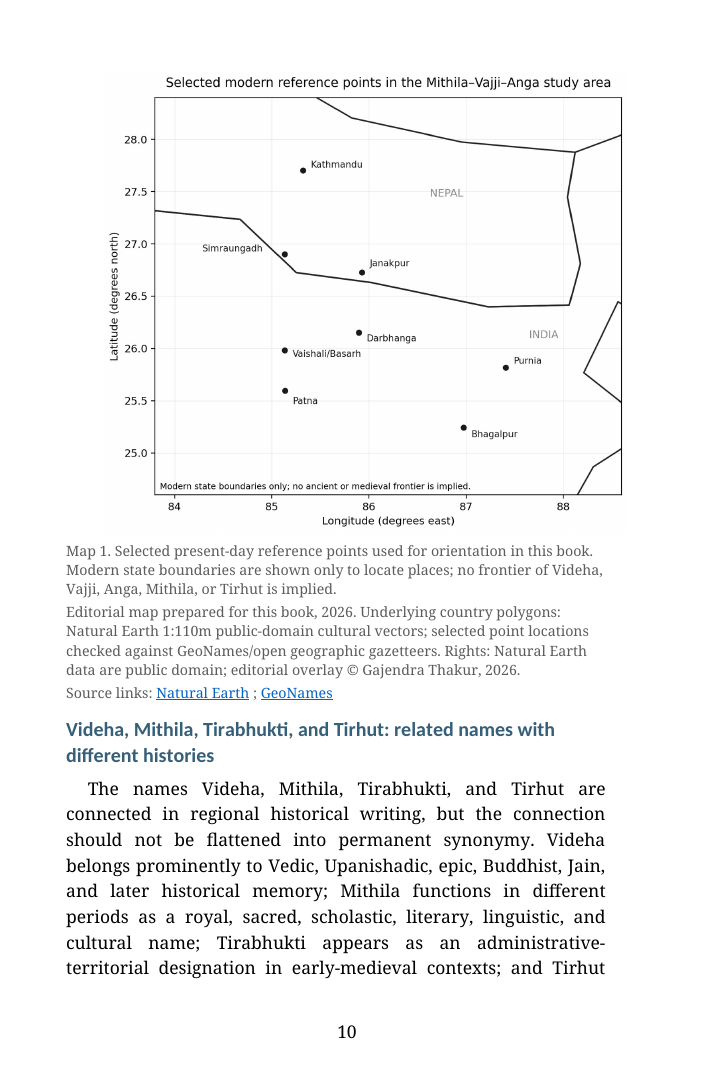
Mithila · Vajji · Anga
Chapter-specific source notes
- Primary chapter witness. Gajendra Thakur, Decoding the Panji of Mithila — Volume IV, formal Chapter 74, PDF pp. 696-703; formal Chapter 74. The HTML transcription is generated from the commit-pinned source PDF and retains the chapter boundary recorded in this edition.
- Internal structure. The repository source-heading inventory records 10 subordinate headings for this chapter: “1. Where Chapter 74 begins”; “2. Entry (607): Kako-Belaunch and the Amarnath invocation”; “3. Entry (608): Kako-Kailakh-Pilkhwar”; “4. Entries (609)-(610): the continuing Kako-Kailakh body”; “5. Entry (611): Shivnagar and Chau Banpura”; “6. Entry (612): Chanpura, Haripur, Vira and Ekma”; “7. Entry (613): Barha Nagram”; “8. Entry (614): Satlakha, Visauni and Jhauwa”; ….
- Digital editorial method. The page keeps the preserved source text distinct from generated navigational, concordance, visual, and provenance apparatus. The synthetic reconstruction is explanatory only and is not evidence for an individual lineage or a determination of social or marital status.