Decoding the Panji of Mithila · Volume IV · Chapter 75
Kako-Babu Chhapra-Dath, Dath- Ekma, Pokhrauni-Tarauni-Pindaruch, Kako- Kailakh-Pindaruch, and Satlakha-Belaunch- Halo: Entries (615)-(620)
Chapter 75. Kako-Babu Chhapra-Dath, Dath-
Ekma, Pokhrauni-Tarauni-Pindaruch, Kako-
Kailakh-Pindaruch, and Satlakha-Belaunch-
Halo: Entries (615)-(620)
1. Where Chapter 75 begins
   Chapter 75 begins at entry (615), immediately after the Satlakha-
Visauni-Jhauwa close of Chapter 74. The new opening is marked by the
invocation “ॐ उँ मापत्यैनम:” and the heading “काकोसँ बावू छपरा दाथ.” The
chapter therefore remains within the wider Kako field, but it turns from
the Satlakha-Visauni-Jhauwa frame to Babu Chhapra, Dath, Ekma,
Pokhrauni, Tarauni, Pindaruch and Halo.
   The natural boundary is entries (615)-(620). Entry (615) opens Kako-
Babu Chhapra-Dath; entry (616) continues Dath and Ekma; entry (617)
widens to Pokhrauni, Tarauni, Pindaruch, Narha and Dhagjari; entry
(618) returns to Kako-Kailakh with Pindaruch; entries (619)-(620) form
the Satlakha-Belaunch-Halo continuation. Entry (621) begins a distinct
Mardari-Baliyas gramaramabh, so it belongs to the next chapter.

2. Entry (615): Kako-Babu Chhapra-Dath
   Entry (615) opens with Bhaiya. Bhaiya gives Dhaniram and Jayram
through the Baliyas-Anant-Mahadev route and the Pabouli-Shubhankar
connection. A separate son-line gives Maniram through the same
Mahadev-Shubhankar frame, showing that the Babu Chhapra-Dath
section begins not with a single narrow descent but with parallel sons
placed against the same marriage geography.
   Dhaniram gives Babunath through Karmah-Dukhans-Jagan and
Baliyas-Pradyumna. Apara sons Gopinath and Janakinath are placed
through Baliyas-Dhir-Manik and Jajival-Kaladhar. Babunath then gives
Babulal, Bhaylal, Ranglal and the Nena/Jagyalal line through Pali-
Umadatt-Kamaladatt and Khandwala-Bhanu.
   The sons of Babunath are not merely listed; each one opens a
different branch route. Babulal is tied through Pali-Devanath-Gopal and
Darihara-Lakshman. Bhaylal is tied through Pabouli-Narayandatt-
Vedanand and Darihara-Gokulnath. Ranglal gives Harinath through
Pandua-Rudramani-Nandalal and Pali-Shaktinath; Harinath then gives

the Surwa-Bhaga line through Gharora-Devakinandan-Harinandan and
Pali-Jhotan, while Bhoga is attached through Tatail-Sakararhi-Keshav-
Shatanjiv.
   The Nena/Jagyalal line gives Harikrishna, Prabhunandan,
Vindhyanath, Ramchandra and Lakshman through Pabouli-
Narayandatt-Vedanand and Darihara-Gokulnath. Harikrishna leads to
Bankbihari through Narun-Chhakkan-Shivnath and Khandwala-Sarvjit
Singh. Bankbihari gives Kamlesh through Alay-Bechanlal-Chhakauri and
Khandwala-Chiranjeev. Kamlesh is then attached through Khaual-
Komalkant-Tarakant and Soderpur-Ghan.
  Prabhunandan is tied through Soderpur-Ramdatt-Sadhu and Baliyas-
Yaddu. Vindhyanath gives Surendranath through Surgan-Rai
Durganarayan-Rai Vedanand Narayan and Khaual-Janakinath.
Ramchandra gives Amarchandra and Samarchandra through
Khandwala-Vishnusingh-Chandeshwar Singh and Pandua-Panjivi.
Lakshman is linked through Alay-Bechanlal-Ballu, also called Balbhadra,
and Sarisab-Janardan.
   The later part of entry (615) preserves an apara Sonmani line.
Sonmani gives Nityanand and Sadanand through Baliyas-Vidhanath-
Dharmdatt and Hariamb-Jangal. Dhodhan is tied through Tisaut-Manai-
Narayandatt and Khaual-Chhata. None is connected through Pali-
Rudradatt-Hirphul and Darihara-Rohini-Nanu, followed by an Ekhara-
Gunakar route. Shrinath gives Krishnakant through Soder-Machal-
Pitambar and Belaunch-Parshmani; an apara route goes through
Pabouli-Machal-Pritinath and Mandar-Sudhakar. Krishnakant closes this
entry through Jajival-Shivrudra-Rajnath and Pali-Amritnath.

3. Entry (616): Dath and Ekma
  Entry (616), “काको सँ दाथ, एकमा,” continues from Nityanand and shifts
the field toward Dath-Ekma. Nityanand’s connected line gives Kalra,
Musha, Teknath and Thithar through Baheradhi-Maherman-Chhatrakar
and Darihara-Bhavan. Apara Gulab is placed through Sakararhi-
Devkrishna-Shyamlal and Hariamb-Ramanath.
   Musha gives Jaydev, Satyadev, Krishnadev and Baldev through
Karmah-Hemkant-Pushpakant and Satlakha-Jagmohan. Jaydev is linked
through a Hariamb-Lutan-Babu route and Digho-Raghunath. Satyadev
gives Danik through Pali-Dukhan-Chakradhar and Darihara-Pyare.
Krishnadev is placed through Soderpur-Ram-Bechu and Belaunch-Nath.

An apara Jaydev line gives Vanshidhar through Khorir-Soderpur-Ram-
Bechu and again Belaunch-Nath.
   Vanshidhar gives Sundarnath, Ishwarnath, Mohan and Shaktinath
through Hariamb-Damahi-Jagdish and Pandua-Bhalle. Sundarnath is
tied through Naga-Dhusaut-Mahesh-Ganganath. Mohan is tied through
Naha-Khaual-Harishankar-Divakar and Soder-Chakrapani. Baldev gives
Badrinath, Durganath, Ratinath and Buddhinath through Ranitola-
Hariamb-Shankar-Bedanand and Soderpur-Mangu.
   Badrinath gives Vivekanand and Sayanand through Dhusaut-
Shrinandan-Jyotishi   Shivanandan      and    Jajival-Ratnadev,   also
remembered as Ratta. Durganath gives Santoshkumar and Manoj
through Tharhi-Pali-Chakradhar-Yogi and Kujauli-Ramakant. Ratinath is
tied through Sarisab-Kedarnath-Kumudnath. The preserved text then
continues through Vivekanand, Ranihol, Jeevanath, Satyanand and
Omkar, before returning to the Santosh-Manoj and Gulab-Thithar lines.
    The close of entry (616) keeps the Dath-Ekma section connected to
Mandar, Panichobh, Budhwal and Soderpur. Gulab is tied through
Mandar-Sanath-Bhavi-Baldev and Panichobh-Lanha-Kalikadatt. Thithar
is placed through Budhwal-Nilambar-Mukund and Soderpur-Brahmdatt.
These routes make entry (616) a bridge between the Babu Chhapra-Dath
opening and the Pindaruch expansion that follows.

4. Entry (617): Pokhrauni, Tarauni, Pindaruch, Narha
and Dhagjari
  Entry (617) is headed “काको सँ पोखरौनी तरौनी पिण्डारुछ: नरहा धगजरी.” It
opens with Bhavanath, who gives Vidhanath, Chhaban and Juraun
through Jajival-Banai-Nitai and Sakararhi-Purushottam. Vidyanath gives
Jyotishi Bachna through Takbal-Sadanand-Bandhu and Sarisab-Nandan.
Apara Vidyanath gives Bawunath through Kujauli-Abhiram-
Madhurapati and Pali-Durgidatt, and another apara branch gives
Maninath, Baduknath, Kirtinath and Shambhunath through Mandar-
Chan-Moti and Soderpur-Bachchu.
  Bachna is tied through Baliyas-Durganath-Dharanath and Sarisab-
Bhikhi. Bawunath gives Kamalnath and Kunja through Khaual-
Dhanshyam-Bhutinath and Ghusaut-Jhontu. Kamalnath then gives
Chandrashekhar, Vishwanath and Markandey through Pali-Radhav-
Rameshwar and Pandua-Rudramani, with a Soderpur-Thothari

attachment. Vishwanath gives Kumesh through Soderpur-Babura-
Sonelal and Belaunch-Kanhaiyalal.
   Kunja gives Rup through Alay-Nena-Nandalal and Baliyas-Nanu. Rup
is tied through Darihara-Balle-Madhusudan and Khandwala-Jirakvan.
Maninath then opens the Battaha-Nandalal-Chhotka route through
Soderpur-Nandeshwar and Sakararhi. Lalit gives Singheshwar,
Vighneshwar, Kapileshwar and Rajeshwar through Soderpur-
Balkrishna-Hanumandatt and Baliyas-Premnath.
   Singheshwar gives Yugalkishor through Mandar-Ishannath-Babulal
and Digho-Chitradhar. Yugalkishor gives Madanmohan through
Darihara-Hiyan-Shrikant and Panichobh-Kapileshwar. Madanmohan
then gives Anandmohan, Dheerendramohan and Sachindramohan
through Mandar-Rukminidatt-Keshav and Soderpur-Sadanand.
   The closing part of entry (617) keeps modern and learned markers
alongside the older route grammar. Anandmohan gives Minaksh
through Danania-Biski-Gopal-Chiranjeev and Soderpur-Sadanand.
Kapileshwar gives Shrikant, Lakshmikant, Kalikant, Kashikant and
Chandrashekhar through Pandua-Hridaymani-Avadhbihari and Pali-
Gauri. Shambhunath is placed through Soder-Juraun-Moti and Alay-
Shyamlal. Dheerendramohan gives Chandranandan through Nahas-
Khaual-Kashinath and the Nyaya/Sachchidanand marker, with Tisaut-
Pitambar at the end.

5. Entry (618): Kako-Kailakh and Pindaruch
  Entry (618), “काको सँ कै लख (३१४) पिण्डारूछ,” returns to the Kako-Kailakh
formula while retaining Pindaruch. Chhaban gives Jeevanath and
Nehnath through Sarisab-Chan-Bhikhi and Karmah-Umanath. Jeevanath
is tied through Apuch-Sakararhi-Pan Banai-Jayanand and Soder-
Chalbali; an apara line places him through Khandwala-Mahinath-
Manchit and Darihara-Subodh. Apuch is separately linked through
Mandar-Vanshidhar-Rankamani and Ekhara-Sanphul.
   Nehnath gives Bhushan, also called Baidyanath, through Digho-
Ankhi-Hira and Karmah-Riddhi. Baidyanath gives Janakinath,
Shobhanath and Tejnath through Khaual-Jaybhadra-Aniruddh and Pali-
Shaktinath. Janakinath gives Umanath and Ramanath through Khaual-
Ishvakar Datt-Ugri and Tisaut-Kamalnayan.
   Umanath gives Kantinath, Jeevanath, Chandranath and Rajnath
through Pali-Raghunandan-Madanand and a Pabouli-Khadganath

reference. Kantinath is attached through Mandar-Shrikant-Kamalakant
and Pali-Umanand. Ramanath gives Shivnath and Devanath through
Karmah-Dukhmangan-Mitrnath and Soderpur-Shitaladatt.
    Shobhanath gives Ganganath and Vidyanath through Khandwala-
Shubhankar Singh-Gudan Singh and Belaunch-Harihardatt. Ganganath
is tied through Karmah-Harinath-Kamalanath and Khaual-Ghanshyam,
while an apara Ganganath line gives Ravindranath through Fanandah-
Rampal and Satlakha-Basudev. Vidhanath is linked through Narun-
Poshnath-Kalanath and Khandwala-Babu Chandrapati Singh. Tejnath is
tied through Barwamad-Jajival-Adinath-Dinanath and Narun-M.M.
Sadde, also read as Sadanand.
   The end of entry (618) moves through Juraun and Pyare. Pyare is
linked through Fanandah-Gunishwar-Gharanath and Sarisab-Bholanath.
Apara sons Ram, Madhav, Prayagdatt, Mani and Himran are distributed
through     Sarisab-Jayshiv-Bhaiyan,   Mandar-Medhanath,      Baliyas-
Bhanudatt, Pali-Vishnupati-Kala and other Khaual, Pabouli and
Chhamuk-Sakararhi lines. This close makes entry (618) both a return to
Kako-Kailakh and a preparation for the Satlakha-Belaunch-Halo section.

6. Entry (619): Halo and the Satlakha-Belaunch gram
  Entry (619) is headed by “ॐ हालो” and then opens “अथ सतलखा बेलउँ च
ग्राम.” Purushottam gives Lala, Bala, Sudarshan, Dattu and Dunananand
through Kujauli-Jagdish-Mohan and Khaual-Parmanand. Lala is tied
through Khaual-Bhagirath-Keshav and Alay-Bhavdev. Apara Basan and
Teknath pass through Sakararhi-Shatanjiv-Andi and Soder-Raghunath.
   Balan gives Lanhi and Hirphul through Karmah-Kalidas-Chilka and
Parisara-Balkrishna. Teknath is tied through Uchati-Hiranand-Mala and
Baliyas-Mahipati, and Sukhpuran through Dhusaut-Madhupati-
Nityanand and Pabouli-Murali-Ramakant. Bala gives Chengan through
Darihara-Dukhran-Yadupati and Pali-Mahesh.
   Chengan gives Bhairavdatt, Kamaladatt and Baidyanath through
Satlakha-Karu-Pitambar and Soder-Chhatu. Bhairav gives Tota and
Ishwaridatt through Gangoli-Krishnaram-Pakshadhar and Hariamb-
Hemai. Ishwaridatt gives Pyare and Triveni through Jajival-Umapati-
Ankhi-Fakir and Karmah-Guni.
  Sudarshan gives Vishwanath through Darihara-Anu-Mahesh and
Soderpur-Kamalapati. Ritu gives Mansak through Soder-Badal-Yogi and
Hariamb-Shivram. Mansak gives Girdhari, Vanshpati, Kalanath and

Shivdatt through Pali-Shulpani-Jiut and Darihara-Bhushan. Girdhari
gives Tirthadatt through Panichobh-Bablu-Baburaiya and Khaual-
Sonma.
   Tirthadatt gives Kodav and Ugradatt through Darihara-Vanshidhar-
Chhakauri and Sarisab-Krishnadatt. Kodan is tied through Baliyas-
Harinath-Raghuvir and Jajival-Bhavani Datt. Vanshpati gives Gopal,
Govind and Goruddhdena through Panichobh-Babanu-Bakraiya and
Khaual-Sonma. Gopal then moves through Soderpur-Vaishnav-Dukhiya-
Mandhan, Satlakhwa-Nilambar-Ankhi and Soderpur-Atmaram. Shivdatt
gives Lal through Khaual-Digambar-Chaudhari Kari and Bamniyam-
Jagaypati.
   Dunananand gives Shital, Kavanath, Dayanath and Hridaynath
through Pali-Purandar-Hari and Ekhara-Madan. Rupnath gives
Hanumandatt and Vishnudatt through Satlarwa-Medhu-Kunjan and
Pali-Kala. Hanumandatt gives Dhairyanath, Amritnath, Bhaynath and
Jhingur through Gangoli-Lochan-Jeevanath and Budhwal-Thakuri.
Dhairyanath gives Shaktinath, Muktinath and Raghunath through
Karmah-Bholi-Teji and Darihara-Saradatt. Shaktinath and Muktinath
are then separately tied through Khaual, Soderpur, Sakararhi, Pabouli,
Ahil, Pali and Ekhara routes.

7. Entry (620): Satlakha-Belaunch-Halo continuation
  Entry (620), “सतलखा बेलउँ च सँ हालो,” continues the Halo section without
beginning a new village field. Amritnath is tied through Sarisab-
Chalbali-Thithar and Karmah-Babujan. Bhaynath gives Riddhipaurnath
through Sakararhi-Narayan-Anupalal and Pabouli-Haridatt. Riddhinath
is   placed    through   Baliyas-Mana-Premnath-Thakkan,     Sarisab-
Hridaynath-Gudar and Satlakha-Ramanath.
  Jhingur is tied through Budhwal-Krishnadatt-Raghudatt and Baliyas-
Hanumandatt. Dayanath gives Babunandan through Khaual-Ratish-
Dharmapati and Pabouli-Bodh. Babunandan is further linked through
Ahil-Hariamb-Ratnapati-Hulli and Satlakha-Kunjan.
   Manikrishna gives Shrinath, Bhavanath and Grihinath through
Karmah-Mahanth-Fakir and Soderpur-Chhora. Shrinath is tied through
Soderpur-Kirtinath-Shankar and Budhwal-Shambhunath. An apara
Shrinath line gives Arjun through the Soder-Yogi lineage leading to
Sitaram, Ramanath and Kalikadatt, then through Khaual-
Khadganarayan Datt-Harshdatt and Pabouli-Bhagvu.

   Grihinath is tied through Hahi-Pali-Bacha-Jeevan-Badri, through
Sarisab-Narayandatt-Kanhai, through Mandar-Gopal-Jayan and through
Jajival-Barju. This is the final preserved movement of Chapter 75. The
source then turns to entry (621), “ अथ माड़रि बलियास ग्रामाराम्भ,” which
begins a new chapter.

8. Reading Chapter 75 as a single movement
    Chapter 75 is best read as a continuation and expansion of the Kako
field after the Satlakha-Visauni-Jhauwa unit. The first two entries, (615)-
(616), move through Babu Chhapra, Dath and Ekma. Entries (617)-(618)
widen the route into Pokhrauni, Tarauni, Pindaruch, Narha, Dhagjari
and a return to Kako-Kailakh. Entries (619)-(620) resolve the movement
into the Halo and Satlakha-Belaunch frame.
   The chapter is especially dense in cross-routes. Baliyas, Pabouli,
Karmah, Jajival, Pali, Khandwala, Darihara, Soderpur, Panichobh,
Budhwal, Mandar, Khaual, Narun, Sarisab, Satlakha, Fanandah,
Ghusaut, Pandua and Ekhara recur throughout the chapter. These
routes show that the chapter is not a simple list of villages; it is a woven
map of descent, marriage and remembered residence.
   Several professional, title or status markers also remain important:
Rai, Jyotishi, Nyaya, M.M., Babu, Singh and other honorific or learned
markers appear inside the genealogical chains. They are not
independent biographical essays, but they show why particular
descendants and marriage routes were memorable enough to be
preserved.

Chapter conclusion
   Entries (615)-(620) complete a coherent Kako-Babu Chhapra-Dath and
Satlakha-Belaunch-Halo chapter. Entry (615) opens Babu Chhapra-Dath
under the Umapatya invocation. Entry (616) continues through Dath and
Ekma. Entry (617) expands to Pokhrauni, Tarauni, Pindaruch, Narha
and Dhagjari. Entry (618) returns to Kako-Kailakh while keeping
Pindaruch in view. Entries (619)-(620) form the Halo continuation of
Satlakha-Belaunch.
  The next chapter should begin at entry (621), where the source
announces “अथ माड़रि बलियास ग्रामाराम्भ.” That heading marks a new village
field and should not be folded into the Kako-Halo unit.
Source structure and verification apparatus
Editorial source apparatus. This apparatus is descriptive, not interpretive. It records the source-controlled structure used to verify that this page corresponds to formal Chapter 75 of Decoding the Panji of Mithila — Volume IV. The chapter text above is preserved from PDF pp. 704-710; formal Chapter 75 in the commit-pinned authoritative source. It is not merged with a neighboring chapter, appendix, annexure, or independent front/back-matter unit. The internal headings below come from the repository’s source-heading inventory and are retained as navigational and audit evidence; showing them here does not turn those headings into separate publications or add claims that are absent from the source.
Internal source headings
- 1. Where Chapter 75 begins
- 2. Entry (615): Kako-Babu Chhapra-Dath
- 3. Entry (616): Dath and Ekma
- 4. Entry (617): Pokhrauni, Tarauni, Pindaruch, Narha and Dhagjari
- 5. Entry (618): Kako-Kailakh and Pindaruch
- 6. Entry (619): Halo and the Satlakha-Belaunch gram
- 7. Entry (620): Satlakha-Belaunch-Halo continuation
- 8. Reading Chapter 75 as a single movement
- Chapter conclusion
Source-text concordance
Kako-Babu · Chhapra-Dath · Dath · Ekma · Pokhrauni-Tarauni-Pindaruch · Kako · Kailakh-Pindaruch · Satlakha-Belaunch · Halo · Entries · begins · entry · immediately · Satlakha · Visauni-Jhauwa · close · opening · marked · invocation · heading · therefore · remains · within · wider · field · turns · Satlakha-Visauni-Jhauwa · frame · Babu · Chhapra · Pokhrauni · Tarauni · Pindaruch · natural · boundary · opens · continues · widens · Narha · Dhagjari · returns · Kako-Kailakh · form · Satlakha-Belaunch-Halo · continuation · distinct · Mardari-Baliyas · gramaramabh · belongs · next · Bhaiya · gives · Dhaniram · Jayram · Baliyas-Anant-Mahadev · route · Pabouli-Shubhankar · connection · separate · son-line · Maniram · Mahadev-Shubhankar · showing · section · single · narrow · descent · parallel · sons · placed · marriage · geography · Babunath · Karmah-Dukhans-Jagan · Baliyas-Pradyumna · Apara · Gopinath · Janakinath · Baliyas-Dhir-Manik · Jajival-Kaladhar
Boundary verification. In the formal sequence this chapter follows Volume IV Chapter 74, “Kako-Belaunch, Kako-Kailakh, Shivnagar-Banpura, Chanpura-Haripur-Vira- Ekma, Barha Nagram and Satlakha-Visauni- Jhauwa: Entries (607)-(614)” and precedes Volume IV Chapter 76, “Mardari-Baliyas and Sakuri- Baliyas: Entries (621)-(624)”. The chapter extractor begins at the verified formal Chapter 75 marker and stops at the next verified formal chapter marker; for a final chapter it stops before recognized book-level back matter. The concordance above is generated only from distinct terms already present in this chapter’s preserved source text. It is provided for discovery, comparison, and audit, not as an automated judgment about persons, lineages, status, kinship, marriage eligibility, or historical truth.
Illustrated research apparatus
Mithila · Vajji · Anga
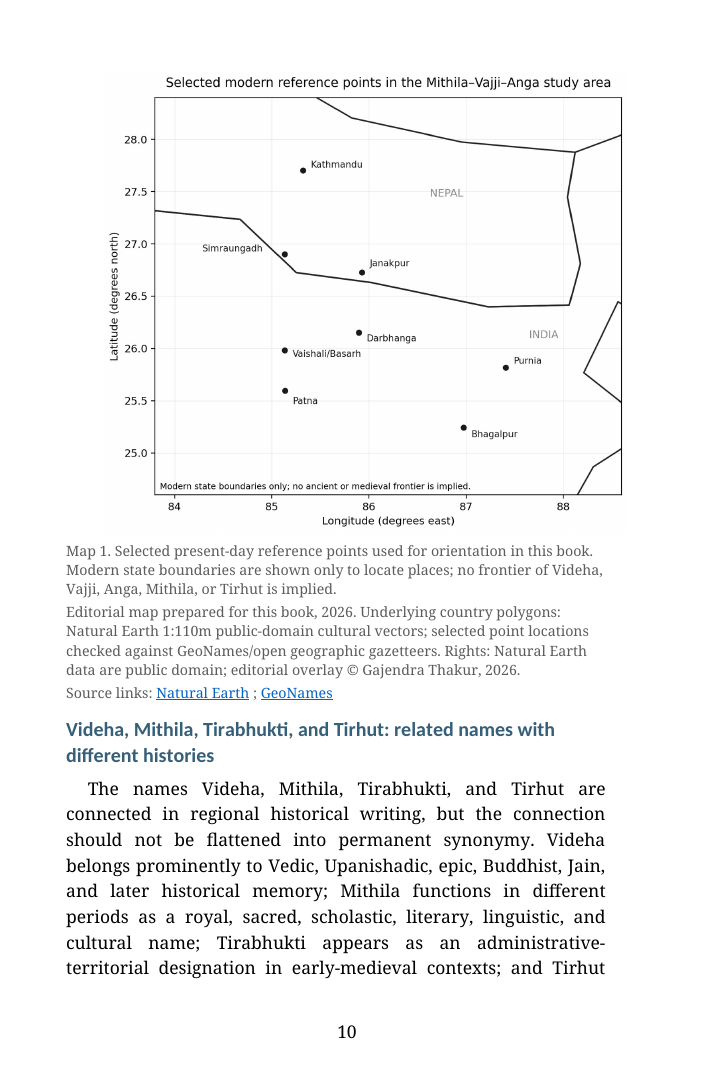
Chapter-specific source notes
- Primary chapter witness. Gajendra Thakur, Decoding the Panji of Mithila — Volume IV, formal Chapter 75, PDF pp. 704-710; formal Chapter 75. The HTML transcription is generated from the commit-pinned source PDF and retains the chapter boundary recorded in this edition.
- Internal structure. The repository source-heading inventory records 9 subordinate headings for this chapter: “1. Where Chapter 75 begins”; “2. Entry (615): Kako-Babu Chhapra-Dath”; “3. Entry (616): Dath and Ekma”; “4. Entry (617): Pokhrauni, Tarauni, Pindaruch, Narha and Dhagjari”; “5. Entry (618): Kako-Kailakh and Pindaruch”; “6. Entry (619): Halo and the Satlakha-Belaunch gram”; “7. Entry (620): Satlakha-Belaunch-Halo continuation”; “8. Reading Chapter 75 as a single movement”; ….
- Digital editorial method. The page keeps the preserved source text distinct from generated navigational, concordance, visual, and provenance apparatus. The synthetic reconstruction is explanatory only and is not evidence for an individual lineage or a determination of social or marital status.