Decoding the Panji of Mithila · Volume IV · Chapter 84
Marriage Networks and Inter- Village Affiliation
Chapter 84. Marriage Networks and Inter-
Village Affiliation

1. Marriage as structure
   The Panji records marriage and inter-village affiliation in compressed
formulae. A simple route expression may preserve a family’s relation to
another house, village, or branch. This is why village names cannot be
read only as physical movement. In many entries they encode social
linkage.
   The marriage network is often visible through repeated patterns: a
principal name is followed by sons, then by a village route, then by
another line. A daughter-line may be brief, but it can be as important as
a long male descent, because it preserves the connection between
houses.

2. Repetition and distinction
   Names such as Gopal, Vishwanath, Raghunath, Madhurapati,
Bhairav, Shambhunath, and Lakshminath recur across the volume.
Repetition should not be treated mechanically. The same name can refer
to different people, or the same person may reappear because another
marriage or village relation is being recorded.
   The safest method is to read every repeated name with its father-
name, village route, title, cross-reference, and immediate branch
context. When those surrounding clues differ, identity should not be
assumed.

3. Affiliation beyond residence
    The phrase 'from X to Y' may indicate residence, but it may also
indicate marriage, ritual service, priestly relation, settlement memory,
or archival classification. A family may be remembered through a
village even when that village is not the only place of residence. The
Panji’s geography is a geography of relationship.
  For this reason the route network is also a marriage network. The
same line that looks like a path across villages can also be a statement
about the social legitimacy of connection.

4. The human meaning of the network
   Marriage in the Panji is not only a private family event. It is a
mechanism of social memory. It joins houses, preserves eligibility,
records status, and transmits village names across generations. The
Nagram Panji therefore turns marriage into a historical map.
Source structure and verification apparatus
Editorial source apparatus. This apparatus is descriptive, not interpretive. It records the source-controlled structure used to verify that this page corresponds to formal Chapter 84 of Decoding the Panji of Mithila — Volume IV. The chapter text above is preserved from PDF pp. 753-754; formal Chapter 84 in the commit-pinned authoritative source. It is not merged with a neighboring chapter, appendix, annexure, or independent front/back-matter unit. The internal headings below come from the repository’s source-heading inventory and are retained as navigational and audit evidence; showing them here does not turn those headings into separate publications or add claims that are absent from the source.
Internal source headings
- 1. Marriage as structure
- 2. Repetition and distinction
- 3. Affiliation beyond residence
- 4. The human meaning of the network
Source-text concordance
Marriage · Networks · Inter · Village · Affiliation · structure · records · inter-village · compressed · formulae · simple · route · expression · preserve · family’s · relation · another · house · branch · names · cannot · read · physical · movement · many · entries · encode · social · linkage · network · often · visible · repeated · patterns · principal · name · followed · sons · line · daughter-line · brief · important · long · male · descent · preserves · connection · houses · Repetition · distinction · Gopal · Vishwanath · Raghunath · Madhurapati · Bhairav · Shambhunath · Lakshminath · recur · across · treated · mechanically · refer · different · people · person · reappear · recorded · safest · method · every · father · title · cross-reference · immediate · context · surrounding · clues · differ · identity · assumed
Boundary verification. In the formal sequence this chapter follows Volume IV Chapter 83, “Major Village Nodes and Route Networks” and precedes Volume IV Chapter 85, “Scholars, Priests, Officials, Lawyers, Engineers, Doctors, and Modern Professions”. The chapter extractor begins at the verified formal Chapter 84 marker and stops at the next verified formal chapter marker; for a final chapter it stops before recognized book-level back matter. The concordance above is generated only from distinct terms already present in this chapter’s preserved source text. It is provided for discovery, comparison, and audit, not as an automated judgment about persons, lineages, status, kinship, marriage eligibility, or historical truth.
Illustrated research apparatus
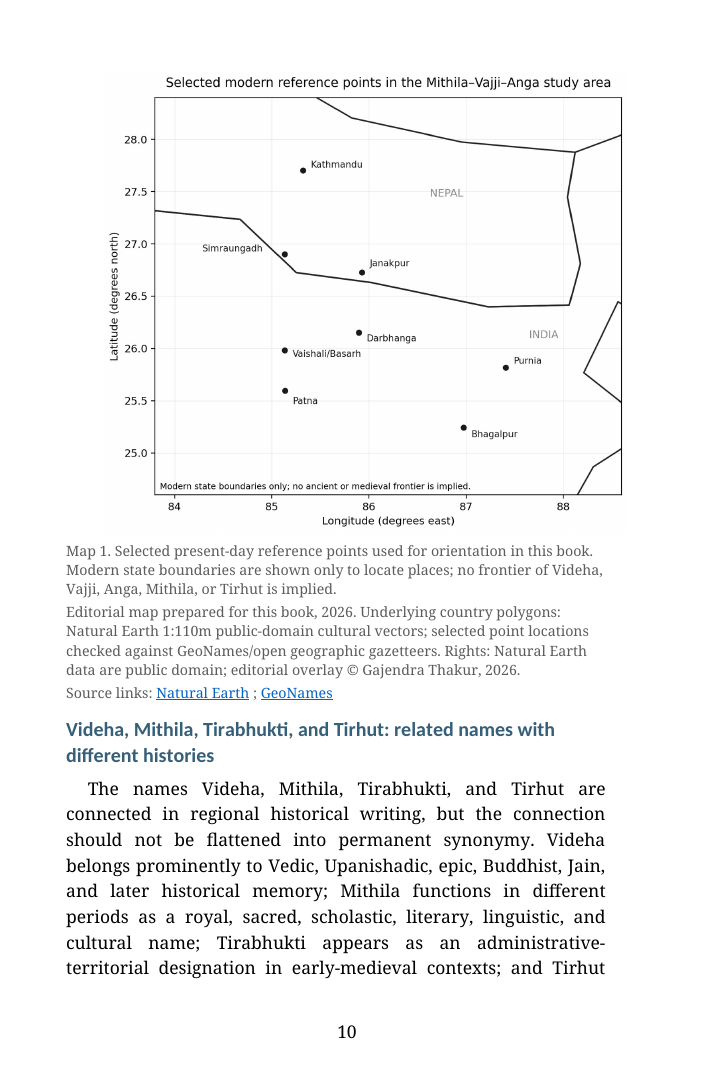
Mithila · Vajji · Anga
Chapter-specific source notes
- Primary chapter witness. Gajendra Thakur, Decoding the Panji of Mithila — Volume IV, formal Chapter 84, PDF pp. 753-754; formal Chapter 84. The HTML transcription is generated from the commit-pinned source PDF and retains the chapter boundary recorded in this edition.
- Internal structure. The repository source-heading inventory records 4 subordinate headings for this chapter: “1. Marriage as structure”; “2. Repetition and distinction”; “3. Affiliation beyond residence”; “4. The human meaning of the network”.
- Digital editorial method. The page keeps the preserved source text distinct from generated navigational, concordance, visual, and provenance apparatus. The synthetic reconstruction is explanatory only and is not evidence for an individual lineage or a determination of social or marital status.