Decoding the Panji of Mithila · Volume IV · Chapter 83
Major Village Nodes and Route Networks
Chapter 83. Major Village Nodes and Route
Networks

1. Village nodes as archival anchors
   The Nagram Panji is organized through villages as much as through
persons. A village-name is not merely a geographical label; it is a
genealogical coordinate. It can mark origin, settlement, marriage
affiliation, branch identity, ritual association, or the place through
which a person became known in the record.
   The central village nodes are not equal in function. Some serve as
beginnings of clusters, some as repeated destinations, some as marriage-
connection markers, and some as memory bridges between old and
recent layers. The reader must therefore ask what the village is doing in
each entry, not merely where it is located.

2. Opening nodes: Sandahpur, Singhwar, and
Shashipur
   Sandahpur, Singhwar, and Shashipur form the opening architecture
of the volume. Sandahpur to Singhwar establishes the first route
grammar; Sandahpur to Shashipur widens the frame into a secondary
centre. The recurrence of these villages shows that early Nagram
identity is relational and networked rather than isolated.
   Shashipur later becomes an organizing point for branches linked
with Pindaruch, Survana, and modernizing names. It is therefore both
an early place node and a later branch-memory node.

3. Middle nodes: Mangrauni, Hati, Samauli,
Balirajpur, and Siwa
    Mangrauni and Hati mark dense transitional zones. Their entries
often combine village opening, repeated names, and route
multiplication. Hati especially shows the force of gramaarambha: a
village beginning is not a mere heading but a new genealogical field.
   Samauli, Balirajpur, and Siwa form wider branching nodes. Samauli
sends the reader through Tarauni, Nanour, Vindhi, Sanha, Jhanjharpur,
Bagahi, and allied routes. Balirajpur brings Ranitole, Ramnagar,
Kakraur, and Chopra into the frame. Siwa becomes a major post-

opening node whose branches link Virsair, Saurath, Singhwar,
Vishnupur, Pilkhwar, and Kachhua.

4. Late nodes: Rohar, Tatail, Rajanpura, Bhakharouli,
Malangia, and Ruchauli
   Rohar and Tatail carry heavy late-stage genealogical work. Rohar
appears as origin, route, and cross-link; Tatail expands toward Nanour,
Pilwarwad, Tharhi, Dhankauli, Bharam, Pindaruch, Jamshedpur,
Rahika, and Kanhouli. These nodes show the Panji moving beyond a
narrow local frame.
   Bhakharouli, Malangia, Dadari, Brahmoli, Ruchauli, Oda, Berma,
Sangram, Shahpur, Ratipar, Maheshpur, and Suday form the late closing
geography of the source-entry chapters. They are not loose appendages.
They show how the Nagram material reaches its final spread before the
closing rikta entries.
Source structure and verification apparatus
Editorial source apparatus. This apparatus is descriptive, not interpretive. It records the source-controlled structure used to verify that this page corresponds to formal Chapter 83 of Decoding the Panji of Mithila — Volume IV. The chapter text above is preserved from PDF pp. 751-752; formal Chapter 83 in the commit-pinned authoritative source. It is not merged with a neighboring chapter, appendix, annexure, or independent front/back-matter unit. The internal headings below come from the repository’s source-heading inventory and are retained as navigational and audit evidence; showing them here does not turn those headings into separate publications or add claims that are absent from the source.
Internal source headings
- 1. Village nodes as archival anchors
- 2. Opening nodes: Sandahpur, Singhwar, and Shashipur
- 3. Middle nodes: Mangrauni, Hati, Samauli, Balirajpur, and Siwa
- 4. Late nodes: Rohar, Tatail, Rajanpura, Bhakharouli, Malangia, and Ruchauli
Source-text concordance
Major · Village · Nodes · Route · Networks · archival · anchors · Nagram · organized · villages · much · persons · village-name · merely · geographical · label · genealogical · coordinate · mark · origin · settlement · marriage · affiliation · branch · identity · ritual · association · place · person · became · known · record · central · equal · function · serve · beginnings · clusters · repeated · destinations · connection · markers · memory · bridges · recent · layers · reader · must · therefore · entry · located · Opening · Sandahpur · Singhwar · Shashipur · form · architecture · establishes · first · grammar · widens · frame · secondary · centre · recurrence · shows · early · relational · networked · rather · isolated · later · becomes · organizing · point · branches · linked · Pindaruch · Survana · modernizing
Boundary verification. In the formal sequence this chapter follows Volume IV Chapter 82, “Major Lineage Nodes of the Nagram Panji Analytical Summary after the Source-Entry Decoding” and precedes Volume IV Chapter 84, “Marriage Networks and Inter- Village Affiliation”. The chapter extractor begins at the verified formal Chapter 83 marker and stops at the next verified formal chapter marker; for a final chapter it stops before recognized book-level back matter. The concordance above is generated only from distinct terms already present in this chapter’s preserved source text. It is provided for discovery, comparison, and audit, not as an automated judgment about persons, lineages, status, kinship, marriage eligibility, or historical truth.
Illustrated research apparatus
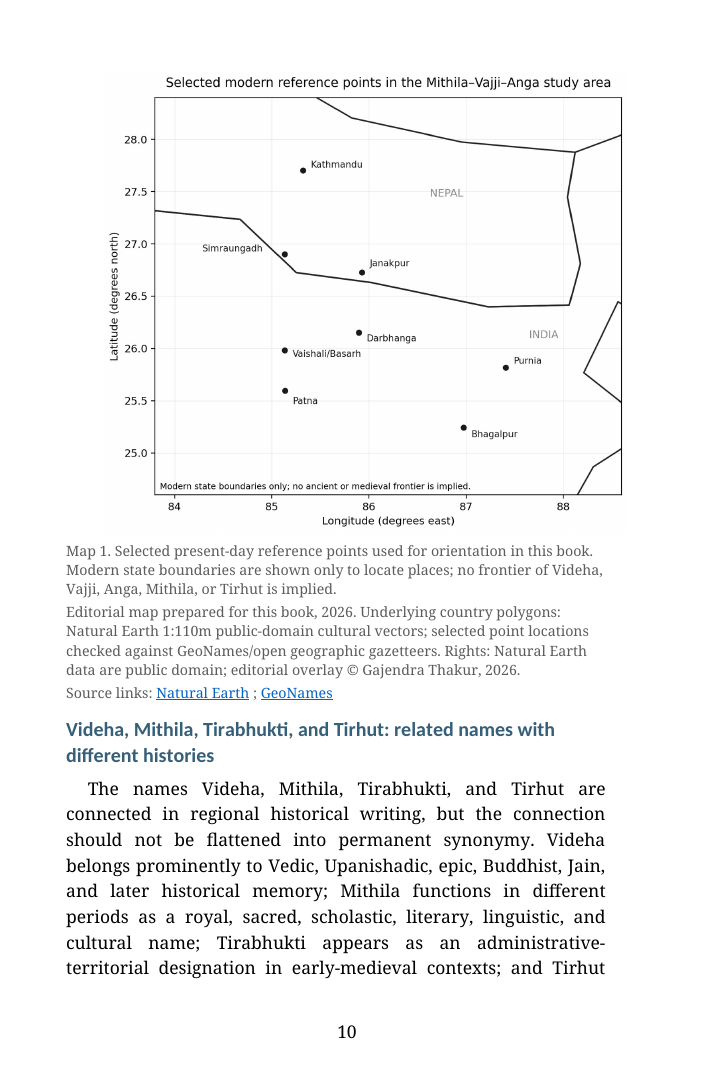
Mithila · Vajji · Anga
Chapter-specific source notes
- Primary chapter witness. Gajendra Thakur, Decoding the Panji of Mithila — Volume IV, formal Chapter 83, PDF pp. 751-752; formal Chapter 83. The HTML transcription is generated from the commit-pinned source PDF and retains the chapter boundary recorded in this edition.
- Internal structure. The repository source-heading inventory records 4 subordinate headings for this chapter: “1. Village nodes as archival anchors”; “2. Opening nodes: Sandahpur, Singhwar, and Shashipur”; “3. Middle nodes: Mangrauni, Hati, Samauli, Balirajpur, and Siwa”; “4. Late nodes: Rohar, Tatail, Rajanpura, Bhakharouli, Malangia, and Ruchauli”.
- Digital editorial method. The page keeps the preserved source text distinct from generated navigational, concordance, visual, and provenance apparatus. The synthetic reconstruction is explanatory only and is not evidence for an individual lineage or a determination of social or marital status.