Decoding the Panji of Mithila · Volume IV · Chapter 86
Migration, Memory, and Mithila Beyond Mithila
Chapter 86. Migration, Memory, and Mithila
Beyond Mithila

1. The wider geography
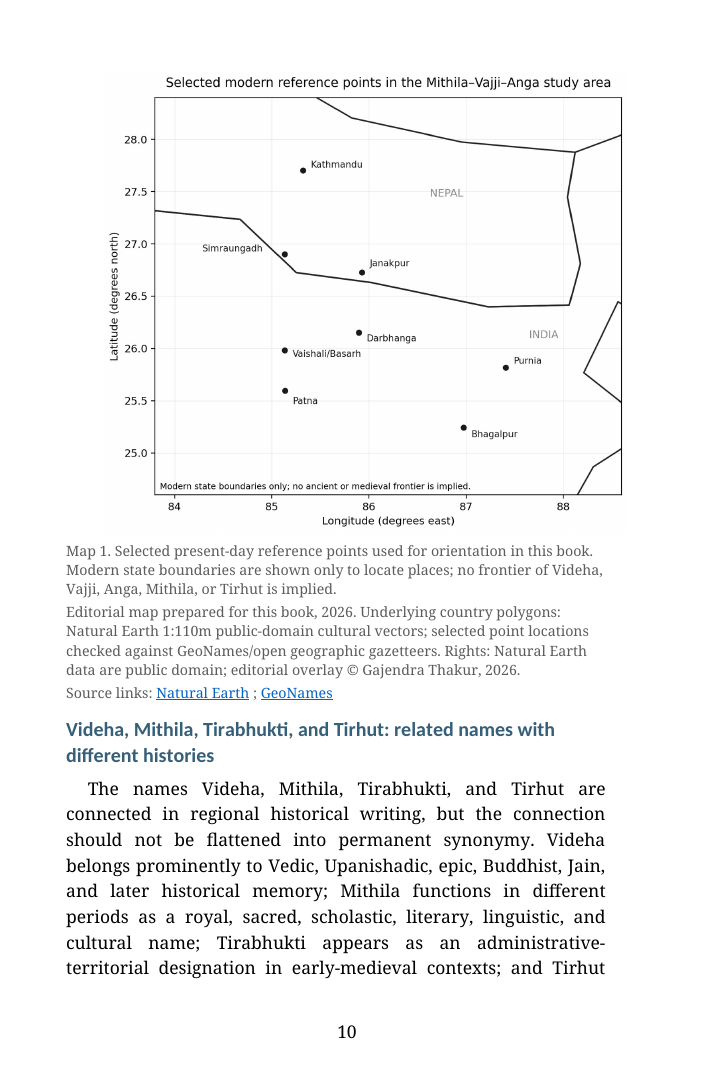
   The Nagram Panji repeatedly reaches beyond the immediate core of
Mithila. Purnea, Champaran, Betia, Uttar Pradesh, Rajasthan,
Jamshedpur, and other wider locations appear in the record. These
references show that Mithila’s genealogical memory travelled with
families, marriages, learning, service, and settlement.
   The wider geography should not be treated as an exception. It is part
of the source’s historical value. The Panji records not only where
families began but how their memory continued across space.

2. Movement without rupture
   Migration in the Panji does not necessarily mean a break from origin.
A family may move, marry, serve, teach, or settle elsewhere while
retaining its original genealogical identity. The Panji therefore preserves
continuity and movement together.
   This is especially visible in entries where a village of origin, a village
of connection, and a modern place-name appear in close sequence. The
record is not confused; it is layered.

3. Regional expansion and social memory
   As the Nagram entries move toward places such as Purnea, Betia,
Rajasthan, and Jamshedpur, the reader sees a widening social world.
Families entered new administrative, educational, professional, and
regional settings, but the Panji kept them tied to lineage and village
memory.
   This makes the Nagram Panji useful not only for family history but
also for the history of mobility in Mithila. It records how memory
remained portable.

4. Reading beyond the map
   A modern map can show where a place lies, but the Panji shows how
that place functions in memory. Some places are ancestral; some are

marital; some are occupational; some are later settlement points. The
historical task is to read the function, not just the location.
Source structure and verification apparatus
Editorial source apparatus. This apparatus is descriptive, not interpretive. It records the source-controlled structure used to verify that this page corresponds to formal Chapter 86 of Decoding the Panji of Mithila — Volume IV. The chapter text above is preserved from PDF pp. 757-758; formal Chapter 86 in the commit-pinned authoritative source. It is not merged with a neighboring chapter, appendix, annexure, or independent front/back-matter unit. The internal headings below come from the repository’s source-heading inventory and are retained as navigational and audit evidence; showing them here does not turn those headings into separate publications or add claims that are absent from the source.
Internal source headings
- 1. The wider geography
- 2. Movement without rupture
- 3. Regional expansion and social memory
- 4. Reading beyond the map
Source-text concordance
Migration · Memory · Beyond · wider · geography · Nagram · repeatedly · reaches · immediate · core · Purnea · Champaran · Betia · Uttar · Pradesh · Rajasthan · Jamshedpur · locations · appear · record · references · show · Mithila’s · genealogical · travelled · families · marriages · learning · service · settlement · treated · exception · part · source’s · historical · value · records · began · continued · across · space · Movement · without · rupture · necessarily · mean · break · origin · family · move · marry · serve · teach · settle · elsewhere · retaining · original · identity · therefore · preserves · continuity · together · especially · visible · entries · village · connection · modern · place-name · close · sequence · confused · layered · Regional · expansion · social · toward · places · reader · sees
Boundary verification. In the formal sequence this chapter follows Volume IV Chapter 85, “Scholars, Priests, Officials, Lawyers, Engineers, Doctors, and Modern Professions” and precedes Volume IV Chapter 87, “Problems of Reading: Scribal Variants, OCR-Like Distortions, and Editorial Decisions”. The chapter extractor begins at the verified formal Chapter 86 marker and stops at the next verified formal chapter marker; for a final chapter it stops before recognized book-level back matter. The concordance above is generated only from distinct terms already present in this chapter’s preserved source text. It is provided for discovery, comparison, and audit, not as an automated judgment about persons, lineages, status, kinship, marriage eligibility, or historical truth.
Illustrated research apparatus
Mithila · Vajji · Anga
Chapter-specific source notes
- Primary chapter witness. Gajendra Thakur, Decoding the Panji of Mithila — Volume IV, formal Chapter 86, PDF pp. 757-758; formal Chapter 86. The HTML transcription is generated from the commit-pinned source PDF and retains the chapter boundary recorded in this edition.
- Internal structure. The repository source-heading inventory records 4 subordinate headings for this chapter: “1. The wider geography”; “2. Movement without rupture”; “3. Regional expansion and social memory”; “4. Reading beyond the map”.
- Digital editorial method. The page keeps the preserved source text distinct from generated navigational, concordance, visual, and provenance apparatus. The synthetic reconstruction is explanatory only and is not evidence for an individual lineage or a determination of social or marital status.