Decoding the Panji of Mithila · Volume IV · Chapter 87
Problems of Reading: Scribal Variants, OCR-Like Distortions, and Editorial Decisions
Chapter 87. Problems of Reading: Scribal
Variants, OCR-Like Distortions, and Editorial
Decisions

1. Why difficulty matters
   The Nagram Panji is difficult because it is a compact record, not
because it is careless. It compresses names, villages, titles, branches, and
cross-references into narrow lines. It also preserves older spellings,
scribal variants, damaged readings, dotted omissions, and occasional
modern transcription distortions.
  The editor’s task is not to make the source look artificially smooth.
The task is to make its difficulty intelligible.

2. Scribal and spelling variants
    A village or personal name may appear in more than one spelling.
Some variation reflects local pronunciation, some reflects scribal habit,
and some may reflect damage or later copying. A variant should not be
silently standardized when the variation may carry evidence.
   In explanatory prose, a readable normalized form may be used, but
the source form remains decisive for genealogical reference.

3. Dots, blanks, and broken readings
   Dotted blanks and incomplete entries are preserved because they
show the condition of the record. They may indicate a missing name, an
unread portion, an omitted father, an incomplete village, or an
intentionally empty slot. The safest editorial rule is to record the gap
and explain its effect.
   Entries marked rikta are especially important. They should not be
deleted. They preserve the numbering and structure of the Panji even
when no genealogy is entered under that heading.

4. Cross-references and numbered records
   B-references and numbered references require caution. They often
point to related records, alternate places, or collateral branches. Where
the linked record is not fully available in the present working source,

the reference should be preserved rather than interpreted beyond
evidence.
  The final principle is transparency. The reader must be able to see
where the source is clear, where the interpretation is strong, and where
uncertainty remains.
Source structure and verification apparatus
Editorial source apparatus. This apparatus is descriptive, not interpretive. It records the source-controlled structure used to verify that this page corresponds to formal Chapter 87 of Decoding the Panji of Mithila — Volume IV. The chapter text above is preserved from PDF pp. 759-760; formal Chapter 87 in the commit-pinned authoritative source. It is not merged with a neighboring chapter, appendix, annexure, or independent front/back-matter unit. The internal headings below come from the repository’s source-heading inventory and are retained as navigational and audit evidence; showing them here does not turn those headings into separate publications or add claims that are absent from the source.
Internal source headings
- 1. Why difficulty matters
- 2. Scribal and spelling variants
- 3. Dots, blanks, and broken readings
- 4. Cross-references and numbered records
Source-text concordance
Problems · Reading · Scribal · Variants · OCR-Like · Distortions · Editorial · Decisions · difficulty · matters · Nagram · difficult · compact · record · careless · compresses · names · villages · titles · branches · cross-references · narrow · lines · preserves · older · spellings · damaged · readings · dotted · omissions · occasional · modern · transcription · editor’s · task · make · look · artificially · smooth · intelligible · spelling · village · personal · name · appear · variation · reflects · local · pronunciation · habit · reflect · damage · later · copying · variant · silently · standardized · carry · evidence · explanatory · prose · readable · normalized · form · used · remains · decisive · genealogical · reference · Dots · blanks · broken · incomplete · entries · preserved · show · condition · indicate · missing · unread
Boundary verification. In the formal sequence this chapter follows Volume IV Chapter 86, “Migration, Memory, and Mithila Beyond Mithila” and precedes the end of this volume’s formal chapter sequence. The chapter extractor begins at the verified formal Chapter 87 marker and stops at the next verified formal chapter marker; for a final chapter it stops before recognized book-level back matter. The concordance above is generated only from distinct terms already present in this chapter’s preserved source text. It is provided for discovery, comparison, and audit, not as an automated judgment about persons, lineages, status, kinship, marriage eligibility, or historical truth.
Illustrated research apparatus
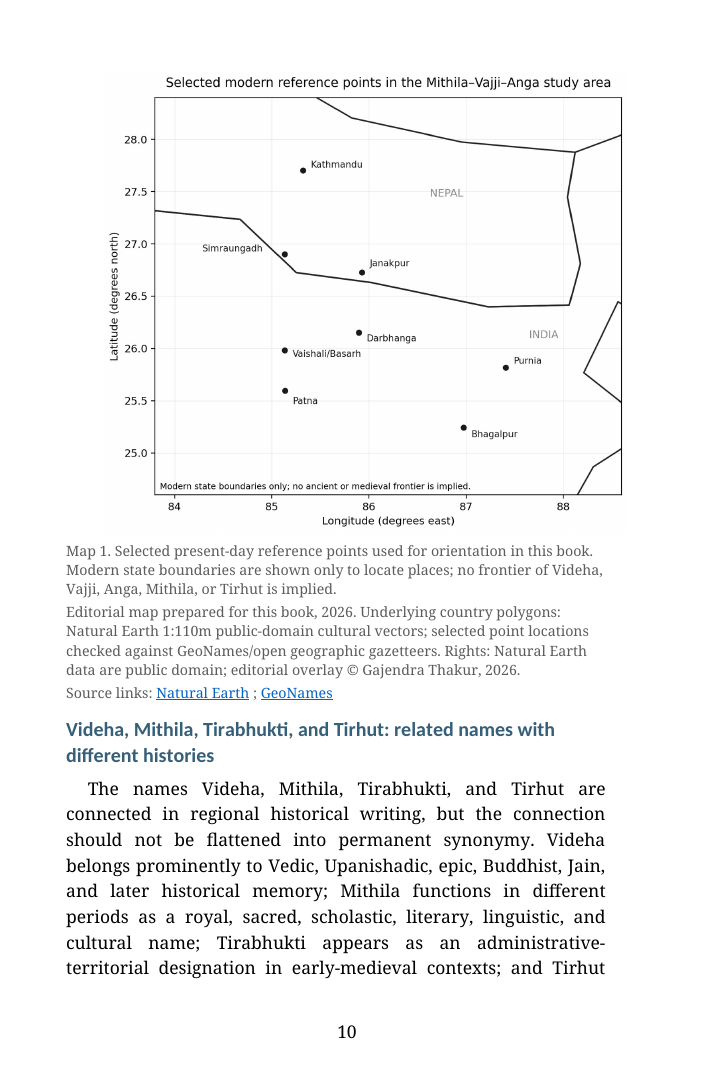
Mithila · Vajji · Anga
Chapter-specific source notes
- Primary chapter witness. Gajendra Thakur, Decoding the Panji of Mithila — Volume IV, formal Chapter 87, PDF pp. 759-760; formal Chapter 87. The HTML transcription is generated from the commit-pinned source PDF and retains the chapter boundary recorded in this edition.
- Internal structure. The repository source-heading inventory records 4 subordinate headings for this chapter: “1. Why difficulty matters”; “2. Scribal and spelling variants”; “3. Dots, blanks, and broken readings”; “4. Cross-references and numbered records”.
- Digital editorial method. The page keeps the preserved source text distinct from generated navigational, concordance, visual, and provenance apparatus. The synthetic reconstruction is explanatory only and is not evidence for an individual lineage or a determination of social or marital status.