Decoding the Panji of Mithila · Volume V · Chapter 16
Badgam Darhiara-Dharmapur Desh Salampur-Salampur-Salempur and Badgam Shalampur: Abhiram, Jay Ram, Raghunath, Santosh, Chandīdatt, Pyarelal, Upendra, Narayandatt, and the Shalampur Register
Chapter 16
Badgam Darhiara-Dharmapur Desh Salampur-Salampur-Salempur and
Badgam Shalampur: Abhiram, Jay Ram, Raghunath, Santosh,
Chandīdatt, Pyarelal, Upendra, Narayandatt, and the Shalampur Register
1. Where Chapter 16 begins
Chapter 16 begins from the heading “ बडगाम दरिहरा-धर्मपुर देशे
सलमपुर-सालमपुर-सलेमपुर.” This is the next formal movement after the
Birwan Batheli learned branch. The heading itself is a compound
location: Badgam Darhiara, Dharmapur Desh, and the Salampur-
Salampur-Salempur naming field are held together in one entry. The
Panji is therefore not giving only a village name. It is placing one branch
inside a mixed territorial memory, where settlement, descent, and
marriage all have to be read together.
The first line begins with Abhiram and gives the next descent through
Bhel and Bhagman. From Bhagman the line moves to Jay Ram and Shri
Ram. Jay Ram produces Basudev and Shiv, and then Raghunath becomes
the central carrier of the branch. The opening is compressed, but it gives
a full genealogical logic: Abhiram is the ancestral point, Bhagman is the
next organising father, Jay Ram and Shri Ram divide the immediate
descent, and Raghunath opens the main line into its later sons.
The method remains the same as in the earlier chapters. Every name is
read in relation to four markers: descent, place, marriage, and continuity.
Thus Jay Ram is not merely named as a son; he becomes important
because Basudev, Shiv, Raghunath, and later Santosh, Motiram, and
Anupram carry the branch outward into marriage fields such as
Panichobh, Tarauni Karmah, Mahishi Budhwal, Guldi Khandwala,
Kujouli, Hati Sodarpur, Parakhand Baheradhi, and other recurring
houses.
2. Abhiram, Bhel, Bhagman, Jay Ram, Shri Ram, and
Raghunath
The first descent unit can be read as Abhiram -> Bhel and Bhagman ->
Jay Ram and Shri Ram. The source immediately marks Bhagman
through Jay Ram and Shri Ram, then gives Jay Ram’s sons Basudev and
Shiv. Basudev’s continuation produces Raghunath through the Gadha-
Belauch link with Chitrasen. This movement is important because it ties
Decoding the Panji of Mithila - Volume V | 161
the Salampur branch back into the Belauch field already seen in earlier
chapters.
Raghunath is then named with his sons Santosh, Motiram, and
Anupram. The entry does not treat them as isolated sons. They are given
through the Panichobh connection of the Rajhans-Kushal-Girishwar line.
This makes Raghunath a point where the Abhiram-Bhagman descent
becomes a wider social network. The sons of Raghunath are placed
inside a known marriage geography, and the branch becomes visible
through the alliances attached to them.
This opening also shows the continuity of place names across chapters.
Didhoy, Jalay, Gadha-Belauch, Panichobh, and Tarauni Karmah all
reappear as active places. The same settlements that were earlier
encountered as marriage houses or descent fields now serve as
connectors for the Salampur line.
3. Santosh and the five sons: Bhairav, Bechu, Bandhu,
Chandīdatt, and Narayandatt
Santosh becomes the first major expansion point. His sons are listed as
Bhairav, Bechu, Bandhu, Chandīdatt, and Narayandatt. The names are
attached to Tarauni Karmah through Dhanjit. This is a dense marker: it
gives descent from Santosh, identifies the five sons as branch-carriers,
and places them in a Tarauni-Karmah connection that has appeared
repeatedly in the Panji record.
Bhairavdatt opens the first sub-branch. His sons are Kaushkidatt,
Chilkaram, Balakram, Batesh, and Lala. They are linked to Ojhōli-Narun
and to Darhiara through marriage and place references. Kaushkidatt leads
to Pushpanath, and Pushpanath becomes one of the strongest carriers of
this chapter’s line.
The naming pattern is significant. The Panji gives Santosh as a descent
point, but it immediately multiplies the branch through five sons. Each
son is then connected to a different social movement. Bhairavdatt leads
to Kaushkidatt and Pushpanath; Bechu leads to Hadi, Ganeshdatt, and
Nand Kumar; Bandhu leads to Shyamlal, Mohar, and Jhumaklal;
Chandīdatt leads to Poshan, Parshamani, Jagmohan, and Harimohan;
Narayandatt later reappears in the separate Badgam Shalampur register.
Thus Santosh’s line is not one line but a five-branch field.
Decoding the Panji of Mithila - Volume V | 162
4. Kaushkidatt, Pushpanath, Matuknath, Govindlal, and
Sumitlal
From Bhairavdatt, Kaushkidatt is followed by Pushpanath. Pushpanath
is linked with Mahrail-Pawli through Ganapati and with Dih Darhiara
through Manorath. This makes Pushpanath a branch of both descent and
place-bridging. His children and continuations show how the line moves
through several matrimonial houses rather than staying in one village.
Pushpanath’s sons include Matuknath, Govindlal, and Sumitlal.
Matuknath is tied to Mahishi Budhwal through Shankardatt. Govindlal
and Sumitlal connect to Tarauni Karmah through Amritnath. These are
not casual place references; they show the branch moving from Salampur
into Budhwal and Karmah networks.
The later continuation of Pushpanath is also repeated: Pushpanath’s
son Govindlal gives Devkrishna, Jaydev, Kakil, Jagdish, and Anuplal,
linked with Guldi Khandwala and the Mauwa-vasi Bahadur Thakur line.
This is an important second wave of expansion. It shows that the
Pushpanath branch first moved through Matuknath and Govindlal, then
later re-entered Khandwala networks through the Govindlal sons.
5. Balakram, Kalikadatt, Sheetladatt, and the Batesh-
Lalit-Tilak branch
Bhairavdatt’s son Balakram produces Kalikadatt and Sheetladatt.
Kalikadatt is connected with Khandwala through Khagapati and later
with Gail-Karmah through Bhikshu. This places the branch inside a
Khandwala-to-Karmah axis. Sheetladatt is named as a companion line,
showing the parallel continuation within Balakram’s house.
Batesh gives another important sub-branch. His sons are Lalit, Tilak,
and Nilambar, with the Sudeb-Belauch connection through Mushay. Lalit
produces Genalal; Genalal then produces Ratinath and Brajlal. This
branch continues through Lagaya, Chudamani, Khushbu, Khushru,
Gajanand, and Bhagirath.
Tilak is linked with Badrinath, Chhatrinath, Bolan, and Khelna
through Gadal-Karmah and Bokan. The Batesh line therefore has two
kinds of memory: a male descent through Lalit and Genalal, and a
parallel extension through Tilak and his named sons. Together they make
Batesh one of the stronger secondary fathers within the chapter.
Decoding the Panji of Mithila - Volume V | 163
6. Bechu, Hadi, Ganeshdatt, Nand Kumar, and the
administrative continuation
Bechu’s sons are Hadi, Ganeshdatt, and Nand Kumar. They are
connected with Punachh-Baheradhi through Mishra Mansukh and with
Mandar through Tengi. Ganeshdatt, also marked through the Doman
name, leads to Adhiklal. Adhiklal is linked to Pariamb Budhwal through
Bhola and to Patauna Khaual through Dulal.
Adhiklal produces Tirthamani, and the line also gives Nand Kumar
and Theghu with Dwarikanath and Bodhna. These names show the
Bechu branch expanding into a practical local network. Pariamb
Budhwal, Jalay, and related place names mark the branch’s marital and
settlement movement.
The Bechu section is smaller than the Bhairavdatt-Pushpanath section,
but it is important because it preserves another branch of Santosh’s five-
son line. Without it, the Salampur genealogy would appear too linear.
With it, the Panji shows that Santosh’s descendants were simultaneously
distributed through Bhairavdatt, Bechu, Bandhu, Chandīdatt, and
Narayandatt.
7. Bandhu, Shyamlal, Mohar, Jhumaklal, Kanaklal, and
Rashiklal
Bandhu’s sons are Shyamlal, Mohar, and Jhumaklal. They are linked
with Belsam Budhwal through Madhusudan, with Gaur Sodarpur
through Ved, and with later Khandwala and Belauch references.
Jhumaklal is the most developed continuation in this cluster.
Jhumaklal produces Kanaklal and Rashiklal. Kanaklal and Rashiklal
are connected with Harshauli Sodarpur through Taradatt. A related Eklal
line gives Giranand, linked with Ujholi-Belauch through Vishnudatt.
This set of names keeps the Bandhu branch visible as a middle branch
between Bechu and Chandīdatt.
Chandīdatt also links back to this part of the register through Poshan
and Parshamani. The Panji’s placement of these names suggests an
interwoven branch rather than isolated lists. Bandhu gives one chain of
sons; Chandīdatt gives another; both operate within Budhwal, Sodarpur,
Khandwala, and Belauch connection-zones.
Decoding the Panji of Mithila - Volume V | 164
8. Chandīdatt, Poshan, Parshamani, Jagmohan,
Harimohan, and Mukund’s sons
Chandīdatt produces Poshan and Parshamani, and then Jagmohan and
Harimohan. The source connects Poshan and Parshamani with Gaur
Sodarpur through Krishna, and also names Bhola and Pratihast Bhola in
the Nahaś-Khaual field. This gives the Chandīdatt branch a strong
Sodarpur-Khaual presence.
Jagmohan and Harimohan continue the same line, and Mukund’s sons
are given as Aniruddh, Abhimanyu, and Suryakant. These names are
linked with Kauta-Kosh-vasi Ekma Khandwala through Brajlal and with
Sakama through Kushumlal and Singheswar. The line therefore carries
the Salampur branch into Ekma Khandwala and Sakama.
This section is one of the clearest examples of branch-continuity in the
chapter. Chandīdatt is not just a son of Santosh. Through Poshan,
Parshamani, Jagmohan, Harimohan, Mukund, Aniruddh, Abhimanyu,
and Suryakant, he becomes a separate working branch with its own
Khandwala and Sakama alliances.
9. Khushru, Gajanand, Bhagirath, Mahesh Mohan,
Pranmohan, and Govindlal’s sons
The source then returns to the Khushru branch. Khushru’s sons are
Gajanand and Bhagirath. Gajanand’s sons include Balbhadra, Ramesh,
and Shaligram, linked with Hati Sodarpur through the Mangani-
Chandidatt-Thithar line. This records both descent and marital placement
in one compressed unit.
Bhagirath produces Mahesh Mohan, Pranmohan, Shighranand, and
Radhamohan, with an Ahila-Sodarpur connection through Thathi-vasi
Kailan and Harshanath. The branch also records female-line
continuations through Chandrama and Chinta. These daughters are not
marginal notes; they show how the Bhagirath branch joined other houses
through marriage.
Govindlal’s branch then gives Devkrishna, Jaydev, Kakil, Jagdish, and
Anuplal, tied to Guldi Khandwala through Bahadur Thakur. The entry
records Yashoda through Nagwad Ghosot and later names Shyam Sundar
and Upendra. This set of names carries the branch forward into another
generation and keeps the Salampur house active in Khandwala and
Ghosot relations.
Decoding the Panji of Mithila - Volume V | 165
10. Matuknath, Vidyanath, Brajnath, and the Samouli
Pali continuation
Matuknath’s line reappears with Badgam-vasi, Mazhaura-Karmah,
Gaual-Karmah, and Amaravati-Darhiara connections. His descendants
include Vidyanath and Brajnath. The entry also names Shrikant and
gives Vidyanath’s sons Paramanand, Sadanand, and Banmali, linked
with Shaktinathpur-Narun and Morsanda.
The chapter then records a Samouli-Pali continuation through
Hanuman Datt and Premlal. Premlal’s sons are Yadunandan and
Dhruvnandan, connected with Badgam Darhiara through Bechu.
Dhruvnandan leads to Chakradhar and Ramchandra, with Vasanpur-vasi
and Pakhaliya links. Ramchandra gives Chiranjeev with Tetari-vasi
Kataya-Mandar and the Shambhu-Gamail connection.
This part of the chapter is important because it gathers several smaller
continuations into the Salampur field. The Panji does not abandon a
branch once it shifts place. It records the movement from Matuknath to
Vidyanath and Brajnath, then from Hanuman Datt and Premlal to
Yadunandan, Dhruvnandan, Chakradhar, Ramchandra, and Chiranjeev.
11. The first Badgam Shalampur heading: Motiram’s
brother-line
After the long Salampur - Salempur register , the source gives the
heading “बडगाम शालमपुर.” This first Badgam Shalampur block begins
with Santosh’s brother Motiram. Motiram’s sons are Dharmeshwar , also
called Tufani , and Visuni. Dharmeshwar / Tufani produces Sahib and
Shankar through the Panichobh - Mangu connection.
Sahib produces Babu Lal, linked with Belsam Budhwal through
Bhairavdatt. Visuni gives Hemkar, Shrinath, and Bhangi, linked with
Dhaoul Sodarpur through Abhiram. Bhangi produces Nokhelal, and
Nokhelal gives Mayanath and Ramanand. Babu Lal’s sons are Shrilal,
Panchlal, and Jagyalal, connected with Visfi through Thakur Jaglal.
This block is a compact brother-line. It takes the earlier Raghunath
sons, especially Santosh and Motiram, and shows that Motiram’s
descendants also formed a separate Shalampur register. The line is
smaller, but it preserves an essential collateral branch.
Decoding the Panji of Mithila - Volume V | 166
12. Parshamani’s branch: Mohanlal, Pyarelal, Babuji, and
Mahant
The next major cluster begins with Chandīdatt’s son Parshamani.
Parshamani’s sons are Mohanlal, Pyarelal, Babuji, and Mahant. They are
linked with Kujouli through Mathuranath and with Hati Sodarpur
through Kalar. This gives the Parshamani branch two clear marital fields
from the start.
Mohanlal produces Dukhharan. Dukhharan, also called Dukhiya, gives
Surendra, Gangadhar, Yamunadhar, Shridhar, and the Chanpur-vasi
Parhat-Baheradhi connection through Thithar. This is a strong male
descent chain and also a place chain, because Guldi Khandwala,
Chanpur, Parhat, Baheradhi, and Purvasi links are all recorded together.
Pyarelal produces Jhapatalal, linked with Hardi Khandwala through
Thakur Kirti. Jhapatalal then becomes the next major father, especially
through Upendra. The branch also records Dayji and Shatamukhi, and
through Sulhani-Narun and Mangalvani it brings the Mahamahopadhyay
Wana-Sadde-Sadanand-Umesh line into the family’s marriage network.
13. Jhapatalal, Upendra, Khadanand, Mahant, and the
modern descent
Jhapatalal’s son Upendra is linked with Mahishi-Pali through Thadhi-
vasi Gumani and Haldhar. Upendra’s sons are Nand Kishor,
Raghuvansh, Harivansh, Suvansh, and Shrivansh, with the Mangrauni-
vasi Chandranath connection. This is the main modern continuation of
the Pyarelal-Jhapatalal branch.
The branch also records the daughters Subhadra, Madhavi, Premshila,
Dharmashila, and Aruna. Their inclusion is important. The Panji does not
treat daughters as ornamental. They carry marriage authority. Through
them the branch enters other houses while still preserving its own
descent memory.
Nand Kishor produces Ajit Babu, linked with Babhani-vasi Dayanand,
and the Uma line gives Ranjan and Poonam. Raghuvansh produces Rajiv
and Manoj, connected with Goshain village and Buddhinath. Harivansh
gives Mukesh; Suvansh gives Lal Babu and Ram Babu; Shrivansh gives
Shyam and Chhotu. Thus the Jhapatalal-Upendra branch moves from
older Panji descent into a recognisably modern family register.
Mahant’s line is also strong. Mahant’s sons are Vishwanath,
Kashinath, Vaidyanath, and Jagannath, linked with Hasauli Sodarpur
through Faturi. Mahant also produces Singheswar, connected with
Decoding the Panji of Mithila - Volume V | 167
Jagatpur-vasi Mahishi Budhwal through Bugal. The female lines
Anuradha, Kaushilya, Sushila, and Sumitra join Mahishi Budhwal,
Mangrauni Pali, and Pada-vasi Behat Khandwala houses. This preserves
Mahant’s branch through both sons and daughters.
14. The second Badgam Shalampur register: Narayandatt
to Tulakant and the Acharya line
The source then gives another “बडगाम शालमपुर” entry. This register
begins with Narayandatt and moves through Brahmadatt, Nenadatt,
Shivanand, Vedanand, and Tulakant. From Tulakant the line gives
Tarakant, Acharya Umakant, Acharya Kavyakant, and Acharya
Vijaykant.
This is a very important closing block because it returns the chapter to
titled learning. Earlier chapters repeatedly showed how scholarly
honorifics became branch memory. Here, the Acharya names mark a
learned-modern continuation within the Badgam Shalampur field. The
line is not only genealogical; it also preserves intellectual identity.
Tarakant’s sons are Sudhanshu, Himanshu, and Prabhanshu, marked
with modern education labels such as B.Sc. and B.A. The Sirniya-vasi
Jhaua-Alay-Valmiki connection shows that the line continued to move
through place and marriage even in modern form. This is a fitting end to
the chapter: it begins with Abhiram and Bhagman, passes through the
many sons of Santosh and the brother-line of Motiram, and ends with
Acharya and degree-bearing names.
15. What Chapter 16 adds
Chapter 16 adds three important things to the Volume V reading. First,
it shows how a compound heading can hold multiple place identities
together. “बडगाम दरिहरा-धर्मपुर देशे सलमपुर-सालमपुर-सलेमपुर” is not a
simple location label. It is a territorial cluster in which Badgam Darhiara,
Dharmapur Desh, Salampur, Salampur, and Salempur preserve
overlapping memories.
Second, it expands the Santosh line into five branches: Bhairavdatt,
Bechu, Bandhu, Chandīdatt, and Narayandatt. These five branches
produce the main body of the chapter. Through them the record reaches
Pushpanath, Matuknath, Govindlal, Balakram, Batesh, Bechu’s Hadi-
Ganeshdatt-Nand Kumar line, Bandhu’s Shyamlal-Mohar-Jhumaklal
line, Chandīdatt’s Poshan-Parshamani-Jagmohan-Harimohan line, and
Narayandatt’s later Shalampur register.
Decoding the Panji of Mithila - Volume V | 168
Third, the chapter shows how modernity enters the Panji without
breaking the old method. B.Com., B.Sc., B.A., M.A., B.Ed., M.Sc.,
Acharya titles, and named professions appear beside older markers such
as Khandwala, Budhwal, Sodarpur, Pali, Karmah, Alay, and Darhiara.
The result is a continuous genealogy, not a modern appendix.
16. Branch summary
Abhiram-Bhagman line: Abhiram, Bhel, Bhagman, Jay Ram, Shri
Ram, Basudev, Shiv, Raghunath.
Raghunath branch: Santosh, Motiram, Anupram; Santosh’s sons
Bhairav, Bechu, Bandhu, Chandīdatt, Narayandatt.
Bhairavdatt branch: Kaushkidatt, Chilkaram, Balakram, Batesh,
Lala; Kaushkidatt to Pushpanath; Pushpanath to Matuknath,
Govindlal, Sumitlal.
Balakram-Batesh branch: Kalikadatt, Sheetladatt; Batesh to Lalit,
Tilak, Nilambar; Lalit to Genalal; Genalal to Ratinath and Brajlal;
Khushru to Gajanand and Bhagirath.
Bechu branch : Hadi , Ganeshdatt , Nand Kumar ; Ganeshdatt /
Doman to Adhiklal ; Adhiklal to Tirthamani ; Nand Kumar and
Theghu to Dwarikanath and Bodhna.
Bandhu branch: Shyamlal, Mohar, Jhumaklal; Jhumaklal to Kanaklal
and Rashiklal; Eklal to Giranand.
Chandīdatt-Parshamani branch: Poshan, Parshamani, Jagmohan,
Harimohan; Mukund to Aniruddh, Abhimanyu, Suryakant;
Parshamani to Mohanlal, Pyarelal, Babuji, Mahant.
Pyarelal-Jhapatalal-Upendra branch: Jhapatalal, Upendra, Nand
Kishor, Raghuvansh, Harivansh, Suvansh, Shrivansh, Rajiv, Manoj,
Mukesh, Lal Babu, Ram Babu, Shyam, Chhotu.
Mahant branch: Vishwanath, Kashinath, Vaidyanath, Jagannath,
Singheswar; daughter-lines Anuradha, Kaushilya, Sushila, Sumitra.
Badgam Shalampur closing register: Narayandatt, Brahmadatt,
Nenadatt, Shivanand, Vedanand, Tulakant, Tarakant, Acharya
Umakant, Acharya Kavyakant, Acharya Vijaykant, Sudhanshu,
Himanshu, Prabhanshu.
17. Conclusion: from Salampur to Khaual Simbarwad
Chapter 16 shows Badgam Darhiara-Dharmapur Desh Salampur-
Salempur as a dense branch-field. It begins in the old Abhiram-Bhagman
descent, expands through Santosh’s five sons, develops through
Pushpanath, Chandīdatt, Parshamani, Pyarelal, and Jhapatalal, and ends
Decoding the Panji of Mithila - Volume V | 169
with a Badgam Shalampur register in which Acharya titles and modern
education labels preserve learned continuity.
The next chapter should begin from the following heading, “अथ
खौआल सिम्बरवाड ग्रामाराम्भः,” with the connected place-field of
Jahanpur, Jamua, Baradbata, Chikni, Rahua, and Balua. That chapter will
move into the Khaual-Simbarwad opening and read Mahamahopadhyay
Prajapati, Vachaspati, Umapati, Ganapati, and the new settlement
network through the same method: descent, place, marriage, title, and
branch-continuity.
Decoding the Panji of Mithila - Volume V | 170Source structure and verification apparatus
Editorial source apparatus. This apparatus is descriptive, not interpretive. It records the source-controlled structure used to verify that this page corresponds to formal Chapter 16 of Decoding the Panji of Mithila — Volume V. The chapter text above is preserved from PDF pp. 162-171; formal Chapter 16 in the commit-pinned authoritative source. It is not merged with a neighboring chapter, appendix, annexure, or independent front/back-matter unit. The internal headings below come from the repository’s source-heading inventory and are retained as navigational and audit evidence; showing them here does not turn those headings into separate publications or add claims that are absent from the source.
Internal source headings
- 2. Abhiram, Bhel, Bhagman, Jay Ram, Shri Ram, and Raghunath
- 3. Santosh and the five sons: Bhairav, Bechu, Bandhu, Chandīdatt, and Narayandatt
- 4. Kaushkidatt, Pushpanath, Matuknath, Govindlal, and Sumitlal
- 5. Balakram, Kalikadatt, Sheetladatt, and the Batesh-Lalit-Tilak branch
- 6. Bechu, Hadi, Ganeshdatt, Nand Kumar, and the administrative continuation
- 7. Bandhu, Shyamlal, Mohar, Jhumaklal, Kanaklal, and Rashiklal
- 8. Chandīdatt, Poshan, Parshamani, Jagmohan, Harimohan, and Mukund’s sons
- 9. Khushru, Gajanand, Bhagirath, Mahesh Mohan, Pranmohan, and Govindlal’s sons
- 10. Matuknath, Vidyanath, Brajnath, and the Samouli Pali continuation
- 11. The first Badgam Shalampur heading: Motiram’s brother-line
- 12. Parshamani’s branch: Mohanlal, Pyarelal, Babuji, and Mahant
- 13. Jhapatalal, Upendra, Khadanand, Mahant, and the modern descent
- 14. The second Badgam Shalampur register: Narayandatt to Tulakant and the Acharya line
- 15. What Chapter 16 adds
- 16. Branch summary
- 17. Conclusion: from Salampur to Khaual Simbarwad
Source-text concordance
Badgam · Darhiara-Dharmapur · Desh · Salampur-Salampur-Salempur · Shalampur · Abhiram · Raghunath · Santosh · Chandīdatt · Pyarelal · Upendra · Narayandatt · Register · begins · heading · सलमप · र-सल · next · formal · movement · Birwan · Batheli · learned · branch · compound · location · Darhiara · Dharmapur · Salampur · Salampur-Salempur · naming · field · held · together · entry · therefore · giving · village · name · placing · inside · mixed · territorial · memory · settlement · descent · marriage · read · first · line · gives · Bhel · Bhagman · moves · Shri · produces · Basudev · Shiv · becomes · central · carrier · opening · compressed · full · genealogical · logic · ancestral · point · organising · father · divide · immediate · opens · main · later · sons · method · remains · earlier · chapters
Boundary verification. In the formal sequence this chapter follows Volume V Chapter 15, “Birwan Batheli: Mahamahopadhyay Batesh, Pashupati, Raghupati,” and precedes Volume V Chapter 17, “Khaual Simbarwad Gramaramabh: Jahanpur, Jamua-Baradbata, Chikni,”. The chapter extractor begins at the verified formal Chapter 16 marker and stops at the next verified formal chapter marker; for a final chapter it stops before recognized book-level back matter. The concordance above is generated only from distinct terms already present in this chapter’s preserved source text. It is provided for discovery, comparison, and audit, not as an automated judgment about persons, lineages, status, kinship, marriage eligibility, or historical truth.
Illustrated research apparatus
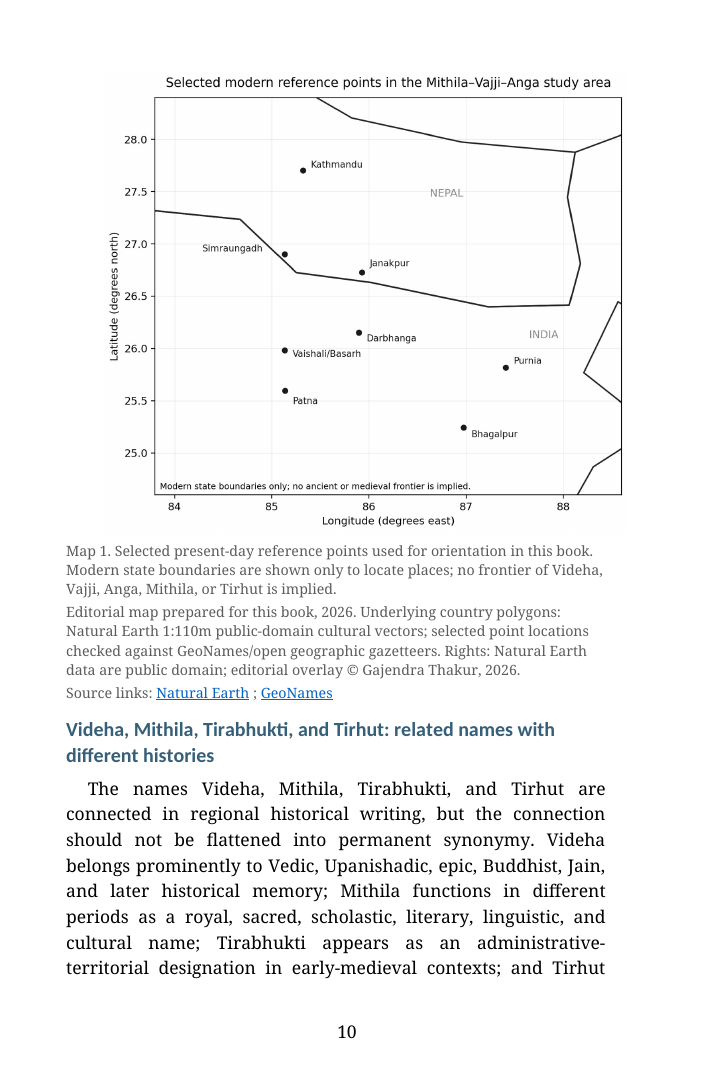
Mithila · Vajji · Anga
Chapter-specific source notes
- Primary chapter witness. Gajendra Thakur, Decoding the Panji of Mithila — Volume V, formal Chapter 16, PDF pp. 162-171; formal Chapter 16. The HTML transcription is generated from the commit-pinned source PDF and retains the chapter boundary recorded in this edition.
- Internal structure. The repository source-heading inventory records 16 subordinate headings for this chapter: “2. Abhiram, Bhel, Bhagman, Jay Ram, Shri Ram, and Raghunath”; “3. Santosh and the five sons: Bhairav, Bechu, Bandhu, Chandīdatt, and Narayandatt”; “4. Kaushkidatt, Pushpanath, Matuknath, Govindlal, and Sumitlal”; “5. Balakram, Kalikadatt, Sheetladatt, and the Batesh-Lalit-Tilak branch”; “6. Bechu, Hadi, Ganeshdatt, Nand Kumar, and the administrative continuation”; “7. Bandhu, Shyamlal, Mohar, Jhumaklal, Kanaklal, and Rashiklal”; “8. Chandīdatt, Poshan, Parshamani, Jagmohan, Harimohan, and Mukund’s sons”; “9. Khushru, Gajanand, Bhagirath, Mahesh Mohan, Pranmohan, and Govindlal’s sons”; ….
- Digital editorial method. The page keeps the preserved source text distinct from generated navigational, concordance, visual, and provenance apparatus. The synthetic reconstruction is explanatory only and is not evidence for an individual lineage or a determination of social or marital status.