Decoding the Panji of Mithila · Volume V · Chapter 15
Birwan Batheli: Mahamahopadhyay Batesh, Pashupati, Raghupati,
Chapter 15
Birwan Batheli: Mahamahopadhyay Batesh, Pashupati, Raghupati,
Ratipati, Haladhar, Lakshminath, Rameshwar, Shulpani, and the
Modern Continuation
1. The Birwan Batheli heading
Chapter 15 begins from the next formal heading, “बीरवन बठै ली.” In the
sequence of Volume II, this heading comes after the Asura-Suptani and
Singholi-Mandar-Danti materials. The movement is not merely
geographical. It is a return to a strongly learned branch, because the first
names under the heading carry the honorific “म0म0,” the compressed Panji
form for Mahamahopadhyay. The heading therefore opens a scholarly field
in which descent, place, title, and marriage all have to be read together.
The source begins with “म0म0 बटे श” and gives his descendants as
“म0म0 पशुपति,” “म0म0 रघु पति,” “म0म0 आदानि,” and “म0म0 भरतपति,”
with a Panichobh link through Jiveshwar. This is a marked learned cluster.
The Panji is telling us that Birwan Batheli is not a casual settlement marker;
it is an authority-bearing branch in which learning itself became part of
family memory.
Because several names in the opening are preceded by the same learned
title, the section has to be read as a scholarly house rather than as a simple
list of sons. Batesh stands at the head of a learned node, and the later names
preserve the continuation of that node through both male descent and
alliance with other recognised houses.
2. Batesh, Pashupati, Raghupati, Adani, Bharatpati, and the
Panichobh link
The first descent cluster is compact: Batesh is followed by Pashupati,
Raghupati, Adani, and Bharatpati. Their connection with Panichobh through
Jiveshwar places the learned branch within a larger inter-village network.
Panichobh has already appeared in earlier chapters as a recurring place of
marriage and descent. Here it functions as a scholarly connector as well.
The repetition of “म0म0” before several names matters. The Panji often
uses titles sparingly, so when a title is repeated in a cluster it signals that
learning was not attached to one individual only. It became a branch-
identity. Pashupati and Raghupati therefore continue the prestige of Batesh,
while Adani and Bharatpati expand the same learned house across the
record.
Decoding the Panji of Mithila - Volume V | 154
The chapter must also notice that the source does not isolate learning from
marriage. The Panichobh connection is recorded immediately. The
implication is that intellectual prestige and marriage authority moved
together: a branch known for learning was simultaneously positioned
through recognised social alliances.
3. Ratipati, Chand, Duve, Kushe, and the Narun connection
After the Batesh cluster, the source turns to “म0म0 रतिपति.” Ratipati’s
descendants include Chand, Duve, and Kushe, with a Narun link through
Madhukar. This is the second learned movement inside the heading. It shows
that the Birwan Batheli block is not a single straight line. It is a branching
learned field in which one sub-branch leads to Narun through Madhukar.
Kushe becomes important because his sons Haladhar and Jagu carry the
line forward. Haladhar is connected with Ujan Budhwal through Deve. The
Budhwal connection is significant because Budhwal families recur across
the earlier chapters as reliable alliance-houses. The source therefore places
the Birwan Batheli learned branch in a broader matrimonial map rather than
leaving it as a self-contained scholarly line.
The names Chand, Duve, and Kushe show the Panji method clearly. A
few words compress ancestry, place, and social linkage. Ratipati gives
learned authority; Narun and Madhukar give place and alliance; Kushe gives
the next generational passage; Haladhar and Jagu open the line into its fuller
descendants.
4. Haladhar and his descendants: Narhari, Shrihari, Kanh,
Vishnu, Madhav, and Pitambar
Haladhar’s descendants are named as Narhari, Shrihari, Kanh, Vishnu,
Madhav, and Pitambar. They are linked with Panichobh through Khantu.
This establishes another strong place-bridge. Panichobh appears again, now
not only as an earlier connection of the Batesh cluster but as a repeated
social field for Haladhar’s descendants.
Narhari’s sons are Ramnath, Lakshminath, Harinath, and Bhavnath,
linked with Hariam through Jor. The entry moves from Haladhar’s six-name
cluster to Narhari’s four-name cluster, thereby giving two layers of descent:
first the sons of Haladhar, then the sons of Narhari. At the same time,
Hariam becomes the place-link through which this sub-branch enters a wider
network.
Lakshminath is especially important because the next sentences follow his
sons Parashuram and Achyut. Lakshminath therefore serves as a pivot: he
receives the Narhari-Hariyam line and sends it forward into the Parashuram-
Decoding the Panji of Mithila - Volume V | 155
Achyut continuation. This is the exact kind of branch-continuity that
Volume V must preserve.
5. Lakshminath, Parashuram, Achyut, Abhiram, Jivai, and
Jagdish
Lakshminath’s sons Parashuram and Achyut are connected with Sarisav
through Kashi. Another Lakshminath-linked line names Abhiram, connected
with Kamarha through Haridev. These entries show that one father’s branch
may be divided through different alliance fields. Sarisav and Kamarha are
not incidental; they tell us where the line entered other houses.
Parashuram’s sons are Jivai and Jagdish. They are linked with Hariam
through Shikhe and with Khandwala through Mahamahopadhyay Mahesh.
This is a very important passage because it re-introduces learned authority
through Mahesh while also linking the family to two recurring fields:
Hariam and Khandwala. The branch is thus both learned and widely allied.
The source further records a female bridge through Lakhima, with the
Sodarpur connection to Mahamahopadhyay Ramdatt. Such a sentence is
easily missed, but it is crucial. Lakhima is not a side note; she is a bridge by
which the Birwan Batheli line touches Sodarpur and another learned house.
The method must therefore treat daughter-lines as active genealogical
connectors.
6. Jagdish, Rameshwar, Vireshwar, Vishweshwar, and the
Shulpani-Chakrapani branch
Jagdish’s sons are named as Rameshwar, Vireshwar, and Vishweshwar,
linked with Budhwal. Among them, Rameshwar becomes the main
continuation because his sons Shulpani and Chakrapani are named next,
connected with Karmah through Raghuram. The movement is clear:
Parashuram gives Jivai and Jagdish; Jagdish gives Rameshwar, Vireshwar,
and Vishweshwar; Rameshwar gives Shulpani and Chakrapani.
Shulpani’s son is Kaushkidatt. Another Rameshwar line names Bechu and
Jiv, connected with Karmah through Tulakrishna’s son Devkrishna. The
source also names Judaon, linked with Sakuri through Lal. These short
phrases create multiple sub-branches under the broad Rameshwar field. Each
branch must be kept separate: Shulpani-Kaushkidatt, Bechu-Jiv, and Judaon.
Judaon’s descendants include Lal, Keshav, and Jayanand, with
Khandwala through Thakur Bhaiyaram. Another Judaon branch gives Andu,
connected with Mandarisam through Ganapati’s son Mahi, and also with
Sukhsenā and Nahas Khaual through Balakrishna. The result is a dense
Rameshwar-derived network in which Budhwal, Karmah, Sakuri,
Khandwala, Mandarisam, Sukhsenā, and Khaual all appear.
Decoding the Panji of Mithila - Volume V | 156
7. Andu and the wide son-cluster: Jagatanand, Hridaynath,
Shyamnath, Babunath, Premnath, Rajnath
The Andu branch is one of the wider clusters in this chapter. His sons are
named as Jagatanand, Hridaynath, Shyamnath, Babunath, Premnath, and
Rajnath. They are linked with Hati Sodarpur through Dharmadatt’s son
Goked and with Samauli Pali through Mishra Horil. This cluster shows a
strong outward marriage spread.
The source also names daughters or female-linked descendants: Hemvati,
Chandravati, and Rudravati. These names must be retained because they
show how the Birwan Batheli branch entered other houses. In Panji logic, a
daughter’s marriage is not outside the genealogy. It is the mechanism
through which prestige, ritual standing, and memory moved between
villages.
The Andu cluster also clarifies the structure of the whole heading. Birwan
Batheli begins with learned titles, but it does not remain only a learned
register. It becomes a practical marriage map. The sons branch outward, and
the daughters bind the branch into other recognised families.
8. Shulpani’s Nanu line, Balakrishna, Brajlal, Rangalal, and
the Mula bridge
The source then returns to Shulpani through Nanu. Nanu is connected
with Tirhut through Mahipati and with Pandua through Ghanshyam. Nanu’s
sons are Ramkrishna, Balakrishna, and Abhaykrishna, linked with Pali
through Hariballabh. Here the line moves from the Shulpani branch into
another triad of sons, again anchored by place.
Balakrishna’s sons are Harshdatt, Brajlal, and Rangalal, connected with
Gaur Sodarpur through Garib’s son Mansaram and with Budhwal through
Madhurapati. This passage places the Balakrishna branch in two alliance
systems: Gaur Sodarpur and Budhwal. The source also gives a female bridge
through Mulavati, who connects Mahishi Budhwal with Shankardatt and
produces Babujan.
Another Mulavati-linked passage connects with Shiva Hariam through
Mishra Sua and gives the sons Dwarikanath and Govind Mahkara. This is a
good example of how the Panji preserves complex continuity. Balakrishna’s
branch is not just his sons. It includes female-linked houses, which then
create further male continuations.
Decoding the Panji of Mithila - Volume V | 157
9. Teknath, Kashinath, Shashinath, Kedarnath, Triloknath,
and Devanath
The source then gives another Balakrishna line: Teknath, Kashinath, and
Shashinath, linked with Chhadan Sarisav. Brajlal’s son Yogdhar is linked
with Mahishi Budhwal through Kripanidhi’s son Chaudhary Harilal and with
Mani Sodarpur through Bhaiyalal. Brajlal also gives Lakshminath,
connected with Padmapur Panichobh through Raghav’s son Hira.
Teknath’s sons are Kedarnath and Shilanath. Kedarnath’s son Triloknath
appears next, and another Kedarnath line gives Devanath and Meghnath in
Sukhsenā. Devanath then produces Jalandhar, with the note “टे ढ़ी परसा
सानिध्य,” and another Devanath line produces Ghanshyam and Madan
Mohan. Ghanshyam’s sons are Purnendu, Gopal, Sopal, and Govind.
This section moves toward the modern register without breaking the older
form. The genealogy still reads through descent, but it now includes
indications of locality and living branch-presence. Kedarnath, Triloknath,
Devanath, Meghnath, Ghanshyam, and Purnendu carry the older Birwan
Batheli line into later named households.
10. Triloknath’s branch: Bateshnath, Gaurinath, Shivnath,
Indranath, Kamalnath, and Baikunthnath
Triloknath’s sons are Bateshnath, Gaurinath, and Shivnath, with a Sahwan
Khunt and Ratinath connection. Another Triloknath branch names Indranath,
Kamalnath, and Baikunthnath, linked with Bhokraha and Majhaura Karmah
through Wajit Lal. The branch is thus divided between an older son-cluster
and a locality-connected continuation.
Bateshnath’s sons Ajit and Dilip are connected with Gamail, Badhiyam
Pawauli, and Raghudev Jha. Ajit’s daughters or linked female entries
connect with Bahoura-Badhiyam Pawauli through Bhaiyalal’s son
Harishchandra and with Belahi-Samauli Pali through Mishra Ratni’s son
Amarnath. Gaurinath is linked with Sarauni and Manohar.
A later passage gives Shivlal’s descendants: Vinay B.A., Suman B.A.,
Avadhesh engineer, and Basanta B.A., linked with Sudai Belauch through
Bholi’s son Rajeshwar. This is one of the chapter’s modernizing points.
Academic degrees and professional identity enter the record, but they do not
replace the old Panji grammar. They stand beside descent and place.
Decoding the Panji of Mithila - Volume V | 158
11. Indranath, Shrinandan, Shyamnandan, and the
daughter-line through Savita, Veena, Hema, Anita, and
Suchita
Indranath’s sons are Shrinandan and Shyamnandan, linked with Bhatottar,
Naduar Karmah, and Indranath Jha. Shrinandan’s sons Girishchandra and
Manish are linked with Shringarapur, Badhiyam Pawauli, and Lakshmikant.
This is another modern continuation of the Birwan Batheli line.
The closing lines of this chapter are especially important because they
preserve female bridges. Indranath’s wife Savita and the descendants Veena,
Hema, and Anita are named. Veena is connected with Naduar Karmah and
Chikni; Hema with Jhunkī Sakuri Gangoli and Vijay; Anita with Belahi
Mahishi Budhwal and Abhaykant. Suchita is linked with Srinagar, Behat
Khandwala, and Gopal’s son Ashok.
These final names demonstrate why the method of this volume must
always read daughters and wives as part of continuity. Savita, Veena, Hema,
Anita, and Suchita close the Birwan Batheli chapter not as marginal names,
but as alliance-lines carrying the branch into Naduar Karmah, Sakuri
Gangoli, Mahishi Budhwal, and Behat Khandwala.
12. Main branches decoded in this chapter
Learned opening: Mahamahopadhyay Batesh, Pashupati, Raghupati,
Adani, Bharatpati, and the Panichobh-Jiveshwar link.
Ratipati branch: Chand, Duve, Kushe, Haladhar, Jagu, Narun,
Madhukar, and Ujan Budhwal.
Haladhar-Narhari branch: Narhari, Shrihari, Kanh, Vishnu, Madhav,
Pitambar, Ramnath, Lakshminath, Harinath, Bhavnath.
Lakshminath-Parashuram branch: Parashuram, Achyut, Abhiram, Jivai,
Jagdish, Mahamahopadhyay Mahesh, and Lakhima’s Sodarpur bridge.
Jagdish-Rameshwar branch: Rameshwar, Vireshwar, Vishweshwar,
Shulpani, Chakrapani, Kaushkidatt, Bechu, Jiv, Judaon.
Andu branch: Jagatanand, Hridaynath, Shyamnath, Babunath, Premnath,
Rajnath, Hemvati, Chandravati, Rudravati.
Nanu-Balakrishna branch: Ramkrishna, Balakrishna, Abhaykrishna,
Harshdatt, Brajlal, Rangalal, Mulavati, Dwarikanath, Govind Mahkara.
Teknath-Kedarnath branch: Teknath, Kashinath, Shashinath, Kedarnath,
Shilanath, Triloknath, Devanath, Meghnath, Ghanshyam, Purnendu.
Modern continuation: Ajit, Dilip, Vinay B.A., Suman B.A., Avadhesh
engineer, Basanta B.A., Shrinandan, Shyamnandan, Girishchandra,
Manish.
Female bridge-lines: Lakhima, Hemvati, Chandravati, Rudravati,
Mulavati, Savita, Veena, Hema, Anita, Suchita.
Decoding the Panji of Mithila - Volume V | 159
13. Chapter conclusion: Birwan Batheli as learned authority
and marriage field
Chapter 15 shows how the heading “ बीरवन बठै ली” carries a learned field
into a broad social network. The first impression of the passage is scholarly
because of the repeated Mahamahopadhyay markers. But as the lines unfold,
the branch becomes a dense map of alliances through Panichobh, Narun,
Budhwal, Hariam, Khandwala, Karmah, Sodarpur, Pali, Sarisav, Sukhsenā,
Belauch, and Behat Khandwala.
The chapter also shows how the old learned order continued into modern
naming. Vinay B.A., Suman B.A., Avadhesh engineer, Basanta B.A.,
Girishchandra, and Manish appear within the same logic that earlier carried
Batesh, Pashupati, Ratipati, Shulpani, and Chakrapani. The Panji therefore
records continuity, not rupture.
The next chapter should begin from the following heading, “बडगाम
दरिहरा-धर्मपुर देशे सलमपुर-सालमपुर-सलेमपुर.” That section opens another
village-and-branch field and should be treated separately so that the Birwan
Batheli scholarly block remains distinct.
Decoding the Panji of Mithila - Volume V | 160Source structure and verification apparatus
Editorial source apparatus. This apparatus is descriptive, not interpretive. It records the source-controlled structure used to verify that this page corresponds to formal Chapter 15 of Decoding the Panji of Mithila — Volume V. The chapter text above is preserved from PDF pp. 155-161; formal Chapter 15 in the commit-pinned authoritative source. It is not merged with a neighboring chapter, appendix, annexure, or independent front/back-matter unit. The internal headings below come from the repository’s source-heading inventory and are retained as navigational and audit evidence; showing them here does not turn those headings into separate publications or add claims that are absent from the source.
Internal source headings
- 2. Batesh, Pashupati, Raghupati, Adani, Bharatpati, and the Panichobh link
- 3. Ratipati, Chand, Duve, Kushe, and the Narun connection
- 4. Haladhar and his descendants: Narhari, Shrihari, Kanh, Vishnu, Madhav, and Pitambar
- 5. Lakshminath, Parashuram, Achyut, Abhiram, Jivai, and Jagdish
- 6. Jagdish, Rameshwar, Vireshwar, Vishweshwar, and the Shulpani-Chakrapani branch
- 7. Andu and the wide son-cluster: Jagatanand, Hridaynath, Shyamnath, Babunath, Premnath, Rajnath
- 8. Shulpani’s Nanu line, Balakrishna, Brajlal, Rangalal, and the Mula bridge
- 9. Teknath, Kashinath, Shashinath, Kedarnath, Triloknath, and Devanath
- 10. Triloknath’s branch: Bateshnath, Gaurinath, Shivnath, Indranath, Kamalnath, and Baikunthnath
- 11. Indranath, Shrinandan, Shyamnandan, and the daughter-line through Savita, Veena, Hema, Anita, and Suchita
- 12. Main branches decoded in this chapter
- 13. Chapter conclusion: Birwan Batheli as learned authority and marriage field
Source-text concordance
Birwan · Batheli · Mahamahopadhyay · Batesh · Pashupati · Raghupati · Ratipati · Haladhar · Lakshminath · Rameshwar · Shulpani · Modern · Continuation · heading · begins · next · formal · sequence · comes · Asura-Suptani · Singholi-Mandar-Danti · materials · movement · merely · geographical · return · strongly · learned · branch · first · names · carry · honorific · म0म0 · compressed · form · therefore · opens · scholarly · field · descent · place · title · marriage · read · together · gives · descendants · भरतपत · Panichobh · link · Jiveshwar · marked · cluster · telling · casual · settlement · marker · authority-bearing · learning · became · part · family · memory · several · opening · preceded · section · house · rather · simple · list · sons · stands · head · node · later · preserve · male · alliance
Boundary verification. In the formal sequence this chapter follows Volume V Chapter 14, “Asura-Suptani Gangoli and Singholi Mandar Danti: Brijmohan, Anand Mohan, Kamal Mohan, Babuji, Jagu, Gangadhar, Harijiv, and the Asura-Andhasur Continuation” and precedes Volume V Chapter 16, “Badgam Darhiara-Dharmapur Desh Salampur-Salampur-Salempur and Badgam Shalampur: Abhiram, Jay Ram, Raghunath, Santosh, Chandīdatt, Pyarelal, Upendra, Narayandatt, and the Shalampur Register”. The chapter extractor begins at the verified formal Chapter 15 marker and stops at the next verified formal chapter marker; for a final chapter it stops before recognized book-level back matter. The concordance above is generated only from distinct terms already present in this chapter’s preserved source text. It is provided for discovery, comparison, and audit, not as an automated judgment about persons, lineages, status, kinship, marriage eligibility, or historical truth.
Illustrated research apparatus
Mithila · Vajji · Anga
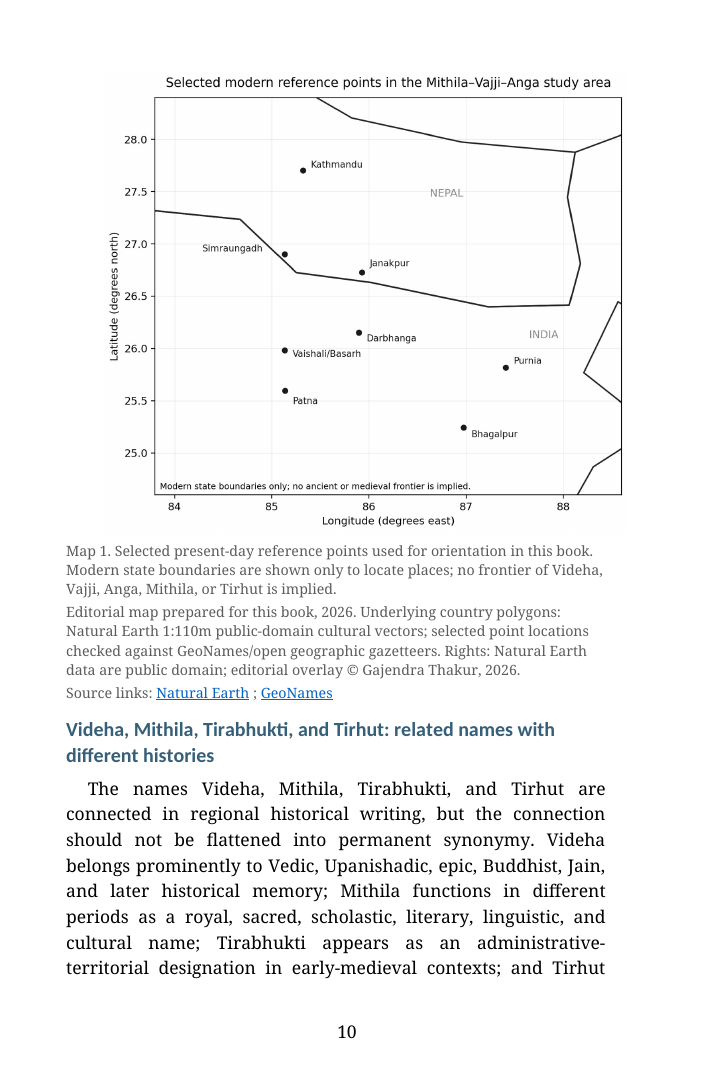
Chapter-specific source notes
- Primary chapter witness. Gajendra Thakur, Decoding the Panji of Mithila — Volume V, formal Chapter 15, PDF pp. 155-161; formal Chapter 15. The HTML transcription is generated from the commit-pinned source PDF and retains the chapter boundary recorded in this edition.
- Internal structure. The repository source-heading inventory records 12 subordinate headings for this chapter: “2. Batesh, Pashupati, Raghupati, Adani, Bharatpati, and the Panichobh link”; “3. Ratipati, Chand, Duve, Kushe, and the Narun connection”; “4. Haladhar and his descendants: Narhari, Shrihari, Kanh, Vishnu, Madhav, and Pitambar”; “5. Lakshminath, Parashuram, Achyut, Abhiram, Jivai, and Jagdish”; “6. Jagdish, Rameshwar, Vireshwar, Vishweshwar, and the Shulpani-Chakrapani branch”; “7. Andu and the wide son-cluster: Jagatanand, Hridaynath, Shyamnath, Babunath, Premnath, Rajnath”; “8. Shulpani’s Nanu line, Balakrishna, Brajlal, Rangalal, and the Mula bridge”; “9. Teknath, Kashinath, Shashinath, Kedarnath, Triloknath, and Devanath”; ….
- Digital editorial method. The page keeps the preserved source text distinct from generated navigational, concordance, visual, and provenance apparatus. The synthetic reconstruction is explanatory only and is not evidence for an individual lineage or a determination of social or marital status.