Decoding the Panji of Mithila · Volume V · Chapter 18
Nasira Desho Dighdi: Bhulek, Keuntu, Bhavanand, Anand, Bhairav, Manmohan, Ramanikant, Pashupatinath, Dharmanand, and the Purnia Modern
Chapter 18 — Nasira Desho Dighdi: Bhulek,
Keuntu, Bhavanand, Anand, Bhairav,
Manmohan, Ramanikant, Pashupatinath,
Dharmanand, and the Purnia Modern
Continuation
1. Where Chapter 18 begins
Chapter 18 begins exactly where Chapter 17 ended: at the source
heading “नशिरा देशो दिघडी.” The source immediately adds the
instruction “खौआल सिमरवाड प्रथम पृष्ठ देखूः-.” This means that the line
is not an isolated Nasira-Dighdi list. It is a return to the Khaual-
Simbarwad opening, now seen from another settlement field and another
branch-continuity angle.
The first movement reads: Bhule’s son Keuntu, Keuntu’s son
Bhavanand, Bhavanand’s son Gatiram, and Gatiram’s son Anand. Anand
is linked with Gora-Jajiwal through Harhar’s son Ramchandra, with
Khandwala through Kangali, and with Darhiara through Ramchandra-
Kastut. Thus the chapter opens with descent, then immediately turns
descent into place-mapping.
2. Bhulek, Keuntu, Bhavanand, Gatiram, Anand, and
Bhairav
The first chain is compressed but clear: भूलेसुत के उंटू, के उंटू-सुत
भवानन्द, भवानन्द-सुत गतिराम, and गतिराम-सुत आनन्द. These names
must be read as a return-line from the earlier Khaual-Simbarwad frame,
not as a new mool detached from the preceding chapter.
Anand then produces Bhairav. Bhairav becomes the first branching
node of the chapter. His children are Khelpati, Ganapati, Vidyapati, and
Chilka. The line also records marriage-place connections with Mahua,
Amaravati-Darhiara, Pariyamb-Budhwal, and other settlements. In Panji
logic, these place names are not decorative; they are the proof that the
branch remains socially traceable.
3. Khelpati: Dhruupnath, Teknath, Bateshnath, and the
female bridge
Khelpati gives the sons Dhruupnath, Teknath, and Bateshnath. Their
links move through Bhandwal, Madhusudan, Lakshminath, Sakuri-
Sakaradhi, Mahinath, and the women Budhavati, Chandravati, and
Decoding the Panji of Mithila - Volume V | 180
Dunmani. The female entries are especially important: they preserve the
marriage-route through which the branch entered or touched other
houses.
Dhruupnath then produces Manmohan. Manmohan is linked with
Jarhatia-Pali through Nanu and with Nikhuti through Rūpnath. The
source notes Jagadamba as a maternal or daughter-line marker and then
moves to Manmohan’s son Ramanikant. This is the shift from the older
return-line into a named modernized branch.
4. Manmohan, Ramanikant, Judī, Subhadra, and the
daughter-line
Ramanikant is linked with Majhaura-Karmah through Indranarayan’s
son Anand Gopal and with Navgharia through Allari and Kashinath.
Subhadra’s children Jalad and Judī are then recorded. Judī receives two
important marriage connections: first with Badhiyam-Pabauli through
Rajkishor, and then with Ahil-Hariam through Matar’s son Babulal.
Through Judī the source records Vindhyavasini, Suvashini, Girija, and
Nirmala. Vindhyavasini is connected with Sandahpur-Didhoy through
Sundarmani’s son Jagmohan. Suvashini is connected with Rupaspur-
Gangi-Digho through Babulal’s son Chaudhary Shivanand, and this entry
produces Kamalanand and Balkrishna. The line therefore keeps
daughters as active carriers of continuity, not as marginal notes.
5. Ramanikant’s sons: Pashupatinath, Paramanand,
Dharmanand, and Devanand
Ramanikant’s main sons are Pashupatinath, Paramanand,
Dharmanand, and Devanand. The source calls them Dighdi-vasi and adds
the Shandilya-gotriya Brahmapura connection through Harinath’s son
Modan, as well as a Jagatpur-Mandar link through Kanhaiya. This is a
classic Panji pattern: descent is followed by residence, gotra marker, and
marriage-place evidence.
The same cluster also lists Jhunaday and the women Nirupama,
Draupadi, and Singheswari. Nirupama is linked with Marichaibari-
Pariyamb-Budhwal through Yashonath’s son Makarū and produces
Bholanath and Sushila. Draupadi is also connected with Pariyamb-
Budhwal through a second marriage after the first wife’s absence, and
this produces Sachchidanand and Vimala. The Panji is recording
household sequence, not merely biological descent.
Decoding the Panji of Mithila - Volume V | 181
6. Pashupatinath and Paramanand
Pashupatinath produces a branch linked with Painagor-vasi Dip-
Baheradih through Tengari’s son Vanshamani. The source records Usha
as a daughter-line marker, with a Sihuli-Sangram-Ekhara connection
through Digambar’s son Jagdish. Another connection goes to Nikhuti
through Rudranand, called “Bachchi” in the source.
Paramanand is linked with Ahil-Hariam through Manta’s son Jagli and
with Kaligram-Belauch through Tejnath. The Budhmaya branch then
records Subhash, Prakash Chandra, and Vikash Chandra, each marked
with modern educational titles. Alongside them appear Manorama,
Radha, and Ranju, whose marriages connect the branch with Tirhut-
Pindaruch-Mangrauna-Hariam and with Purendaha-Sakuri-Pali.
7. Dharmanand: the principal of District School Purnia
Dharmanand is one of the most important modern-title figures in this
chapter. The source calls him a “परम सुप्रतिष्ठित प्रधानाचार्य (जिला स्कू ल
पूर्णिया).” This title places him within a modern educational institution
while keeping him inside the same genealogical grammar of descent,
place, and marriage.
Dharmanand’s sons are Uttam Kumar, Anupam Kumar, Pritam
Kumar, and Vikram. They are connected with Arihana-Digaunth-
Gangoli through Rai Ramanath and Rai Dharmanand, and with
Simarwad-Khaual through Jahanpur-vasi Indranath. The branch thus
connects district education, Rai title, and the older village network in one
compressed entry.
8. Uttam Kumar, Anupam Kumar, Subhash Chandra,
Prakash Chandra, and Vikash Chandra
Uttam Kumar is marked as B.A. and railway office-holder. He
produces Ravishankar, linked with Rashadhya-vasi Kavainarun through
Shubhankar’s son Mukhiya Kanhaiya, and with Patuaha-Chhadan-
Sarisav through Shivnath. The line also records Utpalakshi and
Meenakshi, with Harirahi as a further place signal.
Anupam Kumar is marked M.Sc. His son Prabhashankar is connected
with Bela-vasi Jalay through the jyotishi line of Dayanath, Kapileshwar,
and Chandrabhanu, and also with Vasanahi-Chhadan-Sarisav through
Sadanand. The source adds Anjali and Alka as female continuation
markers.
Decoding the Panji of Mithila - Volume V | 182
Subhash Chandra is marked M.A. , B.Ed. , and Principal. His sons are
Neeraj and Tushar Kant , tied to Ariyar - Chhadan - Sarisav through
Vishwanath’s son Suryanand. Prakash Chandra is marked Professor of
Political Science and gives Tejasva and Shanu , linked with Rajpur -
Chikni - Sarisav - Sodarpur through Shaligram. Vikash Chandra is
marked M.A. and gives Anubhav and Vaibhav / Monu , linked with
Akbarpur and a Parashar - gotra Sakarhon line through Kirtyanand.
9. The movement toward Rajanpura-Darhiara-Koilakh
The chapter ends when the source changes heading to “ अथ राजनपुरा
पु दरिहरा कोईलख सॅ सरौनी निशखुड खु देशे (प्रगन्ना).” This marks a new
field. The Nasira - Dighdi material has finished its return to Khaual -
Simbarwad and its modern continuation through Dighdi , Purnia ,
Arihana , Jahanpur , and the educational - professional lines.
The next chapter should therefore begin with Rajanpura-Darhiara-
Koilakh, not continue the Nasira-Dighdi section. That next field opens
with Kul’s daughters and then moves quickly into Bacha, Kanhaiya,
Babunath, Dwarikanath, Lakshman, Sadānand, Dīnānath, Yugal Kishor,
Digambar, and later Sarouni-Darhiara and Hemnagar material.
10. What Chapter 18 adds
Chapter 18 adds a return-chapter. Instead of announcing a wholly new
genealogy, it begins with a back-reference to the Khaual-Simbarwad first
page. This shows how Panji writing often moves forward by returning
backward: the same remembered origin is reopened from a different
settlement and marriage perspective.
Second, the chapter strengthens the Dighdi connection. Ramanikant’s
sons are placed as Dighdi-vasi Shandilya-gotriya figures, but their
marriages and titles carry them into Brahmapura, Jagatpur-Mandar,
Painagor, Sandahpur-Didhoy, Rupaspur-Gangi-Digho, Arihana-
Digaunth-Gangoli, Purnia, and several modern professional identities.
Third, Chapter 18 confirms the continuity of daughters as genealogy-
makers. Judī, Vindhyavasini, Suvashini, Girija, Nirmala, Nirupama,
Draupadi, Singheswari, Usha, Manorama, Radha, Ranju, Utpalakshi,
Meenakshi, Anjali, Alka, and others are not side entries. They carry
marriage history and connect the branch to other houses.
Decoding the Panji of Mithila - Volume V | 183
11. Branch summary
Opening return: Nasira Desho Dighdi begins with “Khawal Simbarwad
Pratham Prishtha Dekhu,” linking this chapter back to the Khaual-
Simbarwad opening.
First descent chain: Bhule, Keuntu, Bhavanand, Gatiram, Anand,
Bhairav.
Bhairav branch: Khelpati, Ganapati, Vidyapati, Chilka; then
Dhruupnath, Teknath, Bateshnath.
Manmohan-Ramanikant branch: Manmohan, Ramanikant, Judī,
Vindhyavasini, Suvashini, Girija, Nirmala.
Ramanikant sons: Pashupatinath, Paramanand, Dharmanand, Devanand.
Dighdi and Shandilya marker: the sons are read with Dighdi residence
and Shandilya-gotriya Brahmapura connection.
Pashupatinath line: Vanshamani, Usha, Jagdish, Rudranand/Bachchi.
Paramanand line: Jagli, Tejnath, Budhmaya, Subhash, Prakash Chandra,
Vikash Chandra, Manorama, Radha, Ranju.
Dharmanand line: Principal of District School Purnia; sons Uttam
Kumar, Anupam Kumar, Pritam Kumar, Vikram.
Modern professional line: Uttam Kumar as B.A. railway officer,
Anupam Kumar as M.Sc., Subhash Chandra as M.A., B.Ed. Principal,
Prakash Chandra as Professor of Political Science, Vikash Chandra as
M.A.
Next threshold: the next chapter begins with Rajanpura-Darhiara-
Koilakh.
12. Conclusion: from Nasira-Dighdi to Rajanpura-
Darhiara-Koilakh
Chapter 18 is small in length but important in method. It shows that a
Panji chapter may move by return rather than by simple sequence. The
opening “खौआल सिमरवाड प्रथम पृष्ठ देखूः-” tells the reader to remember
an earlier origin, while the following names show how that origin
continued through Nasira-Dighdi, Dighdi residence, Shandilya-gotra,
Purnia education, railway service, and modern academic titles.
The chapter keeps the same rule used throughout this volume: no name
is read alone. Bhule is read through Keuntu; Keuntu through Bhavanand;
Bhavanand through Gatiram; Gatiram through Anand; Anand through
Bhairav; Bhairav through Khelpati, Ganapati, Vidyapati, and Chilka;
Ramanikant through Pashupatinath, Paramanand, Dharmanand, and
Devanand; Dharmanand through Purnia and his sons; and every daughter
through the marriage route she opens.
Decoding the Panji of Mithila - Volume V | 184
The next chapter should begin at “ अथ राजनपुरा पु दरिहरा कोईलख
सॅ सरौनी निशखुड खु देशे(प्रगन्ना) , ” where the source changes field and
starts a new movement through Rajanpura , Darhiara , Koilakh , Sarauni ,
and Nishkhud.
Decoding the Panji of Mithila - Volume V | 185Source structure and verification apparatus
Editorial source apparatus. This apparatus is descriptive, not interpretive. It records the source-controlled structure used to verify that this page corresponds to formal Chapter 18 of Decoding the Panji of Mithila — Volume V. The chapter text above is preserved from PDF pp. 181-186; formal Chapter 18 in the commit-pinned authoritative source. It is not merged with a neighboring chapter, appendix, annexure, or independent front/back-matter unit. The internal headings below come from the repository’s source-heading inventory and are retained as navigational and audit evidence; showing them here does not turn those headings into separate publications or add claims that are absent from the source.
Internal source headings
- 1. Where Chapter 18 begins
- 2. Bhulek, Keuntu, Bhavanand, Gatiram, Anand, and Bhairav
- 3. Khelpati: Dhruupnath, Teknath, Bateshnath, and the female bridge
- 4. Manmohan, Ramanikant, Judī, Subhadra, and the daughter-line
- 5. Ramanikant’s sons: Pashupatinath, Paramanand, Dharmanand, and Devanand
- 6. Pashupatinath and Paramanand
- 7. Dharmanand: the principal of District School Purnia
- 8. Uttam Kumar, Anupam Kumar, Subhash Chandra, Prakash Chandra, and Vikash Chandra
- 9. The movement toward Rajanpura-Darhiara-Koilakh
- 10. What Chapter 18 adds
- 11. Branch summary
- 12. Conclusion: from Nasira-Dighdi to Rajanpura-Darhiara-Koilakh
Source-text concordance
Nasira · Desho · Dighdi · Bhulek · Keuntu · Bhavanand · Anand · Bhairav · Manmohan · Ramanikant · Pashupatinath · Dharmanand · Purnia · Modern · Continuation · begins · exactly · ended · heading · immediately · adds · instruction · means · line · isolated · Nasira-Dighdi · list · return · Khaual · Simbarwad · opening · seen · another · settlement · field · branch-continuity · angle · first · movement · reads · Bhule’s · Keuntu’s · Bhavanand’s · Gatiram · Gatiram’s · linked · Gora-Jajiwal · Harhar’s · Ramchandra · Khandwala · Kangali · Darhiara · Kastut · Thus · opens · descent · turns · place-mapping · chain · compressed · clear · names · must · read · return-line · earlier · Khaual-Simbarwad · frame · mool · detached · preceding · produces · becomes · branching · node · children · Khelpati · Ganapati · Vidyapati · Chilka
Boundary verification. In the formal sequence this chapter follows Volume V Chapter 17, “Khaual Simbarwad Gramaramabh: Jahanpur, Jamua-Baradbata, Chikni,” and precedes Volume V Chapter 19, “Rajanpura Pu Darhiara Koilakh, Sarouni, and Dharmapur- Deshe Hemnagar: Kanhaiya, Dwarikanath, Lakshman, Prayagdatt,”. The chapter extractor begins at the verified formal Chapter 18 marker and stops at the next verified formal chapter marker; for a final chapter it stops before recognized book-level back matter. The concordance above is generated only from distinct terms already present in this chapter’s preserved source text. It is provided for discovery, comparison, and audit, not as an automated judgment about persons, lineages, status, kinship, marriage eligibility, or historical truth.
Illustrated research apparatus
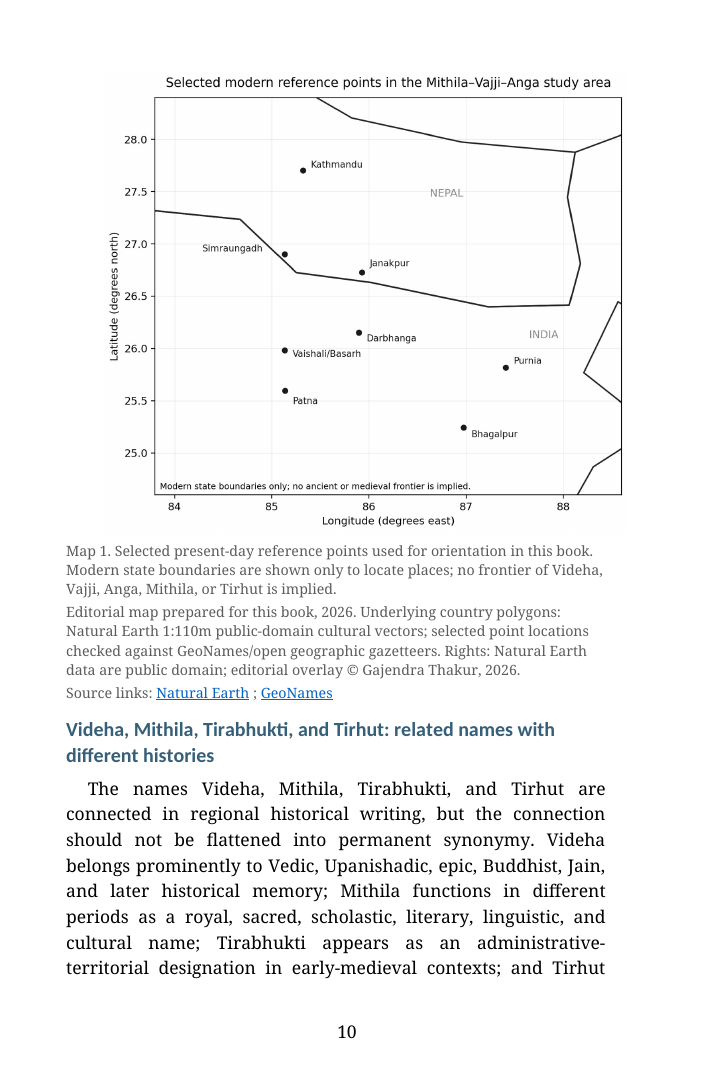
Mithila · Vajji · Anga
Chapter-specific source notes
- Primary chapter witness. Gajendra Thakur, Decoding the Panji of Mithila — Volume V, formal Chapter 18, PDF pp. 181-186; formal Chapter 18. The HTML transcription is generated from the commit-pinned source PDF and retains the chapter boundary recorded in this edition.
- Internal structure. The repository source-heading inventory records 12 subordinate headings for this chapter: “1. Where Chapter 18 begins”; “2. Bhulek, Keuntu, Bhavanand, Gatiram, Anand, and Bhairav”; “3. Khelpati: Dhruupnath, Teknath, Bateshnath, and the female bridge”; “4. Manmohan, Ramanikant, Judī, Subhadra, and the daughter-line”; “5. Ramanikant’s sons: Pashupatinath, Paramanand, Dharmanand, and Devanand”; “6. Pashupatinath and Paramanand”; “7. Dharmanand: the principal of District School Purnia”; “8. Uttam Kumar, Anupam Kumar, Subhash Chandra, Prakash Chandra, and Vikash Chandra”; ….
- Digital editorial method. The page keeps the preserved source text distinct from generated navigational, concordance, visual, and provenance apparatus. The synthetic reconstruction is explanatory only and is not evidence for an individual lineage or a determination of social or marital status.