Decoding the Panji of Mithila · Volume V · Chapter 19
Rajanpura Pu Darhiara Koilakh, Sarouni, and Dharmapur- Deshe Hemnagar: Kanhaiya, Dwarikanath, Lakshman, Prayagdatt,
Chapter 19 — Rajanpura Pu Darhiara
Koilakh, Sarouni, and Dharmapur-
Deshe Hemnagar: Kanhaiya,
Dwarikanath, Lakshman, Prayagdatt,
Rohini, Vishnudatt, Jagatmani, and the
Phoolsara-Baradbatta Continuation
1. Where Chapter 19 begins
Chapter 19 begins at the source opening “ अथ राजनपुरा पु दरिहरा
कोईलख सॅ सरौनी निशखुड खु देशे (प्रगन्ना).” This is not merely another
place - name. It announces a composite field : Rajanpura ,
Darhiara , Koilakh , Sarouni , and the Nishkhud - khu desh or
pargana frame are being brought together as one reading unit.
The chapter therefore reads the line as a movement from a
Rajanpura-Darhiara-Koilakh opening into Sarouni, then into a
second Rajanpur-Darhiara register, and finally into Dharmapur-
deshe Hemnagar, where the Rohini-Phoolsara-Baradbatta
continuation is preserved. The next major threshold appears
only when the source turns to “रतौली दरिहरा जहानपुर ब पु नैली
श्रीनगर, रमै रहटमीना भडरा.”
2. Kula, Bhaiya, Vacha, Chonha, and Bengali: the
compressed opening
The opening clause places कु ल as the first node and records his
descendants or branch persons as भैया, वाचा, चोन्हा, and बंगाली.
These names must be read as an initial set before the source
narrows into specific sons and marriage links.
भैया is linked to पारखण्ड बहेराढी through रतिधर’s son कमलपाणि.
This is the first marriage-place anchor of the chapter. It shows
that Rajanpura-Darhiara material is immediately tied outside
itself by a Baheradhi connection.
Decoding the Panji of Mithila - Volume V | 186
वाचा produces कन्हैया and बाबूनाथ. These two names become
the principal early fork of the section. The source then carries
कन्हैया forward in detail, while बाबूनाथ later reappears in the
Sarouni-Darhiara-Rajanpurpu block.
3. Kanhaiya and the two sons Dwarikanath and
Lakshman
कन्हैया has two sons: द्वारिकानाथ and लक्ष्मण. Their marriages
connect through Chainpur, Mahishi-Pali, Bhavanidatt’s son
Jaydatt, Mani Sodarpur, and Vaidyanath. The line shows that
Kanhaiya’s house is not a single-village household but a
networked Panji node.
कन्हैया’s daughter-side material is also preserved. The source
records Rangkavati’s daughters अजानवती and सरस्वती. Ajanavati
is connected with Baghwas-Sarisav through Panch Ek Nath’s son
Yadav, while Saraswati is linked with Alay through Devidatt’s
son Ramadatt. These daughter entries are not ornamental; they
are the evidence of how the branch was carried into other mool-
place relations.
4. Dwarikanath’s line: Babua, Raghuvar, Arjun,
and the wider branch
द्वारिकानाथ first produces बबु आ, who is linked with Jitwarpur,
Majhaura-Karmaha, Vaidik Pyarelal’s son Bhailal, Katka-
Mandar, and Gunanand. This makes Babua a major connecting
person between Rajanpura-Darhiara and the Majhaura-
Karmaha field.
Through Saraswati’s child-line the text records अमोल दाय,
connected with Rashadh-Kavainarun and Jyotish Maheshdatt.
The daughters जहानवती and रमावती then connect to Mahiya-
Sodarpur through Govind’s son Purandar. Thus the Saraswati
strand creates both ritual-intellectual and marriage continuity.
द्वारिकानाथ also produces रघु वर and अर्जून, linked to Maheshpur
and Ekma-Khandwala through Giridhari. The daughters of this
Decoding the Panji of Mithila - Volume V | 187
line connect Baghwas-Sarisav with Panch Govind’s son Munshi,
and produce नकछे दी and अचम्मित. The branch therefore moves
again through daughter-line continuity into Sarisav and related
houses.
बबु आ’s additional sons and daughters include सत्यदेव, प्रताप,
सुरे श, नरे श, नूनू, बोधीनारायण, शिवनारायण, and रामनारायण. These
names are associated with Morasanda-Tarauni-Karmaha,
Shalampur-Sulhani-Naraun, Ramapur-Ahpur-Karmaha,
Basnahi-Mahishi-Budhwal, Padri-Ullukujouli, and related places.
The section is dense because Babua becomes a large branch-
house.
5. Lakshman’s line: Sadanand, Dinanath, Yugal
Kishor, Avadhnarayan, and Digambar
लक्ष्मण is equally important. His son सदानन्द is linked with
Babhngama and Majhaura-Karmaha through Bhavan, and with
Harinagar-Narsam-Baliyas through Chaturanan. This gives the
Lakshman branch both Karmaha and Baliyas connections.
Through Jānhavī’s daughter-line the source records प्रथमवती,
linked with Kako-Belauch and Koilakh through Chaudhary
Anant. This is one of the clearest examples of the chapter’s
method: a daughter-line confirms the branch’s standing inside
another village and marriage network.
लक्ष्मण also produces दिनानाथ and टूमन, connected with
Bangaon-Chhadan-Sarisav through Poshan. The Pavitrī line
records खुखनी and फू दनी, with links to Mangalwad-Lakshmipur,
Mani-Sodarpur, Ghoghan, Nadhuwar-Karmaha, and Shatanjiv.
The text carefully preserves these daughter paths because they
keep the register socially verifiable.
Another Lakshman son is युगल किशोर, connected with
Vadivan. अवधनारायण is connected with Bhramarpur, Udanpur-
Jajiwal, Premlal’s son Vanshi, Belahi-Mahishi-Budhwal, and Jatu.
His children include चंद्रशेखर, सदाशिव, and गुणेश्वर.
Decoding the Panji of Mithila - Volume V | 188
Chandrashekhar then connects Rataitha-Badhiam-Pavoli with
Nokhelal and Misharpur with Baldev.
लक्ष्मण also produces दिगम्बर and बजन. Digambar connects
Jhalari, Badhiam-Pavoli, Kshatrapati’s son Bhailal, Bangaon-
Hati-Pali, and Hemkar. Through his household the source
records Arun-dai and Bhaiya-dai, then Tarani Prasad and
Jagdish, and daughter-links through Ganga, Godavari, Bholadai,
Nirsamani, Ahilya, Sumitra, Usha, Mahadei, and Chitrrekha.
6. Digambar’s later branch: Devchandra,
Sītambar, Gulab, Bhagirath, and the professional
markers
दिगम्बर’s son देवचन्द्र is attached to Sirniyan, Jhaua-Alay, Ritalal,
Rataitha-Badgaon-Darhiara, and Vithal. The later names
सीताम्बर, गुलाब, and भगीरथ open additional branches through
Oda-Ekhara, Bhupnath’s son Raiya, Chunapur-Nikhuti, and Rai.
The text then records daughter-line continuity through
Matrika and Subhadra. Subhadra links Parihari-Mahishi-
Budhwal with Dukhmochan’s son Lakshmikant. Sitambar
connects Ramnagar-Khangud-Sarisav with Mathuranath’s son
Dukhiya, while Gulab carries the branch through Madhepura-
Chakrami-Udanpur-Jajiwal and Vakil Jayanti Prasad.
बज्जन’s line is especially modern in tone. His sons include
नागेश्वर, कपिलेश्वर, बु चन, डॉ॰ असर्फी लाल, राशेश्वर, and शालेश्वर.
Their links run through Khada-Majhaura-Karmaha, Nandipati,
Ekamba-Jagor-Sodarpur, Muni, Ghosot, Keshav, Manindra,
Badhiam-Pavoli, Babuchandra, Jayanath, Chintamani,
Vishnupur-Pachahi-Jajiwal, Pathak Hansraj, Vishpatti-Pakhaliya,
Rangpura-Bhadgam-Jajiwal, Raghubar, Majhaura-Karmaha, and
Bhogi. The titles “डॉ.” and “वकील” mark how a Panji line enters
modern educated status without leaving genealogical grammar.
Decoding the Panji of Mithila - Volume V | 189
7. Sarouni-Darhiara-Rajanpurpu: Babunath, Raja,
Jaydev, and Prayagdatt
The next internal heading is “सरौनी दरिहरा राजनपुरपु .” It begins
with बाबूनाथ and gives two sons: राजा and प्रयागदत्त. राजा is
connected with Kaharawasi-Deuri-Khandwala through Datt’s
son Thakur Taradatt, and with Punachh-Baheradhi through
Nanu. His daughter-line includes Rani, connected to Behat-
Karmaha through Kirtinath’s son Buddhinath, producing
Kantalal.
राजा’s son जयदेव carries the line through Pakadiya-Andoli-
Jalay, Lal, Dhauli-Suday-Belauch, Baburam, Mandhan, Malini in
Godda district, Deep-Baheradhi, Maharaj, Baijani-Bhagalpur,
and Dhiro. Jaydev’s other sons दिवाकान्त and परमानन्द are linked
with Padariya-Hati-Sodarpur, Hiraman, Srinath, Dih-Dariapur-
Jhaua-Alay, Babulal, Badgaon-Belsam-Budhwal, and Sumarit Lal.
प्रयागदत्त produces भूवनेश्वर and राधानाथ , with Dumaria -
Hasouli - Sodarpur , Chandi , and Badrinath links. The daughters
ध्यानवती and झूलोवती connect Bhakhrauli - Kujouli and Badhiam
- Pavoli , while the son - line continues through इष्टदेव / बटूक ,
सुन्दरकान्त , अवधनारायण , and the associated Basnahi , Babhngama
, Kusauli - Belauch , Kuaadi - Guldi - Khandwala , Lagama -
Rakhwari - Hariam , Hanumandatt , Upma , Gopikant , Purandar
, Sonadai , Shakuntana , and Kako - Belauch links.
8. Dharmapur-deshe Hemnagar: Rohini, Dullah,
Manik, Akli, and Nanu
The chapter then turns to “धरमपुर देशेहेमनगर.” The source
explicitly links Rajanpur-Darhiara with Phoolsara-Rohini and
names दुल्लह, मानीक, अकली, and ननू as the opening sons. This
block must therefore be read as a Hemnagar extension of the
earlier Rajanpura-Darhiara material.
दुल्लह connects Behat - Karmaha through Daro’s son Narayan ,
and Singholi - Mandar through Rameshwar’s son Chakrapani.
His son विष्णुदत्त links with Parhat - Baheradhi through Tejan and
Decoding the Panji of Mithila - Volume V | 190
with Darhiara through Ghani. Vishnudatt then produces इन्द्रमणि
and जगतमणि / भैया.
इन्द्रमणि connects through Deuri-Khandwala, Bodh’s son
Baburaiya, Ratauli-Darhiara, and Nandkumar. Through
Hemvati’s line the text records Ijani, Mahiya-Sodarpur,
Nandishwar’s son Yognath, and sons Loknath and Shri Nandan.
Indramani’s son Kamalakant links through Parkhand-Baheradhi
and Mishra Thithar.
9. Jagatmani/Bhaiya and the Kshatrakant-
Kumarkant-Ramanath-Umanath field
जगतमणि / भैया produces क्षत्रकान्त and कु मर कान्त , linking
Vishnupur , Asja - desh , Ahil - Hariam , Mishra Sonphool ,
Chhonhu , Simarwar - Khaual , Dinanath , and Latai. The source
then carries Jagatmani / Bhaiya into a second son - set : रमानाथ
and उमानाथ , connected with Rahua , Balirajpur - Hariam ,
Mishra Dular’s son Kunji , Shaktiraypur - Naraun , and
Kanhaiya.
Through Panchvati the line produces कु मारकान्त / चिचाई , then
राधाकान्त. Radhakant connects Anlpaur - Karmaha through
Vanshi’s son Mitranath and Ratauli - Darhiara through Dulraiya.
The Chichai branch also sends a daughter into Deshual -
Khandwala through Dular’s grandson Chanan and Khikharu ,
while another Chichai son , सीताकान्त , connects Bhandarisam
with Jitalal.
The Arunvati daughter-line is especially important. It records
Tarani of Sarisav-Sodarpur and her marriage to the grammarian
Lakshminath, marked as “वैयाकरण लक्ष्मीनाथ (स्वयंपाकी).” From
that line is born the internationally known Sanskrit linguist
Prof. Dr. Narayan Ji of BHU, Banaras. The Panji thereby keeps
together ordinary descent, marriage, scholarly title, and modern
institutional renown.
Decoding the Panji of Mithila - Volume V | 191
10. Umanath, Nishikant, Bhālchandra, and the
modern professional line
उमानाथ’s sons are निशिकान्त, अमोल, सरयु ग, चतुर्भुज, and जनार्दन.
Their links move through Khori-Sodarpur, Giridhari’s son Gopal,
Anhara-Katai, Ishkalal, and related households.
निशिकान्त’s son वकील भालचन्द्र is marked with B.Com. and LL.B.
His marriage and place links include Banaili, Baheradhi, Thakur
Manohar, Badhiam-Pavoli, and Vajitlal. The source then records
Shri Bhalchandra’s sons अभियंता गौतम कु मार, अभियंता अनुराग, and
अरूण, connected with Hati-Pali and Aniruddh. This is another
point where modern education and professional identity enter
the genealogical record.
Ramanath’s daughter-line includes Rangra-Samauli-Pali
through Rashik’s son Prabhunath, Raiyam-Sodarpur through
Vasudev’s son Suryadev, and Tadar-Andoli through Ritlal’s son
Jaldhar. These daughter-entries show that the Hemnagar branch
spreads into multiple marriage directions.
11. Rohini’s Nanu-Babujan line and the Anand
branch
रोहिणी’s line then turns through ननू - सुत बबु जन. Babujan is
linked to Ekhara through Karunakar. Babujan’s son आनन्द
connects Belsam - Budhwal through Ratnakar / Khodai’s son
Shambhunath , and Ojholi - Belauch through Dhanai’s son
Machal.
आनन्द produces सिंहेश्वर and रामेश्वर, linked with Gangor,
Chhotakni, Malangia-Kujouli, and Mathuranath. Another Anand
set gives कपिलेश्वर and भूवनेश्वर, tied to Majhiam-Karmaha
through Babulal and to Rajora-Bhamar through Rajkumar. The
daughters or related child-lines include Durlabh and Tun-dai,
with Jajiwal-Parshanath-Jaydev and Vatswal-Naraun-
Lakshminath-Badrinath connections.
Decoding the Panji of Mithila - Volume V | 192
12. Phoolsara and Baradbatta: Revati Nath,
Shaktinath, Lalitnath, and Hitnath
The source then explicitly marks “फू लसरा.” Rohini’s son Revati
Nath gives गोखूलनाथ, अमृतनाथ, राजा, and बाबूलाल. The links pass
through Baghwas-Sarisav, Panch Krishnadev, Panchan, Sakradh,
Jaydatt, Dhenupavoli, Dayanath, Katma-Babhniyam, and
Chhotan.
राजा’s son शक्तिनाथ extends the line through ललितनाथ and
चीचन. Lalitnath is linked with Hati - Sodarpur and Shrilal , and
also with Anhara - Katai and Murlidhar. Chichan links Uda -
Belauch with Lakshmi , while his children Chummanvati and
Uganvati are joined to Majhaura - Karmaha and Tofalal’s son
Naharni / Kamaladatt , Mahishi - Pali and Badrinath , Rauadh
and Motilal , Soini and Gopal , Mahishi - Budhwal and Babulal ,
Rauadh and Jhapatalal , Nanyapur - Alay and Sonalal , and
Madam - Jajiwal and Ghutar.
The Baradbatta note reads Rohini-Revati Nath’s son Raja
producing Hitnath. Hitnath’s children are शिवसुन्दर, नवसुन्दर,
हरिसुंदर, and प्रेमसुन्दरा, linked to Sakuri-Sarisav and Pushpanath.
This closes the chapter’s field: Rajanpura-Darhiara-Koilakh has
moved through Sarouni, Hemnagar, Phoolsara, and Baradbatta,
and is ready to pass to the next major heading.
13. Branch summary
Opening frame : Rajanpura - Darhiara - Koilakh with Sarouni
, Nishkhud - khu desh / pargana.
First branch: Kula → Bhaiya/Vacha/Chonha/Bengali; Vacha →
Kanhaiya and Babunath.
Kanhaiya branch : Dwarikanath and Lakshman ;
Dwarikanath → Babua , Raghuvar , Arjun ; Lakshman →
Sadanand , Dinanath , Yugal Kishor , Avadhnarayan ,
Digambar , and their daughter - lines.
Sarouni - Darhiara - Rajanpurpu : Babunath → Raja and
Prayagdatt ; Raja → Jaydev ; Prayagdatt → Bhuvneshwar ,
Radhanath , Sundarkant , Avadhnarayan.
Decoding the Panji of Mithila - Volume V | 193
Dharmapur - deshe Hemnagar : Rohini’s sons Dullah ,
Manik , Akli , Nanu ; Dullah → Vishnudatt → Indramani and
Jagatmani / Bhaiya.
Jagatmani branch: Kshatrakant, Kumarkant, Ramanath,
Umanath; scholarly-professional markers include
Vaiyakaran Lakshminath, Prof. Dr. Narayan Ji, Vakil
Bhalchandra, and engineer sons Gautam Kumar and Anurag.
Phoolsara - Baradbatta continuation : Rohini → Revati Nath
→ Gokhulnath , Amritnath , Raja , Babulal ; Raja →
Shaktinath and Hitnath line.
Next threshold: the following chapter should begin at “रतौली
दरिहरा जहानपुर ब पु नैली श्रीनगर, रमै रहटमीना भडरा.”
14. Conclusion: from Rajanpura-Darhiara to
Ratauli-Darhiara
Chapter 19 shows how a Panji section can work in layers. Its
first layer is Rajanpura-Darhiara-Koilakh; its second is Sarouni;
its third is Dharmapur-deshe Hemnagar; its fourth is Phoolsara
and Baradbatta. These are not separate anecdotes. They are one
genealogical field held together by descent, marriage, residence,
title, and continuity.
The chapter also shows how the old grammar of the Panji
absorbs modern identity. Names such as Dr. Asarfi Lal, Vakil
Bhālchandra, Engineer Gautam Kumar, Engineer Anurag,
Vaiyakaran Lakshminath, and Prof. Dr. Narayan Ji are not
treated as departures from lineage. They are inserted into the
same grammar of sonship, village, marriage, and branch.
The next chapter should therefore begin with “ रतौली दरिहरा
जहानपुर ब पु नैली श्रीनगर, रमै रहटमीना भडरा,” where the source
turns from the Rajanpura-Hemnagar field into a new Darhiara-
Jahanpur-Naili-Shrinagar-Ramai-Rahatmina-Bhadra field.
Decoding the Panji of Mithila - Volume V | 194Source structure and verification apparatus
Editorial source apparatus. This apparatus is descriptive, not interpretive. It records the source-controlled structure used to verify that this page corresponds to formal Chapter 19 of Decoding the Panji of Mithila — Volume V. The chapter text above is preserved from PDF pp. 187-195; formal Chapter 19 in the commit-pinned authoritative source. It is not merged with a neighboring chapter, appendix, annexure, or independent front/back-matter unit. The internal headings below come from the repository’s source-heading inventory and are retained as navigational and audit evidence; showing them here does not turn those headings into separate publications or add claims that are absent from the source.
Internal source headings
- 1. Where Chapter 19 begins
- 2. Kula, Bhaiya, Vacha, Chonha, and Bengali: the compressed opening
- 3. Kanhaiya and the two sons Dwarikanath and Lakshman
- 4. Dwarikanath’s line: Babua, Raghuvar, Arjun, and the wider branch
- 5. Lakshman’s line: Sadanand, Dinanath, Yugal Kishor, Avadhnarayan, and Digambar
- 6. Digambar’s later branch: Devchandra, Sītambar, Gulab, Bhagirath, and the professional markers
- 7. Sarouni-Darhiara-Rajanpurpu: Babunath, Raja, Jaydev, and Prayagdatt
- 8. Dharmapur-deshe Hemnagar: Rohini, Dullah, Manik, Akli, and Nanu
- 9. Jagatmani/Bhaiya and the Kshatrakant-Kumarkant-Ramanath-Umanath field
- 10. Umanath, Nishikant, Bhālchandra, and the modern professional line
- 11. Rohini’s Nanu-Babujan line and the Anand branch
- 12. Phoolsara and Baradbatta: Revati Nath, Shaktinath, Lalitnath, and Hitnath
- 13. Branch summary
- 14. Conclusion: from Rajanpura-Darhiara to Ratauli-Darhiara
Source-text concordance
Rajanpura · Darhiara · Koilakh · Sarouni · Dharmapur · Deshe · Hemnagar · Kanhaiya · Dwarikanath · Lakshman · Prayagdatt · Rohini · Vishnudatt · Jagatmani · Phoolsara-Baradbatta · Continuation · begins · opening · merely · another · place · name · announces · composite · field · Nishkhud · desh · pargana · frame · brought · together · reading · unit · therefore · reads · line · movement · Rajanpura-Darhiara-Koilakh · second · Rajanpur-Darhiara · register · finally · Rohini-Phoolsara-Baradbatta · preserved · next · major · threshold · appears · turns · रहटम · Kula · Bhaiya · Vacha · Chonha · Bengali · compressed · clause · places · first · node · records · descendants · branch · persons · names · must · read · initial · narrows · specific · sons · marriage · links · linked · धर’s · कमलप · marriage-place · anchor · shows · Rajanpura-Darhiara
Boundary verification. In the formal sequence this chapter follows Volume V Chapter 18, “Nasira Desho Dighdi: Bhulek, Keuntu, Bhavanand, Anand, Bhairav, Manmohan, Ramanikant, Pashupatinath, Dharmanand, and the Purnia Modern” and precedes Volume V Chapter 20, “Ratauli Darhiara, Jahanpur, Naili, Shrinagar, Ramai- Rahatmina-Bhadra: Kamalpani, Devdhar, Dharanidhar, the Poet-Line,”. The chapter extractor begins at the verified formal Chapter 19 marker and stops at the next verified formal chapter marker; for a final chapter it stops before recognized book-level back matter. The concordance above is generated only from distinct terms already present in this chapter’s preserved source text. It is provided for discovery, comparison, and audit, not as an automated judgment about persons, lineages, status, kinship, marriage eligibility, or historical truth.
Illustrated research apparatus
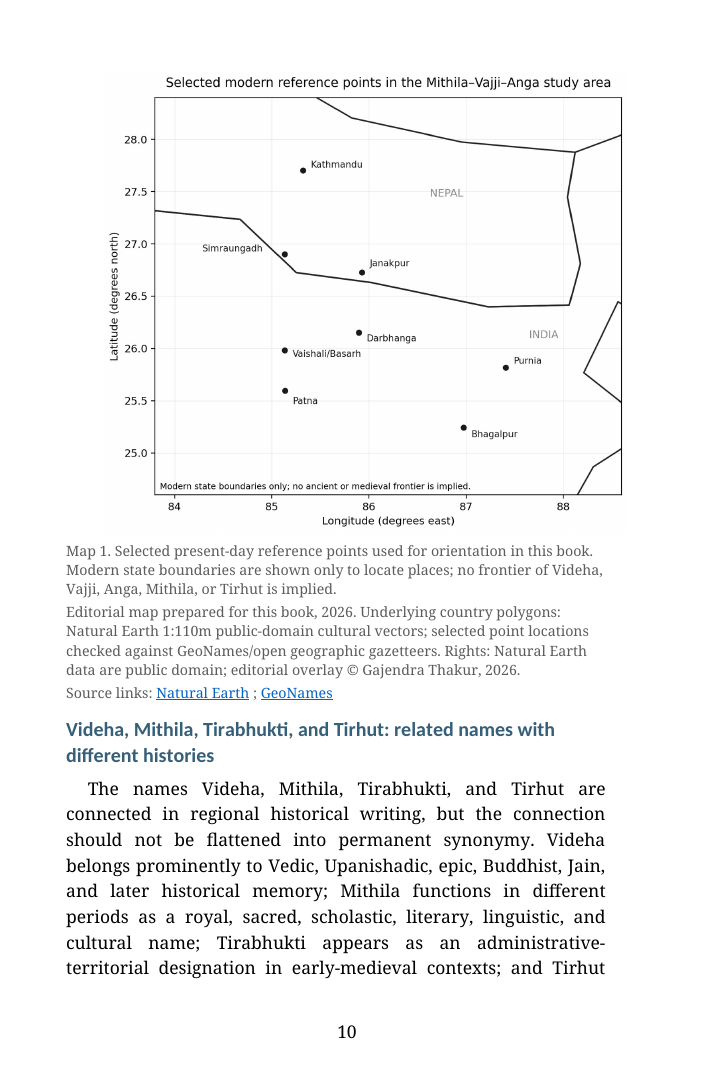
Mithila · Vajji · Anga
Chapter-specific source notes
- Primary chapter witness. Gajendra Thakur, Decoding the Panji of Mithila — Volume V, formal Chapter 19, PDF pp. 187-195; formal Chapter 19. The HTML transcription is generated from the commit-pinned source PDF and retains the chapter boundary recorded in this edition.
- Internal structure. The repository source-heading inventory records 14 subordinate headings for this chapter: “1. Where Chapter 19 begins”; “2. Kula, Bhaiya, Vacha, Chonha, and Bengali: the compressed opening”; “3. Kanhaiya and the two sons Dwarikanath and Lakshman”; “4. Dwarikanath’s line: Babua, Raghuvar, Arjun, and the wider branch”; “5. Lakshman’s line: Sadanand, Dinanath, Yugal Kishor, Avadhnarayan, and Digambar”; “6. Digambar’s later branch: Devchandra, Sītambar, Gulab, Bhagirath, and the professional markers”; “7. Sarouni-Darhiara-Rajanpurpu: Babunath, Raja, Jaydev, and Prayagdatt”; “8. Dharmapur-deshe Hemnagar: Rohini, Dullah, Manik, Akli, and Nanu”; ….
- Digital editorial method. The page keeps the preserved source text distinct from generated navigational, concordance, visual, and provenance apparatus. The synthetic reconstruction is explanatory only and is not evidence for an individual lineage or a determination of social or marital status.