Decoding the Panji of Mithila · Volume V · Chapter 25
Raiyam Ghoshiyam Gramaramabh: Manbodh, Mangani Ram, Tilaknath, Chandranath, Nasira- Haveli Pokharia, Harimohan,
Chapter 25 — Raiyam Ghoshiyam
Gramaramabh: Manbodh, Mangani
Ram, Tilaknath, Chandranath, Nasira-
Haveli Pokharia, Harimohan,
Krishnamohan, Kanchinath Kiran, and
the Sakuri-Belauch Threshold
1. Where Chapter 25 begins
Chapter 25 begins at the formal opening “अथ रै याम घोषियाम
ग्रामारंभः.” The heading marks a new village-register after the
Sodarpur-Mani chapter. The source immediately gives the place-
field as “पूर्व पू भौआर अपर कालशर अपर पोखरिया,” so the Raiyam-
Ghoshiyam chapter should be read not as one isolated village
but as a register joined to Bhauar, Kalashar, and Pokharia.
The first descent-frame begins with परशुराम and his son नरहरि.
From नरहरि the branch divides into मनबोध and गरीब. The line is
then tied to Sakaradhi through बलभद्र ’s grandson वीरे श्वर and his
son माधव. This opening gives a typical Panji pattern: an ancestral
male line, a linked place, and an alliance formula are
compressed into one register-opening movement.
2. Manbodh, Babuk, Mangani Ram, Bhola, and
Tilaknath
मनबोध produces बाबूक. बाबू then produces मंगनीराम and भोला,
and the Basaha-Umai link is attached to this pair. मंगनीराम’s son
तिलकनाथ becomes the first large node of the chapter. Through
तिलकनाथ, the register connects to पद्मपुर पनिचोभ, the Chikni
resident साहेब, ईश्वर, and also to मलंगिया कु जौली and चिलका.
तिलकनाथ produces चन्द्रनाथ and मटूकनाथ , with a Rohad -
Darhiara and Hasouli - Sodarpur connection. A second Tilaknath
line records मुकु न्द , also called भीमदत्त , निधिनाथ , and चुम्मन /
शशिनाथ. This is not a contradiction ; it is the Panji habit of
Decoding the Panji of Mithila - Volume V | 230
recording alternate names and sub - branches together when
the line’s social identity depends on both descent and the
marriage field.
3. The daughter-lines of Tilaknath and the
Chandranath branch
The register places particular weight on women’s names in
this section. नित्यमाया is followed by गंगावती, यमुनावती, महामाया,
and शशिमाया. Their marriages carry the branch to Alay, Tirhut,
Behat, Balirajpur Hariam, and other linked houses. The
daughter-lines are therefore not secondary; they are the
evidence by which this chapter joins Raiyam-Ghoshiyam to
wider Mithila lineages.
चन्द्रनाथ produces इन्द्रनाथ, अमरनाथ, and लक्ष्मीनाथ. The line is
joined to Araria, Ratouli-Darhiara, Gokhulnath’s son वंशी, Tilay,
and राय सुदय सिंह. The source then lists the daughter-field
through राजेश्वरी, सरयु वती, यशोदा, अन्नपूर्णा, and बाबा दाय. Each of
these names is linked to a marriage formula, creating a strong
web through परियाम्ब बु धवाल, कालाबलुआ बेहट करमहा, महिन्द्रपुर
पण्डु आ, जहानपुर झौवा पनिचोभ, and भूडी-जगौर माण्डर.
4. Nasira Haveli Deshe Pokharia: Indranath,
Digambar, and Bhavesh
The next internal heading is “नशिरा हवेली देशे पोखरिया.” It
moves from इन्द्रनाथ to दिगम्बर and भवेश. A separate statement
records विजय, प्रमोद, and विनोदा in connection with Lohana-
Sakaradhi and the repeated Mathuranath link. This is a useful
example of a Panji entry where one branch is preserved through
sons, while another branch is preserved through marriage and
repeated alliance language.
दिगम्बर produces अशोक and संजीव. The line connects to चुनापुर
जगतपुर माण्डर, चमकलाल’s son चन्द्रदेव, गांगी दिधोय, and रूपसपुर
चौधरी शिवानन्द. भवेश produces गणेश, कन्हैया, दिवेश, and मुके श, with
links to विष्णुपुर आहिल हरिअम and कलाधर. Their women’s line
Decoding the Panji of Mithila - Volume V | 231
includes कृ ष्णा, लता, and रूबी, and the Chikni-Padmapur-
Panichobh connection is preserved through यशोधर’s son श्याम.
5. Mukund / Bhimdatt, Harimohan,
Krishnamohan, and Shri Mohan
The branch of मुकु न्द, also called भीमदत्त, produces हरिमोहन,
कृ ष्णमोहन, and श्री मोहन. These names are attached to Bairgachhi-
Araria, Nagwad-Ghosot, the grammarian हेमनाथ, and बछरू; then
to Khaual and Badrinath. The entry continues with शोमनवती and
सुंदर, including a Belbadi connection to वीर and अच्यु तानन्द.
The line then marks a transition into modern professional
memory. It records जनार्दन as a chief engineer and places मधुसूदन
and दिनानाथ alongside him. This is important because the Panji
is not merely ancient descent; it also accepts modern education,
state service, and professional titles as part of family memory.
6. Harimohan’s moral-teacher line and the
modern professional field
हरिमोहन is described as “सदाचारी निविष्ट अध्यापक,” a morally
grounded and dedicated teacher. His sons are रत्नेश्वर, विघ्नेश्वर,
महेश्वर, and मुन्ना. The line connects with शिवनगर in Dharmapur
country, Mahendrapur Pandua, Tirhut, Lalganj, Gangora-
Budhwal, and the wife-line through सत्यभामा and वैयाकरण
शिवनारायण’s son इन्द्रदेव.
The modern entries are dense: रत्नेश्वर produces दीपक and
नीरज; विघ्नेश्वर produces अभियंता आलोक; महेश्वर is described as a
bank manager; मुन्ना produces कृ ष्णमोहन, identified as a well-
established chemistry specialist and professor. कृ ष्णमोहन’s son
ज्ञानेश and the daughters सुधा and संध्या are then linked by
marriage to Sugouna, Oini, Sotipura-Ujan, and Dhamdaha. The
reference to मैथिली साहित्यकार कांचीनाथ किरण through के दारनाथ
places literary memory inside the genealogical frame.
Decoding the Panji of Mithila - Volume V | 232
7. Shri Mohan, Lakshminath, Nidhinath,
Gunanand, Gurunandan, and Bhairavlal
श्री मोहन produces योगेश , नरे श , and गणेश , and the line records
links with Lakshmipur , Lohana - Sakaradhi , Nagwad - Ghosot ,
and Thakur Hiralal. The women’s field is large : पद्मावती , प्रेमा ,
मनोरमा , कान्ति , शान्ति , वीणा , and पुष्पा. These names carry the
branch to Katihariya , Gaul - Karmaha , Kantakosh , Shalampur /
Purnia , Taranagar , Hemnagar , Malangia - Katai , Perwaha -
Kanhauli - Ekhara , Chapahi , and Amaun.
The लक्ष्मीनाथ line records उमाकान्त , जनार्दन , मणिभूषण , and
श्यामाकान्त. जनार्दन produces अमित. निधिनाथ is remembered as the
founder of a Sanskrit school at Katihar. His branches include
Gunanand , Gurunandan , and Bhairavlal. गुणानन्द is styled
ज्योतिर्विद and produces पंकज / शैलेन्द्र , नीरज , and रींकू . गुरुनन्दन is
styled doctor and produces चन्द्र प्रकाश and विकाश. भैरवलाल
produces रवि. The chapter closes this Raiyam - Ghoshiyam field
with these professional , scholarly , and marital continuities.
8. Branch summary
Opening field: “अथ रै याम घोषियाम ग्रामारंभः” opens a register
joined to Bhauar, Kalashar, and Pokharia.
Ancestral frame : परशुराम → नरहरि → मनबोध / गरीब , with a
Sakaradhi - Balbhadra - Vireshwar - Madhav connection.
Manbodh branch: बाबूक → मंगनीराम / भोला; मंगनीराम →
तिलकनाथ.
Tilaknath branch : चन्द्रनाथ / मटूकनाथ ; and another line
through मुकु न्द / भीमदत्त , निधिनाथ , and चुम्मन / शशिनाथ.
Chandranath branch: इन्द्रनाथ, अमरनाथ, लक्ष्मीनाथ; daughter-
lines through राजेश्वरी, सरयु वती, यशोदा, अन्नपूर्णा, and बाबा दाय.
Nasira - Haveli Pokharia : इन्द्रनाथ → दिगम्बर / भवेश ; दिगम्बर →
अशोक / संजीव ; भवेश → गणेश , कन्हैया , दिवेश , मुके श.
Mukund / Bhimdatt branch : हरिमोहन , कृ ष्णमोहन , श्री मोहन ;
including chief engineer , teacher , professor , bank manager
, and literary connections.
Decoding the Panji of Mithila - Volume V | 233
Modern scholarly-professional field: सदाचारी अध्यापक
हरिमोहन, रसायनशास्त्र विशेषज्ञ प्राध्यापक कृ ष्णमोहन, मैथिली
साहित्यकार कांचीनाथ किरण, संस्कृ त पाठशाला founder निधिनाथ,
ज्योतिर्विद गु णानन्द, डॉक्टर गु रुनन्दन.
9. Conclusion: Raiyam-Ghoshiyam as a bridge
from older descent to modern memory
Chapter 25 is one of the clearest examples of how the Panji
carries an old village register into modern social memory. The
descent begins with Parashuram, Narhari, Manbodh, and
Tilaknath, but it ends with teachers, engineers, professors, bank
managers, a Sanskrit-school founder, an astrologer, doctors, and
a Maithili literary figure. The genealogical method remains
traditional, yet the remembered identities are modern as well.
The chapter also shows why daughter-lines must be read
carefully. Without गंगावती, यमुनावती, महामाया, शशिमाया, राजेश्वरी,
सरयु वती, यशोदा, अन्नपूर्णा, बाबा दाय, पद्मावती, प्रेमा, मनोरमा, कान्ति,
शान्ति, वीणा, पुष्पा, and others, the marriage map of this chapter
would be incomplete. The next chapter should begin at “ अथ
सकु री बेलउंच ग्रामारम्भः,” where the source leaves Raiyam-
Ghoshiyam and opens the Sakuri-Belauch register.
Decoding the Panji of Mithila - Volume V | 234Source structure and verification apparatus
Editorial source apparatus. This apparatus is descriptive, not interpretive. It records the source-controlled structure used to verify that this page corresponds to formal Chapter 25 of Decoding the Panji of Mithila — Volume V. The chapter text above is preserved from PDF pp. 231-235; formal Chapter 25 in the commit-pinned authoritative source. It is not merged with a neighboring chapter, appendix, annexure, or independent front/back-matter unit. The internal headings below come from the repository’s source-heading inventory and are retained as navigational and audit evidence; showing them here does not turn those headings into separate publications or add claims that are absent from the source.
Internal source headings
- 1. Where Chapter 25 begins
- 2. Manbodh, Babuk, Mangani Ram, Bhola, and Tilaknath
- 3. The daughter-lines of Tilaknath and the Chandranath branch
- 4. Nasira Haveli Deshe Pokharia: Indranath, Digambar, and Bhavesh
- 5. Mukund / Bhimdatt, Harimohan, Krishnamohan, and Shri Mohan
- 6. Harimohan’s moral-teacher line and the modern professional field
- 7. Shri Mohan, Lakshminath, Nidhinath, Gunanand, Gurunandan, and Bhairavlal
- 8. Branch summary
- 9. Conclusion: Raiyam-Ghoshiyam as a bridge from older descent to modern memory
Source-text concordance
Raiyam · Ghoshiyam · Gramaramabh · Manbodh · Mangani · Tilaknath · Chandranath · Nasira · Haveli · Pokharia · Harimohan · Krishnamohan · Kanchinath · Kiran · Sakuri-Belauch · Threshold · begins · formal · opening · heading · marks · village-register · Sodarpur-Mani · immediately · gives · place · field · read · isolated · village · register · joined · Bhauar · Kalashar · first · descent-frame · नरहर · branch · divides · line · tied · Sakaradhi · बलभद · grandson · typical · pattern · ancestral · male · linked · alliance · formula · compressed · register-opening · movement · Babuk · Bhola · produces · Basaha-Umai · link · attached · pair · becomes · large · node · connects · Chikni · resident · Rohad · Darhiara · Hasouli · Sodarpur · connection · second · records · called · contradiction · habit · Decoding · recording · alternate
Boundary verification. In the formal sequence this chapter follows Volume V Chapter 24, “Sodarpur Pu Mani Gramaramabh: Vishwanath, Gopinath, Batesh, Pashupati, Rameshwar, Ratnakar, Gondi, Krishn, Yagyapati,” and precedes Volume V Chapter 26, “Sakuri Belauch Gramaramabh: Shivdas, Tivyakara, Keuntu, Purai, Gunakar, Ramkrishna, Devanand, Ratnapati-Jhingur, Gauridatt, Buddhinath, Rajkumar, Vasukinath,”. The chapter extractor begins at the verified formal Chapter 25 marker and stops at the next verified formal chapter marker; for a final chapter it stops before recognized book-level back matter. The concordance above is generated only from distinct terms already present in this chapter’s preserved source text. It is provided for discovery, comparison, and audit, not as an automated judgment about persons, lineages, status, kinship, marriage eligibility, or historical truth.
Illustrated research apparatus
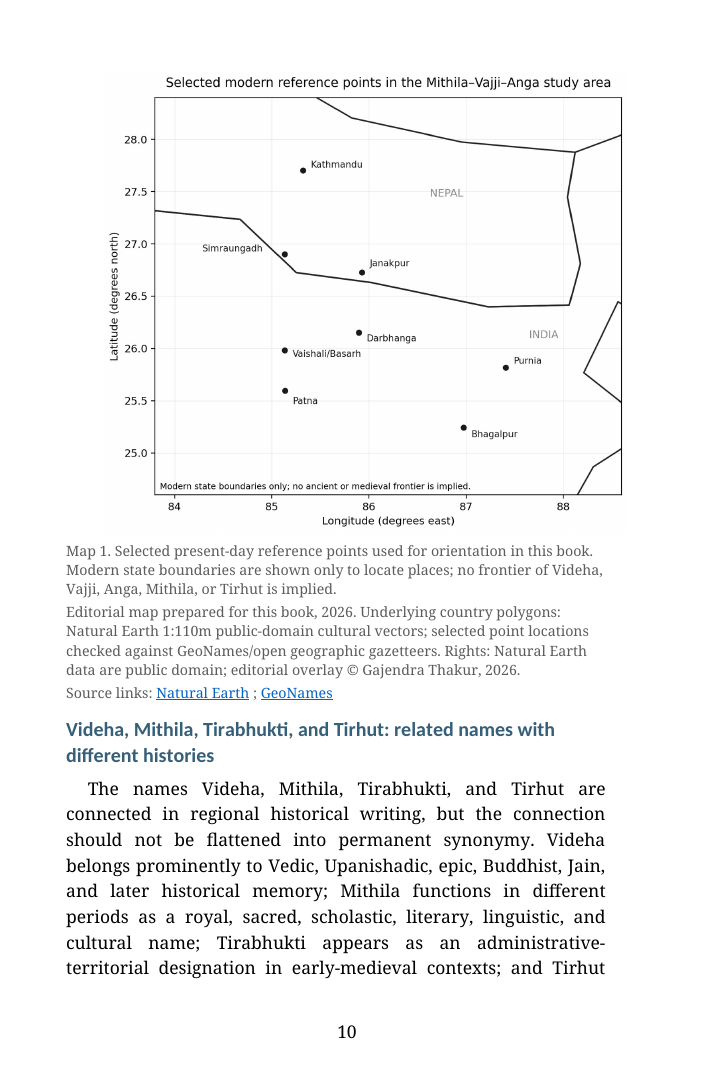
Mithila · Vajji · Anga
Chapter-specific source notes
- Primary chapter witness. Gajendra Thakur, Decoding the Panji of Mithila — Volume V, formal Chapter 25, PDF pp. 231-235; formal Chapter 25. The HTML transcription is generated from the commit-pinned source PDF and retains the chapter boundary recorded in this edition.
- Internal structure. The repository source-heading inventory records 9 subordinate headings for this chapter: “1. Where Chapter 25 begins”; “2. Manbodh, Babuk, Mangani Ram, Bhola, and Tilaknath”; “3. The daughter-lines of Tilaknath and the Chandranath branch”; “4. Nasira Haveli Deshe Pokharia: Indranath, Digambar, and Bhavesh”; “5. Mukund / Bhimdatt, Harimohan, Krishnamohan, and Shri Mohan”; “6. Harimohan’s moral-teacher line and the modern professional field”; “7. Shri Mohan, Lakshminath, Nidhinath, Gunanand, Gurunandan, and Bhairavlal”; “8. Branch summary”; ….
- Digital editorial method. The page keeps the preserved source text distinct from generated navigational, concordance, visual, and provenance apparatus. The synthetic reconstruction is explanatory only and is not evidence for an individual lineage or a determination of social or marital status.