Decoding the Panji of Mithila · Volume V · Chapter 24
Sodarpur Pu Mani Gramaramabh: Vishwanath, Gopinath, Batesh, Pashupati, Rameshwar, Ratnakar, Gondi, Krishn, Yagyapati,
Chapter 24 — Sodarpur Pu Mani
Gramaramabh: Vishwanath, Gopinath,
Batesh, Pashupati, Rameshwar,
Ratnakar, Gondi, Krishn, Yagyapati,
Lakshman, Modinath, Radhanath, and
Khajuri-Bhikhari Mishra
1. Where Chapter 24 begins
Chapter 24 begins at the clear village-opening formula “ अथ
सोदरपुर पु मानी ग्रामारम्भः.” This marks a fresh gramaramabh after
the Jagatpur-Mandar chapter. The heading places the register in
the Sodarpur-Mani field, and the first line immediately connects
the new material to a learned continuation: “ अपरा म॰म॰उ॰
विश्वनाथ सुत गोपीनाथः.”
The first genealogy therefore does not begin with a bare
individual; it begins with an “apara” continuation from
महामहोपाध्याय विश्वनाथ through गोपीनाथ. The record then folds in
the line of म॰म॰उ॰ बटे श, म॰म॰उ॰ पशुपति, and म॰म॰उ॰ रामेश्वर. This
is a compact opening, but it establishes three things at once:
descent from a learned household, the Sodarpur-Mani place-
marker, and the marriage web that connects this branch to
Balias, Alay, and further linked settlements.
2. Vishwanath, Gopinath, Batesh, Pashupati, and
Rameshwar
The opening movement reads Vishwanath’s son Gopinath
with a Balias-Krishna connection and an Alay-Shore connection.
The next statement attaches the learned Batesh-Pashupati line
and brings in Rameshwar. The notation “म॰म॰उ॰” is important
here because it identifies the scholarly standing of the lineage.
In this chapter, scholarly title and genealogy are inseparable:
Decoding the Panji of Mithila - Volume V | 225
title marks the social authority through which the branch is
remembered.
The register then introduces मिश्र रत्नाकर , also called हाउं . His
sons and associated names are given as कमलू , गोंढ़ि , शुभे , अन्दू ,
वीरू , and धीरू. The text groups the first three with Ekma - Balias
and Dube Ganapati , then links them through Takwal and
Madhav. The remaining three are attached to Yashanand -
Takwal , Keshav’s son Hardatt , Surgan , and Madhav. This
creates a two - part branch division under Ratnakar / Haun.
3. Gondi, Thegh, and the Mishra-Krishna branch
The Gondi branch produces Raghukrishna and Murari, with
Dih-Darhiara and Ratanu, and also a Karmaha-Ratikant link. A
separate Gondi son, थेघ, is tied to Patona-Khaual and Harpati’s
son Sone, then to Baheradahi and Virakhu. These short entries
show how the Sodarpur-Mani record moves outward by
recording both sons and their marriage destinations.
From मिश्र कृ ष्ण the source records Ramapati, Shripati,
Ratnapati, and Vidyapati, with a Budhwal-Hari-Dhiru
connection and a Rekoura-Sakaradhi-Ladau connection.
Ratnapati produces Yajyapati, also called Mutuk, tied with
Darhiara-Sudhakar-Gauri, and also with Pali and
Mahamahopadhyay Vachaspati. The line is not merely
biological: it preserves place, scholarly authority, and alternate
personal names side by side.
4. Yagyapati-Bhuttu, Lakshman, Matiram,
Gatiram, and the Durlabh line
A second Yagyapati, marked “भुट्टू ,” produces Purandar,
Lakshman, Vasudev, and Lakshmidev. The line then goes
through Kansa-Mandar, Devanath’s son Shrinath, Godhuli-Alay,
and Hari. The register also records Arundhati as a maternal or
daughter-line marker, reminding us again that women’s names
serve as branch-bridges in the Panji record.
Decoding the Panji of Mithila - Volume V | 226
Lakshman produces Matiram and Gatiram, linked with
Sakaradhi, Dasharath’s son Gangaram, Kujouli, and Lakhai.
Matiram produces Jagannath, Mahadev, and Raghunath.
Jagannath’s son Durlabh is then connected with Ullukujouli,
Thakur Ramabhadra’s son Thakur Devakinandan, Pandoli, and
Thakur Mohan. Through Surasari, Visheshwari, Katauna-
Mandar, Harpati’s son Hareram, and the lines of Subodh and
Madhurapati, the source preserves a dense cluster around
Durlabh, Subodh, Madhurapati, Kashidatt, Medhakar, Mahadev,
Nehal, and Hori.
5. Maani-Sodarpur: Khokha Radhanath Mishra
and the back-reference
The next internal heading reads “मानी सोदरपुर पु खोखा राधानाथ
मिश्र : पिछे देखें .” The phrase “पिछे देखें ” is a reading instruction. It
tells the Panji reader that the present line must be joined to an
earlier thread. The line runs from मिश्र कृ ष्ण to विद्यापति , then to
Modi / Modnath , and from Modnath to Bhavesh.
Bhavesh produces Chilka, and Chilka produces Kshatrapati,
connected with Darhiara, Jayaram, and Khanjanvati.
Kshatrapati produces Chakrapani and Baburam. Baburam’s line
is especially important because it yields Radhanath and
Jagannath, then links with Narwal, Phulchandra’s son Hiran,
Narun, and Dullah. In this section, Radhanath is both a named
descendant and a point of reattachment for the Khokha-Mishra
back-reference.
6. Haun-Ratnakar, Viru, Giru, Ganesh, and
Banmali
The source then returns to हाउं / रत्नकर through Viru , who
produces Giru and Ganesh. This branch is linked with Khaual ,
Harpati’s son Kaure , Baheradahi , and Gadadhar. Giru produces
Mukund , Jagannath , and Badhu , with Babhaniyam - Kulpati -
Vasaon and Ekma - Balias - Rupan connections.
Decoding the Panji of Mithila - Volume V | 227
Jagannath produces Savinand and Gangadhar. Gangadhar
produces Banmali and also Lakshman and Ravinath. Banmali
becomes a central node: one line reaches Chintamani’s son
Gopal through Anandika and Budhwal; another gives Gatiram
and Matiram, then Sakaradhi-Ratu-Budhai and Pavoli-Pathak
Madhav. Anandika’s son Bhikhari then becomes the bridge into
the Khajuri-Ju Bhikhari Mishra subsection.
7. Khajuri-Ju Bhikhari Mishra
The last subsection is “ खजूरी जू भिखारी मिश्र.” It begins from
Mishra Bhikhari’s children or branch-names: Jhingur, Bhuvan,
and Ranjana. The line is tied to Kachhra-Pali, Mahadev’s son
Vaid Govind, Oda-Ekhara, and Purandar. Jhingur produces
Digambar and Jhaban-Hasanu, with Neyam-Kujouli, Dhanapati’s
son Mahesh, Sakuri-Balias, and Bhairav.
Digambar produces Dinbandhu , who is linked with Budhwal ,
Ranjan’s grandson Gokulnath , and Manasukh. Dinbandhu
produces Nityanand and Sitanand , also called Naktu. Sitanand /
Naktu produces Dukhran / Dukhan , whose son Devanand is
placed at Purendaha and connected with Tatail - Sakaradhi and
Adhikalal. This closes the Sodarpur - Mani chapter through a
compact but socially extended Khajuri - Mishra branch.
8. Branch summary
Opening field: “अथ सोदरपुर पु मानी ग्रामारम्भः” opens the
Sodarpur-Mani register through Vishwanath, Gopinath,
Batesh, Pashupati, and Rameshwar.
Ratnakar / Haun branch : Kamalu , Gondi , Shubhe , Andu ,
Viru , Dhiru ; with separate Ekma - Balias , Takwal , Surgan ,
and Baheradahi links.
Mishra - Krishna branch : Ramapati , Shripati , Ratnapati ,
Vidyapati ; Ratnapati gives Yajyapati / Mutuk and the
Vachaspati connection.
Yagyapati-Bhuttu branch: Purandar, Lakshman, Vasudev,
Lakshmidev; Lakshman produces Matiram and Gatiram;
Matiram produces Jagannath, Mahadev, and Raghunath.
Decoding the Panji of Mithila - Volume V | 228
Durlabh branch: Durlabh, Subodh, Madhurapati, Kashidatt,
Medhakar, Nehal, Hori, and the Ullukujouli-Pandoli-Mani-
Sodarpur field.
Khokha Radhanath Mishra back-reference: Krishna,
Vidyapati, Modnath, Bhavesh, Chilka, Kshatrapati,
Chakrapani, Baburam, Radhanath, and Jagannath.
Haun-Viru branch: Giru, Ganesh, Mukund, Jagannath,
Badhu, Savinand, Gangadhar, Banmali, Lakshman, Ravinath,
Anandika, and Bhikhari.
Khajuri - Ju Bhikhari Mishra : Jhingur , Bhuvan , Ranjana ,
Digambar , Dinbandhu , Nityanand , Sitanand / Naktu ,
Dukhran / Dukhan , and Devanand.
9. Conclusion: the Sodarpur-Mani method of
joining learned title and village memory
Chapter 24 is a chapter of learned titles , alternate names , and
back - references. It begins with Mahamahopadhyay - linked
descent and then moves into smaller but dense sections under
Ratnakar / Haun , Gondi , Yagyapati , Lakshman , Radhanath
Mishra , Banmali , and Bhikhari Mishra. The chapter shows how
Panji memory preserves both prestige and practical alliance :
title identifies learned authority , while the दौ and place
formulas identify marital and settlement continuity.
The most important reading rule in this chapter is that
“पिछे देखें ” should not be ignored. It proves that the Panji is not a
simple page-by-page list; it is a linked register where later
headings repair, extend, and reconnect earlier branches. The
next chapter should begin at “अथ रै याम घोषियाम ग्रामारंभः,” where
the source leaves Sodarpur-Mani and opens the Raiyam-
Ghoshiyam field.
Decoding the Panji of Mithila - Volume V | 229Source structure and verification apparatus
Editorial source apparatus. This apparatus is descriptive, not interpretive. It records the source-controlled structure used to verify that this page corresponds to formal Chapter 24 of Decoding the Panji of Mithila — Volume V. The chapter text above is preserved from PDF pp. 226-230; formal Chapter 24 in the commit-pinned authoritative source. It is not merged with a neighboring chapter, appendix, annexure, or independent front/back-matter unit. The internal headings below come from the repository’s source-heading inventory and are retained as navigational and audit evidence; showing them here does not turn those headings into separate publications or add claims that are absent from the source.
Internal source headings
- 1. Where Chapter 24 begins
- 2. Vishwanath, Gopinath, Batesh, Pashupati, and Rameshwar
- 3. Gondi, Thegh, and the Mishra-Krishna branch
- 4. Yagyapati-Bhuttu, Lakshman, Matiram, Gatiram, and the Durlabh line
- 5. Maani-Sodarpur: Khokha Radhanath Mishra and the back-reference
- 6. Haun-Ratnakar, Viru, Giru, Ganesh, and Banmali
- 7. Khajuri-Ju Bhikhari Mishra
- 8. Branch summary
- 9. Conclusion: the Sodarpur-Mani method of joining learned title and village memory
Source-text concordance
Sodarpur · Mani · Gramaramabh · Vishwanath · Gopinath · Batesh · Pashupati · Rameshwar · Ratnakar · Gondi · Krishn · Yagyapati · Lakshman · Modinath · Radhanath · Khajuri-Bhikhari · Mishra · begins · clear · village-opening · formula · marks · fresh · Jagatpur-Mandar · heading · places · register · Sodarpur-Mani · field · first · line · immediately · connects · material · learned · continuation · genealogy · therefore · begin · bare · individual · apara · record · folds · compact · opening · establishes · three · things · descent · household · place · marker · marriage · branch · Balias · Alay · linked · settlements · movement · reads · Vishwanath’s · Balias-Krishna · connection · Alay-Shore · next · statement · attaches · Batesh-Pashupati · brings · notation · important · identifies · scholarly · standing · lineage · title · inseparable · Decoding · social
Boundary verification. In the formal sequence this chapter follows Volume V Chapter 23, “Jagatpur Pu Mandar- Chuna-Chu Pur Pu Belbadi: Nardev, Arjun, Gopal, Harikar, Jagannath, Vishwambhar, Rajora-Mandar” and precedes Volume V Chapter 25, “Raiyam Ghoshiyam Gramaramabh: Manbodh, Mangani Ram, Tilaknath, Chandranath, Nasira- Haveli Pokharia, Harimohan,”. The chapter extractor begins at the verified formal Chapter 24 marker and stops at the next verified formal chapter marker; for a final chapter it stops before recognized book-level back matter. The concordance above is generated only from distinct terms already present in this chapter’s preserved source text. It is provided for discovery, comparison, and audit, not as an automated judgment about persons, lineages, status, kinship, marriage eligibility, or historical truth.
Illustrated research apparatus
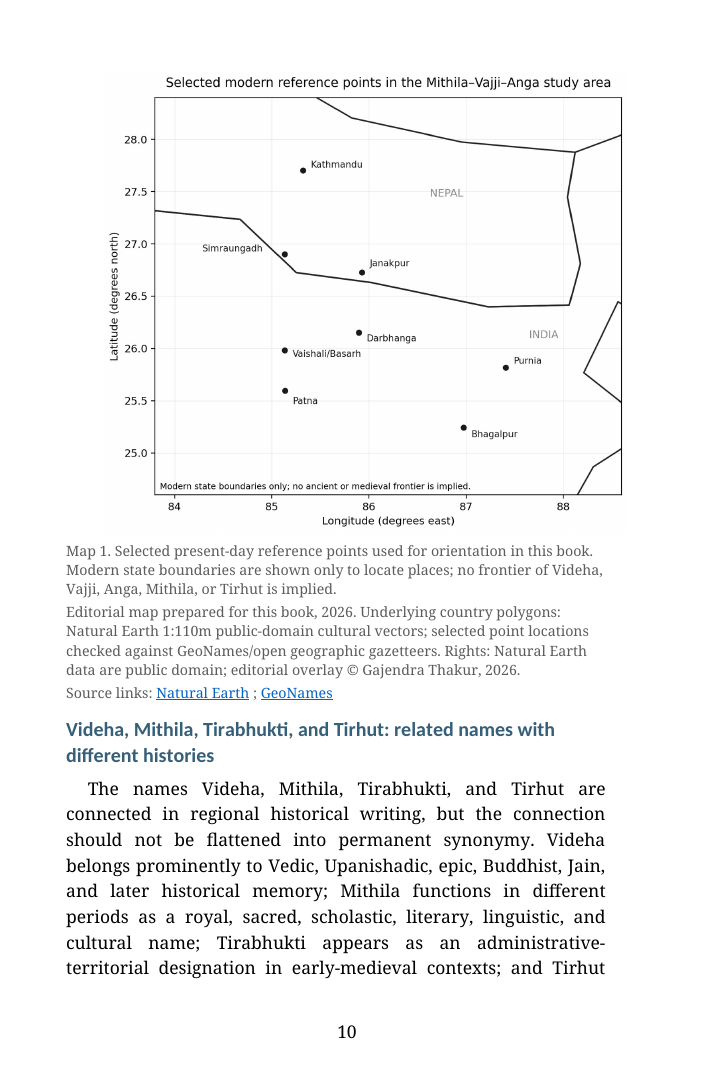
Mithila · Vajji · Anga
Chapter-specific source notes
- Primary chapter witness. Gajendra Thakur, Decoding the Panji of Mithila — Volume V, formal Chapter 24, PDF pp. 226-230; formal Chapter 24. The HTML transcription is generated from the commit-pinned source PDF and retains the chapter boundary recorded in this edition.
- Internal structure. The repository source-heading inventory records 9 subordinate headings for this chapter: “1. Where Chapter 24 begins”; “2. Vishwanath, Gopinath, Batesh, Pashupati, and Rameshwar”; “3. Gondi, Thegh, and the Mishra-Krishna branch”; “4. Yagyapati-Bhuttu, Lakshman, Matiram, Gatiram, and the Durlabh line”; “5. Maani-Sodarpur: Khokha Radhanath Mishra and the back-reference”; “6. Haun-Ratnakar, Viru, Giru, Ganesh, and Banmali”; “7. Khajuri-Ju Bhikhari Mishra”; “8. Branch summary”; ….
- Digital editorial method. The page keeps the preserved source text distinct from generated navigational, concordance, visual, and provenance apparatus. The synthetic reconstruction is explanatory only and is not evidence for an individual lineage or a determination of social or marital status.