Decoding the Panji of Mithila · Volume V · Chapter 27
Bhanupunur Pu Panichobh Gramaramabh: Ramdev, Thitho, Jiveshwar, Bhanukar, Chandrakar, Jivdhar, Shrinath, Hingu, Durgadatt, Narayandatt, Gangadhar, Anantram,
Chapter 27
Bhanupunur Pu Panichobh Gramaramabh:
Ramdev, Thitho, Jiveshwar, Bhanukar,
Chandrakar, Jivdhar, Shrinath, Hingu,
Durgadatt, Narayandatt, Gangadhar, Anantram,
Bhavdev, Ranjan, and the Ruchouli-Ekhara
Threshold
Decoded source span and focus:
• Source block decoded in this chapter
• This chapter begins with the formal heading “अथ भानुपुनुर पु पनिचोभ
ग्रामारम्भः.” It decodes the Panichobh register from Ramdev , Thitho , Gangesh ,
Mahesh , Jiveshwar , Bhanukar , Suryakar , Aditya , Ratnakar , Buddhikar , Gunakar ,
Matikar , Ravikar , Shrikar , Chandrakar , Jivdhar , Shrinath , Hiraram , Parashuram /
Parshi , Ugni , Hingu , Durgadatt , Narayandatt , Khadgamani , Shilanath ,
Gangadhar , Anantram , Bhavdev , Bhajan , Ranjan , and the later Koilakh -
Rashadhya close. It stops before “अथ रूचौलि एकहरा ग्रामारम्भः.”
Decoded source span and focus:
• Reading principle
• The heading marks a new village register , not a continuation of Sakuri - Belauch. The
grammatical sequence begins at Panichobh with Ramdev and moves through “ सुता”
clusters , father - son links , place tags , and marital transfers. The internal subheading
“पद्मपुर पु पनिचोभ सॅ धरमपुर पु देशे चिकनीः” is kept inside this chapter
because it continues the Ugni - Anantram and Bhavdev - Ranjan branch of the same
Panichobh field.
1. The Panichobh opening: Ramdev, Thitho,
Jiveshwar, and Bhanukar
The source opens with “पनिचोभ सॅ बीजी रामदेवः.” Ramdev gives Thitho ,
Gangesh , and Mahesh. Thitho then gives Jiveshwar , and Jiveshwar
gives Bhanukar , Suryakar , and Aditya. This establishes a compact first
Decoding the Panji of Mithila - Volume V | 240
descent : Ramdev to Thitho , Thitho to Jiveshwar , and Jiveshwar to the
Bhanukar - Suryakar - Aditya generation.
Bhanukar produces Ratnakar, linked with Bela-Sakaradhi and Hore.
Ratnakar’s descendants are Buddhikar, Gunakar, Matikar, and Ravikar,
connected with Bisfi and Shaktikar. Buddhikar produces Shrikar,
Chhitar, and Dinkar; Shrikar produces Chandrakar, Vibhakar, and
Venika. The passage therefore creates a scholarly-sounding name
sequence of “kar” endings, but the Panji grammar keeps it genealogical
rather than merely honorific.
Decoded source span and focus:
• Figure - Descendants / linked names - Genealogical value
• रामदेव - थिथो , गंगेश , महेश - Opening Panichobh root.
• थिथो - जीवेश्वर - Intermediate descent point.
• जीवेश्वर - भानुकर , सूर्यकर , आदित्य - Threefold developed branch.
• भानुकर - रत्नाकर - Bela - Sakaradhi and Hore link.
• रत्नाकर - बु द्धिकर , गुणाकर , मतिकर , रविकर - Bisfi - Shaktikar field.
• बु द्धिकर / श्रीकर - श्रीकर , छीतर , दिनकर ; चन्द्रकर , विभाकर , वेणी - The
named “kar” chain.
2. Chandrakar, Jivdhar, Shrinath, and the Belauch-
Haho expansion
Chandrakar produces Pithu and Jivdhar, linked with Tapanpur and
Vidu. The source adds daughters or marital links through Thakura and
Indra. Jivdhar then produces Shrinath, Ramnath, Harinath, another
Shrinath, Shashinath, Gondinath, and Padmanabh, all tied with Belauch
and Haho. This is a dense expansion in which the same root has multiple
male descendants, while the Belauch-Haho tag marks the social field of
the branch.
Shrinath’s descendants include Hiraram , Mahadev , Jagat , and Bhim ,
linked with Kusmal and Chaudhary Mahesh. Hiraram then gives Shriram
, Parashuram called Parshi , Devaram , Buddhiram , and Hariram , linked
with Bisfi and Keshav. Parashuram / Parshi gives Janaki , Ugni ,
Maniram , and Anantram , linked with Darhiara and Bhagwan. The
chapter’s main middle line emerges from Ugni.
Decoding the Panji of Mithila - Volume V | 241
3. Ugni, Hingu, Durgadatt, Narayandatt, and
Khadgamani
Ugni’s sons are Hingu and Madhusudan, linked with Darhiara and
Mahesh. Hingu gives Sitaram, Mayaram, and Ghanaram, tied to Katai,
Kamal, Mahav, and Krishnamani. Ghanaram produces Durgadatt and
Vishnudatt, linked with Ullukujouli, Rava, Patiram, Rava Harishwar,
Tatail-Sakaradhi, and Lala.
Durgadatt’s descendants are Narayandatt, Madhurapati, Kalidatt, and
Bhavanidatt. Their line is connected with Sihouli-Mandar, Rameshwar,
Abhinand, Devanand, Deep-Beharadhi, and Chaudhary Madhubani.
Narayandatt gives Parashmani, Khadgamani, and Harshmani, linked with
Oda-Ekhara, Bhaiya, Buddhianth, Mahishi-Budhwal, and Gonod.
Khadgamani produces Shilanath, Mahaval, and Dharanath, with
Bhadam-Jajival, Manik, Medhan, Dih-Darhiara, and Vidya as place or
marriage anchors.
Decoded source span and focus:
• Line - Names carried forward - Place - link / interpretation
• उगनी - हिंगू , मधुसूदन - Darhiara - Mahesh link.
• हिंगू - सीताराम , मयाराम , घनाराम - Katai - Kamal and Mahav - Krishnamani
field.
• घनाराम - दुर्गादत्त , विष्णुदत्त - Ullukujouli and Sakaradhi connections.
• दुर्गादत्त - नारायणदत्त , मधुरापति , कालीदत्त , भवानीदत्त - Sihouli - Mandar
and Deep - Beharadhi links.
• नारायणदत्त - परशमणि , खड्गमणि , हर्षमणि - Oda - Ekhara and Mahishi -
Budhwal links.
• खड्गमणि - शिलानाथ , महावल , धरानाथ - Bhadam - Jajival and Dih - Darhiara
continuation.
4. Shilanath, Gangadhar, Bhagwan Ji, and the
Hemnagar-Shantinagar-Purnia link
Shilanath produces Chandrashekhar and Gangadhar , linked with
Bhour - Khandwala , Gopinath , Amiyan , and Ramanath. Gangadhar is
then developed through Loknath , also called Babuaji , and through Kako
- Belauch , Kalar , Mushay / Bouku , Naruad - Karmaha , and
Decoding the Panji of Mithila - Volume V | 242
Pushpakant. The source also records Gangadhar’s connection through
Narsam - Baliyas , Teknath , Jankinath , Pali , Chanda , and a daughter -
line through Rajeshwari , Kamalvati , and Nirmala.
A second Gangadhar-linked daughter passage names Bhagwan Ji,
Chikni, Malangiya-Kujauli, Brajbhushan, Chandrabhushan, Shiva-
Hariam, and Dwarikanath. Bhagwan Ji then gives Manoj and Santosh,
linked with Purdendaha, Ratauli-Darhiara, Doman Datt, and Mahadev.
The line then records a Hemnagar-to-Shantinagar-Purnia note and a
Govind branch: Harikrishna and Govind, with Masuriya, Brahmapura,
Gosain Krishnamani, Gosain Manmohan, Tatail-Sakaradhi, and
Adhikalal. Govind’s descendants include Ashok, Sushil, and Anila,
linked with Bhudi and Garh-Khandwala.
5. Padmapur-Panichobh to Dharmapur-Desh
Chikni: Anantram and Bhavdev
The internal heading “पद्मपुर पु पनिचोभ सॅ धरमपुर पु देशे चिकनीः” keeps the
branch inside the broader Panichobh material while shifting place
emphasis. Here Ugni’s son Anantram gives Shukdev , Jaydev ,
Damodar , Balbhadra , and Bhavdev , linked with Darhiara and Mahesh.
Balbhadra produces Hardatt and Bhanudatt , connected through
Sakaradhi , Haridev , Shankar , Sakarhon , and Janai.
Bhavdev produces Bhajan and Ranjan, linked with Malangiya-Kujauli,
Sadanand, Yashodhar, Jalay, and Paramai. Bhajan gives Amritnarayan,
connected with Khaual, Chaudhary Hari, Dharu, Mahishi-Budhwal, and
Devi. The source then lists additional Bhajan descendants:
Ganganarayan, Ramnarayan, Shrinarayan, and Tulakrishna, tied to
Darhiara, Bhora, Chhaba, Pariyamb-Budhwal, and Menai. This branch
strongly uses Narayan-name continuities to show a later familial cluster.
6. Ranjan, Indranarayan, Chandranarayan,
Kirtinarayan, and the Koilakh-Rashadhya close
Ranjan’s descendants are Indranarayan, Chandranarayan, and
Kirtinarayan, linked with Khaual, Basudev, Vaidyanath, Jhauwa-Khalay,
and Shubhankar. Indranarayan produces Lakshminarayan and
Pratapanarayan, tied with Sakaradhi, Durlabh, Nitai, and Belauch-Bala.
Chandranarayan gives Lalitnarayan, Modnarayan, and Harshnarayan,
connected with Pawauli, Manbodh, Ghusaut, and Bhairavdatt.
Decoding the Panji of Mithila - Volume V | 243
Lalitnarayan’s line gives Santosh Narayan, also called Mushay, and
reconnects to Rajanpura-Darhiara through Rohini, Dullah, Vishnudatt,
Mahishi-Budhwal, Pathak Buna, and the Kanhouli-Ekhara line of
Halayudh, Baburam, and Buddhinath. Yadunath gives Muktinath,
Bholanath, Umanath, and Rishinath, linked with Deshual-Khandwala,
Dular, Chanan, Khikharu, Jahanpur, Khaual, and Pritinath. Kirtinarayan
gives Babuan, Babuan gives Ugranarayan, and Ugranarayan gives
Ramanand. The brief marker “कोइलख रशाढ.य” closes the block
immediately before the next formal heading.
7. Main branches decoded in this chapter
Panichobh root: Ramdev, Thitho, Gangesh, Mahesh, Jiveshwar, Bhanukar,
Suryakar, and Aditya.
Bhanukar-Ratnakar line: Buddhikar, Gunakar, Matikar, Ravikar, Shrikar,
Chandrakar, Vibhakar, Venika, Pithu, and Jivdhar.
Jivdhar - Shrinath line : Shrinath , Ramnath , Harinath , Shashinath ,
Gondinath , Padmanabh , Hiraram , Parashuram / Parshi , Ugni , and Hingu.
Durgadatt-Narayandatt line: Narayandatt, Madhurapati, Kalidatt,
Bhavanidatt, Parashmani, Khadgamani, Harshmani, Shilanath, Mahaval,
Dharanath, and Gangadhar.
Dharmapur-Chikni continuation: Anantram, Shukdev, Jaydev, Damodar,
Balbhadra, Bhavdev, Bhajan, Ranjan, Indranarayan, Chandranarayan,
Kirtinarayan, Yadunath, and Ramanand.
8. Chapter close and next threshold
The chapter closes after the Koilakh-Rashadhya marker and before
“अथ रूचौलि एकहरा ग्रामारम्भः.” The following heading begins a separate
Ruchouli-Ekhara register and should be decoded as Chapter 28.
Decoding the Panji of Mithila - Volume V | 244Source structure and verification apparatus
Editorial source apparatus. This apparatus is descriptive, not interpretive. It records the source-controlled structure used to verify that this page corresponds to formal Chapter 27 of Decoding the Panji of Mithila — Volume V. The chapter text above is preserved from PDF pp. 241-245; formal Chapter 27 in the commit-pinned authoritative source. It is not merged with a neighboring chapter, appendix, annexure, or independent front/back-matter unit. The internal headings below come from the repository’s source-heading inventory and are retained as navigational and audit evidence; showing them here does not turn those headings into separate publications or add claims that are absent from the source.
Internal source headings
- 1. The Panichobh opening: Ramdev, Thitho, Jiveshwar, and Bhanukar
- Decoded source span and focus:
- 2. Chandrakar, Jivdhar, Shrinath, and the Belauch-Haho expansion
- 3. Ugni, Hingu, Durgadatt, Narayandatt, and Khadgamani
- Decoded source span and focus:
- 4. Shilanath, Gangadhar, Bhagwan Ji, and the Hemnagar-Shantinagar-Purnia link
- 5. Padmapur-Panichobh to Dharmapur-Desh Chikni: Anantram and Bhavdev
- 6. Ranjan, Indranarayan, Chandranarayan, Kirtinarayan, and the Koilakh-Rashadhya close
- 7. Main branches decoded in this chapter
- 8. Chapter close and next threshold
Source-text concordance
Bhanupunur · Panichobh · Gramaramabh · Ramdev · Thitho · Jiveshwar · Bhanukar · Chandrakar · Jivdhar · Shrinath · Hingu · Durgadatt · Narayandatt · Gangadhar · Anantram · Bhavdev · Ranjan · Ruchouli-Ekhara · Threshold · Decoded · span · focus · block · begins · formal · heading · decodes · register · Gangesh · Mahesh · Suryakar · Aditya · Ratnakar · Buddhikar · Gunakar · Matikar · Ravikar · Shrikar · Hiraram · Parashuram · Parshi · Ugni · Khadgamani · Shilanath · Bhajan · later · Koilakh · Rashadhya · close · stops · एकहर · Reading · principle · marks · village · continuation · Sakuri · Belauch · grammatical · sequence · moves · clusters · father · links · place · tags · marital · transfers · internal · subheading · धरमप · kept · inside · continues · branch · field · opening · opens · gives · establishes
Boundary verification. In the formal sequence this chapter follows Volume V Chapter 26, “Sakuri Belauch Gramaramabh: Shivdas, Tivyakara, Keuntu, Purai, Gunakar, Ramkrishna, Devanand, Ratnapati-Jhingur, Gauridatt, Buddhinath, Rajkumar, Vasukinath,” and precedes Volume V Chapter 28, “Ruchouli Ekhara Gramaramabh: Jyotirvid Harishwar, Gunishwar, Hridayeshwar, Baburaiya, Vyakaran Ramchandra, Shrotriya Gangesh, Rajendra, Dharbharan, Vishwambhar,”. The chapter extractor begins at the verified formal Chapter 27 marker and stops at the next verified formal chapter marker; for a final chapter it stops before recognized book-level back matter. The concordance above is generated only from distinct terms already present in this chapter’s preserved source text. It is provided for discovery, comparison, and audit, not as an automated judgment about persons, lineages, status, kinship, marriage eligibility, or historical truth.
Illustrated research apparatus
Mithila · Vajji · Anga
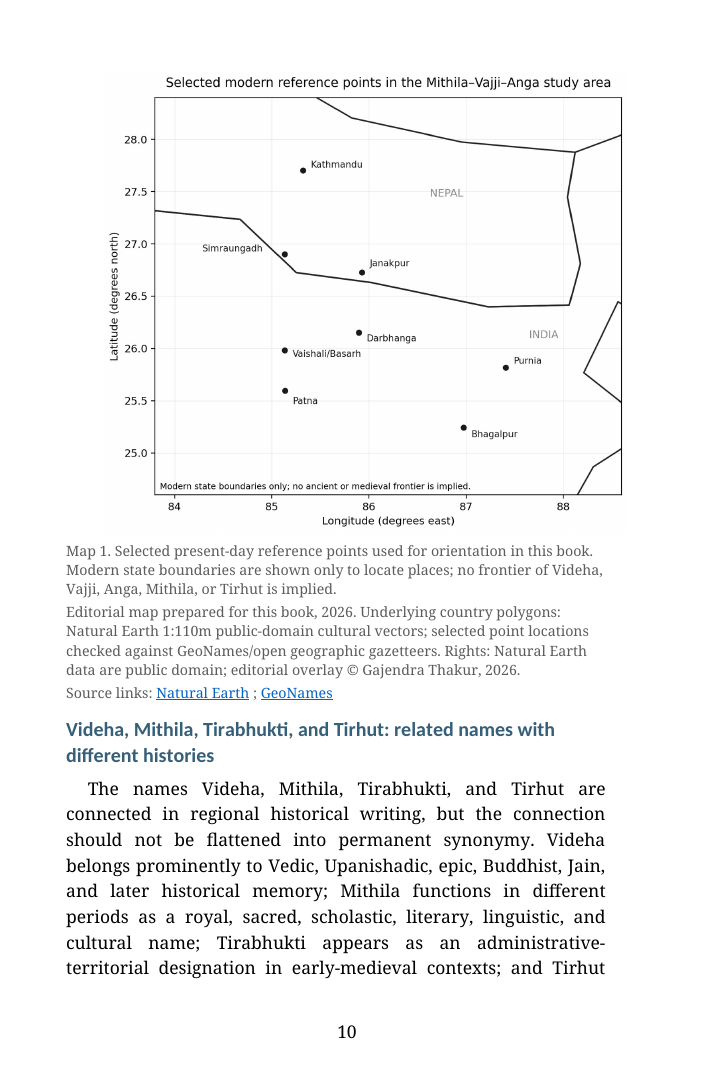
Chapter-specific source notes
- Primary chapter witness. Gajendra Thakur, Decoding the Panji of Mithila — Volume V, formal Chapter 27, PDF pp. 241-245; formal Chapter 27. The HTML transcription is generated from the commit-pinned source PDF and retains the chapter boundary recorded in this edition.
- Internal structure. The repository source-heading inventory records 10 subordinate headings for this chapter: “1. The Panichobh opening: Ramdev, Thitho, Jiveshwar, and Bhanukar”; “Decoded source span and focus:”; “2. Chandrakar, Jivdhar, Shrinath, and the Belauch-Haho expansion”; “3. Ugni, Hingu, Durgadatt, Narayandatt, and Khadgamani”; “Decoded source span and focus:”; “4. Shilanath, Gangadhar, Bhagwan Ji, and the Hemnagar-Shantinagar-Purnia link”; “5. Padmapur-Panichobh to Dharmapur-Desh Chikni: Anantram and Bhavdev”; “6. Ranjan, Indranarayan, Chandranarayan, Kirtinarayan, and the Koilakh-Rashadhya close”; ….
- Digital editorial method. The page keeps the preserved source text distinct from generated navigational, concordance, visual, and provenance apparatus. The synthetic reconstruction is explanatory only and is not evidence for an individual lineage or a determination of social or marital status.