Decoding the Panji of Mithila · Volume V · Chapter 28
Ruchouli Ekhara Gramaramabh: Jyotirvid Harishwar, Gunishwar, Hridayeshwar, Baburaiya, Vyakaran Ramchandra, Shrotriya Gangesh, Rajendra, Dharbharan, Vishwambhar,
Chapter 28
Ruchouli Ekhara Gramaramabh: Jyotirvid
Harishwar, Gunishwar, Hridayeshwar,
Baburaiya, Vyakaran Ramchandra, Shrotriya
Gangesh, Rajendra, Dharbharan, Vishwambhar,
Judge Rameshwar, and the Sulhani-Naraun
Threshold
Decoded source span and focus:
• Source block decoded in this chapter
• This chapter begins with the formal heading “अथ रूचौलि एकहरा ग्रामारम्भः.” It
decodes the Ruchouli - Ekhara register through Jyotirvid Harishwar , Mahopadhyay
Jyotirvid Gunishwar , Tula , Sona , Mahopadhyay Lochana , Hridayeshwar ,
Baburaiya , Vyakaran Ramchandra , Shrotriya Gangesh , Parashmani , Vanshamani ,
Rajendra , Dharbharan , Banamali , Shubhankar / Nirashan , Vishwambhar / Mulur ,
Judge Rameshwar , Parameshwar , Mohan , and the multi - marriage note of Mohan
Mishra. It stops before “अथ सुल्हसु नी नरउन ग्रामारम्भः.”
Decoded source span and focus:
• Reading principle
• The Ruchouli - Ekhara block is a self - contained village register. Its first section is
learned and title - heavy , with Jyotirvid , Mahopadhyay , Vyakaran , Shrotriya , and
later modern professional designations. The decoding therefore keeps the honorifics as
evidence of role and reputation while still reading the grammar as descent , marriage ,
place - transfer , and branch - continuity.
1. The Ruchouli-Ekhara opening: Jyotirvid
Harishwar and Gunishwar
The chapter opens with “ज्योतिर्विद हरिश्वर,” whose line gives
Mahopadhyay Jyotirvid Gunishwar, Tula, Sona, Mahopadhyay Lochana,
and a Hariam-linked connection through Shivdas and Jagannath. The
notation “जिनोम मैपिंग प्रथम खण्ड देखू” is a cross-reference to an earlier
Decoding the Panji of Mithila - Volume V | 245
mapping, but within this register the line continues through Gunishwar
and Hridayeshwar.
Jyotirvid Gunishwar gives Hridayeshwar, described as famous
Baburaiya, and connects with Mahamahopadhyay Vrindavan Chandra,
Pandua, Pandit Dhireshwar, Pali, and Jyotirvid Sonmani. The source also
records daughter or marital connections through Daiyani, Bunni, Dadana,
Sarisav, Hemangad, Hireshwar, Mandar, Shobhakar, and Pakhiyan. This
opening makes the Ruchouli-Ekhara register both genealogical and
scholarly.
Decoded source span and focus:
• Figure - Linked descendants / persons - Value in the register
• ज्योतिर्विद हरिश्वर - गुणीश्वर , तुला , सोना , लोचना - Opening learned
ancestor.
• गुणीश्वर - हृदयेश्वर - Carries the scholarly line forward.
• हृदयेश्वर / बबु रै या - रामचन्द्र , गंगेश , जयकान्त - Vyakaran and
Mahamahopadhyay field.
• दुलरै या - हेमकान्त - Moves into Bhakharouli - Kujauli and Alay links.
• ज्यो0 गंगेश - इन्द्रनाथ , दयानाथ , जानकीनाथ , ललितनाथ - Begins the
Shrotriya sub - line.
2. Hridayeshwar, Baburaiya, Vyakaran
Ramchandra, and the household bridges
The source then gives “मिश्र म॰म॰ हृदयेश्वर प्र0 बुबुरै या,” linking this figure
with Vyakaran Ramchandra, Gangesh, and Jayakant. The marriage links
pass through Kanhouli-Sodarpur, Mohan, Dhir, Darhiara, and Bhikhari.
The daughters Charumati, Bhanumati, and Gomati create further bridges:
Charumati through Mahishi-Pali and Bhikhari-Jayanand, Bhanumati
through Sarisav and Ganeshdatt, and Gomati through Sakaradhi and
Narayandatt.
Dularaiya produces Hemkant, connected with Bhakharouli-Kujauli,
Chhotku, Kulpati, Alay, and Mahi. This closes the first learned
subsection and leads into the explicit “श्रोत्रिय वंश,” where the Panji
changes from title-heavy memory to a more direct genealogical
progression.
Decoding the Panji of Mithila - Volume V | 246
3. Shrotriya Vansh: Gangesh, Chanan, Parashmani,
Vanshamani, and Rajendra
Under “श्रोत्रिय वंश,” Jyotirvid Gangesh gives Indranath, Dayanath,
Jankinath, and Lalitnath. The marriage field links to Mangrauni-Pali,
Pandit Dhanesh, Pandit Ramkrishna, Kujauli, and Kulpati. Tula gives
Chanan, tied to Karmaha and Bhikhari; Chanan gives Parashmani and
Vanshamani, connected with Karmaha, Chhavanu, Chitradhar, Pandua,
and Vanshidhar.
Parashmani’s descendants include Harshmani , Baggi / Jagatmani , and
Natthu. Harshmani produces Ghurghur , linked with Ratauli - Darhiara
and Kanti. Baggi / Jagatmani gives Laggi , who connects to Kala -
Balua , Behat - Karmaha , Mohan , and Poshan. Laggi then gives
Giranand , and Giranand gives Rajendra through Budhwal , Achammit ,
and Kunja Bihari. Rajendra then becomes the gateway into the
Dharmapur - Raghunathpur - Kala - Balua subsection.
Decoded source span and focus:
• Sub - line - Names carried forward - Decoded continuity
• गंगेश - इन्द्रनाथ , दयानाथ , जानकीनाथ , ललितनाथ - Shrotriya opening.
• तुला / चानन - पारशमणि , वंशमणि - Main descent into the Karmaha - Pandua
field.
• पारशमणि - हर्षमणि , जगतमणि / बग्गी , नत्थू - Branching through Bhour -
Khandwala and Ghusaut.
• जगतमणि / लग्गी - गिरानन्द , राजेन्द्र - Moves toward the Dharmapur - Kala -
Balua branch.
4. Dharmapur-Raghunathpur-Kala Balua:
Rajendra, Kamalanand, Dharbharan, and
Vishwambhar
The internal marker “धरमपुर पु देशे रघुना घु थपुरपु, काला बलुआलु” begins
with Rajendra’s descendants: Anil, Jyotish, Shashidhar, Chandrakishor,
Kalanand, and Panch Shekhar. These are linked with Rangara, Ekma-
Khandwala, Bachchu, Krishnamohan, and later with Brahmapura,
Krishnamani, and Dukhmochan through Kamalanand, Shyamanand,
Ramanand, and Chandrakishor.
Decoding the Panji of Mithila - Volume V | 247
The next internal subsection, “धरमपुर पु देशे रशाढ़् य वासीः,” develops
Vanshamani’s sons Dharbharan and Mohan. Dharbharan is connected
with Koilakh-Mailam, Nagwad-Ghosot, Dullah, Lakshman, Pandua,
Pandit Garib, Ratauli-Darhiara, Yadunath, Gopinath, and the notable
royal Beghani-Alay line: Raja Vedanand Singh, Raja Lilanand Singh,
Raja Kalanand Singh, and Raja Kirtyanand Singh Bahadur.
Dharbharan’s sons include Banamali and Shubhankar , also called
Nirashan , with Basundhar. Shubhankar / Nirashan gives Mulur or Raja ;
Vishwambhar / Mulur gives Shambhunath , Muktinath , Jayanath ,
Shashikant , Harikant , Naresh , Suresh , and Arun. The line then names
Pramod and Subodh under Shambhunath and Engineer Rohit under
Jayanath , showing the transition from hereditary register into modern
education and profession.
5. Judge Rameshwar, Parameshwar, Mohan
Mishra, and the eight-marriage note
The source records “सुप्रतिष्ठित न्यायाधीश रामेश्वर,” whose sons are Pankaj
and Pawan, linked with Parwaha, Behat-Khandwala, Brahmanand, and
related branches. Parameshwar gives Shankar and Dinkar; Dinkar
continues through Sultanpur-Deshe Ramnagar, Katauna-Mandar, Suresh,
Dilip, Kako-Belauch, and Liladhar. This is one of the modern-status
portions of the register, with judicial and engineering titles sitting beside
older Panji grammar.
Mohan’s branch is especially important because the source explicitly
says “मोहन मिश्रक आठ विवाह.” Mohan gives Sugan and Damodar, then
records multiple marriages or connections: Ratauli-Darhiara, Khandwala,
Parkhand-Beharadhi, Naruad-Karmaha, Shripur-Deshe Vishnupur,
Tatail-Sakaradhi, Badhiyaam-Pawauli, Hati-Sodarpur, Mahishi-
Budhwal, Satlakha-Satauli, and others. Sugan gives Yadunandan, linked
with Bengal-Deshe Bodhgram, Nagwad-Ghosot, Chitradhar,
Chandrashekhar, Kalishankar, Jafarapur, Badhiyaam-Pawauli, and
Parashmani. This final cluster closes the Ruchouli-Ekhara block.
Decoded source span and focus:
• Modern / status marker - Associated line - Why it matters
• अभियंता रोहित - Jayanath branch - Modern professional continuation inside the
Vishwambhar / Mulur line.
Decoding the Panji of Mithila - Volume V | 248
• प्रो॰ मुक्तिनाथ - Basundhar line - Academic / professional marker before
Rameshwar - Parameshwar.
• सुप्रतिष्ठित न्यायाधीश रामेश्वर - Pankaj , Pawan - Judicial distinction attached
to the Dharmapur - Rashadhya branch.
• मोहन मिश्रक आठ विवाह - Sugan , Damodar , Chaturanand , Gudari , and others -
Explicitly records repeated marriage alliances and branch spread.
6. Main branches decoded in this chapter
Ruchouli-Ekhara opening: Jyotirvid Harishwar, Jyotirvid Gunishwar, Tula,
Sona, Lochana, Hridayeshwar, and Baburaiya.
Learned line: Vyakaran Ramchandra, Gangesh, Jayakant, Charumati,
Bhanumati, Gomati, and Hemkant.
Shrotriya line: Gangesh, Indranath, Dayanath, Jankinath, Lalitnath, Chanan,
Parashmani, Vanshamani, Harshmani, Jagatmani, Laggi, Giranand, and
Rajendra.
Dharmapur-Kala-Balua line: Rajendra, Anil, Jyotish, Shashidhar,
Chandrakishor, Kalanand, Panch Shekhar, Kamalanand, Shyamanand, and
Ramanand.
Dharmapur - Rashadhya line : Dharbharan , Banamali , Shubhankar /
Nirashan , Vishwambhar / Mulur , Shambhunath , Muktinath , Jayanath ,
Rameshwar , Parameshwar , Mohan , and Sugan.
7. Chapter close and next threshold
The chapter closes after the note on Mohan Mishra’s eight marriages
and Sugan’s Bengal-Bodhgram continuation. The next formal heading,
“अथ सुल्हसु नी नरउन ग्रामारम्भः,” begins a new Sulhani-Naraun register and
should be treated as Chapter 29.
Decoding the Panji of Mithila - Volume V | 249Source structure and verification apparatus
Editorial source apparatus. This apparatus is descriptive, not interpretive. It records the source-controlled structure used to verify that this page corresponds to formal Chapter 28 of Decoding the Panji of Mithila — Volume V. The chapter text above is preserved from PDF pp. 246-250; formal Chapter 28 in the commit-pinned authoritative source. It is not merged with a neighboring chapter, appendix, annexure, or independent front/back-matter unit. The internal headings below come from the repository’s source-heading inventory and are retained as navigational and audit evidence; showing them here does not turn those headings into separate publications or add claims that are absent from the source.
Internal source headings
- 1. The Ruchouli-Ekhara opening: Jyotirvid Harishwar and Gunishwar
- Decoded source span and focus:
- 2. Hridayeshwar, Baburaiya, Vyakaran Ramchandra, and the household bridges
- 3. Shrotriya Vansh: Gangesh, Chanan, Parashmani, Vanshamani, and Rajendra
- Decoded source span and focus:
- 4. Dharmapur-Raghunathpur-Kala Balua: Rajendra, Kamalanand, Dharbharan, and Vishwambhar
- 5. Judge Rameshwar, Parameshwar, Mohan Mishra, and the eight-marriage note
- Decoded source span and focus:
- 6. Main branches decoded in this chapter
- 7. Chapter close and next threshold
Source-text concordance
Ruchouli · Ekhara · Gramaramabh · Jyotirvid · Harishwar · Gunishwar · Hridayeshwar · Baburaiya · Vyakaran · Ramchandra · Shrotriya · Gangesh · Rajendra · Dharbharan · Vishwambhar · Judge · Rameshwar · Sulhani-Naraun · Threshold · Decoded · span · focus · block · begins · formal · heading · एकहर · decodes · register · Mahopadhyay · Tula · Sona · Lochana · Parashmani · Vanshamani · Banamali · Shubhankar · Nirashan · Mulur · Parameshwar · Mohan · multi · marriage · note · Mishra · stops · नरउन · Reading · principle · self · contained · village · first · section · learned · title · heavy · later · modern · professional · designations · decoding · therefore · keeps · honorifics · evidence · role · reputation · still · grammar · descent · place · transfer · branch · continuity · Ruchouli-Ekhara · opening · opens · whose · line
Boundary verification. In the formal sequence this chapter follows Volume V Chapter 27, “Bhanupunur Pu Panichobh Gramaramabh: Ramdev, Thitho, Jiveshwar, Bhanukar, Chandrakar, Jivdhar, Shrinath, Hingu, Durgadatt, Narayandatt, Gangadhar, Anantram,” and precedes Volume V Chapter 29, “Sulhani Naraun Gramaramabh: Mahidhar, Udayakar, Ratnakar,”. The chapter extractor begins at the verified formal Chapter 28 marker and stops at the next verified formal chapter marker; for a final chapter it stops before recognized book-level back matter. The concordance above is generated only from distinct terms already present in this chapter’s preserved source text. It is provided for discovery, comparison, and audit, not as an automated judgment about persons, lineages, status, kinship, marriage eligibility, or historical truth.
Illustrated research apparatus
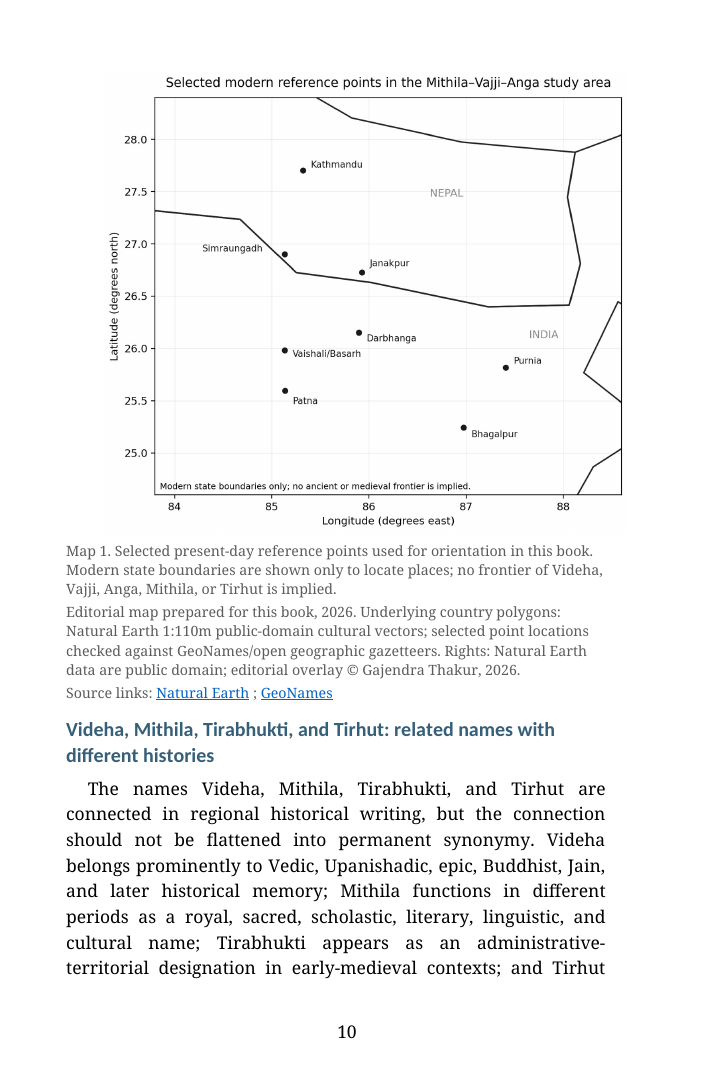
Mithila · Vajji · Anga
Chapter-specific source notes
- Primary chapter witness. Gajendra Thakur, Decoding the Panji of Mithila — Volume V, formal Chapter 28, PDF pp. 246-250; formal Chapter 28. The HTML transcription is generated from the commit-pinned source PDF and retains the chapter boundary recorded in this edition.
- Internal structure. The repository source-heading inventory records 10 subordinate headings for this chapter: “1. The Ruchouli-Ekhara opening: Jyotirvid Harishwar and Gunishwar”; “Decoded source span and focus:”; “2. Hridayeshwar, Baburaiya, Vyakaran Ramchandra, and the household bridges”; “3. Shrotriya Vansh: Gangesh, Chanan, Parashmani, Vanshamani, and Rajendra”; “Decoded source span and focus:”; “4. Dharmapur-Raghunathpur-Kala Balua: Rajendra, Kamalanand, Dharbharan, and Vishwambhar”; “5. Judge Rameshwar, Parameshwar, Mohan Mishra, and the eight-marriage note”; “Decoded source span and focus:”; ….
- Digital editorial method. The page keeps the preserved source text distinct from generated navigational, concordance, visual, and provenance apparatus. The synthetic reconstruction is explanatory only and is not evidence for an individual lineage or a determination of social or marital status.