Decoding the Panji of Mithila · Volume V · Chapter 34
Badhiyam Pawauli Gramaramabh: Nasira-Haveli Sauria, Ravidatt,
Chapter 34
Badhiyam Pawauli Gramaramabh: Nasira-Haveli Sauria, Ravidatt,
Bhagirath, Jagannath, Janardan, Vishwanath, Ram, Ramchandra,
Ratinath, Kamal, Narayan, Manorath, Rajaram, and the Devhar
Threshold
1. The Badhiyam-Pawauli opening under Nasira-Haveli
Sauria
The chapter begins with the formal village heading “ अथ बढ़ि याम पवौली
ग्रामारम्भः.” The source places the register in “नशिरा (हवेली) देशे सौरिया,”
so the entry should be read as a Badhiyam-Pawauli village-start that also
carries a Nasira-Haveli country marker. The first operative ancestor is
Ravidatt, whose son is Bhagirath. Bhagirath is linked with Khaual through
Sone, and his sons are Jagannath and Janardan.
The first descent then moves through Jagannath to Vishwanath.
Vishwanath is tied to Budhwal through Ram, while his son Ram is linked
with Baigani-Alay and Mandan-Hari. A second son, Ramchandra, is linked
with Pali through Gadu and with Sodarpur through Vasudev. The structure is
brief, but it preserves three kinds of evidence: direct descent, marriage
alliances, and repeated place-circuits.
2. Ratinath, Kamal, and the Simarwad-Khaual connection
The next son of Vishwanath is Ratinath. Ratinath is placed through
Pandoli-Darhiara with Pitambar’s son Madhusudan. Ratinath’s son Kamal
then becomes the central node of the next passage, with Sudaay-Belauch,
Gaurinath, Vishwanath, and Baheradhi-Harakhu as linked names and places.
Kamal’s line records Govind, Pitambar, and Moti, and then attaches them to
Simarwad-Khaual through Rambhadra’s son Paduma.
The entry also records an additional Ratinath group: Nath, Manohar,
Paran, Shubhankar, Sundar, and Anand. These names are connected with
Majhaura-Karmaha through Chaudhary Jagannath’s son Lakshminath, and
with Talhanpur through Chatur. This makes the Badhiyam-Pawauli entry a
small but dense connector between Nasira-Haveli, Khaual, Belauch,
Darhiara, Karmaha, and Talhanpur.
3. Bachhna, Narayan, Manorath, Rajaram, and the close of
the entry
The closing passage records Bachhna and his issue: Jeevan and
Navagraha. Through Jalay, Babu’s son Chan is named in relation to the
Decoding the Panji of Mithila - Volume V | 263
wife-line; then Nath’s son Narayan is connected with Singholia-Mandar
through Dasharath. The wording is compressed, but the principle remains
the same: the register uses a short descent formula and immediately attaches
it to marriage geography.
The final line turns to Manorath and Rajaram. Manorath’s son Rajaram is
linked with Panichobh through Banmali. Narayan’s sons are Ramakant,
Kalidas, and Nanuka, linked with Sakaradhi through Ramkrishna and with
Didhoy through Shyam. The passage closes with Lalita’s issue, after which
the source moves to a new formal heading: “अथ देवहार देवहार मूल मू
ग्रामारम्भः.”
4. Main branches decoded in this chapter
Opening descent : Ravidatt , Bhagirath , Jagannath , Janardan ,
Vishwanath , Ram , and Ramchandra under the Badhiyam - Pawauli /
Nasira - Haveli - Sauria frame.
Ratinath line: Ratinath, Kamal, Govind, Pitambar, Moti, Rambhadra,
Paduma, and the Sudaay-Belauch and Simarwad-Khaual links.
Additional Ratinath group : Nath , Manohar , Paran , Shubhankar ,
Sundar , Anand , Lakshminath , and the Majhaura - Karmaha /
Talhanpur links.
Closing line: Bachhna, Jeevan, Navagraha, Narayan, Manorath,
Rajaram, Ramakant, Kalidas, Nanuka, Ramkrishna, Shyam, and Lalita’s
issue.
5. Chapter close and next threshold
Chapter 34 is a short village-start chapter, but it is genealogically useful
because it connects Badhiyam-Pawauli to the larger Nasira-Haveli and
Khaual-Darhiara-Belauch-Karmaha network. It stops before the next formal
heading, “अथ देवहार देवहार मूल मू ग्रामारम्भः,” which should begin
Chapter 35.
Decoding the Panji of Mithila - Volume V | 264Source structure and verification apparatus
Editorial source apparatus. This apparatus is descriptive, not interpretive. It records the source-controlled structure used to verify that this page corresponds to formal Chapter 34 of Decoding the Panji of Mithila — Volume V. The chapter text above is preserved from PDF pp. 264-265; formal Chapter 34 in the commit-pinned authoritative source. It is not merged with a neighboring chapter, appendix, annexure, or independent front/back-matter unit. The internal headings below come from the repository’s source-heading inventory and are retained as navigational and audit evidence; showing them here does not turn those headings into separate publications or add claims that are absent from the source.
Internal source headings
- 2. Ratinath, Kamal, and the Simarwad-Khaual connection
- 3. Bachhna, Narayan, Manorath, Rajaram, and the close of the entry
- 4. Main branches decoded in this chapter
- 5. Chapter close and next threshold
Source-text concordance
Badhiyam · Pawauli · Gramaramabh · Nasira-Haveli · Sauria · Ravidatt · Bhagirath · Jagannath · Janardan · Vishwanath · Ramchandra · Ratinath · Kamal · Narayan · Manorath · Rajaram · Devhar · Threshold · Badhiyam-Pawauli · opening · begins · formal · village · heading · places · register · entry · read · village-start · carries · country · marker · first · operative · ancestor · whose · linked · Khaual · Sone · sons · descent · moves · tied · Budhwal · Baigani-Alay · Mandan-Hari · second · Pali · Gadu · Sodarpur · Vasudev · structure · brief · preserves · three · kinds · evidence · direct · marriage · alliances · repeated · place-circuits · Simarwad-Khaual · connection · next · placed · Pandoli-Darhiara · Pitambar’s · Madhusudan · Ratinath’s · becomes · central · node · passage · Sudaay-Belauch · Gaurinath · Baheradhi-Harakhu · names · Kamal’s · line
Boundary verification. In the formal sequence this chapter follows Volume V Chapter 33, “Gangora Budhwal Gramaramabh: Gondwara-Phulbadiya, Haveli- Radheli, Lotan, Rudra, Rangai, Rameshwar, Shivdatt, Pitambar, Dharanath, Khushi, Domai, Bhola, Rajendra, and the Aamdanda Close” and precedes Volume V Chapter 35, “Devhar Devhar Mul-Mu Gramaramabh: Jaykar, Sagar, Matikar,”. The chapter extractor begins at the verified formal Chapter 34 marker and stops at the next verified formal chapter marker; for a final chapter it stops before recognized book-level back matter. The concordance above is generated only from distinct terms already present in this chapter’s preserved source text. It is provided for discovery, comparison, and audit, not as an automated judgment about persons, lineages, status, kinship, marriage eligibility, or historical truth.
Illustrated research apparatus
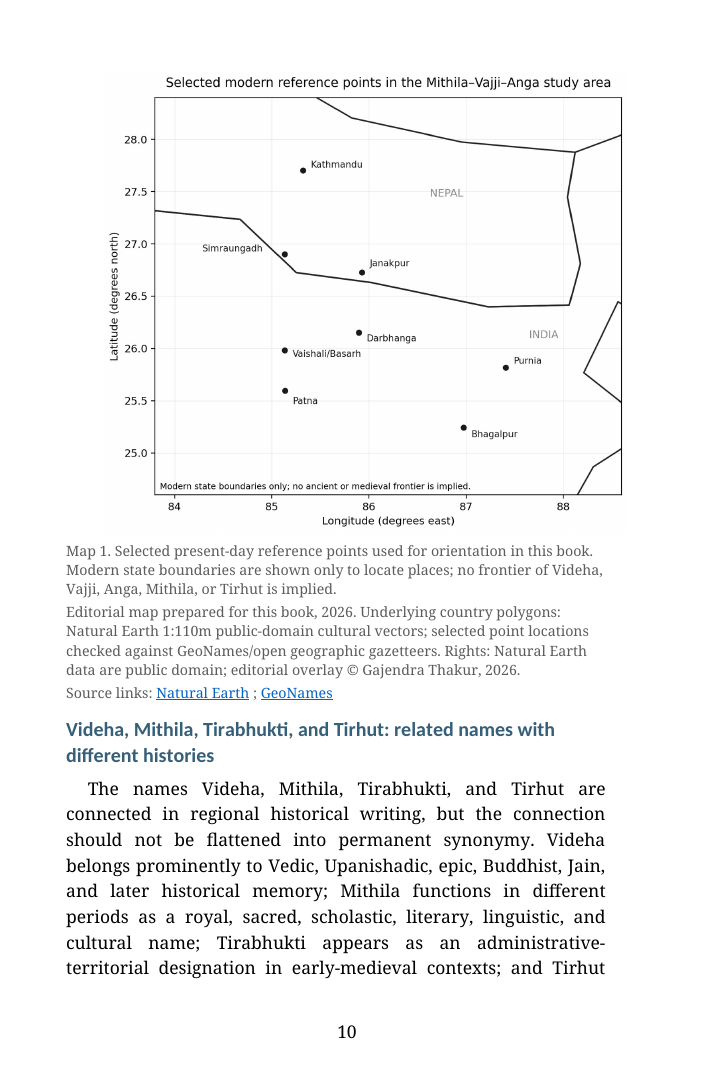
Mithila · Vajji · Anga
Chapter-specific source notes
- Primary chapter witness. Gajendra Thakur, Decoding the Panji of Mithila — Volume V, formal Chapter 34, PDF pp. 264-265; formal Chapter 34. The HTML transcription is generated from the commit-pinned source PDF and retains the chapter boundary recorded in this edition.
- Internal structure. The repository source-heading inventory records 4 subordinate headings for this chapter: “2. Ratinath, Kamal, and the Simarwad-Khaual connection”; “3. Bachhna, Narayan, Manorath, Rajaram, and the close of the entry”; “4. Main branches decoded in this chapter”; “5. Chapter close and next threshold”.
- Digital editorial method. The page keeps the preserved source text distinct from generated navigational, concordance, visual, and provenance apparatus. The synthetic reconstruction is explanatory only and is not evidence for an individual lineage or a determination of social or marital status.