Decoding the Panji of Mithila · Volume V · Chapter 35
Devhar Devhar Mul-Mu Gramaramabh: Jaykar, Sagar, Matikar,
Chapter 35
Devhar Devhar Mul-Mu Gramaramabh: Jaykar, Sagar, Matikar,
Lakshmikar, Gunakar, Kameshwar, Rajoo, Haldhar, Narsingh,
Brahmeshwar, Umapati, Narayan, Haradatt, Krishnadev, Nehal,
Sitaram, Virnarayan, Ramdular, Khadganarayan, and the Shandilya-
Brahmpura Threshold
1. The Devhar village-start and the first descent
The source opens this register with the formal heading “ अथ देवहार
देवहार मूल मू ग्रामारम्भः.” It places the line in the Devhar field and begins
from Vesual-Devhar with Viji Jaykar. The descent is compressed but clear:
Jaykar has Sagar, Sagar has Matikar, Matikar has Lakshmikar, and
Lakshmikar has Gunakar. Gunakar then produces the named branch-set
Vatseshwar, Javeshwar, and Kameshwar.
Kameshwar is the first practical branching node. His sons are Rajoo and
Haldhar, linked with Visphi through Horai. Haldhar then carries the next
names Narsingh, Jaysingh, and Harisingh, with the Allari alliance through
Ray Shivpati. The passage is important because it binds the Devhar line to
Visphi, Allari, and later Nikhuati and Panichobh circuits.
2. Narsingh, Brahmeshwar, Umapati, and Narayan
The strongest continuation in this short chapter runs through Narsingh.
Narsingh has Brahmeshwar, and Brahmeshwar has Umapati. Umapati is tied
to Soini through Karu, and his daughter-line names Sita, Radha, and Durga.
The marriage links are wide: Allari through Parameshwar, Harisinghpur-
Nikhuati through Harikar’s son Ramapati, and Padmapur-Panichobh through
Hari’s son Vishwanath.
Umapati’s son Narayan is linked with Jalay through Ramkar’s son Kashi,
and with Nikhuati through Gondhi. Narayan’s sons Haradatt and Ratidatt
form the next branch. Haradatt leads to Krishnadev, Ramdev, Lakshmidev,
and Shivdev; their connection with Nikhuati through Paran keeps the Devhar
descent moving through a recurring scholastic and marriage network.
3. Krishnadev, Nehal, Sitaram, and Virnarayan
Krishnadev’s line passes through Nehal and Shukdev. Nehal’s named
descendants are Sitaram, Nanu, Shambhu, and Digambar, linked with
Didhoy through Panai’s son Shiv and with Dosti through Kashi. This is one
of the places where the text uses clustered names to preserve a branch rather
than narrating every intervening generation.
Decoding the Panji of Mithila - Volume V | 265
Sitaram becomes the next important node. His sons are Virnarayan and
Bhagirath. The text places them through Loam-Surgan, where Ghanshyam’s
son Lalmani is named, and through Nikhuati with Vir. Virnarayan’s
daughter-line names Chandni and Roopa. Chandni is linked with Ratauli-
Darhiara through Dukharu’s son Narayandatt, while Roopa is linked with
Oini through Bhagirath’s son Gunanand.
4. Ramdular, Khadganarayan, and the closing branch
Virnarayan’s sons are Ramdular, Haridayal, Ganesh, and Dhanpati. The
Ramdular branch is the final substantial part of the chapter. It connects
Vasam through Kali Prasad and records the daughter-line Champa, Ramo,
Hira, Mayna, and Tota. Their marriage network touches Khandwala, Kako-
Belauch, Panichobh, and Nagurdatt, and it identifies Lakshmikant as a son in
the Indranarayan-linked branch.
Ramdular’s sons are Khadganarayan, Paramanand, Indrakant, Brajlal,
and Meghnath, tied to Gangor through Dina’s son Vaidyanath and to
Mandar through Nilmani. Khadganarayan then leads to Baun, Siddhinath,
and Ghanshyam, linked with Didhoy through Vishwanath’s son Madan. The
Devhar chapter ends here, immediately before the new Shandilya-Gotra
Brahmpura heading.
5. Main branches decoded in this chapter
Opening descent: Jaykar, Sagar, Matikar, Lakshmikar, Gunakar,
Vatseshwar, Javeshwar, Kameshwar, Rajoo, and Haldhar.
Narsingh line: Narsingh, Brahmeshwar, Umapati, Narayan, Haradatt,
Ratidatt, Krishnadev, Ramdev, Lakshmidev, and Shivdev.
Nehal-Sitaram line: Nehal, Shukdev, Sitaram, Nanu, Shambhu,
Digambar, Virnarayan, Bhagirath, Chandni, and Roopa.
Ramdular close: Ramdular, Haridayal, Ganesh, Dhanpati,
Khadganarayan, Paramanand, Indrakant, Brajlal, Meghnath, Baun,
Siddhinath, and Ghanshyam.
6. Chapter close and next threshold
Chapter 35 is short , but it gives a complete Devhar village - start and
connects Devhar with Visphi , Allari , Nikhuati , Panichobh , Jalay ,
Didhoy , Loam - Surgan , Ratauli - Darhiara , Oini , Gangor , and Mandar.
The next source heading is “ शाण्डिल्य गोत्रे ब्र ह्मपुरा पु सॅ कोबरा (कोहबरा)
मसुरिसु या , ” which should begin Chapter 36.
Decoding the Panji of Mithila - Volume V | 266Source structure and verification apparatus
Editorial source apparatus. This apparatus is descriptive, not interpretive. It records the source-controlled structure used to verify that this page corresponds to formal Chapter 35 of Decoding the Panji of Mithila — Volume V. The chapter text above is preserved from PDF pp. 266-267; formal Chapter 35 in the commit-pinned authoritative source. It is not merged with a neighboring chapter, appendix, annexure, or independent front/back-matter unit. The internal headings below come from the repository’s source-heading inventory and are retained as navigational and audit evidence; showing them here does not turn those headings into separate publications or add claims that are absent from the source.
Internal source headings
- 2. Narsingh, Brahmeshwar, Umapati, and Narayan
- 3. Krishnadev, Nehal, Sitaram, and Virnarayan
- 4. Ramdular, Khadganarayan, and the closing branch
- 5. Main branches decoded in this chapter
- 6. Chapter close and next threshold
Source-text concordance
Devhar · Mul-Mu · Gramaramabh · Jaykar · Sagar · Matikar · Lakshmikar · Gunakar · Kameshwar · Rajoo · Haldhar · Narsingh · Brahmeshwar · Umapati · Narayan · Haradatt · Krishnadev · Nehal · Sitaram · Virnarayan · Ramdular · Khadganarayan · Shandilya · Brahmpura · Threshold · village-start · first · descent · opens · register · formal · heading · places · line · field · begins · Vesual-Devhar · Viji · compressed · clear · produces · named · branch-set · Vatseshwar · Javeshwar · practical · branching · node · sons · linked · Visphi · Horai · carries · next · names · Jaysingh · Harisingh · Allari · alliance · Shivpati · passage · important · binds · later · Nikhuati · Panichobh · circuits · strongest · continuation · short · runs · tied · Soini · Karu · daughter-line · Sita · Radha · Durga · marriage · links
Boundary verification. In the formal sequence this chapter follows Volume V Chapter 34, “Badhiyam Pawauli Gramaramabh: Nasira-Haveli Sauria, Ravidatt,” and precedes Volume V Chapter 36, “Shandilya-Gotre Brahmpura Pu Sako(b)ra-Kobara, Masuria- Alay: Delhan, Kanh, Ram, Vishweshwar, Shrinath, Dharmnath, Vidyadhar, Yashodhar, Chintamani, Narhari, Dharmeshwar, Jaydev, Rupnarayan, Harikrishna, Krishnanand, Acharya”. The chapter extractor begins at the verified formal Chapter 35 marker and stops at the next verified formal chapter marker; for a final chapter it stops before recognized book-level back matter. The concordance above is generated only from distinct terms already present in this chapter’s preserved source text. It is provided for discovery, comparison, and audit, not as an automated judgment about persons, lineages, status, kinship, marriage eligibility, or historical truth.
Illustrated research apparatus
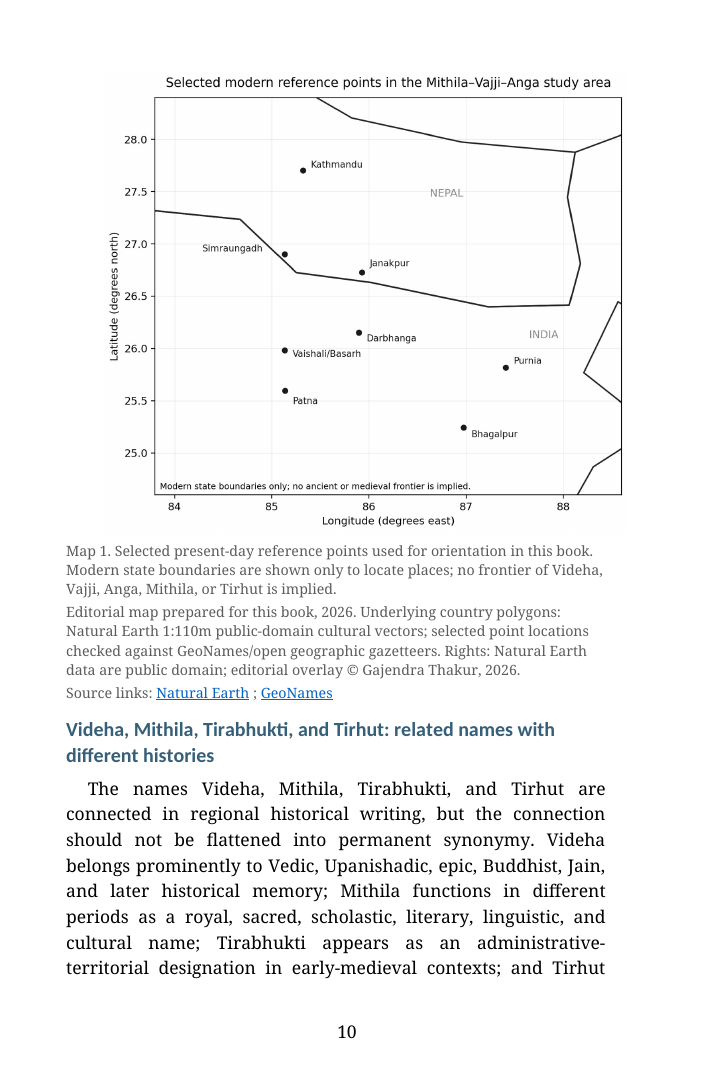
Mithila · Vajji · Anga
Chapter-specific source notes
- Primary chapter witness. Gajendra Thakur, Decoding the Panji of Mithila — Volume V, formal Chapter 35, PDF pp. 266-267; formal Chapter 35. The HTML transcription is generated from the commit-pinned source PDF and retains the chapter boundary recorded in this edition.
- Internal structure. The repository source-heading inventory records 5 subordinate headings for this chapter: “2. Narsingh, Brahmeshwar, Umapati, and Narayan”; “3. Krishnadev, Nehal, Sitaram, and Virnarayan”; “4. Ramdular, Khadganarayan, and the closing branch”; “5. Main branches decoded in this chapter”; “6. Chapter close and next threshold”.
- Digital editorial method. The page keeps the preserved source text distinct from generated navigational, concordance, visual, and provenance apparatus. The synthetic reconstruction is explanatory only and is not evidence for an individual lineage or a determination of social or marital status.