Decoding the Panji of Mithila · Volume VI · Chapter 1
What Is Panji? The Archive of Mithila’s Social Memory Opening To decode Dushan Panji, one must first understand Panji
Chapter 1

What Is Panji? The Archive of Mithila’s
                        Social Memory
Opening
   To decode Dushan Panji, one must first understand Panji
itself. A reader who approaches the Dushan entries only as a
list of defects will misunderstand both the record and the
society that produced it. Dushan Panji is one part of a larger
record-system. It cannot be read properly unless that larger
system is first made visible.
   The source text begins with a concise but decisive
classification: “पञ्जी सात प्रकारक होइत आछि”—Panji is of seven
kinds. These seven are मूल, शाखा, गोत्र, पत्र, दूषण, उतेढ़, and अस्वाजन्यपत्र.
This list is not a casual enumeration. It is the grammar of the
whole archive. Each kind of Panji answers a different question:
Where did the line begin? How did it branch? What gotra and
mool does it carry? What descendants and root-villages are
recorded? Where did rupture enter? How far is sapinda
relation removed? Is a proposed alliance swajana or aswajana?
   The word Panji, therefore, must be understood as a system,
not merely as a manuscript. It is genealogy, legal-social record,
ritual guide, marriage information system, and historical
archive at once. In Panji, a name is rarely only a name. A name
may carry a mool, a village-memory, a father, a mother, a
daughter-line, a marriage-house, a scholarly title, an office, a
route of migration, or a memory of social disturbance.

The Seven Kinds of Panji
   The first kind is मूल पञ्जी, Mool Panji. Mool means root, origin,
or foundational lineage-marker. In Mithila’s genealogical

                          © Gajendra Thakur | 9
                Decoding the Panji of Mithila, Volume VI

vocabulary, mool connects a family to a remembered source-
place or ancestral root. It is not simply a modern village
address. It is a memory-anchor through which a person is
located inside a larger kinship map.
  The second kind is शाखा पञ्जी, Shakha Panji. Shakha means
branch. The source explains that before the order associated
with Darbhanga ruler Madhav Singh, the Mool Panjis were
prepared in a common form. Later, separate branch books
emerged for categories such as Soti, Jog, and Panjibaddha. This
shows that hierarchy and branch-division developed
historically. They were not eternal facts outside time.
  The third kind is गोत्र पञ्जी, Gotra Panji. Gotra is often
translated as lineage, clan, or descent from an ancient rishi, but
none of these words is sufficient by itself. In the Panji context,
gotra works with pravara, mool, and sapinda logic to determine
marriage eligibility and ritual relation.
  The fourth kind is पत्र पञ्जी, Patra Panji. Patra Panji is said to
have been in use for about five hundred years and began to
include the mention of मूलग्राम, the root-village. Patra Panji is
especially important because it connects family memory to
place-memory. Through it, genealogy becomes geographic.
  The fifth kind is दूषण पञ्जी, Dushan Panji. The source says that
Dushan Panji contains the record of “वंशमे आएल क्षरण”—erosion,
rupture, irregularity, or socially marked disturbance that
entered a lineage. This is the part of Panji that the present
volume decodes. But even here, the word dushan must not be
read crudely as permanent condemnation. The entries preserve
a social event, a relation, or a marked route that later
generations had to understand.
  The sixth kind is उतेढ़ पञ्जी, Uthedh Panji. Uthedh gives
knowledge of sapinda removal or generational distance. It
helps determine whether two persons fall within a prohibited
kinship range. The source states that Uthedh gives the mention

                       © Gajendra Thakur | 10
                Decoding the Panji of Mithila, Volume VI

of six ancestors. In the larger Panji logic, this is part of the
technical apparatus through which marriage eligibility was
judged.
  The seventh kind is अस्वाजन्यपत्र पञ्जी, or the record connected
with अस्वजन पत्र / सिद्धान्त पत्र. Swajana means one’s own kin within
the prohibited range. Aswajana means outside that prohibited
relation. A Siddhanta or Aswajana record therefore has
practical legal-social value: it helps determine whether a
marriage alliance may proceed.

Panji as a Civilizational Archive
   The source text insists that Panji was not begun merely to
seek marriage rights. During the work of copying and
transliterating old Panjis, the author found evidence of
Mithila’s high historical consciousness: educational status,
dharma-shastra reasoning, literary capacity, artistic skill, titles,
offices, migration, and relationship networks. Panji is therefore
not only a caste document. It is a civilizational archive of
Mithila.
   A normal genealogy might say that one person was the son
of another. Panji often says much more. It may place the person
in a gotra, mool, branch, village, scholarly title, office, marriage
relation, maternal line, daughter-line, or descendant route. It
may also preserve the memory of migration, a change of
settlement, a contested alliance, or a social rupture.
   For this reason, the book must not reduce Panji to caste
alone. Caste is certainly present, and often present painfully.
But Panji also records scholarship, movement, social
negotiation, memory, loss, and correction. It records how
families wished to be known and how society chose to
remember them.

                       © Gajendra Thakur | 11
               Decoding the Panji of Mithila, Volume VI

Mithilakshar, Devanagari, and the Preservation
Question
   The files repeatedly show that old Panji material was written
in Mithilakshar, also called Tirhuta. Many later readers know
Devanagari but not Tirhuta. This creates a preservation
problem. A manuscript may physically survive, yet become
unreadable to the community that inherits it. Transliteration is
therefore not merely technical; it is an act of cultural rescue.
   A script is not only a writing technology. It is a gate to
memory. If Mithilakshar disappears from living knowledge,
then the old Panjis become silent even if the leaves survive. If
Devanagari transliteration is done carelessly, the record
survives only in damaged form. If explanation is omitted, even
a correct transcription remains closed to most readers.
  This volume stands in the third position. It does not replace
the manuscript or the transcription. It explains them. The
reader should be able to understand what kind of book is being
read, what the technical terms mean, and why a difficult entry
should be read as historical evidence rather than as insult.

Why Dushan Panji Is Placed inside the Larger
Panji System
   It would be easy to isolate Dushan Panji and treat it as a
scandalous appendix. That would be a mistake. Dushan Panji is
meaningful only because the larger Panji system had rules.
Without gotra, mool, swajana, aswajana, sapinda distance,
maternal line, daughter-line, and marriage-route, the Dushan
entries would become a loose list of names. With the larger
system restored, each entry becomes a readable social
document.
   For example, an entry involving an unknown maternal line
matters because maternal descent mattered in calculating
eligibility. An entry involving a woman from a non-Brahmin or
Muslim community matters because the system marked social

                      © Gajendra Thakur | 12
               Decoding the Panji of Mithila, Volume VI

boundary through marriage and descent. An entry involving
widowhood matters because lineage continuity, social
legitimacy, and female sexuality were all placed under severe
control.
  Dushan Panji thus reveals the gap between rule and life. The
rule says society is ordered by gotra, mool, branch, and
approved alliance. Life produces love, widowhood, remarriage,
migration, secrecy, social contact, and children across
boundaries. The archive preserves both the rule and the life
that exceeded the rule.

The Social Use of Forgetting
   One of the most important ideas in the introductory material
is that society eventually forgets many events that once caused
agitation. The source says that a burning question of one era
may disappear from social consciousness after time passes.
This is not merely a comment on forgetfulness. It is an
interpretive key for Dushan Panji.
    In the explanation after the Dushan table, one line becomes
“पूर्णतः शुद्ध” by the sixth generation. The phrase must be read
historically, not as an endorsement of an old purity ideology. It
shows that the archive itself records a passage from stigma
toward reintegration. A marked event did not always remain
socially active forever. Time, distance, descent, and accepted
marriages could change the meaning of a line.
   This is why Dushan Panji is more complex than a blacklist. A
blacklist only excludes. Dushan Panji both marks and
preserves. It records stigma, but it also records descent beyond
stigma. It shows that society remembered rupture, but also that
society eventually learned how to live beyond it.

Women in Panji
  The source makes a small but revealing observation: only in
the Rasaadh-Araria Panji are women’s names found in the
Panji. This sentence opens a large question. Genealogical

                      © Gajendra Thakur | 13
                Decoding the Panji of Mithila, Volume VI

systems often claim to be male-line systems, but Dushan Panji
repeatedly shows that women are indispensable to lineage
memory.
  In the Dushan material, women appear through categories
such as mother, daughter, widow, Devadasi, Dasi, Yavani,
Rajaki, Charmakarini, Hadini, Gop daughter, Yadav daughter,
Kocha Rajvanshi princess or wife, and other relation-markers.
They may be named directly, hidden behind a category, or
present through the phrase “माता अज्ञात.” Even when a woman is
erased as a personal name, the record cannot avoid her
genealogical force.
   A humane decoding must therefore recover women from the
labels attached to them. When the record says “mother
unknown,” we must ask what kind of social condition made the
mother unknowable or unrecorded. When it says “daughter,”
“wife,” or “widow,” we must read that relation as a route of
descent, not merely as a note of blame.

Panji and Social Hierarchy
   The Panji system preserved memory, but it also produced
hierarchy. Later sections of the source criticize the way Panji,
originally meant for order and record, contributed to internal
stratification, Panjikar decline, the Bikaua class, child marriage,
widowhood, and the absence of effective reform. This double
character must be kept visible.
  To honor Panji is not to romanticize every social effect of
Panji. A serious reader must hold two truths together. First,
Panji is an extraordinary archive of Mithila’s memory. Second,
Panji could also become an instrument of hierarchy, anxiety,
and social control. The task of this volume is to read the archive
without hiding either truth.
   Therefore this book will neither worship the archive nor
dismiss it. It will read it. To read means to understand the
system, decode the entries, explain the terms, reveal the social

                       © Gajendra Thakur | 14
               Decoding the Panji of Mithila, Volume VI

life hidden inside them, and prevent old wounds from
becoming new weapons.

How This Volume Will Proceed
   Chapter 1 has introduced Panji as a system. Chapter 2 will
move directly to Dushan Panji and ask why this part of the
archive became the Black Book. Chapter 3 will set the ethical
method of decoding. Chapters 4 through 10 will explain the
larger Panji apparatus: old unified order, Harisinghdev and
Panjikar tradition, Uthedh and marriage eligibility, Gotra-
Pravara-Mool grammar, the twenty Gotras and 167 Mools,
migration through mool and village, and the method for
decoding the 97 cases.
  Chapters 11 through 17 will prepare the reader to
understand the central themes of the table: unknownness,
Devadasi and Dasi memory, Dalit and artisan connections,
Muslim and Yavani connections, widowhood, Gangesha, and
named women. Chapters 18 through 21 will then decode all 97
Dushan cases in four blocks. Chapters 22 through 30 will
synthesize the meaning of the record through generational
absorption, vocabulary, Vamshavali, regional branching, social
damage, ownership, preservation, ethical modern use, and final
conclusion.
  No entry should remain a bare list of names. Every entry
must be opened: who is named, what is the mool sequence,
what relationship is marked, what category of dushan appears,
how many generations are involved, and what the entry
reveals about Mithila’s social history. Only then can Dushan
Panji be transformed from a feared Black Book into a readable
archive of difficult truth.

Chapter 1 Source Notes
Source note 1: The sevenfold classification of Panji—Mool,
Shakha,    Gotra,   Patra,    Dushan,       Uthedh,   and

                      © Gajendra Thakur | 15
                Decoding the Panji of Mithila, Volume VI

Aswajanya/Siddhanta record—is taken from the Dushan Panji
opening section.
Source note 2: The explanation that Gotra Panji preserves gotra
and ancient mool, Patra Panji records root-village and
descendants, and Dushan Panji records lineage erosion or
rupture is based on the same introductory source passage.
Source note 3: The interpretation of Panji as a historical archive
of education, dharma-shastra, literary ability, artistic skill,
migration, relationship, and social memory is based on the
source’s description of the Panji transcription work and its
historical value.
Source note 4: The discussion of Dushan Panji as a record that
must not be weaponized is based on the source’s own
statement that difficult events become less socially harmful
after time has passed.
Source note 5: The discussion of women, unknown maternal
lines, Devadasi, Dasi, Yavani, Rajaki, Charmakarini, and related
categories prepares for later chapters where the 97 Dushan
cases are decoded entry by entry.

                       © Gajendra Thakur | 16
                Decoding the Panji of Mithila, Volume VI
Source structure and verification apparatus
Editorial source apparatus. This apparatus is descriptive, not interpretive. It records the source-controlled structure used to verify that this page corresponds to formal Chapter 1 of Decoding the Panji of Mithila — Volume VI. The chapter text above is preserved from PDF pp. 10-18; formal Chapter 1 in the commit-pinned authoritative source. It is not merged with a neighboring chapter, appendix, annexure, or independent front/back-matter unit. The internal headings below come from the repository’s source-heading inventory and are retained as navigational and audit evidence; showing them here does not turn those headings into separate publications or add claims that are absent from the source.
Internal source headings
- Opening
- The Seven Kinds of Panji
- Panji as a Civilizational Archive
- Mithilakshar, Devanagari, and the Preservation Question
- Why Dushan Panji Is Placed inside the Larger Panji System
- The Social Use of Forgetting
- Women in Panji
- Panji and Social Hierarchy
- How This Volume Will Proceed
- Chapter 1 Source Notes
Source-text concordance
Archive · Mithila’s · Social · Memory · Opening · decode · Dushan · must · first · understand · reader · approaches · entries · list · defects · misunderstand · record · society · produced · part · larger · record-system · cannot · read · properly · unless · system · made · visible · text · begins · concise · decisive · classification · seven · kinds · casual · enumeration · grammar · whole · kind · answers · different · question · line · begin · branch · gotra · mool · carry · descendants · root-villages · recorded · rupture · enter · sapinda · relation · removed · proposed · alliance · swajana · aswajana · word · therefore · understood · merely · manuscript · genealogy · legal-social · ritual · guide · marriage · information · historical · name · rarely · village-memory · father · mother · daughter-line
Boundary verification. In the formal sequence this chapter follows the beginning of this volume’s formal chapter sequence and precedes Volume VI Chapter 2, “What Is Dushan Panji? The “Black Book” and the Meaning of Dushan Opening”. The chapter extractor begins at the verified formal Chapter 1 marker and stops at the next verified formal chapter marker; for a final chapter it stops before recognized book-level back matter. The concordance above is generated only from distinct terms already present in this chapter’s preserved source text. It is provided for discovery, comparison, and audit, not as an automated judgment about persons, lineages, status, kinship, marriage eligibility, or historical truth.
Illustrated research apparatus
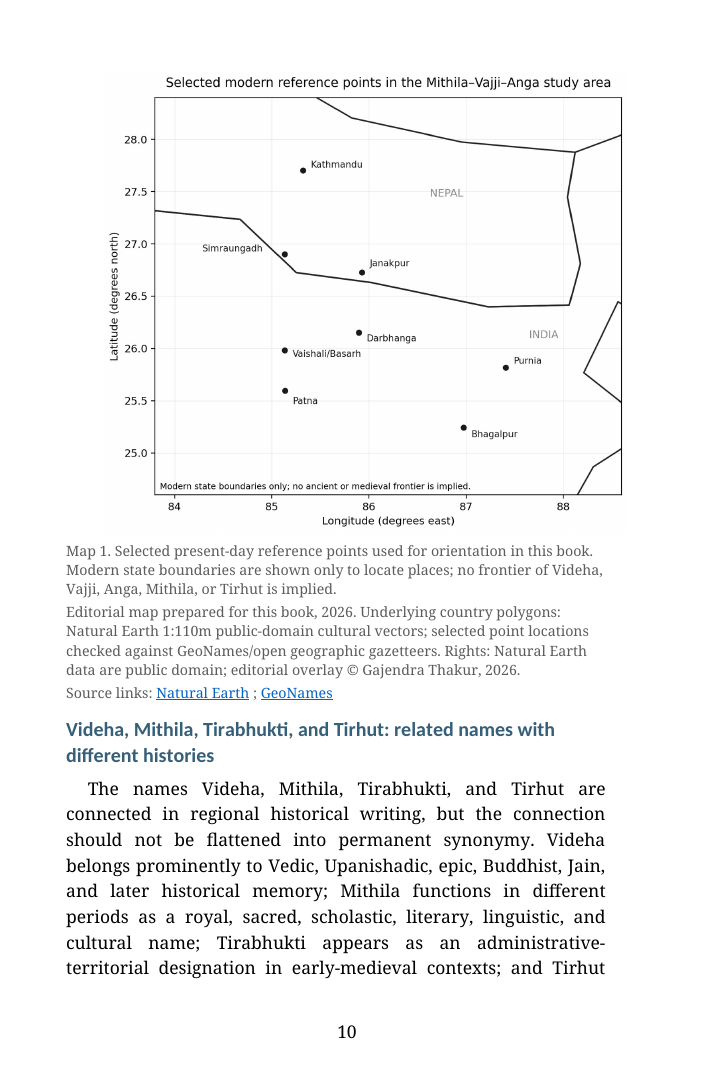
Mithila · Vajji · Anga
Chapter-specific source notes
- Primary chapter witness. Gajendra Thakur, Decoding the Panji of Mithila — Volume VI, formal Chapter 1, PDF pp. 10-18; formal Chapter 1. The HTML transcription is generated from the commit-pinned source PDF and retains the chapter boundary recorded in this edition.
- Internal structure. The repository source-heading inventory records 10 subordinate headings for this chapter: “Opening”; “The Seven Kinds of Panji”; “Panji as a Civilizational Archive”; “Mithilakshar, Devanagari, and the Preservation Question”; “Why Dushan Panji Is Placed inside the Larger Panji System”; “The Social Use of Forgetting”; “Women in Panji”; “Panji and Social Hierarchy”; ….
- Digital editorial method. The page keeps the preserved source text distinct from generated navigational, concordance, visual, and provenance apparatus. The synthetic reconstruction is explanatory only and is not evidence for an individual lineage or a determination of social or marital status.