Decoding the Panji of Mithila · Volume VI · Chapter 2
What Is Dushan Panji? The “Black Book” and the Meaning of Dushan Opening
Chapter 2
What Is Dushan Panji? The “Black
Book” and the Meaning of Dushan
Opening
The second step in decoding Panji is to understand why one
part of the archive became feared. Dushan Panji is not simply
another genealogical book. It is the section in which the Panji
system records rupture, social discomfort, contested descent,
and relationships that later ideology often preferred to hide.
The source defines Dushan Panji with a precise phrase: “वंशमे
आएल क्षरण”—the wearing, break, erosion, or rupture that
entered a lineage. This phrase is the key to the whole volume.
The English phrase “Black Book” is useful only if it is handled
carefully. It should not mean a book of evil people. It should not
mean a list for permanent condemnation. It means a difficult
register: a record of those moments when the formal grammar
of gotra, mool, branch, sapinda distance, and marriage
eligibility encountered the actual complexity of social life.
Unknown mothers, Devadasi lines, Dasi lines, widow-related
descent, Chamar or Rajak or Yavani connections, Gop and
Yadav connections, Dhivar and Tailik connections, Guru-patni
and Mahapatra references, Path-patita women, and
generational absorption all appear because lived society
exceeded the neatness of the rule.
A reader must therefore begin with humility. Dushan Panji is
uncomfortable not because it proves that society was uniquely
corrupt, but because it refuses to let social memory become
myth. It shows that Mithila’s lineages were never as sealed,
static, or pure as later pride might claim. At the same time, the
source itself repeatedly indicates that time, distance, and social
© Gajendra Thakur | 17
Decoding the Panji of Mithila, Volume VI
acceptance could soften or erase the effect of a rupture. The
“Black Book” is thus also a book of reintegration.
The Meaning of “Dushan”
The word दूषण can easily be misunderstood. In ordinary use
it may suggest defect, pollution, blemish, or blame. In the Panji
context, however, it functions as an archival marker. It marks a
place where the recorded lineage crossed a boundary, lost
clarity, or came under social doubt. The entry may involve a
marriage, a maternal line, a daughter-line, a wife-line, a widow-
line, a community-labeled relationship, an unknown origin, or
a regional arrival. The word records the fact that a question
entered the lineage; it does not give the modern reader
permission to insult the persons named.
This distinction is essential. A source can preserve an old
category without requiring the present reader to adopt its
cruelty. When the record says अज्ञात, the task is to ask what was
unknown and why that unknownness mattered. When the
record names a community, the task is to ask how that
relationship entered the lineage and what happened to the
descendants. When the record says विधवा or वार्तिनी विधवा, the task
is to reconstruct the social anxiety around widowhood,
remarriage, and children, not to repeat stigma. When the
record says यवनी, चर्मकारिणी, रजकी, दासी, देवदासी, धीवर दासी, तैलिक, गोप,
यादव, हड़िनी, or ताँती, the task is historical reading, not social
punishment.
In this book, therefore, “Dushan” will be translated
interpretively as a recorded rupture, a marked deviation, or a
socially charged lineage event. Each translation is partial.
“Rupture” emphasizes break; “deviation” emphasizes
departure from rule; “marked event” emphasizes the act of
recording. The safest method is not to freeze the word into one
English equivalent. The safest method is to read each case in its
own relationship-route.
© Gajendra Thakur | 18
Decoding the Panji of Mithila, Volume VI
Why the Record Survived
The source itself explains that Dushan Panji could be
discussed only much later, when the immediate harmful effects
on a related lineage had diminished. This is a profound
archival rule. It means that the Panji system knew the danger
of disclosure. It preserved the record, but it also understood
that premature public circulation could damage families. The
record was not meant to be shouted in the marketplace. It was
a controlled memory, preserved for future judgment, guidance,
and social understanding.
This delayed-discussion principle also explains why Dushan
Panji is not merely a gossip book. Gossip thrives on immediacy;
Dushan Panji depends on distance. Gossip destroys context;
Dushan Panji requires context. Gossip isolates one accusation;
Dushan Panji places the event within mool, branch, maternal
line, daughter-line, and generational sequence. A serious
reader must respect this difference. To read Dushan Panji
responsibly is to restore context where society may have
preserved only shame.
The compiler’s note later in the source shows how sensitive
this material remained even after transcription. The Dushan
material caused disputes, anger, and phone calls. It could not be
altered because the work claimed to be a word-for-word
transliteration from Mithilakshar into Devanagari. This
insistence on non-alteration is crucial. The difficult words are
preserved not because they are beautiful, but because changing
them would damage the evidentiary value of the archive.
What Makes Dushan Panji Different from Other
Panji Books
Mool Panji gives root identity. Shakha Panji records later
branch divisions. Gotra Panji preserves gotra and ancient mool.
Patra Panji adds root-village and branch detail. Uthedh Panji
helps determine sapinda distance and marriage eligibility.
Aswajanya or Siddhanta-related records declare whether a
© Gajendra Thakur | 19
Decoding the Panji of Mithila, Volume VI
proposed marriage is permitted. Dushan Panji differs because it
records moments when this system met rupture. It is the
archive of strain inside the system.
This is why Dushan Panji cannot be interpreted without the
other Panji books. If one reads only the Dushan word, the entry
appears like a punishment. If one reads the mool sequence, the
maternal route, the daughter-line, the village path, and the
generation distance, the entry becomes social history. The
apparent stain becomes a route. The route may pass through
pain, unequal power, caste boundary, widowhood, servitude,
religious difference, or unknown origin; but it remains a route,
not a mere label.
The central question of this volume is therefore not “Who
was impure?” That is the wrong question. The better questions
are these: What relationship is being recorded? Which line
carries the mark? Is the link maternal, paternal, marital,
daughter-line, wife-line, or descendant-line? Is the category
unknownness, inter-community connection, widowhood,
servitude, migration, or generation distance? Did the mark
remain fixed, or did it fade across time?
The Black Book as Social History
The source’s introductory prose gives a larger social
interpretation. It says that many events which once shook
society eventually become forgotten, and that this forgetting
can protect lineages from permanent damage. This is not an
argument for erasing history. It is an argument for
understanding the rhythm of social memory. First, an event
occurs. Second, the event is marked. Third, descendants
continue. Fourth, society adjusts. Fifth, after enough time, the
old rupture may no longer define the living lineage.
Dushan Panji therefore documents both exclusion and
absorption. It shows the anxiety of a society committed to rule,
but it also shows the practical flexibility of a society that
continued to marry, settle, produce descendants, and recognize
© Gajendra Thakur | 20
Decoding the Panji of Mithila, Volume VI
families after rupture. The post-table explanation of the first
example, where a line becomes “पूर्णतः शुद्ध” by the sixth
generation, will be examined later in detail. Already in Chapter
2, however, it warns us against reading Dushan as permanent
damnation.
This double character makes Dushan Panji one of the most
valuable archives for Mithila’s social history. Formal
genealogies often hide rupture. Hagiographies often polish
lineage. Community pride often simplifies the past. Dushan
Panji does the opposite. It preserves discomfort. It forces the
reader to see unknown mothers, named women, non-Brahmin
connections, Muslim or Yavani links, artisans, servants,
widows, and children after socially difficult unions. It makes
the margin visible.
Stigma, Concealment, and the Ethics of Reading
Because Dushan Panji contains old stigma, modern reading
must follow strict rules. First, no entry should be used against a
living person or family. Second, no community label should be
repeated as insult. Third, named women should not be reduced
to the category attached to them. Fourth, where the record says
unknown, the reader should not invent certainty. Fifth, the
existence of a marked relationship should not be turned into
sensationalism. Sixth, a line that the source itself shows as
absorbed into society should not be dragged back into stigma.
The ethical danger is real because the archive is powerful. It
names. It connects. It preserves. A careless reader can turn
preservation into humiliation. A responsible reader must do
the opposite: turn preservation into understanding. This book’s
purpose is not to expose families; it is to expose the false
ideology that families were ever completely sealed from one
another. Dushan Panji undermines the myth of purity more
than it condemns the people inside the record.
The older vocabulary remains in this manuscript because
removing it would falsify the source. But the interpretation
© Gajendra Thakur | 21
Decoding the Panji of Mithila, Volume VI
surrounding that vocabulary must be humane. Where the
source says चर्मकारिणी, the commentary must remember the
person and the relationship, not merely the caste category.
Where the source says यवनी, the commentary must examine the
genealogical function of the term and the historical contact it
reveals. Where the source says दासी or देवदासी, the commentary
must not romanticize service or ritualized dependency. Where
the source says विधवा, the commentary must hear the suffering
and resistance hidden beneath the genealogical notation.
Dushan as Evidence against Purity Myth
The strongest historical lesson of Dushan Panji is that social
purity was not a simple fact. It was an aspiration, a rule, an
ideology, a classification, and often a claim. The records show
that life repeatedly crossed the boundaries that the formal
system tried to police. These crossings did not occur outside
history; they occurred inside the archive itself. The Panji
system that preserved hierarchy also preserved evidence
against exaggerated claims of untouched hierarchy.
This does not mean that all boundaries were false or that all
rules were meaningless. Panji rules mattered deeply. They
shaped marriage, status, recognition, and memory. But the
presence of Dushan entries means that rule and life must be
studied together. A society may define rules with great
precision and still live through exceptions. The exceptions are
not footnotes; they are part of the history of the society.
The Dushan table, with its 97 examples, will later
demonstrate this point case by case. Some cases involve
unknown maternal lines. Some involve Devadasi or Dasi
relationships. Some involve named women such as Anandaa,
Vallabha, Medha, Sohago, and others. Some involve Rajak,
Chamar, Charmakarini, Hadini, Dhivar, Tailik, Gop, Yadav,
Tanti, Mahapatra, Guru-patni, Path-patita, or Yavani categories.
Some involve migration from the west. Some involve
© Gajendra Thakur | 22
Decoding the Panji of Mithila, Volume VI
widowhood. Together they show that Mithila’s social history
was not static, closed, or cleanly separable by later pride.
How Chapter 2 Prepares the Rest of the Book
Chapter 1 introduced Panji as a full memory-system. Chapter
2 has explained why Dushan Panji must be read as the difficult
part of that system. The following chapters will now build the
tools needed for decoding. Chapter 3 will set the ethical rules.
Chapter 4 will explain the Panji system before fragmentation.
Chapter 5 will examine Harisinghdev, Panjikars, and
institutionalization. Chapter 6 will explain Uthedh, Sapinda,
Swajana, and marriage eligibility. Chapters 7 and 8 will provide
the grammar of gotra, pravara, mool, moolgram, and the
twenty gotras with 167 mools. Chapter 9 will treat mool and
migration. Chapter 10 will introduce the method for reading
entries 1–97.
Only after that preparation will the book move into thematic
decoding: unknown lineage, Devadasi and Dasi, Dalit and
artisan connections, Muslim and Yavani connections,
widowhood, the Gangesha record, and named women. Then, in
Chapters 18 through 21, the 97 entries will be decoded in order.
This structure matters. It prevents the reader from rushing into
judgment before learning the grammar of the archive.
Conclusion: The Black Book as a Mirror
Dushan Panji is called black because it preserves what social
pride could not easily display. But blackness here should be
understood as depth, not evil. It is the dark ink of memory, the
unpolished side of genealogy, the archive of rupture, and the
mirror that shows society what it tried to hide. If read cruelly, it
becomes a weapon. If read responsibly, it becomes a rare
document of social truth.
The work of this volume is to choose the second path. The
book will not hide Dushan Panji. It will not sensationalize it. It
will not use it to shame descendants. It will decode it as
© Gajendra Thakur | 23
Decoding the Panji of Mithila, Volume VI
evidence of human life moving through rules, across
boundaries, into pain, through time, and sometimes back into
social acceptance. That is why Dushan Panji must be read.
Dushan Panji Decoding Rules Established by
Chapter 2
Read दूषण as an archival marker of lineage rupture, not as
present-day moral condemnation.
Always identify the relationship-route: mother-line,
daughter-line, wife-line, descendant-line, unknown origin,
community connection, widowhood, servitude, migration, or
generational distance.
Preserve source terms, but interpret them humanely and
historically.
Do not weaponize entries against living families or
descendants.
Treat delayed discussion and generational absorption as part
of the source’s own social logic.
Use the other Panji forms—Mool, Shakha, Gotra, Patra,
Uthedh, and Aswajana/Siddhanta records—to understand
each Dushan entry fully.
Chapter 2 Source Notes
Source note 1: The source defines Dushan Panji as the Panji
in which “वंशमे आएल क्षरण” is recorded. This definition controls
the interpretation of Dushan throughout the volume.
Source note 2: The same source says that Dushan matters
can usually be discussed only after time has passed, so that
the related lineage is protected from harmful consequences.
This supports the ethical rule against present-day
weaponization.
Source note 3: The introductory prose says that difficult
events often become forgotten by society after time, and that
this forgetting can prevent permanent social damage. This
© Gajendra Thakur | 24
Decoding the Panji of Mithila, Volume VI
explains why Dushan is not merely exclusion but also social
absorption.
Source note 4: The compiler’s later note states that the
Dushan material caused anger and Panchayat-level reaction,
but that alteration was not possible because the material
was transliterated word-for-word from Mithilakshar into
Devanagari. This supports preservation without falsification.
Source note 5: The 97-entry table and the post-table
explanation will be decoded later; Chapter 2 uses them only
to define the meaning and ethical frame of Dushan Panji
before the case-by-case chapters.
© Gajendra Thakur | 25
Decoding the Panji of Mithila, Volume VISource structure and verification apparatus
Editorial source apparatus. This apparatus is descriptive, not interpretive. It records the source-controlled structure used to verify that this page corresponds to formal Chapter 2 of Decoding the Panji of Mithila — Volume VI. The chapter text above is preserved from PDF pp. 18-27; formal Chapter 2 in the commit-pinned authoritative source. It is not merged with a neighboring chapter, appendix, annexure, or independent front/back-matter unit. The internal headings below come from the repository’s source-heading inventory and are retained as navigational and audit evidence; showing them here does not turn those headings into separate publications or add claims that are absent from the source.
Internal source headings
- Opening
- The Meaning of “Dushan”
- Why the Record Survived
- What Makes Dushan Panji Different from Other Panji Books
- The Black Book as Social History
- Stigma, Concealment, and the Ethics of Reading
- Dushan as Evidence against Purity Myth
- How Chapter 2 Prepares the Rest of the Book
- Conclusion: The Black Book as a Mirror
- Dushan Panji Decoding Rules Established by Chapter 2
- Chapter 2 Source Notes
Source-text concordance
Dushan · Black · Book · Meaning · Opening · second · step · decoding · understand · part · archive · became · feared · simply · another · genealogical · section · system · records · rupture · social · discomfort · contested · descent · relationships · later · ideology · often · preferred · hide · defines · precise · phrase · wearing · break · erosion · entered · lineage · whole · English · useful · handled · carefully · mean · evil · people · list · permanent · condemnation · means · difficult · register · record · moments · formal · grammar · gotra · mool · branch · sapinda · distance · marriage · eligibility · encountered · actual · complexity · life · Unknown · mothers · Devadasi · lines · Dasi · widow-related · Chamar · Rajak · Yavani · connections · Yadav · Dhivar · Tailik
Boundary verification. In the formal sequence this chapter follows Volume VI Chapter 1, “What Is Panji? The Archive of Mithila’s Social Memory Opening To decode Dushan Panji, one must first understand Panji” and precedes Volume VI Chapter 3, “The Ethics of Decoding: Record, Stigma, and Historical Justice Opening”. The chapter extractor begins at the verified formal Chapter 2 marker and stops at the next verified formal chapter marker; for a final chapter it stops before recognized book-level back matter. The concordance above is generated only from distinct terms already present in this chapter’s preserved source text. It is provided for discovery, comparison, and audit, not as an automated judgment about persons, lineages, status, kinship, marriage eligibility, or historical truth.
Illustrated research apparatus
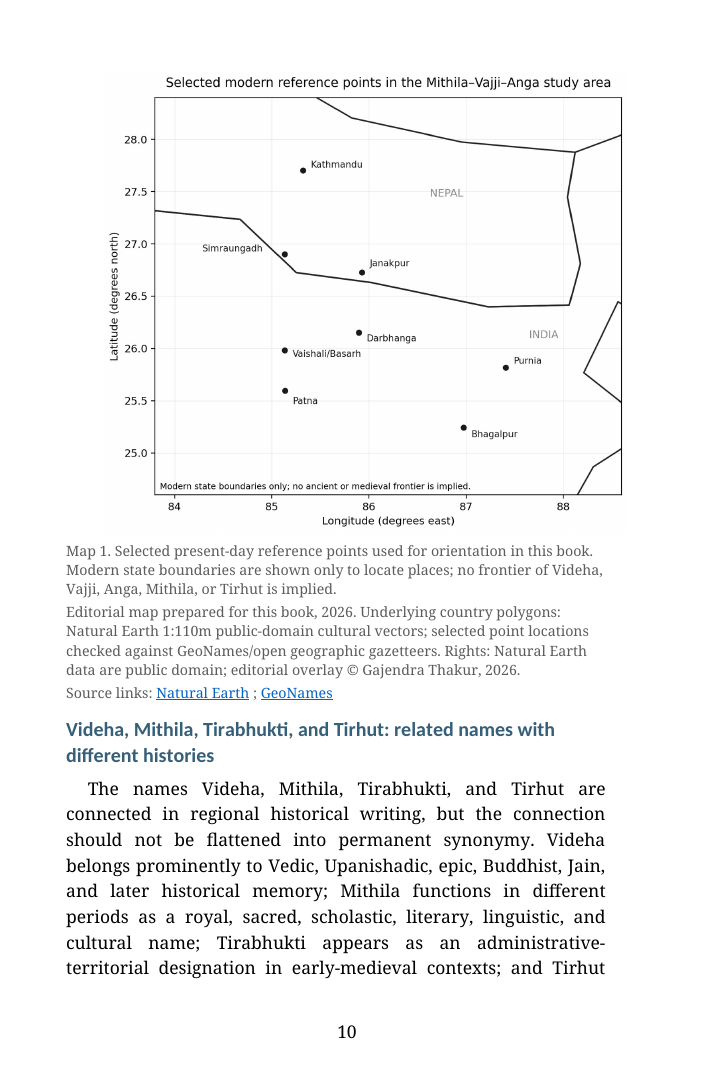
Mithila · Vajji · Anga
Chapter-specific source notes
- Primary chapter witness. Gajendra Thakur, Decoding the Panji of Mithila — Volume VI, formal Chapter 2, PDF pp. 18-27; formal Chapter 2. The HTML transcription is generated from the commit-pinned source PDF and retains the chapter boundary recorded in this edition.
- Internal structure. The repository source-heading inventory records 11 subordinate headings for this chapter: “Opening”; “The Meaning of “Dushan””; “Why the Record Survived”; “What Makes Dushan Panji Different from Other Panji Books”; “The Black Book as Social History”; “Stigma, Concealment, and the Ethics of Reading”; “Dushan as Evidence against Purity Myth”; “How Chapter 2 Prepares the Rest of the Book”; ….
- Digital editorial method. The page keeps the preserved source text distinct from generated navigational, concordance, visual, and provenance apparatus. The synthetic reconstruction is explanatory only and is not evidence for an individual lineage or a determination of social or marital status.