Decoding the Panji of Mithila · Volume VI · Chapter 10
Reading the Dushan Tables: Method for Entries 1–97
Chapter 10 — Reading the Dushan
Tables: Method for Entries 1–97
Chapter 10 is the methodological doorway into the entry-by-entry
section of this volume. This volume requires that every Dushan
entry be handled by case number, Panji folio or reference, mool
chain, named persons, maternal or marital link, category of
© Gajendra Thakur | 96
Decoding the Panji of Mithila, Volume VI
dushan, generation-distance, social implication, and present-day
historical reading. This chapter therefore does not begin the 97
cases themselves. It teaches the reader how to read them.
The Dushan table is not a simple list of “faults.” It is a compact
genealogical code. Each line places a relationship inside a
sequence of mool names, personal names, female-line markers,
marital terms, and social labels. If read hastily, the table looks
abrupt and even cruel. If read with Panji grammar, it becomes
a dense map of descent, marriage, migration, women’s
memory, community contact, and social absorption.
Why a Separate Method Is Necessary
The Dushan entries are written in a form closer to register
language than narrative prose. A table line may contain only a
mool, a folio-like reference, a chain of names, and a word such
as मातृक, सुता, पत्नी, अज्ञात, चर्मकारिणी, रजकी, दासी, यवनी, विधवा, पथपतिता, or
अंतर्जातीय. None of these words is self-explanatory when isolated.
The method must reconstruct what the table compresses.
A responsible reading therefore moves from notation to
relationship, from relationship to lineage route, and from
lineage route to historical meaning. The reader must ask: Who
is being located? Through which side is the connection made? Is
the route maternal, marital, daughter-line, wife-line, servant-
status, caste/community-marked, Muslim/Yavani-linked,
unknown, or generationally absorbed? Only after these
questions are answered can the entry be interpreted.
The Basic Unit: A Case, Not a Slur
Each numbered item in the Dushan table should be treated as a
case. A case is not a moral sentence. It is a recorded
genealogical problem, remembered by the Panji system
because it mattered to marriage eligibility, lineage identity, or
social classification at some earlier moment.
The first rule is therefore simple: never detach the source label
from the case structure. A word like चर्मकारिणी, रजकी, दासी, यवनी, or
© Gajendra Thakur | 97
Decoding the Panji of Mithila, Volume VI
विधवा must not be repeated as insult. In this book it functions as
an archival label. The historian’s task is to explain how that
label worked inside the record, not to revive the stigma
attached to it.
The Nine Fields for Reading Every Entry
The following table gives the working method that will be used
in Chapters 18–21. It is also the reader’s guide for moving
through the 97 entries.
Field Question to Ask Use in Decoding
1. Case number Which of the 97 Dushan Keeps each explanation
examples is being read? tied to the source order
and prevents confusion
between similar names.
2. Panji reference Does the entry give a Preserves the table’s
number such as १७८/१, archival location and
allows later checking.
१९६/७, or another
reference?
3. Mool chain Which mools appear Shows how the line is
around the case? placed inside the wider
gotra-mool system.
4. Named persons Who are the named men Separates the subject of
and women? the case from ancestors,
descendants, spouses, and
in-laws.
5. Relationship marker Is the route marked by Identifies whether the
सुत, सुता, पत्नी, मातृक, route is male-line,
daughter-line, wife-line,
दौहित्र, माता, or another maternal, or grandson-
term? through-daughter.
6. Dushan category Is the issue अज्ञात, Names the recorded social
boundary without turning
अंतर्जातीय, दासी, देवदासी, it into present-day abuse.
चर्मकारिणी, रजकी, यवनी,
विधवा, पथपतिता, or
another label?
© Gajendra Thakur | 98
Decoding the Panji of Mithila, Volume VI
Field Question to Ask Use in Decoding
7. Generation distance How far is the case from Prepares the sixth-
the person later treated as generation question and
active in marriage or the logic of absorption.
lineage?
8. Social implication What anxiety or boundary Converts the notation into
does the entry reveal? social history: caste,
gender, widowhood,
migration, or religious
contact.
9. Present-day reading How should the case be Protects descendants and
explained now? turns the record into
historical knowledge
rather than humiliation.
Reading the Mool Chain
The mool chain is the spine of many Dushan entries. It may list
several mools before or after the relationship marker. These
are not decorative words. They position the case inside a
network of descent and settlement. The method developed in
Chapters 7–9 must therefore be applied before any Dushan
label is interpreted.
For example, when an entry links a person to a maternal line
and then lists several mools, the reader should not assume that
all listed names are equally responsible for the dushan. The
chain may be recording the route by which a relationship
spread into several linked houses. Mool names show memory,
not necessarily blame.
This is why Chapter 9 argued that geography becomes
genealogy in Panji. In the Dushan table, a village-root name can
function as an address, a lineage signal, a branch marker, and a
memory of movement all at once.
Reading Named Persons
The Dushan table often moves quickly through names. A name
may be the person whose relation is being discussed, the father,
the son, the daughter, the maternal ancestor, the wife’s family,
© Gajendra Thakur | 99
Decoding the Panji of Mithila, Volume VI
or the descendant through whom the case became relevant.
The first interpretive task is therefore to slow the entry down.
A good decoding should separate:
the person named directly in the entry;
the ancestor or descendant to whom that person is
attached;
the woman through whom the route is marked, when the
entry says सुता, पत्नी, मातृक, माता, or दासी;
the mool or village chain that places the case;
the later descendants or houses affected by the record.
Without this separation, the reader may wrongly attach the
social label to the wrong person. The ethical danger is large: a
compact entry can easily be misread as a blanket judgment on
an entire line. This book will avoid that error by reconstructing
the relationship route first.
Reading Female-Line Markers
The words सुता, पत्नी, मातृक, माता, and दौहित्र are crucial. They show
that many Dushan entries do not travel through a simple male-
to-male chain. Instead, they move through daughters, mothers,
wives, daughters’ sons, and maternal houses. This is one reason
Dushan Panji is also a women’s archive.
A notation such as रामक मातृक does not merely say “Ram’s
maternal side.” It asks the reader to reconstruct a maternal
route. A phrase such as अमुकसुता places a daughter at the hinge
of lineage memory. A word such as दौहित्र directs attention to the
grandson through a daughter. These terms make women
structurally central even when the surrounding genealogy is
written in a male-dominant idiom.
The later chapters will therefore not treat women as incidental.
When a female-line marker appears, it will be made explicit.
The reader will be told whether the case is moving through
mother, daughter, wife, daughter’s son, or a named woman
© Gajendra Thakur | 100
Decoding the Panji of Mithila, Volume VI
such as Anandaa, Vallabha, Medha, Hira’s daughter, Rahmu’s
daughter, or Sohaago.
Reading “Agyat” and Unknownness
The term अज्ञात is one of the most important categories in the
table. It does not always mean that no history existed. More
often, it means that the Panji system could not, or would not,
place the person or family within its acceptable categories of
known descent. Unknownness is therefore a social status inside
the record.
When the entry says अज्ञात वंश, अज्ञात जाति, अज्ञात कु ल, अज्ञात माता, or an
unknown maternal route, the question is not simply “Who was
unknown?” The question is: what did the Panji system require
in order to make a person known, and what happened when
that requirement was not satisfied?
Chapter 11 will take up this question in detail. Chapter 10 only
establishes the method: do not treat अज्ञात as emptiness. Treat it
as a recorded gap, and then read the consequences of that gap.
Reading Community-Marked Labels
Many entries name community or caste-marked terms: चमरू,
चर्मकारिणी, रजक, रजकी, हाडी, हाडिनी, ताँती, धीवर, तैलिक, गोप, यादव, दासी,
देवदासी, and others. These terms must be handled with strict
discipline. They are source labels, not language for present-day
insult.
The method is to ask what kind of relationship the label marks.
Is the person a mother? A wife? A daughter? A maternal
ancestor? A woman taken into a line? A servant-status woman?
A community-marked bride? A descendant of such a union?
Only then can the social implication be stated.
The purpose is not to protect a purity myth. The purpose is to
understand how the Panji system recorded social contact across
boundaries. Chapters 13, 18, 19, 20, and 21 will use this method
repeatedly.
© Gajendra Thakur | 101
Decoding the Panji of Mithila, Volume VI
Reading Muslim and Yavani References
The source uses terms such as यवनी and names such as
Daulatijahan. These entries must be read historically and
carefully. The term belongs to the archive’s vocabulary; it
should not be enlarged into a generalized judgment about
Muslims, nor softened so much that the historical boundary
disappears.
A Yavani-linked entry should therefore be decoded by route:
who is named, what relationship is marked, whether the line
passes through mother, daughter, wife, or descendant, and how
the Panji treats later generations. Chapter 14 will prepare the
thematic reading, and the entry-by-entry chapters will explain
the specific cases.
Reading Widowhood and Post-Marital Routes
Widow-related entries are especially sensitive. Terms such as
विधवा or वार्तिनी विधवा are not merely legal labels; they reveal the
social anxiety produced by remarriage, union after
widowhood, children born after the death of a husband, or the
movement of a woman outside the expected marital frame.
The method here is to separate fact, social judgment, and
modern interpretation. The fact is the recorded relation. The
social judgment is the source’s classification. The modern
interpretation asks what this reveals about women’s lives,
widowhood, resistance, and social control.
Generation-Distance and the Question of
Absorption
Some entries show that Dushan did not always remain
permanent. The source’s own explanatory material includes a
model in which a line becomes “fully pure” by the sixth
generation. This is methodologically important. It means the
table records stigma, but it also records time, distance,
forgetting, and reintegration.
© Gajendra Thakur | 102
Decoding the Panji of Mithila, Volume VI
Therefore, each entry must be read with an eye to generation-
distance. Does the dushan attach directly to the person named,
or to a mother, grandmother, wife, daughter, or earlier
ancestor? Has the line spread into several houses? Is there
evidence that the source itself treats later descendants
differently? These questions prepare Chapter 22.
The Ethical Sequence for Every Entry
The safest way to read the 97 entries is to follow the same
ethical sequence each time:
first, transcribe or paraphrase the entry without
exaggeration;
second, identify the names and the relationship route;
third, identify the mool, maternal, marital, or community-
marked chain;
fourth, explain the source category as an archival category;
fifth, state the social meaning without slur or
sensationalism;
sixth, protect present-day descendants by refusing to turn
the case into accusation;
seventh, connect the entry to larger patterns only after the
particular case has been understood.
This ethical sequence is not optional. Without it, Dushan Panji
can easily be misused. With it, the record becomes a source for
studying gender, caste, mobility, marriage, migration,
absorption, and the instability of social purity.
How the Four Entry Chapters Will Work
This volume divides the 97 entries into four chapters. Chapter 18
will cover cases 1–25. Chapter 19 will cover cases 26–50. Chapter
20 will cover cases 51–75. Chapter 21 will cover cases 76–97. This
arrangement keeps the table manageable and allows repeated
patterns to be recognized without collapsing all entries into one
undifferentiated mass.
Each case will be explained in plain language. The purpose is
not to reproduce the table mechanically, nor to leave the reader
© Gajendra Thakur | 103
Decoding the Panji of Mithila, Volume VI
staring at compressed notations. The purpose is to translate
each entry into a readable historical explanation while
preserving the source’s structure.
What This Method Will Reveal
Once the method is applied, the 97 entries will show several
broad patterns: unknown lineage, female-line memory, Dalit
and artisan connections, Muslim/Yavani connections,
widowhood and remarriage, migration from outside the
familiar region, internal Brahman boundary labels, and
generational absorption. These patterns are already visible in
the table, but they must be proven case by case.
The table therefore has two levels. At the first level, it records
individual cases. At the second level, it exposes the social map
of Mithila: a society regulated by strict genealogical rules, yet
constantly crossed by marriage, maternal descent, migration,
service relations, widowhood, and inter-community contact.
Conclusion: From Table to Historical Reading
Chapter 10 has set the method for reading Dushan entries 1–97.
The table must not be read as a list of insults or as a weapon
against descendants. It must be read as a compressed archive.
Each entry must be unpacked through case number, mool
chain, relationship marker, social label, generation-distance,
and ethical interpretation.
The next chapters follow the thematic order of the structure of this
volume before the entry-by-entry decoding begins. Chapter 11 will
examine अज्ञात and unknown lineage. Chapter 12 will examine
Devadasi, Dasi, and female-line memory. Chapter 13 will examine
Dalit and artisan connections. Chapter 14 will examine Muslim
and Yavani connections. Chapter 15 will examine widowhood and
remarriage. Chapter 16 will examine the Gangesha case. Chapter
17 will restore named women and hidden mothers. Only then will
Chapters 18–21 decode the 97 cases in sequence.
© Gajendra Thakur | 104
Decoding the Panji of Mithila, Volume VI
Chapter 10 Source Notes
Source note 1: This chapter follows the structure of Chapter 10,
which requires a method for reading the Dushan table through
case number, Panji reference, mool chain, named persons,
maternal or marital link, category of dushan, generation-distance,
social implication, and present-day historical reading.
Source note 2: The method is grounded in the Dushan source’s
own explanation that Dushan Panji records lineage rupture
and that the table of 1–97 examples is followed by explanatory
examples.
Source note 3: The treatment of mool chains follows the earlier
source explanation of gotra, mool, moolgram, and Biji Purush
as the basic grammar of Panji.
Source note 4: The attention to सुता, मातृक, पत्नी, माता, and दौहित्र
follows the repeated female-line and maternal-line notations in
the Dushan entries.
Source note 5: The ethical rule used here follows the source’s
own caution that difficult Dushan matters can be discussed
only after time has passed and should not harm present-day
lineages.Source structure and verification apparatus
Editorial source apparatus. This apparatus is descriptive, not interpretive. It records the source-controlled structure used to verify that this page corresponds to formal Chapter 10 of Decoding the Panji of Mithila — Volume VI. The chapter text above is preserved from PDF pp. 97-106; formal Chapter 10 in the commit-pinned authoritative source. It is not merged with a neighboring chapter, appendix, annexure, or independent front/back-matter unit. The internal headings below come from the repository’s source-heading inventory and are retained as navigational and audit evidence; showing them here does not turn those headings into separate publications or add claims that are absent from the source.
Internal source headings
- Why a Separate Method Is Necessary
- The Basic Unit: A Case, Not a Slur
- The Nine Fields for Reading Every Entry
- Reading the Mool Chain
- Reading Named Persons
- Reading Female-Line Markers
- Reading “Agyat” and Unknownness
- Reading Community-Marked Labels
- Reading Muslim and Yavani References
- Reading Widowhood and Post-Marital Routes
- Generation-Distance and the Question of Absorption
- The Ethical Sequence for Every Entry
- How the Four Entry Chapters Will Work
- What This Method Will Reveal
- Conclusion: From Table to Historical Reading
- Chapter 10 Source Notes
Source-text concordance
Reading · Dushan · Tables · Method · Entries · methodological · doorway · entry-by-entry · section · requires · every · entry · handled · case · number · folio · reference · mool · chain · named · persons · maternal · marital · link · category · Gajendra · Thakur · Decoding · generation-distance · social · implication · present-day · historical · therefore · begin · cases · teaches · reader · read · table · simple · list · faults · compact · genealogical · code · line · places · relationship · inside · sequence · names · personal · female-line · markers · terms · labels · hastily · looks · abrupt · even · cruel · grammar · becomes · dense · descent · marriage · migration · women’s · memory · community · contact · absorption · Separate · Necessary · written · form · closer · register · language
Boundary verification. In the formal sequence this chapter follows Volume VI Chapter 9, “Mool and Migration: How Villages Became Genealogical Memory Opening” and precedes Volume VI Chapter 11, “Unknown Lineage and “Agyat”: The Social Meaning of the Unknown”. The chapter extractor begins at the verified formal Chapter 10 marker and stops at the next verified formal chapter marker; for a final chapter it stops before recognized book-level back matter. The concordance above is generated only from distinct terms already present in this chapter’s preserved source text. It is provided for discovery, comparison, and audit, not as an automated judgment about persons, lineages, status, kinship, marriage eligibility, or historical truth.
Illustrated research apparatus
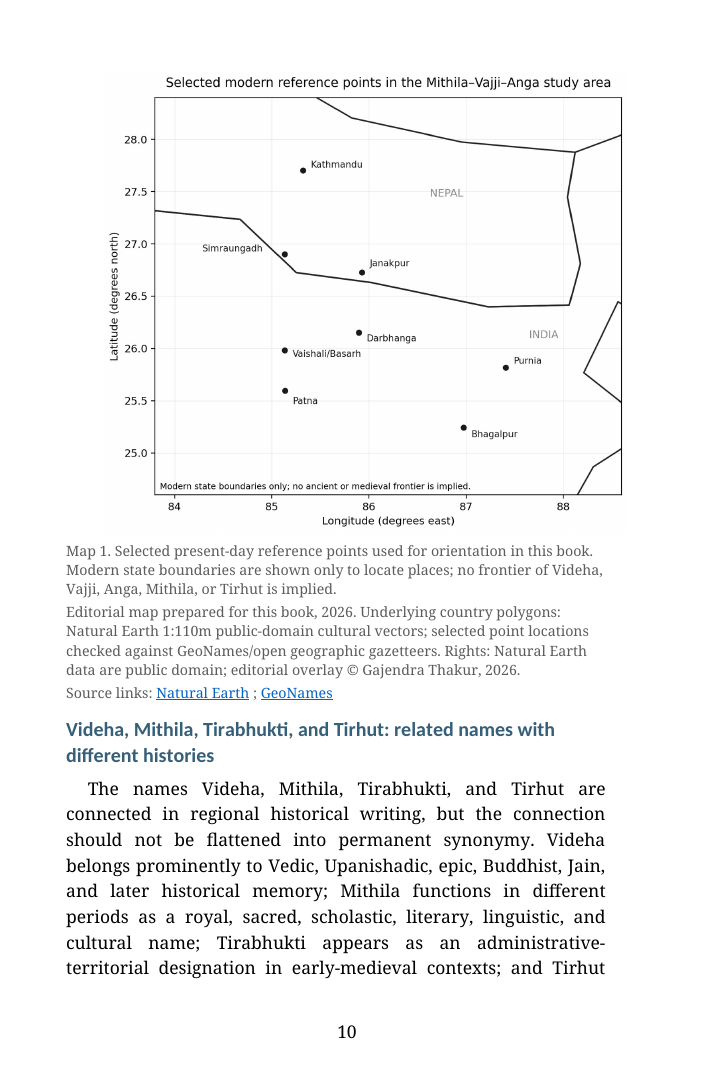
Mithila · Vajji · Anga
Chapter-specific source notes
- Primary chapter witness. Gajendra Thakur, Decoding the Panji of Mithila — Volume VI, formal Chapter 10, PDF pp. 97-106; formal Chapter 10. The HTML transcription is generated from the commit-pinned source PDF and retains the chapter boundary recorded in this edition.
- Internal structure. The repository source-heading inventory records 16 subordinate headings for this chapter: “Why a Separate Method Is Necessary”; “The Basic Unit: A Case, Not a Slur”; “The Nine Fields for Reading Every Entry”; “Reading the Mool Chain”; “Reading Named Persons”; “Reading Female-Line Markers”; “Reading “Agyat” and Unknownness”; “Reading Community-Marked Labels”; ….
- Digital editorial method. The page keeps the preserved source text distinct from generated navigational, concordance, visual, and provenance apparatus. The synthetic reconstruction is explanatory only and is not evidence for an individual lineage or a determination of social or marital status.