Decoding the Panji of Mithila · Volume VI · Chapter 9
Mool and Migration: How Villages Became Genealogical Memory Opening
Chapter 9
Mool and Migration: How Villages
Became Genealogical Memory
Opening
In Panji, a village is never only a village. It can be a place where an
ancestor lived, a sign of a branch, a clue to migration, a marriage
boundary, a memory of settlement, and sometimes a social rank
imposed later upon what had first been a genealogical marker.
This chapter explains why the volume places mool and migration
© Gajendra Thakur | 86
Decoding the Panji of Mithila, Volume VI
immediately after the gotra-mool chapter. Chapter 8 listed the
map. Chapter 9 explains how the map moves.
The central argument is simple: in Panji, geography is
genealogy. A name such as माण्डर, दरिहरा, सरिसव, सोदरपुर, खौआल,
बुधवाल, पनिचोभ, पाली, करमहा, घुसौत, अलय, सकराढी, नरौन, गंगोली, or पर्वपल्ली
is not merely a postal place. It is a genealogical address. It tells
the reader where a line was remembered to have rooted,
where a branch later settled, and how a family was made
readable for marriage, ritual, and social decision.
This is especially important for Dushan Panji. Many Dushan
entries are not written as modern sentences. They are chains of
mool names, personal names, maternal references, daughter-
line references, and short labels. Without understanding how
village names became memory-signs, the reader will see only a
pile of names. With this grammar, each chain becomes a route.
Mool as Ancestral Place
The source gives a decisive definition of मूल. The mool is the
ancient place where the earliest remembered man of a line, the
बीजी पुरुष, was said to have lived. This does not mean that every
later descendant lived in that same place. It means that the line
remained anchored to that place as its genealogical point of
origin.
The phrase बीजी पुरुष is crucial. It does not claim to identify the
first biological human being in an absolute sense. It identifies
the earliest remembered or systemically recognized ancestor
for the purpose of Panji ordering. A lineage can spread into
many villages, but the mool keeps its earlier genealogical
signature. In this way, mool prevents migration from erasing
memory.
The source uses the example of सोदरपुर. The mool is one, but
several later मूलग्राम or branch-village forms appear around it:
सोदरपुर सरिसव, सोदरपुर मानी, सोदरपुर दिगउन्ध, सोदरपुर कटका, सोदरपुर रै याम,
© Gajendra Thakur | 87
Decoding the Panji of Mithila, Volume VI
सोदरपुर हसौली, सोदरपुर हाटी, and others. This shows that a single root
could produce many local identities without losing its root
identity.
Moolgram: The Second Layer of Place
If मूल is the older root, मूलग्राम is the later place-memory attached
to that root. The source says that later Panjikars began to name
branches according to villages where members of a mool were
living in roughly the thirteenth, fourteenth, or fifteenth
centuries. Thus a mool could carry two layers at once: the
ancient root-village and the later branch-village.
This two-level structure explains why Panji place names
sometimes appear doubled or compounded. A phrase such as
सोदरपुर सरिसव does not simply mean that two villages have been
placed side by side. It means that the person or branch is to be
understood through both an older root and a later settlement
marker. The record is therefore not confused; it is compressed.
The same logic appears in examples such as माण्डर रजौरा, मड़रय
सिहौलि, पलिवाड़ मंगरौनी, पलिवाड़ हाटी, and कटैवार अन्हड़ा. These names
preserve movement while still linking the moving branch to a
remembered root. In a society where marriage decisions
depended on identity, migration had to be remembered rather
than allowed to dissolve kinship boundaries.
Why Migration Required Record-Keeping
Migration creates a problem for every genealogical society.
When people remain in one place, neighbors remember who
belongs to whom. When people move, the memory becomes
fragile. A family may leave the ancestral village, settle in
another region, marry into a new network, and after several
generations no longer carry ordinary local memory of the old
connection. Panji solved this problem by turning place into a
layered record.
© Gajendra Thakur | 88
Decoding the Panji of Mithila, Volume VI
The system did not merely say, “this man now lives here.” It
asked: What is his root? What is his mool? Who is his Biji
Purush? What is his gotra? What is his branch? What village
does the current line bear? Which related line must be avoided
in marriage? Such questions transformed migration from a
danger to memory into a subject of record.
For this reason, Panji should be read as a mobile archive. It
does not assume that people never moved. On the contrary, the
very existence of moolgram and branch naming shows that
people did move. The archive records movement by attaching
later geography to earlier descent.
Village Chains in Dushan Panji
Dushan entries repeatedly contain village or mool chains. A
typical entry may move through सरिसव, सकराढी, पनिचोभ, दरिहरा, पाली,
नरवाल, वलियास, घुसौत, सोदरपुर, अलय, माण्डर, सुरगन, पचही, पकलिया, or
सिम्भुनाम. These names are not decorative. They are the
coordinates by which the entry can be decoded.
When a Dushan entry says that a person’s मातृक is connected
with a chain of mools, the chain shows how the maternal line
was being located. When an entry says that someone married
into an unknown or socially marked line, the mool chain shows
how far the effect traveled. When a daughter-line appears, the
place names help identify the route through which a later
descendant became attached to the entry.
The source’s examples below the 97-entry table show this
clearly. They do not simply give names of individuals. They
place those individuals inside mool sequences. This is why the
entry-by-entry chapters must be read with a geographical eye.
A person’s name is only one part of the record; the surrounding
mool names are the map that makes the name intelligible.
© Gajendra Thakur | 89
Decoding the Panji of Mithila, Volume VI
A Working Model: Ancient Root, Later Branch,
Social Route
For decoding purposes, each place term in a Dushan entry can
be read through three questions:
Is this the older mool, the genealogical root attached to the
Biji Purush?
Is this a later moolgram or branch-village that shows where
a line settled after migration?
Is this place functioning as part of a maternal, daughter-
line, marriage, or Dushan route?
These questions prevent two common mistakes. The first
mistake is to treat every place as a modern residence. The
second mistake is to treat every place as a caste-rank sign. The
source itself warns that the original purpose of Panji was not to
establish smallness and greatness. The historical archive was
first a memory system; hierarchy was later attached to it by
power, rank, and social control.
Panji place layer Meaning in the record Use in Dushan decoding
मूल Ancient root-place Identifies the deep
associated with the genealogical anchor of a
earliest remembered line.
ancestor or Biji Purush.
मूलग्राम Later branch-place Shows how a root line
attached to a mool spread into later villages.
through settlement and
migration.
गोत्र + मूल Descent category Helps decide whether a
combined with root-place person belongs to the
identity. same broad lineage field.
मातृक place Place or mool attached to Locates the mother-line or
the maternal line. maternal-house route of a
Dushan entry.
सुता / daughter-line place Place attached to the Shows how a Dushan
daughter or daughter- effect travels through
descendant route. female-line descent.
© Gajendra Thakur | 90
Decoding the Panji of Mithila, Volume VI
Panji place layer Meaning in the record Use in Dushan decoding
Migration marker Evidence that a branch Prevents the reader from
moved from an older confusing movement with
remembered place to a loss of identity.
later settlement.
Mool as Memory, Not Modern Address
The distinction between mool and modern address is essential.
A man whose family is living in one village may still be known
by another mool because the mool points backward to the
recognized root. This is not an error. It is the very logic of the
system. Modern address answers the question, “Where does
this person live now?” Mool answers the question, “Where is
this line remembered to have begun?”
Moolgram stands between these two questions. It does not
erase the ancient mool, but it gives a later settlement-sign. In
this sense, moolgram is the archive’s way of saying: this line
has moved, but the movement itself has been recorded.
This makes Panji a history of settlement as well as a genealogy.
It can show not only who descended from whom but also how
families spread from one node to another. The map of Maithil
Brahmin mools is therefore also a map of roads, rivers, royal
centers, agrarian expansion, learning networks, and marriage
circuits.
Mandar, Darihara, Sarisab, Soderpur, and Other
Memory-Nodes
This chapter treats several places as genealogical memory-nodes:
माण्डर, दरिहरा, सरिसव, सोदरपुर, खौआल, बु धवाल, पनिचोभ, पाली, करमहा,
and others. Each of these names can appear in the archive not only
as a settlement but as a sign of connection. Some are mools. Some
appear in branch forms. Some recur in Dushan entries as part of
maternal or marital chains.
माण्डर is especially useful for understanding the distinction
between root and branch. The source explains that a Kashyap-
© Gajendra Thakur | 91
Decoding the Panji of Mithila, Volume VI
gotra mahakul with many branches was established, on the
basis of collected genealogical knowledge, as originally
connected with माण्डर. Yet before the formal Panji arrangement,
branches such as मँगरौनी and गढ़ were already visible. The record
therefore preserved both unity and branching.
सोदरपुर gives another model. It is treated as a mool with multiple
moolgram associations. The source lists numerous सोदरपुर
combinations, making it clear that one root may support a
broad web of later village identities. This is why a Dushan entry
involving सोदरपुर cannot be read merely by looking at the
surface name. The question is: which layer of सोदरपुर memory is
active here?
पाली / पलिवाड़, करमहा, बुधवाल, घुसौत, गंगोली, पर्वपल्ली, and other mools
similarly show how a root identity could branch into many
local lines. The branch lists are long because the migration
history itself is long. A short list would hide the social reality;
the Panji record keeps the complexity.
Migration and Marriage
Migration matters because marriage eligibility depended on
remembered connection. If two lines had separated
geographically but remained genealogically close, their
distance in space did not automatically make them
marriageable. Conversely, a line living in a new village might
still carry a root identity that linked it to older kin networks.
Panji was the tool through which this hidden connection could
be checked.
This is why Chapter 6 on Uthedh and Chapter 9 on Mool-
Migration belong together. Uthedh asks whether the
generational distance is sufficient. Mool and moolgram ask
where the line belongs. Together they convert scattered family
memory into a decision system.
© Gajendra Thakur | 92
Decoding the Panji of Mithila, Volume VI
Dushan Panji then records what happened when the system
encountered rupture: unknown maternal lines, inter-
community marriages, daughter-line descent, widow-related
descent, Yavani connections, and other entries that could not be
treated as ordinary. Even in these entries, migration and mool
identity remain the skeleton of the record.
The Danger of Turning Mool into Rank
The source is explicit that the original purpose of Panji was not
to show who was small and who was great. Later, however,
state order, social hierarchy, and Panjikar practice attached
status differences to mools and branches. This is one of the
most damaging transformations in the history of the system.
A responsible reading must therefore separate two things: the
archival function of mool and the later social use of mool as
rank. The first is necessary for historical understanding. The
second must be examined critically. If the book repeats rank
language without critique, it would fail the ethical rule
established in Chapter 3.
This does not mean that the hierarchy should be hidden. It
means that hierarchy should be historicized. A mool can be a
genealogical marker, a branch sign, a marriage clue, and later a
rank label. The reader must ask which function is active in each
passage.
Dushan Entries as Routes, Not Isolated
Accusations
The most important practical result of this chapter is
methodological. A Dushan entry should be read as a route, not
as an isolated accusation. The route may begin with a mool,
pass through a maternal connection, name a daughter, mention
an unknown line, identify a community label, and then show
descendants spread into later houses. The place names tell the
reader how the route travels.
© Gajendra Thakur | 93
Decoding the Panji of Mithila, Volume VI
This is why the entry-by-entry chapters later in the volume will
not simply reproduce the 97 cases. Each entry will be decoded
by asking: What are the mool names? Which are root markers?
Which are branch markers? Where is the maternal line? Where
is the wife-line? Where is the daughter-line? What has
migrated? What has been remembered? What has been
forgotten?
Only after this route is reconstructed can the ethical reading
begin. Without the route, the entry becomes a label. With the
route, it becomes a social history.
The Geography of Absorption
Migration also helps explain social absorption. When a line
spreads into many villages, a once-burning Dushan event may
eventually lose its power to harm a living lineage. The source
says that many events once capable of disturbing society
become forgotten over time. It also gives examples in which
descendants are later socially accepted. This does not erase the
old record, but it changes its meaning.
Geographical spread is one reason this happens. A stigma
attached to one relationship may not remain equally visible
after a line disperses across villages, generations, marriages,
and branches. Panji preserves the old memory, but society may
gradually treat the descendants as part of normal life. This is
why Dushan Panji is not merely a record of exclusion; it is also
a record of absorption.
The sixth-generation question, treated in Chapter 22, will develop
this point in detail. Chapter 9 prepares that argument by showing
that genealogical memory is spatial as well as temporal. Lines
move through both time and place.
How Chapter 9 Prepares the Dushan Table
Chapter 10 will explain the method for reading the 97 Dushan
entries. Chapter 9 prepares that method by teaching the reader
how to recognize geographical signals. When the table gives a
© Gajendra Thakur | 94
Decoding the Panji of Mithila, Volume VI
mool sequence, the reader should not skip it. The sequence is
often the key to the whole case.
For example, a maternal reference such as रामक मातृक or जगन्नाथक
मातृक is not complete until the surrounding mool names are
read. Likewise, a daughter-line such as के शव सुता or गोढिसुता
cannot be fully understood without asking where that
daughter-line is placed in the mool chain. Place, relation, and
stigma are interlocked.
Thus the reader should enter the Dushan table with three
mental maps: the gotra-mool map from Chapter 8, the
migration-moolgram map from Chapter 9, and the case-
decoding method from Chapter 10. Only then will the 97 entries
become readable as history rather than remain cryptic notes.
Conclusion: Geography Is Genealogy
Chapter 9 has argued that Panji converts geography into
memory. A village name may preserve an ancient root, a later
branch, a maternal route, a daughter-line, a marriage
connection, or a migration trace. The mool is the root; the
moolgram is the branch-place; the Dushan table is the difficult
route where these place names meet social rupture.
This chapter also prepares an ethical conclusion. To understand
migration is to understand that Maithil society was not static.
Lines moved. Branches formed. Women carried memory across
houses. Unknownness appeared. Communities met. Some
events became Dushan; some later faded. The archive records
all of this because Mithila’s social life was more mobile, more
interwoven, and more historically complex than purity myths
allow.
The next chapter, in this volume, is Chapter 10: Reading the
Dushan Tables: Method for Entries 1-97. It will turn the
grammar of gotra, mool, moolgram, migration, maternal line,
daughter-line, and social category into a step-by-step method
for decoding every entry.
© Gajendra Thakur | 95
Decoding the Panji of Mithila, Volume VI
Chapter 9 Source Notes
Source note 1: This chapter follows the structure of Chapter 9,
which requires explanation of how places such as Mandar,
Darihara, Sarisab, Soderpur, Khaual, Budhwal, Panichobh, Pali,
Karamha, and others function inside Panji, and argues that in
Panji geography is genealogy.
Source note 2: The definitions of mool, moolgram, and Biji
Purush follow the source explanation that mool is the ancient
place of the earliest recognized ancestor, and that later
Panjikars added branch-village names based on later
settlement.
Source note 3: The Soderpur examples and other paired root-
branch names follow the source’s “मूलग्राम विवरण” section,
including the explanation that the same mool can be attached
to several later village branches.
Source note 4: The distinction between descriptive genealogy
and social hierarchy follows the source warning that the
original purpose of Panji was not to show smallness and
greatness; hierarchy entered through later social and political
processes.
Source note 5: The use of Dushan mool chains, मातृक references,
and सुता references follows the Dushan table examples and the
explanatory material beneath the 97 entries.Source structure and verification apparatus
Editorial source apparatus. This apparatus is descriptive, not interpretive. It records the source-controlled structure used to verify that this page corresponds to formal Chapter 9 of Decoding the Panji of Mithila — Volume VI. The chapter text above is preserved from PDF pp. 87-97; formal Chapter 9 in the commit-pinned authoritative source. It is not merged with a neighboring chapter, appendix, annexure, or independent front/back-matter unit. The internal headings below come from the repository’s source-heading inventory and are retained as navigational and audit evidence; showing them here does not turn those headings into separate publications or add claims that are absent from the source.
Internal source headings
- Opening
- Mool as Ancestral Place
- Moolgram: The Second Layer of Place
- Why Migration Required Record-Keeping
- Village Chains in Dushan Panji
- A Working Model: Ancient Root, Later Branch, Social Route
- Mool as Memory, Not Modern Address
- Mandar, Darihara, Sarisab, Soderpur, and Other Memory-Nodes
- Migration and Marriage
- The Danger of Turning Mool into Rank
- Dushan Entries as Routes, Not Isolated Accusations
- The Geography of Absorption
- How Chapter 9 Prepares the Dushan Table
- Conclusion: Geography Is Genealogy
- Chapter 9 Source Notes
Source-text concordance
Mool · Migration · Villages · Became · Genealogical · Memory · Opening · village · never · place · ancestor · lived · sign · branch · clue · marriage · boundary · settlement · sometimes · social · rank · imposed · later · upon · first · marker · explains · places · Gajendra · Thakur · Decoding · immediately · gotra-mool · listed · moves · central · argument · simple · geography · genealogy · name · करमह · merely · postal · address · tells · reader · line · remembered · rooted · settled · family · made · readable · ritual · decision · especially · important · Dushan · Many · entries · written · modern · sentences · chains · names · personal · maternal · references · daughter · short · labels · Without · understanding · memory-signs · pile · grammar · chain · becomes · route
Boundary verification. In the formal sequence this chapter follows Volume VI Chapter 8, “The Twenty Gotras and the 167 Mools of Maithil Brahmins” and precedes Volume VI Chapter 10, “Reading the Dushan Tables: Method for Entries 1–97”. The chapter extractor begins at the verified formal Chapter 9 marker and stops at the next verified formal chapter marker; for a final chapter it stops before recognized book-level back matter. The concordance above is generated only from distinct terms already present in this chapter’s preserved source text. It is provided for discovery, comparison, and audit, not as an automated judgment about persons, lineages, status, kinship, marriage eligibility, or historical truth.
Illustrated research apparatus
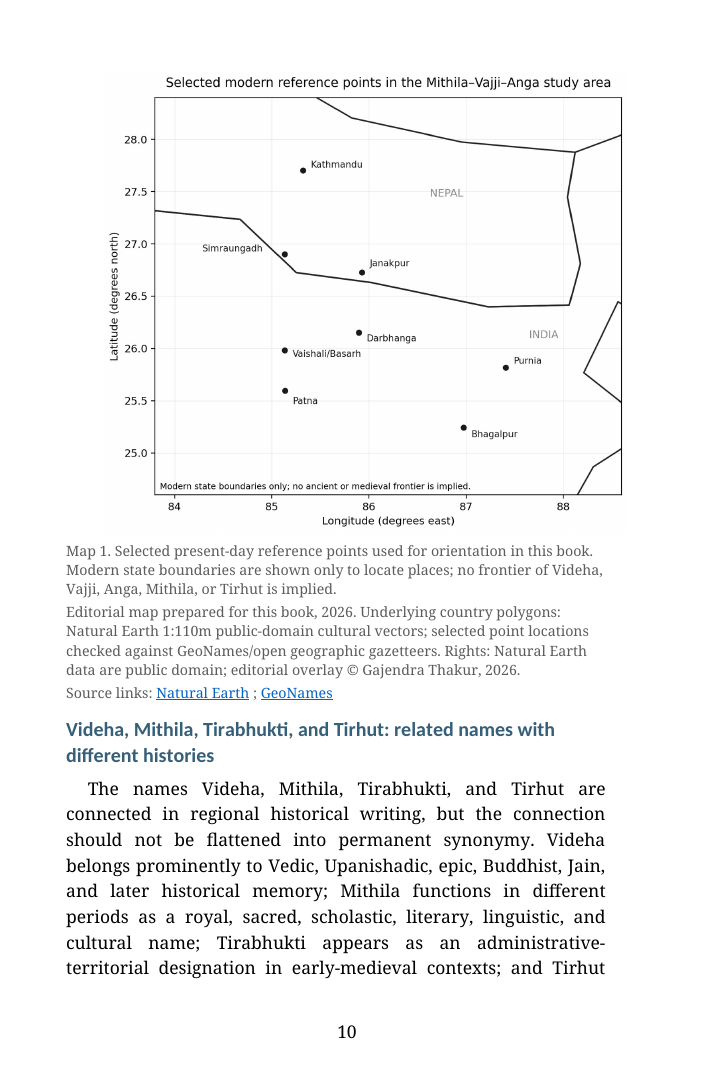
Mithila · Vajji · Anga
Chapter-specific source notes
- Primary chapter witness. Gajendra Thakur, Decoding the Panji of Mithila — Volume VI, formal Chapter 9, PDF pp. 87-97; formal Chapter 9. The HTML transcription is generated from the commit-pinned source PDF and retains the chapter boundary recorded in this edition.
- Internal structure. The repository source-heading inventory records 15 subordinate headings for this chapter: “Opening”; “Mool as Ancestral Place”; “Moolgram: The Second Layer of Place”; “Why Migration Required Record-Keeping”; “Village Chains in Dushan Panji”; “A Working Model: Ancient Root, Later Branch, Social Route”; “Mool as Memory, Not Modern Address”; “Mandar, Darihara, Sarisab, Soderpur, and Other Memory-Nodes”; ….
- Digital editorial method. The page keeps the preserved source text distinct from generated navigational, concordance, visual, and provenance apparatus. The synthetic reconstruction is explanatory only and is not evidence for an individual lineage or a determination of social or marital status.