Decoding the Panji of Mithila · Volume VI · Chapter 12
Devadasi, Dasi, and Female-Line Memory
Chapter 12 — Devadasi, Dasi, and
Female-Line Memory
Chapter 12 follows the structure of this volume by reading the
Dushan material through Devadasi, Dasi, and the female-line
notations that preserve women in compressed but decisive
genealogical form. The chapter does not treat these terms as
sensational labels. It treats them as archival signs. They tell us
where descent, marriage, memory, uncertainty, and social
classification entered the Panji system through women.
The previous chapter showed that अज्ञात is not emptiness. It is a
record of unresolved recognizability. This chapter moves one
step further. It asks what happens when the Panji does name
the female route, but names it through categories that later
readers may either misunderstand or misuse: देवदासी, दासी, माता,
सुता, मातृक, पत्नी, and daughter-line descent. The purpose is not to
soften the source. The purpose is to read it accurately and
humanely.
Women as Structure, Not Decoration
A surface reading of Panji can create the impression that
genealogy is only a male archive: fathers, sons, gotras, mools,
branches, and Biji Purush. But Dushan Panji unsettles that
impression. Women appear exactly where the record has to
explain why a line became difficult, disputed, altered, marked,
or reabsorbed. The female line is therefore not marginal. It is
structurally necessary.
In ordinary genealogical writing, women may disappear
behind the name of a father or husband. In the Dushan entries,
however, women often become the hinge of the record. A
mother may be named or marked as unknown. A daughter may
© Gajendra Thakur | 114
Decoding the Panji of Mithila, Volume VI
carry a line into another mool. A wife may introduce a
boundary-crossing relation. A Devadasi or Dasi may become
the recorded origin of a later chain. A daughter’s son may
preserve a route that a purely paternal register would conceal.
This is why the structure of this volume rightly treats Devadasi,
Dasi, and female-line memory before the chapters on Dalit/artisan
connections, Muslim/Yavani connections, widowhood, and named
women. Without this chapter, the reader would meet the later
examples as scattered anomalies. With this chapter, the reader
sees the logic: many Dushan entries are organized around the
movement of lineage through women.
The Source’s Small but Revealing Remark
The source makes a striking observation: only in the Rasaadh-
Araria Panji are women’s names found in the Panji record. The
remark is small, but its implication is large. If women’s names
are rare in the formal Panji system, then every appearance of a
woman, even through a painful or partial category, becomes
historically significant.
This means that Dushan Panji must not be read merely as a
record of blemish. It is also one of the places where women
become visible because the system could not explain the
descent route without them. The record may use hierarchical
language, but the historical fact is that descent, marriage, and
social continuity repeatedly depended on women whose
names, statuses, or relationships had to be recorded.
Devadasi in the Dushan Record
The term देवदासी must be handled with special care. It should not
be translated into a modern insult, nor should it be
romanticized. In the Dushan entries, it functions as a source
category attached to maternal identity, lineage route, and social
classification. The reader must ask: where does the term
appear, whose mother is being identified, and how does that
identity affect the later chain?
© Gajendra Thakur | 115
Decoding the Panji of Mithila, Volume VI
Several entries use the expression माता followed by देवदासी. The
record speaks, for example, of हरिहरक-माता (देवदासी), विद्यापतिक-माता
(देवदासी), श्रीरामक-माता (देवदासी), and other mother-marked instances.
In these cases the key word is not only देवदासी. The key structure
is माता. The source is not merely listing a social category. It is
identifying a maternal point through which descent is read.
This changes the interpretive frame. A reader who focuses only
on the status label may miss the genealogical function. The
entry is saying: here is a line whose explanation requires the
mother. The mother is not incidental. She is the hinge of the
record. To decode the case, one must identify the person whose
mother is being marked, the mool sequence around that
person, and the later descendants attached to the route.
Dasi as a Wider Female-Line Marker
The word दासी appears in several forms. Sometimes it is part of
देवदासी. Sometimes it appears with a community label, as in धीवर
दासी. Sometimes it appears in a marriage phrase such as गोप-विवाह
दासी. Each form must be read separately. A single translation
cannot cover them all without distorting the record.
In the table, धीवर दासी appears in case 96, followed by a chain of
mools and names. The phrase should not be treated as a loose
abuse. It is a technical signal in the Dushan record: a woman
identified through the Dhivar/Dheevar community and through
Dasi status is entering the genealogical chain. The surrounding
mools and persons show that the entry is not an isolated moral
remark; it is a structured relationship record.
Similarly, the phrase गोप-विवाह दासी in case 97 is not to be read as
a free-floating phrase. It combines a community-marked
marriage route with a female status term. The interpretive
question is: who marries whom, through what route, and what
happens to the descendants? Only after that can the social
meaning be discussed responsibly.
© Gajendra Thakur | 116
Decoding the Panji of Mithila, Volume VI
Female-Line Vocabulary: A Working Table
The following table gives a controlled vocabulary for reading
women’s appearance in the Dushan material. It is not a
replacement for the entries. It is a guide for decoding them
without losing either precision or humanity.
Term or notation Literal / archival How it should be
function decoded
माता Mother; the maternal Identify whose mother is
point in the record. named or marked, then
read the mool chain that
depends on her.
मातृक Maternal side or Treat it as a route of
maternal-house descent and eligibility, not
connection. as a casual note.
सुता Daughter; female descent Follow the daughter-line
link. carefully because it may
carry the lineage into
another mool or
community.
पत्नी Wife; marital connection. Ask whether the wife
introduces an unknown,
community-marked,
widow, or forbidden
relation.
देवदासी Source category tied to a Read as a recorded
female status and often to maternal or female-line
motherhood. category, not as a modern
insult.
दासी Female status category; Determine whether the
sometimes linked with entry is about mother,
community labels. wife, marriage, or
descendant route.
दौहित्र Daughter’s son. Use it to recover descent
through the daughter-line
where male-line reading
would fail.
Why Female-Line Memory Appears in Dushan
Panji
Female-line memory appears in Dushan Panji because the
system was built around marriage eligibility and descent
© Gajendra Thakur | 117
Decoding the Panji of Mithila, Volume VI
recognition. Whenever a woman’s origin, status, marriage, or
maternal identity affected the classification of descendants, the
record had to preserve her route. The result is paradoxical.
Women are often unnamed or partially named in the wider
archive, yet the Dushan entries make them unavoidable.
This does not mean the record is feminist in a modern sense. It
is not. The language often reflects hierarchy, anxiety, and
control. But the historian can still read the archive against its
own silences. The very anxiety that made the system record
certain women also preserved evidence of women’s role in
lineage formation.
Thus, a mother marked as देवदासी is not merely the object of
judgment. She is the person through whom the later line is
made intelligible. A daughter marked as सुता is not merely a
daughter. She may be the route by which the next generation
enters the table. A wife marked by a community term is not
merely a social problem. She is evidence of a real marriage or
union that the formal ideology of separation could not erase.
Maternal Identity and the Limits of Male
Genealogy
Panji often appears to be organized by male ancestry: Biji
Purush, sons, grandsons, mool, gotra, and branch. But the
Dushan entries reveal the limits of that structure. Male
genealogy can say who the father is, but it cannot always
explain why a line was marked. For that, the record often turns
to the mother, wife, daughter, or daughter’s son.
This is especially important for the later entry-by-entry
chapters. A case may list a sequence of male names, yet the
decisive interpretive fact may be hidden in one phrase: माता
देवदासी, मातृक अज्ञात, सुता, पत्नी, दासी, or विवाह. If the reader skips that
phrase, the entire case is misread.
The chapter therefore insists on a rule: in Dushan Panji, the
female term is not secondary evidence. It is often the primary
© Gajendra Thakur | 118
Decoding the Panji of Mithila, Volume VI
key. The mool chain supplies the frame, but the female-line
marker supplies the explanation.
Devadasi, Dasi, and Agyat
The relation between देवदासी / दासी and अज्ञात must also be
understood. The source’s introductory explanation says that
several women of Devadasi traditions were treated as
unknown, yet their descendants are later socially respected.
This is one of the most important statements in the file, because
it links three ideas: female-line origin, archival uncertainty, and
later social absorption.
If a woman from a Devadasi tradition is recorded as अज्ञात, that
does not mean she had no identity. It means the formal Panji
system did not, or would not, recognize her origin through its
usual categories. The woman’s actual life existed outside the
record’s comfortable grammar. The Dushan entry is the place
where the record admits that discomfort.
This also reinforces the ethical rule of the book. The task is not
to convert देवदासी, दासी, or अज्ञात into new labels of humiliation.
The task is to explain what the old archive was doing and then
to refuse the archive’s hierarchy as present-day judgment.
From Marginal Label to Historical Person
A major danger in reading Dushan Panji is to let the label
swallow the person. When an entry says देवदासी, the reader may
remember only the label and forget that a woman, a mother, a
relation, and a line of descendants stand behind it. This book
must reverse that tendency. It must begin with the archival
term but end with historical recognition.
This recognition does not require inventing biographies that
the source does not provide. It requires a disciplined reading of
the little that is given: whose mother, whose wife, whose
daughter, whose maternal side, whose descendant line, which
© Gajendra Thakur | 119
Decoding the Panji of Mithila, Volume VI
mool, which case number, which surrounding names. Even
compressed data can be humane if it is read with care.
The later chapter on named women will bring forward
Anandaa, Vallabha, Medha, Hira’s daughter, Rahmu’s daughter,
Sohaago, and other female figures more fully. Chapter 12
prepares that work by giving a method for reading women
even when the record offers only a role, a status, or a
relationship marker.
The Paradox of Visibility
The female-line material in Dushan Panji creates a paradox.
Women become visible because the record is worried about
them. They are preserved not because the system was
generous, but because the system needed to explain descent,
eligibility, and boundary-crossing. The archive’s anxiety
became the historian’s evidence.
This paradox must be handled honestly. To say that Dushan
Panji preserves women does not mean it treated women
equally. To say that it uses women to explain lineage does not
mean it honored women as full historical subjects. But to ignore
the women because the language is difficult would repeat the
old erasure. The better method is to read the terms, expose the
hierarchy, and recover the relationship structure.
Reading Devadasi and Dasi Entries without
Sensationalism
The Devadasi and Dasi entries can easily be mishandled. A
sensational reading would extract the most striking label and
present it as scandal. A defensive reading would hide the label
and claim that the archive says nothing important. Both
readings fail. The correct reading is slower and more exact.
First, preserve the source term exactly, because changing it
would falsify the archive.
Second, identify its grammatical function: mother, wife,
daughter, Dasi, Devadasi, or community-marked relation.
© Gajendra Thakur | 120
Decoding the Panji of Mithila, Volume VI
Third, read the surrounding mool and person chain,
because the label alone is never the whole case.
Fourth, ask whether the entry shows later descendants,
absorption, or continuation.
Fifth, explain the social history without turning the source
term into present-day humiliation.
Female-Line Memory and the Instability of
Purity Claims
The existence of these entries also challenges rigid purity
narratives. If society were perfectly closed, there would be no
need for so many female-line markers involving unknown
origin, Devadasi traditions, Dasi relations, community-marked
marriages, and maternal routes. The record exists because life
exceeded the formal ideal.
Dushan Panji therefore shows both control and porosity. It
shows control because the system marks and classifies. It shows
porosity because the marked relations existed, produced
descendants, and in many cases entered ordinary social
memory over time. The female line is one of the main places
where this porosity becomes visible.
How Chapter 12 Will Guide Later Chapters
Chapter 12 is a bridge. It prepares Chapter 13 on Dalit and
artisan connections, because many such entries pass through
women: Chamar/Charmakarini, Rajak/Rajaki, Hadi/Hadini,
Tanti, Dhivar, Telik, Gop, Yadav, Dasi, and related categories. It
prepares Chapter 15 on widowhood, because widow and post-
husband relations are also female-line questions. It prepares
Chapter 17 on named women, because the named women can
be understood only after the grammar of unnamed or category-
marked women is clear.
Most importantly, it prepares Chapters 18 through 21, where
every Dushan entry must be decoded in full. In those chapters,
© Gajendra Thakur | 121
Decoding the Panji of Mithila, Volume VI
no मातृक, माता, सुता, दासी, देवदासी, पत्नी, or दौहित्र marker should be
passed over. Each is part of the case architecture.
Conclusion: The Female Line as Archive
Chapter 12 has argued that Devadasi, Dasi, and female-line
notations are not peripheral. They are one of the main keys to
Dushan Panji. They reveal how women, even when partly
hidden, carried memory, descent, anxiety, and continuity
through the record.
The ethical conclusion is clear. We must preserve the source
terms, but we must not preserve the cruelty of their possible
misuse. We must read the archive exactly, but not injure the
descendants. We must recognize that women appear in Dushan
Panji because the lineage could not be explained without them.
In that sense, the Black Book is also a difficult women’s archive.
The next chapter follows the structure of this volume by turning to
Dalit and artisan connections in Dushan Panji. Chapter 12 has
prepared that movement by showing that many community-
marked entries are also female-line entries. The path from social
boundary to genealogy often passes through women.
Chapter 12 Source Notes
Source note 1: This chapter follows the structure of Chapter 12,
which requires explanation of Devadasi tradition, Dasi, female-line
recording, maternal identity, daughter-line descent, and the
paradox that women are both marginalized and indispensable in
Panji.
Source note 2: The general basis is the source remark that only
in the Rasaadh-Araria Panji are women’s names found, and the
broader Dushan explanation that the record preserves difficult
matters after time has passed.
Source note 3: The Devadasi discussion follows table entries
that identify mothers as Devadasi, including Harihar’s mother,
Vidyapati’s mother, Lakhuk’s mother, and Shriram’s mother.
© Gajendra Thakur | 122
Decoding the Panji of Mithila, Volume VI
Source note 4: The Dasi discussion follows later Dushan
examples including Dhivar Dasi and Gop-marriage Dasi, where
the female status term appears inside a larger mool and
descent chain.
Source note 5: The ethical reading follows the source’s own
observation that descendants of women treated through
unknown or difficult categories later became socially respected,
and that such facts should guide rather than injure later
readers.Source structure and verification apparatus
Editorial source apparatus. This apparatus is descriptive, not interpretive. It records the source-controlled structure used to verify that this page corresponds to formal Chapter 12 of Decoding the Panji of Mithila — Volume VI. The chapter text above is preserved from PDF pp. 115-124; formal Chapter 12 in the commit-pinned authoritative source. It is not merged with a neighboring chapter, appendix, annexure, or independent front/back-matter unit. The internal headings below come from the repository’s source-heading inventory and are retained as navigational and audit evidence; showing them here does not turn those headings into separate publications or add claims that are absent from the source.
Internal source headings
- Women as Structure, Not Decoration
- The Source’s Small but Revealing Remark
- Devadasi in the Dushan Record
- Dasi as a Wider Female-Line Marker
- Female-Line Vocabulary: A Working Table
- Why Female-Line Memory Appears in Dushan Panji
- Maternal Identity and the Limits of Male Genealogy
- Devadasi, Dasi, and Agyat
- From Marginal Label to Historical Person
- The Paradox of Visibility
- Reading Devadasi and Dasi Entries without Sensationalism
- Female-Line Memory and the Instability of Purity Claims
- How Chapter 12 Will Guide Later Chapters
- Conclusion: The Female Line as Archive
- Chapter 12 Source Notes
Source-text concordance
Devadasi · Dasi · Female-Line · Memory · follows · structure · reading · Dushan · material · notations · preserve · women · compressed · decisive · genealogical · form · treat · terms · sensational · labels · treats · archival · signs · tell · descent · marriage · uncertainty · social · classification · entered · system · previous · showed · emptiness · record · unresolved · recognizability · moves · step · asks · happens · name · female · route · names · categories · later · readers · either · misunderstand · misuse · daughter-line · purpose · soften · read · accurately · humanely · Decoration · surface · create · impression · genealogy · male · archive · fathers · sons · gotras · mools · branches · Biji · Purush · unsettles · appear · exactly · explain · line · became · difficult · disputed · altered
Boundary verification. In the formal sequence this chapter follows Volume VI Chapter 11, “Unknown Lineage and “Agyat”: The Social Meaning of the Unknown” and precedes Volume VI Chapter 13, “Dalit and Artisan Connections in Dushan Panji”. The chapter extractor begins at the verified formal Chapter 12 marker and stops at the next verified formal chapter marker; for a final chapter it stops before recognized book-level back matter. The concordance above is generated only from distinct terms already present in this chapter’s preserved source text. It is provided for discovery, comparison, and audit, not as an automated judgment about persons, lineages, status, kinship, marriage eligibility, or historical truth.
Illustrated research apparatus
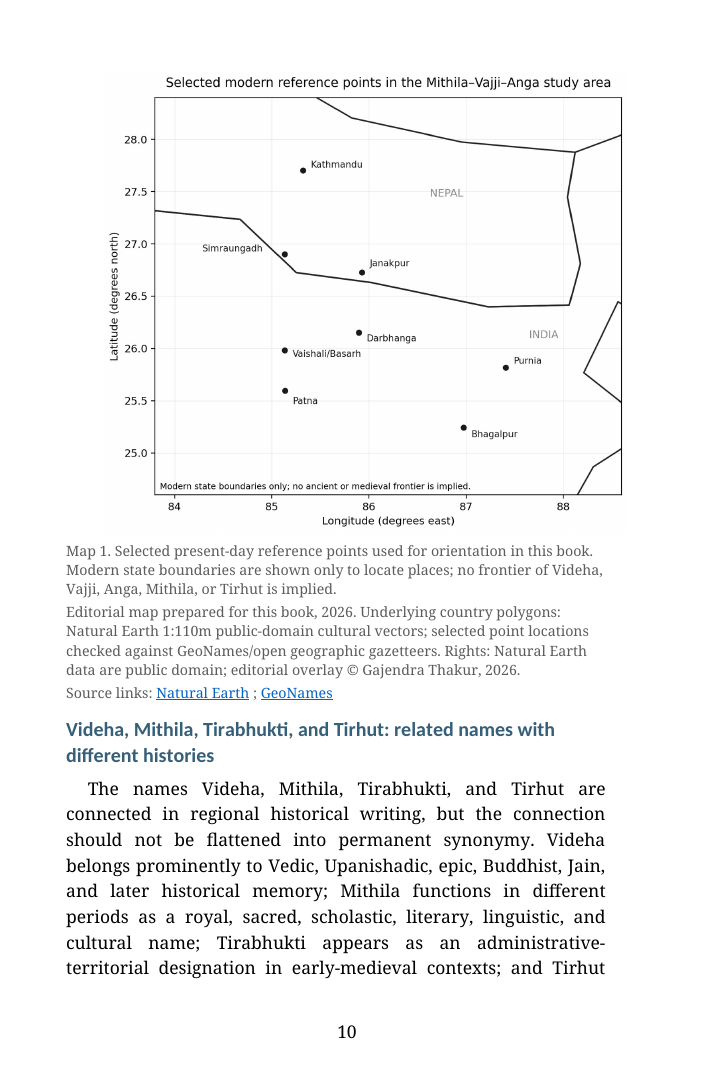
Mithila · Vajji · Anga
Chapter-specific source notes
- Primary chapter witness. Gajendra Thakur, Decoding the Panji of Mithila — Volume VI, formal Chapter 12, PDF pp. 115-124; formal Chapter 12. The HTML transcription is generated from the commit-pinned source PDF and retains the chapter boundary recorded in this edition.
- Internal structure. The repository source-heading inventory records 15 subordinate headings for this chapter: “Women as Structure, Not Decoration”; “The Source’s Small but Revealing Remark”; “Devadasi in the Dushan Record”; “Dasi as a Wider Female-Line Marker”; “Female-Line Vocabulary: A Working Table”; “Why Female-Line Memory Appears in Dushan Panji”; “Maternal Identity and the Limits of Male Genealogy”; “Devadasi, Dasi, and Agyat”; ….
- Digital editorial method. The page keeps the preserved source text distinct from generated navigational, concordance, visual, and provenance apparatus. The synthetic reconstruction is explanatory only and is not evidence for an individual lineage or a determination of social or marital status.