Decoding the Panji of Mithila · Volume VI · Chapter 13
Dalit and Artisan Connections in Dushan Panji
Chapter 13
Dalit and Artisan Connections in Dushan Panji

Opening
This chapter requires a careful reading of entries involving
Chamar or Charmakarini, Rajak or Rajaki, Hadi or Hadini, Tanti,
Dhivar, Telik or Tailik, Gop, Yadav, Dasi, Devadasi, and related
social categories. The purpose is not to repeat social insult. The
purpose is to understand how Dushan Panji preserved
relationships across caste and occupational boundaries, and how
those relationships entered formal genealogical memory.
The source material makes this unavoidable. It explicitly says
that Dushan Panji contains written documentation of Brahmin
relations and marriages with other communities, “especially
Dalit and Muslim,” and also records marriage after a husband’s
death. Such a statement is not a passing remark. It is a key to
the whole archive. It tells us that Dushan Panji is not merely a
list of internal blemishes; it is a record of a society whose lived
relationships crossed the boundaries that later ideology wanted
to present as absolute.

                      © Gajendra Thakur | 123
                   Decoding the Panji of Mithila, Volume VI

This chapter therefore reads Dalit and artisan connections in
three ways: as community labels in the source, as relationship
routes in genealogy, and as evidence that social life in Mithila
was more porous than later purity claims allowed. The reader
must keep these three layers separate. A source label is not a
present-day judgment. A relationship route is not a slur. A
Dushan entry is not a license to humiliate descendants. It is a
difficult piece of historical evidence.

Community Label and Genealogical Function
A major mistake in reading Dushan Panji is to treat each
community term as if it were only a caste label. In the table, the
term usually performs a genealogical function. It tells the
reader where a mother, wife, daughter, or descendant-line
entered the record. When the source says चर्मकारिणी, रजकी, धीवर
दासी, तैलिक देवाई, यादव रहमू, गोप पुत्री, or हड़िनी रुद्रमति, the term does not
stand alone. It is attached to a relationship: mother, daughter,
wife, marriage, maternal line, or descendant-line.
The entry therefore has to be decoded grammatically before it
is interpreted socially. “माता” points to a maternal route. “सुता”
points to a daughter-route. “विवाह” points to a marriage-route.
“सन्तान” points to the descendants through whom the entry was
carried forward. Without these relational words, the
community label is easily misread as mere stigma. With them,
it becomes evidence of social contact and lineage formation.

Chamar, Charmakarini, and the First Model of
Absorption
The source’s own explanatory example begins with a cross-
community marriage involving गुणवति हिमशा and चमरू of Valiyas
mool. A child, गंगाधर, is born. The line then moves through a
daughter’s marriage into Sarisav, then to Sakaraadhi, then to
Panichobh, then to Darihara, then to Pali, and later to Narwal.
The explanation ends with Devadhar becoming “पूर्णतः शुद्ध” in

                          © Gajendra Thakur | 124
                Decoding the Panji of Mithila, Volume VI

the sixth generation. This example is central because it shows
the source’s own method: Dushan is recorded, but time and
generational distance also provide a route of absorption.
This means that the Chamar/Charmakarini entries cannot be
read only as exclusion. They also show how lines were
remembered, tracked, and eventually integrated. The very
archive that records the boundary-crossing also records the
route by which the boundary became less socially active. The
case is painful because it reveals stigma. It is also historically
important because it reveals reintegration.
The Chamar/Charmakarini cluster appears again in relation to
Hirua, Vallabha, Medha, Surpati’s mother, Anandaa, and
Gangesha-related traditions. These cases do not all have the
same structure. Some are mother-line entries. Some are wife-
line entries. Some are daughter-line entries. Some are later
explanatory summaries. A responsible reading does not flatten
them. It asks: who is the named woman, what is the route, what
is the generational distance, and how does the entry connect to
other mool chains?

Rajak, Rajaki, and Washer Community Routes
The Rajak/Rajaki material is one of the clearest examples of
how Dushan Panji records community contact through
maternal and marital routes. The source gives entries in which
a mother is identified as Rajaki, another line carries “रजक
परम्परा,” and later entries involve “रजकक कन्या” and Hadini
Rudramati. These are not isolated words. They create a
network: Rajak father or community reference, Rajaki mother,
Rajak daughter, and a descendant-line continuing through
Panji names.
The presence of Rajak/Rajaki entries also shows why Chapter
10’s method is necessary. If a reader only sees the community
label, the entry becomes a caste mark. If the reader follows the
chain, the entry becomes a genealogical statement: which mool
is involved, whose mother is named, which daughter or wife is

                      © Gajendra Thakur | 125
                Decoding the Panji of Mithila, Volume VI

the route, and which descendants are later affected. The table is
therefore a social map, not a dictionary of insult.

Hadi, Hadini, and Rudramati
The source preserves the name हड़िनी रुद्रमति in connection with
Rajak and inter-community routes. Her presence matters
because the entry keeps a woman’s name in a system where
women often appear only as “mother,” “daughter,” “wife,” or
“unknown.” Rudramati is not simply a category. She is a named
figure through whom the line is remembered.
This is one reason Dushan Panji can be reread as a hidden
archive of women. The same entry that stigmatizes also
preserves. It preserves the fact of a woman’s connection, the
social anxiety around that connection, and the genealogical
consequences. A humane reading must not erase her name
after extracting the caste label. Rudramati must remain visible
as a person in the archive.

Tailik, Tanti, Dhivar, and Occupational
Communities
The Dushan material also records artisan and occupational
groups beyond the Chamar and Rajak clusters. The entry for
तैलिक देवाई is marked as inter-community or अन्तर्जातीय. The later
entry for धीवर दासी places the fisher community label inside a
wife-line or service-status route. These cases show how
occupational communities entered Panji memory through
marriage, domestic relation, or maternal descent.
The chapter scope also names Tanti. Where the table gives
weaving or similar occupational community markers, the same
reading principle applies: identify the relationship term first and
the community label second. A label without its relationship route
is incomplete evidence. Panji does not merely say that an
occupational group existed. It shows how a person from such a
community entered a named Brahmin mool chain, how the event
was remembered, and how the descendant-line was treated.

                      © Gajendra Thakur | 126
                   Decoding the Panji of Mithila, Volume VI

This is important for the social history of Mithila. Artisan and
service communities were not outside history. They were part
of domestic life, village economy, ritual support, labor
networks, and intimate relationships. Dushan Panji, however
uneasily, preserves traces of this shared world.

Gop, Yadav, and Pastoral Connections
The source contains entries involving यादव जयसिंह and यादव रहमू,
and its post-table summary refers to the descendants of
Rahmu’s daughter and to a Gop daughter-line. These cases
show pastoral and Yadav-linked routes entering Dushan
memory. They must be read with the same care as other
community routes: who is named, whose daughter is involved,
whose descendants are marked, and through which mool chain
the record proceeds.
The Yadav and Gop cases are especially useful because they
remind us that Dushan Panji is not limited to one kind of
boundary-crossing. It records not only Dalit-artisan routes but
also pastoral, regional, widow, Muslim, unknown, and internal
Brahman boundary routes. This variety is one of the main
reasons the archive undermines simplistic purity mythology.
Social life was not closed. The records themselves show contact.

A Working Table for Chapter 13
The following working table summarizes how some of the main
community routes should be decoded in this chapter and later
in the entry-by-entry chapters. It is not a replacement for the 1-
97 case decoding. It is a guide to method.
Source label or cluster    Relationship route to       Historical reading
                           identify first

चमरू / चर्मकार / चर्मकारिणी Mother, wife, daughter, or Evidence of Dalit-artisan
                           descendant-line; in some    contact, marital relation,
                           cases a named woman         and generational
                           such as Vallabha, Medha,    absorption; not a present-
                           or Anandaa.                 day accusation.

                          © Gajendra Thakur | 127
                     Decoding the Panji of Mithila, Volume VI

Source label or cluster     Relationship route to      Historical reading
                            identify first

रजक / रजकी / रजक            Mother-line, daughter-     Shows washer-community
                            line, or Rajak-family      connections entering
परम्परा                     route; sometimes linked to formal mool chains
                            Hadini Rudramati.          through maternal and
                                                       marital routes.

हड़िनी रुद्रमति              Named woman and            A woman’s name survives
                            daughter-line route, not   inside a stigmatized
                            merely a category.         record; she must be read
                                                       as person and route.

तैलिक देवाई                 Inter-community            Occupational community
                            marriage or maternal       contact preserved as
                            route within a named       genealogical event.
                            mool chain.

धीवर दासी                   Dasi or wife-line route    Service-status and
                            involving fisher-          occupational identity
                            community label.           intersect with descent
                                                       memory.

यादव रहमू / गोप पुत्री      Daughter-line and          Pastoral/Yadav/Gop routes
                            descendant-line.           show porous social
                                                       boundaries beyond a
                                                       single caste axis.

Why These Entries Challenge Purity Myths
The older ideology of purity often imagines social groups as if
they lived in sealed vessels. Dushan Panji contradicts that
imagination. The table shows marriages, maternal relations,
daughter-lines, unknown lines, and inter-community routes. It
shows that the society which spoke in the language of purity
also lived through contact, dependence, affection, desire,
adoption, widowhood, service, migration, and practical
accommodation.
The source itself is aware of this tension. It says that the entries
caused anger, disputes, and discomfort because they
documented relations with other castes, especially Dalit and
Muslim communities, and because the compiler could not alter
the material. That admission is not marginal. It explains why
the Dushan record is difficult: it does not allow society to
maintain a simple self-image.

                           © Gajendra Thakur | 128
                Decoding the Panji of Mithila, Volume VI

But the purpose of this chapter is not to reverse humiliation by
creating new humiliation. The purpose is to show that purity
was always a social claim under pressure from lived reality.
The entries prove the existence of contact. They do not prove
inherited shame.

Reading without Reviving Stigma
A present-day reader must avoid three errors. First, do not turn
the source label into a modern insult. Second, do not treat a
descendant-line as permanently polluted. Third, do not use the
archive to identify or shame living families. The ethical rule of
this volume is simple: the older record may be studied, but its
cruelty must not be reproduced.
A better method is to use neutral language: “source label,”
“community-marked route,” “mother-line,” “daughter-line,”
“wife-line,” “descendant-line,” “inter-community relation,” and
“generational absorption.” These phrases allow historical
analysis without repeating the violence of the old social
vocabulary.
This does not mean softening the evidence. The entries should
be cited, decoded, and explained plainly. But plain explanation
is not the same as social accusation. The historian must keep
the archive open and the wound from being reopened
unnecessarily.

How This Chapter Prepares the Entry-by-Entry
Decoding
The entry-by-entry chapters later in this volume will not treat
Dalit and artisan entries as isolated curiosities. They will place
each case inside its mool chain, relationship route, and
generational position. This chapter has supplied the
interpretive frame for that work.
When the reader reaches cases involving Chamaru, Gangadhar,
Hirua, Vallabha, Medha, Surpati’s mother, Rajaki mothers,
Rajak daughters, Hadini Rudramati, Tailik Dewai, Dhivar Dasi,

                      © Gajendra Thakur | 129
                Decoding the Panji of Mithila, Volume VI

Yadav Rahmu, and Gop daughter-lines, the question should not
be “Who is to be blamed?” The question should be “What
relation is being recorded, why did Panji mark it, and what
does the record reveal about Mithila’s social reality?”
The answer, repeatedly, is that Mithila’s social life was more
mixed, mobile, and human than the later language of purity
could admit.

Conclusion: Contact as History
Chapter 13 has shown that Dalit and artisan connections in
Dushan Panji are not peripheral. They are central to the
archive’s historical power. They reveal that the Panji system
recorded not only approved descent but also the relationships
that tested, crossed, and eventually reshaped social boundaries.
The old record may have named these entries as Dushan. A
modern scholarly reading must name them also as history: the
history of contact, the history of women’s lines, the history of
village dependence, the history of artisan and pastoral
communities, and the history of reintegration after stigma. The
next chapter will extend this method to Muslim and Yavani
connections, where the same ethical challenge appears in
another form.

Chapter 13 Source Notes
Source note 1: This chapter follows the structure of Chapter 13,
which requires decoding entries involving Chamar/Charmakarini,
Rajak/Rajaki, Hadi/Hadini, Tanti, Dhivar, Telik, Gop, Yadav, Dasi,
Devadasi, and related categories.
Source note 2: The source’s introductory and editorial material
states that Dushan Panji preserves written records of relations
or marriages with other communities, especially Dalit and
Muslim communities, and that these records were
transliterated word-for-word from Mithilakshar into
Devanagari.

                      © Gajendra Thakur | 130
               Decoding the Panji of Mithila, Volume VI

Source note 3: The chapter uses the explanatory example in
which a Chamaru-related line moves through several daughter-
line marriages and Devadhar becomes “पूर्णतः शुद्ध” in the sixth
generation.
Source note 4: The Rajak/Rajaki discussion draws on entries
where mothers, daughters, and Rajak tradition are recorded,
including lines involving Rajaki mothers and Hadini
Rudramati.
Source note 5: The Tailik, Dhivar, Gop, and Yadav discussions
draw on later Dushan entries and the post-table summary
naming Tailik Dewai, Dhivar Dasi, Yadav Rahmu’s daughter,
Gop daughter-line, and related descendants.
Source structure and verification apparatus
Editorial source apparatus. This apparatus is descriptive, not interpretive. It records the source-controlled structure used to verify that this page corresponds to formal Chapter 13 of Decoding the Panji of Mithila — Volume VI. The chapter text above is preserved from PDF pp. 124-132; formal Chapter 13 in the commit-pinned authoritative source. It is not merged with a neighboring chapter, appendix, annexure, or independent front/back-matter unit. The internal headings below come from the repository’s source-heading inventory and are retained as navigational and audit evidence; showing them here does not turn those headings into separate publications or add claims that are absent from the source.
Internal source headings
- Opening
- Community Label and Genealogical Function
- Chamar, Charmakarini, and the First Model of Absorption
- Rajak, Rajaki, and Washer Community Routes
- Hadi, Hadini, and Rudramati
- Tailik, Tanti, Dhivar, and Occupational Communities
- Gop, Yadav, and Pastoral Connections
- A Working Table for Chapter 13
- Why These Entries Challenge Purity Myths
- Reading without Reviving Stigma
- How This Chapter Prepares the Entry-by-Entry Decoding
- Conclusion: Contact as History
- Chapter 13 Source Notes
Source-text concordance
Dalit · Artisan · Connections · Dushan · Opening · requires · careful · reading · entries · involving · Chamar · Charmakarini · Rajak · Rajaki · Hadi · Hadini · Tanti · Dhivar · Telik · Tailik · Yadav · Dasi · Devadasi · related · social · categories · purpose · repeat · insult · understand · preserved · relationships · across · caste · occupational · boundaries · entered · formal · genealogical · memory · material · makes · unavoidable · explicitly · says · contains · written · documentation · Brahmin · relations · marriages · communities · especially · Muslim · records · marriage · husband’s · death · statement · passing · remark · whole · archive · tells · merely · list · internal · blemishes · record · society · whose · lived · crossed · later · ideology · wanted · present · absolute · Gajendra · Thakur
Boundary verification. In the formal sequence this chapter follows Volume VI Chapter 12, “Devadasi, Dasi, and Female-Line Memory” and precedes Volume VI Chapter 14, “Muslim and Yavani Connections”. The chapter extractor begins at the verified formal Chapter 13 marker and stops at the next verified formal chapter marker; for a final chapter it stops before recognized book-level back matter. The concordance above is generated only from distinct terms already present in this chapter’s preserved source text. It is provided for discovery, comparison, and audit, not as an automated judgment about persons, lineages, status, kinship, marriage eligibility, or historical truth.
Illustrated research apparatus
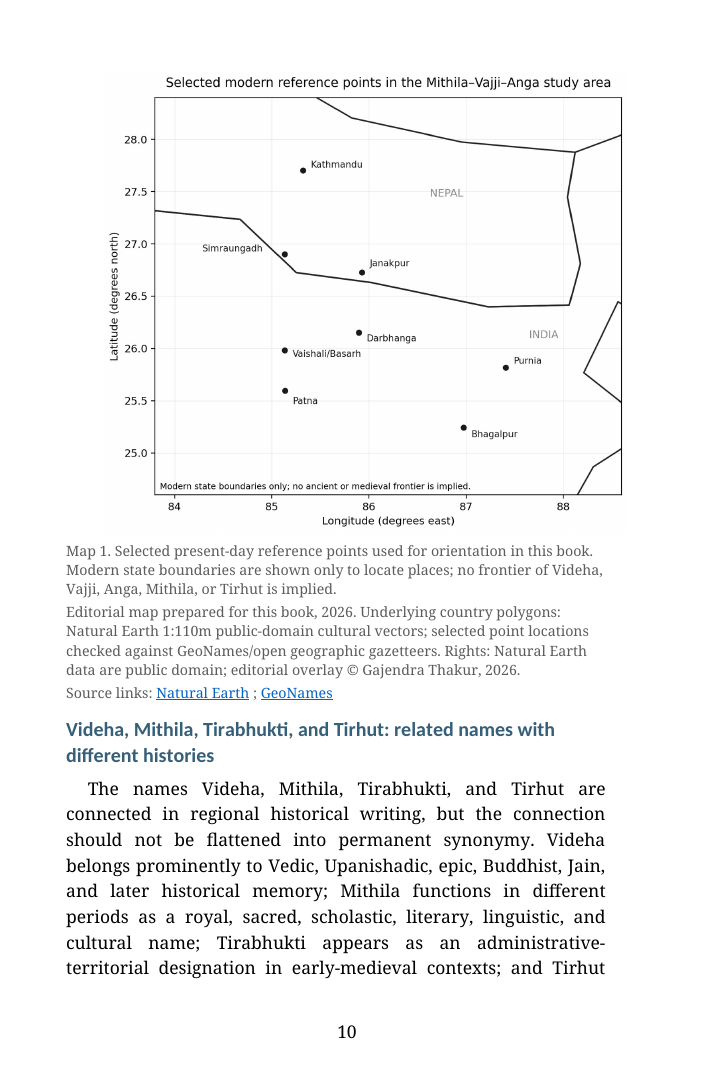
Mithila · Vajji · Anga
Chapter-specific source notes
- Primary chapter witness. Gajendra Thakur, Decoding the Panji of Mithila — Volume VI, formal Chapter 13, PDF pp. 124-132; formal Chapter 13. The HTML transcription is generated from the commit-pinned source PDF and retains the chapter boundary recorded in this edition.
- Internal structure. The repository source-heading inventory records 13 subordinate headings for this chapter: “Opening”; “Community Label and Genealogical Function”; “Chamar, Charmakarini, and the First Model of Absorption”; “Rajak, Rajaki, and Washer Community Routes”; “Hadi, Hadini, and Rudramati”; “Tailik, Tanti, Dhivar, and Occupational Communities”; “Gop, Yadav, and Pastoral Connections”; “A Working Table for Chapter 13”; ….
- Digital editorial method. The page keeps the preserved source text distinct from generated navigational, concordance, visual, and provenance apparatus. The synthetic reconstruction is explanatory only and is not evidence for an individual lineage or a determination of social or marital status.