Decoding the Panji of Mithila · Volume VI · Chapter 30
Conclusion: Dushan Panji as Mithila’s Difficult Truth
Chapter 30 — Conclusion: Dushan Panji
as Mithila’s Difficult Truth
Dushan Panji is Mithila’s difficult truth because it preserves
what a proud society often prefers to simplify. It shows that
Mithila was learned, disciplined, and record-conscious; it also
shows that Mithila was never as closed, pure, or static as later
ideology claimed.

What the Black Book Reveals
It reveals that marriage rules mattered deeply. It reveals that
gotra, pravara, mool, moolgram, Biji Purush, sapinda, swajana,
aswajana, and Uthedh were part of a sophisticated information
system. It reveals that women, though often hidden, carried the
consequences of descent. It reveals that Dalit, artisan, Muslim,
Yavani, Dasi, Devadasi, widow, and unknown-lineage
references were not outside Mithila’s history; they were inside
the archive itself.

                     © Gajendra Thakur | 230
                Decoding the Panji of Mithila, Volume VI

Rigidity and Flexibility
The Panji system is rigid in its categories, but the historical
record is flexible in its outcomes. Lines were marked, but they
also continued. Stigma was recorded, but it could fade.
Descendants were traced, married, absorbed, and sometimes
honored. This is why the book’s argument cannot be reduced to
condemnation or apology.

Memory and Forgetting
A mature society needs both memory and forgetting. It must
remember enough to understand its past honestly, and forget
enough not to punish the innocent. Dushan Panji teaches both.
It is a warning against false purity and a warning against cruel
historical revival.

The Final Ethical Position
The final position of this volume is therefore clear: preserve the
archive; decode it carefully; credit the labor; protect
descendants; study women and social contact seriously; and
reject the misuse of Panji as a weapon. Dushan Panji is not a
black book because it makes Mithila shameful. It is a black
book because it holds shadows that make the truth visible.

Source Note
Based on the Chapter 30 scope and the full cumulative
argument of this volume: Dushan Panji records rigidity and
flexibility, stigma and absorption, hierarchy and reform,
memory and forgetting.

Appendices
The following appendices gather working terms, indices, and
ethical notes for readers and researchers.

                      © Gajendra Thakur | 231
                  Decoding the Panji of Mithila, Volume VI
Source structure and verification apparatus
Editorial source apparatus. This apparatus is descriptive, not interpretive. It records the source-controlled structure used to verify that this page corresponds to formal Chapter 30 of Decoding the Panji of Mithila — Volume VI. The chapter text above is preserved from PDF pp. 231-233; formal Chapter 30 in the commit-pinned authoritative source. It is not merged with a neighboring chapter, appendix, annexure, or independent front/back-matter unit. The internal headings below come from the repository’s source-heading inventory and are retained as navigational and audit evidence; showing them here does not turn those headings into separate publications or add claims that are absent from the source.
Internal source headings
- What the Black Book Reveals
- Rigidity and Flexibility
- Memory and Forgetting
- The Final Ethical Position
- Source Note
Source-text concordance
Conclusion · Dushan · Mithila’s · Difficult · Truth · preserves · proud · society · often · prefers · simplify · shows · learned · disciplined · record-conscious · never · closed · pure · static · later · ideology · claimed · Black · Book · Reveals · marriage · rules · mattered · deeply · gotra · pravara · mool · moolgram · Biji · Purush · sapinda · swajana · aswajana · Uthedh · part · sophisticated · information · system · women · though · hidden · carried · consequences · descent · Dalit · artisan · Muslim · Yavani · Dasi · Devadasi · widow · unknown-lineage · references · outside · history · inside · archive · Gajendra · Thakur · Decoding · Rigidity · Flexibility · rigid · categories · historical · record · flexible · outcomes · Lines · marked · continued · Stigma · recorded · fade · Descendants
Boundary verification. In the formal sequence this chapter follows Volume VI Chapter 29, “How to Read Dushan Panji Today” and precedes the end of this volume’s formal chapter sequence. The chapter extractor begins at the verified formal Chapter 30 marker and stops at the next verified formal chapter marker; for a final chapter it stops before recognized book-level back matter. The concordance above is generated only from distinct terms already present in this chapter’s preserved source text. It is provided for discovery, comparison, and audit, not as an automated judgment about persons, lineages, status, kinship, marriage eligibility, or historical truth.
Illustrated research apparatus
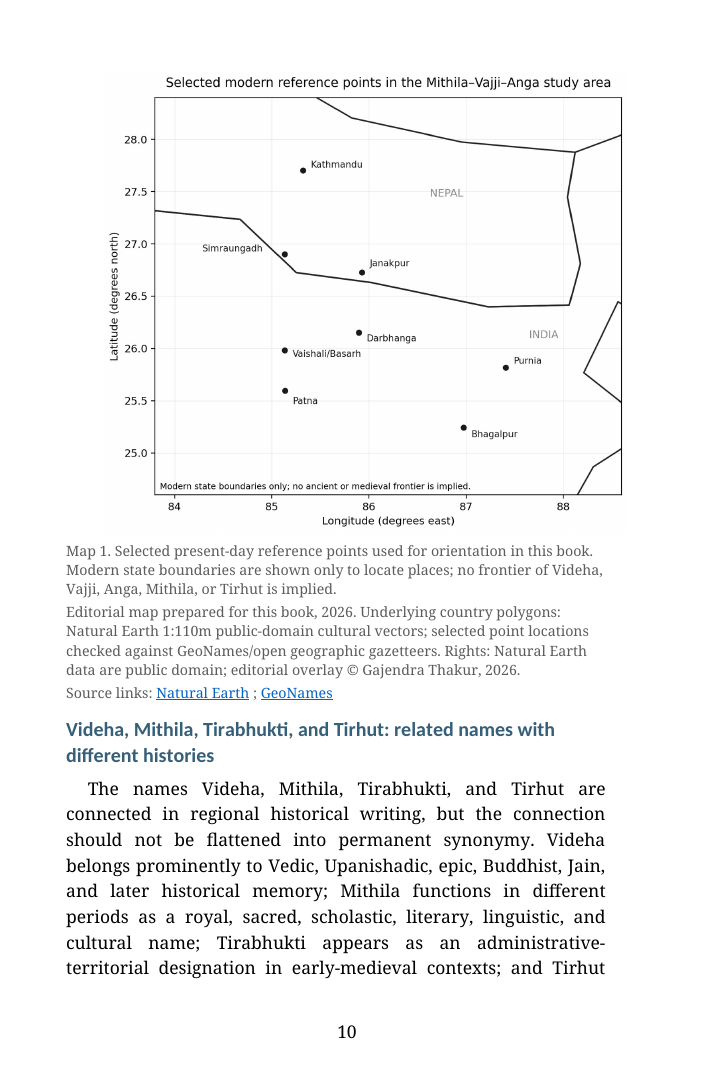
Mithila · Vajji · Anga
Chapter-specific source notes
- Primary chapter witness. Gajendra Thakur, Decoding the Panji of Mithila — Volume VI, formal Chapter 30, PDF pp. 231-233; formal Chapter 30. The HTML transcription is generated from the commit-pinned source PDF and retains the chapter boundary recorded in this edition.
- Internal structure. The repository source-heading inventory records 5 subordinate headings for this chapter: “What the Black Book Reveals”; “Rigidity and Flexibility”; “Memory and Forgetting”; “The Final Ethical Position”; “Source Note”.
- Digital editorial method. The page keeps the preserved source text distinct from generated navigational, concordance, visual, and provenance apparatus. The synthetic reconstruction is explanatory only and is not evidence for an individual lineage or a determination of social or marital status.