Decoding the Panji of Mithila · Volume VI · Chapter 29
How to Read Dushan Panji Today
Chapter 29 — How to Read Dushan
Panji Today
To read Dushan Panji today is to stand between two dangers.
One danger is denial: pretending that caste, gender, inter-
community marriage, widowhood, and hidden maternal lines
were not recorded. The other danger is weaponization: using
old entries to humiliate living descendants. Both are wrong.
© Gajendra Thakur | 228
Decoding the Panji of Mithila, Volume VI
Do Not Weaponize the Record
The first rule is simple: no Dushan entry should be used as a
present-day attack. The source itself gives examples where later
society rightly forgot old facts and where descendants became
respected. If the record contains a route by which stigma fades,
modern readers have no right to restore stigma.
Protect Descendants
The living descendants of recorded lines are not responsible for
old entries. The ethical reader separates historical analysis
from social accusation. A line may be studied for migration,
gender history, caste contact, Muslim/Hindu interaction,
widowhood, or archive grammar, but not for shaming.
Study Social Change Responsibly
Dushan Panji is valuable because it breaks the myth of a closed,
pure, static Mithila. It shows boundary crossing, absorption,
and memory-management. It should be used to study social
change: how communities met, how women carried lines, how
status was rebuilt, how categories faded, and how power
shaped marriage.
A Practical Reading Protocol
Read the original wording before interpreting the case.
Separate source label from modern identity.
Trace the relationship route: mother, daughter, wife, son,
dauhitra, or branch.
Identify whether the issue is caste/community, unknown
lineage, widowhood, migration, office, or prohibited
relation.
Never infer guilt or status for living people.
Use the archive to correct myths, not to create new
humiliation.
© Gajendra Thakur | 229
Decoding the Panji of Mithila, Volume VI
Liberation from Myth
The purpose of decoding is liberation from myth. Dushan Panji
reveals a society more complex than ideological purity allows.
It shows rigidity and repair, boundary and absorption, stigma
and forgetting. A responsible reader must hold all of these
together.
Source Note
Based on the Chapter 29 scope and the Dushan Panji source’s
own cautionary pattern: difficult facts are preserved as
historical guidance, while later descendants should not be
harmed by old records.Source structure and verification apparatus
Editorial source apparatus. This apparatus is descriptive, not interpretive. It records the source-controlled structure used to verify that this page corresponds to formal Chapter 29 of Decoding the Panji of Mithila — Volume VI. The chapter text above is preserved from PDF pp. 229-231; formal Chapter 29 in the commit-pinned authoritative source. It is not merged with a neighboring chapter, appendix, annexure, or independent front/back-matter unit. The internal headings below come from the repository’s source-heading inventory and are retained as navigational and audit evidence; showing them here does not turn those headings into separate publications or add claims that are absent from the source.
Internal source headings
- Do Not Weaponize the Record
- Protect Descendants
- Study Social Change Responsibly
- A Practical Reading Protocol
- Liberation from Myth
- Source Note
Source-text concordance
Read · Dushan · Today · stand · dangers · danger · denial · pretending · caste · gender · inter · community · marriage · widowhood · hidden · maternal · lines · recorded · weaponization · using · entries · humiliate · living · descendants · wrong · Gajendra · Thakur · Decoding · Weaponize · Record · first · rule · simple · entry · used · present-day · attack · gives · examples · later · society · rightly · forgot · facts · became · respected · contains · route · stigma · fades · modern · readers · right · restore · Protect · responsible · ethical · reader · separates · historical · analysis · social · accusation · line · studied · migration · history · contact · Muslim · Hindu · interaction · archive · grammar · shaming · Study · Change · Responsibly · valuable · breaks · myth
Boundary verification. In the formal sequence this chapter follows Volume VI Chapter 28, “Tirhuta, Devanagari, Scan Copies, and the Preservation Problem” and precedes Volume VI Chapter 30, “Conclusion: Dushan Panji as Mithila’s Difficult Truth”. The chapter extractor begins at the verified formal Chapter 29 marker and stops at the next verified formal chapter marker; for a final chapter it stops before recognized book-level back matter. The concordance above is generated only from distinct terms already present in this chapter’s preserved source text. It is provided for discovery, comparison, and audit, not as an automated judgment about persons, lineages, status, kinship, marriage eligibility, or historical truth.
Illustrated research apparatus
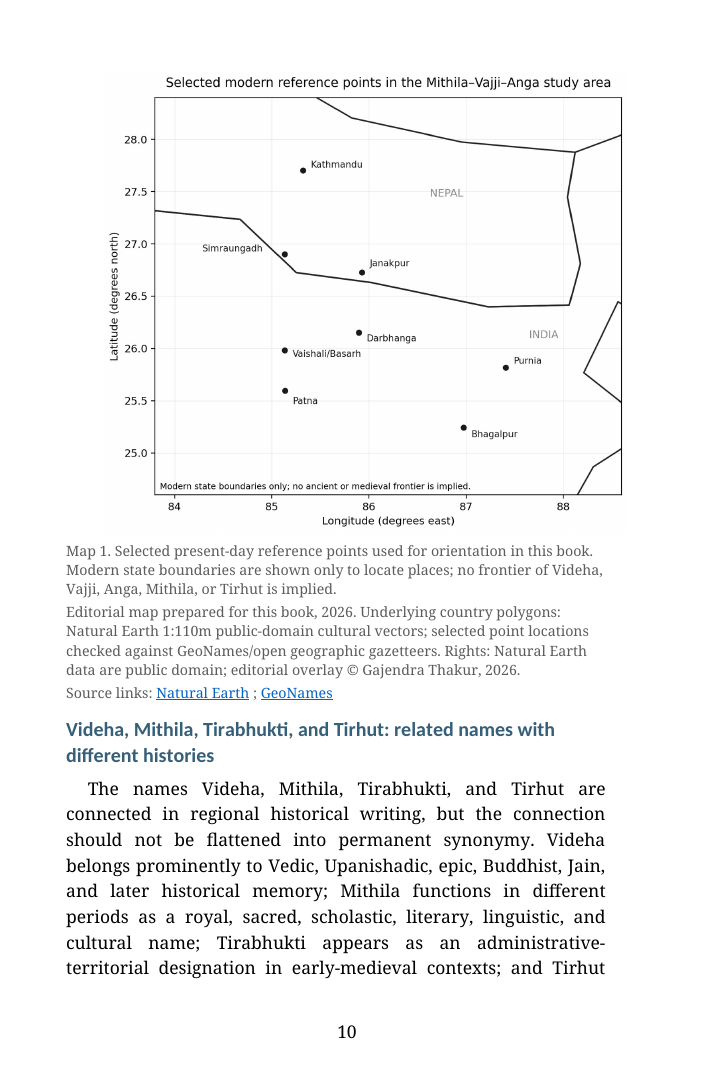
Mithila · Vajji · Anga
Chapter-specific source notes
- Primary chapter witness. Gajendra Thakur, Decoding the Panji of Mithila — Volume VI, formal Chapter 29, PDF pp. 229-231; formal Chapter 29. The HTML transcription is generated from the commit-pinned source PDF and retains the chapter boundary recorded in this edition.
- Internal structure. The repository source-heading inventory records 6 subordinate headings for this chapter: “Do Not Weaponize the Record”; “Protect Descendants”; “Study Social Change Responsibly”; “A Practical Reading Protocol”; “Liberation from Myth”; “Source Note”.
- Digital editorial method. The page keeps the preserved source text distinct from generated navigational, concordance, visual, and provenance apparatus. The synthetic reconstruction is explanatory only and is not evidence for an individual lineage or a determination of social or marital status.