Decoding the Panji of Mithila · Volume I · Chapter 3
The Panji Prabandh of Mithila: Genomic Mapping, Theoretical Frameworks, and Socio-Historical Trajectories
Chapter 3
   The Panji Prabandh of Mithila: Genomic Mapping,
     Theoretical Frameworks, and Socio-Historical
                     Trajectories

The Panji Prabandh of Mithila: Genomic Mapping, Theoretical
Frameworks, and Socio-Historical Trajectories (450 A.D. – 2009 A.D.)

Abstract
The Panji Prabandh (Genealogical Records System) of Mithila stands as one
of the most comprehensive and oldest unbroken consanguinity registers in
human history, spanning more than one and a half millennia. Originally
codified under the Karnata dynasty in 1326 A.D. to systematize family
lineages among Maithil Brahmins, Kayastha (Karna Kayastha), and
Kshatriyas, the system served as a rigorous, documentation-based check
against incestuous marriages and genetic degradation.
This paper provides a thorough academic analysis of the data contained
within the seminal volumes compiled by Gajendra Thakur, Nagendra Kumar
Jha, and Panjikar Vidyanand Jha "Mohan Ji," utilizing the
documents"PANJI THEORY MERGED.pdf"and"PRACHIN PANJI
UPTIP MERGED.pdf". It explores the mathematical-genetic framework of
the Sapinda exogamy rules, the structural deployment of Gotras and
Pravaras, the practical apparatus of the Panjikars (genealogists), the
architectural organization of Mools and Moolgrams, and the sociological
evolution of the system.
Furthermore, this study extracts and analyzes extensive historical case
studies embedded within the Panji records—including the lineages of the
foundational astronomer Aryabhata, the Navya-Nyaya logician Gangesha
Upadhyaya, and the iconic poet Vidyapati—alongside a critical examination
of the Dooshan Panji (records of lineage degradation and inter-caste unions).

1. Introduction and Historical Origins

                            Gajendra Thakur — 46
                           Decoding the Panji of Mithila
Long before modern genetic mapping, the cultural and geographical isolation
of the Mithila region (bounded by the Himalayas and the Ganges River)
fostered an extraordinarily structured intellectual environment. To protect the
genetic and cultural matrix of this community, ancient Maithil scholars relied
on memory and fragmented family registers known as Samuha-Lekhya to
trace ancestry. The earliest philosophical justification for these registries is
found in Kumarila Bhatta’s 7th-century Mimamsa treatise, the Tantra-
Varttika, which explicitly states:
"The noble and cultured preserve their lineage with great effort. For this
reason, Kings and Brahmins established Samuha-Lekhyani (collective
written registers) so that the continuity of ancestry from fathers and
grandfathers is never forgotten, allowing unions to be formed strictly by
examining the merits and faults of each family."
By the early 14th century, the informal Samuha-Lekhya system had begun to
decay. A turning point occurred when Pandit Harinath Upadhyaya, a
renowned scholar of Dharmashastra and author of the Smritisara,
inadvertently married his maternal first cousin (his maternal uncle’s
daughter's daughter) due to a lack of accurate genealogical tracking.
Recognizing that even the most erudite scholars could no longer track
complex bloodlines mentally, the contemporary Karnata Ruler of Mithila,
Maharaja Harisinghadeva, intervened in Shaka Year 1248 (1326 A.D.). He
decreed that genealogical record-keeping would no longer be a private family
responsibility but a formalized, state-supervised department run by
specialized scholars known as Panjikars.
The system was organized under institutional heads: Pandit Gunakar Jha (a
scholar from the Mahindra-Pandua Mool) was entrusted with the Brahmin
registers; Shankardatta was appointed for the Karna Kayasthas; and
Vijayadatta was placed in charge of the Kshatriyas (specifically the
Gandhavariya Rajputs).
2. Theoretical Framework: The Science of Consanguinity&Genome
Mapping
The Panji Prabandh acts as an ancient algorithm for genetic exogamy,
operating through a deeply mathematical system designed to calculate blood
proximity over multiple generations. Its structural mechanics parallel modern
genetic pedigree mapping through several layers of biological and social
classifications.

                             Gajendra Thakur — 47
                                     Decoding the Panji of Mithila
2. The Mathematics of Sapinda Proximity and theUtehdFormula
The core function of the Panji system is to avoid Sapinda (shared-body or
consanguineous) marriages. According to classical Dharmashastra texts like
the Manusmriti and Yajnavalkya Smriti, a bride must be Asapinda (not
sharing a common ancestral body) with the groom. The mathematical
baseline requires the elimination of the maternal line up to the 5th generation
and the paternal line up to the 7th generation.
Under Maharaja Mahesh Thakur, the paternal restriction was modified for
practical marriageability to an absolute separation of 6 generations, making
the 7th generation permissible.
To execute this, the Panjikar reconstructs anUtehd—a comprehensive
ancestral matrix charting32 specific ancestral linesfor both the prospective
bride and groom. This matrix maps out the binary lineage tree backward,
tracking:
•       The paternal grandfather and grandmother
•       The maternal grandfather and grandmother
•       Great-grandparents and great-great-grandparents across all maternal and
        paternal permutations up to 32 foundational ancestors.
[Prospective Bride / Groom]
/        \
[Paternal Line]              [Maternal Line]
/        \           /       \
(Father) (Mother) (Maternal (Maternal
|        |       Father) Mother)
[...] [...]              |       |
[...]        [...]
(Tracing back to 32 distinct ancestral lineages)
The system evaluates16 specific generational check-points, known
colloquially as theChhati(sixth-degree ancestors). For any given individual,
the 16 Chhatis represent the ultimate structural boundaries of their Sapinda
zone:
             Chhati No. | Ancestral Identity and Lineage Position PDF
             1 | Paternal Great-Great-Grandfather (Prapitamaha's Paternal Grandfather)
             2 | Father of the Paternal Great-Grandfather’s Paternal Grandmother

                                       Gajendra Thakur — 48
                           Decoding the Panji of Mithila
      3 | Father of the Paternal Grandfather’s Maternal Grandfather
      4 | Father of the Paternal Grandfather’s Maternal Grandmother
      5 | Paternal Great-Great-Grandfather of the Paternal Grandmother
      6 | Maternal Grandfather of the Paternal Grandfather’s Mother
      7 | Paternal Grandmother's Maternal Great-Grandfather
      8 | Maternal Grandmother of the Paternal Grandmother’s Mother
      9 | Maternal Grandfather's Paternal Great-Great-Grandfather
      10 | Maternal Great-Grandfather’s Maternal Grandfather
      11 | Maternal Grandfather’s Maternal Great-Grandfather
      12 | Maternal Grandfather’s Maternal Grandmother’s Mother
      13 | Maternal Grandmother’s Paternal Great-Great-Grandfather
      14 | Maternal Grandmother’s Paternal Grandmother's Father
      15 | Maternal Grandmother’s Maternal Great-Grandfather
      16 | Maternal Grandmother’s Maternal Grandmother’s Mother
The Exclusion Rule:If even a single individual among these 16 Chhatis
appears within the paternal line of the groom up to the 6th generation, the
marriage is blocked as incestuous and invalid (Anadhikara). However, if the
common ancestor appears within the groom's maternal line outside the 5-
generation restriction, the union may be cleared.
2. Gotras andPravaras
Superimposed on the Sapinda restrictions is the absolute block on Sagotra
(same clan) and Sapravara (same invoked sages) marriages. The Maithil
Brahmin register tracks20 primary Gotras, each linked to a specific
constellation of Vedic Pravaras (either Tri-Pravara or Pancha-Pravara,
indicating three or five legendary rishi ancestors who composed Vedic
hymns):
•   Shandilya: Tri-Pravara (Shandilya, Asit, Deval)
•   Vatsa: Pancha-Pravara (Orva, Chyavana, Bhargava, Jamadagnya,
    Apnuvana)
•   Savarna: Pancha-Pravara (Orva, Chyavana, Bhargava, Jamadagnya,
    Apnuvana)
•   Kashyap: Tri-Pravara (Kashyap, Avatsar, Naidhruva)
•   Parashar: Tri-Pravara (Shakti, Vashistha, Parashar)
•   Bharadwaj: Tri-Pravara (Bharadwaj, Angiras, Barhaspatya)
•   Katyayan: Tri-Pravara (Katyayan, Vishnu, Angiras)
                             Gajendra Thakur — 49
                          Decoding the Panji of Mithila
•   Garga: Pancha-Pravara (Gargya, Ghrita, Vaishampayana, Kaushik,
    Mandavyatharvan)
•   Kaushik: Tri-Pravara (Kaushik, Atri, Jamadagni)
•   Alambukaksha: Tri-Pravara (Garga, Gautama, Vashistha)
•   Krishnatriya: Tri-Pravara (Krishnatriya, Apnuvana, Saraswat)
•   Gautam: Tri-Pravara (Angira, Vashistha, Barhaspatya)
•   Maudgalya: Tri-Pravara (Maudgalya, Angiras, Barhaspatya)
•   Vashistha: Tri-Pravara (Vashistha, Atri, Sankriti)
•   Kaundinya: Tri-Pravara (Aastik, Kaushik, Kaundinya)
•   Upamanyu: Tri-Pravara (Upamanyu, Angiras, Barhaspatya)
•   Kapil: Tri-Pravara (Shatatapa, Kaundilya, Kapil)
•   Vishnuvriddhi: Tri-Pravara (Vishnuvriddhi, Kaurapuccha, Trasadashya)
•   Tandi: Tri-Pravara (Tandi, Sankhya, Angiras)
•   Jatukarna: Tri-Pravara (Jatukarna, Angiras, Bharadwaj)
Genetic Exception Case: Even thoughVatsaandSavarnaare distinct Gotras,
they share the exact same Pravara ancestors. Consequently, marriages
between Vatsa and Savarna individuals are prohibited under the Panji system
due to their identical ancestral genetic source.
3. Topographical and Clan Architecture:MoolsandMoolgrams
To map a massive, growing population over centuries, the Panji system uses
a geolocation framework based on two coordinates: theMool(the original
ancestral house or primary clan line) and theMoolgram(the specific village
or settlement where that branch relocated).
The system tracks167 uniqueMools, which are broadly divided into three
tiers based on antiquity and scholarly lineage:AyantShrestha(highest
tier),Prajayant(second tier), andMadhyam(medium tier).
3. Structural Classification of KeyMools
The records outline the classification of the primary 35 Mools as follows:
AyantShrestha (First Category)
•   Khadaure (Khadauray)
•   Khauadal (Khauaday)
•   Budhabaday
•   Madaray (Baruani Madaar)
•   Dariharay (Athari Darihara)
•   Ghusautay
                            Gajendra Thakur — 50
                          Decoding the Panji of Mithila
•   Tisautay
•   Karamahay (Sonkariam Karmaha)
•   Naraunay (Shakrirampur Naraun)
•   Vabhniamay
•   Hariammay
•   Sarisavay
•   Sodarporiye (Sodarpur)
Prajayant(Second Category)
•   Gangolivar (Karambeli Gangoli)
•   Pavaulivar (Parvapalli / Pabauli)
•   Kujaulivar
•   Alevar
•   Bahidwar
•   Sakarivar (Karwani Sakaradhi)
•   Palivar
•   Visevar
•   Fanevar (Phanandah)
•   Uchitvar (Uchati Bhandarisam)
•   Pandulivar
•   Kataivar
•   Tilaivar
MadhyamMool(Medium Category)
•   Dighve (Dirghosh)
•   Belauche (Bilvapanchak / Belauvch)
•   Ekahare
•   Panichobhe (Govindavan Panichobh)
•   Valiase (Ekama Valiyas)
•   Jajival (Dandapani Jajival)
•   Takval (Haripani Takval)
•   Pandue
Note on Branching: Over time, secondary branches emerged. For example,
the Khanam branch of the *PhanandahMool* eventually gained recognition
as the 35th high-tier lineage.
3. Mapping ofShrotriyaMoolgrams

                            Gajendra Thakur — 51
                            Decoding the Panji of Mithila
For the elite Shrotriya class, the Panji preserves specific village records:
•   Shandilya Gotra: Sarisab (Mool) maps to the Khanguad, Sakuri, and
    Jonki Moolgrams; Parvapalli maps to Vadhiyam; Khandavala maps to
    Bhaur; and Sodarpur maps to Sarisab, Mani, Digaundh, Tetarihar,
    Kanholi Katka, and Hati.
•   Vatsa Gotra: Pali maps to Mahishi, Mangrauni, and Jamadauli; Hariamb
    maps to Valirajpur; Ghusaut maps to Nagwad; and Karmaha maps to
    Ruchauli, Naruvad, Behat, Tarauni, Jhanjharpur, and Analpur.
•   Kashyap Gotra: Khaual maps to Simvarwad, Murajpur, and Mahua;
    Sakaradhi maps to Parhat and Lohana; Darihara maps to Ratauli; and
    Maandar maps to Sihauli, Rajaura, Kanasama, and Patanuka.
4. Practical Apparatus: ThePanjikars,Utehd, andSiddhantpatra
The operational validity of the system rests entirely on state-
appointedPanjikars. These genealogists preserve massive, bound
manuscripts written on palm leaves (Talapatra) or specialized paper
(Basahapatra) in the traditionalTirhuta(Mithilakshar) script.
Step 1: Family applies to Panjikar 5-10 years before marriage.
↓
Step 2: Panjikar drafts the Utehd (Ancestry Matrix of 32 lines).
↓
Step 3: Cross-verifies the 16 Chhatis for Sapinda/Sagotra conflicts.
↓
Step 4: Public verification at Saurath Sabha Gachhi.
↓
Step 5: Issuance of the Siddhantpatra (Certificate of Exogamy).

4.1 Process of Verification
•   The Request: Several years before an individual reaches marriageable
    age, the family approaches a Panjikar to draw up an Utehd Card
    containing prospective, validated matches.
•   Manuscript Cross-Referencing: The Panjikar pulls down their records—
    including the historical Mool Panji (the baseline ancestor lists), the
    Shakha Panji (extended branch histories updated down to every newborn

                              Gajendra Thakur — 52
                          Decoding the Panji of Mithila
    and marriage), and the Patra Panji (location and village movement
    charts).
•   The Assembly Verification: Every summer, during the auspicious
    astrological periods, thousands of families assemble at the Saurath Sabha
    Gachhi (a large orchard in Madhubani). The Panjikars sit with their
    manuscripts to publicly verify the lineages of prospective brides and
    grooms.
•   Siddhantpatra Issuance: Once the Panjikar verifies that there are zero
    Sapinda, Sagotra, or Sapravara violations across the 32 ancestral lines,
    they issue a formal document called the Siddhantpatra (also known as the
    Asvajan Patra or non-kinship certificate). A marriage conducted without
    a verified Siddhantpatra is declared uncanonical and illegitimate
    (Ashastriya).

5. Extensive Case Studies of Historical Lineages
The Panji manuscripts provide detailed records of historical figures, serving
as an important tool for verifying chronology in Indian history. Below are
transcriptions and structural analyses of the family trees of key scientists,
logicians, and poets found in the registers.

5.1 The Lineage of the Astronomer Aryabhata
A common challenge in Indian history is confirming the regional origins and
exact dates of the legendary astronomer Aryabhata. The Mandar Mool
register clearly tracks Aryabhata’s lineage back across generations, placing
his family origins in the Mangrauni-Maandar axis of Mithila:
Trinayanbhatta (c. 400 A.D. Foundational Ancestor / Beeji)
↓
Udayabhatta
↓
Vijayabhatta
↓
Sulochandabhatta (Sunayanbhatta)
↓
Bhatta
↓

                            Gajendra Thakur — 53
                          Decoding the Panji of Mithila
Dharajatimishra
↓
Dharajatimishra II
↓
Brahmajarimishra
↓
Tripurajatimishra
↓
Vidhujatimishra
↓
Ajaysingh
↓
Vijaysingh
↓
Aadivaraha
↓
Mahovaraha
↓
Duryodhan Singh
↓
Sodhar Jaysingh Tarkacharyastra ( scholar of defensive arts)
↓
M.M. Narasingh ( scholar of advanced arts)
Manuscript Entry Reference (Page 18):
"Mahipatayah Mangrauni Mandair se Pitambar Suta Damu Dau Mandu Beeji
Trinayanbhatta: e suto Aryabhatta: e suto Udayabhatta: e suto Vijayabhatta e
suto Sulochandabhatta... e suto Tripurajati Mishra e sut Vidhujati Mishra e
suto Ajaysingha e suto Vijaysingha... e suto Duryodhan Singh e suto Sodhar
Jaysinghartacharyastras Mahastra Vidya Parangata Mahamahopadhyaya
Narasingha."

                            Gajendra Thakur — 54
                           Decoding the Panji of Mithila
This line demonstrates how the Panji tracks intellectual titles (like
Mahamahopadhyaya) and tactical specialties alongside names, establishing
an unbroken lineage across centuries.

5.2 The Lineage of the Logician Gangesha Upadhyaya
Gangesha Upadhyaya, the 14th-century intellectual giant who founded the
Navya-Nyaya school of logic through his masterwork Tattvacintamani, is
recorded in the *ChhadanMool* register. His record is particularly notable
for confirming a major historical event: his birth occurred five years after his
father's death.
Gangesha Upadhyaya
(M.M.P. Gangesh of Chhadan Mool)
↓
───────────────────────────────────────────
──────
M.M. Vardhaman                        Pandit Supan
(Author of Upaya-Karaka)            (Relocated to Bhandarisam Mool)
Daughter (Married                    Daughter (Married
Shivnath of Khandavala)                 Bhaveshwar of Jajival)
Manuscript Entries:
•   Devanand Panji (39-2): "Chhadan se Jagadguru Guru Gangesh sutaya
    Vabhniam se Jayaditya sut Sadhukar Patni".
•   Devanand Panji (339-3): "Jagadguru Gangesh sut Supan dau
    Bhandarisam se Haraditya dau... e sut Sandgahi Bhaveshwar".
•   Devanand Panji (30-5): "Chhadan se Upayakaraka M.M.P. Vardhaman
    sutacha Khandavala se Vishwanath sut Shivnath Patni".
5. The Lineage ofMahamahopadhyayaPoetVidyapatiThakur
Vidyapati, the foundational poet of Maithili literature and court scholar of the
Oiniwar Dynasty, is recorded in the *GarhVisphi register of the Kashyap
Gotra. The Panji* preserves his line down to his direct descendants:
Deuvaditya (Sandhivigrahika / Royal Counselor)
↓
───────────────────────────────────────
Vireshwar (Bhandagarika)               Bhavaditya (Parnagarika)

                             Gajendra Thakur — 55
                           Decoding the Panji of Mithila
↓
Dhireshwar (Nibandhika)
↓
M.M.U. Ganeshwar (Mhasamantadhipati)
↓
Jayadatta
↓
Kirtidatta
↓
M.M.U. VIDYAPATI THAKUR (The Poet-Scholar / "Kavi Kokil")
↓
M.M. Ramapati (Vilas / Left for Bengal, became preceptor to Chaitanya
Mahaprabhu)
Manuscript Entry Reference (Page 45):
"Visphi se Sandhivigrahic Deuvaditya Rajavallabh Bhavaditya Parnagarika
Vireshwar Vartik Naivandhik Dhireshwar... Mamatak Ganeshwar
Bhandagarika Yateshwar... Visphi se M.M. Jayadatt Sadu Kirtidatt Kavikokil
Rajapandit M.M.U. Vidyapati."
6. TheDooshanPanji: Documentation of Social Integration
A common misconception is that the Panji Prabandh operated as an inflexible
system of caste purity that completely isolated families. In reality, the
existence of theDooshanPanji (Fault/Degradation Register) proves that the
Panjikars systematically documented boundary-crossings, cross-caste
marriages, and alternative unions.
Rather than casting out the offspring of irregular marriages, the Panji system
tracked them over generations. This allowed their descendants to be
integrated back into the mainstream fold once the generational distance
cleared them from the original Dooshan infraction.
The manuscripts list detailed records of unconventional unions across
families:
6. Inter-Caste and Extramarital Unions tracked in theDooshanPanji
The records note several specific historical exceptions:
[Case 1: Integration of Unknown Lineage]

                             Gajendra Thakur — 56
                          Decoding the Panji of Mithila
Yavanas/Unknown Tribe × Chamaroo (Valiyas Mool)
↓
Gangadhar
↓
Daughter × Nathu (Sarisab Mool)
↓
Visho
↓
Daughter × Gangu (Sakaradhi Mool)
↓
Goge
↓
Daughter × Kanh (Panichobh Mool)
↓
Rud
↓
Daughter × Helu (Darihara Mool)
↓
Chand
↓
Daughter × Horai (Pali Mool)
↓
Ram (Maternal side unknown)
↓
Daughter × Chand (Narval Mool)
↓
Devadhar
(Declared perfectly pure by 6th gen!)
•   Case 1 Analysis: The text details that Gunavati Himsha, an individual of
    unknown/outside caste status, married Chamaroo of the Valiyas Mool.
    Their son, Gangadhar, married into the Sarisab Mool. By the time the

                            Gajendra Thakur — 57
                          Decoding the Panji of Mithila
    lineage reached Devadhar in the sixth generation, the ancestry was
    considered fully integrated and pure (Purnatah Shuddh), completely
    neutralizing the original Dooshan.
•   The Devadasi/Ajnata Origins: Multiple prominent lines trace back to
    Devadasis (temple dancers) or recorded Ajnata Kula (unknown maternal
    lineages). The registers list figures like Jagannath (Satalakha Mool),
    Ratanu (Ghusaut Mool), Ram (Pali Mool), and Vidhoo (Tilay Mool)
    whose maternal sides were unknown, yet their descendants remained
    respected members of Maithil society.
•   Islamic/Yavana Integration: The registers document marriages involving
    elite Muslim women. For instance, the Pabauli Mool record notes that
    Dagar, the son of Pandit Keshava, married Dhaulati Jahan, a Yavana
    woman. Their son, Harihar, was recorded directly into the registry
    without facing social exclusion. Similarly, the Kujouli Mool records the
    line of Gopal, whose son Lakhusha also married into the family of
    Dhaulati Jahan.
•   The Legend of Gangesha's Birth: The entry for Gangesha Upadhyaya in
    the Dooshan Panji contains a notable note: "Pitri Parokshe Pancha
    Varsha Vyatite Gangeshotpatti". This explicitly states that Gangesha was
    born five years after his father had passed away, noting that his mother,
    Vallabha, was a Charmakarini (from the shoemaker caste). The Panji
    records this union openly, alongside Gangesha's output of the
    Tattvacintamani, without removing him from the scholarly register.
•   The Chamar/Leatherworker Unions: The Talhanpur Mool records that
    Ananda a leatherworker woman (Charmakarini) got married , and their
    son, Diwakar, was preserved in the records. Similarly, the Mandar Mool
    records Hirua, a Chamar individual whose daughter married into the elite
    Alei Mool.
•   The Rajak/Washerman Unions: The Khaual Mool records Rajeshwar,
    who married a washerman's daughter (Rajak Kanya). Additionally, the
    Sodarpur Mool traces the lines of Dharam and Maniki, noting a long-
    standing Rajak relationship within their ancestry.
•   The Koch Royalty Union: The Khandavala Mool register records that the
    daughter of Pandit Chandraputi married into the Koch Rajvanshi royal
    family of Assam, bringing Princess Sohago into the lineage.

7. Sociological Evolution: Stratification and Social Ramifications

                            Gajendra Thakur — 58
                           Decoding the Panji of Mithila
While the Panji Prabandh was designed as a tool for genetic exogamy, its
implementation over the centuries brought deep social changes and
unintended consequences to Mithila.
7. internal Stratification:Shrotriya, Jog, andJaibar
The original deployment under Maharaja Harisinghadeva treated all families
as structurally equal within their respective caste registers. However, during
the reign of Maharaja Madhav Singh (mid-to-late 18th century), the
introduction of theShakhaPanji completely transformed Maithil society.
A complex, hierarchical classification emerged, breaking the community into
three strict tiers:
•   Shrotriya (Soti): The highest social tier, comprising families with
    impeccable records of scriptural scholarship and zero lineage blemishes
    across generations. Their registers are referred to as Laukit registers, split
    across 8 primary Chaugoala tiers and 32 dynamic sub-panjis.
•   Jog (Yogya): The intermediate category, consisting of families with
    minor documented Dooshan infractions or lineages that had slightly
    diverged from the highest standard of scholarship.
•   Jaibar (Vanshaja): The baseline populace tier. Though their lineages
    were fully documented and verified for marriage validity, they did not
    receive the elite social privileges granted to the Shrotriyas. They track 15
    distinct social tiers using 153 specific Panji indices (such as the Narapati
    Jha Panji).

7.2 Social Ramifications: Hypergamy, Child Marriage, and
Widowhood
This rigid internal hierarchy distorted the marriage market through
hypergamy (Anuloma unions). Because marrying a daughter into a higher-
tier Shrotriya family raised the social standing of her entire clan, demand for
Shrotriya grooms spiked dramatically. This dynamic triggered severe social
issues across Mithila:
•   The Rise of Polygamy: Wealthy, high-tier Shrotriya men began marrying
    dozens of women from lower Jaibar or Jog tiers, often treating marriage
    as a financial arrangement driven by substantial dowries.
•   Child Marriages: Families raced to marry off daughters at very young
    ages to secure alliances with high-status grooms before the marriage
    market shifted.

                             Gajendra Thakur — 59
                           Decoding the Panji of Mithila
•   The Crisis of Widowhood: Because old, higher-tier men frequently
    married young girls, a large demographic wave of child widows emerged
    across Mithila. Due to strict religious prohibitions against widow
    remarriage at the time, these girls faced a lifetime of social isolation.

8. Conclusion and Modern Transition to Digital Conservation
The Panji Prabandh represents an early, highly structured approach to genetic
genealogy, tracking bloodlines with precision long before the advent of
modern computers or DNA sequencing. It effectively prevented inbreeding
depression within a concentrated population across generations.
However, when the system shifted from its original focus on genetic health
toward enforcing social status and hierarchy, it introduced deep social
imbalances, including hypergamy and child marriage, which affected Maithil
society for generations.
Today, the Panji system faces an existential threat. The decline of traditional
scripts like *Tirhuta(Mithilakshar)* has left younger generations unable to
read the original palm-leaf records.
To protect this historical resource, digital conservation efforts began in 2000
A.D.. Over 10, historic palm-leaf, Basahapatra, and paper manuscripts—
spanning over 1, years of genealogical data—have been digitally imaged,
mapped onto modern storage media, and transliterated into the widely
accessible Devanagari script. This ensures that one of humanity's deepest
genealogical archives remains preserved and open to historical and genetic
research.

                             Gajendra Thakur — 60
          Decoding the Panji of Mithila
Source structure and verification apparatus
Editorial source apparatus. This apparatus is descriptive, not interpretive. It records the source-controlled structure used to verify that this page corresponds to formal Chapter 3 of Decoding the Panji of Mithila — Volume I. The chapter text above is preserved from PDF pp. 47-62; formal Chapter 3 in the commit-pinned authoritative source. It is not merged with a neighboring chapter, appendix, annexure, or independent front/back-matter unit. The internal headings below come from the repository’s source-heading inventory and are retained as navigational and audit evidence; showing them here does not turn those headings into separate publications or add claims that are absent from the source.
Internal source headings
No subordinate heading was separately encoded in the repository source-heading inventory for this chapter.
Source-text concordance
Prabandh · Genomic · Mapping · Theoretical · Frameworks · Socio-Historical · Trajectories · Abstract · Genealogical · Records · System · stands · comprehensive · oldest · unbroken · consanguinity · registers · human · history · spanning · half · millennia · Originally · codified · Karnata · dynasty · systematize · family · lineages · Maithil · Brahmins · Kayastha · Karna · Kshatriyas · served · rigorous · documentation-based · check · incestuous · marriages · genetic · degradation · paper · provides · thorough · academic · analysis · data · contained · within · seminal · volumes · compiled · Gajendra · Thakur · Nagendra · Kumar · Panjikar · Vidyanand · Mohan · utilizing · documents · THEORY · MERGED · PRACHIN · UPTIP · explores · mathematical-genetic · framework · Sapinda · exogamy · rules · structural · deployment · Gotras · Pravaras · practical · apparatus · Panjikars · genealogists
Boundary verification. In the formal sequence this chapter follows Volume I Chapter 2, “Mithila's Pañjī-Prabandha: Genealogical Theories Study (Volume II)” and precedes Volume I Chapter 4, “Analytico-Genetic Report on the Mithila Panji Prabandh: Socio-Historical Evolution, Taxonomic Structure, and Matrimonial Algorithms”. The chapter extractor begins at the verified formal Chapter 3 marker and stops at the next verified formal chapter marker; for a final chapter it stops before recognized book-level back matter. The concordance above is generated only from distinct terms already present in this chapter’s preserved source text. It is provided for discovery, comparison, and audit, not as an automated judgment about persons, lineages, status, kinship, marriage eligibility, or historical truth.
Illustrated research apparatus
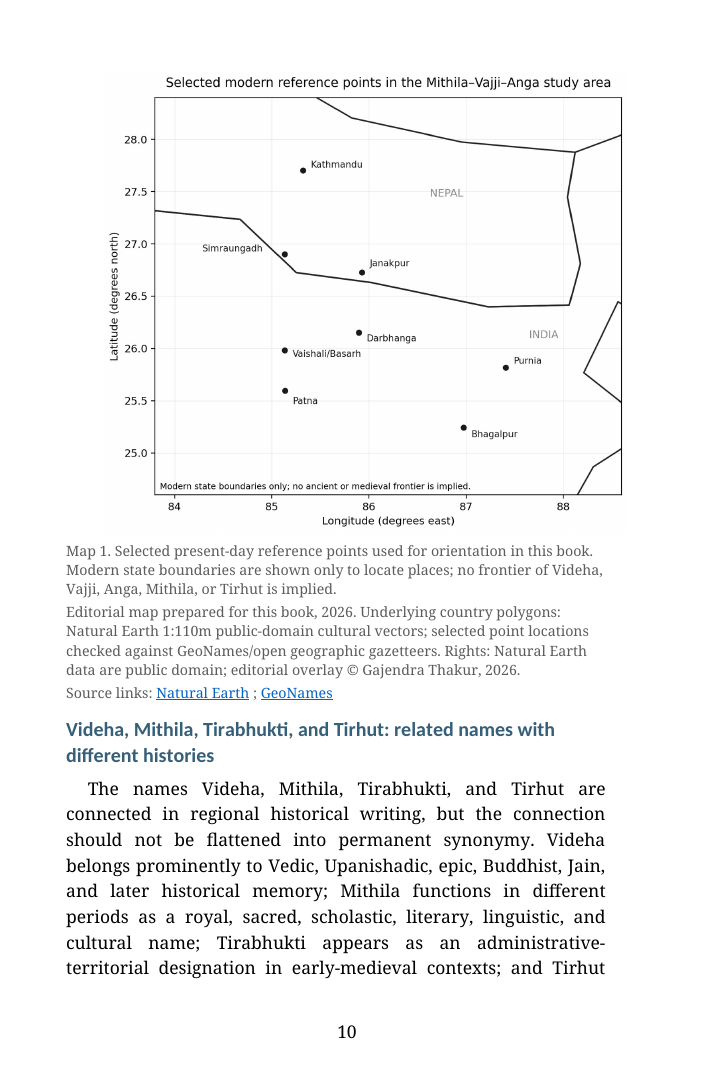
Mithila · Vajji · Anga
Chapter-specific source notes
- Primary chapter witness. Gajendra Thakur, Decoding the Panji of Mithila — Volume I, formal Chapter 3, PDF pp. 47-62; formal Chapter 3. The HTML transcription is generated from the commit-pinned source PDF and retains the chapter boundary recorded in this edition.
- Internal structure. The repository source-heading inventory records no separately encoded subordinate heading for this chapter.
- Digital editorial method. The page keeps the preserved source text distinct from generated navigational, concordance, visual, and provenance apparatus. The synthetic reconstruction is explanatory only and is not evidence for an individual lineage or a determination of social or marital status.