Decoding the Panji of Mithila · Volume I · Chapter 4
Analytico-Genetic Report on the Mithila Panji Prabandh: Socio-Historical Evolution, Taxonomic Structure, and Matrimonial Algorithms
Chapter 4
     Analytico-Genetic Report on the Mithila Panji
    Prabandh: Socio-Historical Evolution, Taxonomic
        Structure, and Matrimonial Algorithms

Comprehensive Analytico-Genetic Report on the Mithila Panji
Prabandh: Socio-Historical Evolution, Taxonomic Structure, and
Matrimonial Algorithms (450 AD–2009 AD)

Architectural and Geo-Cultural Framework of Mithila's Varna
State
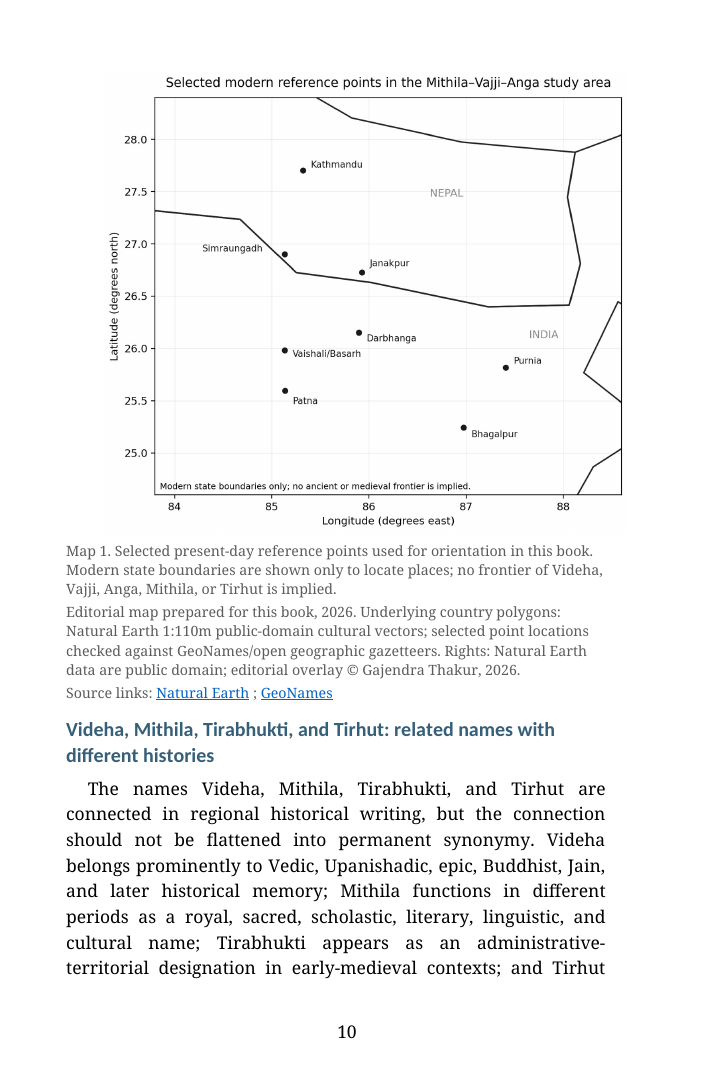
The region of Mithila, historically recognized under the classical
nomenclatures of Videha, Tirabhukti, Tirhut, or Mithilanchal, is a
geographically and culturally distinct territory bounded by the Himalayas in
the north, the Ganges River in the south, the Gandak River in the west, and
the Mahananda River in the east. From antiquity, this region has served as an
intellectual crucible for the development of Vedic, Upanishadic, and classical
Sanskrit learning, nurturing major orthodox philosophical systems, including
Nyaya, Vaisheshika, Mimamsa, and Samkhya.
Following the dissolution of the Pala dynasty in Bengal, Mithila transitioned
into a socio-political order dominated by high-ranking landowning and
priestly lineages. In this unique administrative landscape, the Maithil
Brahmins assumed positions as both Bhudevas (landowners) and Bhupalas
(monarchs or state protectors), effectively unifying temporal and spiritual
authority. To preserve this concentrated authority and defend the orthodox
social order against external socio-religious changes, the regional dynasties
established the Panji Prabandh—an exceptionally comprehensive system of
written, state-regulated genealogical record-keeping.

                            Gajendra Thakur — 62
                          Decoding the Panji of Mithila
      Volume Classification | Documented Section Name | Page Index Range |
      Editorial Board and Publication
      Volume I | Ancient Panji (Prachin Panji) | 1.1 – 1.337 | Gajendra Thakur,
      Nagendra Kumar Jha, and Panjikar Vidyanand Jha; Published by Shruti
      Prakashan, Delhi 9
      Volume II | Supplementary Annotations (Upateep) | 2.1 – 2.147 |
      Gajendra Thakur, Nagendra Kumar Jha, and Panjikar Vidyanand Jha;
      Published by Shruti Prakashan, Delhi 9
      Volume III | Territorial Settlements (Nagram) | 3.1 – 3.316 | Gajendra
      Thakur, Nagendra Kumar Jha, and Panjikar Vidyanand Jha; Published by
      Shruti Prakashan, Delhi 9
Prior to the state-sponsored codification of the Panji Prabandh in the
fourteenth century, the preservation of lineage was decentralized. Families
recorded their ancestry through oral transmission or localized, family-held
manuscripts known as Samuh Lekhya. The seventh-century Mimamsa
scholar Kumarila Bhatta, in his monumental philosophical work Tantra
Varttika, explicitly notes that elite families maintained Samuh Lekhya as a
formal mechanism to track virtues, defects, and ancestral lineages across
generations, ensuring the preservation of caste identity.
However, by the late thirteenth and early fourteenth centuries, these
decentralized records had suffered significant decay, leading to genealogical
amnesia within families. This loss of historical memory made it difficult to
verify the exogamic restrictions mandated by the Smriti texts, resulting in
accidental violations of marriage laws. This growing social crisis eventually
prompted the royal administration to intervene.

Historical Catalysts and the Legend of Harinath Upadhyaya
The formal codification of the Panji Prabandh took place during the reign of
Maharaja Harisimhadeva (r. 1307–1324 AD), the last sovereign of the Karnat
dynasty of Mithila. While the political stability of the Karnat state was
disrupted in 1324–1325 AD by the military campaign of Delhi Sultan
Ghiyasuddin Tughlaq—forcing Maharaja Harisimhadeva to withdraw to the
Nepal hills—the structural framework of the genealogical registry had
already been established under his patronage.
The immediate catalyst for this administrative initiative was a highly
publicized social scandal involving Pandit Harinath Upadhyaya, an eminent
scholar of Dharmashastra and the author of the Smritisarasangraha. Due to

                            Gajendra Thakur — 63
                          Decoding the Panji of Mithila
the degradation of family records, Harinath Upadhyaya unknowingly married
a woman who fell within the prohibited degrees of consanguinity—
specifically, his maternal cousin’s daughter (saakshat pitayaut bhaik
dauhitri). Sometime after the wedding, Upadhyaya's wife was accused of
infidelity with an individual of a lower caste.
To assert her innocence and prove her marital fidelity, she was subjected to a
traditional hot-iron ordeal. Despite her absolute physical innocence, her
hands were severely burned during the test.
The failure of a chaste woman to pass a divine ordeal prompted an intense
inquiry by the court pandits under Maharaja Harisimhadeva. The
investigation revealed that while she had been physically faithful to her
husband, her hands had burned because she had committed the sin of incest
by marrying within prohibited kinship degrees (swajana). Realizing that the
absence of written genealogies left the community vulnerable to accidental
incestuous marriages, Maharaja Harisimhadeva ordered the creation of a
systematic genealogical register for every family in the Maithil Brahmin and
Karna Kayastha communities.
This state-sponsored census was initiated around Shaka 1248 (corresponding
to 1326–1327 AD). The King convened the historic Vishwachakra
Sammelan at Jamsam, located in the Pandaul region of Madhubani, where
genealogists gathered family trees from every village.
To manage this archive, the King established a state department of genealogy
and appointed specialized registrars known as Panjikars. Sadupadhyaya
Gunakar Jha, of the Madhudhepur Pandua lineage, was appointed as the first
Panjikar for the Brahmins. Simultaneously, Shankardutt was appointed to
manage the records of the Karna Kayasthas, and Vijayadutt was appointed
for the Kshatriyas, specifically the Gandhavariya Rajputs.
The female scholar Thakurain Lakhima, a contemporary of Harisimhadeva
celebrated for her expertise in Dharmashastra, also played a key role in
developing this institutional framework, contributing her scholarly authority
to the design of the registry.

Taxonomic Architecture: Gotras, Mools, and Shakhas
The Panji Prabandh identifies and maps family lines using three primary
coordinates: the Biji Purush (progenitor seed-man), the Mool (original
ancestral village of the Biji Purush), and the Moolgram/Shakha (subsequent

                            Gajendra Thakur — 64
                           Decoding the Panji of Mithila
village migrations). The Biji Purush represents the earliest historically
verifiable ancestor of a specific patrilineage. The Moolgram identifies the
geographical village where this progenitor resided at the time of the
fourteenth-century census. As descendants migrated over time, these new
settlements were recorded as Shakhas (branches) and appended to the
original Mool.
For example, the Kaushik-gotra Mandar mool split into branches like the
Mangroni and Garh shakhas. Similarly, the Khandila mool, associated with
the Khadauray lineage, originally originated from the Gangoli (Gangulivar)
mool. When the medieval scholar Mahamahopadhyaya Shankarshan Thakur
established his academy in the Khanda province (modern Madhya Pradesh),
his descendants lived there for several generations. In the eighth generation,
Surapati Thakur returned to Mithila, and his descendants were categorized
under the Khandila mool’s Ghoshi branch.
At its inception, the Panji registry classified the Maithil Brahmin community
into 20 Gotras (clans) representing patrilineal descent from ancient Vedic
sages, containing 167 primary Moolgrams. Within these, 34 original mools—
which later expanded to 35 with the inclusion of the Khanam branch of the
Phanandah mool—were recognized as prestigious high-ranking lineages.
      Gotra Index | Gotra Name | Pravara Classification | Representative
      Moolgrams and Lineages Associated
      1 | Shandilya | Tri-Pravara (3 Sages) | Dirghosh (Dighve), Sarisab, Mahua,
      Parvapalli (Pavoli), Khandabala, Gangoli, Yamusham, Karian, Mohari,
      Sajhual, Madar, Pandoli, Jajival, Dahibhat, Tilay, Mahab, Simmual,
      Singhasram, Sodarpur, Kadariya, Allari, Hodyar, Talhanpur, Parisara,
      Parasada, Veernam, Uttampur, Kodariya, Chhatiman, Vareva, Machheal,
      Gangaur, Bhator, Budhaura, Brahmpura, Koiar, Kerahivar, Gangual,
      Ghoshiyam, Chhatauni, Bhigual, Nanauti, Tapanpur
      2 | Vatsa | Pancha-Pravara (5 Sages) | Palli (Pali), Hariamb, Tisuri, Raudh,
      Takval, Ghusaut, Jajival, Pahaddi, Jallaki (Jalay), Bhandval, Koiyar,
      Kerahivar, Nanaur, Dadhar, Karmaha, Budhval, Madar, Lahi, Sauni, Sakauna,
      Phanandah, Mohari, Vanthval, Tisaut, Baruali, Pandoli, Baheradhi, Bareva,
      Alay, Bhandarisamay, Babhaniyam, Uchati, Tapanpur, Vithual, Narval,
      Chitrapalli, Jarhatiya, Ratval, Brahmpura, Sarauni
      3 | Kashyapa | Tri-Pravara (3 Sages) | Oini, Khaual, Sakaradhi, Jagati,
      Darihara, Mandar, Valias, Pachaut, Katai, Satlakha, Pandua, Malich,
      Merandi, Bhadual, Pakaliya, Budhval, Pibhuya, Mauri, Bhutahari, Chhadan,
      Visphi, Thariya, Dosti, Bhareha, Kusumbhal, Narval, Lagurdah

                             Gajendra Thakur — 65
                           Decoding the Panji of Mithila
      4 | Savarna | Pancha-Pravara (5 Sages) | Sondpur, Panichobh, Bareba,
      Nandor, Merandi
      5 | Parashara | Tri-Pravara (3 Sages) | Naraun, Suragan, Sakuri, Suiri,
      Sammual, Pihval, Nadam, Maheshari, Sakrahon, Soini, Tilay, Bareba
      6 | Bharadwaja | Tri-Pravara (3 Sages) | Ekahara, Vilvapanchak
      (Belaunch), Deyam, Kaligam, Bhutahari, Godhar, Godhuli
      7 | Katyayana | Tri-Pravara (3 Sages) | Kujoli, Nanauti, Jallaki, Vatigam
      8 | Garga | Pancha-Pravara (5 Sages) | Vasaha, Vasam, Brahmpura,
      Suraur, Budhaur, Uraur
      9 | Kaushika | Tri-Pravara (3 Sages) | Nikhuti
      10 | Alambukaksha | Tri-Pravara (3 Sages) | Vasam, Katai, Brahmpura
      11 | Krishnatreya | Tri-Pravara (3 Sages) | Lohana, Busavan, Podauni
      12 | Gautama | Tri-Pravara (3 Sages) | Brahmpura, Untampur, Kodyar
      13 | Maudgalya | Tri-Pravara (3 Sages) | Ratval, Malich, Dirghosh,
      Kapinjal, Jallaki
      14 | Vashistha | Tri-Pravara (3 Sages) | Kothua
      15 | Kaundilya | Tri-Pravara (3 Sages) | Ekahara, Paraun
      16 | Jatukarna | Tri-Pravara (3 Sages) | Devahear
      17 | Tandi | Tri-Pravara (3 Sages) | Katai
      18 | Vishnuvriddhi | Tri-Pravara (3 Sages) | Busavan
      19 | Upamanyu | Tri-Pravara (3 Sages) | Unspecified in primary database
      20 | Kapila | Tri-Pravara (3 Sages) | Unspecified in primary database
Beyond patrilineal gotra associations, the Panji Prabandh divided the Maithil
Brahmin community into ranked hierarchies based on their ritual adherence
and academic lineage 6:
•   Shrotriya: The highest ranked class, composed of families that
    maintained absolute adherence to Vedic sacraments and scripture,
    historically requiring the abandonment of five maternal and seven
    paternal generations in marriage unions.
•   Yogya: The respectable class, possessing high intellectual and ritual
    status, but ranked slightly below the Shrotriyas.
•   Panjibaddh (or Vanshaj): Registered lineages whose marriages strictly
    conformed to the standardized maternal five-generation and paternal six-
    generation exogamy rules.

                             Gajendra Thakur — 66
                              Decoding the Panji of Mithila
•   Jaibar (or Jayabar): Families whose records were either incomplete
    during the initial registration or who suffered lower social status due to
    non-standard or un-Shastric marriage alliances.
This internal hierarchical system, while initially intended to promote ritual
discipline, was made highly rigid during the eighteenth century under
Maharaja Madhav Singh of the Khandavala dynasty (Darbhanga Raj).
Madhav Singh introduced the Shakha Panji (branch registries) and
formalized ranked classifications. This institutionalized hypergamy (similar
to the Kulin system of Bengal), creating social divisions and sub-castes
within the community.
The Mathematical Mechanics of Matrimony and the Sixteen Chhathis
The primary function of the Panji Prabandh is to govern marriages by verifying that
no consanguineous relationship exists between the prospective bride and groom. To
achieve this, the Panjikar constructs a comprehensive genealogical matrix known as
the Utedh. The Utedh maps a 32-ancestor bilateral tree spanning up to six
generations on the paternal side and five generations on the maternal side.

The mathematical progression governing this ancestral tracking across       generations
is modeled as:

For the maternal side, where                , the system tracks                 specific
ancestors to verify lineage. This structural configuration ensures that the fundamental
exogamic axiom of Hindu law—Matritah Panchami Tyaktwa, Pitritah Saptami
Bhajet (avoiding five generations on the mother's side and seven on the father's
side)—is mathematically satisfied.9 In the modified practice established by
Mahamahopadhyaya Mahesh Thakur during the sixteenth century, the paternal
restriction was adjusted to six generations, while the maternal remained strictly at
five.
To verify non-consanguinity, the Panjikar must trace the bride’s descent from
sixteen distinct, highly specific ancestral nodes known as the Sixteen Chhathis. If
any of these sixteen Chhathi ancestors of the bride appear within the prohibited
generations of the groom's paternal or maternal pedigree, the prospective union is
classified as Swajana (consanguineous/incestuous) and is legally and ritually barred.

                                Gajendra Thakur — 67
                           Decoding the Panji of Mithila

      Chhathi Node | Genealogical Progenitor Designation | Precise Identity
      Relative to the Bride
      First | Prapitamaha-Pita | Paternal great-grandfather’s father
      Second | Prapitamaha-Matamaha | Paternal great-grandfather’s maternal
      grandfather
      Third | Pitamaha-Matamaha-Pita           |       Paternal grandfather’s maternal
      grandfather’s father
      Fourth | Pitamaha-Matamaha-Sasura | Paternal grandfather’s maternal
      grandfather’s father-in-law
      Fifth | Pitamahi-Prapitamaha | Paternal grandmother’s paternal great-
      grandfather
      Sixth | Pita-Matamaha-Matamaha               |    Father's maternal grandfather’s
      maternal grandfather
      Seventh | Pitamahi-Pramatamaha | Paternal grandmother’s maternal great-
      grandfather
      Eighth | Pitamahi-Matrumatamaha          |       Paternal grandmother’s maternal
      grandmother’s maternal grandfather
      Ninth | Matamaha-Prapitamaha | Maternal grandfather’s paternal great-
      grandfather
      Tenth | Pramatamaha-Matamaha | Maternal great-grandfather’s maternal
      grandfather
      Eleventh | Matamaha-Pramatamaha | Maternal grandfather’s maternal
      great-grandfather
      Twelfth | Matamaha-Matrumatamaha | Maternal grandfather’s maternal
      grandmother’s maternal grandfather
      Thirteenth | Matamahi-Prapitamaha | Maternal grandmother’s paternal
      great-grandfather
      Fourteenth | Matamahi-Pitrumatamaha | Maternal grandmother’s paternal
      grandfather’s maternal grandfather
      Fifteenth | Matamahi-Pramatamaha | Maternal grandmother’s maternal
      great-grandfather
      Sixteenth | Matamahi-Matrumatamaha | Maternal grandmother’s maternal
      grandmother’s maternal grandfather
If the Utedh successfully demonstrates that no Chhathi node overlaps with
the prohibited generational boundaries of the groom, the Panjikar issues an
official certificate of non-consanguinity known as the Aswajana Patra or
                             Gajendra Thakur — 68
                           Decoding the Panji of Mithila
Siddhanta Patra. The Siddhanta is a formal social and religious license;
without this written certificate, any matrimonial union is declared ashastriya
(un-Shastric) and is rejected by Maithil society.

Operational Walkthrough of an Utedh Calculation
To illustrate the application of these rules, the following case study analyzes
a proposed marriage between a bride from the Karamaha mool and a groom
from the Darihara mool.
The bride is the daughter of Shashinath Jha and the granddaughter of
Pitambar Jha, belonging to the Karamaha mool, Behat moolgram, and
residing in the village of Vittho (Darbhanga). Her maternal grandfather is
Narayandutt Thakur of the Khandabala mool, Bhaur moolgram, residing in
Dharampur.
The groom is the son of Krishnanand Jha and the grandson of Gopinand Jha,
belonging to the Darihara mool, Ratauli moolgram, and residing in Lohana
village. The groom is the maternal grandson of Kanhaiya Jha, of the
Karamaha mool, Behat moolgram, residing in Vittho.
The Panjikar evaluates the sixteen Chhathi nodes of the bride to ensure no
overlap occurs with the groom's lineage 9:
•   First Chhathi: The paternal great-grandfather’s father is Vishwanath Jha,
    son of Shankardutt, of the Karamaha mool. Tracing the descent shows
    that his son is Radhanath, grandson is Kantir (Revatinath), great-
    grandson is Pitambar, and great-great-granddaughter is the bride.
    Vishwanath Jha is thus identified as the First Chhathi.
•   Second Chhathi: Dhanapati Jha, son of Indrapati Jha of the Madari
    Valias mool, who is the father-in-law of Radhanath Jha, is identified as
    the Second Chhathi.
•   Third Chhathi: Raghuvar Jha, of the Mandar Sihauli mool, is identified
    as the Third Chhathi. He is the maternal grandfather’s father of Pitambar
    Jha, with the lineage progressing through his son Feeku Jha, daughter's
    husband Kantir Jha, grandson Pitambar, and great-granddaughter (the
    bride).
•   Fourth Chhathi: Harshi Jha, of the Pali Mahishi mool, is identified as the
    Fourth Chhathi. He is the father-in-law of Feeku Jha.

                             Gajendra Thakur — 69
                          Decoding the Panji of Mithila
•   Fifth Chhathi: Brajnath Jha, of the Sakaradhi Parhat mool, is identified as
    the Fifth Chhathi. He is the paternal great-grandfather of Pitambar Jha's
    wife.
•   Sixth Chhathi: Maheshwar Thakur, of the Khandabala Bhaur mool, is
    identified as the Sixth Chhathi. He is the father-in-law of Pitambar Jha's
    wife's father.
•   Seventh Chhathi: Sevanath Mishra, of the Hariam Balirajpur mool, is
    identified as the Seventh Chhathi.
•   Eighth Chhathi: Gadadhar Mishra, of the Sodarpur Sarisab mool, is
    identified as the Eighth Chhathi.
•   Ninth Chhathi: Dharmanath Thakur, of the Khandabala Bhaur mool, is
    identified as the Ninth Chhathi.
•   Tenth Chhathi: Santalal Jha, of the Babhaniyam Karain mool, is
    identified as the Tenth Chhathi.
•   Eleventh Chhathi: Bachharan Jha, of the Karamaha Naduar mool, is
    identified as the Eleventh Chhathi.
•   Twelfth Chhathi: Jikkhan Thakur, of the Khandabala Bhaur mool, is
    identified as the Twelfth Chhathi.
•   Thirteenth Chhathi: Yogilal Mishra, of the Hariam Balirajpur mool, is
    identified as the Thirteenth Chhathi.
•   Fourteenth Chhathi: Kaushilyanand Mishra, of the Sodarpur Digaundh
    mool, is identified as the Fourteenth Chhathi.
•   Fifteenth Chhathi: Maharaj Kumar Babu Guneshwar Singh, of the
    Khandabala Bhaur mool, is identified as the Fifteenth Chhathi.
•   Sixteenth Chhathi: Padmanath Jha, of the Khaual Simarwar mool, is
    identified as the Sixteenth Chhathi.
During the verification process, the Panjikar compares these sixteen nodes
against the groom’s pedigree. If any of these sixteen individuals or their
direct lineages appear within the prohibited generations of the groom's
paternal side, the marriage is rejected. However, if an overlap occurs on the
maternal side outside the maternal prohibited degree, the union may be
permitted.
In this case, because both the bride and the groom's maternal grandfather
descend from the Karamaha mool and Behat moolgram, the Panjikar must
carefully calculate the exact generational distance from their common

                            Gajendra Thakur — 70
                           Decoding the Panji of Mithila
ancestor, the Biji Purush. If the groom is within six generations or the bride
is within five generations of the common ancestor, the union is barred.

Typology of Panji Manuscripts and Preservation Traditions
The Panji Prabandh archive is divided into seven distinct types of specialized
registers, each serving a specific function within the genealogical system 9:
•   Mool Panji: The foundational, comprehensive pedigree register that
    records the main family trees of the entire community, organized by their
    Biji Purush and original villages.
•   Shakha Panji: The branched registry system introduced during the reign
    of Maharaja Madhav Singh, which tracks the migration of families to
    secondary settlements (shakhas) and records social stratifications.
•   Gotra Panji: A specialized index organized by the 20 Gotras,
    documenting the ancient villages and sages associated with each clan.
•   Patra Panji: A territorial registry system established approximately 500
    years ago, which records family histories by village names, facilitating
    spatial tracking.
•   Dushan Panji: A register that documents social and ritual decline,
    recording past un-Shastric marriages or other transgressions to warn
    families and protect the community's ritual standing.
•   Utedh Panji: The register used to verify sapinda-exogamy, mapping
    paternal and maternal lineages to ensure marriages conform to Smriti
    regulations.
•   Aswajanyapatra Panji: A specialized registry containing copies of the
    issued certificates of non-consanguinity, serving as a legal and social
    record of approved marriages.
An exceptional exception within this system is the Rasadh-Araria Panji,
which is the only registry that systematically records the names of female
ancestors. In other registers, female names are omitted, and maternal lines
are tracked through their fathers' names.
Because these manuscripts were written on fragile palm leaves and
handmade paper, the Panjikars developed strict preservation protocols. A
traditional Sanskrit conservation mantra was used to guide the care of the
documents:
This translates to: "Protect the manuscript from water, protect it from oil, and
protect it from loose or poor binding." 9 Additionally, the Panjikars were

                             Gajendra Thakur — 71
                            Decoding the Panji of Mithila
advised to dry the manuscripts under the sun only when it entered the
constellation of Leo (Singh Rashi, between August 16 and September 15).
The atmospheric heat during this late-summer period is exceptionally dry and
powerful, making it ideal for drying the fragile leaves without making them
brittle.

The Spatial Ecology of Sabhagachis and the Matrimonial
Assemblies
To put this complex genealogical verification system into practice, the
sovereigns of Mithila established fourteen designated, state-supervised
venues known as Sabhagachis. These Sabhagachis were large, open-air
campuses situated in sacred mango groves, where thousands of families,
scholars, and Panjikars gathered annually during the auspicious wedding
seasons.
      Sabhagachi Locus | Geographical/District Association             |   Historical
      Prominence and Contemporary Status
      Saurath | Madhubani District | Historically the preeminent assembly site;
      remains active and is celebrated as Saurath Sabha 4
      Sasaula | Sitamarhi District | Highly active historical site; continues to host
      annual marriage assemblies 8
      Partapur | Darbhanga Region | Maintained under the patronage of the
      Darbhanga Raj; now largely inactive 8
      Khanagadi | Madhubani Region | Important historical node; now used
      primarily for local records 8
      Sukhasana | Saharsa Region | Served eastern Mithila; now largely defunct 8
During these assemblies, families sat under the shade of mango trees while
Panjikars consulted their palm-leaf registers to cross-reference the lineages of
prospective couples. Once the Panjikars confirmed that the proposed union
met all exogamic requirements, they issued the Siddhanta Patra in public,
allowing the wedding to proceed.
These assemblies served not only as matrimonial markets but also as cultural
and intellectual centers where scholars engaged in public debates
(Shastrartha). To ensure the integrity of this system, Panjikars had to pass the
Dhaut Pariksha, a rigorous ten-year course of study and examination held at
the court of the Darbhanga Raj. Successful candidates were awarded the title

                              Gajendra Thakur — 72
                           Decoding the Panji of Mithila
of Panjikar and honored by the state, establishing a highly respected class of
professional genealogists.

Bio-Anthropological Insights and Modern Genomic Parallelisms
From a bio-anthropological perspective, the Panji Prabandh represents a
highly sophisticated pre-modern system of genetic mapping and public health
management. Although medieval lawgivers framed the Panji rules in terms of
ritual purity and religious duty, the system is deeply aligned with the
scientific principles of avoiding close-kin mating.
In small, endogamous communities, marriages between close relatives
significantly increase the coefficient of inbreeding (), leading to high
homozygosity of deleterious recessive alleles. This causes inbreeding
depression, which manifests as congenital abnormalities, developmental
delays, and weakened immune systems.
By enforcing strict, multi-generational bilateral exogamy, the Panji Prabandh
effectively prevented the concentration of these harmful recessive genes,
protecting the genetic health of the community.
A major strength of the Panji system is its bilateral approach. While many
patriarchal societies only track the father's direct patrilineal line, the Utedh
and the sixteen Chhathis place equal emphasis on maternal lineages.
By tracking maternal ancestors across five generations, the system monitors
mitochondrial DNA (mtDNA) lines and prevents the concentration of rare
maternal genetic disorders.
Additionally, because the system tracks complex female-male ancestral
crossings up to five generations, it limits autosomal genetic sharing, keeping
the coefficient of kinship between partners low.
The massive scale of this archive is demonstrated by the research of modern
historians and genealogists. The transcription of over 11, palm-leaf
manuscripts by scholars Gajendra Thakur, Nagendra Kumar Jha, and
Panjikar Vidyanand Jha shows that the Panji records trace uninterrupted
lineages of millions of individuals from approximately 450 AD to 2009 AD.
This represents one of the largest continuous human pedigree databases in
existence, predating and rivaling modern national genealogical databases.
The Panji is not merely a list of names; it serves as a demographic record,
documenting ancestral migrations, historical educational titles (such as

                             Gajendra Thakur — 73
                            Decoding the Panji of Mithila
Upadhyaya, Mahamahopadhyaya, and Pandit), and physical relocations
across six centuries.

Contemporary Crisis and the Future of Mithila's Archives
Despite its historical, scientific, and cultural significance, the Panji Prabandh
faces severe challenges in the modern era. Changing lifestyles, urbanization,
and global migration have scattered the Maithil Brahmin and Karna Kayastha
populations, distancing younger generations from these traditional customs.
The practice of gathering at Sabhagachis has declined significantly, and
many families now rely on digital matchmaking platforms and horoscope
software, which lack the deep lineage verification of the Utedh.
This decline has also had a severe impact on the Panjikars themselves.
Historically, becoming a Panjikar required a demanding ten-year course of
study at the court of the Darbhanga Raj, culminating in the rigorous Dhaut
Pariksha examination. Scholars who passed this state examination were
awarded the prestigious status of a licensed genealogist.
Following the dissolution of the Darbhanga Raj, the Dhaut Pariksha was
discontinued, and the profession became largely hereditary, lacking formal
institutional training. Because the profession offers little financial stability in
the modern economy, younger members of Panjikar families are increasingly
pursuing other careers, leaving only a small number of elderly registrars to
maintain these massive archives.
The physical preservation of the genealogical records is also a matter of
urgent concern. The vast majority of these 700-year-old records are written
in the traditional Mithilakshar (or Tirhuta) and Kaithi scripts on fragile palm
leaves and aging, handmade paper. These manuscripts are highly vulnerable
to humidity, dust, insect damage, and daily wear and tear.
In the absence of a systematic, state-funded archiving program, centuries of
valuable genetic, demographic, and sociological history are at risk of being
lost forever. Scholars and cultural organizations have emphasized that there
is an urgent need to digitize, catalog, and preserve these palm-leaf records.
Digitizing the Panji would not only preserve Mithila's cultural heritage but
would also create an invaluable resource for modern genetic research,
enabling bio-medical studies to map hereditary diseases and population
genetics across South Asia.

                              Gajendra Thakur — 74
                           Decoding the Panji of Mithila
Source structure and verification apparatus
Editorial source apparatus. This apparatus is descriptive, not interpretive. It records the source-controlled structure used to verify that this page corresponds to formal Chapter 4 of Decoding the Panji of Mithila — Volume I. The chapter text above is preserved from PDF pp. 63-76; formal Chapter 4 in the commit-pinned authoritative source. It is not merged with a neighboring chapter, appendix, annexure, or independent front/back-matter unit. The internal headings below come from the repository’s source-heading inventory and are retained as navigational and audit evidence; showing them here does not turn those headings into separate publications or add claims that are absent from the source.
Internal source headings
No subordinate heading was separately encoded in the repository source-heading inventory for this chapter.
Source-text concordance
Analytico-Genetic · Report · Prabandh · Socio-Historical · Evolution · Taxonomic · Structure · Matrimonial · Algorithms · Comprehensive · Architectural · Geo-Cultural · Framework · Mithila's · Varna · State · region · historically · recognized · classical · nomenclatures · Videha · Tirabhukti · Tirhut · Mithilanchal · geographically · culturally · distinct · territory · bounded · Himalayas · north · Ganges · River · south · Gandak · west · Mahananda · east · antiquity · served · intellectual · crucible · development · Vedic · Upanishadic · Sanskrit · learning · nurturing · major · orthodox · philosophical · systems · including · Nyaya · Vaisheshika · Mimamsa · Samkhya · Following · dissolution · Pala · dynasty · Bengal · transitioned · socio-political · order · dominated · high-ranking · landowning · priestly · lineages · unique · administrative · landscape · Maithil · Brahmins · assumed · positions · Bhudevas · landowners
Boundary verification. In the formal sequence this chapter follows Volume I Chapter 3, “The Panji Prabandh of Mithila: Genomic Mapping, Theoretical Frameworks, and Socio-Historical Trajectories” and precedes Volume I Chapter 5, “The Socio-Genetic Architecture of Mithila: An Exhaustive Anthropological and Historical Analysis”. The chapter extractor begins at the verified formal Chapter 4 marker and stops at the next verified formal chapter marker; for a final chapter it stops before recognized book-level back matter. The concordance above is generated only from distinct terms already present in this chapter’s preserved source text. It is provided for discovery, comparison, and audit, not as an automated judgment about persons, lineages, status, kinship, marriage eligibility, or historical truth.
Illustrated research apparatus
Mithila · Vajji · Anga
Chapter-specific source notes
- Primary chapter witness. Gajendra Thakur, Decoding the Panji of Mithila — Volume I, formal Chapter 4, PDF pp. 63-76; formal Chapter 4. The HTML transcription is generated from the commit-pinned source PDF and retains the chapter boundary recorded in this edition.
- Internal structure. The repository source-heading inventory records no separately encoded subordinate heading for this chapter.
- Digital editorial method. The page keeps the preserved source text distinct from generated navigational, concordance, visual, and provenance apparatus. The synthetic reconstruction is explanatory only and is not evidence for an individual lineage or a determination of social or marital status.