Decoding the Panji of Mithila · Volume I · Chapter 5
The Socio-Genetic Architecture of Mithila: An Exhaustive Anthropological and Historical Analysis
Chapter 5
     The Socio-Genetic Architecture of Mithila: An
   Exhaustive Anthropological and Historical Analysis

The Socio-Genetic Architecture of Mithila: An Exhaustive
Anthropological and Historical Analysis of the Panji Prabandha
(450 AD – 2009 AD)

Introduction and Regional Context
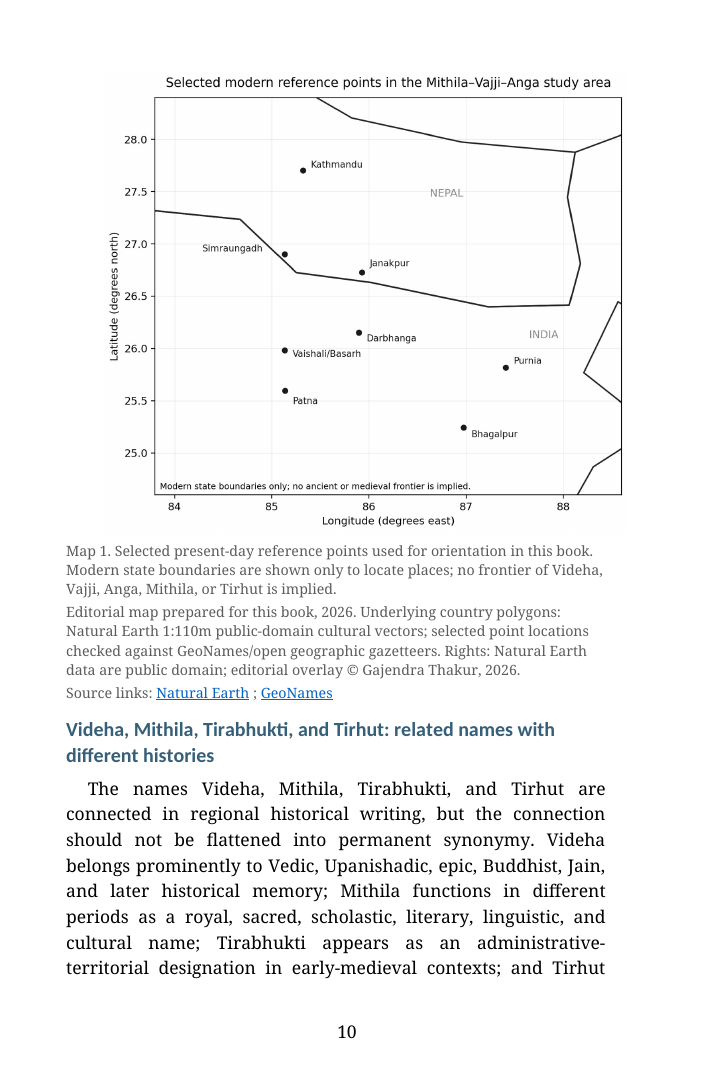
The cultural and geographical region of Mithila, historically designated as
Videha, Tirabhukti, Tirhut, or Mithilanchal, is situated between the foothills
of the Himalayas to the north and the Ganges River to the south, bounded by
the Gandaki River to the west and the Mahananda River to the east. For
millennia, this territory has served as a primary sanctuary for Vedic and
Upanishadic scholarship, fostering unique socio-legal systems that governed
local populations under strict shastric frameworks. Politically, Mithila’s
history is marked by a succession of influential dynasties, notably the Pala
Empire, the Karnata Dynasty, the Oiniwar Dynasty, and the Khandavala
Dynasty (ruling as the Darbhanga Raj).
Within this historical framework, the social hierarchy of Mithila evolved a
distinct power dynamic characterized by the convergence of Bhudevas
(landowners) and Bhupalas (land protectors). In Mithila, the priestly class
and the ruling class closely aligned their authority, with the monarchs serving
as both secular administrators and protectors of the orthodox Brahmanical
social order. To preserve this structure against socio-cultural shifts and
external invasions, the state instituted the Panji Prabandha—an extensive,
highly structured system of genealogical record-keeping maintained for the
Maithil Brahmins and Karna Kayasthas. This system established strict
endogamous boundaries through state-enforced marital regulations, making it

                             Gajendra Thakur — 75
                            Decoding the Panji of Mithila
one of the most comprehensive genealogical and genetic archiving systems
in human history.

Historical Foundations and the Crisis of 1326 AD
Prior to the formalization of the Panji Prabandha, genealogical tracking in
Mithila was decentralized and maintained through oral traditions and
informal family records known as Uteadh. Marital alliances relied on the
recollection of ancestral lineages up to a few generations and the matching of
Gotras. However, as the population expanded and migrated across different
river systems, these oral networks proved insufficient to prevent accidental
endogamous violations of prohibited degrees of kinship (Sapinda).
│
(Inability to reliably verify distant cousinship)
│
▼
[Pandit Harinath Upadhyaya's Accidental Incestuous Marriage]
│
(Socio-religious crisis and royal court trial by ordeal)
│
▼
│
▼
The institutionalization of the Panji Prabandha was precipitated by a major
socio-religious crisis in $1326\text{ AD}$. Pandit Harinath Upadhyaya, a
highly respected authority on Dharma-shastra and the author of the Smritisar,
resided in the village of Satadhara. Lacking detailed written records of his
maternal lineage, he inadvertently married his cousin—specifically, his
paternal uncle’s daughter’s daughter (pitayaut bhaik dauhitri).
The transgressive nature of this union was exposed following an incident
where an "untouchable" man of the Dusadh caste approached Pandit
Harinath's wife. Though she was vindicated through a trial by ordeal—where
her chastity was tested by fire—subsequent investigations in the royal court
revealed that the marriage itself violated sacred law. Under shastric
jurisprudence, a marriage within prohibited Sapinda degrees was considered

                              Gajendra Thakur — 76
                           Decoding the Panji of Mithila
invalid, and any offspring of such a union were classified as Chandala,
leading to exclusion from the Aryan social fold.
Recognizing that even the most learned scholars could no longer accurately
trace their lineages orally, the last ruler of the Karnat Dynasty, King
Harisimhadeva (reigned 1304–1325/1326 AD), intervened. In Sake 1248
(corresponding to $1326\text{ AD}$), the king decreed that the state would
take over the documentation of family histories. He convened a grand
assembly of scholars, known as the Vishwachakra Sammelan, at Jamsam
(Pandaul, Madhubani district) in $1327\text{ AD}$.
At this assembly, King Harisimhadeva appointed official genealogists,
known as Panjikars, who were tasked with conducting a comprehensive
census of every family’s lineage, gotra, pravara, ancestral village, and
migrated settlements. This registry was designed to ensure that no future
marriage could occur within the prohibited degrees of kinship.
[King Harisimhadeva]
│
┌─────────────────────────┼────────────────
────────┐
▼                 ▼                  ▼
[Karna Kayasthas]
(Registrar: Gunakar Jha) (Registrar: Shankardatt) (Registrar: Vijaydatt)
The king appointed specific registrars for the three principal socio-political
groups of Mithila :
•   Saduphyadhyaya Gunakar Jha of the Mahendrapur-Pandua lineage was
    appointed the registrar for the Maithil Brahmins.
•   Shankardatt was appointed the registrar for the Karna Kayasthas.
•   Vijaydatt was appointed the registrar for the Kshatriyas, particularly the
    Gandhavariya Rajputs.
The Panji system was later patronized by subsequent ruling dynasties,
including the Oiniwar dynasty and the Khandavala dynasty (Darbhanga Raj).
To maintain high standards, the Darbhanga Raj established a ten-year
academic program. Aspiring Panjikars had to pass a rigorous examination,
the Dhaut Pariksha, after which they were formally authorized as registrars.
Over time, following the dissolution of the Darbhanga Raj, this system
transitioned into a hereditary guild.

                             Gajendra Thakur — 77
                            Decoding the Panji of Mithila
Socio-Ritual Divisions and Sub-Caste Formations
The implementation of the Panji Prabandha codified existing ritual and
philosophical distinctions within the Maithil Brahmin community. At its
core, the community was divided along Vedic and ritual lines into two
groups :
•   vājasaneyī (Vajasaneyi): Followers of the Madhyandina branch of the
    White Yajurveda.
•   chandoga (Chandogya): Followers of the Kauthuma branch of the
    Samaveda.
These ritual divisions are marked by distinct lifecycle ceremonies (Sanskara),
particularly during the Upanayana (sacred thread ceremony) and the Vivaha
(marriage rituals) :
      Lifecycle Ceremony      |   Vajasaneyi (Yajurvedi) Practice   |   Chandogya
      (Samavedi) Practice
      Upanayana Sacraments | Comprises four distinct rituals: 1. Chudakarana
      (tonsure) 2. Upanayana (investiture) 3. Vedarambha (initiation into Vedic
      study) 4. Samavartana (graduation) | Comprises four distinct rituals: 1.
      Namakarana (naming) 2. Chudakarana (tonsure) 3. Upanayana (investiture)
      4. Samavartana (graduation)
      Vivaha (Marriage) Structure | Conducted as a single, continuous ceremony
      that can be performed during either the day or the night. | Divided into two
      distinct parts: 1. Purva-vivah (initial marriage) 2. Uttara-vivah (concluding
      marriage), performed strictly after sunset after viewing the star Arundhati.
At a broader level, Mithila's codification reflects the wider regional
classification of Indian Brahmins. According to puranic frameworks, the
Brahmin community of India is divided into ten categories, separated
geographically by the Vindhya Range into the Pancha-Gauda (Northern) and
Pancha-Dravida (Southern) groups :
│
┌───────────────────────────┴──────────────
─────────────┐
▼                                       ▼
[Pancha-Gauda]
1. Utkal (Odishan)                              1. Karnat (Karnataka)
2. Kanyakubja (Gangetic Plains)                       2. Gurjar (Gujarati)

                              Gajendra Thakur — 78
                          Decoding the Panji of Mithila
3. Gauda (Bengali)                             3. Tailang (Andhra)
4. Maithil (North Bihar/Nepal)                     4. Dravida (Tamil/Kerala)
5. Saraswat (North-Western)                        5. Maharashtriya (Marathi)
Within this framework, Maithil Brahmins developed a distinct identity
shaped by their unique geography, dietary habits, language, and the local
administrative influence of the Panji system.

Taxonomic Architecture: Gotras, Mulas, and Mulgrams
The structural integrity of the Panji Prabandha relies on three key concepts:
the Biji Purush (the seed ancestor), the Mula (the ancestral village), and the
Mulgram (the village of migration).
The Biji Purush is the earliest identifiable ancestor of a lineage, serving as
the root of the family tree. The Mula represents the original territorial
settlement where this Biji Purush resided at the time of the $1327\text{
AD}$ census. If a family migrated to a new village, their new residence was
recorded as the Mulgram, which was appended to their original Mula to track
the family’s geographic movement (e.g., Mandar-Garh or Mandar-
Mangarouni).
At the time of the census, the community was classified into twenty
patrilineal Gotras (clans). Each Gotra is associated with specific Pravaras
(groups of Vedic rishis) and original Mulas.
│
┌─────────────────────────┴────────────────
─────────┐
▼                                  ▼
[Pancha-Pravara]
(Three Sages)                            (Five Sages)
The system recognizes twenty distinct Gotras, classified by their Pravara
structures :
      Gotra | Pravara Type | Associated Pravara Sages | Associated Original
      Mulas (Ancestral Settlements)
      Shandilya | Tri-Pravara | Shandilya, Asit, Deval | Dirghosh (Dighve),
      Sarisab, Mahua, Parvapalli (Pavouli), Khandabala, Gangoli, Yamusham,
      Karian, Mohari, Sajhual, Madar, Pandoli, Jajiwal, Dahibhat, Tilay, Mahab,
      Simmual, Singhasram, Sodarpur, Kadariya, Allari, Hodyar, Talhanpur,
      Parisara, Parasada, Virnam, Uttampur, Kodariya, Chhatiman, Vareva,
                            Gajendra Thakur — 79
                     Decoding the Panji of Mithila
Machehal, Gangaur, Bhator, Budhaura, Brahmpura, Koiar, Kerhivar,
Gangual, Ghosiyam, Chatauni, Bhigual, Nanauti, Tapanpur
Vatsa | Pancha-Pravara | Orv, Chyavan, Bhargav, Jamadagnya, Aplavan |
Palli (Pali), Hariamb, Tisuri, Raudh, Takwal, Ghusaut, Jajiwal, Pahaddi,
Jallaki (Jalay), Bhandwal, Koiar, Kerhivar, Nanaur, Dadhar, Karmaha,
Budhwal, Madar, Lahi, Sauni, Sakauna, Phanandah, Mohari, Vanthwal,
Tisaut, Baruali, Pandoli, Baheradhi, Bareva, Alay, Bhandarisamay,
Babhaniyam, Uchati, Tapanpur, Vithual, Narwal, Chitrapalli, Jarhatiya,
Ratwal, Brahmpura, Sarauni
Kashyapa | Tri-Pravara | Kashyapa, Avatsar, Naibhruva | Oini, Khaual,
Sankaradhi, Jagati, Darihara, Mandar, Valias, Pachaut, Katai, Satalakha,
Pandua, Malich, Merandi, Bhadual, Pakaliya, Budhwal, Pibhuyan, Mauri,
Bhutahari, Chhadan, Visphi, Thariya, Dosti, Bareha, Kusumbhal, Narwal,
Lagurdah
Savarna | Pancha-Pravara | Orv, Chyavan, Bhargav, Jamadagnya, Aplavan
| Sondpur, Panchobh, Bareba, Nandor, Merandi
Parashara | Tri-Pravara | Shakti, Vashistha, Parashara | Naraun, Suragan,
Sakuri, Suiri, Sammual, Pihwal, Nadam, Maheshari, Sakrahon, Soini, Tilay,
Bareba
Bharadvaja | Tri-Pravara | Bharadvaja, Angiras, Barhaspatya | Ekahra,
Vilvapanchak (Belouach), Deyam, Kaligam, Bhutahari, Godhar, Godhuli
Katyayana | Tri-Pravara | Katyayana, Vishnu, Angiras | Kujouli, Nanauti,
Jallaki, Vatigam
Alambukaksha | Tri-Pravara | Garga, Gautama, Vashistha | Basam, Katai,
Brahmpura
Garga | Pancha-Pravara | Gargya, Ghrit, Vaishampayan, Kaushik,
Mandavyatharvan | Basaha, Basam, Brahmpura, Suraur, Budhaur, Uraur
Kaushika | Tri-Pravara | Kaushik, Atri, Jamadagni | Nikhuti
Krishnatreya | Tri-Pravara | Krishnatreya, Aplavan, Saraswat | Lohna,
Busavan, Padauni
Maudgalya | Tri-Pravara | Maudgalya, Angiras, Barhaspatya | Ratwal,
Malich, Dirghosh, Kapinjal, Jallaki
Gautama | Tri-Pravara | Angira, Vashistha, Barhaspatya | Brahmpura,
Untampur, Kodyar
Vashistha | Tri-Pravara | Vashistha, Atri, Sankriti | Kothua
Kaundinya | Tri-Pravara | Astik, Kaushik, Kaundinya | Ekahra, Paraun
Jatukarna | Tri-Pravara | Jatukarna, Angiras, Bharadvaja | Devahar

                       Gajendra Thakur — 80
                             Decoding the Panji of Mithila
      Tandi | Tri-Pravara | Tandi, Sankhya, Angiras | Katai
      Vishnuvriddhi | Tri-Pravara | Vishnuvriddhi, Kaurapucch, Trasadasyu |
      Busavan
      Upamanyu | Tri-Pravara | Upamanyu, Angiras, Barhaspatya | (Noted in
      registers as sparsely populated)
      Kapila | Tri-Pravara | Shatatap, Kaundilya, Kapila | (Noted in registers as
      sparsely populated)
To maintain a clear social record, the genealogist Raghudev Jha compiled a
taxonomy dividing these lineages into five status-based categories :
•   Ayanta (Superior)
•   Varanta (Secondary)
•   Madhyama (Intermediate)
•   Adhama (Lower)
•   Adhamadhama (Lowest)
[Ancestral Lineages]
│
┌──────────────┬───────────────┼───────────
────┬──────────────┐
▼          ▼             ▼            ▼             ▼
[Ayanta]     [Varanta]       [Madhyama]           [Adhama] [Adhamadhama]
These structural categories are outlined in the table below :
      Categorization | Lineages (Mulas) Included
      Ayanta     |  Khadauray, Khaualay, Budhabalay, Madaray, Dariharay,
      Ghusautay, Tisautay, Naraunay, Karmahay, Babhaniyamay, Hariambay,
      Sarisaway, Sodarpuriyay
      Varanta | Gangolivar, Pavaulivar, Kujaulivar, Alewar, Vahedarwar,
      Sakadivar, Palivar
      Madhyama | Dighvay, Belauchey, Ekahray, Panchobhe, Valiasay, Jajiwalay,
      Takwalay, Panduay, Sakun
      Adhama | Phanandahwar, Dasautivar, Alariye, Kodariye, Kothuye, Mahue,
      Busavanay
      Adhamadhama | Suraganay, Lagudday, Dahibhatavar, Satalakhay, Uchitivar,
      Visaivar, Jalaywar

The Mechanics of Exogamy: Utedh and Sapinda Calculations

                               Gajendra Thakur — 81
                           Decoding the Panji of Mithila
The primary function of the Panji Prabandha is to enforce strict exogamy
rules to prevent inbreeding within the relatively small, endogamous Maithil
community. It strictly prohibits unions between individuals who share a
common ancestor within a specified number of generations.
To calculate these prohibited degrees, the Panjikars use a standardized
genealogical framework known as the Utedh. This tool maps out $32$
distinct ancestral lines of both the prospective bride and groom, representing
the paternal and maternal grandparents of their ancestors.
│
┌───────────────────────┴──────────────────
─────┐
▼                                ▼
[Paternal Lineage]                     [Maternal Lineage]
(Exogamous Avoidance)                        (Exogamous Avoidance)
│                               │
▼                                ▼
Paternal Generation $\ge 6$                 Maternal Generation $\ge 5$
The mathematical rule governing marriageability is expressed through
generation avoidance limits :
$$\text{Sapinda Avoidance Limit} = \begin{cases} \text{Generation } (g_p)
\ge 6, & \text{on Paternal side} \\ \text{Generation } (g_m) \ge 5, & \text{on
Maternal side} \end{cases}$$
Historically, under classical Dharma-shastra frameworks (such as the Manu
Smriti), the paternal avoidance limit was seven generations. However, in the
sixteenth century, Maharaja Mahesh Thakur modified the paternal limit to six
generations for practical matching purposes within the community, a
standard that has since been followed.
To verify eligibility, the Panjikar cross-references the lineages of both parties
against sixteen ancestral nodes, known as the Chhatis (Sixteenths). These
nodes represent the sixteen possible maternal and paternal ancestral roots of
an individual :
      Chhati Node | Genealogical Definition and Kinship Path
      1 | Bride's paternal great-great-grandfather (Vriddha-prapitama-prapitama)

                              Gajendra Thakur — 82
                            Decoding the Panji of Mithila
      2 | Bride's paternal great-great-grandfather's father-in-law (Vriddha-
      pitamahasya Swasura)
      3 | Bride's paternal great-grandfather's maternal grandfather's father
      4 | Bride's paternal great-grandfather's maternal grandfather's father-in-law
      5 | Bride's paternal grandmother's paternal great-grandfather
      6 | Bride's father's maternal grandfather's maternal grandfather
      7 | Bride's paternal grandmother's maternal great-grandfather
      8   |    Bride's paternal grandmother's maternal grandfather's maternal
      grandfather
      9 | Bride's maternal grandfather's paternal great-grandfather
      10 | Bride's maternal great-grandfather's maternal grandfather
      11 | Bride's maternal grandfather's maternal great-grandfather
      12 | Bride's maternal grandfather's maternal grandfather's maternal
      grandfather
      13 | Bride's maternal grandmother's paternal great-grandfather
      14 | Bride's maternal grandmother's paternal grandfather's maternal
      grandfather
      15 | Bride's maternal grandmother's maternal great-grandfather
      16 | Bride's maternal grandmother's maternal grandfather's maternal
      grandfather
An alliance is deemed invalid (Aswajan) if any ancestor within these sixteen
nodes appears in the groom's paternal lineage within six generations or
maternal lineage within five generations.
To illustrate the mathematical application of this system, consider the historic
case study of a proposed marriage recorded in the Panji. The verification
involved the daughter of Shashinath Jha (of the Karmah-Behat lineage,
residing in Vittho, Darbhanga) and the maternal grandson of Kanhaiya Jha
(of the Karmah-Behat lineage, residing in Vittho). The bride’s mother was
the daughter of Narayandatt Thakur (of the Khadabala-Bhaur lineage). The
groom’s father was Krishnanand Jha, whose paternal grandfather was
Gopinand Jha (of the Darihara-Ratauli lineage, residing in Lohna).
The Panjikar mapped out the bride's sixteen Chhatis to verify her lineage :
      Chhati Node | Identified Ancestor / Mula-Mulgram | Paternal / Maternal
      Lineage Path of the Bride
      1 | Vishwanath Jha | Karmah-Behat Mula (Son of Shankardatt)

                              Gajendra Thakur — 83
                           Decoding the Panji of Mithila
      2 | Dhanapati Jha | Madari-Valiyas Mula (Son of Indrapath Jha)
      3 | Feku Jha | Mandar-Sihouli Mula (Son of Raghubar Jha)
      4 | Harshi Jha | Pali-Mahishi Mula (Son of Lakshmidatt Jha)
      5 | Siddhinath Jha | Sakaradhi-Parhat Mula (Son of Harshanand Jha)
      6 | Maheshwar Thakur        | Khadabala-Bhaur Mula (Son of Shyamnath
      Thakur)
      7 | Sevanath Mishra | Hariamb-Balirajpur Mula (Father of Balmukund
      Mishra)
      8 | Gadadhar Mishra | Sodarpur-Sarisab Mula (Son of Vedadhar)
      9 | Dharmanath Thakur | Khadabala-Bhaur Mula (Paternal line of maternal
      grandfather)
      10 | Santalal Jha | Babhaniyam-Kadain Mula (Son of Rudi)
      11 | Bacharan Jha | Karmah-Naduar Mula (Son of Hemnarayan)
      12 | Jirakkhan Thakur | Khadabala-Bhaur Mula (Son of Thothi)
      13 | Yogilal Mishra | Hariamb-Valirajpur Mula (Son of Harshamani)
      14 | Kaushilyanand Mishra | Sodarpur-Digaundh Mula (Son of Kari)
      15 | Guneshwar Singh | Khadabala-Bhaur Mula (Son of Maharaj Kumar
      Babu Guneshwar Singh)
      16 | Padmanath Jha | Khaual-Simarwar Mula (Son of Bhavanath)
During the cross-referencing process, the Panjikar identified that the bride’s
14th Chhati—Kaushilyanand Mishra of the Sodarpur-Digaundh lineage—
also appeared on the groom’s paternal side.
<── Overlap ──> [Present in Groom's Paternal Lineage]
│
(Within Forbidden 6 Generations)
│
▼
This overlap placed the bride and groom within the prohibited sixth
generation of relationship on the paternal side. Consequently, the union was
disqualified, and the Panjikar refused to issue the Siddhanta Patra, protecting
the community's exogamous rules.

Sakha Panji and Social Stratification
In $1327\text{ AD}$, the original Panji Prabandha was established on an
egalitarian basis, recording all families with equal standing. However, in the
                             Gajendra Thakur — 84
                            Decoding the Panji of Mithila
mid-eighteenth century, during the reign of Maharaja Madhav Singh, the
system underwent a major structural shift with the introduction of the Sakha
Panji (branch registries). This new framework divided the Maithil Brahmin
community into three hierarchically stratified classes based on perceived
lineage purity and ritual adherence :
•   Shrotriya (Soti): The highest class, characterized by strict endogamous
    marriages and rigorous performance of Vedic rituals.
•   Yogya (Jog): The middle class, comprising families of respected
    scholarly standing.
•   Panjibaddha: The basic registered class, consisting of families of
    standard lineage.
Families not registered in these three categories were classified asJaibar.
The introduction of this hierarchy led to significant social issues. It fostered a
system of hypergamy, where families from lower tiers sought alliances with
Shrotriya men to elevate their social status. This practice contributed to
polygamy, child marriage, and a rising number of young widows, as older
Shrotriya men frequently married multiple younger women from lower-status
families.
Under this system, the elite Shrotriya class was organized into eight ritual
tiers, known as Chaugolas (quadrants), which regulated marriages across
thirty-two specific registries :
      Chaugola Grade | Representative Scholar / Family | Associated Mula-
      Mulgram and Gotra | Page / Register Code
      First | Bharthiyar Jha | Darihara-Ratouli / Kashyapa | 52//02
      First | Bhadai Jha | Pavauli-Badhiyam / Vatsa | 61//07
      First | Babhan Jha | Sodarpur-Rayyam / Shandilya | 190//05
      First | Pitambar Jha | Sarisab-Jonki / Shandilya | 113//01
      Second | Raghuni Jha | Karmah-Anal / Vatsa | 240//05
      Second | Narayan Jha | Budhwal-Dumra / Vatsa | 146//02
      Second | Devai Jha | Sakaradhi-Parhat / Kashyapa | 218//01
      Second | Gangadhar Jha | Khadabala-Bhaur / Shandilya | 121//06
      Third | Babu Mishra | Sodarpur-Sarisab / Shandilya | 112//04
      Third | Balabhadra Thakur | Khadabala-Bhaur / Shandilya | 70//06
      Third | Tisaut Jha | Tisaut-Kua / Vatsa | 128//04
      Third | Ramdev Mishra | Sodarpur-Rayyam / Shandilya | 111//04

                              Gajendra Thakur — 85
                           Decoding the Panji of Mithila
A parallel classification was developed for the non-Shrotriya population
(known as the Pachhbaripar). Formalized under Maharaja Rameshwar Singh
in $1929\text{ AD}$, this system divided the Pachhbaripar into fifteen
distinct grades based on their Laukits (ancestral honorifics), managing a total
of $153$ registers :
      Pachhbaripar Grade | Representative Laukit Name | Original Mula and
      Mulgram | Register Page Reference
      Grade I | Narapati Jha | Sakaradhi-Haradi | 166-4
      Grade I | Madhav Mishra | Sodarpur-Rohad | 435-5
      Grade I | Gonu Mishra | Sodarpur-Katka | 45-4
      Grade I | Bhaiyan Jha | Budhwal-Dumra | 195-9
      Grade II | Padum Jha | Satalakha-Satauli | 171-5
      Grade II | Shrikant Jha | Sakaradhi-Bhakharouli | 497-4
      Grade II | Madhupati Mishra | Sodarpur-Gaur | 310-1
      Grade III | Gahananand Jha | Budhwal-Dumra | 179-4
      Grade IV | Chhitari Jha | Sakaradhi-Tatail | 297-3
      Grade V | Harinarayan Thakur | Khadabala-Behat | 186-5
      Grade V | Sukhai Jha | Pavauli-Badhiyam | 301-1
      Grade VI | Taraivalla Chaudhary | Naraun-Vatsawal | 213-1
      Grade VII | Badani Jha | Karmah-Tarauni | 71-4
      Grade VIII | Bodhkrishna Jha | Takwal-Ankusi | 388-6
      Grade IX | Ratikar Jha | Mandar-Rajoura | 9-4-1
      Grade X | Damodar Jha | Sakaradhi-Chhamu | 158-2
      Grade XI | Manikant Jha | Khadabala-Dyori | 313-2
      Grade XII | Nakat Jha | Alay-Alay | 424-6
      Grade XIII | Ghanashyam Jha | Naraun-Ojholi | 49-6
      Grade XIV | Ghansiram Chaudhary | Kusumal-Savas | 178-6
      Grade XV | Chatur Thakur | Digho-Nagar | 310-8

The Dushana Panji: Social Adaptations and Genetic Anomalies
To document and manage lineage deviations, the Panjikars compiled a
separate volume known as the Dushana Panji (the Register of Blemishes).
This register served as an unfiltered record of social and biological history,
documenting cases of inter-caste marriages, non-traditional unions, and
hereditary medical disorders.

                             Gajendra Thakur — 86
                           Decoding the Panji of Mithila
Among its most significant entries are records concerning prominent
historical figures, some of which were omitted from later traditionalist
publications to preserve orthodox narratives.
┌──────────────────────────────────────────
──────────────────────────────┐
│                SUPPRESSED GENEALOGICAL RECORDS                                      │
├──────────────────────────────────────────
──────────────────────────────┤
│ 1. GANGESHA UPADHYAYA (Founder of Navya-Nyaya school of
logic)  │
│   • Born 5 years after his father's death                       │
│    ("Pitri Parokshe Panch Varsh Vyatite")                           │
│   • Marriage: Allied with a woman of the leather-working caste                  │
│    ("Charmakarini")                                        │
├──────────────────────────────────────────
──────────────────────────────┤
│ 2. ARYABHATA (Astronomer-Mathematician)                                         │
│   • Lineage: Mandar Mula (Mangeroni branch)                             │
│   • Commences from Biji Trinayanbhatta (c. 400 AD)                          │
├──────────────────────────────────────────
──────────────────────────────┤
│    3.    CHAITANYA           MAHAPRABHU                  (Vaishnavite   reformer)
│
│   • Lineage: Karmah-Tarauni branch (Vatsa gotra)                        │
│   • Disciple of Ramapati Upadhyaya (Vishnupuri/Paramanandapuri)                     │
└──────────────────────────────────────────
──────────────────────────────┘
The register contains a detailed entry for Gangesha Upadhyaya, the founder
of the Navya-Nyaya school of logic and author of the Tattvachintamani. The
original Panji manuscripts state that Gangesha was born five years after the
death of his legal father (pitri parokshe panch varsh vyatite). Additionally,
the text records that his mother was a Charmakarini (a woman from the
leather-working caste). While these details were omitted from later

                             Gajendra Thakur — 87
                            Decoding the Panji of Mithila
genealogies compiled by twentieth-century scholars, the original palm-leaf
manuscripts preserve these records of his ancestry.
The Dushana Panji also provides a clear lineage for the astronomer-
mathematician Aryabhata, tracing his family back to the Mandar Mula
(Mangeroni branch). This lineage begins with the Biji ancestor
Trinayanbhatta (c. $400\text{ AD}$) and details fifteen generations of
descendants :
$$\text{Trinayanbhatta (Biji)} \rightarrow \text{Udayabhata} \rightarrow
\text{Vijayabhata} \rightarrow \text{Sulochana} \rightarrow \text{Bhatta}
\rightarrow \text{Dharmajati Mishra} \rightarrow \text{Dharajati Mishra}$$
$$\rightarrow \text{Brahmaraj Mishra} \rightarrow \text{Tripurajati Mishra}
\rightarrow \text{Vidhujati Mishra} \rightarrow \text{Ajaysingh} \rightarrow
\text{Vijaysingh} \rightarrow \text{Adivaraha}$$
$$\rightarrow \text{Mahovaraha} \rightarrow \text{Duryodhan Singh}
\rightarrow \text{Mahamohopadhyaya Narasimha (Weapon Specialist)}$$
This record places Aryabhata's family within the historical intellectual
landscape of ancient Mithila.
Similarly, the Panji traces the spiritual lineage of Chaitanya Mahaprabhu to
Ramapati Upadhyaya (also known as Vishnupuri or Paramanandapuri) of the
Vatsa gotra and Karmah-Tarauni lineage, documenting the connections
between medieval Maithil scholars and the wider Bhakti movement in
Bengal.
The Dushana Panji also contains records of numerous other non-traditional
unions, which were documented to track their long-term genetic and social
impacts on the community :
      Family Mula | Non-Traditional Union and Lineage Intersections | Social
      Integration and Generational Resolution
      Pali (Devsharma Branch) | Kanh married a woman of unknown caste and
      origin. | Descendants integrated into the main lineage after six generations of
      dilution.
      Budhwal (Govind Branch) | Damu married an undocumented woman of
      unknown caste. | Descendants classified under the Dushana registry but
      retained in the community.
      Sarisab (Shrinath Branch) | Chakrapani married a woman of unknown caste.
      | Descendants monitored through subsequent generational records.

                              Gajendra Thakur — 88
                           Decoding the Panji of Mithila
      Darihara (Bhim Branch) | Umapati married an undocumented woman of
      unknown caste. | Branch classified under intermediate status (Madhyama).
      Sodarpur (Shrihari Branch) | Harinath married a woman of unknown caste. |
      Lineage split; branch tracked in separate registers.
      Hariamb (Vasudev Branch) | Krishnadeva married a woman of unknown
      caste. | Descendants integrated into the general community over several
      generations.
      Panchobh (Madhukar Branch) | Madhukar married a woman of unknown
      caste. | Generational dilution tracked through maternal lineage records.
      Sarisab (Bhavanath Branch) | Kishai married the daughter of Gangadhar,
      whose maternal grandmother was of unknown origin. | Descendants cleared
      of ritual blemishes by the sixth generation.
      Gangoli (Dagar Branch) | Married Yavani Daulat Jahan (a Muslim woman).
      | Descendants reintegrated into the main lineage after several generations.
      Khadabala (Surapati Branch) | Union with Sohago, daughter of the Koch
      Rajbanshi King of Assam. | Lineage split; branch classified as Katham.
      Sodarpur (Govind Branch) | Union with Medha, a woman of the Charmakar
      (cobbler) caste. | Descendants barred from Shrotriya status but retained
      within Pachhbaripar.
      Hadini (Sureshwar Branch) | Union with a woman of the Hadi (scavenger)
      caste. | Descendants recorded as Hadini lineage.
The register also contains records of marriages with women from the
Devadasi (temple dancer) tradition, such as the mothers of Jagannath
(Satalakha Mula), Ratanu (Ghusaut Mula), Ram (Pali Mula), Raghav
(Sakaradhi Mula), Chand (Sodarpur Mula), Harikar (Alay Mula), and Vidu
(Tilay Mula). Despite their mothers' non-traditional backgrounds, their
descendants were gradually integrated into the community over several
generations of recorded marriages.
Beyond social classification, the Dushana Panji functioned as an early system
of medical genetics. The Panjikars systematically recorded families carrying
hereditary physical and mental disorders, classifying them under specific
medical categories :
•   Apasmari: Lineages with a history of epilepsy.
•   Unmadi: Lineages with a history of chronic mental illness or insanity.
•   Kunji: Lineages carrying physical deformities, such as blindness,
    deafness, or congenital lameness.

                             Gajendra Thakur — 89
                           Decoding the Panji of Mithila
By documenting these conditions, the Panji system sought to prevent the
transmission of hereditary disorders, demonstrating an early, practical
understanding of genetic inheritance.

Archival Systems: Seven Types of Panji and Preservation Rituals
To manage these complex records, the Panji system was organized into seven
distinct types of registers, each designed for a specific genealogical or
administrative function :
│
┌───────────┬───────────┬────────┼─────────
──┬───────────┬───────────┐
▼        ▼         ▼       ▼         ▼          ▼          ▼
[Mula]       [Gotra] [Patra]      [Uteadh] [Aswajanam]
These structural registries are detailed below :
      Registry Type | Specific Administrative and Genealogical Function
      1. Mula Panji | The original baseline register, recording the primary
      ancestral villages (Mulas) and Biji Purush lineages established in $1327\text{
      AD}$.
      2. Sakha Panji | The branch registries introduced under Maharaja Madhav
      Singh, tracking social classes (Shrotriya, Yogya, Panjibaddha).
      3. Gotra Panji | Records the twenty patrilineal clans and their associated
      original ancestral villages.
      4. Patra Panji | Introduced around $1500\text{ AD}$ to track family
      migrations from original settlements (Mulas) to new villages (Mulgrams).
      5. Dushana Panji | Records lineage blemishes, non-traditional marriages, and
      hereditary physical or mental disorders.
      6. Uteadh Panji | A specialized tracking tool used to calculate Sapinda
      avoidance up to six generations before marriage.
      7. Aswajanam Patra | The registry of official non-relation certificates
      (Siddhanta Patra) issued to authorize marriages.
A unique historical exception is found in the Rasadh-Araria registry, which is
the only traditional Panji volume that explicitly records the personal names
of women. In all other regional registries, women are recorded only by their
maternal and paternal lineage connections.

                             Gajendra Thakur — 90
                           Decoding the Panji of Mithila
Because these documents were written on fragile organic materials, such as
palm leaves and bark paper, the Panjikars followed a strict preservation
routine. This routine was codified in a traditional Sanskrit mnemonic :
$$\text{\textit{“Jalat   Rakshet       Tailat     Rakshet   Rakshet     Shthila
Bandhanat”}}$$
This instruction commanded the registrars to protect the manuscripts from
water, oil, and loose binding. Additionally, the registries were dried once a
year under the hot sun during the transit of the Sun through the zodiac sign of
Leo (Simha Rashi, corresponding to mid-August to mid-September), when
solar radiation is strongest, to prevent mold and insect infestation.

Academic Traditions and Dynastic Inscriptions
Mithila's genealogical codification was supported by a strong scholarly
tradition led by the region's intellectual elite, known as the Shadayantri (six-
system) scholars. These scholars were master commentators on the six
classical schools of Indian philosophy.
The Panji records preserve the names of thirteen key Shadayantri scholars,
documenting their ancestral lineages and contributions to the region's
intellectual history :
•   Mahamahopadhyaya Godhi Sharma
•   Mahamahopadhyaya Madhav Sharma
•   Mahamahopadhyaya Adiya Madhav Sharma
•   Mahamahopadhyaya Shankar Sharma
•   Mahamahopadhyaya Yajnapati Sharma
•   Mahamahopadhyaya Parashurama Sharma
•   Mahamahopadhyaya Vamadeva Sharma
•   Mahamahopadhyaya Pitambara Sharma Vidyanidhi
•   Mahamahopadhyaya Gokulnath Sharma Phanandah
•   Mahamahopadhyaya Jagnnātha Sharma Phanandah
•   Mahamahopadhyaya Vamshadhara Sharma Rajanpura Darihara
•   Mahamahopadhyaya Raghunath Sharma Phanandah
•   Upadhyaya Datta (alias Vishnudatta Sharma Paramanandapuri)
The Panji system also recorded the lineages of local ruling dynasties,
providing valuable historical context for researchers. A notable example is
the $17\text{th}$-century Sanskrit inscription from the Vashaiti (Araria)

                             Gajendra Thakur — 91
                           Decoding the Panji of Mithila
temple, built by Queen Indravati of the Suragan-Loam dynasty. This
inscription records her family lineage over seven generations :
$$\text{King Krishnadeva} \rightarrow \text{Samarasingha} \rightarrow
\text{Vishvanatha Raja} \rightarrow \text{Viranarayana Raja} \rightarrow
\text{Naranarayana Raja} \rightarrow \text{Ramachandra Narayana}
\rightarrow \text{Indranarayana}$$
This record aligns with the family histories preserved in the official Panji
registries.
Similarly, the Panji archives provide detailed context for other social groups.
For example, the early Maithili text Varna Ratnakar, written by the royal
minister Jyotirishwar Thakur, lists sixty-two distinct Rajput clans that lived
in the region during the medieval period :
$$\text{Somvamsha}, \text{ Suryavamsha}, \text{ Doda}, \text{ Chausi},
\text{ Chola}, \text{ Sen}, \text{ Pal}, \text{ Yadav}, \text{ Parmar}, \text{
Nand}, \text{ Nikumbh}, \text{ Pushpabhuti},$$
$$\text{ Shringar}, \text{ Arahan}, \text{ Gupjharjhar}, \text{ Suruki},
\text{ Shikhar}, \text{ Bayekwar}, \text{ Ganhwar}, \text{ Surwar}, \text{
Meda}, \text{ Mahar}, \text{ Vat}, \text{ Kul},$$
$$\text{ Kachhwah}, \text{ Vayesh}, \text{ Karamba}, \text{ Heyana},
\text{ Chhewarak}, \text{ Chhuriyij}, \text{ Bhond}, \text{ Bhim}, \text{
Vinha}, \text{ Pundirayan},$$
$$\text{ Chauhan}, \text{ Chhind}, \text{ Chhikor}, \text{ Chandel}, \text{
Chanuki}, \text{ Kanchival}, \text{ Ranchkant}, \text{ Mundaut}, \text{
Bikaut}, \text{ Gulhaut},$$
$$\text{ Changal}, \text{ Chhela}, \text{ Bhati}, \text{ Mandatta}, \text{
Singhvirabhahya}, \text{ Khati}, \text{ Raghuvamsha}, \text{ Panihar},
\text{ Surbhanch},$$
$$\text{ Gumat}, \text{ Gandhar}, \text{ Vardhan}, \text{ Vahom}, \text{
Vashishth}, \text{ Gutiya}, \text{ Bhadra}, \text{ Khursam}, \text{
Vahattari}$$
This exhaustive classification reflects the structured approach to social
organization that characterized medieval Mithila.

Modern Preservation and Genetic Validation

                             Gajendra Thakur — 92
                          Decoding the Panji of Mithila
In the modern era, the Panji Prabandha faces challenges from urbanization,
changing social values, and the physical decay of historical manuscripts. As
families increasingly rely on modern matchmaking methods, the traditional
Saurath Sabha gathering in Madhubani has declined in participation,
transitioning into a largely symbolic cultural event.
To protect this historical archive, scholars launched a major preservation
project. Led by author and paleographer Gajendra Thakur, Nagendra Kumar
Jha, and Pandit Vidyanand Jha, the project digitized and transliterated over
$11,000$ historical palm-leaf manuscripts from the traditional Tirhuta
(Mithilakshar) script into modern Devanagari. This work was published as
Genome Mapping – 450 AD to 2009 AD: Mithilak Panji Prabandh, ensuring
the preservation of these genealogical records.
Concurrently, research in genetic anthropology has begun to explore the
biological basis of these traditional exogamy rules. Genetic analyses using
single nucleotide polymorphism (SNP) markers and Y-chromosomal short
tandem repeats (Y-STR) indicate a strong correlation within patrilineal
Gotras.
These findings suggest that the strict exogamy rules maintained by the Panji
system for over seven centuries have effectively limited the risk of
inbreeding and preserved genetic diversity within these endogamous
communities. The integration of these ancient genealogical records with
modern digital archiving and genetic science ensures that the Panji
Prabandha remains a valuable resource for studying human population
genetics and social history.

                            Gajendra Thakur — 93
                          Decoding the Panji of Mithila
Source structure and verification apparatus
Editorial source apparatus. This apparatus is descriptive, not interpretive. It records the source-controlled structure used to verify that this page corresponds to formal Chapter 5 of Decoding the Panji of Mithila — Volume I. The chapter text above is preserved from PDF pp. 76-95; formal Chapter 5 in the commit-pinned authoritative source. It is not merged with a neighboring chapter, appendix, annexure, or independent front/back-matter unit. The internal headings below come from the repository’s source-heading inventory and are retained as navigational and audit evidence; showing them here does not turn those headings into separate publications or add claims that are absent from the source.
Internal source headings
No subordinate heading was separately encoded in the repository source-heading inventory for this chapter.
Source-text concordance
Socio-Genetic · Architecture · Exhaustive · Anthropological · Historical · Analysis · Prabandha · Introduction · Regional · Context · cultural · geographical · region · historically · designated · Videha · Tirabhukti · Tirhut · Mithilanchal · situated · foothills · Himalayas · north · Ganges · River · south · bounded · Gandaki · west · Mahananda · east · millennia · territory · served · primary · sanctuary · Vedic · Upanishadic · scholarship · fostering · unique · socio-legal · systems · governed · local · populations · strict · shastric · frameworks · Politically · Mithila’s · history · marked · succession · influential · dynasties · notably · Pala · Empire · Karnata · Dynasty · Oiniwar · Khandavala · ruling · Darbhanga · Within · framework · social · hierarchy · evolved · distinct · power · dynamic · characterized · convergence · Bhudevas · landowners · Bhupalas · land · protectors
Boundary verification. In the formal sequence this chapter follows Volume I Chapter 4, “Analytico-Genetic Report on the Mithila Panji Prabandh: Socio-Historical Evolution, Taxonomic Structure, and Matrimonial Algorithms” and precedes Volume I Chapter 6, “The Mithila Panji Prabandha: An Anthropological, Legal, and Socio-Historical Analysis”. The chapter extractor begins at the verified formal Chapter 5 marker and stops at the next verified formal chapter marker; for a final chapter it stops before recognized book-level back matter. The concordance above is generated only from distinct terms already present in this chapter’s preserved source text. It is provided for discovery, comparison, and audit, not as an automated judgment about persons, lineages, status, kinship, marriage eligibility, or historical truth.
Illustrated research apparatus
Mithila · Vajji · Anga
Chapter-specific source notes
- Primary chapter witness. Gajendra Thakur, Decoding the Panji of Mithila — Volume I, formal Chapter 5, PDF pp. 76-95; formal Chapter 5. The HTML transcription is generated from the commit-pinned source PDF and retains the chapter boundary recorded in this edition.
- Internal structure. The repository source-heading inventory records no separately encoded subordinate heading for this chapter.
- Digital editorial method. The page keeps the preserved source text distinct from generated navigational, concordance, visual, and provenance apparatus. The synthetic reconstruction is explanatory only and is not evidence for an individual lineage or a determination of social or marital status.