Decoding the Panji of Mithila · Volume I · Chapter 6
The Mithila Panji Prabandha: An Anthropological, Legal, and Socio-Historical Analysis
Chapter 6
   The Mithila Panji Prabandha: An Anthropological,
         Legal, and Socio-Historical Analysis

The Mithila Panji Prabandha: An Anthropological, Legal, and
Socio-Historical Analysis of India’s Written Genealogical Registry

Historical Genesis and the Politics of Purity
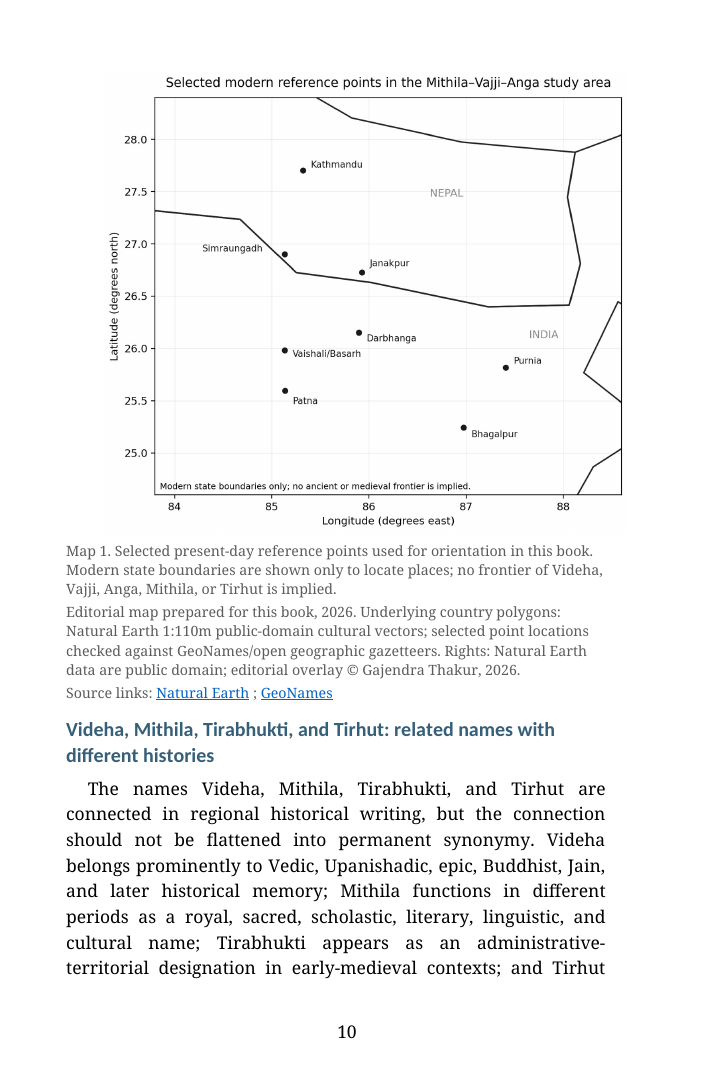
The cultural zone of Mithila, bounded geographically by the Himalayas to
the north, the Ganges to the south, the Gandaka to the west, and the Kaushiki
or Kosi river to the east, has historically served as a fertile crucible for
intense legal, philosophical, and social developments. Within this region, the
transition from decentralized, oral lineage introductions to a centralized,
state-mandated written registry was precipitated by a crisis of social
classification in Shaka 1248, corresponding to 1326/1327 CE, under the
reign of King Harisimhadeva of the Karnat dynasty. Prior to this period,
families sporadically relied on localized, memory-based introductions to
verify bloodlines during marital negotiations.
The institutionalization of the Panji Prabandha arose from a controversial
court trial in the village of Gangaura involving Harinatha Upadhyaya, a
prominent court pundit. Harinatha’s wife was accused of having an improper
relationship with an outcaste of the Dusadh community. To demonstrate her
chastity, she underwent a traditional fire ordeal, declaring "nāhaṃ
cāṇḍālagāminī" ("I have not associated with an outcaste"). However, the
ordeal resulted in her hands being burned, which the community interpreted
as a divine confirmation of guilt.
Distressed by this outcome, she sought counsel from Lakkhima Devi, an
exceptionally learned female scholar and the daughter of the Mimamsa
scholar Rati Mishra and wife of the legal authority Mahamahopadhyay
Rameshwar. Lakkhima Devi analyzed the situation and discovered a

                            Gajendra Thakur — 94
                          Decoding the Panji of Mithila
structural infraction rather than a moral one: Harinatha had unknowingly
married a woman related to him within the prohibited fifth degree of
consanguinity, a direct violation of the exogamous marriage codes prescribed
in the Smritis. Under Hindu jurisprudence, this transgressive marriage had
technically rendered Harinatha an outcaste (cāṇḍāla). Armed with this
realization, the wife demanded a retrial, altering her oath to declare "nāhaṃ
svapativy-atiricta cāṇḍālagāminī" ("I have not associated with any outcaste
except my husband"). This time, she emerged from the fire ordeal unscathed,
proving both her personal chastity and the underlying structural corruption of
the community's marital alliances.
The realization that even elite scholars were entering into incestuous
alliances due to the decay of lineage tracking deeply alarmed King
Harisimhadeva. To protect the ritual purity of the priestly and administrative
classes, the king ordered a comprehensive census of all Brahmin, Kayastha,
and Kshatriya lineages in his realm. He convened a grand assembly known as
the Vishwachakra Sammelan at the village of Jamsam, located in Pandaul in
the Madhubani district, to formalize the recording of family histories. He
appointed official registrars, known as Panjikars, led by Gunakar Jha for the
Maithil Brahmins, Shankardatta for the Karna Kayasthas, and Vijayadatta for
the Kshatriyas. While the Kshatriya lineages eventually drifted away from
this system due to marriages contracted outside the territorial boundaries of
Mithila, the Maithil Brahmins and Karna Kayasthas maintained the registry
with mathematical precision for over seven centuries.
This historical apparatus is preserved and evaluated in modern scholarship,
notably in the volume Genealogical Mapping (450 A.D. to 2009 A.D.) -
Mithila's Panji Prabandh, Volume II, edited and compiled by Gajendra
Thakur, Nagendra Kumar Jha, and Panjikar Vidyanand Jha, and published by
Shruti Prakashan in Delhi. This work represents a continuation of the first
volume, which was titled Genome Mapping and consisted of three sections
focusing on family history as the foundational phase of genealogical tracing.

The Structural Typology of the Panji System
The architectural foundation of the Panji Prabandha relies on the systematic
categorization of individuals based on their paternal and maternal lineages. A
Maithil Brahmin's identity within this framework is defined by several nested
concepts: the Gotra, which is the maximal patrilineal clan tracing descent to
an ancient Rishi; the Biji Purush, who is the earliest historically verifiable

                            Gajendra Thakur — 95
                          Decoding the Panji of Mithila
patrilineal ancestor; the Mool, representing the ancestral village associated
with the Biji Purush; the Moolgram, representing a secondary branch
associated with subsequent migrations; and the Shakha, which tracks the
specific lineage of descendants down to contemporary generations.
To mathematically illustrate the generational calculations used by the
Panjikars to align historical figures within this framework, the generational
interval can be standardized. The system calculates historical chronology
using an estimated average generational span of forty years per generation:
where represents the calculated historical epoch, represents the cumulative
number of generations recorded in the lineage tree, and is the established
generational constant of approximately 40 years.
Through this formula, the Panji records have been used to verify the
chronologies of several prominent figures of Mithila. For example, the
lineage of the mathematician-astronomer Aryabhata (476–550 CE) is
preserved within the Mandar-Kashyap Gotra, where he is recorded as the
39th generation. Similarly, the legendary philosopher and humorist Gonu Jha
is placed in the Vatsa Gotra (Karamhe Sonkariyam branch) at the 24th
generation, establishing his birth in approximately 1050 CE. The famous
poet Vidyapati Thakur (1350–1435 CE) is situated at the 14th generation of
the Bisphi-Kashyap branch, aligning perfectly with established historical
datings.
The system also records key legends associated with political power in the
region, such as the arrival of Nanyadeva, the founder of the Karnat dynasty.
According to the Panji texts, Nanyadeva arrived in Mithila on horseback,
exhausted and thirsty, and tied his horse under a tree. When he attempted to
cut grass for his horse, a cobra appeared, raising its hood. A Sanskrit
prophecy was found written nearby, which Nanyadeva could not read.
Kameshwar Thakur, a learned Brahmin, read the prophecy, revealing that
Nanyadeva was destined to be the King of Mithila.
Kameshwar Thakur’s descendant, Chandeshvar Thakkura, later served as the
minister of war and peace under Harisimhadeva and successfully led a
military expedition to Nepal, performing the tulā-pūruṣadāna along the
Vagmati River. When Chandeshvar handed over the state administration to
Harisinghdev and fled, soldiers pursued him. He threw water on the first
pursuer, freezing him in place, and threw water on the second pursuer,

                            Gajendra Thakur — 96
                           Decoding the Panji of Mithila
blinding him, which according to local tradition led to the naming of the
village Anhra Thadhi.
The structural subdivisions of the Maithil Brahmin community are
categorized by the number of Mools associated with each of the primary
Gotras.
      Gotra | Common Dialectical Pronunciation | Number of Registered Mools
      Sandilya | Sandilyae | 43
      Vatsa | Vatsavaal | 40
      Kashyap | Kashyap | 27
      Savarna | Savarnay | 7
      Katyayana | Katyaayane | 5
      Parashar | Parashari | 7
      Bhardwaj | Bhardwaji | 5
      Garga | Gargay | 3
These Mools represent the territorial anchors of the community, legitimizing
the families as indigenous inhabitants of Mithila. For instance, the
Brahmpura Mool is associated with seven distinct Gotras, including
Kashyap, Gautam, Vatsa, and Vashistha, while the Karamaha Mool
comprises both Sandilya and Vatsa Gotra branches, making intermarriage
within the same Mool possible if the Gotras differ.

Canonical Prohibitions and the Genetic Rationale of Exogamy
The primary utility of the Panji Prabandha is to prevent consanguineous
marriages, thereby avoiding the genetic disorders, developmental delays, and
immunological vulnerabilities associated with inbreeding. The Panji enforces
several non-negotiable rules of exclusion before a marriage is certified
through a Sidhanta issued by the Panjikar.
In addition to Gotra exogamy, the system enforces Pravara exogamy. For
example, marriages between individuals of the Vatsa and Savarna Gotras are
strictly prohibited because they share identical Pravaras, indicating a
common ritual lineage despite different patrilineal clan designations. The
system also enforces the Saptapada and Panchapada consanguinity rules,
which bar couples from sharing a common ancestor within seven generations
on the paternal side of the groom and five generations on the maternal side of
the bride.

                             Gajendra Thakur — 97
                            Decoding the Panji of Mithila
Furthermore, the Kashta Matula rule prevents a man from marrying the
offspring of his stepmother's brother. The system also prohibits marriages
between descendants of common paternal or maternal grandfathers. To
ensure these rules are met, the Panjikars evaluate sixteen distinct maternal
and paternal bloodlines, known as Kul, of both families.
      Vector Number | Bloodline Vector Evaluated for Sidhanta Approval
      1 | Paternal grandfather of father's paternal grandfather
      2 | Maternal grandfather of father's paternal grandfather
      3 | Paternal grandfather of father's paternal grandmother
      4 | Maternal grandfather of father's paternal grandmother
      5 | Paternal grandfather of father's maternal grandfather
      6 | Maternal grandfather of father's maternal grandfather
      7 | Paternal grandfather of father's maternal grandmother
      8 | Maternal grandfather of father's maternal grandmother
      9 | Paternal grandfather of mother's paternal grandfather
      10 | Maternal grandfather of mother's paternal grandfather
      11 | Paternal grandfather of mother's paternal grandmother
      12 | Maternal grandfather of mother's paternal grandmother
      13 | Paternal grandfather of mother's maternal grandfather
      14 | Maternal grandfather of mother's maternal grandfather
      15 | Paternal grandfather of mother's maternal grandmother
      16 | Maternal grandfather of mother's maternal grandmother
The structural maintenance of these fragile palm-leaf manuscripts was
traditionally aligned with the region's climate. The preservation,
transcriptions, and drying of the manuscripts were conducted during the Leo
solar cycle, from August 16 to September 16, when the intense heat was
utilized to dry the leaves and protect them from moisture and pests.

Social Stratification and the Evolution of the Caste Hierarchy
Over centuries, the interaction of bloodlines, academic prestige, and marital
choices led to the creation of five distinct endogamous sub-castes, which
began to function as independent social strata. The registry originally divided
families into five qualitative tiers based on the purity of their marriages and
ancestral accomplishments: Aeyaant, Baaraant, Maddhyamaa, Bhrashtaa, and
Atibhrashtaa. The top three tiers, comprising thirty-four "Superior Mools,"

                              Gajendra Thakur — 98
                            Decoding the Panji of Mithila
formed the elite core of the community. Over time, these categories
crystallized into five socio-ritual ranks.
      Socio-Ritual Class | Local Term | Key Structural and Ritual Characteristics
      Shrotriya | Soit | The highest rank, historically requiring scholarly merit but
      later determined solely by birth and ritual purity. Comprises the top 20 Mools
      of the Aeyaant and Baaraant divisions.
      Yogya | Jog | Formed by Shrotriya families who married into the lower
      Panjeebadh or Maddhyamaa classes, or from three elevated Maddhyamaa
      Mools (Balias-Narsam, Digho-Sannahpur, and Belauche-Sudai).
      Panjeebadh | Bhalmanush | Comprising the fourteen Maddhyamaa Mools.
      They frequently married into the Yogya class to elevate their social standing.
      Vanshadhar | Vanshadhar | Formed by Shrotriyas who fell in rank due to
      marrying outside the thirty-four superior Mools, often receiving a derogatory
      Moolgram suffix.
      Jaiwaar | Jaiwaar | The lowest tier of the classified hierarchy, consisting of
      families who did not maintain rigorous ritual records or married outside the
      classified lineages.
To manage social mobility within these ranks, the Paainj (or Laukit) system
was introduced. If a high-ranking family married into a lower-ranking
family, their social status dropped. However, if their descendants
subsequently contracted high-status marriages over successive generations,
they could recover some of their lost rank and were awarded a Paainj—a title
indicating that they had successfully rehabilitated their status, though they
were rarely restored to their original high standing.
The social hierarchy was heavily modified in the nineteenth century by Raja
Madhav Singh of Darbhanga. In a bid to centralize political authority and
curb the rising power of rival aristocratic houses, the Raja reconstructed the
social landscape. He confined the elite Shrotriya class to a specific
geographic enclave known as Soitpura and severed their social and marital
interactions with the rest of Maithil society.
Furthermore, he made it mandatory for any Shrotriya family to obtain his
personal written permission, known as Parmaangi, before finalizing any
marriage alliance. This political intervention effectively turned the Shrotriyas
into dependent landlords under the Darbhanga Raj, converting what was once
an intellectually active, debating scholarly class into a subservient, isolated
aristocracy, which ultimately led to the decay of their traditional
philosophical pursuits.

                              Gajendra Thakur — 99
                           Decoding the Panji of Mithila
The system also preserves records of historical disputes and social
demotions, such as the case of "Taskar Keshav" (Keshav Jha of Jamasam).
When Maharaja Lakshmishwar Singh sought to contract a marriage with a
girl from Keshav's village, Keshav Jha intervened, brought the girl back to
the village, and forced a passing dye-maker to perform the Kanyadaan. In
response, the Maharaja summoned the Panjikar and ordered that the title
"Taskar" (thief) be officially attached to Keshav's lineage, affecting the social
status of any families associated with them.
To maintain this complex apparatus of social monitoring, the selection and
training of Panjikars became a highly professionalized affair. During the
Darbhanga Raj period, candidates underwent a rigorous ten-year course of
study in the royal court, mastering genealogy, legal texts, and scriptural
codes.
At the end of this training, the candidate had to sit for the Dhaut Pariksha—a
rigorous public examination overseen by the region's leading scholars.
Successful candidates were awarded a ceremonial white cloth (Dhoti) and the
formal title of Panjikar. Following the dissolution of the Darbhanga Raj, this
formal academic certification ended, and the office of the Panjikar became
strictly hereditary.

Archival Classifications of Panji Manuscripts
The handwritten records preserved by the Panjikars are classified into three
distinct categories based on their content and purpose 5:
•   Gothra Panji: Records detailing the fundamental associations between
    specific Gotras and their primary Mools.
•   Patra Panji: Lineage sheets recording the names of children, marital
    alliances, and changes of residence, capturing the historical migrations of
    families across generations.
•   Dushan Panji: The registry of faults, documenting structural deviations,
    inter-caste marriages, and other violations of orthodox boundaries.
Several seminal historical manuscripts are preserved within this archival
tradition. These include the Mandar Mool manuscript written by Raghudev
Jha during the late seventeenth and early eighteenth centuries, and the
subsequent Shakha book composed on palm leaves by his grandson, Panji
Chhoti (Devanand Jha), between 1760 and 1776 CE.

                            Gajendra Thakur — 100
                           Decoding the Panji of Mithila
Other significant records include the Shakha book of Panji Bhikhia Jha,
written by Panji Domai Mishra of the Hariamb Mool (a resident of Koilakh),
and the Shakha book of Panji Harshanand Jha, composed by Panji Jhonti Jha
(Mitranand Jha). Additionally, the Shakha books of Panji Jhulanand Jha,
Panji Modanand Jha, and those written between 1925 and 1935 CE in
Saurath by Panji Lutan Jha and his maternal cousin Panji Nirsu Jha remain
central reference texts for modern genealogical verification.

The Subaltern Counter-Archive: The Dushan Panji and Gangesha
Upadhyaya
While the official Panji Prabandha presented an idealized image of absolute
ritual purity and social compliance, the actual practice of Maithil society was
far more complex. This social reality is preserved in the Dushan Panji, a
parallel archive that recorded violations of orthodox boundaries. For
centuries, the Dushan Panji was kept hidden by elite registrars, as its contents
threatened the high-caste status of several prominent families.
The Dushan Panji documented structural deviations that the mainstream
narratives sought to erase, including inter-caste alliances with lower-caste
individuals, widow remarriages, and illegitimate births. The most significant
revelation from the Dushan Panji concerns Gangesha Upadhyaya, the
legendary thirteenth-century founder of the Navya-Nyaya (New Logic)
school of philosophy and author of the seminal text Tattvachintamani.
For centuries, elite Maithil historians, such as Ramanath Jha, actively
suppressed or omitted specific genealogical details of Gangesha's life to
maintain the narrative of unblemished high-caste lineage. The original
Dushan Panji manuscripts (such as Record 21//10 of the Chhadan Mool)
preserve two highly controversial facts 5:
•   Paternal Absence: Gangesha was born five years after the death of his
    father ("Pitri Parokshe Panch Varsh Vyatite"), pointing directly to an
    illegitimate or extra-marital conception.
•   Inter-Caste Marriage: Gangesha's wife (Vallabha), named Ananda or
    Medha, was a Charmakarini—a woman belonging to the leather-tanning
    (Chamar) caste.
The preservation of these details in the Dushan Panji reveals that the Panji
Prabandha did not merely function as an instrument of elite exclusion.
Rather, it operated as a record of social reality, documenting transgressions

                            Gajendra Thakur — 101
                           Decoding the Panji of Mithila
with clinical precision and creating a counter-archive that exposes the fluid
and contested boundaries of historical Maithil society.
The modern preservation of these records has been marked by plagiarism and
copyright disputes. For example, the 2009 work Genome Mapping by
Gajendra Thakur, Nagendra Kumar Jha, and Panjikar Vidyanand Jha was
reportedly plagiarized in 2010 by Dr. Yoganand Jha (also known as
Yoganand "Sindhu") under the title Panji Prabandh (Vansh Parichay - First
Part), with the support of the Shrotriya organization "Maharaja Kameshwar
Singh Sanskritik Vikas Manch". Similarly, the 1962 work Mithila ki
Sanskritik Lokchitrakala by painter Laxminath Jha was translated and
published under the title Aripan in 2008 by Sushila Jha, utilizing scanned
images from the original book under a grant from the Central Institute of
Indian Languages, Mysore.

Cultural Geography and Regional Profiles of Purbanchal Mithila
The operationalization of the Panji system was historically tied to the cultural
geography of Mithila. To facilitate marriages, King Harisimhadeva
established fourteen major regional centers, known as Sabha Gachhis
(orchard assemblies), where matrimonial negotiations could take place under
the supervision of the Panjikars. These locations included Saurath,
Khanagadi, Partapur, Sheohar, Govindpur, Fattepur, Sajhaul, Sukhasana,
Akhdari, Hemnagar, Balua, Baruali, Samsaul, and Sasaula. Of these, the
Saurath Sabha (near Madhubani) and the Sasaula Sabha (near Sitamarhi)
became the most popular.
The eastern and northern regions of Mithila, encompassing Purnia, Araria,
and Saharsa (collectively referred to as Purbanchal Mithila), present distinct
historical and geographical profiles within the Panji records. For example,
the name of the Araria district is derived from the British administrative
designation "R. Area" (Rural Area), which was subsequently corrupted into
the local vernacular.
Within the Sripur Pargana of Araria, the village of Jahanpur stands as a
prominent center of Maithil settlement. Originally settled in the early
sixteenth century by Nikai and Rakai Jha of the Panichobh Jhoua Mool,
alongside the brothers Haridev and Govind Thakur of the Khandvala Ekma
Mool in the adjacent village of Satghara, the settlement shifted to Jahanpur in
the third generation under the leadership of Nikai's grandson, Umanath, and
Bhajaram Thakur.
                            Gajendra Thakur — 102
                          Decoding the Panji of Mithila
In 1708 CE, following dreams directing excavation, the village consecrated
physical idols of Vishnu, Narasimha, Radha-Krishna, and Durga. Jahanpur
has produced several prominent figures, including Pandit Punyanand Jha, a
celebrated scholar, writer, and the first postgraduate from the old Purnia
district, who served as a Member of the Legislative Assembly in Bihar.
The village was also home to Giranand Thakur, a just zamindar and scholar
of English and Persian, and Rashmohan Jha, an Honorary Magistrate of the
Darihara Ratauli Mool. Jahanpur also contributed several freedom fighters to
the national movement, including Pandit Balabhadra Thakur, Pandit
Ramsundar Thakur, Pandit Surendra Mohan Thakur, Pandit Gokhulanand
Thakur, and Pandit Suryamohan Thakur, while its local administration was
served for decades by Harishchandra Jha (Bechan Jha) of the Sinhouli
Mandar Mool.
Other prominent villages in the Sripur Pargana include Chopra Bukhari,
settled by the Khandvala Behat family who migrated from Tirhut to Katihar,
and Asura, a highly populated but flood-prone village situated along the
banks of the Kankai River.
The Asanga (or Asaja) Pargana comprises several key villages, including
Begampur, Ekamba, Vishnupur, Asarna, Sakma, Bhawanipur, and Ufraul.
Among these, Vishnupur is home to families of the Hariamb Ahil and
Khouade Kurma Mools, including Mitranath Jha, a Persian scholar and
Tehsildar. The village also claims the lineage of Lal Mishra (also known as
Doman) of the Hariamb Ahil Mool, whose four sons—Gunanand,
Tirthanand, Padmanand, and Gajanand—contributed significantly to the
region.
Gunanand founded several educational institutions, while Tirthanand's son
served as a scholar, research authority on the economic history of Purnia, and
the founder Vice Chancellor of Mithila University. This scholarly tradition
was continued by his son, Dr. Ratneshwar Mishra, who served as the Head of
the Post Graduate History Department at Mithila University.
The Haveli (or Nashira) Pargana was traditionally celebrated for the
meticulousness of its ritual observances. Shrotriya families resided in this
region for generations under the protection of the Surgan Loam dynasty, later
returning to Tirhut during the reign of Raja Madhav Singh after 1760 CE.
Nashira was also the residence of Jyotirishwar Thakur, the author of the first
Maithili dictionary and compendium, Varnaratnakara. During periods of

                           Gajendra Thakur — 103
                          Decoding the Panji of Mithila
famine in Bengal, several families migrated to Nashira, including the Ray
family of the Gangoliwar Digoun Mool, who subsequently settled in Arihana
in the Katihar district.
The Dharampur Pargana, spanning the western portions of Purnia, Araria,
and Katihar, was historically ruled by the Khandwala dynasty and the
Puhasara rulers of the Surgan Loam Mool. During the reign of the Darbhanga
ruler Raja Raghav Singh, a local revenue officer named Viru Kurmi
constructed a fort in Virnagar and ceased paying state revenues.
A military expedition led by Sarmast Ali Khan, with the assistance of
Raghav Singh, defeated the rebellion, and the administration of the Nathpur
and Goradi talukas was subsequently transferred to the Surgan Loam kings of
Purnia. In western Dharampur, the Janakinagar area was marked by the
spiritual influence of Mahanth Ramdas, who traveled the region and
protected local populations from administrative tyranny, a tradition continued
by his disciple, Mahanth Raghavdas.
Dharampur also includes the village of Rashadh, a historic center of Sanskrit
scholarship home to Mahamahopadhyay Harishwar Mishra, and the village
of Dhamdaha (historically Dharmadiha), which produced scholars such as
Mahamahopadhyay Chitrapat Jha and Mahamahopadhyay Shyam Sundar
Thakur.

Modern Challenges and the Imperative of Digital Archiving
In the contemporary era, the seven-century-old Panji system faces significant
operational challenges arising from demographic and socio-economic shifts
6:
•   Geographic Dispersion: The migration of families to metropolitan areas
    and abroad has weakened the localized community networks that
    historically supported the Sabha Gachhis.
•   Changing Matrimonial Priorities: Modern marriages increasingly
    prioritize educational background, career compatibility, and personal
    choice over traditional genealogical verification, resulting in nearly
    twenty percent of marriages occurring without Panji verification.
•   Economic Unviability: The profession of the Panjikar provides minimal
    financial security in the absence of state or institutional patronage,
    prompting the younger generation of registrar families to pursue
    alternative careers.

                           Gajendra Thakur — 104
                           Decoding the Panji of Mithila
•   Physical Decay of Manuscripts: The primary records, written on fragile
    palm leaves and handmade paper, are highly vulnerable to humidity,
    pests, and decay, raising the risk that centuries of ancestral history may
    be lost.
To address these challenges, scholars have emphasized the need for
systematic digitization and archival preservation. Transforming these
physical manuscripts into a secure, searchable digital database would
preserve the genealogical heritage of the region, ensuring that its historical
records and genetic utility remain accessible to future generations.

                            Gajendra Thakur — 105
                           Decoding the Panji of Mithila
Source structure and verification apparatus
Editorial source apparatus. This apparatus is descriptive, not interpretive. It records the source-controlled structure used to verify that this page corresponds to formal Chapter 6 of Decoding the Panji of Mithila — Volume I. The chapter text above is preserved from PDF pp. 95-107; formal Chapter 6 in the commit-pinned authoritative source. It is not merged with a neighboring chapter, appendix, annexure, or independent front/back-matter unit. The internal headings below come from the repository’s source-heading inventory and are retained as navigational and audit evidence; showing them here does not turn those headings into separate publications or add claims that are absent from the source.
Internal source headings
No subordinate heading was separately encoded in the repository source-heading inventory for this chapter.
Source-text concordance
Prabandha · Anthropological · Legal · Socio-Historical · Analysis · India’s · Written · Genealogical · Registry · Historical · Genesis · Politics · Purity · cultural · zone · bounded · geographically · Himalayas · north · Ganges · south · Gandaka · west · Kaushiki · Kosi · river · east · historically · served · fertile · crucible · intense · philosophical · social · developments · Within · region · transition · decentralized · oral · lineage · introductions · centralized · state-mandated · precipitated · crisis · classification · Shaka · corresponding · reign · King · Harisimhadeva · Karnat · dynasty · Prior · period · families · sporadically · relied · localized · memory-based · verify · bloodlines · marital · negotiations · institutionalization · arose · controversial · court · trial · village · Gangaura · involving · Harinatha · Upadhyaya · prominent · pundit · Harinatha’s · wife · accused
Boundary verification. In the formal sequence this chapter follows Volume I Chapter 5, “The Socio-Genetic Architecture of Mithila: An Exhaustive Anthropological and Historical Analysis” and precedes Volume I Chapter 7, “Panji Prabandh: A Comprehensive Briefing and Study Guide to Maithil Genealogical Mapping”. The chapter extractor begins at the verified formal Chapter 6 marker and stops at the next verified formal chapter marker; for a final chapter it stops before recognized book-level back matter. The concordance above is generated only from distinct terms already present in this chapter’s preserved source text. It is provided for discovery, comparison, and audit, not as an automated judgment about persons, lineages, status, kinship, marriage eligibility, or historical truth.
Illustrated research apparatus
Mithila · Vajji · Anga
Chapter-specific source notes
- Primary chapter witness. Gajendra Thakur, Decoding the Panji of Mithila — Volume I, formal Chapter 6, PDF pp. 95-107; formal Chapter 6. The HTML transcription is generated from the commit-pinned source PDF and retains the chapter boundary recorded in this edition.
- Internal structure. The repository source-heading inventory records no separately encoded subordinate heading for this chapter.
- Digital editorial method. The page keeps the preserved source text distinct from generated navigational, concordance, visual, and provenance apparatus. The synthetic reconstruction is explanatory only and is not evidence for an individual lineage or a determination of social or marital status.