Decoding the Panji of Mithila · Volume I · Chapter 7
Panji Prabandh: A Comprehensive Briefing and Study Guide to Maithil Genealogical Mapping
Chapter 7
 Panji Prabandh: A Comprehensive Briefing and Study
        Guide to Maithil Genealogical Mapping

Panji Prabandh: A Comprehensive Briefing on Maithil Genealogical
Mapping (450 AD – 2009 AD)/ Panji Prabandh: A Comprehensive Study
Guide to Maithil Genealogy
Executive Summary
ThePanjiPrabandhis a unique and exhaustive genealogical documentation
system utilized by the Maithil Brahmin and Karna Kayastha communities of
Mithila. While its roots trace back to the Vedic period and early medieval era
(starting circa 450 AD), the system was formally institutionalized and
standardized      in1326AD         (Saka    1248)under       the     patronage
ofKingHarisimhadevaof the Karnata dynasty.The primary mission of the
Panji is to maintain "Jati Shuddhi" (purity of lineage) by regulating marriages
through a complex verification of ancestry. It serves as a dense record of
Gotras , Mulas (original villages), Shakhas (branches), and titles. The
system dictates that for a marriage to be valid, the couple must not share a
common ancestor within specific generational limits (typically seven
generations on the paternal side and five on the maternal side). This briefing
outlines the structural framework, historical evolution, and the rigorous
genealogical investigations required for the issuance of "Siddhanta"
(marriage eligibility certificates).
6. Historical Evolution and Codification
The Maithil Brahmin community evolved from Vedic roots, specifically
divided                                                                between
theYajurvedic(MadhyandinaShakha)andSamavedic(KauthumaShakha)tra
ditions. Over centuries, geographical isolation, climate, and local customs led
to the distinct identity of "Maithil" Brahmins among the ten categories of
Indian Brahmins ( Pancha-Gauda and Pancha-Dravida ).
The Harisimhadeva Reforms (1326 AD)
In the 14th century, King Harisimhadeva observed a decline in the voluntary
maintenance of genealogical records ( Samuha-Lekhya ). To prevent

                            Gajendra Thakur — 106
                           Decoding the Panji of Mithila
accidental prohibited marriages (incestuous by Vedic standards), he
established an official state department for genealogy.
•   First Panjikars: The King appointed Gunakar Jha (for Brahmins),
    Shankardatta (for Karna Kayasthas), and Vijaydatta (for Kshatriyas) to
    collect and codify all existing family records.
•   Incentive for Accuracy: The system was built on "Absolute Source
    Fidelity," where Panjikars traveled from village to village, interviewing
    family heads to record their Bijipurush (founding ancestor) and Mula
    Gram (original village).
7. Structural Framework: Gotra, Mula, and Pravara
The Panji system classifies families based on three primary markers:
I. Gotras (Lineage from Sages)
The Maithil Brahmin community is divided into20Gotras . Seven of these are
considered the most prominent and populous.| Major Gotras (7) | Minor
Gotras (13) || ------ | ------ || Shandilya, Vatsa, Kashyapa, Savarna, Parashara,
Bharadwaj, Katyayana | Garga, Kaushika, Alambukaksha, Krishnatreya,
Gautama, Mudgala, Vashistha, Kaundinya, Upamanyu, Kapila,
Vishnuvriddha, Tandi, Jatukarna |
II. Mulas (Roots) and Mula-Grams
There are167recognizedMulasin Mithila, derived from the original village of
the founding ancestor ( Bijipurush ).
•   From these 167, 34 to 35 "Mukhya" (Main) Mulas were identified as
    primary ancestral nodes.
•   The Panji identifies the current residence of a family as their Shakha
    (branch), but their identity remains tied to the Mula .
III. Pravaras
Pravaras refer to the ancestral sages who authored Vedic hymns. Maithil
Brahmins are classified into:
•   Tri-Pravara: Descendants of three specific sages.
•   Pancha-Pravara: Descendants of five specific sages (e.g., Vatsa,
    Savarna, and Garga gotras).
8. Social Stratification and Categories
The system categorizes families into hierarchical ranks based on their
adherence to rituals and historical conduct:

                            Gajendra Thakur — 107
                           Decoding the Panji of Mithila
•   Shrotriya: The highest rank, subdivided into eight grades. They observe
    the strictest marriage rules (discarding 7 paternal and 5 maternal
    generations).
•   Yogya: The middle tier, subdivided into thirteen grades.
•   Panjibaddha (Vanshaja): The baseline rank of recorded families.
•   Jayavar: Those who were not originally included in the formal Panji
    records but are part of the broader community.
9. The Mechanics of Marriage Eligibility
The central function of the Panji is to determine if a prospective bride and
groom are"Asvajan"(unrelated within prohibited degrees).
The Sapinda Rule
Marriage is prohibited if the couple shares a common ancestor within:
•   Paternal Side: 6 or 7 generations.
•   Maternal Side: 5 generations.
The "Chhapthi" Investigation (Six-Point Verification)
A Panjikar (Genealogist) must verify 32 points of ancestry (the Utedh ) for
both parties. This includes the ancestry of:
•   Paternal and Maternal Grandfathers/Grandmothers.
•   Great-grandparents and beyond.
•   The investigation ensures that none of the 16 "Chhapthi" (critical
    genealogical nodes) of the bride appear in the groom's paternal lineage.
The Siddhanta Process
Before any marriage can take place, the Panjikar must issue aSiddhanta.
This is a written document certifying that the union is "Shastric" (scripturally
valid). Without a Siddhanta, a marriage is considered "Ashastriya" (invalid)
and the offspring may be socially marginalized.
10. Historical Records and Anomalies
The Panji is more than a marriage registry; it is a historical archive. The
documents record various sociological data points:
•   Academic Titles: Extensive records of titles like Mahamahopadhyaya ,
    Upadhyaya , and Pandit from as early as 450 AD.
•   Historical Figures: The records trace the lineage of notable figures such
    as the poet Vidyapati , the philosopher Gangesha Upadhyaya (author of

                            Gajendra Thakur — 108
                           Decoding the Panji of Mithila
    Tattva Chintamani ), and even the connections of Chaitanya
    Mahaprabhu (whose teacher was from the Karamha Mula).
•   Migration and "Dosha": The Panji records "Doshas" (faults or deviations
    in lineage), such as marriages into unknown castes or prohibited families,
    ensuring that the social standing of a lineage is transparent.
•   Script Preservation: The Panji records are traditionally maintained in the
    Tirhuta (Maithili) script. The survival of this script is intrinsically linked
    to the Panji Prabandh.
11. Current Challenges and Maintenance
•   Script Decay: As the knowledge of the Tirhuta script declines, fewer
    people can read the original palm-leaf ( Tal-Patra ) records, leading to a
    reliance on Devanagari transliterations.
•   Preservation of Records: The ancient palm-leaf manuscripts are fragile.
    Traditional preservation involves drying them in the sun during the
    month when the Sun enters the Leo zodiac sign (August/September).
•   Role of the Panjikar: The Panjikar is viewed as the "Protector of
    Culture." The document notes a modern decline in the ethical standards
    of some practitioners and emphasizes the need for a new generation of
    trained genealogists to maintain the system's integrity.
Conclusion:The Panji Prabandh represents an unparalleled genealogical
achievement, maintaining a continuous record of a population for over 1,
years. It remains a critical instrument for social organization and cultural
identity in Mithila, functioning as a "Genome Map" that predates modern
genetic science by centuries.
Panji Prabandh: A Comprehensive Study Guide to Maithil Genealogy
This study guide provides a detailed synthesis of the "Panji Prabandh," a
unique genealogical system practiced primarily by the Maithil Brahmins,
Karna Kayasthas, and Kshatriyas of the Mithila region. Spanning from
approximately 450 AD to 2009 AD, this system serves as a traditional form
of genome mapping and lineage management.
Source structure and verification apparatus
Editorial source apparatus. This apparatus is descriptive, not interpretive. It records the source-controlled structure used to verify that this page corresponds to formal Chapter 7 of Decoding the Panji of Mithila — Volume I. The chapter text above is preserved from PDF pp. 107-110; formal Chapter 7 in the commit-pinned authoritative source. It is not merged with a neighboring chapter, appendix, annexure, or independent front/back-matter unit. The internal headings below come from the repository’s source-heading inventory and are retained as navigational and audit evidence; showing them here does not turn those headings into separate publications or add claims that are absent from the source.
Internal source headings
No subordinate heading was separately encoded in the repository source-heading inventory for this chapter.
Source-text concordance
Prabandh · Comprehensive · Briefing · Study · Guide · Maithil · Genealogical · Mapping · Genealogy · Executive · Summary · ThePanjiPrabandhis · unique · exhaustive · documentation · system · utilized · Brahmin · Karna · Kayastha · communities · roots · trace · back · Vedic · period · early · medieval · starting · circa · formally · institutionalized · standardized · in1326AD · Saka · patronage · ofKingHarisimhadevaof · Karnata · dynasty · primary · mission · maintain · Jati · Shuddhi · purity · lineage · regulating · marriages · complex · verification · ancestry · serves · dense · record · Gotras · Mulas · original · villages · Shakhas · branches · titles · dictates · marriage · valid · couple · must · share · common · ancestor · within · specific · generational · limits · typically · seven · generations · paternal · side · five · maternal
Boundary verification. In the formal sequence this chapter follows Volume I Chapter 6, “The Mithila Panji Prabandha: An Anthropological, Legal, and Socio-Historical Analysis” and precedes Volume I Chapter 8, “Special Studies: Q&A; Women in the Pañjī; Dooshan Pañjī and the Political Economy of Status”. The chapter extractor begins at the verified formal Chapter 7 marker and stops at the next verified formal chapter marker; for a final chapter it stops before recognized book-level back matter. The concordance above is generated only from distinct terms already present in this chapter’s preserved source text. It is provided for discovery, comparison, and audit, not as an automated judgment about persons, lineages, status, kinship, marriage eligibility, or historical truth.
Illustrated research apparatus
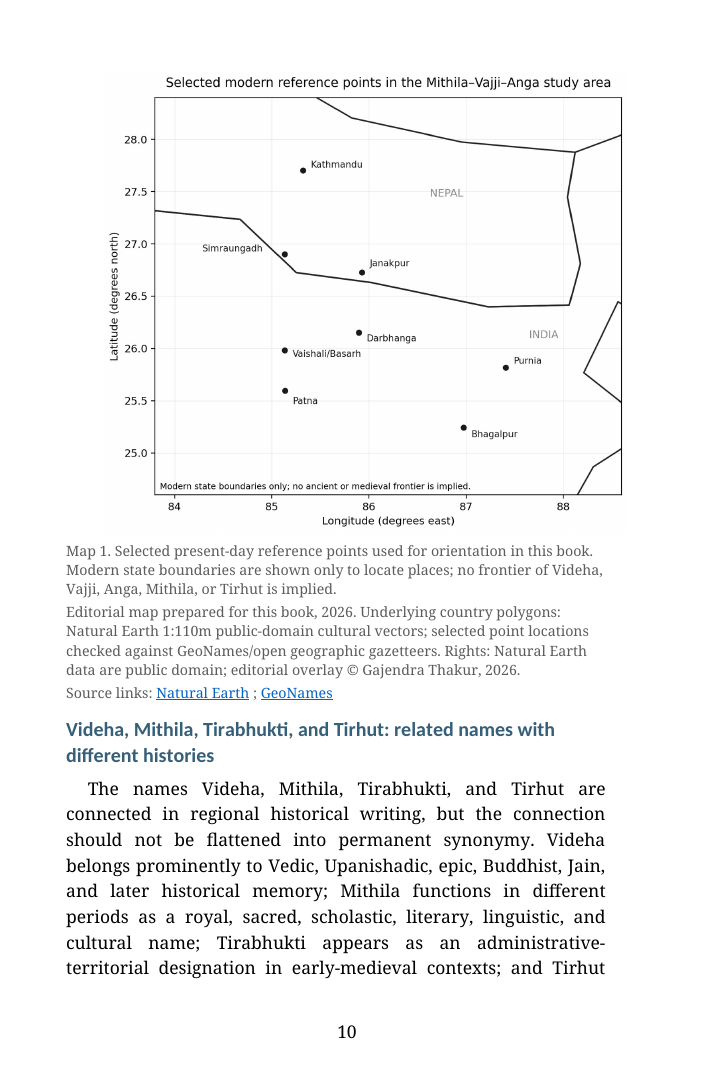
Mithila · Vajji · Anga
Chapter-specific source notes
- Primary chapter witness. Gajendra Thakur, Decoding the Panji of Mithila — Volume I, formal Chapter 7, PDF pp. 107-110; formal Chapter 7. The HTML transcription is generated from the commit-pinned source PDF and retains the chapter boundary recorded in this edition.
- Internal structure. The repository source-heading inventory records no separately encoded subordinate heading for this chapter.
- Digital editorial method. The page keeps the preserved source text distinct from generated navigational, concordance, visual, and provenance apparatus. The synthetic reconstruction is explanatory only and is not evidence for an individual lineage or a determination of social or marital status.