Decoding the Panji of Mithila · Volume I · Chapter 8
Special Studies: Q&A; Women in the Pañjī; Dooshan Pañjī and the Political Economy of Status
Chapter 8
Special Studies: Q&A; Women in the Pañjī; Dooshan
Pañjī and the Political Economy of Status
The Panji text outlines thePanjiPrabandha, an extensive genealogical
system established in the 14th century to document the lineage
ofMaithilBrahminsand other communities in the Mithila region. Initiated
under the reign ofKingHarisimhadeva, this record-keeping tradition was
designed to prevent prohibited marriages by tracking ancestral details
across multiple generations. The sources detail a complex structure
ofgotras(clans) andmools(ancestral villages), categorising families into
specific social and hierarchical tiers based on their heritage. Essential to
this system is theUtedh, a genealogical chart used by specialized
registrars known asPanjikarsto verify marital eligibility through a
rigorous examination of maternal and paternal lines. Beyond marriage
laws, the text reflects the preservation ofMaithila cultureand the Tirhuta
script, illustrating a sophisticated historical effort to maintain
community identity and genetic purity. Modern efforts to digitise and
transliterate these ancient palm-leaf manuscripts aim to protect
this1,500-year-old genealogical heritage from physical decay and linguistic
obsolescence.
How did the Panji Prabandha system reorganise Maithil society in 1326?
In 1326 AD (Shaka 1248), the ruler of Mithila, Maharaja Harisimhadeva,
alongside contemporary scholars, introduced thePanjiPrabandha system to
radically reorganize Maithil society and its marital practices. This
reorganization was triggered by the decline of the older family-maintained
genealogical record system (Samuha Lekhya), which had led to people
unknowingly entering into unscriptural marriages within forbidden degrees
of kinship.
The Panji Prabandha system reorganized Maithil society in several key ways:
• Centralization of Genealogical Records: The responsibility of
maintaining family lineages was taken away from individual families and
institutionalized as an official state department.
Gajendra Thakur — 143
Decoding the Panji of Mithila
• Creation of the 'Panjikar' Class: The king appointed specialized scholars
known as Panjikars (genealogists) who traveled to each family to collect
detailed ancestral information. The comprehensive written records
containing data on every new birth and marriage became known as the
Panji, and the citizens registered within these records were designated as
Panjibaddha.
• Mandatory Marriage Verification: It became mandatory to obtain an
authorization certificate (Siddhanta Patra or Aswajana Patra) from a
state-appointed Panjikar before finalizing any marriage. This ensured the
bride and groom did not fall within forbidden degrees of consanguinity—
specifically, avoiding five generations on the mother's side and six to
seven generations on the father's side. Any marriage without this
certificate was considered unscriptural.
• Social Stratification and Hierarchy: While Harisimhadeva's original
system was intended to be a purely scientific and egalitarian genealogical
record across Brahmins, Kayasthas, and Kshatriyas, it fundamentally
reorganized Maithil Brahmins into distinct hierarchical categories.
Society was divided into classifications such as Shrotriya (the highest
tier), Yogya, and Panjibaddha (or Vamshaj).
• Long-Term Societal Shifts: Over the centuries, this rigid classification
system led to deep internal stratification and a decline in the democratic
values of Mithila. It eventually gave rise to the Bikaua class (high-
ranking men who married multiple times to confer their social status on
lower-ranking families) and contributed to severe societal issues like
child marriage and a significantly high number of widows.
Explain the 'Utedh' rules for determining marriage eligibility between
families.
The'Utedh'(or Utteh) rules form the fundamental genealogical framework
used by Maithil Panjikars (genealogists) to determine strict marriage
eligibility between a prospective bride and groom. Before a marriage can be
formally authorised with a Siddhanta (authorisation certificate), the Panjikar
must construct an 'Utedh Panji' for both families to meticulously map their
lineages and ensure they do not violate scriptural rules of consanguinity.
The rules and structure of the Utedh calculation process involve the
following key components:
Gajendra Thakur — 144
Decoding the Panji of Mithila
1. The 32Moolsand Ancestral MappingTo determine eligibility, the Utedh
maps out32 ancestral*Mools* (root families) for both the bride and the
groom. The chart introduces seven generations of ancestors,
systematically detailing the lineages of the paternal and maternal
grandfathers, grandmothers, and their respective ancestors. Specifically,
the Utedh tracessix generations on the paternal sideandfive generations on
the maternal side for both parties to map out their complete biological
lineage.
2. Formatting theUtedhChartTo create the Utedh, the Panjikar writes the
bride's village and Mool village on the left side of the chart. Directly next to
this, the specific Mool is listed, followed by the names of her ancestors in
descending chronological order—starting from the great-great-great-
grandfather down to the father. A structurally identical Utedh chart is
simultaneously created for the groom.
3. The 16ChhathiCalculationThe most critical rule of the Utedh is
calculating the16Chhathi. The Chhathi represents the 16 specific ancestors
(drawn from both the maternal and paternal lines) from whom the bride or
groom is exactly the sixth descendant.
• The Rule of Exclusion: Once the bride's 16 Chhathi are identified, they
are cross-referenced with the groom's Utedh. If even one of the bride's 16
Chhathi ancestors appears within the groom's paternal lineage (Pitru-
Paksha) within six generations, the marriage is strictly forbidden.
• The Exception: If the overlapping ancestor appears exclusively on the
groom's maternal side (Matru-Paksha), the shared ancestry (Sapinda) is
considered ceased, and the marriage is permitted.
4. Additional ProhibitionsAlongside the Chhathi rules, the Utedh enforces
three additional strict prohibitions to authorise a marriage:
• The bride and groom must not belong to the same Gotra (patrilineal
clan).
• The bride and groom must not share the same Pravara (sage lineage
associated with their Gotra).
• The bride must not be the offspring of the groom's step-mother's brother
(a rule locally known as avoiding the Kathmama's lineage).
By cross-referencing these Utedh charts, the Panjikars scientifically ensure
that the bloodlines are sufficiently distanced and all religious and genetic
boundaries are respected before allowing the families to unite.
Gajendra Thakur — 145
Decoding the Panji of Mithila
What are the roles of Gotras, Pravaras and Muls in lineage?
Gotrasdefine the broad patrilineal ancestry within Maithil Brahmin society.
Every Gotra is named after the earliest known great sage (Mahapurush) of
that lineage, and belonging to the same Gotra indicates a shared patrilineal
bloodline. There are 20 Gotras in total, with seven being particularly
prominent and well-established, such as Shandilya, Vatsa, Kashyap, Savarna,
Parashar, Bharadwaj, and Katyayan. In the context of lineage and marriage,
sharing the same Gotra strictly prohibits a marital union, ensuring genetic
distance between families.
Pravarasrepresent the specific revered ancient sages from a family's lineage
who are recognized as the composers of Rigvedic hymns. Maithil Brahmins
are divided into two main Pravara categories based on their Gotra: those with
three ancestral sages (Tri-pravara) and those with five (Panch-pravara).
Historically, Pravaras were recited during Yagnas (fire rituals) to invoke the
sacred fire. Much like Gotras, Pravaras act as a strict boundary for marital
eligibility; a bride and groom must not share the same Pravara to be
authorized for marriage.
Muls(Mools) pinpoint the exact geographical origin or the most ancient
known village where the founding ancestor (Biji Purush) of a specific family
branch originally settled. While Gotras identify the broad sage lineage, Muls
identify the specific, localized sub-branch of that family. Historical records
identify 167 distinct Muls scattered across various villages, which later
evolved into a hierarchy where 34 or 35 were considered primary Muls for
higher-ranking families.
The Mul is the most critical component for maintaining genealogical records
(Panji). For instance, tracing a person's complete biological lineage to create
an Utedh chart requires mapping out 32 ancestral Muls (tracing back
grandparents and great-grandparents on both the maternal and paternal sides)
to verify marriage eligibility. Furthermore, as families migrated, different
branches of the same family were often identified by compounding their
original Mul village with their newer settled village to prevent losing their
exact lineage. While a Mul generally aligns with one specific Gotra, there are
exceptions; for example, the Brahmpura Mul contains families belonging to
multiple different Gotras (Shandilya, Vatsa, Kashyap, Alambukaksh,
Gautam, and Garg).
Who are the thirty-two ancestral figures mentioned in the records?
Gajendra Thakur — 146
Decoding the Panji of Mithila
The thirty-two ancestral figures mentioned in the records refer to the thirty-
two root families (Kulas or Mools) that are meticulously mapped out to
construct the Utedh chart, which details seven generations of a person's
biological lineage
.
To verify marital eligibility and maintain the purity of the bloodline, the
genealogists trace the ancestry back to these specific thirty-two figures,
which include:
The paternal grandfather and paternal grandmother of the person's father and
mother
.
The paternal grandfather and paternal grandmother of the person's maternal
grandfather and maternal grandmother
.
The fathers of the person's mother and maternal grandmother
.
The primary purpose of mapping these specific ancestors is to scientifically
guarantee genetic distance. According to the rigid rules of the Panji
Prabandha, for a marriage to be authorized, the prospective bride or groom
must fall exactly in the seventh generation (seventh position) descending
from these thirty-two ancestors
. Mapping these thirty-two root branches ensures that the families are
sufficiently distanced and do not violate the forbidden degrees of
consanguinity.
What are the specific rules regarding mother's and father's lineages?
The specific rules regarding the mother's and father's lineages dictate the
acceptable genetic distance (Sapindata) required to authorize a marriage
under the Panji Prabandh system. Based on ancient Dharmashastra texts like
the Manu Smriti, the primary directive governing this is
*"MatrutahPanchamiTyaktva,PitrutahSaptami"* (abandon the fifth from
the mother, abandon the seventh from the father).
The rules are strictly defined as follows:
• Maternal Lineage (Matru-paksha): A prospective bride and groom must
not share an ancestor within five generations on the mother's side. Any
Gajendra Thakur — 147
Decoding the Panji of Mithila
overlapping ancestor within this five-generation boundary prohibits the
marriage. The shared ancestry is considered to cease after the fifth
generation, making the sixth generation scientifically eligible for a
marital union.
• Paternal Lineage (Pitru-paksha): The bloodline on the father's side is
traced further back. A bride and groom must not share an ancestor within
seven generations on the paternal side. While the original scriptural rule
strictly excludes up to the seventh generation, some later records and
regional modifications (such as those by Maharaja Mahesh Thakur)
adjusted this to excluding six generations and accepting the seventh
generation for marriage.
In practice, this means a bride cannot be a descendant within five generations
of any man from the groom's maternal clan, nor can she be a descendant
within seven (or six, as amended) generations of the groom's paternal clan. If
these conditions are met alongside the Gotra and Pravara rules, the families
are considered sufficiently distanced to marry.
How did Maharaja Harisimhadeva select the original Panjikars?
Maharaja Harisimhadeva selected the original Panjikars through ajoint
decision with the contemporary learned scholarsof his kingdom. After
convening an assembly to address the societal crisis of unscriptural
marriages, the scholars and the king concluded that the vital task of
managing genealogical records should be entrusted only to themost capable
and qualified individuals in society who were experts
inDharmashastra(religious texts) and deeply committed to protecting
Dharma.
Following these criteria, the king established an official state department and
appointed the first Panjikars byroyal decree (Rajagnya). The original
selections were specifically divided by caste:
• For the Maithil Brahmins: He appointed Sudhyaya Gunakar Jha of the
Mahindrapur Pandua Mool. The king specifically sought out Gunakar
Jha because he had already been voluntarily collecting and maintaining
genealogical records of the Brahmin community on his own initiative.
• For the Karna Kayasthas: He appointed Shankardatt.
• For the Kshatriyas: He appointed Vijaydatt.
Gajendra Thakur — 148
Decoding the Panji of Mithila
These selected experts were officially designated as Panjikars and were
granted the exclusive state authority to verify bloodlines and issue the
necessary authorization certificates before any marriage could take place.
What is the significance of the 16 Chhathi ancestors?
The 16 Chhathi refer to the 16 specific ancestors (drawn from both the
maternal and paternal lineages) from whom a prospective bride or groom is
exactly the sixth descendant
. They are the most critical component in calculating marriage eligibility
within the Panji Prabandha system.
The significance of the 16 Chhathi lies in the following strict rules:
Foundation of Marital Verification: Before a marriage can be authorised, a
Panjikar (genealogist) must first meticulously calculate and identify the
bride's 16 Chhathi
. Once identified, these ancestors are cross-referenced with the groom's
Utedh (genealogical chart) to ensure the bloodlines do not overlap within
forbidden degrees
.
The Rule of Exclusion: If even one of the bride's 16 Chhathi ancestors
appears anywhere within the groom's paternal lineage (Pitru-paksha) within
six generations, the marriage is strictly prohibited
.
The Maternal Exception: If the overlapping Chhathi ancestor appears
exclusively within the groom's maternal lineage (Matru-paksha), the shared
ancestry is considered to have ceased, and the marital union is permitted
.
Equal Weight and Mutual Application: All 16 Chhathi hold equal
importance, and no single ancestor among them is given special privilege or
exemption under scriptural rules
. Furthermore, this strict genealogical cross-referencing applies equally to
both the bride and the groom to guarantee scientific genetic distance between
the two families.
How does the system define the same 'Gotra' prohibition?
In the Panji Prabandha system, the prohibition against marrying within the
same Gotra is rooted in the concept of shared patrilineal ancestry.
Gajendra Thakur — 149
Decoding the Panji of Mithila
The system defines the prohibition through the following principles:
• Lineage and Blood Relation: A Gotra acts as a marker of a family's
patriarchal lineage (Vamsha-bodhak), indicating that all its members are
descendants of a single, earliest known great sage (Mahapurush or
Muni). Therefore, belonging to the same Gotra implies a direct blood
relationship (Rakta Sambandha) among its members. For example,
anyone belonging to the Shandilya Gotra is considered a direct
descendant of the sage Shandilya.
• The Rule of Prohibition: To prevent marriages between closely related
bloodlines, the system strictly dictates that a prospective bride and groom
must not belong to the same Gotra (Saman Gotra).
• Scriptural Basis: This explicit prohibition serves as one of the primary
rules for determining marriage eligibility and is heavily based on the
directives of ancient Dharmashastra texts and scholars like Manu and
Yajnavalkya.
Before any marriage can be authorized, the genealogists (Panjikars) must
verify that the bride and groom do not share the same Gotra, ensuring that the
necessary genetic and religious boundaries are respected.
What are the three tiers of Maithil Brahmin hierarchy?
The Maithil Brahmin society was hierarchically divided into three primary
tiers based on their genealogical registration (Panji):
• Shrotriya: This is considered the highest tier within the hierarchy.
• Yogya: This constitutes the second or middle tier.
• Panjibaddha (also known as Vamshaj): This is the third tier, comprising
the remaining registered families.
Additionally, the historical records note that individuals who werenot
registered within the Panji system were classified separately as
'Jaewar'(or Jaebar). Despite these strict hierarchical divisions, the
fundamental Dharmashastra rules regarding marriage and religious conduct
applied equally across the Shrotriya, Yogya, Panjibaddha, and Jaewar
categories.
Over time, this hierarchy developed further internal stratifications; for
example, theShrotriyatier was sub-divided into 8 distinct categories, while
theYogya andVamshajtiers were divided into 15 categories.
How did the 1326 reorganisation create the Shrotriya hierarchy?
Gajendra Thakur — 150
Decoding the Panji of Mithila
The 1326 reorganisation under Maharaja Harisimhadeva did not actually
create the Shrotriya hierarchy. When the Panji Prabandha system was first
established in 1326, it was a purely scientific and egalitarian genealogical
record, and all Brahmins, Kayasthas, and Kshatriyas were treated as equals
within their respective caste records. During this early period, only the Mool
(root) books were used, and their sole purpose was to determine scriptural
marital eligibility.
The hierarchical division into categories like Shrotriya, along with the rigid
ranking of "high" and "low" families, emerged centuries later during the
reign of Maharaja Madhav Singh. Around 1760 AD, certain intellectuals
influenced the king to order the Panjikars (genealogists) to compile the
*ShakhaPustaks* (branch books).
It was the introduction of this Shakha Panji system that officially partitioned
the society and created these hierarchical classifications, which unfortunately
gave rise to various social malpractices. As a direct result of these later
modifications, theShrotriyaofficially emerged as a distinct new Brahmin
sub-caste in Mithila around 1800 AD, long after the original 1326
reorganisation.
Explain the role of Biji Purush in genealogical records.
In the Maithil genealogical records (Panji Prabandha), aBijiPurush(bījī
puruṣa) refers to theearliest known founding ancestor of a specific family
lineage. The identification of the Biji Purush serves as the fundamental
anchor for mapping a family's genetic history.
His role in the records is defined by the following key aspects:
• Establishing the Mool (Root Village): The concept of the Biji Purush is
intrinsically tied to the Mool Gram (root village). The specific, ancient
village where this founding ancestor originally resided and settled
became the permanent Mool for all of his future descendants.
• Unifying Scattered Family Branches: Over centuries, as families grew,
members naturally migrated and settled in various new villages, creating
different family branches (Shakhas). However, the Panji records trace all
these scattered individuals back to their original Mool Gram to prove
they all descend from the same Biji Purush. For instance, historical
records proved that two distinct branches residing in the villages of
Mangarauni and Garh actually belonged to the same Mandar Mool,
meaning they shared the exact same Biji Purush.
Gajendra Thakur — 151
Decoding the Panji of Mithila
• Scientific Tracking of Lineage: By identifying the Biji Purush,
genealogists (Panjikars) can compile a complete, unbroken biological
history of a family's roots. This precise historical tracking is what allows
them to confidently map out the 32 ancestral roots (Utedh) required to
verify marriage eligibility and prevent unions within forbidden degrees
of blood relation.
The historical records meticulously list the specific Biji Purush for various
Mools to keep the lineages distinct. For example:
• The Biji Purush of the Gangoli Mool is Gangadhar.
• The Biji Purush of the Khandwala Mool is Sankarshan.
• The Biji Purush of the Mandar Mool is Trinayan Bhatt.
While a family's Gotra indicates their broad descent from an ancient revered
sage, tracing the lineage back to the Biji Purush pinpoints the exact localized,
historical patriarch who founded their specific sub-branch.
What was Maharaja Madhav Singh's role in the shakha system?
Maharaja Madhav Singh played the central role in establishing
theShakhaPanji (branch books) system around 1760 AD. While the original
Panji Prabandha introduced by Maharaja Harisimhadeva in 1326 was an
egalitarian system that recorded all families equally in the Mul Panji,
Maharaja Madhav Singh fundamentally altered this structure.
Under the influence of certain "intellectually driven" or "luxurious"
individuals at his court, Madhav Singh officially ordered the Panjikars
(genealogists) to compile the new *ShakhaPustaks*. His role and its impact
on the system included:
• Creation of Separate Records: Prior to his reign, the Mul Panji was made
equally for all families purely to determine marital eligibility. Madhav
Singh mandated the creation of distinct, separate Shakha Panjis
specifically tailored to divide families into categories such as Soti
(Shrotriya), Jog (Yogya), and Panjibaddha.
• Institutionalizing Hierarchy: His order marked the beginning of a rigid
hierarchical division within Maithil Brahmin society. The Shakha system
officially categorized and ranked families as "high" and "low,"
discarding the egalitarian nature of the original records.
• Long-Term Social Impact: By systematically partitioning society through
these branch books, his decree eventually led to the formal emergence of
Gajendra Thakur — 152
Decoding the Panji of Mithila
the Shrotriya as a distinct sub-caste around 1800 AD. Furthermore, this
rigid stratification gave rise to various deep-rooted social malpractices
that subsequently plagued the community.
How did the later reorganisations lead to social malpractices?
The later reorganisations, specifically the introduction of the Shakha Panji
system during Maharaja Madhav Singh's reign, fundamentally altered the
original scientific purpose of the records by imposing rigid "high" and "low"
hierarchical classifications. This shift led to severe internal stratification and
a sharp decline in the democratic values of Mithila.
This rigid hierarchy directly fueled several devastating social malpractices:
• Rise of the Bikaua Class and Polygamy: The strict ranking system
birthed the Bikaua class, where high-ranking men essentially sold their
social status through multiple marriages. The original scientific and
genealogical strictness of the Panji system was completely sidelined to
accommodate this rampant malpractice of polygamy.
• Absurd Relational Dynamics: Due to these excessive marriages across
different families, men became tangled in absurd and unscriptural
relationships. A man could simultaneously become a father-in-law or
son-in-law to one family and a brother-in-law (sadhu) to another. The
Panjikars (genealogists) were left helpless as these chaotic unions openly
violated the strict scriptural rules of consanguinity they were supposed to
enforce.
• Decline in Panjikars' Integrity: The corruption of the system
compromised the genealogists themselves, leading to a noticeable
decline in their selfless service, truthfulness, and trustworthiness.
• Child Marriage and the Widow Crisis: Driven by families' desperate need
to secure high-ranking grooms to elevate or maintain their status, the
toxic practice of child marriage became deeply entrenched.
Consequently, this led to an unprecedented and tragic increase in the
number of widows within the community.
The historical records note that Maithil society continues to suffer from the
long-term consequences of these malpractices, especially since strong social
reform movements advocating for widow remarriage or opposing child
marriage never truly materialized in the region.
Tell me more about the Panjikar and the branch books they maintain.
Gajendra Thakur — 153
Decoding the Panji of Mithila
ThePanjikarsare the officially designated genealogists of Mithila, and
theShakhaPustaks(branch books) they maintain are considered an
unprecedented genealogical record system globally, tracing complex family
histories over a span of more than 1, years.
The Role and Evolution of thePanjikars
• Original Appointment: The first Panjikars were appointed in 1326 AD by
Maharaja Harisimhadeva. To manage the records across different
communities, the king appointed Gunakar Jha for the Maithil Brahmins,
Shankardatt for the Karna Kayasthas, and Vijaydatt for the Kshatriyas.
• Marriage Authorization: Their primary responsibility was to verify
marital eligibility by mathematically ensuring that prospective brides and
grooms did not share ancestors within forbidden degrees. If a union was
scripturally permissible, the Panjikar would issue an authorization
certificate known as a Siddhanta or Aswajana Patra.
• Hardships and Dedication: Historically, Panjikars showed immense
dedication. They travelled extensively from village to village to collect
and cross-reference family data, often enduring great hardships without
any state financial support or protection.
• Decline in Integrity: Over time, particularly as hierarchical ranks became
more important than scriptural rules, the Panjikars' integrity declined. As
the Bikaua class (men marrying multiple times for social status)
emerged, Panjikars found themselves helpless and were forced to
authorize unscriptural and absurd marital relationships, compromising
their traditional truthfulness. Some modern Panjikars are also noted to sit
at home and arbitrarily fill out records rather than traveling to collect
accurate data.
TheShakhaPustaks(Branch Books)The original Panji system relied on a
purely egalitarian Mul Panji (root book). However, around 1760 AD,
Maharaja Madhav Singh ordered the Panjikars to compile theShakhaPustak
(branch books) specifically to separate society into hierarchical categories
like Soti (Shrotriya), Jog (Yogya), and Panjibaddha.
The branch books have several unique and highly structured features:
• Detailed Personal Histories: The Shakha Panji is not just a list of names.
It provides a comprehensive (Sangopang) description of individuals,
documenting their education, titles, special attributes, changes in
occupation, and detailed maternal lineages.
Gajendra Thakur — 154
Decoding the Panji of Mithila
• Alphabetical Indexing and Roots: The books begin with an alphabetical
index detailing the Gotras (sage lineages), the Mools (root families), the
Moolgrams (founding villages), and the founding ancestors (Biji Purush)
from whom the branches originated.
• Sophisticated Numbering System (Ankan): Because the lineages are vast
and scattered, the branch books rely heavily on a complex numerical
cross-referencing system. If a person's marriage is recorded, the book
assigns a specific page and line number (e.g., "38/5", meaning page 38,
line 5). If a reader needs to find the maternal or paternal ancestry of that
person, the text provides the exact numerical coordinates to jump to an
earlier or later page to trace the unbroken lineage.
• Seven Types of Panji: The broader Panji system, which the Shakha
Pustak is a part of, actually consists of seven distinct types of records:
Mool (roots), Shakha (branches), Gotra, Patra, Dooshan (books recording
flaws or "blemishes" in a lineage), Utedh (consanguinity calculations),
and Aswajanya Patra Panji.
Which families were assigned to the original 32 root Mools?
To clarify a slight misconception: the "32 root Mools" mentioned in the
genealogical records do not refer to a fixed list of 32 original families for the
entire society. Instead, as part of the Utedh calculation, "32 Mools" refers to
the 32 specific ancestral positions (the great-great-great-grandparents) that
must be mapped out for each individual bride and groom to verify their
genetic distance.
At a societal level, the Panji records actually identify a total of167
distinctMools (root families) among Maithil Brahmins.
Out of these 167, historical records highlight34 or 35 primaryMools (34
main roots plus the Khanam branch of the Fandah Mool) that were
exceptionally prominent. These primary root families were later divided into
a strict three-tier hierarchy:
1. The First Category (Ayant*Shreshtha- 13 Families)* This tier was
considered the highest and included the following root families:
• Khandauray
• Khauaaray
• Budhbaaray
• Maraaray
• Dariharay
Gajendra Thakur — 155
Decoding the Panji of Mithila
• Ghusautay
• Tisautay
• Karamhay
• Naraunay
• Vabhaniyaamay
• Hariammay
• Sarisavay
• Sodarpuriyay
2. The Second Category (Dwitiya Shreni- 13 Families)This tier included
the following root families:
• Gangolivar
• Pavaulivar (or Pabaulivar)
• Kujaulivar
• Alevar
• Vahidvar
• Sakaridvar
• Palivar
• Visevar
• Fanevar
• Uchitvar
• Pandulvar
• Kataivar
• Tilaivar
3. The Third Category (Madhyam *Mool- 8 Families)* This tier included
the following root families:
• Dighave
• Valaunche
• Ekhare
• Panchobhe
• Valiyase
• Jajival
• Takval
• Pandue
How do Panjikars trace maternal ancestors in the Utedh chart?
Gajendra Thakur — 156
Decoding the Panji of Mithila
In the Utedh chart, Panjikars trace the maternal lineage (Matru-paksha)
backfive generationsto ensure no overlapping bloodlines (Sapindata) exist
between the prospective bride and groom.
To map this out accurately, Panjikars mathematically calculate 16 specific
ancestral positions (the Chhathi) from whom the bride or groom is the sixth
descendant. While the first eight Chhathi map the father's lineage, the9th
through the 16thChhathi specifically isolate and trace the complex branches
of the mother's biological ancestry.
According to the genealogical records, these maternal ancestors are traced as
follows:
• 9th Chhathi: The maternal grandfather's great-grandfather (Matamaha's
Prapitamaha).
• 10th Chhathi: The great-maternal grandfather's maternal grandfather
(Pramatamaha's Matamaha).
• 11th Chhathi: The maternal grandfather's great-maternal grandfather
(Matamaha's Pramatamaha).
• 12th Chhathi: The maternal grandfather's maternal grandmother's
maternal grandfather (Matamaha's Matru-matamaha).
• 13th Chhathi: The maternal grandmother's great-grandfather (Matamahi's
Prapitamaha).
• 14th Chhathi: The maternal grandmother's paternal maternal-grandfather
(Matamahi's Pitru-matamaha).
• 15th Chhathi: The maternal grandmother's great-maternal grandfather
(Matamahi's Pramatamaha).
• 16th Chhathi: The maternal grandmother's maternal grandmother's
maternal grandfather (Matamahi's Matru-mahi's Matru-matamaha).
By identifying these specific root figures on the mother's side alongside the
paternal figures, the Panjikars mathematically guarantee the scriptural rule of
*"MatrutahPanchamiTyaktva"* (abandoning five generations from the
mother's side) is strictly respected before a marriage can be authorized.
What specifically defines a sixth-generation descendant or 'Chhathi'?
In the Panji Prabandha system, a 'Chhathi' specifically defines an ancestor
from whom a prospective bride or groom is exactly thesixth descendant(or
in the sixth position).
Gajendra Thakur — 157
Decoding the Panji of Mithila
There are exactly16 such male ancestors—collectively known as the 16
Chhathi—who are meticulously calculated by combining both the paternal
(Pitru-kula) and maternal (Matru-kula) lineages of the individual.
The genealogical records strictly define these 16 specific ancestral positions.
For example, a bride's 16 Chhathi consist of the following ancestors:
• Her great-grandfather's grandfather (the Vriddha Prapitamaha, who is
considered the first Chhathi).
• The maternal grandfather of her great-grandfather.
• The father of her grandfather's maternal grandfather.
• The father-in-law of her grandfather's maternal grandfather.
• Her grandmother's great-grandfather.
• The maternal grandfather of her father's maternal grandfather.
• Her grandmother's great-maternal grandfather, and the maternal
grandfather of her grandmother's maternal grandmother.
• Ancestors on the mother's side, such as her maternal grandfather's great-
grandfather, up to the maternal grandfather of her maternal
grandmother's maternal grandmother (who is the 16th Chhathi).
To verify if a marriage is scripturally permissible, the Panjikar (genealogist)
must identify all 16 of these Chhathi for the bride.If even one of these 16
specific sixth-generation ancestors appears anywhere within the groom's
paternal side (Pitru*-paksha), the marriage is strictly prohibited*. The rules
clearly state that all 16 Chhathi hold equal authority, and no single ancestor
among them is given any special privilege or exemption.
What are the specific generational rules for paternal and maternal lines?
The generational rules for paternal and maternal lines define the acceptable
genetic distance (Sapindata) required to authorize a marriage in the Panji
Prabandha system. These rules are deeply rooted in ancient texts like the
Manu Smriti and are summarized by the primary
directive:"*MatrutahPanchamiTyaktva,PitrutahSaptami"*(abandon the
fifth from the mother, accept the seventh from the father).
The specific generational boundaries are enforced as follows:
• Maternal Lineage (Matru-paksha): According to the scriptures, shared
ancestry ceases after the fifth generation (Panchamat Urdhvam).
Therefore, a marriage is strictly prohibited if a prospective bride and
groom share an ancestor within five generations on the mother's side.
Gajendra Thakur — 158
Decoding the Panji of Mithila
Because the exclusion applies to five generations, the sixth-generation
descendant (the Chhathi) on the maternal side is mathematically eligible
for marriage.
• Paternal Lineage (Pitru-paksha): The required genetic distance is greater
on the father's side. The original scriptural rule dictates that families must
abandon seven generations of shared ancestry on the paternal side.
• The Paternal Amendment: Later in history, a prominent scholar and
ruler, M.M. Maharaja Mahesh Thakur, introduced a regional
modification to the paternal rule. He established that while six
generations must be strictly excluded, the seventh generation can be
deemed acceptable for a marital union. This modified arrangement
became widely accepted by Maithil society.
In practice, the genealogists ensure these boundaries are not breached by
mapping out the 32 ancestral Mools and identifying the 16 Chhathi ancestors.
This scientifically guarantees that a bride is not a descendant within five
generations of any man from the groom's maternal clan, nor within seven (or
the amended six) generations of the groom's paternal clan.
How does the '16 Chhathi' calculation determine if a marriage is forbidden?
The '16 Chhathi' calculation determines if a marriage is forbidden by
meticulously cross-referencing the specific sixth-generation ancestors of the
prospective bride and groom.
The rules of this calculation dictate marriage eligibility as follows:
• Identification of the 16 Chhathi: The genealogist (Panjikar) must first
mathematically identify the 16 specific ancestors—combining both the
maternal and paternal clans—from whom the bride or groom is exactly
the sixth descendant .
• The Paternal Prohibition: Once identified, the bride's 16 Chhathi are
checked against the groom's genealogical chart. If even one of these 16
Chhathi ancestors appears anywhere within the groom's paternal lineage
(Pitru-paksha) within six generations, the marriage is strictly forbidden ,,.
• The Maternal Exception: If the overlapping Chhathi ancestor appears
exclusively in the groom's maternal lineage (Matru-paksha), the marriage
is authorized ,,.
• Equal Application and Weight: This strict verification rule applies
equally to both the bride and the groom . Furthermore, all 16 Chhathi
ancestors hold equal importance and authority; scriptural rules do not
Gajendra Thakur — 159
Decoding the Panji of Mithila
grant any special privilege, exception, or exemption to any single
ancestor among the sixteen ,,
Why was Maharaja Madhav Singh's introduction of Shakha Pustaks
significant?
Maharaja Madhav Singh's introduction of the *ShakhaPustaks (branch
books) around 1760 AD was significant because it permanently transformed
the Panji Prabandha from a purely scientific and egalitarian genealogical
record into a rigid tool for social stratification. Prior to his decree, the records
consisted solely of the Mul Panji*, which treated all registered families as
absolute equals and was used exclusively to verify scriptural marital
eligibility.
Under the influence of certain courtiers, Madhav Singh ordered the Panjikars
(genealogists) to compile separate *ShakhaPanjis* specifically designed to
divide society into hierarchical categories of "high" and "low," such
asSoti(Shrotriya),Jog(Yogya), andPanjibaddha.
This reorganization had two major areas of significance:
1. Devastating SocialConsequences The institutionalisation of this hierarchy
directly contradicted the original democratic values of Mithila and triggered
severe, long-lasting social malpractices. The rigid focus on familial rank
gave rise to the Bikaua class, where high-ranking men essentially sold their
social status by engaging in rampant polygamy with lower-ranking families.
Consequently, the desperate need for families to secure high-ranking grooms
entrenched the practice of child marriage, which in turn led to an
unprecedented and tragic increase in the widow population throughout the
region.
2. Unprecedented Genealogical ComplexityDespite their negative societal
impact, the *ShakhaPustaks are recognised as a globally unprecedented
genealogical achievement, successfully mapping interconnected family
networks over a span of 1, years. These branch books went far beyond
recording names; they provided comprehensive (Sangopang) personal
histories, detailing an individual's education (Vidya), titles (Upadhi), special
attributes, changes in occupation, and complete maternal lineages. To
navigate this vast amount of scattered data, the ShakhaPustaks* utilized a
highly sophisticated numerical cross-referencing system, allowing
genealogists to trace an individual's unbroken biological lineage by jumping
precisely between specific pages and lines across the records.
Gajendra Thakur — 160
Decoding the Panji of Mithila
Who were Gunakar Jha, Shankardatt and Vijaydatt?
Gunakar Jha,Shankardatt, andVijaydattwere the first official Panjikars
(genealogists) appointed by Maharaja Harisimhadeva of the Karnat dynasty
around 1326 AD to formally establish and manage the Panji Prabandha
(genealogical record system) in Mithila. They were granted the exclusive
state authority to maintain family lineages and scientifically verify marital
eligibility before any marriage could be authorized.
To effectively manage the records across the society, the king specifically
divided their appointments by community:
• Sudhyaya Gunakar Jha was appointed as the official genealogist for the
Maithil Brahmins. Belonging to the Mahindrapur Pandua Mool, he was
specifically sought out and chosen for this role because he had already
been voluntarily collecting and preserving the genealogical history of the
Brahmin community on his own initiative.
• Shankardatt was appointed to maintain the genealogical records for the
Karna Kayasthas.
• Vijaydatt was appointed to maintain the genealogical records for the
Kshatriyas.
Together, these three experts formed the foundational institution of the
Panjikar system, ensuring that marriages across Mithila were conducted
strictly according to scriptural rules of consanguinity and genetic distance.
What was the significance of Sudhyaya Gunakar Jha's prior work?
The significance of Sudhyaya Gunakar Jha's prior work lies in the fact that it
served as the very foundation for the institutionalised Panji Prabandha
system. Belonging to the Mahindrapur Pandua Mool, Gunakar Jha had
already been voluntarily engaging in the meticulous collection and
preservation of the genealogical histories of the Brahmins and other classes
entirely on his own initiative.
His prior work was significant for the following reasons:
• Foundation of the Official System: His voluntary, systematic collection
of family lineages caught the attention of the Karnat dynasty ruler,
Maharaja Harisimhadeva. When the king and his assembly of
contemporary scholars recognized the urgent need to protect scriptural
marriage rules from being violated, they discovered Gunakar Jha's
Gajendra Thakur — 161
Decoding the Panji of Mithila
existing body of work and officially entrusted him with the management
of the Panji Prabandha.
• The First Royal Appointment: Because of his pre-existing expertise and
dedication to genealogical tracking, the king issued a royal decree
(Rajagnya) appointing him as the very first official Panjikar (genealogist)
for the Maithil Brahmins.
• A Lasting Legacy: Gunakar Jha is recognised as the creator of the current
form of the Panji Prabandha. The firm vow he took to collect, expand,
and protect the genealogies of the Maithil society with immense
dedication established a robust framework that has remained safely
preserved, respected, and continuously utilized for centuries.
How did Panjikars verify ancestral information across different castes?
To verify ancestral information across different castes, the Panjikars utilised
a meticulously structured, community-specific approach to data collection
and genealogical calculation. When Maharaja Harisimhadeva established the
Panji Prabandha in 1326 AD, the system was scientifically designed to
encompass three main castes: the Maithil Brahmins, the Karna Kayasthas,
and the Kshatriyas (Gandhavariya Rajputs).
The verification process was executed through the following methods:
1. Dedicated CastePanjikarsand Ground-Level Data CollectionTo ensure
accurate mapping, the King appointed specific chief genealogists for each
caste: Gunakar Jha for the Brahmins, Shankardatt for the Kayasthas, and
Vijaydatt for the Kshatriyas. The genealogists (or Parichetas) travelled
extensively from village to village, directly interviewing the head of each
family. They recorded whatever ancestral memory the family possessed—
often going back up to six generations or more—and mapped this data to
identify each family's founding ancestor (Biji Purush), root village (Mool
Gram), Gotra, and Pravara.
2. Caste-Specific Verification RulesWhile the fundamental goal of avoiding
marriages within forbidden bloodlines was the same, the application differed
slightly based on the caste:
• Maithil Brahmins: As discussed earlier, Panjikars mathematically
verified eligibility by calculating the Utedh chart based on a family's
Gotra, Pravara, and Mool, ensuring a bride and groom did not share any
of the 16 Chhathi ancestors within the forbidden degrees.
Gajendra Thakur — 162
Decoding the Panji of Mithila
• Karna Kayasthas: The verification process for this community had a
unique scientific nuance. Because all Karna Kayasthas belong to a single
Gotra (the Kashyap Gotra), the standard prohibition against marrying
within the same Gotra could not be applied. Therefore, for Kayasthas, the
Panjikars calculated the Utedh and verified marital eligibility exclusively
based on the Mool (root family lineage).
• Kshatriyas: Initially, they were equally registered in the scientific Panji
records. However, over time, the formal written Panji system became
extinct among the Kshatriyas. Despite this, they continued to
independently practice genealogical verification by strictly avoiding
marriages in the specific root villages of their ancestors (such as the
paternal grandmother's village) to prevent consanguinity.
Initially, this process was purely egalitarian; all Brahmins, Kayasthas, and
Kshatriyas were recorded as absolute equals within their respective caste
registers, with the sole purpose of authorising scripturally sound marriages.
What is the rule for the groom's step-mother's brother?
In the Panji Prabandha system, the specific rule regarding the groom's step-
mother's brother (traditionally referred to as
theKathamamorKashta*Matul*) states thata prospective bride must not
be the offspring of the groom's step-mother's brother.
This explicit prohibition serves as the fourth primary directive (Niyam 4) for
determining marital eligibility. It is based on the foundational rules
established by ancient scriptural scholars like Manu and Yajnavalkya, which
were designed to prevent unions that violated acceptable relational
boundaries. Therefore, genealogists must verify that a bride is not the
daughter of the groom's step-maternal uncle before authorizing a marriage.
How is the 16 Chhathi calculation structured for verification?
The calculation and verification of the16Chhathiare structured around a
meticulous genealogical charting process known as theUtedh, which
systematically measures the genetic distance between a prospective bride and
groom.
The structure of this verification is executed by the Panjikars (genealogists)
through the following steps:
1. Mapping the 32Mools(Ancestral Roots)To begin the verification, the
Panjikar must chart the Utedh, which requires compiling the ancestral history
of32 specific rootsfor both the bride and the groom. This comprehensive
Gajendra Thakur — 163
Decoding the Panji of Mithila
record maps out six generations of the paternal lineage (Pitru-kula) and five
generations of the maternal lineage (Matru-kula). From these combined
lineages, the genealogist isolates 16 specific ancestors from whom the bride
or groom is exactly the sixth descendant.
2. Identifying the Specific 16Chhathi Before authorizing any marriage, the
Panjikar first mathematically calculates and identifies the bride's 16 Chhathi.
The calculation traces ancestors in a descending order, pinpointing precise
biological intersections across both sides of her family. The structure of these
16 ancestors is highly specific:
• 1st Chhathi: The bride's Vriddha Prapitamaha (her great-grandfather's
grandfather).
• 2nd to 8th Chhathi: These map the maternal branches within her father's
side, such as her great-grandfather's father-in-law (2nd Chhathi), her
grandfather's maternal grandfather's father (3rd Chhathi), or her
grandmother's maternal grandfather (8th Chhathi).
• 9th to 16th Chhathi: These map the complex branches of her mother's
biological ancestry, starting from her maternal grandfather's great-
grandfather (9th Chhathi) and extending all the way to her maternal
grandmother's maternal grandmother's maternal grandfather (16th
Chhathi).
3. Cross-Referencing with the Groom's ChartOnce all 16 of the bride's
Chhathi are identified, the Panjikar creates the groom's Utedh. The core of
the verification is to check if any of the bride's 16 specific Chhathi ancestors
appear anywhere within the groom's recorded ancestry.
4. Applying the Rules of Prohibition and ExceptionThe final marital
eligibility is determined by where the overlapping ancestor falls in the
groom's chart:
• The Prohibition: If even one of the 16 Chhathi ancestors appears
anywhere in the groom's paternal lineage (Pitru-paksha), the marriage is
strictly forbidden.
• The Exception: If the shared Chhathi ancestor appears exclusively within
the groom's maternal lineage (Matru-paksha), the shared ancestry is
considered to have adequately ceased, and the marriage is authorized.
The system structures this verification with absolute equality;all
16Chhathihold equal importance and authority. The ancient scriptural
Gajendra Thakur — 164
Decoding the Panji of Mithila
rules do not grant any special privilege or exemption to any single ancestor
among the sixteen, ensuring the genetic boundary is never compromised.
What criteria determines if an ancestor is in the maternal side?
In the Panji Prabandha system, an individual's ancestry is broadly divided
into two primary clans: the Pitru-kula (paternal clan) and the Matru-kula
(maternal clan).
The specific criterion that determines whether an ancestor belongs to the
maternal or paternal side is defined by the following strict genealogical rule:
• The Paternal Classification Rule: The records explicitly state that both
the paternal and maternal lineages of a person's father and grandfather
are legally classified as the person's paternal side (Pitru-kula). This
means that even if an ancestor comes from the father's mother's family
(such as the father's maternal grandfather), they are strictly counted as
part of the paternal side, not the maternal side.
• The Maternal Classification Rule: Consequently, an ancestor is only
considered to be on the maternal side (Matru-paksha or Matru-kula) if
they belong exclusively to the biological lineage of the individual's own
mother.
This defining criterion is directly reflected in how genealogists calculate the
16 Chhathi (sixth-generation ancestors):
• The 1st through 8th Chhathis map out the father's side, which includes
the father's maternal ancestors (e.g., the father's maternal grandfather).
• The 9th through 16th Chhathis strictly isolate the ancestors on the
mother's side, tracing back exclusively through the maternal grandfather
and maternal grandmother's lineages.
Furthermore, ancient Dharmashastra texts explicitly define specific maternal
relatives (Matru Bandhava) as the descendants of the mother's maternal
uncle, the mother's father's sister, and the mother's mother's sister, reinforcing
the strict biological boundaries of the maternal clan.
What is the significance of the 167 Mools?
In the Panji Prabandha system, the167Mools represent the total number of
distinct, foundational root families recorded for the entire Maithil Brahmin
community.
While the community's overarching ancestry is broadly divided into 20
ancient Gotras (sage lineages), the 167 Mools serve as the specific, localized
Gajendra Thakur — 165
Decoding the Panji of Mithila
origin points for family branches. Their significance is highlighted by the
following points:
• The Origin of All Branches: Every Maithil Brahmin family traces its
historical origin back to one of these 167 Mools. Over centuries,
descendants from these 167 root families migrated and spread out to
settle in various different regions and new villages across Mithila.
• The Basis for the "Main" Families: Out of the total 167 Mools, 34 (or 35,
if including the Khanam branch of the Fandah Mool) were historically
identified as the primary or most prominent root families.
• Foundation of the Hierarchy: As discussed earlier in our conversation, it
was exclusively these 34 or 35 prominent families—drawn from the
larger pool of 167—that were later classified into the strict three-tier
societal hierarchy: the Ayant Shreshtha (first category), Dwitiya Shreni
(second category), and Madhyam Mool (third category).
• Comprehensive Record Keeping: The genealogical branch books
(Shakha Pustaks) maintained by the Panjikars (genealogists) were
designed to contain the detailed histories and descriptions of all 167
Mools, ensuring no family's genetic map was left undocumented.
How did the Shakha Pustaks change Maithil hierarchy?
The introduction of theShakhaPustaks(branch books) completely
transformed the Maithil hierarchy by replacing a scientifically egalitarian
genealogical system with a rigid structure of social ranking.
Originally, the Panji system established by Maharaja Harisimhadeva was
purely genealogical and treated all registered Brahmins, Kayasthas, and
Kshatriyas as absolute equals within their respective records. However,
during the reign of Maharaja Madhav Singh, genealogists were explicitly
ordered to compile the *ShakhaPustaks*, which fundamentally partitioned
the society into hierarchical categories of "high" and "low".
This reorganisation changed the Maithil hierarchy in the following specific
ways:
• Categorisation of Families: Instead of maintaining a single, equal Mul
Panji for everyone, separate branch books were created to formally
divide the community into distinct tiers, most notably the Soti
(Shrotriya), Jog (Yogya), and Panjibaddha classifications.
• Internal Stratification: The society became broadly grouped into
'Pubaripar' (the highest-ranking Shrotriyas) and 'Pichhbaripar' (the
Gajendra Thakur — 166
Decoding the Panji of Mithila
remaining Brahmins). The Shrotriya records were then further
subdivided into specific hierarchical tiers known as Chaugala.
• Loss of Democratic Values: The imposition of this strict internal
stratification directly contradicted the traditionally democratic values of
Mithila and severely compromised the integrity, selflessness, and
trustworthiness of the Panjikar (genealogist) institution.
• Rise of Devastating Social Malpractices: By institutionalising social
superiority, the Shakha Pustaks directly fueled several deeply harmful
social evils. The desperation to secure or maintain high-ranking marital
alliances led to the creation of the Bikaua class (high-ranking men who
exploited their status through rampant polygamy), entrenched the
practice of child marriage, and subsequently caused an unprecedented
and tragic increase in the region's widow population.
Why is Same-Gotra marriage forbidden in the system?
In the Panji Prabandha system,Sam-Gotra(same Gotra) marriages are strictly
forbidden because a Gotra functions as a direct indicator of patriarchal
lineage (Vamsha-bodhak).
Every Gotra traces its members back to a single, ancient founding sage or
patriarch (such as Shandilya or Bharadwaj). Consequently, if a prospective
bride and groom belong to the same Gotra, it signifies that they are
descendants of the exact same ancient ancestor, indicating a shared blood
relationship (Rakta Sambandha) between them.
The primary purpose of the Panji genealogical system is to prevent
consanguinity. Following the fundamental rules of marital eligibility
established by ancient scholars like Manu and Yajnavalkya, a marriage is
only permissible if the couple does not share the same Gotra or the same
Pravara (sage lineage).
To absolutely guarantee that a Sam-Gotra union does not take place, the
genealogists (Panjikars) must meticulously verify the Gotra, Pravara, and
Mool (root family) of both individuals before authorizing the marriage.
Who are the Shrotriya, Yogya, and Panjibaddha categories?
TheShrotriya(Soti),Yogya(Jog), andPanjibaddhacategories represent the
rigid hierarchical tiers into which Maithil Brahmin society was
systematically partitioned. As noted earlier in our conversation, these
classifications did not exist in the original 1326 egalitarian system but were
officially institutionalized when Maharaja Madhav Singh ordered
Gajendra Thakur — 167
Decoding the Panji of Mithila
genealogists to compile separate branch books (*ShakhaPanjis*) tailored
specifically for these newly formed ranks.
Based on the genealogical records, these categories are defined as follows:
• Shrotriya (Soti): Positioned at the absolute top of the social hierarchy,
this group is traditionally referred to as Pubaripar. Their genealogical
records, which are sometimes called Laukik, are highly exclusive and
structured. The Shrotriyas possess 32 specific Panjis, which are further
subdivided into 8 distinct Chaugala (categories).
• Yogya (Jog) and Panjibaddha: Families assigned to these subsequent
tiers—along with other recorded descendants (Vanshaj)—are collectively
classified as Pachhbaripar (the remaining Brahmins). The records for the
Pachhbaripar are much more extensive, encompassing 15 distinct
categories and 153 Panjis.
• Jaewar: Individuals and families who were completely left out of these
tiered classifications and were not officially registered as Panjibaddha
fell into a general category known as the Jaewar.
The Mechanics of the HierarchyA defining characteristic of this ranking
system is that status is inherently downward-trending (Adhogami). If
members of a high-ranking family (such as a Shrotriya) engage in marriage
alliances with lower-ranking families, their elevated status steadily
deteriorates and eventually ends. The genealogical texts note that due to the
passage of time and such inter-tier marriages, the absolute first and second
categories of this hierarchy eventually ceased to exist.
Scriptural Equality vs. Social StratificationWhile the branch books strictly
enforced these divisions to create "high" and "low" societal statuses, the
records explicitly point out the irony of the system. From the strict, original
perspective of the Dharmashastras (ancient Hindu scriptures), there is
absolutely no difference between a Shrotriya, a Yogya, a Panjibaddha, or a
Jaewar. The fundamental rules of consanguinity and religious duty dictate
exactly the same system for all of them, rendering the social hierarchy a
purely man-made construct.
Explain the significance of the 167 Mul villages.
he 167 Mul (root) villages hold profound significance in the Panji Prabandha
system because they represent thecomprehensive foundational geographic
and genetic origins of the entireMaithilBrahmin community.
Gajendra Thakur — 168
Decoding the Panji of Mithila
Their significance is defined by several key factors in the genealogical
records:
• Geographical Anchor of the Biji Purush: The term 'Mul' fundamentally
denotes the ancient, original village (Mul Gram) where the earliest
known founding ancestor (Biji Purush) of a specific family lineage
originally resided. Every registered Maithil Brahmin traces their
unbroken biological history back to one of these 167 root villages, which
are categorized under 20 broader Gotras (ancient sage lineages). Over
centuries, as descendants migrated and settled in various new regions,
genealogists continuously linked their identities back to their original
Mul village to maintain an accurate genetic map.
• The Foundation of the 34 Primary Families: Out of the total 167 root
villages, 34 (or 35, if including the Khanam branch of the Fandah Mul)
were historically recognized as the most prominent or "main" Muls. As
the system evolved from an egalitarian record into a tool for social
stratification, it was exclusively these 34 or 35 prominent Muls that were
classified into the rigid three-tier hierarchy: the Ayant Shreshtha (first
category), Dwitiya Shreni (second category), and Madhyam Mul (third
category).
• Status Based on Merit and Contribution: The historical records
emphasize that the prominence or "high" and "low" status of a specific
Mul was originally not arbitrary. Instead, a root family's distinction was
based on their deeds (Karma), sacraments (Sanskara), and specific
scholarly or scriptural contributions (Shastriya Yogdan) to the society,
which collectively enriched the region of Mithila.
• Comprehensive Documentation: The massive genealogical branch books
(Shakha Pustaks) were structured to meticulously record the descendants,
historical migrations, and detailed personal histories of all 167 Mul
villages. This ensured that the complete genetic map of the society was
preserved without leaving any family undocumented.
What is the role of a Panjikar in Mithila?
In Mithila, aPanjikarserves as an officially designated genealogist and a
protector of the community's scriptural marital laws. Originally appointed by
royal decree during the reign of Maharaja Harisimhadeva in 1326 AD, their
role is central to the functioning and preservation of the vast Panji Prabandha
genealogical system.
Gajendra Thakur — 169
Decoding the Panji of Mithila
The primary responsibilities and roles of a Panjikar include:
• Verifying Marital Eligibility: A Panjikar's most critical role is to
mathematically verify that a prospective bride and groom do not share
ancestors within forbidden degrees of consanguinity. To do this, they
chart the Utedh (a genealogical map) for the couple and verify that none
of the 16 specific Chhathi (sixth-generation ancestors) overlap
inappropriately between the maternal and paternal lines.
• Issuing the Siddhanta (Authorization): If the proposed marriage strictly
adheres to the scriptural rules of genetic distance, the Panjikar issues a
formal authorization certificate known as a Siddhanta or Aswajana Patra.
Without this official written approval from the Panjikar, a marriage is
considered unscriptural and invalid within Maithil society.
• Data Collection and Record Maintenance: Historically, Panjikars showed
immense dedication by travelling extensively from village to village,
often enduring great hardships without royal financial protection, to
interview family heads. They meticulously recorded new births,
marriages, shifting lineages, and educational achievements, preserving
this complex data in massive palm-leaf registers.
• Managing Social Hierarchy: While their original 14th-century role was
purely scientific and egalitarian, it was fundamentally altered during the
reign of Maharaja Madhav Singh. Panjikars were ordered to compile
Shakha Pustaks (branch books) that categorized society into rigid,
hierarchical tiers like Shrotriya (Soti), Yogya (Jog), and Panjibaddha.
• Navigating Social Pressures: As the society became rigidly stratified, the
Panjikars' traditional integrity was severely tested. The rise of the Bikaua
class—men who engaged in rampant polygamy to sell their high social
status—often forced Panjikars to navigate and formally authorize absurd,
unscriptural relational dynamics to accommodate the community's
obsession with social rank.
What are the specific roles of the 167 Mools?
In the Panji Prabandha system, the167Mools serve several critical
foundational and practical roles for the Maithil Brahmin community:
• Geographical and Ancestral Anchors: The term Mool fundamentally
denotes the original ancient villages (Mool Gram) where the founding
male ancestors (Biji Purush) of specific family lineages resided
Gajendra Thakur — 170
Decoding the Panji of Mithila
approximately 1, years ago. Every registered Maithil Brahmin traces
their unbroken biological history back to one of these 167 root villages.
• Precise Identification Within Gotras: While the community's overarching
ancestry is broadly divided into 20 ancient Gotras (sage lineages), the
167 Mools act as specific, localized sub-categories within them.
Genealogists use a family's Mool—alongside their Gotra and Pravara—
as the primary tool to chart the Utedh and scientifically verify that a
marriage does not violate scriptural rules of consanguinity.
• Establishing Merit-Based Status: Originally, the genealogical records
were not designed to create an arbitrary "high" or "low" social hierarchy.
The prominence and status of any of the 167 Mools were strictly based
on their members' deeds (Karma), sacraments (Sanskara), and scholarly
or scriptural contributions (Shastriya Yogdan) to the society. It was
based on these specific merits that 34 (or 35) of the 167 Mools were
historically recognised as the "main" families that enriched Mithila.
• Tracking Historical Migrations and Sub-branches: Over centuries, as
descendants migrated from the 167 root villages to settle in new regions,
Panjikars systematically linked these new sub-branches back to their
original Mool. This allowed the system to manage incredibly complex
genetic data; for instance, the records successfully map 74 distinct family
branches back to their root villages within the Kashyap Gotra alone.
How is an Utedh chart formatted by a Panjikar?
To format anUtedhchart—the genealogical map used to verify marital
eligibility—a Panjikar systematically lays out the 32 ancestral Mools to
identify the 16 Chhathi (sixth-generation) ancestors.
According to the genealogical records, the Panjikar formats the chart using a
specific spatial and chronological structure:
• The Left Side (Vam Bhag): The chart begins on the left side, where the
Panjikar writes the prospective bride or groom's current residing village
(Gram) and their ancient root village (Mool Gram).
• The Right Side (Dahin Bhag): Directly across on the right side, the
specific Mool (root family) is recorded.
• The Descending Lineage (Avarohi Kram): Immediately below the Mool,
the Panjikar lists the names of the individual's direct ancestors in a strict
descending order. This specific written sequence is formatted as follows:
• Ati Vriddha Prapitamaha (Great-great-great-grandfather)
Gajendra Thakur — 171
Decoding the Panji of Mithila
• Vriddha Prapitamaha (Great-great-grandfather)
• Prapitamaha (Great-grandfather)
• Pitamaha (Grandfather)
• Pita (Father).
By structuring the chart in this exact descending order, the Panjikar easily
isolates theVriddhaPrapitamaha, who is identified as the very first
Chhathi—the specific ancestor from whom the prospective bride or groom is
exactly the sixth descendant.
This identical formatting process is prepared equally for both the bride and
the groom. Once formatted, the Panjikar can mathematically cross-reference
the two charts to ensure none of the 16 Chhathi ancestors overlap in a way
that violates scriptural rules.
Tell me more about the later reforms by Maharaja Madhav Singh.
Maharaja Madhav Singh's reforms, enacted around1760 AD, fundamentally
shifted the Panji Prabandha from an egalitarian genealogical database to a
rigidly stratified social system.
According to historical records,these reforms were heavily influenced by
certain sycophantic courtiers(described as "intellectually luxurious"
individuals) who persuaded the King to issue a royal decree ordering the
Panjikars to compile the *ShakhaPustaks* (branch books).
The key changes and consequences of his reforms included:
• Abandonment of the Equal Mool Panji: Before his decree, genealogists
solely maintained the Mool Panji, which treated all registered families as
absolute equals and was completely sufficient on its own for
scientifically verifying marital eligibility.
• Creation of Separate Tiered Records: Madhav Singh ordered the creation
of distinct, separate branch books tailored to forcefully divide the society
into the hierarchical categories of Soti (Shrotriya), Jog (Yogya), and
Panjibaddha.
• Emergence of a New Sub-caste: Following the compilation of these
newly segregated books, the rigid classifications took permanent hold.
This eventually led to the Shrotriya category crystallizing into an entirely
new, exclusive Brahmin sub-caste in Mithila around 1800 AD.
• Institutionalisation of Social Evils: By arbitrarily imposing "high" and
"low" ranks based on these records, the reforms replaced a functional,
Gajendra Thakur — 172
Decoding the Panji of Mithila
scientific system with a toxic obsession over social status and the rote-
learning of hierarchical behaviour. This state-mandated stratification
directly gave rise to the severe social malpractices—such as the Bikaua
class, rampant polygamy, and child marriage—that plagued Maithil
society in later centuries.
The specific evidence detailing the bribes offered to upgrade an individual's
status in the Panji hierarchy and to obtain favorable orders.
Based on the provided genealogical records, there are explicit instances
where financial transactions ("donations" or bribes) were used to secure a
favorable genealogical classification and upgrade a family's social status
within the Panji system.
The specific details of these evidences include:
• The Bribe of 1. Lakh Takas: Lakshmipati Mishra of Dhakajari, who was
known as a "Navalakhadhipati" (owner of nine lakhs), successfully
acquired his official Panji status (specifically securing the Kodariye
Mool and Shandilya Gotra) by giving a "Chanda" (donation) of 1. lakh
Takas (Rupees) to Maharaja Rameshwar Singh.
• The Pindaruch Chaudharis: Through a similar process, the Chaudhari
family of Pindaruch—specifically Nityanand Chaudhari—was also
granted a formalized Panji status.
• Documentary Evidence: The historical texts explicitly note that the
annexure of the book Panji Prabandh (Vol I & II) contains actual copies
of these "genealogy-based upgradation orders," which act as direct
"proof of upgradation for cash".
Tell me more about Lakshmipati Mishra's 1. lakh Taka payment.
The records explicitly document thatLakshmipati Mishra was
fromDhakajariand was notably recognized by the
title"Navalakhadhipati"(meaning the owner of nine lakhs). By providing
a "Chanda" (donation) of1. lakh Takas to Maharaja Rameshwar Singh, he
successfully purchased his official genealogical classification, specifically
acquiring theKodariyeMoolwithin theShandilya Gotra.
The text highlights this specific payment as concrete documentary evidence
of how wealthy individuals could effectively buy or upgrade their family's
official status within the rigid social hierarchy of the Panji system.
Gajendra Thakur — 173
Decoding the Panji of Mithila
Are there other recorded instances of caste-status upgrades in the light of
Dooshan Panji?
In the light of the provided sources, theDooshanPanji(often referred to as
"The Black Book") was actually not used to record financial
transactions for status upgrades. Instead, it was a highly secretive
genealogical register dedicated exclusively to documentingflaws,
degradations, or "impurities" (*Doshas)* that had entered a family's lineage.
The Dooshan Panji was maintained by genealogists to secretly track societal
and genetic realities that deviated from strict scriptural norms. Its recorded
instances include:
• Inter-caste Marriages: It explicitly documented marriages between
Maithil Brahmins and people of other castes, specifically noting unions
with Dalits (such as Charmakarinis, or tanners) and Muslims.
• Widow Remarriages and Unconventional Births: The book kept written
documentary evidence of women remarrying after their husband's death,
as well as children born outside of conventional timelines.
A prominent historical example of what the Dooshan Panji actually recorded
is the case of the great Navya-Nyaya philosopher,Gangesha Upadhyaya.
The secret records explicitly note the "flaw" that he was born five years after
his father's death, and that he himself later married a Charmakarini.
Therefore, while cash-based status upgrades were facilitated through official
"genealogy-based upgradation orders" (like those issued by the Darbhanga
Raj), the Dooshan Panji served an entirely different purpose: acting as a
hidden database of unscriptural marriages and genetic "flaws" so that
genealogists could prevent those specific lineages from unknowingly causing
negative consequences in future marital alliances.
Explain the relation between Gangesha Upadhyaya and Dooshan Panji.
The relationship between the great Navya-Nyaya philosopher Gangesha
Upadhyaya and the Dooshan Panji (The Black Book) centers around the fact
that this highly secretive genealogical register explicitly recorded societal
and genetic "flaws" (Doshas) regarding his birth and marriage.
As the founder of the New Logic school of philosophy and author of the
famous text Tattvachintamani, Gangesha Upadhyaya's legacy is deeply tied
to the Dooshan Panji, which documented two major deviations from strict
scriptural norms in his life:
Gajendra Thakur — 174
Decoding the Panji of Mithila
• Unconventional Birth: The Dooshan Panji contains an ancient scribal
note stating that Gangesha was born five years after the death of his
father (recorded in the texts as "Pitri parokshe panch varsh vyatite
Gangeshotpattiḥ").
• Inter-caste Marriage: The secret book explicitly records that Gangesha
married a Charmakarini (a woman from the tanner community, which
was considered a Dalit caste). Different entries within the records refer to
his wife as Vallabha, Medha, or Aananda.
The Historical Cover-up and "Honour Killing"The presence of these
entries in the Dooshan Panji led to a massive historical cover-up. According
to the sources, later 20th-century scholars like Prof. Ramanath Jha were
ashamed of Gangesha's roots and offspring due to these unscriptural realities.
As a result, they chose to keep the Dooshan Panji a closely guarded secret.
This suppression is described in the texts as the "honour killing" of Gangesha
Upadhyaya's legacy. Because the records were hidden, these scholars falsely
informed researchers (such as Dinesh Chandra Bhattacharya in 1958) that
Gangesha's family was completely ignored, his father's name was unknown,
and his lineage had quickly dwindled into insignificance and gone extinct. It
was not until the Dooshan Panji was finally released in 2009 that these
hidden truths about his life were brought to light.
Additionally, the explicit documentation of his marriage to the Charmakarini
Aananda found within the Dooshan Panji later served as the factual
inspiration for the Maithili love story *'Shabdashastram'* ('The Science of
Words'), authored by Gajendra Thakur.
How did Maharaja Rameshwar Singh's orders affect the social hierarchy?
Maharaja Rameshwar Singh's orders fundamentally impacted the social
hierarchy by formalizing the stratification of thePachhbaripar(the general
category for the remaining Brahmins who were not classified in the top
Shrotriya tier) and institutionalising the practice of buying social rank.
Specifically, his directives affected the hierarchy in the following ways:
• Creation of a 15-Tier System: Under the Maharaja's orders, the
genealogists (Panjikars) formalized the genealogical records and social
standing for the Pachhbaripar, dividing these families into 15 distinct
hierarchical categories.
• Monetization of Social Status: This formal categorization process
sparked massive disputes and controversies throughout the community.
Gajendra Thakur — 175
Decoding the Panji of Mithila
The records explicitly note that there was widespread outrage because
official Panji recognition and elevated status within these new tiers were
granted to so-called "lower" families purely in exchange for money.
• Direct Purchases of Lineage: Wealthy individuals could now officially
buy their way into the hierarchy. A notable example is Lakshmipati
Mishra, a wealthy man known as a "Navalakhadhipati", who secured his
official Panji classification (in the Shandilya Gotra) by giving a
"donation" of 1. lakh Takas directly to Maharaja Rameshwar Singh.
By legally establishing these 15 tiers while simultaneously allowing ranks to
be purchased for cash, his orders entrenched financial corruption deeply into
the region's genealogical and social systems.
How did the 15 categories for Pachhbaripar Brahmins create conflict?
The creation of the 15 hierarchical categories for thePachhbaripar(also
recorded as Chhabaripar) Brahmins generated significant conflict because it
exposed the blatant monetization of the genealogical system.
When the genealogists (Panjikars), acting on the orders of the
Maharajadhiraj, established and initially published this 1 to 15 tier system,
they invited the community to submit any written objections or feedback.
The plan was to have a special assembly review these concerns before
making the final publication.
However, massive disputes (vivad) immediately erupted across the
community. The core of the outrage was the widespread realization that
official Panji recognition and placement within these newly formed tiers
were being granted to numerous so-called "lower" families purely in
exchange for money (pai lae). This confirmed to the community that the
hierarchy was compromised, as wealthy individuals were effectively buying
their way into formalized social ranks.
What does the Shrotriya tier's exclusion of earlier categories mean?
The Shrotriya tier's exclusion and replacement of earlier categories signifies
thecomplete transformation of theMaithilgenealogical system from a
merit-based record into a rigid, sub-caste social hierarchy.
The significance of this shift is defined by the following points:
• Erasure of Merit-Based Status: Originally, the system identified 34 or 35
prominent root families (Mools) based on their actual deeds (Karma),
sacraments, and scriptural contributions, classifying them into the Ayant
Gajendra Thakur — 176
Decoding the Panji of Mithila
Shreshtha (first category), Dwitiya Shreni (second category), and
Madhyam Mool (third category).
• Creation of an Artificial Sub-Caste: When Maharaja Madhav Singh
ordered the creation of the separate Shakha Pustaks (branch books), this
original structure was abandoned in favour of the artificially created
Shrotriya (Soti), Yogya (Jog), and Panjibaddha tiers. Consequently, the
Shrotriya category eventually crystallized into an entirely new and
exclusive Brahmin sub-caste around 1800 AD, overriding the ancient
system.
• The Downward-Trending Collapse: A defining rule of this new
Shrotriya-led hierarchy was that status was strictly downward-trending
(Adhogami). If members of a high-ranking family married into lower
tiers, their elevated status steadily deteriorated. The genealogical texts
explicitly note that because of these strict marriage rules and the
resulting social degradation, the original first and second categories
(Ayant Shreshtha and Dwitiya Shreni) completely ceased to exist.
Which royal families issued these cash-based upgradation orders?
The cash-based genealogy upgradation orders were issued by theDarbhanga
Raj(the Maharajas of Darbhanga).
The historical records and annexures containing the documentary proof of
these transactions are specifically linked to the Darbhanga royal family, such
as Maharaja Rameshwar Singh, who received the 1. lakh Takas payment for
a status upgrade.
The sources provide an interesting historical context regarding this royal
family's influence:
• British Indian Zamindars: The texts note that the Maharajas of
Darbhanga were actually "permanent settlement zamindars of
Cornwallis" operating within British India. It was under their authority
that these official genealogy-based upgradation orders were issued to
wealthy individuals.
• The Contrast with Nepal: The records highlight that because there were
no such zamindars or royal families issuing these types of status orders in
the Nepalese part of Mithila, the cash-purchased sub-castes never took
root there. Consequently, while the Darbhanga Raj's orders created the
exclusive "Shrotriya" sub-caste in British India around 1800 AD, no such
sub-caste exists among the Maithil Brahmins in Nepal today.
Gajendra Thakur — 177
Decoding the Panji of Mithila
What are the specific marital rules for different hierarchical tiers?
The specific marital rules for the different hierarchical tiers in the Panji
Prabandha system primarily revolved around the required generational
distance (Sapinda) and the strict downward-trending nature of social status.
According to the genealogical records, the specific rules were enforced as
follows:
• Generational Distance for Shrotriyas: The highest-ranking Shrotriyas
were required to exclude 5 generations on the mother's side (Matri-
paksha) and 7 generations on the father's side (Pitri-paksha) when
calculating marital eligibility.
• Generational Distance for Panjibaddhas: Families in the Panjibaddha tier
(often referred to as Vanshaj) were required to exclude 5 generations on
the mother's side, but only 6 generations on the father's side.
• The Rule of Degradation (Adhogami): A fundamental rule of this
hierarchy was that social status and lineage purity ("Panji and Pani")
were strictly downward-trending. If a higher-ranking family married into
a lower-ranking family (Nimna Kul), their elevated status systematically
deteriorated over time and eventually ceased to exist.
The Scriptural ContradictionDespite the strict enforcement of these
differing generational rules to separate the tiers, the texts point out a major
contradiction. According to the original Dharmashastras (ancient Hindu
scriptures), there is actually a single, uniform arrangement for everyone.
Whether someone is a Shrotriya, a Yogya, a Panjibaddha, or an unrecorded
Jaewar, the fundamental scriptural rules for marriage are completely
identical, noting that the different marital rules applied to the tiers were an
arbitrary societal construct.
Are marital rules the same for the Jaewar category?
Yes, according to the ancient scriptures (Dharmashastras), the marital rules
are exactly the same for theJaewarcategory.
The Jaewar were individuals and families who were left out of the formal,
tiered classifications and were not officially registered as Panjibaddha.
However, the genealogical texts explicitly state that from a strict scriptural
perspective, there is a single, uniform arrangement applied to everyone.
The rules of consanguinity and marital eligibility are completely identical
whether someone is a high-ranking Shrotriya, a Yogya, a Panjibaddha, or an
Gajendra Thakur — 178
Decoding the Panji of Mithila
unrecorded Jaewar, meaning the differing rules later enforced by the tiered
hierarchy were an arbitrary societal construct.
What are the common generational rules for all tiers?
According to the ancient Dharmashastras, the fundamental marital and
generational rules are entirely identical for all Maithil Brahmins, regardless
of whether they belong to the Shrotriya, Yogya, Panjibaddha, or Jaewar tiers.
The genealogical texts outline seven uniform rules that apply to everyone for
verifying marital eligibility:
• Same Caste (Swajati): The prospective bride and groom must belong to
the same caste.
• Different Lineage: The couple must not share the same Gotra (sage
lineage) or Pravara (sage sub-lineage).
• Generational Distance (Sapinda): To prevent consanguinity, the bride
must not be a descendant within five generations on the groom's mother's
side (Matri-paksha) and within six generations (traditionally cited as
seven) on the groom's father's side (Pitri-paksha).
• The Step-Mother Rule (Kathmama): The bride cannot be a descendant of
the groom's stepmother's brother.
• Grandparent Exclusions: The bride must not be the direct offspring of the
groom's paternal or maternal grandfather.
• Sibling Hierarchy: A younger sibling is not permitted to marry if their
older sibling remains unmarried.
• Living Wife's Sister: A man is forbidden from marrying the biological
sister of his currently living wife.
The records emphasize that these specific directives form a single,
scientifically and scripturally sound framework designed to ensure genetic
distance and the birth of healthy offspring, proving that the differing rules
later enforced to separate the social tiers were purely artificial constructs.
What is the 'Rule of 16' for sixth-generation ancestors?
The"Rule of 16"refers to the 16 specific ancestral figures—known as
theChhathi—from whom a prospective bride or groom is exactly the sixth-
generation descendant.
In the Panji Prabandha system, these 16 ancestors are mathematically
isolated by mapping out the 32 root families (Mools) across both the paternal
and maternal lineages.
Gajendra Thakur — 179
Decoding the Panji of Mithila
Identifying the 16Chhathi The genealogist (Panjikar) identifies these 16
distinct generational nodes for both the bride and the groom. The list covers
complex relational branches, such as:
• 1st Chhathi: The grandfather of the great-grandfather.
• 8th Chhathi: The maternal grandfather of the paternal grandmother.
• 16th Chhathi: The maternal grandfather of the maternal grandmother.
The Marital Test (Consanguinity Rules)All 16 Chhathi hold equal
importance in the verification process. Once the 16 sixth-generation
ancestors are identified for the bride, they are cross-referenced with the
groom's chart using strict scriptural logic:
• The Paternal Block: If even a single one of the bride's 16 Chhathi
ancestors appears anywhere in the groom's paternal lineage (Pitri-
paksha), the marriage is strictly forbidden and deemed invalid. This is
because scriptural rules require a genetic distance of more than six
generations on the father's side.
• The Maternal Allowance: However, if that exact same sixth-generation
ancestor appears in the groom's maternal lineage (Matri-paksha), the
marriage is officially authorized. This is because the consanguinity rule
for the mother's side only requires an exclusion of five generations;
therefore, a sixth-generation connection is perfectly acceptable.
This rule applies equally to both the bride and the groom, ensuring that the
genetic distance between the two families strictly adheres to the ancient
Dharmashastras.
Are the marital rules for women also documented?
Yes, the marital rules and genealogical details are meticulously documented
for women, and the fundamental rules of consanguinity apply equally to both
the bride (Kanya) and the groom (Var).
The records highlight several specific details regarding how women are
treated within the Panji Prabandha system:
• Equal Application of Consanguinity Rules: The ancient scriptures
explicitly dictate that just as a groom must avoid specific generational
overlaps, a bride is only considered eligible and highly recommended for
marriage if she is not a Sapinda (a blood relative within forbidden
degrees) of either her mother's or her father's side.
Gajendra Thakur — 180
Decoding the Panji of Mithila
• Charting the Bride's Lineage: To verify a marriage, the genealogist
(Panjikar) must create an Utedh chart specifically for the bride. They
systematically map out her direct descending lineage—from her great-
grandparents down to her parents—to mathematically isolate her exact
16 Chhathi (sixth-generation ancestors) across both her maternal and
paternal lines. This chart is then cross-referenced with the groom's chart
to ensure there is no genetic overlap.
• Preservation of Women's Names: The texts emphasize a highly
significant and progressive feature of the Panji Prabandha: despite
existing in a heavily male-dominated society where women's identities
were often historically forgotten, this genealogical system deliberately
documented and preserved the names of women unbroken, generation
after generation.
By recording the female lineages with the exact same mathematical precision
as the male lineages, the genealogists ensured that the genetic logic of the
system functioned flawlessly across centuries.
How did Panjikars document women's names historically?
Historically, Panjikars took a remarkably progressive approach to
documenting women's names, especially considering the era. In a highly
male-dominated society where women's identities and names were often
forgotten or excluded from historical texts, the Panji Prabandha system
deliberatelypreservedwomen's names continuously from generation to
generation.
The specific ways they documented women included:
• Recording Unbroken Lineages: To map out the complex genetic
networks, Panjikars meticulously recorded the births and marriages of
women just as they did for men. If a family had a daughter instead of a
son, the genealogist would explicitly record her in the registers using the
terms Suta (daughter) or Sutascha (and daughters) to ensure the lineage
was not lost.
• Formatting the Bride's Details: When verifying a marriage, the
genealogist systematically charted the bride's ancestry. In the Utedh
chart, the Panjikar would formally write the prospective bride's current
residing village and her ancient root village (Mool Gram) on the left side
of the document, laying out her direct ancestors to mathematically isolate
her 16 Chhathi.
Gajendra Thakur — 181
Decoding the Panji of Mithila
• Preserving the Legacy of Female Scholars: Because of this rigorous
documentation, the names and achievements of prominent historical
women were safeguarded. For instance, the records proudly preserve the
legacy of Thakurain Lakhima, an exceptionally brilliant female scholar
and philosopher from the 13th/14th century, noting her profound intellect
and eloquence in scriptural debates.
• Documenting Female Genealogists: While the role of a Panjikar was
almost exclusively male, the genealogical texts explicitly mention that
the Panji records of the Rasadh-Arariya region uniquely document the
name of a female genealogist (Stri-ganak).
By recording female lineages with this level of mathematical precision, the
genealogists ensured that the genetic logic of the Panji Prabandha functioned
flawlessly, acting as a historical testament to the community's recognition of
maternal ancestry.
Could you provide information on the judgment concerning Mahesh Thakur
in respect of Panaji?
Mahamahopadhyaya Maharaja Mahesh Thakur made a significant ruling
(known as a Vyavastha) regarding the rules of consanguinity and
generational distance (Sapinda) used to determine marital eligibility in the
Panji system.
According to the ancient scriptural directives, a prospective bride and groom
must exclude five generations on the mother's side (Matri-paksha) and seven
generations on the father's side (Pitri-paksha). This traditional rule was stated
as *"Matritahpanchamimtyaktvapitritahsaptamimtyajet"* (abandon the
fifth on the mother's side and the seventh on the father's side).
However,Mahesh Thakur modified this traditional interpretation
to"*SaptamimBhajet", specifically ruling that the seventh generation on the
father's side is actually acceptable (graahya) and authorized for marriage.
Under this arrangement, the father's lineage is counted up to seven
generations, where one ancestor is the giver of the Pinda, three are sharers of
the Pinda (Pinda Bhagi), and three partake in the remnants (Lep Bhagi*).
This specific ruling provided by Mahesh Thakur was happily accepted
by the society and became the officially recognized standardfor verifying
marital eligibility within the Panji records.
What is the 'Saptamim Bhajet' modification for the seventh generation?
Gajendra Thakur — 182
Decoding the Panji of Mithila
The"SaptamimBhajet"modification fundamentally changed the marital
eligibility rules regarding a person's paternal lineage (Pitri-paksha).
Originally, the ancient scriptural rule for preventing consanguinity (Sapinda)
was stated as *"Matritahpanchamimtyaktvapitritahsaptamimtyajet"*—
meaning one must abandon (exclude) five generations on the mother's side
and seven generations on the father's side.
However, Mahamahopadhyaya Maharaja Mahesh Thakur modified the rule
regarding the father's side from *"tyajet"* (abandon)
to"SaptamimBhajet"(accept the seventh).
Specifically, this modification meant:
• Acceptance of the Seventh Generation: While the first six generations on
the groom's paternal side remained strictly forbidden (tyajya), the
seventh generation was officially declared acceptable and authorized
(graahya) for marriage.
• The Pinda Calculation: This mathematical boundary of seven generations
was based on the traditional understanding that within a lineage of seven,
there is one giver of the Pinda, three sharers of the Pinda (Pinda Bhagi),
and three who partake in the remnants (Lep Bhagi).
• Societal Adoption: The community happily accepted this specific ruling
(Vyavastha) provided by Mahesh Thakur, and the "Saptamim Bhajet"
rule became the formalized standard used by genealogists to verify
marriages.
Because of this modification, genealogists only needed to ensure a genetic
distance of exactly six full generations on the father's side, rather than seven,
allowing a marriage to take place if the shared ancestor appeared in the
seventh generation.
How is a daughter recorded if there are no sons?
In the Panji genealogical records, if a person does not have a single son but
has a daughter, she is explicitly recorded to ensure the lineage is preserved.
The genealogists documented this by using specific Sanskrit terminology:
• Instead of a son's name, the term Suta (sutā, meaning daughter) or
Sutascha (sutāśca, meaning "and daughters") is written next to the
individual's name.
To provide context on how this fits into the broader recording system, male
offspring were recorded with specific numerical indicators:
Gajendra Thakur — 183
Decoding the Panji of Mithila
• Sutah (sutaḥ) indicated exactly one son.
• Sutau (sutau) indicated two sons.
• Sutah (sutāḥ) indicated three or more sons.
However, in the absolute absence of male heirs, the use of Suta or Sutascha
guaranteed that a daughter was officially registered. This meticulous
documentation was crucial because her exact identity needed to be
mathematically tracked for verifying future marital eligibility and
generational distance across the maternal line.
Tell me more about the female genealogist documented in Arariya.
The provided sources mention that the Panji records from the Rasadh-
Arariya region uniquely document the presence of a female genealogist (Stri-
ganak). This stands out as a notable exception in a tradition where the role of
a genealogist (Panjikar) was almost exclusively held by men.
However, the given texts do not actually reveal her specific name, nor do
they provide any further biographical details or context about her life and
work. They merely state the fact that the mention of her name is uniquely
found within the Utedh Panji records of that specific region, alongside the
documentation of the six ancestors used to calculate marital eligibility.
Since the current sources lack further details about her identity, would you
like me to run a quick search to see if we can discover her name and more
about her history?
Where is the Rasadh-Arariya region located?
The Rasadh-Arariya region is located within the historical bounds of
theDharampurPargana in the eastern part of the Mithila area.
Based on the geographical details provided in the records:
• Arariya is a district. The historical Dharampur Pargana encompasses the
western parts of the present-day Arariya, Purnia, and Katihar districts.
The texts also note that the Sultanpur Pargana within the Arariya district
contains about forty villages with a dense Brahmin population.
• Rasadh is a specific village situated within this Dharampur Pargana.
Historically, the village of Rasadh was highly renowned for its prosperity
and intellect. It served as a prominent centre where scholars who had
received their education in Kashi would travel to participate in scriptural
debates (Shastrartha) and receive honours.
Which village was a major centre for Kashi scholars?
Gajendra Thakur — 184
Decoding the Panji of Mithila
The village ofRashadh(or Rasadh) was a major centre for Kashi scholars.
Located in the Dharmapur Pargana, this village was historically renowned for
its prosperity and intellect, serving as a prominent destination where scholars
who had received their education in Kashi would travel to participate in
scriptural debates (Shastrartha) and receive honours.
What is the significance of the Dooshan Panji?
TheDooshanPanji (often referred to as the "impure secret book" or "The
Black Book") is one of the seven types of genealogical registers (Panji)
maintained in the Maithil Brahmin tradition. Its primary significance lies in
its highly secretive and objective documentation of societal and genetic
"flaws" (Doshas) or instances of degradation (Ksharan) that entered various
family lineages.
The core significance of the Dooshan Panji can be understood through the
following key aspects:
• Recording Societal Deviations: It served as the official repository for
documenting unscriptural realities and "burning questions" of the time.
This included explicit records of inter-caste marriages (such as unions
with individuals from the Charmakar or Muslim communities),
marriages with unknown maternal lineages, and highly unconventional
births. For example, as discussed earlier, it is the text that recorded the
Navya-Nyaya philosopher Gangesha Upadhyaya being born five years
after his father's death and marrying a Charmakarini.
• Tracking Lineage Purification: The purpose of documenting these
genetic and societal flaws was not to permanently condemn a family, but
to track the lineage so that it could be saved from future negative
consequences regarding marital eligibility. By mathematically mapping
these "impure" branches, the system could identify when a bloodline was
officially "purified" over time. The text provides an example of a lineage
stemming from an inter-caste marriage that was mathematically deemed
"completely pure" (Purnatah Shuddha) by the time it reached the sixth
generation.
• Objective Historical Transparency: The Dooshan Panji demonstrates that
ancient genealogists recorded historical events and offspring without
prejudice or permanent malice. It highlights an advanced historical
consciousness where the society objectively documented reality,
Gajendra Thakur — 185
Decoding the Panji of Mithila
understanding that major controversies or societal disruptions would
eventually fade from public memory and the collective mind over time.
• Subject of Modern Cover-ups: Because the book contained these "impure
secrets" regarding the roots of highly revered historical figures, it was
intentionally suppressed by later 20th-century scholars (like Prof.
Ramanath Jha) who were ashamed of these unscriptural realities. This
desire to hide the contents of the Dooshan Panji resulted in the historical
cover-up of certain legacies until the book was finally released to the
public in 2009.
Who was Ramanath Jha and why did he suppress the Dooshan Panji book?
Professor Ramanath Jha was a20th-century scholarwho possessed deep
knowledge of the Maithil Panji (genealogical) records. He suppressed the
Dooshan Panji (also known as the "impure secret book" or "The Black
Book") out ofobscurantism and a desire to hide the "unscriptural"
realitiesrecorded within its pages.
The primary reason for this suppression was that he wasashamed of the
historical truths regarding highly revered figures, most notably the great
Navya-Nyaya philosopher Gangesha Upadhyaya. The Dooshan Panji
explicitly documented that Gangesha was born five years after the death of
his father and that he had engaged in an inter-caste marriage with a
Charmkarini (a woman from the tanner community).
Instead of allowing these objective historical facts to be known,Jha
deliberately kept theDooshan*Panji* a secret and facilitated a historical
cover-up. He provided false information to other historians, such as
Dinesh Chandra Bhattacharya, leading them to wrongly conclude and
publish that Gangesha's family had simply "dwindled into
insignificance" and gone extinct. The sources condemn this deliberate
erasure of a revered scholar's true lineage and inter-caste marriage as
an"honour killing of Gangesh Upadhyaya".
Who is Udaya Nath Jha 'Ashok' and what is his role in "honour killing of
Gangesh Upadhyaya"
UdayanathJha 'Ashok' is an author who wrote a 2016 monograph on the
great Navya-Nyaya philosopher Gangesha Upadhyaya, published by the
Sahitya Akademi. He is also a recipient of the Sahitya Akademi's Bhasha
Samman award.
Gajendra Thakur — 186
Decoding the Panji of Mithila
His role in the "honour killing" of Gangesha Upadhyaya involves continuing
the deliberate historical cover-up that was initially started by the 20th-
century scholar Prof. Ramanath Jha.
As discussed in our previous conversation, Prof. Ramanath Jha had originally
hidden the Dooshan Panji because he was ashamed that it recorded Gangesha
being born five years after his father's death and marrying a Charmkarini (a
woman from the tanner community). Even though this "Black Book" was
finally released to the public in 2009—making the truth about Gangesha's
lineage widely available—Udayanath Jha 'Ashok' still chose to suppress
these facts in his 2016 monograph.
The sources note that his role in this "honour killing" of Gangesha's legacy
includes:
• Perpetuating False History: Instead of using the 2016 monograph to
correct the historical record, he appeared ashamed of Gangesha's roots
and deliberately confused the issue.
• Ignoring the Released Records: He mockingly pretended to search for
Gangesha's name and lineage, refusing to muster the courage to tell the
truth despite the objective records being public since 2009.
• Repeating the Cover-up: He ended up simply repeating the false
narrative published by Dinesh Chandra Bhattacharya in 1958 (which
incorrectly claimed that Gangesha's family had gone extinct), thereby
carrying out a "casteist agenda" into the 21st century.
By refusing to acknowledge Gangesha's true lineage and inter-caste
marriage, the sources argue that Udayanath Jha 'Ashok' and the Sahitya
Akademi hypocritically took forward the "honour killing" of Gangesha
Upadhyaya.
How were the 15 categories for Pachhbaripar Brahmins officially defined?
The 15 categories (Shrenis) for thePachhbariparwere officially structured
by the genealogists (Panjikars) into a hierarchy containing 153 distinct
genealogical groups or Panjis.
When officially defining and classifying these newly formed Laukik
(social/worldly) sub-lineages across the 1 to 15 tiers, the authorities relied on
two primary naming conventions:
Gajendra Thakur — 187
Decoding the Panji of Mithila
• Names of Prominent Individuals: Many categories were officially
defined and recorded directly under the name of a specific individual
(Laukik person).
• Names of Villages: Other categories were defined based on the names of
specific villages associated with the families.
The genealogical texts provide a list of examples illustrating how these
official titles were established using a blend of personal identities and
geographical locations. Some of the defining titles included:
• Categories defined by individual names such as Nityanand Chaudhari
(associated with Pindaruch), Lakshmipati Mishra (Dhagjari), Kant Jha
(Chanpura), and Lal Thakur (Dhamdaha).
• Categories defined by villages or a combination of village and
individual, such as Singhwar (Mathuresh Thakur), Maniyari (Madhupati
Mishra), Amaun (Balakram Pathak), and Vasantpur (Madhav Mishra).
These 15 categories were formalized under the orders of the Maharajadhiraj.
Because these Laukik definitions were heavily tied to specific, wealthy
individuals who could simply purchase their placement and official
recognition, the resulting 15-tier system became a monetized hierarchy rather
than a merit-based spiritual classification.
How did Gangesha Upadhyaya's family supposedly go extinct?
The supposed extinction of Gangesha Upadhyaya's family was adeliberate
historical cover-up orchestrated by 20th-century scholars to hide his
unconventional origins and inter-caste marriage.
According to the objective records found in the Dooshan Panji (The Black
Book), the great Navya-Nyaya philosopher was born five years after the
death of his father and later married a Charmkarini (a woman from the tanner
community). Because these historical facts were considered "unscriptural"
and shameful by later orthodox standards,Prof.RamanathJha intentionally
kept theDooshan*Panjia secret*.
To obscure the truth, Prof. Jha fed false information to the historianDinesh
Chandra Bhattacharya, who relied on it for his 1958 book, "History of
Navya-Nyaya in Mithila". In this text, Bhattacharya incorrectly published
that Gangesha's family possessed an "inferior social status" and was therefore
completely ignored by society, to the point where even his father's name was
allegedly unknown. Consequently, Bhattacharya wrongly concluded that"the
Gajendra Thakur — 188
Decoding the Panji of Mithila
family dwindled into insignificance again and became extinct soon after
his son's death".
This fabricated narrative of the family's extinction, driven by a casteist
agenda to erase his true roots, is condemned in the sources as the"honour
killing of Gangesh Upadhyaya". Despite the public release of the Dooshan
Panji in 2009—which proved his lineage was actually meticulously tracked
rather than extinct—this false story of the family's disappearance was
hypocritically perpetuated into the 21st century by authors like Udayanath
Jha 'Ashok'.
How is the fifth Chhathi ancestor calculated for the bride?
The fifth Chhathi (sixth-generation ancestor) for a prospective bride is
mathematically calculated as herpaternal grandmother's great-
grandfather(*Pitamahi'sPrapitamah*). This can also be described
genealogically as her paternal grandfather's father-in-law's grandfather.
To isolate this specific ancestor, the genealogist traces the lineage back
exactly six generational steps. The historical records provide a specific
example of how this descent is mapped:
• First Generation (The 5th Chhathi): The ancestor himself (e.g., Brajanath
Jha of the Sakaradhi Mool).
• Second Generation: His son (e.g., Harshnath Jha).
• Third Generation: His grandson, who becomes the father-in-law to the
bride's grandfather (e.g., Siddhinath Jha).
• Fourth Generation: The son-in-law, who is the bride's paternal
grandfather (e.g., Pitambar Jha).
• Fifth Generation: The bride's father (e.g., Shashinath Jha).
• Sixth Generation: The prospective bride herself.
Through this exact step-by-step lineage, the bride is placed exactly at the
sixth position from her paternal grandmother's great-grandfather, officially
establishing him as her fifth Chhathi for the purpose of verifying marital
eligibility.
The Archival Omission and Relational Mapping of Women in Mithila's
PanjiPrabandh
Introduction: The Structural Epistemology of Mithila's PanjiPrabandh
The Panji Prabandh (genealogical records) of the Mithila region, located in
northeastern Bihar and the Terai region of Nepal, represents one of the most
Gajendra Thakur — 189
Decoding the Panji of Mithila
highly structured, state-sponsored genealogical systems in the Indian
subcontinent. Established in 1326 or 1327 AD under the patronage of King
Harisimhadeva of the Karnat dynasty, this extensive archival system was
designed to regulate marriage alliances, maintain caste endogamy, and
prevent consanguineous marriages among the Maithil Brahmins and Karna
Kayasthas. The system divided the community into ranked hierarchical
categories, primarily Shrotriya (or Soit), Yogya (or Jog), and Panjibaddh,
with unregistered families categorized as Jaibar.
The origin of the Panji Prabandh is traditionally attributed to a socio-legal
crisis involving Pandit Harinath Upadhyaya, a renowned court scholar of
Dharmashastra in the village of Satadhara. Due to the absence of systematic,
written genealogical records, Pandit Harinath Upadhyaya unwittingly
married a woman who was a maternal cousin within the prohibited degrees
of consanguinity (Sapinda). The marital transgression came to light after his
wife was accosted by a man of the lower-caste Dusadh community. Though a
black snake miraculously intervened to save her, rumors of an improper
meeting forced her to undergo an ordeal by fire, holding a red-hot iron rod to
prove her chastity. When her hands burned, she was declared guilty under
standard interpretations, yet she was determined to prove her purity.
She approached Lakhima Thakurain (also known as Lakkhima Devi), a
highly learned female philosopher and the wife of the famous lawgiver
Chandeshvara Thakkura. Recognizing that the wife's hands had burned not
due to unchastity but because of the spiritual pollution of an unrecognized
Sapinda marriage, Lakhima advised her to request a retrial with a modified
oath. Upon declaring before the court that she had not had relations with any
outcaste other than her husband, her hands remained unburned. This
revelation shocked the community: the court pundit Harinath Upadhyaya had
committed a serious breach of exogamy by marrying his cousin's daughter’s
daughter within the fifth degree of maternal kinship, rendering his wife a
Chandalini in the eyes of the law.
To prevent such unrecognized transgressions, King Harisimhadeva
established a state-backed bureaucracy of genealogists known as Panjikars.
The primary function of these genealogists was to collect family histories and
issue a Siddhanta (a certificate of matrimonial eligibility) before any
marriage could be solemnized, confirming that the prospective bride and
groom did not share common ancestors within the prohibited degrees of
Sapinda.
Gajendra Thakur — 190
Decoding the Panji of Mithila
Structural Erasure: The Relational Node and Kinship Syntax
Within this highly structured patrilineal framework, women were historically
documented not as independent entities, but strictly as relational nodes—
conduits through which lineages intersected and status was transferred. In the
standard public registers of the Mool Panji (the root registers) and the Shakha
Panji (branch books), the personal names of women were systematically
omitted. This was not a consequence of archival negligence, but a deliberate
feature of the Panji methodology. Because the system was designed as a
mathematical apparatus to compute consanguinity (Utedh), the personal
identity of a female was irrelevant to the calculation. The system required
tracking her Mool (village of paternal origin), her Gotra (paternal clan), her
Pravara (sages associated with the clan), and her father's paternal pedigree.
Consequently, women were recorded solely through a standardized kinship
syntax that defined them in relation to their closest male relatives. A typical
entry in the palm-leaf manuscripts (patras) documented a female through
specific Sanskrit and Maithili kinship terms and abbreviations.
Notation / Kinship Term | Sanskrit / Maithili Script | Meaning |
Genealogical Context & Application
Suta / Putri | sutā / putrī | Daughter of | Links a female node directly to her
father's lineage to trace her paternal descent line.4
Patni / Vallabha | patnī / vallabhā | Wife of | Connects a female node to
her husband's family line, marking the formal union of two lineages.4
Dau (or Ddau) | dau / ddau | Daughter's son (Dauhita) / Maternal
Grandfather | Indicates the maternal grandfather (Matamaha) or mother's
maternal grandfather (Matrmatamaha) to verify the maternal side of the
pedigree.4
Adya | ādyā | First / Primary wife | Designates the first wife or the primary
matrimonial alliance of a male, used to establish the primary line of descent.4
Apara | aparā | Subsequent wife / Subsequent marriage | Documents
second, third, or subsequent wives, essential for tracking complex
hypergamous and polygamous families.4
Săñ | sa~ | From / Originating from | Identifies the ancestral village
(Mool-gram) associated with the family branch.4
This syntax ensured that the maternal grandfather's lineage (Matrika) could
be systematically computed. A woman's pedigree was expressed as a
relational chain, such as:
Gajendra Thakur — 191
Decoding the Panji of Mithila
By converting female identities into functional relational nodes, the Panji
system maintained mathematical precision while systematically erasing the
personal names of women from the standard public record.
The Cross-Referencing Coordinates and Lineage Algebra
To manage the enormous volume of data across generations without
duplicating long paternal lineages, Panjikars developed a highly sophisticated
indexing and cross-referencing coordinate system. Instead of transcribing a
maternal grandfather's entire paternal tree each time his daughter's children
were recorded, the Panjikar used a coordinate code consisting of the page
number and line number of the grandfather's primary entry in the Shakha
Panji.
For example, an entry in the Shakha Panji might contain a coordinate note
such as "114/4". This coordinate directed the reader to Folio 114, Line 4 of
the manuscript, where the full paternal pedigree of Rav Shankar of the
Valiyasa mool was documented. His marriage to the daughter of Pratitnath of
the Pavouli mool was fully mapped at coordinate "103/2". By navigating
these coordinates, a genealogist could instantly reconstruct the maternal
lineage (Matrik) of any individual across several centuries, maintaining a
compact and manageable database on fragile palm leaves.
This algebraic tracking of maternal lineages was crucial for computing the
sixteen consanguineous nodes, known as the Chhatis. Before a marriage
could be approved, the Panjikar calculated these sixteen generational
boundaries for the prospective bride to ensure she did not overlap with the
groom's prohibited maternal or paternal lines.
Chhati Node | Relationship Definition in the Panji Syntax | Prohibited
Degree of Kinship
First Chhati | Paternal Great-Grandfather's Paternal Grandfather | 6th
generation from paternal line.4
Second Chhati | Paternal Great-Grandfather's Maternal Grandfather | 6th
generation from maternal line.4
Third Chhati | Paternal Grandfather's Maternal Grandfather's Father | 6th
generation from maternal line.4
Fourth Chhati | Paternal Grandfather's Maternal Grandfather's Father-in-law
| 6th generation from maternal line.4
Fifth Chhati | Paternal Grandmother's Paternal Great-Grandfather | 6th
generation from paternal line.4
Gajendra Thakur — 192
Decoding the Panji of Mithila
Sixth Chhati | Father's Maternal Grandfather's Maternal Grandfather | 6th
generation from maternal line.4
Seventh Chhati | Paternal Grandmother's Maternal Great-Grandfather | 6th
generation from maternal line.4
Eighth Chhati | Paternal Grandmother's Maternal Grandmother's Father |
6th generation from maternal line.4
Ninth Chhati | Maternal Grandfather's Paternal Great-Grandfather | 6th
generation from paternal line.4
Tenth Chhati | Maternal Great-Grandfather's Maternal Grandfather | 6th
generation from maternal line.4
Eleventh Chhati | Maternal Grandfather's Maternal Great-Grandfather | 6th
generation from maternal line.4
Twelfth Chhati | Maternal Grandfather's Maternal Grandmother's Father |
6th generation from maternal line.4
Thirteenth Chhati | Maternal Grandmother's Paternal Great-Grandfather |
6th generation from paternal line.4
Fourteenth Chhati | Maternal Grandmother's Paternal Grandfather's Father-
in-law | 6th generation from paternal line.4
Fifteenth Chhati | Maternal Grandmother's Maternal Great-Grandfather |
6th generation from maternal line.4
Sixteenth Chhati | Maternal Grandmother's Maternal Grandmother's Paternal
Grandfather | 6th generation from maternal line.4
If any of these sixteen Chhati lines of the bride overlapped with the groom’s
paternal line within seven generations, or maternal line within five
generations, the marriage was declared Anadhikar (lacking rights) and was
forbidden.
Contextual Exceptions: The Socioeconomics of theRasarh-Araria Sub-
Archive
The absolute omission of female personal names from Maithil genealogies
contains one notable historical exception. Panji manuscripts and primary
Maithili studies explicitly record that:
*"Only in theRasarh-Araria Panji is the mention of women's/female names
found in the Panji." ("mātrarasār̤ha-
arariyākapañjīmestrīgaṇakakanāmakaullekhapañjīmebheṭaitaachi"* ) 4
This unique recording of female personal names within the registers of the
Rasarh-Araria branch—located on the eastern frontier of Mithila, spanning
Gajendra Thakur — 193
Decoding the Panji of Mithila
the Purnea and Araria districts of modern-day Bihar—represents a significant
archival deviation. A social and economic analysis of this region explains
why personal names became necessary in this specific geographic sub-
archive.
Historically, the eastern districts of Mithila were dominated by large, wealthy
estate holdings, notably held by the Srinagar and Champanagar branches of
royal landholders (Zamindars). Under British colonial land policies,
particularly the Permanent Settlement of 1793, the exact legal identification
of individuals holding land or receiving maintenance allowances became a
matter of strict legal and civil litigation.
The ruling families of these eastern estates frequently practiced the transfer
of large, rent-free landed properties—referred to as Devotter Mahals and
Talukas—directly to their daughters, sisters, and widows for their lifelong
maintenance. For example, when brothers in these noble families divided
their estates, large tracts of land, such as two hundred bighas of rent-free land
at Mouja-Rasarh, were formally settled in the names of female descendants
for their maintenance.
The legal and administrative records of the Srinagar branch preserve the
specific names of these women, including Yog Maya Dai (assigned the Bara
Singhoul Taluka), Maha Maya Dai (assigned the Kedali Taluka), Nity Maya
Dai (assigned the Chakla Taluka), Maina Dai (assigned the Shahpur Taluka),
Baba Dai, Kirtimaya, and Dharmamaya Daiji. Under the jurisdiction of
British courts and traditional land registries, recording a female merely as
"the daughter of Abhaynath" or "the granddaughter of Hari" was legally
insufficient to protect her land tenure or to secure her monthly maintenance
allowances.
To prevent estate disputes and satisfy the requirements of colonial land
registries, the local Panjikars of the Rasarh-Araria branch adapted their
traditional methods. They began recording the actual, personal names of
these female landholders directly in the Panji registers. This synthesis of
traditional ritual genealogy with colonial property rights forced the Panjikars
of this sub-region to depart from the structural anonymity that characterized
the rest of Mithila.
Transgressive Inscriptions: Female Names in theDooshanPanji
The structural documentation of women also played a critical role in the
Dooshan Panji (popularly termed "The Black Book" or the register of
Gajendra Thakur — 194
Decoding the Panji of Mithila
pollutions). While the public *ShakhaPanjis projected an unblemished
narrative of caste purity and hypergamous elevation, the secret Dooshan
Panji* served as a pragmatist's counter-archive, detailing lineage
"pollutions," illicit alliances, marriages within prohibited degrees, and inter-
caste unions.
In the Dooshan Panji, the documentation of women was highly precise,
recording alliances with women from outside the accepted endogamous
boundaries. This secret record was maintained because, under traditional
rules, a family that had suffered a "pollution" could gradually regain its status
and achieve "purification" (Purnatah Shuddha) after five or six generations of
strictly verified endogamous marriages.
A prominent historical example documented within the Dooshan Panji
concerns the family of Gangesh Upadhyaya, the 14th-century founder of the
Navya-Nyaya (New Logic) school of Indian philosophy. Publicly, Gangesh
Upadhyaya was celebrated as a Jagadguru and Param Guru. However, the
Dooshan Panji preserves the private reality:
*"From theChhadanroot, the wife (Vallabha) of Gangesh, the author
ofTattvachintamani, wasCharmakarini[belonging to the tannercaste]...It is
recorded that Gangesh was born five years after the passing of his father
(PitriParokshePanch VarshVyatite)."* 4
This entry reveals that Gangesh was born five years after his father's death,
and his mother is recorded as a lower-caste woman named Medha.
Additionally, the Dooshan Panji preserves the rare, explicit names of women
in cases of extreme genealogical anomalies. In the Devanand Panji, the
daughter of Gangesh’s son Supan is explicitly named "Gora":
*"JagadguruGaṅgeśsutSupandauBhaṇḍārisam-sañHarādityadau.
Putrasutā-chaGorāJajivāl-sañJīvepatnī..."* 4
Furthermore, the Dooshan Panji provides a detailed, generation-by-
generation mapping of how lower-caste maternal lines were tracked across
centuries until their descendants achieved purification.
[Generation 1] Gunawati Himsha (Outcaste/Aan Jatik woman)
│ (Married Chamaru of Valiyasa Mool)
▼
[Generation 2] Gangadhar
│ (Married daughter of Nathu of Sarisav Mool)
Gajendra Thakur — 195
Decoding the Panji of Mithila
▼
[Generation 3] Visho
│ (Married daughter of Gangu of Sakaradhi Mool)
▼
[Generation 4] Goge
│ (Married daughter of Kanhu of Panichobh Mool)
▼
[Generation 5] Rud (Rudra)
│ (Married daughter of Helu of Darihara Mool)
▼
[Generation 6] Chand
│ (Married daughter of Horai of Pali Mool)
▼
[Generation 7] Ram (Maternal lineage unknown)
│ (Married daughter of Chand of Narwal Mool)
▼
[Generation 8] Devadhar (Declared "Purnatah Shuddha" or completely
purified)
Through this highly systematic tracking of maternal descent, the Dooshan
Panji ensured that the genetic and social "pollutions" brought by women
from outside the caste were monitored over six generations, until the lineage
could once again be integrated into the public, elite hypergamous marriage
pool.
Philosophical and Literary Dimensions of Elite Women
The systematic erasure of female personal names in standard Maithil
genealogies stands in stark contrast to the prominent intellectual and political
roles played by elite women in Mithila's history. While ordinary women were
strictly bound by the purdah (veiling) system and hypergamous dependency,
noble and scholarly women frequently managed estates, patronized great
poets, and made significant contributions to orthodox Hindu philosophy.
Notable Mithila Woman | Historical Era & Royal Association | Key
Intellectual / Political Contribution | Status in Traditional Genealogies
Gajendra Thakur — 196
Decoding the Panji of Mithila
Lakhima Thakurain (Lakkhima Devi) | Chief Queen of Shivasimha, Oiniwar
Dynasty (15th Century).20 | Author of Padarthachandra, a treatise on Nyaya
Vaisheshika philosophy; advisor on social laws and re-trials.5 | Omitted or
recorded solely by her title (Thakurain) and husband's name.4
Queen Visvasa Devi | Ruler of Mithila (15th Century, ruled for 12 years).20
| Patron of the poet Vidyapati; commissioned major Sanskrit legal and
religious works like the Gangavakayavali.20 | Omitted from standard public
paternal registries.4
Queen Dhiramati | Queen of Shivasimha's court, Oiniwar Dynasty.20 |
Prominent patron of learning and literature; supported early Maithili and
Sanskrit compositions.20 | Omitted from standard public paternal registries.4
Chandrakala | Granddaughter of Vidyapati (15th Century).20 | Renowned
classical poet; quoted in Lochan's Rajtarangini.20 | Omitted from standard
public paternal registries.4
These women achieved significant personal renown and wielded substantial
political and intellectual power. Yet, under the rules of the Panji Prabandh,
their individual names were excluded from the standard public genealogies.
This dichotomy demonstrates that the Panji was not a historical narrative
designed to honor individuals, but a highly specialized, functional database
built to compute caste purity and exogamous boundaries.
Conclusion: The Contemporary Trajectory ofMaithilGenealogy
Over seven centuries, the Panji Prabandh served as the social and genetic
backbone of the Mithila region, preserving an unbroken record of hundreds
of thousands of family trees. Within this complex system, women were
historically documented as relational nodes designed to calculate caste purity
and exogamous boundaries. The unique exception of the Rasarh-Araria Panji
demonstrates how traditional genealogical practices adapted to
socioeconomic shifts, recording female personal names to secure legal land
titles under colonial rule.
In the modern era, the traditional Panji system faces significant challenges.
Urbanization, global migration, and the rise of digital matchmaking
platforms have led many younger families to prioritize education and career
compatibility over ancestral lineage verification. However, the historic palm-
leaf manuscripts and basaha paper scrolls of the Panjikars remain an
invaluable archive. Efforts by organizations like the National Mission for
Manuscripts to digitize these centuries-old records represent a crucial step
toward preserving Mithila’s unique cultural and sociological heritage.
Gajendra Thakur — 197
Decoding the Panji of MithilaSource structure and verification apparatus
Editorial source apparatus. This apparatus is descriptive, not interpretive. It records the source-controlled structure used to verify that this page corresponds to formal Chapter 8 of Decoding the Panji of Mithila — Volume I. The chapter text above is preserved from PDF pp. 144-199; formal Chapter 8 in the commit-pinned authoritative source. It is not merged with a neighboring chapter, appendix, annexure, or independent front/back-matter unit. The internal headings below come from the repository’s source-heading inventory and are retained as navigational and audit evidence; showing them here does not turn those headings into separate publications or add claims that are absent from the source.
Internal source headings
No subordinate heading was separately encoded in the repository source-heading inventory for this chapter.
Source-text concordance
Special · Studies · Women · Pañjī · Dooshan · Political · Economy · Status · text · outlines · thePanjiPrabandha · extensive · genealogical · system · established · 14th · century · document · lineage · ofMaithilBrahminsand · communities · region · Initiated · reign · ofKingHarisimhadeva · record-keeping · tradition · designed · prevent · prohibited · marriages · tracking · ancestral · details · across · multiple · generations · sources · detail · complex · structure · ofgotras · clans · andmools · villages · categorising · families · specific · social · hierarchical · tiers · based · heritage · Essential · theUtedh · chart · used · specialized · registrars · known · asPanjikarsto · verify · marital · eligibility · rigorous · examination · maternal · paternal · lines · Beyond · marriage · laws · reflects · preservation · ofMaithila · cultureand · Tirhuta · script · illustrating · sophisticated
Boundary verification. In the formal sequence this chapter follows Volume I Chapter 7, “Panji Prabandh: A Comprehensive Briefing and Study Guide to Maithil Genealogical Mapping” and precedes Volume I Chapter 9, “Prācīn Pañjī, Khaṇḍa 1: Villages, Families, Lineages, and Gotras (Pages 1–65)”. The chapter extractor begins at the verified formal Chapter 8 marker and stops at the next verified formal chapter marker; for a final chapter it stops before recognized book-level back matter. The concordance above is generated only from distinct terms already present in this chapter’s preserved source text. It is provided for discovery, comparison, and audit, not as an automated judgment about persons, lineages, status, kinship, marriage eligibility, or historical truth.
Illustrated research apparatus
Mithila · Vajji · Anga
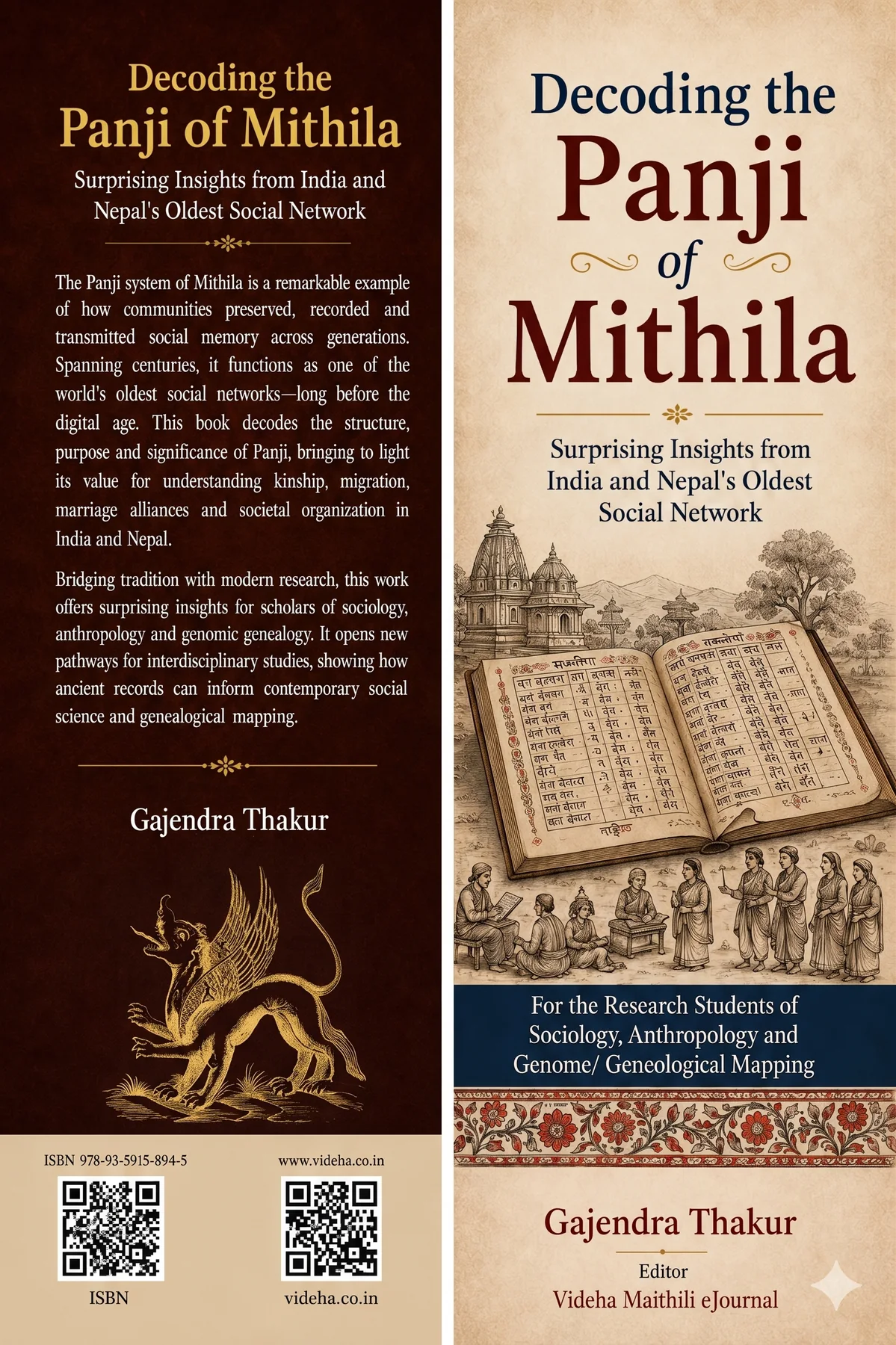
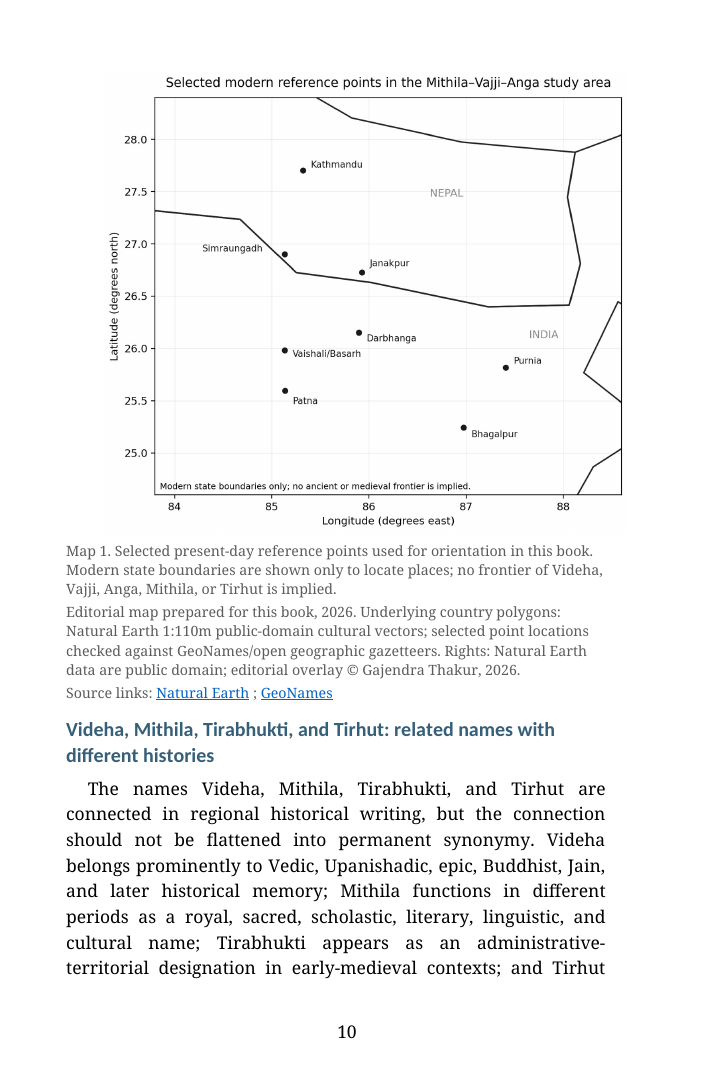
Chapter-specific source notes
- Primary chapter witness. Gajendra Thakur, Decoding the Panji of Mithila — Volume I, formal Chapter 8, PDF pp. 144-199; formal Chapter 8. The HTML transcription is generated from the commit-pinned source PDF and retains the chapter boundary recorded in this edition.
- Internal structure. The repository source-heading inventory records no separately encoded subordinate heading for this chapter.
- Digital editorial method. The page keeps the preserved source text distinct from generated navigational, concordance, visual, and provenance apparatus. The synthetic reconstruction is explanatory only and is not evidence for an individual lineage or a determination of social or marital status.