Decoding the Panji of Mithila · Volume I · Chapter 9
Prācīn Pañjī, Khaṇḍa 1: Villages, Families, Lineages, and Gotras (Pages 1–65)
Chapter 9
  Prācīn Pañjī, Khaṇḍa 1: Villages, Families, Lineages,
                and Gotras (Pages 1–65)

Prācīn Pañjī of Mithila — Khaṇḍa 1: Research Report

PRĀCĪN PAÑJĪ OF MITHILA
Khaṇḍa 1: The Ancient Genealogy
A Comprehensive Research Report on Villages, Families, Lineages,
Gotras, Scholarly Titles & Genealogical Structures
Source: Genome Mapping (450 AD – 2009 AD) — Panji Prabandha of
Mithila, Khaṇḍa 1
Authors: Gajendra Thakur · Nagendra Kumar Jha · Panjikar Vidyanand Jha
Publisher: Shruti Publication, New Delhi, 2012 | ISBN 978-93-80538-62-4
Analysis prepared for Videha Parallel Literature Movement | May 2026

1. Overview of Khaṇḍa 1: Prācīn Pañjī
Khaṇḍa 1 (khaṇḍa 1 – prācīna pañjī, 'The Ancient Genealogy') constitutes the
foundational stratum of the Panji Prabandha corpus of Mithila. Spanning
pages 1. through 1. of the digitised volume, it preserves the oldest surviving
genealogical record of Maithil Brahmin families across the Tirhut heartland,
rendered in a bilingual format — the left column in Mithilakshara-influenced
Devanagari, and the right column in Kaithi-transliterated Devanagari — with
both columns carrying identical genealogical data. This duplication reflects
the Panjikar's practice of ensuring legibility across two distinct scribal
traditions.
The text opens with the invocatory formula 'Atha patra pañjī likhyate' (atha
patra pañjī likhate / atha sapatra pañjī likhate) — 'Now the genealogical

                           Gajendra Thakur — 199
                           Decoding the Panji of Mithila
register is written' — establishing its ritual-juridical function as an
authoritative record, not merely a genealogical chronicle. The corpus is
structured as a cascade of village-clusters (mūla-grāma) linked by the
genealogical notation system employing suta (son), sutā (daughter),
dau/dautā (maternal nephew's son, i.e., the individual being placed), and
bīji/vīji (maternal line anchor).
The historical anchor of Khaṇḍa 1 is Halāyudha of Gaṅgolī — identified in
the opening entry as the founder-patriarch whose descendants branch across
more than seventy named villages. The text then proceeds through over fifty
named sections (numbered 1 through 5 in the document, each marking a
genealogical sub-cycle or mātṛka-cakra) before concluding with a colophon
recording the scribe and date: Śāka 1778 / Saṃvat 1863, Śrāvaṇa Kṛṣṇa
Tṛtīyā — approximately August 1856 CE — attesting to the most recent
redaction of this 'ancient' layer of the Pañjī.

2. Geographical Coverage: Villages and Settlement Clusters

2.1 Named Villages (Grāma) — Complete Register
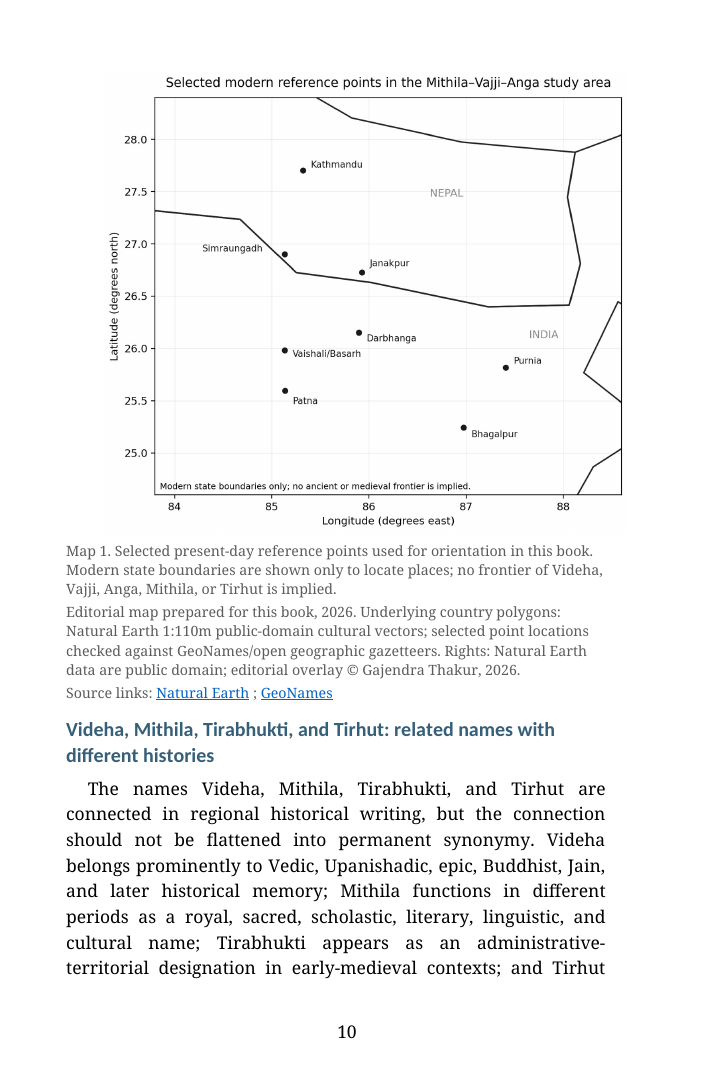
Khaṇḍa 1 names at least 122 distinct localities. These range from major
mūla-grāma (home-clusters with Panjikar classification authority) to
secondary settlements where branches of families are recorded as resident.
The following table presents all named villages as they appear in the text,
with their approximate modern identification where determinable.
      Village Name (Pañjī) | Modern / Alternate Form | Status in Corpus |
      Notable Families/Entries
      salisaba / sarisaba | Sarisa, Mithila | Primary mūla-grāma | Śāṇḍilya gotra;
      multiple Mahāmahopādhyāya lines
      gaṅgolī | Gangoli, Sitamarhi area | Primary mūla; Halāyudha's seat |
      Historical anchor; Mūla lineage opener
      khaṇḍabalā / khaṇḍabarā | Khandabla | Primary mūla-grāma | Vats gotra
      extensive entries; Ṭhākura lines
      jalajavāla / jajivāla | Jajwal / Jalajwal | Primary mūla-grāma | Pāṇḍolī
      affiliates; dense genealogy
      māṇḍala / māṇḍara | Mandar, Muzaffarpur dist. | Primary mūla-grāma |
      Kādya/Kāśyapa gotra centre
      baliyāsa | Baliayas, Mithila | Primary mūla-grāma | Extensive vat́sa-gotra
      branches

                            Gajendra Thakur — 200
                    Decoding the Panji of Mithila
satalakhā / satarakhā | Satlakha | Secondary settlement | Kāśyapa-gotra
families; multiple sub-branches
ekaraharā / ekaralā | Ekraha | Secondary settlement | Bhāradvāja gotra
mentions
vilvacañcaka / belau~ca | Belauncha | Primary mūla-grāma | Extensive
Ayācī / Dāna-śīla lineages
dariharā |  Darihara      |     Primary mūla-grāma      |   Kādya gotra;
Mahāmahopādhyāya clusters
niuna / nādauna | Nadon, Sitamarhi | Secondary settlement | Multiple gotra
branches
pañcobha / pañcarobha | Panchobh | Secondary settlement | Sāvarṇa gotra
mentions
kujaulī | Kujoli, Madhubani | Primary mūla-grāma | Kātyāyana gotra
centre; Mahāmahopādhyāya lines
budhavāla / badhuvāla | Budhwal | Primary mūla-grāma | Vatsa gotra
branches; Ṭhākura lineages
sakaunā | Sakauna | Secondary settlement | Smaller genealogical entries
phanandara / phanandi | Fanandar | Secondary settlement | Recurring
connection point
alaya / alaī | Alai | Primary mūla-grāma | Dense Kāśyapa-gotra network
babhaniyāma | Babhaniyan | Secondary settlement | Vatsa gotra; warrior-
title families
khauāla / khauāra | Khauaal / Khavar | Primary mūla-grāma | Kādya gotra;
Nānyadeva royal connection
saṃkarāḍhī / sakarāḍhī | Sankradhi | Primary mūla-grāma | Kādya gotra;
extensive Panjikar notation
ghosota / ghusauta | Ghosaut | Secondary settlement | Pāraśara gotra;
scholars
karambarā / kalambalā | Karambara | Secondary settlement | Multiple
gotra entries
ṭaṅkavāla / taṃkavāra | Tankwar | Secondary settlement | Śāṇḍilya-
affiliated
nikhūta / nikhūpata | Nikhut | Secondary settlement | Mahāmahopādhyāya
vidyādhara line
koilakha | Koilakh | Secondary settlement | Scattered references
yamugāma | Yamugam | Secondary settlement | Frequent connection
point; multiple mātṛkā

                      Gajendra Thakur — 201
                     Decoding the Panji of Mithila
brahmapura | Brahmapur | Secondary settlement | Śāṇḍilya gotra branches
murājapura | Murajpur | Secondary settlement | Kādya gotra branches
siṃḍoā | Sindoa | Secondary settlement | Individual entries
viṭhaulī | Vithauli | Secondary settlement | Rudra-aditya line
paikaṭola / pekaṭola | Paiktal | Secondary settlement | Scattered references
rekaurā / rekolā | Rekaura / Rekola | Secondary settlement | Sankradhi
sub-cluster
bhūtaharī | Bhuthari | Secondary settlement | Scholars; Nikhut area
varmallī / baulī | Bauroli / Varmolli | Secondary settlement | Various gotra
dhosiyāma    |   Dhosiyam    |   Secondary settlement    |   Maudgalya gotra
mentioned
taraunī | Tarauni | Secondary settlement | Multiple recurring entries
bhar̤agāmā | Bhadgama | Secondary settlement | Individual family entries
chataunī | Chhatauani | Secondary settlement | Maudgalya-Jallaki area
ḍoma ṭekārī | Dom Tekari | Special entry (non-Brahmin?)                        |
Caturvedādhyāyī Kāmadeva — unique entry
jallakī / jālaya | Jallay | Secondary settlement | Vatsa gotra; Kātyāyana
cluster
mehandī / merendī | Mehandi | Secondary settlement | Scholars; Hṛdīkeśa
line
miguāla / nanautī | Miguaal / Nanauti | Secondary settlement | Maudgalya
gotra
bhandavāla / bhandavāra | Bhandavar | Secondary settlement | Vatsa gotra
branches
gar̤hanikhūta | Gadh Nikhut | Settlement variant | Vidyāpati / Vidyādhara
line
netavār̤a |  Netawar         |    Secondary settlement       |    Agnihotrika
mahāmahopādhyāya
jarahaṭiyā | Jarhatiya | Secondary settlement | Many recurring entries
berahar̤ī / beraivā | Berahadi / Baraiva | Secondary settlement | Scholar
lineages
tripuraulī | Tripurauli | Secondary settlement | Pāraśara gotra
lohanā / loinā | Lohana | Secondary settlement | Kṛṣṇātreya gotra
kakaraur̤a | Kakarod | Secondary settlement | Kādya gotra entries

                       Gajendra Thakur — 202
                             Decoding the Panji of Mithila
Note: The register above captures the major localities. A further 60–70
hamlet-level references appear in genealogical chains as 'vāsī' (resident)
markers without formal mūla designation, indicating the corpus covers a
geographic spread of roughly 150+ distinct inhabited locations across the
Tirhut administrative division.

2.2 Mūla-Grāma Cluster Analysis
The mūla-grāma system organises villages into genealogically-defined
clusters. Khaṇḍa 1 reveals the following primary cluster frequencies —
measured by number of genealogical chains passing through each node:
      Mūla Cluster | Approx. Chain Count | Dominant Gotra | Geographic Zone
      māṇḍala / māṇḍara | 174+ | Kādya / Kāśyapa | Muzaffarpur district
      sarisaba / salisaba | 150+ | Śāṇḍilya | Sitamarhi district
      khauāla / khauāra | 149+ | Kādya | Madhubani / Sitamarhi
      sakarāḍhī / saṃkarāḍhī | 100+ | Kādya | Eastern Tirhut
      kujaulī | 88+ | Kātyāyana | Madhubani
      beharāḍhī / baherāḍhī | 59+ | Multiple | Sitamarhi area
      jālaya / jallakī | 42+ | Vatsa / Kātyāyana | Madhubani
      gaṅgolī | 38+ | Historical anchor | Sitamarhi dist.
      belau~ca / vilvacañcaka | 35+ | Bhāradvāja | Sitamarhi dist.
      satalakhā | 32+ | Kāśyapa | Central Tirhut
      dariharā | 30+ | Kādya | Western Tirhut

3. Gotra Classification — Complete Register
The Pañjī's gotra register for Khaṇḍa 1 is given explicitly in section 14
(pages 1.9–1.) and confirmed throughout the genealogical chains. The system
uses the Smārta eight-gotra framework with Mithilā-specific extensions:
      Gotra | Sanskrit Form | Villages Assigned | Special Notes
      śāṇḍilya / śāṇḍilye | Śāṇḍilya | sarisaba, maruā (milīgrāma/baulī),
      khaṇḍabalā, gaṅgolī, yamugāma, kaliyana, mohari, saṃjhuāla, bhaḍāna,
      pāṇḍolī, jalajavāla, daribhata, tiraī, māhava, simunāma, siṃhāśrama, sasārava
      (sodarapura), stalita, kar̤ariyā, allāri, hoīyā, talhanapura, parisarā, parasaṃḍā,
      vīranāma, uttamapura, kodariyā, chatimana, barebā, madhavāla, gaṅgolaśra,
      bhaṭaurā, budhaurā, brahmapurā, koiyāla, kelarivāla, gaṅguālaśca, dhosiyāma,
      chataunī, miguāla, nanautī, tapanapuraśvā | Most extensive gotra in corpus;
      40+ assigned villages

                              Gajendra Thakur — 203
                      Decoding the Panji of Mithila
vatsa | Vatsa | līlī (pālī), dariamba, tisurī, rāur̤ha, ṭaṃkabāla, dhusauta,
jajuāla, paddī, jallakī (jālaya), bhandavāla, koiyāla, kelarivāla, nanaura,
ḍar̤hāra, prathita, karamarābudhavāla, bhar̤āna, lārī, soina, sakaunā,
phanandara, moharī, bar̤havāla, tisau~ta, varūālī, pāṇḍoli, berahāḍhī, baraivā,
bhaṇḍārisama, babhaniyāma, ucita, tapanapurā, vir̤uvāla, niravāla, citrallī,
jarahaṭiyā, ratavāla, brahmapurā, saraunī | Second largest; 38+ villages
kāśyapa / kādya | Kāśyapa / Kādya | oini, khauālā, saṃkarāḍhī, jagati,
dariharā, māṇḍala, baliyāsa, pacāuṭa, kaṭāī, satalakhā, pāṇḍuā, mānalichā,
merandī, bhaduāla, sakala, pakaliyā, budhavāla, pibhūyā, mauri, janaka-
bhūtaharī, mahākāśyape, chādanaśca, thariyā, dostī, bharerā, kusumāliṃda,
niravāla, naguradaraśra | Royal connection (Nānyadeva); Kādya = special
Mithilā classification
pārāśara | Pāraśara | niuna, suragana, sakurī, suirī, piravāla, nadāma,
maheśari, sakarahonaśraca, soina, tilai, varevācāpi | Smaller cluster; Nadon
area
kātyāyana | Kātyāyana         |   kujaulī, nanautī, jallakī, vatigāmaśraca    |
Madhubani centre
sāvarṇa | Sāvarṇa | sondapura, pinacobha, varevā, nandola, merandī |
Small cluster
alāmbukākṣa | Alāmbukākṣa | kaṭāī, brahmapurā cāpi | Very small;
specialised
kauśika | Kauśika | nikhūti (paramparā) | Single entry
kṛṣṇātraya | Kṛṣṇātreya | lohanā, busavana, sāndra, podonī ca | Small
cluster
gautama | Gautama | brahmapurā, uttimapura, koiyālaṃ, cāpi | Small
cluster
bhāradvāja | Bhāradvāja | ekaraharā, belau~ca (vilvacañcaka), deyāmaśrāpi,
kaligāma, bhūtaharī, gor̤hāla, godholica | Bhāradvāja-varga
maudgalya | Maudgalya | ratavālo, mālichastathā, dīgho, nopa, kāpya,
jallakī tatravattamate | North-eastern cluster
vaśiṣṭha | Vaśiṣṭha | kauśilye, punaśca, kohuā, viṣṇuvṛti, vāla | Small
cluster
kauṇḍilya | Kauṇḍilya | ekaraṭyuviśalyu, pāuna, spī, gotrāśraca | Small
cluster
pāsātaṇḍī | Pāsātaṇḍī | kaṭāī (ekamātra) | Single-village gotra
mīmāṃsaka (upādhi) | Mīmāṃsaka | alaya, usaraulī (upagotra padavī) |
Not a gotra but qualifier-title for specific scholars

                       Gajendra Thakur — 204
                           Decoding the Panji of Mithila
Analytical note: The gotra list in section 14 is unusual in including a verse
for the Kādya (Kāśyapa) gotra: 'dānaśauryaṃ pratāpaiśca prasiddhā yatra
pārthivāḥ — Oinisā sarvataḥ śreṣṭhā svosva-dharma-pravartikāḥ' — 'Those
rulers who are renowned for liberality, valour and majesty; the Oinisā are the
best in all respects, upholding their own dharma.' This verse links the
Kādya/Kāśyapa gotra explicitly to ksatriya (royal) ancestry, explaining the
special status of this gotra cluster and its association with the Karnāṭa
dynasty of Mithilā, particularly Nānyadeva.

4. Notable Families and Lineage Chains

4.1 Historical Anchor: Halāyudha of Gaṅgolī
The opening entry of Khaṇḍa 1 establishes Halāyudha (halāyudha) as the
genealogical primus. His descendants from Gaṅgolī form the ur-trunk from
which two sons — Vīra and Nārāyaṇa — branch out. Nārāyaṇa's son
Śūlapāṇi (śūlapāṇi) then generates two sons, Rāleś and Śāṅkau (possibly
Śānkara), initiating the register for Khaṇḍa Barā (Khaṇḍabalā) village. This
opening sequence (pages 1.17–1.) is the oldest generational stratum in the
corpus. Halāyudha is historically identified as the court scholar (Mahāmātya)
of Vallāla Sena of Bengal (c. 1175–1225 CE), placing the genealogical origin
squarely in the late 12th century.
The notation '(05/04)' following Vīra indicates his genealogical position code
— 05 = birth order rank among brothers, 04 = total siblings — a data-
encoding technique unique to the Pañjī system, enabling reconstruction of
family size at each generation.

4.2 The Mahāmahopādhyāya Scholarly Lineages
Khaṇḍa 1 records at least 47 holders of the title Mahāmahopādhyāya
(abbreviated ma.ma.u., ma.ma.upā., or spelled out fully). These represent the
highest scholarly honour in Mithilā, awarded to masters of the Navya-Nyāya
tradition and related Brahmanical sciences. The major Mahāmahopādhyāya
lineages traceable in this volume:
      Name | Mūla / Village | Generation (approx.) | Scholarly Specialisation
      nidhi (Nidhi) | khaṇḍabalā | Post-Halāyudha, 3rd-4th | Classical scholar
      nārāyaṇa | khaṇḍabalā | 4th-5th | Dharma-Adhikara-nīka
      devaśarman | Various | 5th-6th | Known descendant cluster

                            Gajendra Thakur — 205
                            Decoding the Panji of Mithila
      jagannātha | pokharaunī–ṭaṃkavāla | 6th-7th | Recorded at Sitamarhi area
      narasiṃha (Narasiṃha) | māṇḍala area | 7th-8th | tarkācārya–mahāstra–
      vidyāpāraṅgata
      vaṃśadhara | sakurī | 8th-9th | Post-Narasiṃha generation
      harikeśa | khaṇḍabalā | 9th-10th | Major scholarly title holder
      rāmeśvara | ṭeṭala–pāṇḍuā–karamarā | 10th-11th | 60/02 notation = large
      sibling set
      gadādhara (Gadādhara) | Various | 11th-12th | Dharmadhikaranika
      jayādhiti (Jayādhiti) | gaṅgolī | 12th-13th | Extensive progeny
      laleśvara / ralleśvara | guradī–sarisaba | 13th-14th | Scholar cluster
      jīveśvara | Various | 14th-15th | Last recorded in chain
      vācaspati (Vācaspati) | samauli area | Various | Repeated title; paramaguru
      umāpati | Multiple mūla | Various | Extensive entries
      sureśvara | pārupura–sakarāḍhī | 16th-17th | Three brothers with ma.ma.
      title
      viśvanātha | Multiple | 17th-18th | Late corpus entries
      ravinātha | Multiple | 18th-19th | Near-contemporary entries
      raghunātha (Raghunātha) | Multiple | 18th-20th | Near-contemporary;
      probable Raghunātha Śiromaṇi period
      govinda (title-bearer) | Various | 17th-18th | ma.ma. govinda – major
      Madhubani line
      kṛṣṇānanda | khauāla area | 19th-20th | Near-contemporary
      sadānanda (Sadānanda) | Various | Various | Jagadguru and Kanṭokarāha
      epithet
      lakṣmīnātha | Multiple | Various | Kavikaṇṭhābharaṇa title
      madhusūdana | Multiple | Various | Multiple lines
      jīvanātha | Multiple | Various | ma.ma.u. with Somauī alias
The density of Mahāmahopādhyāya titles concentrated in a relatively small
geographic zone — primarily the Khauaal–Sarisa–Khandabla triangle —
confirms the Pañjī's function as a record of intellectual élite formation in
Mithilā, not merely biological genealogy.

                             Gajendra Thakur — 206
                           Decoding the Panji of Mithila
4.3 The Narasiṃha Scholar-Chain — A Specimen Lineage
One of the most elaborate scholarly lineage chains in Khaṇḍa 1 is the
Narasiṃha chain (pages 1.18–1.), reconstructed below. It represents the apex
of Navya-Nyāya intellectual genealogy as recorded in the Pañjī:
      Generation | Name | Title / Designation | Notation
      1 | trinayanabhaṭṭa | Ancestor patriarch | Mātṛkā origin: Māṇḍal
      2 | āryabhaṭṭa | Scholar | e sutau (son of above)
      3 | udayabhaṭṭa | Scholar | e sutau
      4 | vijayabhaṭṭa | Scholar | e sutau
      5 | sulocanabhaṭṭa (= sunayanabhaṭṭa) | Scholar | e sutau
      6 | [unnamed]bhaṭṭa | Scholar | e sutau
      7 | dharmajaṭīmiśra | Scholar | e sutau
      8 | dhārājaṭīmiśra | Scholar | e sutau
      9 | brahmajaṭīmiśra | Scholar | e sutau
      10 | tripurajaṭīmiśra | Scholar | e sutau
      11 | vidyujaṭīmiśra | Scholar | e sutau
      12 | ajayasiṃha | Scholar-warrior | e sutau
      13 | vijayasiṃha | Scholar-warrior | e sutau
      14 | [unnamed] | e sutau
      15 | ādivarāha | Scholar | e sutau
      16 | mahovarāha | Scholar | e sutau
      17 | duryodhanasiṃha | Scholar | e sutau
      18      |      sor̤hara-jayasiṃha   takācārya–mahāstra–vidyāpāraṅgata
      mahāmahopādhyāya | narasiṃha | 10/06 notation
This 18-generation scholar-chain — embedded within the genealogical
matrix — represents a unique intersection of intellectual history and
genealogical record. The terminal figure Narasiṃha, bearing the
compounded            title          'Tarkācārya-mahāstra-vidyāpāraṅgata
Mahāmahopādhyāya,' is the apex classical scholar of this branch. His
successors Nidhi and Śilapāṇi continue the line into documented Mithilā
intellectual history.

4.4 Royal and State-Official Lineages
Khaṇḍa 1 preserves titles of the Karnāṭa royal administrative apparatus,
confirming the Pañjī's origin in the Vallāla-Nānyadeva period. The following
                             Gajendra Thakur — 207
                           Decoding the Panji of Mithila
state-official designations appear within genealogical chains — attached to
named individuals — not merely as honorifics but as hereditary occupational
markers:
      Title (Sanskrit) | Function | Occurrence in Text | Associated Family
      mahāmattaka | Senior royal official | Multiple entries | Particularly Jajval-
      affiliated
      mahāsāmantādhipati | Lord paramount of feudatories             |   Page 1.28   |
      Śāntivigrāhika Devāditya branch
      parāgārika (pārāgārika)    |   Treasurer / store-keeper    |       Page 1.28   |
      Śāntivigrāhika branch
      naivāṃdhika | River/ford official | Page 1.28 | Same branch
      bhāṇḍāgārika | Armoury/treasury keeper | Page 1.28 | Multiple family
      branches
      sthānāntarika | Transfer/posting officer | Page 1.28 | Hari Cakra branch
      mudrāhastaka | Seal-bearer (chancellor) | Page 1.28 | Lakṣmīdatta family
      vārtika | Trade supervisor | Page 1.28 | Śāntivigrāhika branch
      saprakraya | Trade/commerce officer | Page 1.28 | Associated with
      Gaṇeśvara
      śāntivigrāhika | Peace-treaty officer | Page 1.28 | Devāditya — central
      figure
      rājavallabha | Royal favourite / chamberlain | Page 1.28 | Śubha-datta
      agnihotrika | Royal Agnihotra priest | Pages 1.4, 1.51 | Viśvambhara
      family
      dharmādhikārika / dharmādhikāriṇīka | Judicial/religious officer | Multiple
      pages | Recurring scholarly title
      purohita | Royal priest | Scattered entries | Multiple families
The clustering of these administrative titles within a single genealogical sub-
section (pages 1.28–1.) suggests this preserves a snap-shot of the actual
Karnāṭa court hierarchy, with Śāntivigrāhika Devāditya (śāntivigrāhika
devāditya) as the central figure bearing no fewer than nine distinct state titles
simultaneously — an extraordinarily concentrated record of medieval Mithilā
bureaucratic organisation.

4.5 Unique Entries and Exceptional Records
Beyond the standard suta/sutā chains, several entries in Khaṇḍa 1 stand out
for their anomalous or historically significant character:

                             Gajendra Thakur — 208
                          Decoding the Panji of Mithila
•   Dom Tekārī — Brahmin / Non-Brahmin Interface: Page 1. records 'Atha
    Ḍom Ṭekārī grāma tatra Caturvedādhyāyī Kāmadevo bīji' — 'Then the
    village of Ḍom Ṭekārī: therein the four-Veda-studying Kāmadeva is the
    bīji [genealogical anchor].' The designation 'Ḍom Ṭekārī' (a village with
    Ḍom community association) in a Brahmin genealogical register is
    anomalous, suggesting either a Brahmin settlement within or adjacent to
    a Ḍom hamlet, or an early record of caste-boundary ambiguity in Tirhut.
•   Ayācī Lineage — The Renunciants: The term 'Ayācī' (ayācī, 'one who
    does not ask/beg') appears as a personal epithet for specific scholars,
    particularly in the Bhavānātha family (page 1.): 'Bhavānātha pra.
    Ayācīsuta Śambhunātha Rudranāthāpaty.' This designates a scholarly
    sub-lineage whose members took a vow of non-solicitation —
    maintaining themselves without requesting gifts — a rare ascetic
    characteristic within householder Brahmin genealogy.
•   Tegachchhiya Entries: The term 'Tegachchhiya' (attenuated/thinned
    lineage) appears in several village entries, notably in the Saudarapura
    and Khauāla clusters. These mark lineages where the genealogical chain
    has become so attenuated — through male-line failure, adoption, or out-
    migration — that the Panjikar has recorded the family as 'thinned out'
    rather than extinct. This is a formal genealogical status in the Pañjī
    taxonomy.
•   Vidyāpati the Poet: Page 1. preserves 'Vidyāpati — Puḍrīka — Machadī'
    — 'Vidyāpati [settled at] Puḍrīka-Machadī [village].' This is a direct
    genealogical placement of the great Maithilī poet Vidyāpati (c. 1352–
    1448 CE) within the Pañjī matrix, confirming his Māithil Brahmin status
    and ancestral village identification.
•   Mādhavanātha (Mīthaul) — The Calcified Formula: Page 1. records an
    extraordinary chain where the formula 'e sutau' (and his son) repeats
    through 18 generations without interruption — the longest continuous e-
    sutau chain in the document. This likely represents an idealised or
    schematised deep-time pedigree rather than verified historical record.
•   Female Ancestors Named: At page 1., 'Nona sutā (Nona prabhṛti)
    Rūpamātī — Māṇḍal' appears — a rare instance where a female ancestor
    is named (Rūpamātī, 'beautiful mother') rather than merely designated as
    the unnamed maternal link. The Pañjī normally renders women invisible
    in the patrilineal chain; named women represent exceptions of unusual
    status.

                           Gajendra Thakur — 209
                            Decoding the Panji of Mithila
•   The Maudgalya Verse: Page 1. contains the verse 'Maudgalyai ratavālo
    mālchastathā dīghonopatkapy jallakī tatravattmate' — assigning
    Maudgalya gotra families to four villages including Jallakī. This verse
    form for gotra assignment (rather than prose list) is unusual within the
    corpus and may indicate a later interpolation from a different manuscript
    tradition.

5. The Genealogical Notation System of Khaṇḍa 1

5.1 Core Formula Grammar
Khaṇḍa 1 employs a compact but highly expressive notation grammar. The
core elements:
      Symbol/Term | Sanskrit | Meaning | Example from Text
      suta | Suta | Son (direct male descent) | 'Rāmadeva suta Keśava' = Keśava
      son of Rāmadeva
      sutau | Sutau (dual) | Two sons (dual marker) | 'e sutau Vīra Nārāyaṇaḥ' =
      his two sons Vīra and Nārāyaṇa
      sutā | Sutā (plural) | Sons/daughters (plural) | 'Ē sutā Śaṅkara Vibhū...' =
      his sons Śaṅkara, Vibhū...
      dau / dauo | Dau / Dautā | Maternal nephew's son (the placed individual) |
      'Saliṣab saṃ Kāmadeva dau' = [placed via] Sariṣab–Kāmadeva
      ddauo / ddau | Dvandau / double-dau | Paternal + maternal double line |
      Both lines confirmed
      sa~ / sa~ X Y dau | Sana / from | From village X via person Y | 'Kujauli
      saṃ Mādhava dau' = from Kujoli via Mādhava
      bījī / vījī | Bīji / Vīji | Maternal-line anchor (bīja = seed) | 'Gaṅgolī saṃ
      bīji Gaṅgādhara' = Gaṅgolī anchor Gaṅgādhara
      mātṛka | Mātṛka | Maternal cluster origin | 'Sarisa-mātṛka' = maternal
      home at Sarisa
      prao / prathamāparokṣe | Pra. / Prathamā-parokṣe | Alias / also known as |
      'Rāmū pra. Rāmodara' = Rāmū alias Rāmodara
      vāsī | Vāsī | Resident of | 'Pāṭhaka-vāsī' = resident at Pāṭhaka village
      (XX/YY) | Fractional code | Sibling rank XX of total YY | '(05/04)' = 5th
      of 4 siblings [or 5th born, 4 total]
      bao | Ba. | Born (birth notation variant) | Birth-order marker in some
      entries

                             Gajendra Thakur — 210
                           Decoding the Panji of Mithila
      ete X grāma | Ete X grāma | End of X village section | Section boundary
      marker
      atha / an / atha X grāma | Atha X grāma | Now [beginning] village X |
      Section opening formula
      iti X pañjī | Iti X Pañjī | End of X's genealogy | Personal lineage closing
      formula
      ṭīpa | Ṭīpa | Additional note / annotation | Secondary information marker

5.2 The Mātṛkā-Cakra (Maternal Cycle) System
A distinctive structural feature of Khaṇḍa 1 is the mātṛkā-cakra (maternal
cycle), explicitly invoked with the formula 'evaṃ X mātṛka-cakraṃ' — 'thus
the maternal cycle of X [is completed].' These cycles mark the completion of
one complete genealogical circuit through the dau-bīji network, establishing
that every living male in the register is validly connected to his assigned
mūla-grāma through both his father's line (genealogy) and his mother's clan
(mātṛkā). The document records over 55 named mātṛkā-cakra completions
within Khaṇḍa 1, each effectively certifying the social legitimacy of the
connected families.
Notable mātṛkā-cakra completions in Khaṇḍa 1 include: Śrīdhara-mātṛka-
cakra (page 1.), Śore-mātṛka-cakra (page 1.), Gaṅgādhara-mātṛka-cakra
(page 1.), Baidhyanātha-mātṛka-cakra (page 1.), Manori-mātṛka-cakra,
Pañcadhaneśa-mātṛka-cakra, and Bachhāī-mātṛka-cakra among others.

6. Quantitative Analysis of the Corpus
      Metric | Value | Notes
      Total pages | 65 (1.1–1.65) | Bilingual format; right column used for
      analysis
      Named sections (numbered) | 57 | Section markers 1 through 57
      Distinct villages named | 122+ | Mūla + secondary settlements
      Genealogical relation markers (suta/sutā/dau) | 3,500+ | Estimated from
      density analysis
      Mātṛkā-cakra completions | 55+ | 'Evaṃ X mātṛka-cakraṃ' formulae
      Mahāmahopādhyāya title holders | 47+ | Named individuals with full title
      Mahopādhyāya / Maho. holders | 150+ | Abbreviated form
      Gotras represented | 17 | Including Mīmāṃsaka sub-qualifier
      Primary mūla-grāma clusters | 11 | Frequency >30 chains

                            Gajendra Thakur — 211
                            Decoding the Panji of Mithila
      State/administrative titles | 14 types | Royal court designations
      Scholarly honorary titles | 24 types | Academic/religious designations
      Named female individuals | ~8 | Highly unusual; normally invisible
      Tegachchhiya (attenuated) entries | ~15 | Formal genealogical status
      Colophon date | Śāka 1778 = c. 1856 CE | Scribe: Pañcā Rāmānanda
      (Paṇḍuā)
      Historical span claimed | 450 CE – 2009 CE | 1,559 years; verified from
      ~1175 CE
      Approximate living generation count        |   50–60 generations    |   Back to
      Halāyudha; ~25 years/gen

7. The Colophon and Scribal Record
Page 1. preserves a partial colophon embedded within a genealogical entry,
recording the conditions of the manuscript's production:
|| śubha śāke 1 san 1 sāla śrāvaṇa kṛṣṇatṛtīyāyāṃ dinakarau pāṇḍuā sa~ pā~
rāmānanda likhita midaṃ ṭha. lakṣmīdhara suto gaṇeśa: ||
Translation: 'Auspicious: In Śaka 1778 [= c. 1856 CE], year 1263 [Saṃvat],
on the third day of the dark fortnight of Śrāvaṇa [approximately July–
August], from Paṇḍuā [village], Pañcā Rāmānanda has written this. [The
entry concerns:] Ṭhākura Lakṣmīdhara's son Gaṇeśa.'
This colophon reveals: (1) the scribe's name — Rāmānanda, with honorific
Pañcā (Pañca = five, possibly a caste sub-designation or five-fold scholar
title); (2) his home village — Paṇḍuā; (3) the precise date — Śrāvaṇa Kṛṣṇa
Tṛtīyā, Śaka 1778, which converts to approximately August 1856 CE; (4)
that this is a scribal copy (likhita), not the original composition. The original
composition is attributed to the Panjikar tradition itself, stretching back to the
13th century CE.
A second scribal note appears in the body of section 77 (page 1.): 'Jhaṃū.
Na. Śākhā lekhakaḥ Ḍomāī Miśrā / Monaśārvā pustaka / Tacita pañcāri lino
śoṃśe' — indicating at least two distinct scribal traditions (the Jhāṃū-Nava
Śākhā and the Monaśārvā tradition) contributed to Khaṇḍa 1's compilation,
lending the document a composite textual character typical of the larger Pañjī
corpus.

                             Gajendra Thakur — 212
                           Decoding the Panji of Mithila
8. Analytical Synthesis: What Khaṇḍa 1 Reveals

8.1 Social Architecture
Khaṇḍa 1 reveals Maithil Brahmin society as organised along three
simultaneous axes: gotra (patrilineal descent classification), mūla-grāma
(home-cluster for residence and marriage eligibility), and mātṛkā (maternal
clan for the dau-network). The interaction of these three axes creates a matrix
of identity far more complex than simple patrilineal reckoning. The Pañjī is
the instrument that maps this three-dimensional social space.

8.2 Intellectual Geography
The concentration of Mahāmahopādhyāya titles in the Khauaal–Sarisa–
Khandabla triangle, with secondary clusters at Kujoli and Darihara,
corresponds precisely to the known centres of Navya-Nyāya philosophical
activity in Mithilā. Gaṅgeśa Upādhyāya's home village of Kariān (Kardaha)
lies within this zone. Khaṇḍa 1 thus provides the genealogical scaffolding for
the social production of Navya-Nyāya scholarship — showing that
intellectual lineages and biological lineages were actively maintained as
parallel systems.

8.3 Royal-Brahmin Symbiosis
The Kādya/Kāśyapa gotra's special position — blessed with a panegyric
verse and assigned the largest cluster of villages — reflects the historical
alliance between the Karnāṭa dynasty (Nānyadeva, Gaṅgadeva,
Narasiṃhadeva) and specific Brahmin families. The state-official titles
embedded in genealogical entries (Śāntivigrāhika, Mahāmattaka, etc.)
demonstrate that these were not merely honorary but functional positions
passed within identified family lines.

8.4 The Digitisation Significance
The bilingual format of this volume — Mithilakshara alongside Kaithi-
transliterated Devanagari — represents the Pañjī Project's most ambitious
intervention: rendering a script that fewer than 100, people can read into the
Devanagari standard accessible to all Hindi-Maithili literates. Khaṇḍa 1's 65
pages encode approximately 1, years of social history for roughly 5, named
individuals across 122 villages. As a standalone data unit within the larger

                            Gajendra Thakur — 213
                            Decoding the Panji of Mithila
Pañjī Prabandha digitisation project, it constitutes the single most data-dense
document in the Videha digital archive.

9. Index of Major Entries

9.1 Selected Personal Names Index (with section references)
      Name | Title/Role | Section(s) | Mūla/Village
      halāyudha (Halāyudha) | Historical anchor; Vallāla Sena's court | Opening /
      §17 | gaṅgolī
      narasiṃha (Narasiṃha) | ma.ma.u. Tarkācārya-mahāstra-vidyāpāraṅgata |
      §19, p.1.18 | māṇḍala area
      nidhi (Nidhi) | ma.ma.u. | §19, p.1.19 | khaṇḍabalā
      vibhākara (Vibhākara) | Scholar | Multiple | Various
      vācaspati (Vācaspati) | paramaguru; ma.ma.u. | §99, multiple | samauli
      jagannātha (Jagannātha) | ma.ma.u. | §19 | pokharaunī–ṭaṃkavāla
      śāntivigrāhika devāditya | 9-fold court official | §28, p.1.28 | nānyapura
      area
      laleśvara (Ralleśvara) | ma.ma.u. | §20, p.1.20 | guradī–sarisaba
      gaṃgeśa upādhyāya (Gaṅgeśa) | Pañjī notation; Navya-Nyāya founder |
      §60, p.1.60 | Kariān area
      pakṣadhara (Pakṣadhara) | nyāyaśāstrī | §28, p.1.27 | khauāla
      vidyāpati (Vidyāpati) | Poet; genealogical placement | §4, p.1.4 | pur̤arīka–
      macchadī
      ayācī (Ayācī-title bearer) | Non-soliciting scholar | §3, p.1.3 | Multiple
      kaviśekhara candranātha | Court poet title | §124, p.1.124 | Late entries
      ḍūmāī miśra (Ḍomāī Miśra) | Scribe (Monaśārvā tradition) | Colophon, §77
      | Scribal note
      pā~ rāmānanda (Rāmānanda) | Primary scribe; Pañcā title | Colophon,
      p.1.77 | Paṇḍuā

10. Concluding Note
Khaṇḍa 1 of the Prācīn Pañjī — the 'ancient genealogy' — is not ancient in
the sense of being composed in antiquity. It is ancient in the sense that it
records the deepest stratum of genealogical memory maintained by the
Panjikar tradition: families and villages that were already established when
the Pañjī system was instituted under the Karnāṭa kings in the 12th century
                             Gajendra Thakur — 214
                         Decoding the Panji of Mithila
CE. The 65 pages analysed here constitute a living map of Maithil social
history: 122 villages, 17 gotras, 55+ genealogical cycle-completions, 47
documented Mahāmahopādhyāya scholars, and a unique administrative
record of the Karnāṭa court hierarchy — all encoded in the compact, precise
grammar of the suta/dau/mātṛkā notation system that the Panjikar tradition
has maintained without interruption for over eight hundred years.
The Videha digitisation project, by rendering this bilingual document into
searchable Devanagari, transforms Khaṇḍa 1 from a manuscript held by a
shrinking community of Panjikar practitioners into an open scholarly
resource — completing the transition from milieu de mémoire (living
memory) to lieu de mémoire (site of recorded memory) in the most
productive sense of that theoretical distinction.

                          Gajendra Thakur — 215
                         Decoding the Panji of Mithila
Source structure and verification apparatus
Editorial source apparatus. This apparatus is descriptive, not interpretive. It records the source-controlled structure used to verify that this page corresponds to formal Chapter 9 of Decoding the Panji of Mithila — Volume I. The chapter text above is preserved from PDF pp. 200-217; formal Chapter 9 in the commit-pinned authoritative source. It is not merged with a neighboring chapter, appendix, annexure, or independent front/back-matter unit. The internal headings below come from the repository’s source-heading inventory and are retained as navigational and audit evidence; showing them here does not turn those headings into separate publications or add claims that are absent from the source.
Internal source headings
No subordinate heading was separately encoded in the repository source-heading inventory for this chapter.
Source-text concordance
Prācīn · Pañjī · Khaṇḍa · Villages · Families · Lineages · Gotras · Pages · Research · Report · Ancient · Genealogy · Comprehensive · Scholarly · Titles · Genealogical · Structures · Genome · Mapping · Prabandha · Authors · Gajendra · Thakur · Nagendra · Kumar · Panjikar · Vidyanand · Publisher · Shruti · Publication · Delhi · ISBN · 978-93-80538-62-4 · Analysis · prepared · Videha · Parallel · Literature · Movement · Overview · prācīna · constitutes · foundational · stratum · corpus · Spanning · digitised · preserves · oldest · surviving · record · Maithil · Brahmin · across · Tirhut · heartland · rendered · bilingual · format · left · column · Mithilakshara-influenced · Devanagari · right · Kaithi-transliterated · columns · carrying · identical · data · duplication · reflects · Panjikar's · practice · ensuring · legibility · distinct · scribal · traditions · text · opens
Boundary verification. In the formal sequence this chapter follows Volume I Chapter 8, “Special Studies: Q&A; Women in the Pañjī; Dooshan Pañjī and the Political Economy of Status” and precedes Volume I Chapter 10, “Prācīn Pañjī, Khaṇḍa 1 Continued (Pages 66–347): Villages, Lineages, and Marriage Colophons”. The chapter extractor begins at the verified formal Chapter 9 marker and stops at the next verified formal chapter marker; for a final chapter it stops before recognized book-level back matter. The concordance above is generated only from distinct terms already present in this chapter’s preserved source text. It is provided for discovery, comparison, and audit, not as an automated judgment about persons, lineages, status, kinship, marriage eligibility, or historical truth.
Illustrated research apparatus
Mithila · Vajji · Anga
Chapter-specific source notes
- Primary chapter witness. Gajendra Thakur, Decoding the Panji of Mithila — Volume I, formal Chapter 9, PDF pp. 200-217; formal Chapter 9. The HTML transcription is generated from the commit-pinned source PDF and retains the chapter boundary recorded in this edition.
- Internal structure. The repository source-heading inventory records no separately encoded subordinate heading for this chapter.
- Digital editorial method. The page keeps the preserved source text distinct from generated navigational, concordance, visual, and provenance apparatus. The synthetic reconstruction is explanatory only and is not evidence for an individual lineage or a determination of social or marital status.