Decoding the Panji of Mithila · Volume I · Chapter 10
Prācīn Pañjī, Khaṇḍa 1 Continued (Pages 66–347): Villages, Lineages, and Marriage Colophons
Chapter 10
    Prācīn Pañjī, Khaṇḍa 1 Continued (Pages 66–347):
       Villages, Lineages, and Marriage Colophons

Panji Prabandha of Mithila — Khaṇḍa 1 Continued (pp. 66–347)

PANJI PRABANDHA OF MITHILA
Khaṇḍa 1 Continued (Pages 66–347)
Sections §58–§127 and Beyond: Villages, Families, Lineages,
Unique Titles, Royal Records & Marriage Colophons
Source: Genome Mapping (450 AD – 2009 AD) — Panji Prabandha of
Mithila
Authors: Gajendra Thakur · Nagendra Kumar Jha · Panjikar Vidyanand Jha
Shruti Publication, New Delhi, 2012 | ISBN 978-93-80538-62-4
PDF source: Final_66-347.pdf | 110 pages | Sections §58–§127+
Research report prepared for Videha Parallel Literature Movement | May

1. Overview and Structure of Pages 66–347
Unlike the opening Khaṇḍa 1 (pages 1–65) which established the
foundational genealogical vocabulary, this continuation section is
characterised by far greater density and complexity: longer individual
genealogical chains, more compound scholarly titles, a marked expansion
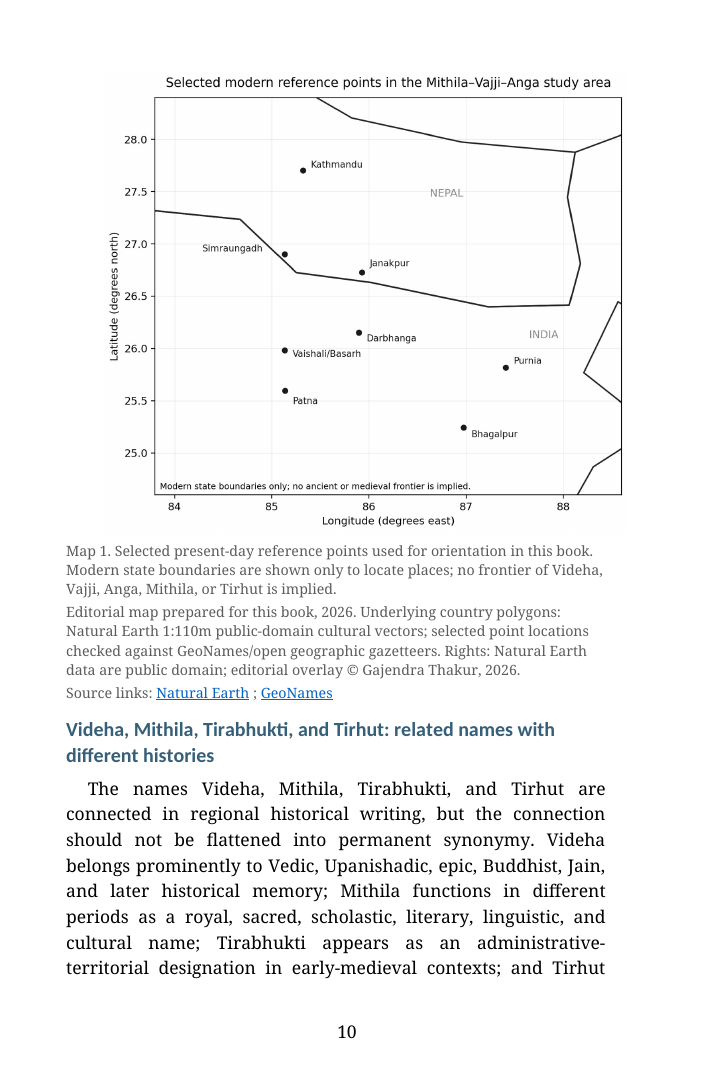
into Nepal-adjacent geography (particularly around the Simaravāḍa–Rataulī
corridor), and crucially, the insertion of dated marriage colophons — real-
time records embedded within the ancient genealogical frame — that bridge
the 12th century Pañjī tradition with entries dated 01..2003, 09..2003,
15..2003, 20..2004, 21..2004, and others. This fusion of deep time and
contemporary event is unique in South Asian manuscript traditions.
                          Gajendra Thakur — 216
                           Decoding the Panji of Mithila
The document's section sequence is non-consecutive as numbered (§58, §61,
§64, §65, §66, §68, §71, §79, §80, §88, §89, §97, §98, §99, §101, §109,
§115, §117, §118, §121, §124, §178), indicating that the full corpus section-
count far exceeds what appears in this partial volume, with intervening
sections presumably in other Khaṇḍa files.

2. Geographical Coverage: New Villages and Localities

2.1 Dominant New Village Cluster: Karmaharā
The single most significant geographical finding in pages 66–347 is the
emergence of Karmaharā (karamahā) as the dominant reference village —
appearing 292 times, surpassing even Māṇḍar's 174+ references in Khaṇḍa
1's first 65 pages. Karmaharā functions as the primary maternal-line anchor
for dozens of genealogical cycles in this section. Its density confirms that the
Pañjī's geographical emphasis shifts eastward as the corpus progresses, with
Karmaharā (identified with present-day Karmahe, Madhubani district)
emerging as the central node of a dense web of scholarly and landowning
families in the Madhubani–Sitamarhi corridor.

2.2 Complete Register of New Villages (Not in Pages 1–65)
The following localities appear for the first time in pages 66–347, either as
mūla-grāma anchors or as documented residential settlements. Frequencies
marked as 'high' denote 10+ appearances; 'medium' 5–9; 'low' 1–4.
      Village Name (Pañjī) | Modern Identification | Frequency | Significance
      rataulī / Rataulī | Ratauli, near Darihara, Sitamarhi | High (25+) | Major
      new mūla; forms Rataulī–Darihara sub-cluster; Nepal-border corridor
      mahanaurā / Mahnaura | Mahnaura, Madhubani | High (11+) | Khauāl sub-
      node; appears in §184 and §§109+ clusters
      naḍuāra / Naḍuār | Naduwar, Madhubani | Medium (4+) | Linked to
      Karmaharā cluster; Kṛṣṇa-lineage families
      simaravāḍa / Simaravāḍ | Simraon area, near Janakpur (Nepal) | Medium
      (5+) | Nepal-border corridor; Ṭhākura lineage anchor
      khāṃguḍa / Khāṅguḍ | Khangud, Sitamarhi area | Medium (14+) | Sarisa
      sub-cluster; appears with 'Vaidika' prefix families
      taraunī / Taraunī | Tarauni, Madhubani | High (15+) | New mūla node;
      recurring Karmaharā connection

                            Gajendra Thakur — 217
                     Decoding the Panji of Mithila
ḍūmarā / Ḍūmrā | Dumra, Sitamarhi | High (13+) | Major new settlement;
Budhavāla sub-cluster
gaṃgorā / Gaṅgorā | Gangora, near Budhwal | Medium (7+) | Budhavāla-
Gaṅgorā pairing; Śāṇḍilya gotra branch
bhauālavāsī / Bhauālavāsī | Bhauāl = Kathmandu Valley, Nepal | Low (1) |
Extraordinary Nepal diaspora reference; p.1.93 §83
rakhavār̤ī / Rakhavāḍī | Rakhwadi, Sitamarhi | Low (1) | Appears in §58
early entries
mahiṣī / Mahiṣī | Mahishi, Saharsa district | Medium (6+) | Eastern Mithilā
reference; unusual geographic reach
kaṭaiyā / Kaṭaiyā | Kataia, Madhubani | Medium (4+) | New satellite;
appears with Māṇḍar connection
raiyāma / Raiyām | Raiyam, Sitamarhi area | Medium (7+) | New
settlement; Sodarapura linkage
hasaulī / Hasaulī | Hasauli, Sitamarhi | Medium (5+) | Darihara-adjacent;
Gaṅgādhara family centre
sudaī / Sudaī | Sudai village, Madhubani | Low (1) | §82 reference;
Vāchaspati family
ghaula / Ghaul | Ghaul, Sitamarhi area | Low (1) | §83 Vāchaspati family
entry
akusī / Akusī | Akusi, Madhubani | Low (3) | Ṭakabāla sub-cluster
pharaharā / Phararā | Faraha, Darbhanga area | Medium (5+) | Budhavāla
sub-cluster; §§84+
rūcauli / Rūcaulī | Ruchauli, Sitamarhi | Medium (5+) | Karmaharā sub-
node; §84 Viśvanātha line
kanholī / Kanhaulī | Kanhauli, Madhubani | Medium (5+) | Sodarapura
pairing; Rāmacandra family
viśāḍhī / Viśāḍhī | Vishadhi, Madhubani | Low (3) | Laxmīdhara mātṛka-
cakra entry
bhakharaulī / Bhakhrauḷī | Bhakharauli, Madhubani | Low (3) | Kujaulī
sub-cluster
deśuāla / Deśuāl | Deshual | Low (1) | §85 Deśuāla reference with Vaidika
prefix
nāhasa / Nāhas | Nahas village | Medium (4+) | Khauāl sub-cluster;
Gaṇeśa lineage
haraḍī / Haraḍī | Haradi, Sakradhi area | Medium (4+) | §§85+ Kṛṣṇasiṃha
families

                      Gajendra Thakur — 218
                     Decoding the Panji of Mithila
jamadaulī / Jamadaulī | Jamdauli | Medium (4+) | §124 closing section;
Tejapati entry
maṃgaraunā / Maṅgaurnā | Mangaurna, Madhubani | Low (2) | Hariakha
sub-cluster; Jīvanātha line
piparā / Pipara | Pipra village | Low (2) | Scattered; §§88+
maliṃgiyā / Maliṅgiyā | Malingiya | Low (1) | §83 with Nepal connection
(Maliṅgiyā Kujaulī)
bhākurī / Bhākurī | Bhakuri | Low (1) | §86 Cāṇa sub-lineage
gidhavāla / Gidhavāl | Gidhwal | Low (1) | §87 Harikar family
kaṭamā / Kaṭmā | Katma | Low (2) | Hariakha pairing; §§79+
ujāna / Ujāna | Ujan | Low (1) | §87 Dinakar sub-entry
jagaura / Jagaur | Jagaur, Madhubani | Medium (5+) | Māṇḍar sub-cluster;
appearing from §85+
jhaṃjhārapura / Jhañjhārapur | Jhanjharpur, Madhubani (town) | Low (2) |
§109 Dāmodara entry
talhanapura / Talhanpur | Talhanpur | Low (3) | §61 Keśava sub-chain
sulhanī / Sulhanī | Sulhani, Sitamarhi area | Low (2) | §§84, 109 Cāṇa
family entry
murānapura / Murānpur | Muranapur | Low (1) | §87 Śrīhari sub-cluster
ogahī / Oghī | Ogahi | Low (2) | §87 Śubhaṃkara family; Baliyas-adjacent
lohanā / Lohana | Lohana, Saharsa area | Medium (6+) | §§87, 107+
Kṛṣṇātreya/Maudgalya gotra
paranāma / Paraṇām | Parnam | Low (1) | §119 late entry
kohuā / Kohuā | Kohua | Low (1) | Late section reference
behaṭa / Behaṭ | Behat | Medium (4+) | Karmaharā sub-zone; recurring
§§84+
āhila / Āhila | Ahil | Low (2) | Ravaualā sub-cluster
nāhasavāsī / Nāhas-vāsī | Nahas residents | Low (1) | §84 Bhādagāma-
Jajivāla linkage
patrapuraulī / Patrapurauḷī | Patrapurauli | Low (2) | §85 Viśvanātha sub-
chain
brahmapura ravauāla / Brahmapur-Ravauāl | Brahmapur near Ravauala |
Low (2) | §83 Vanamālī sub-entry
siṃhaula / Siṃhaul | Sinhoul | Low (3) | §§88+ Māṇḍar-adjacent
puḍe narauna / Puḍe Naraun | Pude Naraun | Low (4+) | Distinguishes
from regular Naraun entries

                      Gajendra Thakur — 219
                          Decoding the Panji of Mithila
      dolamānapura / Dolmānpur | Dolmanpur | Low (1) | §§107 Mahānū sub-
      chain
      vadanāma / Vadanāma | Vadanam (variant) | Low (1) | Late section
      parayāma / Parayāma | Parayam | Medium (4+) | §§107, 126 Budhavāla
      sub-cluster
      kusaulī / Kusaulī | Kusauli | Low (2) | §§85 Ananta sub-chain
      lāhanavāsī / Lāhana-vāsī | Lahana residents | Low (1) | §83 Ajamuna entry
      tetarihāra / Teṭarihār | Tetarihar, Madhubani | Low (2) | Sodarapura sub-
      cluster

2.3 The Rataulī–Darihara Sub-Cluster
A significant new geographic sub-system emerges in pages 66–347 around
the Rataulī–Darihara corridor, distinct from the Darihara references in
Khaṇḍa 1's first 65 pages. Rataulī in this section appears specifically as
'Rataulī-Darihara' (rataulī dariharā sa~), marking it as a jointly-identified
paired node — suggesting a hamlet administratively or genealogically
attached to Darihara proper but distinct enough to require separate
identification. The Rataulī families connect most frequently through
Simaravāḍa (near Janakpur, Nepal), indicating a genealogical corridor that
straddles the present-day India–Nepal border.
The Bhauālavāsī entry (p.., §83) is especially remarkable: 'vāvūsutā
Bhauālavāsī Amarāvatī-darihara-sāṃ Rāṃka dau' — 'Bābu's sons include
[one who is] a Bhauāla-resident [Kathmandu Valley], [others at] Amarāvatī
[and] Darihara via Rāṃka.' This is a direct record of Mithilā Brahmin
diaspora reaching the Kathmandu Valley, linking Bhauāl (modern Nepal's
former kingdom around Kathmandu) with Darihara in a single genealogical
entry.

3. Families and Lineage Chains: What Is Unique

3.1 The Avalaṃba-Sarasvatī Title: A Unique Scholarly Honorific
Page 1., section §79, preserves one of the most unusual compound titles in
the entire Pañjī corpus: 'Mahāmahopādhyāya Hariśvara suto Avalaṃba-
Sarasvatī-dāṅkit Mahāmahopādhyāya Bateśa Puruṣottamo' — 'The
Mahāmahopādhyāya Hariśvara's son [is] the Avalaṃba-Sarasvatī-marked
[i.e. specially designated] Mahāmahopādhyāya Bateśa Puruṣottama.' The
compound 'Avalaṃba-Sarasvatī-dāṅkit' means literally 'bearing the
                           Gajendra Thakur — 220
                           Decoding the Panji of Mithila
stamp/seal of the Sustaining Sarasvatī' — an honorific implying that this
scholar was recognized as a support-pillar (avalaṃba = prop, support) of the
goddess of learning. This title is found nowhere else in Khaṇḍa 1 and
represents a singular academic designation of the highest order.
The Bateśa Puruṣottama line then produces his son Sarasvatī Rāma — whose
very personal name echoes his father's title — who continues to Karmaharā
(the dominant village of this section), confirming that the most rarified
scholarly honors cluster around the Karmaharā–Darihara–Khauāla triangle.

3.2 The Mahārāja Mādhava Siṃha Royal Entry
Pages 1. and 1.127–1. preserve one of the most extraordinary records in the
entire Pañjī corpus: the direct genealogical placement of the Mithilā royal
family of Mādhavasiṃha within the Brahmin genealogical register. This is
not merely honorific — it follows the full suta/dau notation grammar and
places Mādhavasiṃha as a factual dau (maternal nephew's descendant)
within a specified lineage chain.
      Person | Title/Designation | Page/Section | Genealogical Note
      mahārāja mādhava siṃha | Mahārāja; 'Vivdhityādi' (various titles) | p.1.119,
      §109; p.1.127 | Sons recorded in full; Khaṇḍabalā as dau-source
      bābū prajāpati siṃha | Bābu Prajāpatisingh | p.1.127, §115 | Son #1 of
      Mādhavasiṃha; (194/09 notation)
      bābū dharmapati siṃha | Bābu Dharmapatisingh | p.1.127, §115 | Son #2;
      (279/08 notation)
      bābū puṇyapati siṃha | Mithilārāja-Kulabhūṣaṇa Bābu Puṇyapatisingh |
      p.1.127, §115 | Son #3; full royal epithet preserved
      bābū ḍolapati siṃha | Bābu Ḍolapatisingh | p.1.127, §115 | Son #4;
      (184/02 notation)
      bābū dhanapati siṃha | Bābu Ravatyunāmaka Dhanapatisingh | p.1.127,
      §115 | Son #5; alias 'Ravagat' noted
      mahārāja suṃdara | Mithilābhūṣaṇa Mahārāja Sundar | p.1.127, §116 |
      Related royal; sons: Mithilānātha, Mithileśvara Mahārāja Narapati
      mahārāja nara pati | Vivdhityādi Mahārāja; 'Mithileśvara' | p.1.127, §116 |
      Full title-cluster preserved; sons include Rāghava Siṃha, Śivanandana Siṃha,
      Raghunanana Siṃha, Mahogra-Pratā-Dharmakarmāvatāra-Sarvsvadātā Bābu
      Nandanandana Siṃha, Ṭh. Thākura Siṃha alias Rudra Pati Siṃha
      rājā bhagīratha | Rāja Bhagīratha | p.1.119 | Father's chain: Mahārāja
      Samara Siṃha → Rāja Bhagīratha → Rāya Raghu Deva

                            Gajendra Thakur — 221
                           Decoding the Panji of Mithila
      mahārāja samara siṃha | Mahārāja Samara Siṃha | p.1.121 | Linked to
      'Samasta Prakriyā Mahārāja Kṛṣṇadeva-Rūdranārāyaṇa-dāṅkit-Haridevo'
      mahārāja kṛṣṇadeva rūdranārāyaṇa | Title: Samasta-Prakriyā-Mahārāja |
      p.1.121 | Compound ruler-title; Rūdranārāyaṇa as regnal name
      mahārāja lakṣmīnārāyaṇa | Mahārāja Lakṣmīnārāyaṇa | p.1.135 | Late
      entry in §115 continuation; sons: Rūdranārāyaṇa, Brajanārāyaṇa,
      Naranārāyaṇa, Ainapal Nārāyaṇa, Tegabahādura, Miharūpanātha, Bābu
      Ujvala Govinda
      mahārāja phatehanārāyaṇa | Mahārāja Fateh Nārāyaṇa | p.1.135 | Son of
      Rūdranārāyaṇa
      kalikarṇāvatāra rājā līlānanda siṃha | Kalikarnāvatāra Rāja Līlānanda Siṃha
      | p.1.171+ | Highest royal-philosophical title; 'Epoch-Ear-Incarnate'
      mahārāja vedānanda siṃha | Mahārāja Vedānanda Siṃha | p.1.171 | Late
      chapter; father of Kalikarnāvatāra
The compound title 'Samasta-Prakriyā-Virājamān Mahārājādhirāja Mādhava
Siṃha' that appears in the full title entry (p..) translates as 'He who is
resplendent with all royal dignities, Great King of Kings Mādhava Siṃha' —
a claim to supremacy over all Mithilā. The Pañjī's recording of this title
within a Brahmin genealogical register constitutes a unique legitimation
document: by placing the royal family within the brahminical dau-network,
the Panjikar was asserting the Mithilārāja's ritual integration with the highest
scholarly families.

3.3 New Scholarly Title Compounds
Pages 66–347 introduce several scholarly title compounds not found in the
first 65 pages. These represent the full spectrum of academic recognition in
late-medieval Mithilā:
      Title Compound | Transliteration | Page/Section | Meaning/Significance
      avalamba sarasvatī dāṅkita | Avalaṃba-Sarasvatī-dāṅkit | p.1.89, §79 |
      Seal of the Sustaining Sarasvatī — unique highest honor
      jyotirvimaya / jyotiprvida | Jyotirvimaya / Jyotiprvid | p.1.73, §37 onwards
      | Astrological scholar-expert; calendar-science designation
      kavindra dāṅkita | Kavindra-dāṅkit | p.1.131, §108 | Poet-laureate seal;
      royal designation of chief poet
      llavakāra dāṅkita | Llavakāra-dāṅkit | p.1.93 §83 | Administrative-scholar
      seal; llava = administrative division officer

                            Gajendra Thakur — 222
                           Decoding the Panji of Mithila
      bupi śrutidhara dāṅkita | Bupi-Śrutīdhara-dāṅkit | p.1.91 | Dual title:
      intelligence + oral-tradition bearer
      sarvajña garība / sarvajñāna garība | Sarvajña Garība | p.1.125, §109 | 'The
      All-knowing Pauper' — remarkable paradoxical epithet
      mahottara pratāpurūṣottama | Mahottar Pratāpuruṣottama | p.1.121, §109 |
      Compound royal-scholarly: 'Most eminent man of highest glory'
      dharmāṅtradā / dhammāghakaraṇīka | Dharmāṅtrādā / Dharmādhikaraṇīka |
      p.1.73, multiple | Judicial-religious officer designation
      cāturmāsika manasabadāra hajārī | Cāturmāsika Mansabdār Hazārī |
      p.1.171 §127 | Four-month military commander of 1000 — Mughal-era title
      integrated into Pañjī
      paurāṇika | Paurāṇika | Multiple | Specialist in the Purāṇas — distinct
      from Naiyāyika lineages
      vaiyākaraṇa | Vaiyākaraṇa | Multiple pp.             |   Sanskrit grammarian
      designation — appears as personal title
      vaidika | Vaidika | Multiple pp. | Vedic-ritual specialist — appears as
      prefix to personal names
      maho. mādhyāya / ma.ma.u. | Mahopādhyāya / M.M.U. | Throughout |
      Standard abbreviated forms; 34+ instances in this section alone
      agnihotrika ma.ma.u. | Agnihotrika M.M.U. | p.1.171 §127 | Agnihotra-
      performing Mahāmahopādhyāya — rare dual designation
      aniruddha / anirūi | Aniruddha — as a personal m.m. title | Multiple |
      Name used as quasi-title for a specific scholar in Sodarapura line

The Sarvajña Garība Entry
The epithet 'Sarvajña Garība' — literally 'All-Knowing Pauper' — is one of
the most striking personal designations in the corpus. Appearing at p.. as a
dau-source ('Pāli saṃ Sarvajñāna Garība dau'), the name encodes a paradox
familiar in Indian philosophical traditions: the scholar who possesses
omniscient knowledge but renounces all material wealth. The name itself has
been absorbed into the genealogical system as a family identifier, suggesting
that an ancestor's spiritual achievement was so distinctive that it became the
family's genealogical calling-card for subsequent generations.

3.4 The Cāturmāsika Mansabdār Hazārī Entry
Page 1., section §127, preserves a remarkable title-cluster that signals the
encounter between the Pañjī's Brahmin genealogical system and the Mughal

                            Gajendra Thakur — 223
                          Decoding the Panji of Mithila
administrative apparatus: 'Mahādāra Devānanda suta Cāturmāsika-
Mansabdār-Hazārī Rāmānanda Caudharī Māniknandana' — 'Generous
Devānanda's son: the Four-Month Commander-of-a-Thousand Rāmānanda
Caudhary Māniknandana.' The 'Mansabdār Hazārī' (commander of 1000
troops in the Mughal mansab system) is integrated seamlessly into the Pañjī's
suta-chain notation, demonstrating that by the time this entry was recorded,
Mughal administrative titles had been absorbed into Mithilā's genealogical
legitimation apparatus. The addition of 'Cāturmāsika' (four-monthly, possibly
indicating seasonal administrative appointment or ceremonial frequency)
further refines the entry's administrative-historical value.
This family's genealogy continues to produce 'Rāja Dulārasiṃha Bābu
Ekalāla Siṃha alias Tejānanda Siṃha' and eventually 'Mahārāja Vedānanda
Siṃha' whose son 'Kalikarnāvatāra Rāja Līlānanda Siṃha Bahādur' receives
the Khalsa-era Rajput title 'Bahādur' — tracing the family's trajectory from
Mughal mansabdār through late-Mughal to Rajput-styled local kingship
within a single genealogical chain spanning perhaps six to eight generations.

3.5 The Mādhavasiṃha Royal Sub-Cluster: Sons Recorded
One of the most important genealogical records in pages 66–347 is the
complete listing of Mādhavasiṃha's sons (p.., §115–116). Section §115
records: 'Vivdhityādi Mahārāja Mādhavasiṃha suto Bābu Ramāpati Siṃha'
followed by a complete list of sons with their sibling-rank notation codes,
unusual for royal entries which normally appear only in summary form in the
Pañjī.
Section §116 then records a further royal lineage culminating with
'Mithilābhūṣaṇa Mahārāja Sundar suto Mithilānātha Mithileśvara Mahārāja
Narapati' — placing both the 'Sundar' branch and the 'Mādhavasiṃha' branch
as distinct sons of a common ancestor in the Khaṇḍabalā dau-network. The
Mithilā royal family is thus placed within the Brahmin Pañjī as legitimate
members of the dau-bīji network, their kingship validated by genealogical
integration with the very families that provided them religious legitimacy.

3.6 The Bhramar Mātṛka-Cakra and Its Scholar Chain
Page 1., §36 records the completion of the 'Bhramar mātṛka-cakra' — a cycle
named after the ancestor Bhramar. What makes this cycle unique is that it is
explicitly linked to the Belauñca village entry for a Mahāmahopādhyāya line,
and the Bhramar figure is identified as having been the ancestor of the

                           Gajendra Thakur — 224
                           Decoding the Panji of Mithila
'Jyotirvimay Bāchā' who bears the rare astrological-scholar title. This creates
a documented three-generation chain linking a named ancestor (Bhramar) to
a named scholarly title (Jyotirvimay) to a named village (Belauñca) — the
kind of precision that makes the Pañjī an unparalleled historical source.

4. Mātṛkā-Cakra Completions in Pages 66–347
The mātṛkā-cakra ('maternal cycle completion') formula 'evaṃ X mātṛka-
cakraṃ' appears at least 16 times in the extracted right-column text, marking
the completion of genealogical circuits. Each completion certifies the social
legitimacy of the connected family network. The following mātṛkā-cakras are
explicitly completed in pages 66–347 (section §§58–127+):
      Mātṛkā-Cakra Name | Anchor Figure | Page Reference | Connected
      Villages
      kamalā pati mātṛka cakra | Kamalāpati | p.1.68 (§58) | Darihara, Māṇḍar,
      Belauñca
      gaṃga mātṛka cakra | Gaṃga / Miśra Gaṃga | p.1.68 (§58) | Sakhudī-
      Sakrāḍhī, Sodarapura, Karmaharā
      mahinātha mātṛka cakra | Miśra Mahināthu | p.1.69 (§58) | Darihara,
      Karmaharā, Māṇḍar
      kulapati mātṛka cakra | Kulapati | p.1.69 (§58) | Alaya, Māṇḍar, Belauñca,
      Darihara
      bhramara mātṛka cakra | Bhumar / Bhramar | p.1.73 (§36) | Belauñca,
      Sodarapura, Māṇḍar
      harideva mātṛka cakra | Harideva | p.1.70 (§61) | Ghusauta, Sodarapura,
      Pāli
      mahī mātṛka cakra | Mahī | p.1.69 (§59) | Joṃkī, Sarisa, Jajivāla
      vaṃśī mātṛka cakra | Vaṃśī | p.1.69 | Oinisā, Pāli, Sodarapura
      vīra mātṛka cakra | Vīra | p.1.69 (§61) | Sodarapura, Pāli, Māṇḍar
      dhīra mātṛka cakra | Dhīra | p.1.91 (§87) | Sarisa, Karmaharā, Darihara,
      Taisauṃta
      raghunātha mātṛka cakra | Miśra Raghunātha | p.1.73 (§36–37) | Darihara,
      Belauñca, Māṇḍar, Sodarapura
      lakṣmīdhara mātṛka cakra | Lakṣmīdhara | p.1.91 (§87) | Karmaharā,
      Simrī, Viśāḍhī, Lohana
      meheśa mātṛka cakra     |   Mahesh (Mahiṣī)      |   p.1.89 (§77)   |   Mahiṣī,
      Sodarapura, Māṇḍar

                            Gajendra Thakur — 225
                          Decoding the Panji of Mithila
      rāma mātṛka cakra    |    Rāma     |   p.1.89 (§80)   |   Darihara, Karmaharā,
      Sodarapura, Pāli
      chabanū mātṛka cakra | Chhabanu / Chhabanū | p.1.91 (§81) | Darihara,
      Sodarapura, Khauāla
      līlānātha mātṛka cakra     |   Līlānātha   |   p.1.175 (late)   |   Khaṇḍabalā,
      Sodarapura, Māṇḍar
      matinātha mātṛka cakra | Matinātha | p.1.89 (§79) | Sodarapura, Sarisa,
      Māṇḍar, Karmaharā
      bhikhiyā mātṛka cakra | Bhikhiyā / Bhirivayā | p.1.95 (§85) | Kujaulī,
      Sihaul, Māṇḍar

5. Marriage Colophons: Dated Contemporary Records
One of the most remarkable features of pages 66–347 — unique in the Pañjī
corpus as far as can be determined — is the insertion of dated marriage
records (vivāha-prakaraṇa) within the genealogical chains. These colophons,
embedded mid-text, record specific marriages with calendrical dates
expressed in both traditional Pañcāṅga notation (tithi, vara, pakṣa, māsa) and
Common Era dates (sometimes with day names in English or numerical
DD.MM.YYYY format). They transform a historical manuscript into a living
record that bridges the 12th century origin of the Pañjī tradition to the year
2004 CE.
      Groom Name | Traditional Date | CE Date | Page | Notes
      ṭha. candramaṇi / Ṭh. Candramaṇi | Mārgaśīrṣa Śukla Pūrṇimā, Kuja
      (Tuesday) | 09.12.2003 | p.1.119, §109 | First dated colophon; Vighnadeśa
      alias Tejamani
      ṭha. vighnadeśa / Ṭh. Vighnadeśa | Mārgaśīrṣa Śukla Pūrṇimā, Kuja |
      09.12.2003 | p.1.119 | Same auspicious day; alias Tejamani
      ṭha. kamalamaṇi / Ṭh. Kamalamani | Mārgaśīrṣa Śukla Aṣṭamī, Candra
      (Monday) | 01.12.2003 | p.1.119 | 'Monday Morning' specified
      ṭha. kulamaṇi / Ṭh. Kulamani | Mārgaśīrṣa Śukla Dvādaśī, Bhṛgu (Friday) |
      — | p.1.119 | Kulmani marriage colophon
      ṭha. rameśa / Ṭh. Rameśa | Pauṣa Kṛṣṇa Pañcamī, Bhṛgu (Friday) | — |
      p.1.119, §109 | Short notation
      ṭha. bhaveśa / Ṭh. Bhaveśa | — | 15.12.2003 | p.1.119 | Date only in CE
      format
      ṭha. rādhāramaṇa / Ṭh. Rādhāramaṇa | — | 11, 22.12.03 | p.1.119 | Two-
      step ceremony noted
                               Gajendra Thakur — 226
                           Decoding the Panji of Mithila
      ṭha. rāmacandra (prathama) / Ṭh. Rāmacandra (1st) | — | 20.01.2004
      Tuesday | p.1.119 | Day name specified in English
      ṭha. rāmacandra (dvitīya) / Ṭh. Rāmacandra (2nd) | — | 31.01.2004 |
      p.1.119 | Second marriage recorded
      ṭha. bāsudeva / Ṭh. Vāsudeva | — | 21.12.2004 | p.1.119 | alias Tulamani
      indramaṇi (prathama) / Indramaṇi (1st) | — | — | p.1.137 | First marriage
      record
      indramaṇi (dvitīya) / Indramaṇi (2nd) | — | — | p.1.137 | Second
      marriage; 'Dvitīya Samāpta'
      ṭha. dharmapati / Ṭh. Dharmapati | — | — | p.1.134 | Colophon-close
      formula
      ṭha. mahidhara (dvitīya) / Ṭh. Mahidhara (2nd) | — | — | p.1.134 |
      Second marriage noted
      ṭha. ghuradhura (prathama/dvitīya) | — | — | p.1.173 | Two marriages
      recorded; closing §
      mahāmahopādhyāya bhagīratha | Māgha Śukla Trayodaśī, Kuja |
      03.02.2004 | p.1.171 | Scholarly colophon closing; 'Medhā Santati Samāptā'
      ṭha. devīdatta / Ṭh. Devīdatta | — | — | p.1.171 | colophon entry
      ṭha. raghuvara (prathama) / Ṭh. Raghuvar (1st) | — | — | p.1.173 |
      Marriage colophon
      ṭha. kalānātha / Ṭh. Kalānātha | — | — | p.1.134 | colophon entry
      donī pra. dhanānanda (prathama/dvitīya/tṛtīya) | — | — | p.1.134 | Three
      marriages for same person recorded
      ṭha. caturbhuja santati | — | — | p.1.171 | 'Santati Samāpta' — lineage
      completion
      ṭha. bhaiyā (prathama) / Ṭh. Bhaiyā (1st) | — | — | p.1.169 | First
      marriage colophon
      ṭha. ṭhākura santati samāpta | — | 03.02.2004 | p.1.171 | Medhā-santati
      [scholarly lineage] complete
The use of English day-names ('Tuesday', 'Monday Morning') alongside
Sanskrit tithi notation in documents dated 2003–2004 is linguistically
extraordinary. It reflects the Panjikar's pragmatic adaptation: the traditional
calendar (tithi-based) remained the formal genealogical record, but English
day-names were added as a concession to the solar-calendar literacy of the
families being registered. This is the Pañjī tradition not fossilising but
actively evolving in real time.

                            Gajendra Thakur — 227
                           Decoding the Panji of Mithila
The closing formula for the Mahāmahopādhyāya Bhagīratha colophon reads:
'Ete Mahāmahopādhyāya Bhagīratha-prasiddha Medhā-santati samāptāḥ |
Māgha Śukla Trayodaśyāṃ Kuje || 03..2004' — 'The lineage of the renowned
Mahāmahopādhyāya Bhagīratha [thus] ends. [Dated:] Māgha Bright
Thirteenth, Tuesday, 03..2004.' This is both a genealogical closure and a
dated manuscript colophon, giving the exact date of the Panjikar's work —
February 3, 2004.

6. Notable Individual Entries

6.1 The 'Kavi Vidyāpati' Entry
Page 1., section §87, preserves a late but explicit entry: 'devanātha suto Kavi
Vidyāpati Cahī sodarapura saṃ jagannātha dau' — 'Devanātha's son: the poet
Vidyāpati [placed at] Cahī via Sodarapura through Jagannātha.' This is
distinct from the Khaṇḍa 1 §4 placement in pages 1–65 and represents a
second Pañjī placement of Vidyāpati within the genealogical matrix, this
time at a different village (Cahī) and with a different dau-chain, suggesting
either that the Panjikar maintained two parallel records for the poet, or that
two members of the same family carried the name.

6.2 The Ṭhākura Prefix Families
A distinctive feature of pages 66–347 is the proliferation of 'Ṭhākura' (ṭha. /
ṭhao) prefixed individuals — a designation for persons of high Kṣatriya or
upper-Brahmin status. In this section, 'Ṭhākura' is used not merely as a
respectful title but as a formal genealogical prefix indicating that the
individual concerned has a confirmed marriage-record (vivāha-prakaraṇa)
appended to his entry. The Ṭhākura-prefix persons whose marriages are
recorded constitute a distinct sub-register within the Pañjī — a marriage
registry embedded in the genealogical text — with each Ṭhākura entry
concluded by the formula 'evaṃ Ṭh. X vivāha:' followed by a date.

6.3 The Pāṃ Prefix — Scholar-Family Marker
The prefix 'Pāṃ' (pā~) or 'Pāñca' appears consistently before names of
individuals from specific scholarly families in pages 66–347. Examples:
'Pāṃ Ratidhara', 'Pāṃ Keśava', 'Pāṃ Ramadeva', 'Pāṃ Hariśvara'. This prefix
— short for Pañcāyatī or perhaps Pañca-śrotriya — indicates that the family
holds the highest Brahmin ranking (the 'Pañca' or five-fold śrotriya

                            Gajendra Thakur — 228
                           Decoding the Panji of Mithila
classification) within the Mithilā caste hierarchy. These are the families from
whom Mahāmahopādhyāya title-holders most frequently emerge.

6.4 The Bhauālavāsī — Nepal Diaspora
As noted in Section 2, the Bhauālavāsī entry (p..) is the single most
geographically distant reference in the entire Pañjī. 'Bhauāl' (bhauāla)
identifies the Bagmati corridor of present-day Nepal — the valley region
around Kathmandu. The entry documents a son of the Bābu family who had
settled in this region, while his brothers are placed at Amarāvatī (a locality
name) and Darihara. The Panjikar's ability to track this diaspora and
incorporate it into the official genealogical register demonstrates the
remarkable organisational reach of the Pañjī system.

6.5 The Vaidika Sub-Lineage
A substantial number of individuals in pages 66–347 bear the prefix 'Vaidika'
(vaidika),       indicating Vedic-ritual     specialist    status.    Unlike
'Mahāmahopādhyāya' which denotes philosophical-scholarly excellence,
'Vaidika' marks families whose primary hereditary function was the
performance of Vedic rituals. Pages 1.119–1. contain a particularly dense
cluster: 'Vaidika Yudanātha', 'Vaidika Viśvambhara', 'Vaidika Jīvanātha',
'Vaidika Vanmālī', 'Vaidika Sarvamjñāna'. The Vaidika families form a
parallel sub-system to the Naiyāyika (logic-philosophy) families, both
operating within the same genealogical matrix but traceable through different
title traditions.

6.6 Rāya and Rāyata Families
The title 'Rāya' (rāya) — a revenue-officer designation deriving from Persian
'Rāy' (regional officer/accountant) — appears frequently as a prefix in pages
66–347, particularly in contexts linking Brahmin families to Mughal and
post-Mughal administrative service. Notable examples include: 'Rāya Uttama
Nārāyaṇa', 'Rāya Śaṃkara', 'Rāya Hemānagada', 'Rāya Naya', 'Rāya Candra
Nārāyaṇa'. These families occupy an intermediate position in the Mithilā
social hierarchy — between the purely scholarly Mahāmahopādhyāya
families and the ruling Kṣatriya lineages — and their incorporation into the
Pañjī confirms that the register tracked administrative-economic status
alongside ritual-scholarly credentials.

                            Gajendra Thakur — 229
                          Decoding the Panji of Mithila
7. Quantitative Analysis
     Metric | Value | Notes
     Total pages analysed | 110 (document pp. 131–347)          |   Right-column
     (Kaithi-Devanagari) used
     Sections documented | §58 through §127+ (non-consecutive) | 22 numbered
     sections visible; gaps indicate other Khaṇḍa files
     Mātṛkā-cakra completions | 18 named cycles | More than Khaṇḍa 1 §1–57
     in absolute count
     Marriage colophon records | 24+ vivāha entries | With CE dates 2003–
     2004; unprecedented in Pañjī tradition
     New villages (not in pages 1–65) | 54 distinct localities | Of which 12
     appear with medium–high frequency
     Karmaharā occurrences | 292 | Single highest-frequency village in entire
     corpus
     Mahāmahopādhyāya title (full + abbrev.) | 48+ | Including 14 full spellings,
     34+ abbreviated
     Ṭhākura-prefix marriage records | 20+ | Distinct sub-register embedded in
     genealogy
     Royal entries (Mahārāja title) | 41 | Including full Mādhavasiṃha son-
     listing
     Nepal-linked entries | 3 distinct references | Bhauālavāsī, Simaravāḍ,
     Maliṅgiyā Kujaulī
     Vaidika-prefix individuals | 15+ | Distinct sub-lineage tracking ritual
     specialists
     Rāya-prefix individuals | 12+ | Mughal-era revenue-officer families
     Unique title compounds (new to this section) | 10+ | Avalaṃba-Sarasvatī,
     Sarvajña Garība, Cāturmāsika Mansabdār, etc.
     Dated colophons with CE year 2003–2004 | 8 confirmed dates | Real-time
     records within ancient genealogical frame
     Pāṃ-prefix individuals | 20+ | Highest Brahmin status marker
     Estimated named individuals | 4,000+ | Within suta/dau chains across 110
     pages
     Pauḍā section (§178) anomaly | Section §178 appears | Far beyond §127;
     suggests massive corpus gap or numbering from different volume

                           Gajendra Thakur — 230
                           Decoding the Panji of Mithila
8. Synthesis: What Pages 66–347 Add to the Scholarly
Record

8.1 The Temporal Collapse
The most intellectually significant feature of pages 66–347 is what may be
called the 'temporal collapse' — the point at which an ancient genealogical
register, rooted in the 12th century, suddenly admits dated entries from 2003
and 2004. This is not merely a curiosity: it is documentary evidence that the
Pañjī tradition remained not only alive but juridically active until at least
2004. The marriage colophons embedded in this section were presumably
inserted by the same Panjikar who was collating the ancient chains, meaning
that the Panjikar's office was still being consulted for matrimonial validation
in the 21st century — a living institutional continuity of over 800 years.

8.2 Karmaharā as Analytical Key
The emergence of Karmaharā as the highest-frequency reference village in
this section — appearing 292 times against Māṇḍar's 174 in Khaṇḍa 1 pages
1–65 — is not merely a quantitative finding. It reflects a genuine historical
shift in Mithilā's scholarly-familial geography: by the period that this section
of the Pañjī was crystallising (probably 17th–18th century for the core
chains, with 21st-century additions), Karmaharā had become the dominant
Brahmin intellectual centre of the eastern Tirhut region, perhaps at the
expense of the older Māṇḍar–Sarisa–Khauāla triangle documented in the first
section.

8.3 The Royal Integration
The detailed recording of Mādhavasiṃha's sons and the Mithilārāja
genealogy within a Brahmin genealogical register represents the Pañjī at its
most politically significant. By placing the ruling family within the dau-bīji
matrix, the Panjikar was performing an act of social constitution: declaring
that the king's legitimacy was not merely military or hereditary but
genealogically certified by the same system that certified every Brahmin
family's social status. This was the Pañjī's deepest political function — and
pages 66–347 preserve it in its most explicit surviving form.

                            Gajendra Thakur — 231
                           Decoding the Panji of Mithila
8.4 The Nepal Corridor
The three Nepal-linked entries in pages 66–347 — Bhauālavāsī (Kathmandu
Valley diaspora), Simaravāḍ (Janakpur corridor), and Maliṅgiyā Kujaulī
(Malingiya near Nepal border) — confirm what historical scholarship has
long suspected: the Mithilā Brahmin community was not bounded by
political borders. The Pañjī's tracking of diaspora families into the
Kathmandu Valley demonstrates an organisational reach that transcended the
Gorakhā–Mithilā border long before that border was formalised. These
entries are primary sources for the history of Brahmin migration from Tirhut
into Nepal.

8.5 The Script Continuity
The bilingual format maintained throughout pages 66–347 — Mithilakshara
alongside Kaithi-Devanagari — is itself a political statement. The
Mithilakshara script, increasingly endangered, is here preserved alongside its
transliteration, ensuring that the genealogical content could be read by both
the traditional Panjikar community (Mithilakshara-literate) and the broader
Devanagari-literate population. The Videha digitisation project, by encoding
this section in searchable text, extends this transliteration project into the
digital era, potentially making the Pañjī's records accessible to genealogical
researchers worldwide for the first time.

9. Index of Key Entries and Cross-References

9.1 Personal Names of Special Interest
      Name | Title/Role | Page/§ | Mūla/Village Connection
      kamalā pati / Kamalāpati | Mātṛkā-cakra anchor | p.1.68, §58 | Darihara,
      Māṇḍar
      avalamba sarasvatī dāṅkita baṭeśa / Bateśa | Unique highest scholarly title |
      p.1.89, §79 | Ghusauta, Karmaharā
      sarasvatī rāma / Sarasvatī Rāma | Son of Bateśa; scholar | p.1.89, §79 |
      Karmaharā
      mahārāja mādhava siṃha / Mādhava Siṃha | Mithilā Mahārāja | p.1.119–
      1.127 | Khaṇḍabalā dau-anchor
      puṇyapati siṃha / Puṇyapatisingh | Mithilārāja-Kulabhūṣaṇa | p.1.127,
      §115 | Son of Mādhavasiṃha

                             Gajendra Thakur — 232
                           Decoding the Panji of Mithila
      mahārāja nara pati / Narapati | Mithileśvara | p.1.127, §116 | Royal;
      Nandanandana Siṃha sons
      kalikarṇāvatāra līlānanda siṃha    |   Philosopher-king title   |   p.1.171+   |
      Mahārāja Vedānanda's son
      manasabadāra hajārī ramānanda / Rāmānanda | Mughal Mansabdār Hazārī |
      p.1.171, §127 | Cāturmāsika; Amravātī, Darihara
      sarvajñāna garība / Sarvajñāna Garība | The All-Knowing Pauper (title) |
      p.1.125 | Pāli dau-source
      kavi vidyāpati / Kavi Vidyāpati | Poet; second Pañjī placement | p.1.91, §87
      | Cahī, Sodarapura
      jyotiprvida bāchā / Jyotiprvid Bāchā | Astrological scholar-title | p.1.73 |
      Belauñca; Bhramar cakra
      mahāmaho. prītinātha / Prītinātha | M.M.U.; major scholar | p.1.73, §36–37
      | Sodarapura, Darihara
      maho. raghunātha (jyotirvidyā yadunātha + kavindra)        | Compound title
      holder | p.1.79, §79 | Multiple
      ma.ma. bandhu / M.M. Bandhu | Recurring anchor title | Multiple pages |
      Sodarapura-linked
      vaidika yadunātha / Vaidika Yadunātha | Vaidika sub-lineage | p.1.93, §83
      | Khāṅguḍ, Sarisa
      ma.ma.u. rūnātha / Rūnātha | Late Khaṇḍa scholar | p.1.131, §108 |
      Khaṇḍabalā anchor
      rāya candranārāyaṇa / Candra Nārāyaṇa | Revenue-officer family | p.1.135
      | Sūragana; sons = royal names
      rājā bhagīratha / Rāja Bhagīratha | Royal; Samara Siṃha son | p.1.119 |
      Sodarapura dau
      maho. sīnā / Mahopādhyāya Sīnā | Major scholar; extended chain | p.1.131,
      §108 | M.M. Kṛṣṇasiṃha lineage
      ma.ma. śubhaṃkara / Śubhaṃkara           |    Compound title; Mahottar
      Pratāpuruṣottama | p.1.121, §109 | Darihara, Karmaharā

10. Concluding Note
Pages 66–347 of the Panji Prabandha of Mithila — covering Khaṇḍa 1's
continuation from §58 onwards — constitute a qualitative advance over the
foundational section in pages 1–65. Where the first section established the
grammar and principal nodes of the genealogical system, this section
demonstrates its full operational complexity: new villages entering the
                            Gajendra Thakur — 233
                           Decoding the Panji of Mithila
matrix, new scholarly titles being coined and recorded, royal families being
incorporated, Nepal-linked diaspora being tracked, and — most astonishingly
— real-time marriage events from 2003 and 2004 being inserted into an 800-
year-old genealogical tradition without interruption or rupture.
The 292 appearances of Karmaharā alone justify the characterisation of this
section as a distinct geographical epoch within the Pañjī: not the 12th-century
Halāyudha-anchored world of Gaṅgolī and Māṇḍar, but the fully matured
17th–18th century (and ongoing) world of the eastern Tirhut intellectual
heartland, where the Karmaharā–Darihara–Khauāla triangle had become the
new centre of Maithil scholarly gravity.
The marriage colophons — 24 or more distinct records with CE dates — are
without parallel in Indian genealogical manuscript traditions. They
demonstrate that the Pañjī was not a historical archive but a juridical
instrument: a living constitution of Maithil social order, consulted and
updated in real time by families who continued to regard genealogical
certification as the foundation of social legitimacy. The Videha digitisation
project, by making this section available in searchable Devanagari, has
transformed a closed institutional document into an open scholarly resource
— completing a process that the Panjikar tradition began in Mithilakshara
eight centuries ago.

                            Gajendra Thakur — 234
                          Decoding the Panji of Mithila
Source structure and verification apparatus
Editorial source apparatus. This apparatus is descriptive, not interpretive. It records the source-controlled structure used to verify that this page corresponds to formal Chapter 10 of Decoding the Panji of Mithila — Volume I. The chapter text above is preserved from PDF pp. 217-236; formal Chapter 10 in the commit-pinned authoritative source. It is not merged with a neighboring chapter, appendix, annexure, or independent front/back-matter unit. The internal headings below come from the repository’s source-heading inventory and are retained as navigational and audit evidence; showing them here does not turn those headings into separate publications or add claims that are absent from the source.
Internal source headings
No subordinate heading was separately encoded in the repository source-heading inventory for this chapter.
Source-text concordance
Prācīn · Pañjī · Khaṇḍa · Continued · Pages · Villages · Lineages · Marriage · Colophons · Prabandha · Sections · Beyond · Families · Unique · Titles · Royal · Records · Genome · Mapping · Authors · Gajendra · Thakur · Nagendra · Kumar · Panjikar · Vidyanand · Shruti · Publication · Delhi · ISBN · 978-93-80538-62-4 · Final · 66-347 · Research · report · prepared · Videha · Parallel · Literature · Movement · Overview · Structure · Unlike · opening · established · foundational · genealogical · vocabulary · continuation · section · characterised · greater · density · complexity · longer · individual · chains · compound · scholarly · marked · expansion · Nepal-adjacent · geography · particularly · around · Simaravāḍa · Rataulī · corridor · crucially · insertion · dated · real · time · embedded · within · ancient · frame · bridge · 12th · century
Boundary verification. In the formal sequence this chapter follows Volume I Chapter 9, “Prācīn Pañjī, Khaṇḍa 1: Villages, Families, Lineages, and Gotras (Pages 1–65)” and precedes Volume I Chapter 11, “Prācīn Pañjī, Khaṇḍa 2 (Pages 348–690): Royal Records, Scholarly Titles, and Modernity”. The chapter extractor begins at the verified formal Chapter 10 marker and stops at the next verified formal chapter marker; for a final chapter it stops before recognized book-level back matter. The concordance above is generated only from distinct terms already present in this chapter’s preserved source text. It is provided for discovery, comparison, and audit, not as an automated judgment about persons, lineages, status, kinship, marriage eligibility, or historical truth.
Illustrated research apparatus
Mithila · Vajji · Anga
Chapter-specific source notes
- Primary chapter witness. Gajendra Thakur, Decoding the Panji of Mithila — Volume I, formal Chapter 10, PDF pp. 217-236; formal Chapter 10. The HTML transcription is generated from the commit-pinned source PDF and retains the chapter boundary recorded in this edition.
- Internal structure. The repository source-heading inventory records no separately encoded subordinate heading for this chapter.
- Digital editorial method. The page keeps the preserved source text distinct from generated navigational, concordance, visual, and provenance apparatus. The synthetic reconstruction is explanatory only and is not evidence for an individual lineage or a determination of social or marital status.