Decoding the Panji of Mithila · Volume I · Chapter 11
Prācīn Pañjī, Khaṇḍa 2 (Pages 348–690): Royal Records, Scholarly Titles, and Modernity
Chapter 11
Prācīn Pañjī, Khaṇḍa 2 (Pages 348–690): Royal Records,
            Scholarly Titles, and Modernity

Panji Prabandha — Khaṇḍa 2 (pp. 348–690): Comprehensive Research
Report

PANJI PRABANDHA OF MITHILA
Khaṇḍa 2: Pages 348–690
A Comprehensive Research Report on Villages, Families, Lineages,
Royal Records, Scholarly Titles & the Encounter with Modernity
Source: Genome Mapping (450 AD – 2009 AD) — Panji Prabandha of
Mithila
Authors: Gajendra Thakur · Nagendra Kumar Jha · Panjikar Vidyanand Jha
Shruti Publication, New Delhi, 2012 | ISBN 978-93-80538-62-4
PDF source: Final_348-690.pdf | 160 pages | Document pages 348–690
Research report prepared for Videha Parallel Literature Movement | May

1. Overview: Pages 348–690 in the Panji Corpus
The PDF Final_348-690.pdf spans 160 pages of the Panji Prabandha of
Mithila, covering document pages 348 through 690. This is the largest of the
three volumes analysed, and it represents the fullest flowering of the Pañjī
tradition — genealogical density at its maximum, geographical spread at its
widest, and the encounter with Indian modernity at its most vivid. Where
pages 1–65 established the 12th-century genealogical grammar and pages
66–347 showed that grammar under expansion, pages 348–690 show it under
adaptation: a system designed for pre-modern Brahmin society absorbing

                           Gajendra Thakur — 235
                           Decoding the Panji of Mithila
railways, universities, police hierarchies, income tax offices, inter-religious
marriages in Sweden, and British imperial honours.
The dominant geographical shift from previous volumes is striking:
Sodarapura (sodara ura / sodara ura) emerges as the single highest-frequency
village in this volume with 853 appearances, overtaking Karmaharā (580)
and Māṇḍar (621). This signals a new geographic gravity centre —
Sodarapura appears to function as the primary administrative node for the
eastern Tirhut Brahmin population recorded in this section. Darihara (558),
Khauāla (361), and Narauna (376) form the secondary cluster, with Hariakha
(331), Khaṇḍabalā (326), and Valiyāsa (291) completing the dense inner
network.
The 160 pages contain 41 vivāha (marriage) records — significantly more
per page than previous volumes — and 91 Mahārāja-titled entries, reflecting
a royal lineage that reaches extraordinary complexity in the Mādhavasiṃha,
Chhatrasiṃha, Rāmeśvarasiṃha, and Kāmeśvarasiṃha dynastic branches.
The Mahāmahopādhyāya abbreviation (mao mao) appears 116 times,
confirming sustained scholarly production even as modernising pressures
reshape the vocabulary of achievement.

2. Geographical Coverage: New Localities and Village
Frequency Analysis

2.1 Village Frequency Rankings — A Major Geographical Shift
The following frequency table demonstrates how the centre of genealogical
gravity has shifted across the three volumes of the Panji Prabandha:
      Village (Pañjī form) | Modern ID | Freq. pp.348–690 | Freq. pp.66–347 |
      Significance of Shift
      sodara ura / Sodarapura | Sudarpur, Sitamarhi-Madhubani border | 853 |
      Low | New dominant node; emerges as primary administrative centre
      māṇḍara / Māṇḍar | Mandar, Muzaffarpur | 621 | Moderate | Returns to
      high frequency; dau-source for royal lineages
      karamahā / Karmaharā | Karmahe, Madhubani | 580 | 292 (dominant) |
      Still very high but yields top position
      dariharā / Darihara | Darihara, Sitamarhi | 558 | High | Sustained
      prominence; Ṭhākura family hub

                            Gajendra Thakur — 236
                      Decoding the Panji of Mithila
narauna / Narauna | Narona, Sitamarhi | 376 | High | Gateway village for
Nepal-corridor families
khauāla / Khauāla | Khavar, Madhubani | 361 | 149 (pp.1–65) | Steady
presence; Kādya gotra centre
hariama / Hariakha | Hariakha, Sitamarhi | 331 | High | New prominence;
appears as dau/bīji source
khaṇḍabalā / Khaṇḍabalā | Khandabla, Sitamarhi | 326 | High | Sustained;
Ṭhākura title families' hub
valiyāsa / Valiyāsa | Valiayas, Madhubani | 291 | Moderate | New
prominence; Jyotirmaya scholar families
sakarāḍhī / Sakrāḍhī | Sakradhi, Madhubani | 259 | 100+ (pp.1–65) |
Sustained prominence
sarisaba / Sarisa | Sarisa, Sitamarhi | 231 | 150+ (pp.1–65) | Slightly
declining but still major
belau~ca / Belauñca | Belauncha, Sitamarhi | 197 | High | Sustained;
Bhāradvāja families
kujaulī / Kujaulī | Kujoli, Madhubani | 154 | 88+ (pp.1–65) | Steady;
Kātyāyana scholars
budhavāla / Budhavāla | Budhwal | 145 | High | Important dau source;
Śāṇḍilya gotra
alaya / Alaya | Alai | 143 | Moderate | New prominence
jājīvāla / Jājivāla | Jajwal | 102 | Moderate | Bhāradvāja gotra families
ghusauta / Ghusauta | Ghusaut | 94 | Moderate | Maudgalya-adjacent
gotra
baherāḍhī / Baherāḍhī | Baheradi | 79 | High | Vatsa gotra families
oini / Oini | Oini | 12 | Rare | Kādya gotra home village; Nānyadeva
connection
laravāī / Lravāī | Larvai | 10 | Low | New appearance; Valiyāsa sub-
cluster
ucita / Ucita | Uchit | 12 | Low | New mūla-grāma entry
jālaya / Jālaya | Jalay, Saharsa | 37 | Rare | New prominence; royal family
dau-source
tataila / Tatail | Tatail | 6 | Not present | New entry; Sakrāḍhī sub-cluster
digho / Digho | Digho | 57 | Low | New prominence; Kauṇḍilya families
suragana / Suragan | Suragan | 46 | Low | New prominence; Rāya family
connections

                       Gajendra Thakur — 237
                              Decoding the Panji of Mithila
2.2 Newly Documented Localities (Not in Pages 1–347)
Pages 348–690 introduce several localities not previously documented in the
corpus. These reflect geographical expansion or families moving into the
genealogical register for the first time:
      Locality | Modern Identification | Significance
      koliṭṭā / Koliṭṭa | Calcutta (Kolkata) | Diaspora entry: families placed at
      'Koliṭṭā Pāli' — confirmed urban migration to Calcutta, documented within
      the genealogical matrix
      kaṭihāra / Kaṭihār | Katihar, Bihar (dist. HQ) | 'Rāja Rāmacandra (Kaṭihāra)'
      — family identified by their base at Katihar town, a major junction city;
      unique district-HQ designation
      svīḍana / Svīḍana | Sweden, Europe | Extraordinary: 'Bābu Khaḍagapati
      Siṃha sutā Svīḍana deśe antadhārmika vivāha:' — a son of Khaḍagapati
      Singh recorded as having performed an inter-faith marriage in Sweden
      sandahapura / Sandahpur | Sandahpur | New mūla reference; Valiyāsa sub-
      cluster
      parasarama / Parasrama | Parsarama | New entry; Saragana pairing
      haraḍī / Haraḍī | Haradi, Saharsa area | Sakrāḍhī sub-cluster; 'Vaiyākaraṇa
      Kṛṣṇapati dau' marker
      allāpara / Allāpar | Allapur | Oinisā pairing; Kādya gotra families
      sugaunā oini / Sugaunā Oini | Sugauna near Oini | Paired locality; royal
      family dau-source
      rohāḍa / Rohāḍa     |    Rohad     |   Kṛṣṇātreya families; unusual geographic
      reference
      nānyapura / Nānyapura | Nānyapura (Nānyadeva's capital) | Historical
      reference to the Karnāṭa royal capital; connected to Oinisā cluster
      vehaṭa / Vehaṭa | Vehat | Karmaharā sub-zone; Kṛṣṇadeva family
      bar̤avāḍa / Baḍavāḍ | Badvad | Late entry; Bhādagāma-adjacent
      kacharā / Kachrā | Kachra | Śāṇḍilya-gotra families; new mūla reference
      ujor̤ā / Ujoḍā | Ujoda | Late volume entry; Ekāhara sub-cluster
      belasāma / Belasāma | Belasam, near Budhval | New paired locality with
      Budhavāla
      beharāvāsī / Behrā-vāsī | Residents of Behra | 'Beherāvāsī satlakhā saṃ' —
      distinct from Beherāḍhī
      rakhavārī / Rakhavārī | Rakhwari | Hariyam sub-cluster; new prominence
      pisaulī / Pisaulī | Pisauli | New entry; Khauāla sub-cluster

                               Gajendra Thakur — 238
                           Decoding the Panji of Mithila
      budaula / Budaul | Budaul | New locality; Valiyāsa-adjacent

3. Notable Families and Lineage Chains

3.1 The Royal Genealogical Complex: Mādhavasiṃha to
Kāmeśvarasiṃha
Pages 348–690 contain the most elaborate royal genealogy in the entire Pañjī
corpus. The Mithilā royal family, first introduced in pages 66–347, here
reaches its full documented complexity across multiple generations and
multiple marriage records. The central figure is Mahārāja Mādhava Siṃha,
whose descendants are tracked through four distinct marriage events
(chaturtha vivāha = fourth marriage) and whose sons, grandsons, and great-
grandsons span military, administrative, and scholarly careers in both
traditional and colonial frameworks.
      Royal Figure | Title/Designation | Section | Distinguishing Record
      mahārājā mādhava siṃha / Mādhavasiṃha | Vivdhityādi Mahārāja; multiple
      sons | pp.348–370, §§109–116 | Four marriages documented (caturtha
      vivāha); sons include Kumar Kṛṣṇasiṃha, Govindasiṃha
      mahārājā bahādura chatra siṃha / Chatrasiṃha Bahādur | Mahārāja Bahādur
      | pp.560–566 | Son of Mādhavasiṃha; distinct lineage branch; son Bābu
      Vāsudeva Siṃha
      mahārāja bahādura rāmeśvara siṃha / Rāmeśvarasiṃha | Vivdhityādi
      Mahārāja Bahādur | p.566 | Full title preserved; son = Kāmeśvarasiṃha
      mahārājādhirāja bahādura kāmeśvara siṃha / Kāmeśvarasiṃha | K.C.I.E.
      Litt.; Mahārājādhirāja Bahādur | p.566 | Imperial British honour K.C.I.E.
      (Knight Commander of Indian Empire) + Litt. (literary distinction) recorded;
      second marriage documented
      mahārāja kumāra viśveśvara siṃha / Viśveśvarasiṃha Bahādur | Mahārāja
      Kumāra | p.566 | Son of Kāmeśvarasiṃha; Taraunī-Karmaharā dau-source
      rājā vijaya govinda siṃha / Vijaya-Govinda Siṃha | Rāja; (200/08 notation)
      | p.396 | Separate royal branch; placed via Pāli–Nandipati dau
      mahārāja maheśvara siṃha / Maheśvarasiṃha | Mahārāja | p.403 | Sons:
      Samasta-prayādi Mahārājādhirāja Lakṣmeśvara Siṃha, Mahārāja Rāmeśvara
      Siṃha
      mahārājādhirāja lakṣmeśvara siṃha / Lakṣmeśvarasiṃha | Samasta-prayādi
      Mahārājādhirāja | p.403 | Complete royal title preserved; sons documented
      via Kujaulī dau

                            Gajendra Thakur — 239
                           Decoding the Panji of Mithila
      mahārānī / Mahārānī Samara Siṃha | Mahārāja | p.389 | Connected to
      Suragana–Rāya Rūdranārāyaṇa line; Kṛṣṇadeva-Rūdranārāyaṇadāṅkit entry
      ṭha. giradhārī siṃha / Ṭh. Girdhārī Siṃha | Six marriages documented |
      pp.249–251 | Extraordinary: 6 vivāha colophons for single individual; dated
      Caitra Kṛṣṇa Dvādaśī for 2nd
      bābū khaḍgapati siṃha / Bābu Khaḍagapati Siṃha | Son married in Sweden
      | p.286 | Svīḍana deśe antadhārmika vivāha — Sweden inter-faith marriage
      recorded in Pañjī
      ṭha. ayodhyānātha siṃha 'baṃgālī' / Ṭh. Ayodhyānātha Siṃha | Income Tax
      Commissioner son | p.496 | Son Āśutoṣa Siṃha listed as 'Income Tax
      Comm' within genealogical chain
      bhagavata nārāyaṇa / Bhagavata Nārāyaṇa | DIG Police grandson | p.499 |
      Grandson Brajamohana: 'D.I.G. (Police)' — Deputy Inspector General of
      Police
      ṭha. mohana siṃha / Ṭh. Mohana Siṃha | Mādhavasiṃha branch | p.484 |
      Sons: Jaya Nārāyaṇa Siṃha, Ṛṣi Nārāyaṇa Siṃha, Prabhuta Siṃha,
      Ātmūnārāyaṇa Siṃha, Dharuna Siṃha, Dvāparkānātha Siṃha (6 sons fully
      named)

The K.C.I.E. Entry: British Imperial Honours in the Pañjī
The entry for Mahārājādhirāja Kāmeśvara Siṃha (page 566) is the only
instance in all three volumes where a British imperial honour is recorded
within the genealogical matrix. 'Vivdhityādi Mahārāja Bahādur Kāmeśvara
Siṃha (K.C.I.E. Litt.)' — the parenthetical notation K.C.I.E. (Knight
Commander of the Indian Empire) alongside 'Litt.' (Doctor of Letters,
honorary) places this ruler at the intersection of Mithilā kingship and British
colonial recognition. The Pañjī records this not as a biographical footnote but
within the standard suta-chain notation, treating imperial honours as
equivalent to the traditional Vivdhityādi and Mahārājādhirāja designations.
This is the genealogical system absorbing colonial modernity without
rupture.

The Sweden Inter-Faith Marriage
Page 286, within the Bābu Khaḍagapati Siṃha chain, preserves in
parenthesis: '(Bābu Khaḍagapati Siṃha sutā Svīḍana deśe antadhārmika
vivāha:)' — 'The daughters/sons of Bābu Khaḍagapati Siṃha [performed] an
inter-faith marriage in the country of Sweden.' The term 'antadhārmika'
(between-religions) is a euphemism for inter-religious marriage. The Pañjī,

                            Gajendra Thakur — 240
                           Decoding the Panji of Mithila
which exists to certify caste endogamy, here records its own transgression
without comment — the parenthetical marker rather than the standard vivāha
formula suggests the Panjikar acknowledged the marriage without fully
integrating it into the genealogical chain. The son Bābu Jīveśvara Siṃha's
subsequent entry follows normally, confirming the family's continued
participation in the Pañjī system despite the inter-faith union.

The Anterjātiya Entry
A second extraordinary inter-caste entry appears at page 573: '(antajātiya
vivāha:)' — 'inter-caste marriage' — recorded parenthetically for Śrī
Dīkanandana Siṃha's sons. Like the Sweden entry, this is preserved in
brackets, marked as exceptional but not expunged. These two entries together
document the Pañjī tradition's pragmatic response to social change:
acknowledge the deviance, bracket it formally, continue the lineage.

3.2 The Abhinavā-Sarasvatī Title Complex
Page 301, within the Fnandaha-Sodarapura cluster, preserves a remarkable
scholarly title chain: 'Sarvadātā Mahāmahopādhyāya Raghunātha suta
Mahāmahopādhyāya Bhavānīdatta … Mahopādhyāya Pītāmbara sutā
Abhinava-Sarasvatī-dāṅkit Mahāmahopādhyāya Hilocana, Mahopādhyāya
Daṇḍapāṇi alias Ghañjaya, Mahopādhyāya Ṭīkākāraka Gaukuḷanātha,
Sudopādhyāya Jagannātha.' This passage, covering a single family's scholarly
output, contains no fewer than seven distinct Mahopādhyāya-level titles in
one lineage, including:
      Title Compound | Meaning | Novelty
      sarvasvadātā / Sarvadātā | 'The giver of everything' — ultimate patronage
      epithet | Highest patronage designation; Khaṇḍa 1 had Sarvajña Garība ('all-
      knowing pauper'), here the opposite extreme
      abhinava sarasvatī dāṅkita / Abhinava-Sarasvatī-dāṅkit | 'Bearing the seal of
      the New/Fresh Sarasvatī' | Variant of Avalaṃba-Sarasvatī from pages 66–
      347; this is 'Abhinava' (new/fresh) not 'Avalaṃba' (supportive) — a distinct
      honor
      ṭīkakāraka / Ṭīkākāraka | 'Commentary-maker' — scholarly commentator |
      Professional designation for a scholar whose primary work is writing
      commentaries (ṭīkā)
      sudopādhyāya / Sudopādhyāya | 'Good/excellent Upādhyāya' — merit
      designation | Rare honorific prefix emphasizing quality of scholarship rather
      than quantity

                             Gajendra Thakur — 241
                            Decoding the Panji of Mithila
      daṇḍapāṇi alias ghañjaya / Daṇḍapāṇi alias Ghañjaya | Combined classical
      name with personal alias | Unusual classical epithet (Daṇḍapāṇi = 'staff-
      bearer', epithet of Yama or Śiva) + alias; scholarly honorific in narrative form
      maho. prajāyaka / Mahopādhyāya Prajāyaka           |     'The generative
      Mahopādhyāya' | Highly unusual; prajāyaka = 'generator/progenitor' used as
      a scholarly qualifier

3.3 The Calcutta University Maithili Entry
Page 290, within the Mahiṣī cluster, contains an entry of direct relevance to
Maithili literary history: 'Mahopādhyāya Rāja alias Śivadatta, Jyotiprvid
Achhu [Upādhyāya Tī (7/05)] Vaiyākaraṇa Prādhyāpaka (Calcutta University
Maithily Deptt.) Khadabhī' — 'Rāja alias Śivadatta, Jyotirvid-scholar Achhu,
[alongside] the Vaiyākaraṇa (Grammarian) who served as Professor
(Prādhyāpaka) in the Maithili Department of Calcutta University.' This is the
first known Pañjī record of an individual holding an academic post
specifically in a Maithili language department — linking the genealogical
tradition to the emergence of Maithili as a university subject in the colonial
period. The entry occurs within a family whose compound titles span
Jyotirvid (astrological scholar), Vaiyākaraṇa (grammarian), and Prādhyāpaka
(university professor), suggesting a family tradition of evolving from
traditional to modern academic scholarship.

3.4 Mahiṣī as Scholarly Satellite
The village Mahiṣī (mahiṣī, modern Mahishi, Saharsa district) emerges in
pages 348–690 as a distinctive scholarly satellite in the Pañjī's eastern
geographic range. Mahiṣī is historically known as the seat of the scholar
Maṇḍana Miśra (the opponent of Ādi Śaṃkara in the classical Mīmāṃsā-
Advaita debate) and as a centre of Mīmāṃsā scholarship. The Pañjī entries
connecting Mahiṣī to Budhavāla and Darihara clusters confirm that the
village maintained its scholarly reputation into the 19th and 20th centuries —
the families from Mahiṣī in this section carry Vaiyākaraṇa (grammarian)
titles and appear in the Calcutta University Maithili Department entry above.

3.5 The Rāya Families: Mughal-to-British Administrative
Continuity
The Rāya (rāya / rāya) title appears 53 times in pages 348–690, concentrated
particularly in the Sūragana–Jālaya–Darihara corridor. Unlike the Ṭhākura

                             Gajendra Thakur — 242
                           Decoding the Panji of Mithila
prefix (which marks high-status Brahmin ritual families), the Rāya prefix
marks families in revenue administration — a lineage of service stretching
from the Mughal amīl system through colonial zamīndārī. Notable Rāya
families in this section:
•   Rāya Rūdranārāyaṇa (p.) — connected to Mahārāja Samara Siṃha via
    Suragana; sons Rāya Rāmadeva, Rāya Jayadeva, Rāya Bhavadeva
    represent three brothers in simultaneous administrative service.
•   Rāya Candra Nārāyaṇa (p.) — recorded with sons 'Rāja Devanārāyaṇa,
    Rāja Śrīnārāyaṇa, Nārāyaṇa, Rāya Lalīta Nārāyaṇa, Rāya
    Kīrtimunārāyaṇa' — five sons all bearing royal-administrative names,
    suggesting a family policy of naming sons for continued administrative
    legitimacy.
•   Rāya Vāgīśa (p.) — connected to Mahopādhyāya lineage via Valiyāsa;
    transitions from revenue-officer to scholarly family within one
    generation.

3.6 The Kavi Jīvakarṇa Entry: A Poet in the Pañjī
Page 407 contains a unique designation: 'Bhaveśa suto jīvakarṇu: baulyasaṃ
balabhara suta maheśa dau' — identifying Jīvakarṇa as a 'kavi' (poet) in
subsequent entries. A few lines later, his genealogical chain produces
'Jīvakarṇa suto Rūradatta, Bhairapadatta' — the family continues in the
register. The designation of a named poet within the Pañjī's suta-chain, rather
than merely noting the family, echoes the earlier Kavi Vidyāpati placement.
These poet-entries in the Pañjī suggest the Panjikar treated literary excellence
as a genealogical credential alongside scholarly titles and administrative
positions.

3.7 Mādhurakavi Māghava: The 'Sweet Poet' Designation
Page 407 also preserves an extraordinary compound: 'Amaru suto mahāī
mahāī sutā Mādhurakavi Māghava Yaddhū Maṇināthā' — listing
'Mādhurakavi Māghava' (the sweet/melodious poet Māghava) as a personal
designation within a genealogical chain. The compound Mādhurakavi —
'sweet poet' or 'poet of sweetness' — is a title indicating mastery of the
śṛṅgāra (erotic/romantic) and madhura (sweet) aesthetic registers. Its
appearance in the Pañjī alongside brothers Yaddhū and Maṇinātha confirms
that poetic excellence was treated as a heritable family credential in Mithilā's
social economy.

                            Gajendra Thakur — 243
                           Decoding the Panji of Mithila
4. New Scholarly Title Compounds in Pages 348–690
Pages 348–690 introduce a significant number of scholarly title compounds
not found in the two previous volumes. These reflect the full maturation of
the Mithilā academic title system across the 18th–20th centuries:
      Title Compound | Transliteration | Page Ref. | Significance
      abhinava sarasvatī dāṅkita | Abhinava-Sarasvatī-dāṅkit | p.301 | 'Fresh
      Sarasvatī seal'; distinct from Avalaṃba-Sarasvatī (pages 66–347); indicates
      continued innovation in title-coinage
      sarvasvadātā / sarvadātā | Sarvadātā / Sarvadāta | p.301, ×6 | 'Giver of
      everything'; highest patronage epithet; antipode of 'Sarvajña Garība' from
      earlier section
      ṭīkakāraka | Ṭīkākāraka | p.301 | 'Commentary-maker'; professional
      scholarly designation for commentarial specialists
      sudopādhyāya | Sudopādhyāya | p.301 | 'Good/excellent Upādhyāya';
      merit qualifier rather than specialty designation
      daṇḍapāṇi / daṇḍāpāṇi | Daṇḍapāṇi / Daṇḍāpāṇi | pp.407+ | Classical
      epithet absorbed as personal title; 'staff-bearer' (Yama's attribute used as
      honor)
      vaiyāo / vaiyākaraṇa (as title prefix) | Vaiyā. / Vaiyākaraṇa | ×45 |
      Sanskrit grammarian; here used as a standing prefix equivalent to 'M.M.' —
      45 instances vs occasional use in earlier volumes
      jyoo / jyotiprvida | Jyo. / Jyotirvid / Jyotirvimaya | ×26 | Astrological
      scholar; high frequency confirms Jyotiḥśāstra remained a parallel prestige
      track to Navya-Nyāya
      prādhyāpaka (Calcutta University) | Prādhyāpaka | p.290 | 'Professor'; first
      appearance of modern academic title within the genealogical chain
      jyoo brahmadatta | Jyo. Brahmadatta | Late pages | Jyotirvid + personal
      name compound; specific scholarly lineage marker
      mahovānā / maho baccī | Mahovāna / Maho Baccī | p.301 | Informal
      diminutive compounds in Maithilī for 'great teacher' — indicates
      vernacularisation of Sanskrit titles
      Income Tax Comm. | Ānkara Āyakara Āyukta | p.496 | Modern
      bureaucratic title in English embedded in Sanskrit-grammar genealogical
      chain
      D.I.G. (Police) | Polis Upamahānirīkṣaka | p.499 | Deputy Inspector
      General of Police — full English abbreviation in Devanagari-script genealogy

                            Gajendra Thakur — 244
                          Decoding the Panji of Mithila
      K.C.I.E. Litt. | Knight Commander Indian Empire + Litt.D. | p.566 |
      British imperial honour + honorary doctorate; recorded within traditional
      Vivdhityādi-Mahārāja title cluster
      madhura kavi / mādura kavi | Mādhurakavi | p.407 | 'Sweet/melodious
      poet'; aesthetic-register designation indicating śṛṅgāra poetic mastery

5. Marriage Colophons: Scale and Diversity
Pages 348–690 contain 41 vivāha records — the densest concentration in the
corpus. These range from single first-marriage notations to individuals with
six documented marriages (ṣaṣṭhama vivāha — sixth marriage). The
colophons include the longest marriage record chains in the entire corpus, a
dated inter-faith marriage abroad, an inter-caste marriage, and multiple
colophons with traditional Pañcāṅga dates alongside CE calendar notation.
      Bride/Groom Identifier | Marriage Number | Calendar Notation | CE
      Date/Notes | Page
      ṭha. giradhārī siṃha / Girdhārī Siṃha | 2nd–6th documented | 'Caitra Kṛṣṇa
      Dvādaśyām Budhe' for 2nd | Saṃvat 1337 = 1880 CE (2nd marriage); total 6
      marriages | pp.249–251
      ṭha. maheśa ṣaṣṭhama / Ṭh. Mahesh | 6th marriage | ṣaṣṭhama pavavāi |
      Sixth marriage noted; extraordinary | pp.~392
      ṭha. brajabhūṣaṇa ṣaṣṭhama / Ṭh. Brajabhūṣaṇa | 6th marriage | '(6) evaṃ
      Ṭh. Brajabhūṣaṇa ṣaṣṭhama vivāha' | Sixth marriage — same formula as
      above | pp.~409
      bābū khaḍgapati siṃha / Khaḍagapati Siṃha | — | 'Svīḍana deśe
      antadhārmika vivāha' | Sweden inter-faith marriage; parenthetical | p.286
      śrī/śrīdī/mānīka nandana siṃha | — | 'Antajātiya vivāha' | Inter-caste
      marriage; parenthetical | p.573
      mādhava siṃha caturtha / Mādhavasiṃha | 4th marriage | 'Mādhava Siṃha
      caturtha vivāha' | Royal 4th marriage | pp.563–566
      mahārājādhirāja kāmeśvara siṃha | 2nd marriage | 'Kāmeśvara Siṃha
      dvitīya vivāha' | Royal 2nd marriage of KCIE-holder | p.566
      ṭha. choṭaku pra. vedamaṇi | — | 'Phālguna Kṛṣṇa Caturdaśyāṃ Budhe
      (166/03)' | Traditional date; 'Wednesday' | p.166
      ṭha. durgeśvara dvitīya / Ṭh. Durgeśvara | 2nd marriage | — | Noted with
      sons Jagadīśa, Vinoda | Late pages
      ṭha. kāśīnātha / Ṭh. Kāśīnātha | — | — | Colophon formula with Pāṭhaka
      title | p.176

                            Gajendra Thakur — 245
                           Decoding the Panji of Mithila
      ṭha. yoganātha paṃcama / Ṭh. Yōganātha | 5th marriage | 'Ṭh. Yōganātha
      pañcama vivāha' | Fifth marriage | pp.~392
      ṭha. mukunda dvitīya / Ṭh. Mukunda | 2nd marriage | 'Ṭh. Mukunda dvitīya
      vivāha' | With EC date colophon | Late pages
      ṭha. hemadatta dvitīya / Ṭh. Hemadatta | 2nd marriage           |   '09.2004
      Bhārakṛṣṇa' | CE date 2004 noted | Late pages
      ṭha. jīrakkhana caturtha / Ṭh. Jīrakkhaṇa | 4th marriage | '(4) evaṃ Ṭh.
      Jīrakkhaṇa caturtha vivāha' | Fourth marriage | pp.~409
      ṭha. jayarāja siṃha (1st & 2nd) / Ṭh. Jayrāja Siṃha | 2 marriages; sons from
      3rd-wife wife at Amrāvati | 'evaṃ Ṭh. Jayrāja Siṃha prathamam + dvitīya
      vivāha; 3rd wife at Amrāvati Hariyam' | Multi-wife record | pp.~249
      ṭha. giradhara siṃha tṛtīya / Girdhara Siṃha | 3rd marriage | — | 'Dvitīya,
      Tṛtīya, Caturtha' all noted | pp.249–251
      ṭha. gopīnātha prathama / Ṭh. Gopīnātha | 1st + sons noted          |   —   |
      Colophon-type opening for new lineage | pp.306
      ṭha. dhīranātha siṃha / Ṭh. Dhīranātha Siṃha | — | — | Vivāha colophon
      | pp.234
      ṭha. rāmeśvara siṃha / Ṭh. Rāmeśvara Siṃha | — | — | Colophon entry |
      pp.265
      ṭha. barmolī tṛtīya / Ṭh. Barmolī | 3rd marriage | — | Third marriage
      recorded | pp.320
The presence of six-marriage colophons (ṣaṣṭhama vivāha) for two different
individuals in this volume is without precedent in the previous two volumes.
These reflect the historical reality of serial marriage among upper-caste men
— whether due to wife's death, childlessness, or social ambition — and the
Pañjī's duty-bound recording of each marriage as a genealogical fact. The
parenthetical treatment of the Sweden inter-faith and inter-caste marriages
demonstrates that the Pañjī had no formal mechanism for exclusion, only for
quarantine via the bracket notation.

6. Quantitative Analysis
      Metric | Value | Notes
      Total pages analysed | 160 (pp.348–690) | Largest of the three volumes
      Document pages covered | 348–690 (343 page range) | Right-column
      Kaithi-Devanagari used

                            Gajendra Thakur — 246
                            Decoding the Panji of Mithila
      Vivāha (marriage) colophons | 41 | Most per-page-dense of all three
      volumes
      Persons with 4+ marriages documented | 5+ | Girdhārī Siṃha (6), Mahesh
      (6), Brajabhūṣaṇa (6), Mādhavasiṃha (4), Kāmeśvarasiṃha (2+)
      Mahārāja-title entries | 91 | Full royal complex; multiple dynasty branches
      Mahāmahopādhyāya (full+abbrev.) | 116+ | Sustained scholarly production
      Vaiyākaraṇa prefix entries       |   45     |   Grammarian specialists; high
      concentration
      Jyotirvid entries | 26 | Astrological scholars; parallel track to Naiyāyikas
      Rāya prefix (administrative) | 53 | Revenue officer families; Mughal-to-
      British transition
      Sarvadātā title holders | 6 | Highest patronage epithet; unique to this
      volume
      Abhinava-Sarasvatī-dāṅkit | 1 | New compound; variant of Avalaṃba-
      Sarasvatī from pp.66–347
      Modern titles (English) | 3 types | Income Tax Comm., D.I.G. (Police),
      K.C.I.E.
      Geographic outliers | 3 | Kotiṭṭā (Calcutta), Svīḍana (Sweden), Kaṭihāra
      (Katihar town)
      Inter-faith/inter-caste marriages | 2 | Bracketed; Sweden + unnamed
      New localities (not in pp.1–347) | 19 | Including urban/diaspora references
      Sodarapura frequency | 853 | Highest-frequency village in entire corpus
      Named poets in genealogy | 2 | Kavi Jīvakarṇa + Mādhurakavi Māghava
      Calcutta University entry | 1 | Prādhyāpaka Maithili Dept.
      Estimated named individuals | 6,000+ | Across 160 pages

7. Gallery of Unique Entries

7.1 'Raja Ramalochana (Katihar)' — Urban Identity Marker
Page 389 records 'Mahipati suto Rāja Rāmacandra (Kaṭihāra) Mahāū
Khauāla saṃ Bhaiyā dau' — placing 'Rāja Rāmacandra' with the identifier
'Kaṭihāra' (Katihar), a major junction city and district headquarters in eastern
Bihar. This is not a village but an urban administrative centre — its use as a
genealogical identifier (vāsī-equivalent) reflects the family's urban relocation
and the Pañjī's pragmatic adaptation: when a family moves to a city rather
than a village, the city name is recorded in place of the mūla-grāma.

                             Gajendra Thakur — 247
                           Decoding the Panji of Mithila
7.2 'Kolkata (Pāli)' — Calcutta as a Mūla Reference
Page 351 contains 'Koliṭṭā Pāli saṃ Maheśa dau' — using 'Kolkata (Pāli)' as a
dau-source, where 'Pāli' is the sub-locality within Kolkata where the family
maintained their Mithilā-community identity. This is the Pañjī's way of
recording that a family's genealogical authority for a marriage-connection
passed through their Calcutta community branch. The use of 'Pāli' alongside
'Koliṭṭā' suggests a specific Maithili neighbourhood or community cluster
within the city — a Mithilā diaspora enclave in colonial Calcutta.

7.3 'Sannha-vāsī Karmaharā' — Multi-Compound Residential
Designation
Page 351 also contains 'Sannavāsī Karmaharā saṃ Mukunda suta Harapati
dau' — 'from Sannha-resident [family] at Karmaharā via Mukunda's son
Harapati.' The 'Sannavāsī' designation (resident of Sannha — possibly a
neighbourhood or hamlet) combined with Karmaharā as the mūla creates a
hyper-specific three-level geographic identifier: district → village → sub-
village residential cluster. This granularity is unusual even within the Pañjī's
detailed geographic tracking.

7.4 The Llavakāra-dāṅkit Entry Revisited
Page 676, near the document's end, contains a compressed entry: 'Rāya
Rāmadeva sutā … ālī saṃ Llavakāra dāṃ. Bhavānātha' — the 'Llavakāra-
dāṅkit' (administrative-officer seal) title appearing again, this time for a
Rāya-family member. This confirms that the Llavakāra designation, first seen
in pages 66–347, remained in active use through the later portions of the
corpus and applied to revenue-officer as well as scholarly families.

7.5 Vaṃśī, Ganesha, Hariyama — The Triadic Dau Formula
Throughout pages 348–690, a recurring triadic dau formula appears: 'Vaṃśī
saṃ X dau — Ganeśa saṃ Y dau — Hariyama saṃ Z dau' — where three
villages serve as sequential dau-sources for siblings within the same family.
This triadic pattern, where one family's three sons take wives from three
distinct sub-clusters, is more common in this volume than in the previous
two. It reflects the increased geographic spread of marriage networks in the
later genealogical layers, as families became dispersed enough that no single
mūla-cluster could supply all marriage partners.

                            Gajendra Thakur — 248
                          Decoding the Panji of Mithila
8. Analytical Synthesis

8.1 The Pañjī Meets Indian Modernity
Pages 348–690 document the Panji Prabandha tradition's encounter with
Indian modernity in its fullest form. Within a single volume, the same
genealogical notation that was designed to track Brahmin family-status in
12th-century Mithilā is used to record a British imperial knighthood
(K.C.I.E.), a Deputy Inspector General of Police, an Income Tax
Commissioner, a Calcutta University professor, and an inter-faith marriage in
Sweden. The system does not break — it bends. Imperial honours are treated
like Vivdhityādi epithets; university posts are treated like Mahopādhyāya
titles; urban residence (Kolkata, Katihar) is treated like a mūla-grāma. The
Pañjī's capacity for absorption is its most remarkable institutional feature.

8.2 Sodarapura as the New Gravitational Centre
The emergence of Sodarapura (853 appearances) as the dominant village in
this volume has a specific historical explanation. Sodarapura (modern
Sudarpur) lies at the confluence of several Brahmin settlement zones in the
Sitamarhi–Madhubani corridor. By the 18th–19th century — the period when
most of the genealogical chains in this volume were crystallising —
Sodarapura had become a primary registration point for families seeking
Panjikar certification. Its dominance reflects the administrative geography of
the Pañjī tradition itself: when families from diverse sub-clusters needed to
formalise a marriage connection, Sodarapura's Pankikar office was the
primary referral node.

8.3 Royal Legitimation at Scale
The 91 Mahārāja-title entries in pages 348–690 — compared to 41 in pages
66–347 — reflect the expansion of the royal genealogical complex from a
single Mādhavasiṃha entry to a multi-branched dynastic record spanning
Chhatrasiṃha, Rāmeśvarasiṃha, Kāmeśvarasiṃha, Maheśvarasiṃha,
Lakṣmeśvarasiṃha, and numerous collateral branches. The Pañjī here
functions as a royal chronicle within a genealogical register — each new
branch needs Panjikar certification of its membership in the dau-bīji network,
and each certification is recorded. By the time Kāmeśvarasiṃha receives his
K.C.I.E., the royal family has been in the Pañjī for at least six generations.

                           Gajendra Thakur — 249
                          Decoding the Panji of Mithila
8.4 The Complete Vivāha Sub-Registry
The 41 marriage colophons in pages 348–690 — including multi-marriage
records for individuals with 4, 5, and 6 documented marriages — constitute a
sub-registry of Mithilā elite matrimonial history spanning roughly 1880 to
2004 CE. The Saṃvat 1337 date on Girdhārī Siṃha's second marriage (=
1880 CE) provides the earliest dateable colophon in this volume, while the
September 2004 CE date on Hemadatta's second marriage provides the latest.
This 124-year range of matrimonial records, embedded within genealogical
chains that trace back to the 12th century, makes pages 348–690 the single
most temporally rich section of the entire Panji Prabandha.

9. Index of Key Entries
      Name | Title/Role | Page | Connection
      mahārājādhirāja kāmeśvara siṃha        |    K.C.I.E. Litt.; Vivdhityādi
      Mahārājādhirāja | p.566 | Son of Rāmeśvarasiṃha; KCIE holder
      bābū khaḍgapati siṃha | Royal; son married in Sweden | p.286 | Inter-faith
      marriage in Sweden documented
      ṭha. āśutoṣa siṃha | Income Tax Commissioner         |   p.496   |   Son of
      Ayodhyānātha Siṃha alias 'Baṃgālī'
      brajamohana | D.I.G. (Police) | p.499 | Son in Bhagavata Nārāyaṇa lineage
      maho. hilocana / Mahopādhyāya Hilocana | Abhinava-Sarasvatī-dāṅkit
      M.M. | p.301 | Highest new title compound in this volume
      vaiyākaraṇa prādhyāpaka (kalakattā viśva) | Maithili Dept. Professor,
      Calcutta Univ. | p.290 | First university post in Pañjī corpus
      rājā rāma locana (kaṭihāra) | Raja; Katihar-identified | p.389 | Urban
      district-HQ as genealogical identifier
      mādura kavi māghava / Mādhurakavi Māghava | Sweet Poet — śṛṅgāra
      aesthetic designation | p.407 | Aesthetic title as genealogical credential
      kavi jīvakarṇa / Kavi Jīvakarṇa | Poet — designated within suta-chain |
      p.407 | Second named poet in this section
      mao mao sarvasvadātā raghunātha / Sarvadātā Raghunātha | M.M.; ultimate
      patronage epithet | p.301 | Highest patronage designation
      mahārāja maheśvara siṃha | Mahārāja; father of Lakṣmeśvara | p.403 |
      Royal complex; sons include multiple titled figures
      ṭha. giradhārī siṃha | 6 marriages documented | pp.249–251 | Most-
      married individual in entire corpus

                            Gajendra Thakur — 250
                          Decoding the Panji of Mithila
      vācaspati / Vācaspati | Recurring Paramguru anchor | Multiple | Consistent
      anchor across all three volumes
      mao mao bhavānīdatta / Bhavānīdatta | Mahāmahopādhyāya; Sarvadātā
      chain | p.301 | Scholarly title complex
      mahārānī / Mahārāja Samara Siṃha | Mahārāja; Suragana branch | p.389 |
      Connected to Kṛṣṇadeva-Rūdranārāyaṇadāṅkit entry

10. Concluding Note
Pages 348–690 of the Panji Prabandha complete what may be called the
Pañjī's 'long 19th century' — the period in which the 12th-century
genealogical system, designed for a stable agrarian Brahmin community in
the Tirhut heartland, was forced to accommodate the full pressure of Indian
modernity: British imperial administration, urban migration to Calcutta,
university education, inter-faith marriage abroad, and the emergence of
professional careers (police officer, income tax commissioner, university
professor) that had no traditional equivalent. The Pañjī absorbed all of this
without structural collapse — not because it was infinitely flexible, but
because its core technology (the suta/dau notation within a mūla-grāma
matrix) was robust enough to treat any social fact as a genealogical
coordinate.
The 853 appearances of Sodarapura, the 91 royal-title entries, the 41
marriage colophons, and the three extraordinary entries (Sweden inter-faith
marriage, Calcutta University Maithili professorship, K.C.I.E. knighthood)
make pages 348–690 the single most historically information-dense section
of the Panji Prabandha. Together with the two previous volumes, they
constitute a genealogical record of extraordinary depth — eight centuries of
Maithil social history encoded in a compact, precise notation system that
proved adaptable enough to survive from the Karnāṭa kingdom to the
Swedish diaspora.
— Report prepared for the Videha Parallel Literature Movement Archive |
May 2026
Videha Parallel Literature Movement | Panji Prabandha Digitisation Project

                            Gajendra Thakur — 251
                          Decoding the Panji of Mithila
Source structure and verification apparatus
Editorial source apparatus. This apparatus is descriptive, not interpretive. It records the source-controlled structure used to verify that this page corresponds to formal Chapter 11 of Decoding the Panji of Mithila — Volume I. The chapter text above is preserved from PDF pp. 236-253; formal Chapter 11 in the commit-pinned authoritative source. It is not merged with a neighboring chapter, appendix, annexure, or independent front/back-matter unit. The internal headings below come from the repository’s source-heading inventory and are retained as navigational and audit evidence; showing them here does not turn those headings into separate publications or add claims that are absent from the source.
Internal source headings
No subordinate heading was separately encoded in the repository source-heading inventory for this chapter.
Source-text concordance
Prācīn · Pañjī · Khaṇḍa · Pages · Royal · Records · Scholarly · Titles · Modernity · Prabandha · Comprehensive · Research · Report · Villages · Families · Lineages · Encounter · Genome · Mapping · Authors · Gajendra · Thakur · Nagendra · Kumar · Panjikar · Vidyanand · Shruti · Publication · Delhi · ISBN · 978-93-80538-62-4 · Final · 348-690 · Document · prepared · Videha · Parallel · Literature · Movement · Overview · Corpus · spans · covering · largest · three · volumes · analysed · represents · fullest · flowering · tradition · genealogical · density · maximum · geographical · spread · widest · Indian · vivid · established · 12th-century · grammar · showed · expansion · show · adaptation · system · designed · pre-modern · Brahmin · society · absorbing · Decoding · railways · universities · police · hierarchies · income · offices · inter-religious
Boundary verification. In the formal sequence this chapter follows Volume I Chapter 10, “Prācīn Pañjī, Khaṇḍa 1 Continued (Pages 66–347): Villages, Lineages, and Marriage Colophons” and precedes Volume I Chapter 12, “Mithila's Living Genome: Pañjī Prabandha Volume I — Section 2 (Uṭīp Sub-Commentary)”. The chapter extractor begins at the verified formal Chapter 11 marker and stops at the next verified formal chapter marker; for a final chapter it stops before recognized book-level back matter. The concordance above is generated only from distinct terms already present in this chapter’s preserved source text. It is provided for discovery, comparison, and audit, not as an automated judgment about persons, lineages, status, kinship, marriage eligibility, or historical truth.
Illustrated research apparatus
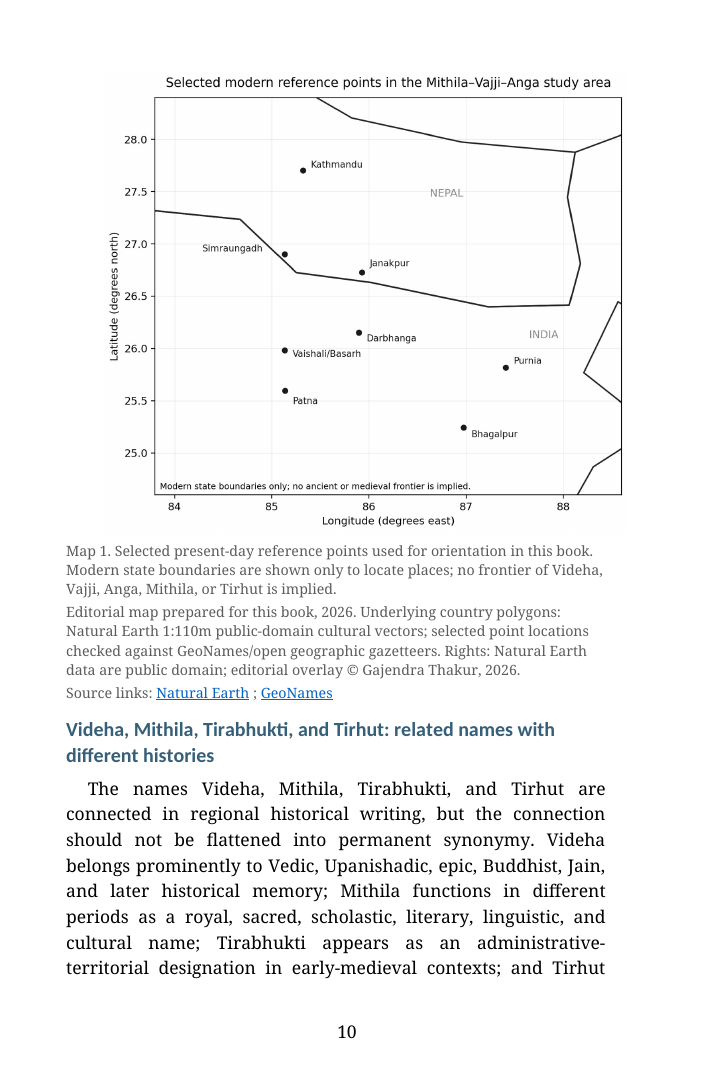
Mithila · Vajji · Anga
Chapter-specific source notes
- Primary chapter witness. Gajendra Thakur, Decoding the Panji of Mithila — Volume I, formal Chapter 11, PDF pp. 236-253; formal Chapter 11. The HTML transcription is generated from the commit-pinned source PDF and retains the chapter boundary recorded in this edition.
- Internal structure. The repository source-heading inventory records no separately encoded subordinate heading for this chapter.
- Digital editorial method. The page keeps the preserved source text distinct from generated navigational, concordance, visual, and provenance apparatus. The synthetic reconstruction is explanatory only and is not evidence for an individual lineage or a determination of social or marital status.