Decoding the Panji of Mithila · Volume I · Chapter 12
Mithila's Living Genome: Pañjī Prabandha Volume I — Section 2 (Uṭīp Sub-Commentary)
Chapter 12
Mithila's Living Genome: Pañjī Prabandha Volume I —
           Section 2 (Uṭīp Sub-Commentary)

MITHILA'S LIVING GENOME
A Comprehensive Scholarly Report on

Genome Mapping (450 A.D. – 2009 A.D.): The Panjī Prabandha of
Mithila
[jīnoma maipiṃga (4 e.ḍī. sa~ 2 e.ḍī.) – mithilāka pañjī prabandha]
Volume II, Section 2 (Uṭīp / Sub-Commentary)
Prepared as an Analytical and Explanatory Scholarly Report
Drawing upon Anthropological, Sociological, Genealogical,
and Historical Frameworks

Source Document Series:
Videha Parallel Literature Movement
Gajendra Thakur, Founder-Editor

1. THE DOCUMENT: IDENTITY AND ARCHITECTURE

1.1 What Is This Document?
The text under examination is Volume II, Section 2 (Khaṇḍa 2) of a
monumental work titled Jīnom Maipiṃg (450 A.D. to 2009 A.D.) —
Mithilāk Pañjī Prabandha, translatable as "Genome Mapping (450 A.D. to
2009 A.D.) — The Genealogical Record Management of Mithila." The
section presented is the Uṭīp, which in Maithili scholarly tradition means
"sub-commentary" or "supplementary lineage record."

                            Gajendra Thakur — 252
                            Decoding the Panji of Mithila
The framing of genealogical data as "genome mapping" is a deliberate
intellectual move by the editor: it asserts that traditional Pañjī is, in essence,
an indigenous biotechnology — a continuous, living database of human
genetic and social inheritance, maintained by a dedicated priestly-scholarly
class across fifteen-plus centuries.
      Full Title | Jīnom Maipiṃg (450 A.D. – 2009 A.D.) – Mithilāk Pañjī
      Prabandha
      Volume | II
      Section | Khaṇḍa 2 (khaṇḍa 2) — Uṭīp (upaṭīpa)
      Script | Devanagari (Maithili dialect conventions)
      Language | Classical Maithili (genealogical register)
      Page Range | 2.2 to 2.72 (71 pages of dense genealogical text)
      Sub-sections | 155+ numbered Uṭīp sub-entries across villages and lineages
      Families / Lineage Trees | Several hundred individual family trees (vaṃśa-
      vṛkṣa)
      Temporal Span | Approximately 450 A.D. to 2009 A.D. (1,559 years)
      Geographical Coverage | Mithila region (present-day North Bihar, India; and
      Terai Nepal)
      Publication Context | Videha Parallel Literature Movement

1.2 The Genre: Pañjī Prabandha
The Pañjī Prabandha (pañjī prabandha) is one of the most remarkable
indigenous record-keeping systems in world history. It is a hereditary
genealogical register maintained by a caste of specialists known as Pañjīkāra
or Pañjīkār, who function as official custodians of patrilineal and
matrimonial data among Maithili Brahmin communities.
Unlike European parish records or Chinese clan genealogies, the Pañjī is a
living, transactional document: it is consulted and updated at every marriage
negotiation to verify gotra (patrilineal exogamous clan), mūl (root lineage),
pravara (Vedic sage-ancestry), and matrimonial compatibility across an
enormous kinship network. The Pañjīkār acts as a human search engine —
or, in the document's own framing, a genetic database manager.
Key Concept:The Pañjī system is not archival in the Western sense; it is
operational genealogy. Its purpose is not merely commemoration but active
social governance — determining who may marry whom across hundreds of
villages and dozens of generations.

                             Gajendra Thakur — 253
                          Decoding the Panji of Mithila
1.3 The Uṭīp (upaṭīpa) Sub-genre
The specific section before us is titled Uṭīp, meaning "sub-note" or
"supplementary annotation." Within the Pañjī architecture:
•   The main Pañjī (Mūl Pañjī) records primary lineages of high-status
    Maithili Brahmin families.
•   The Uṭīp records secondary, collateral, and migrant branches — families
    who have moved to new villages, lineages that branched from the main
    stem, or sub-families whose records needed a supplementary volume.
•   The Uṭīp is therefore a genealogical "overflow" or "index extension" —
    essential for completeness, and in practice indispensable because
    Mithila's Brahmin population spread across hundreds of villages through
    strategic marriage migration.
The section is further divided by geographic circuit: Sakkari-Sārisab-Pāhīṭol,
Digauṃdh, Kanhauli, Mānī, Hāṭī, Tetraharā, Mahiyā, Mahiṣī, Maṃgaraunī,
Barlirājpur, Naḍuār, Bheṭ, Rurauculī, Tarauni, Jhañjhārpur, Analapur,
Gaṃgaurā, Ḍumrā, Simarivāṛ, Murajpur, Raṭaulī, Ṭarauni, and many others
— each a village or village-cluster in the Mithila heartland.

2. MITHILA AND THE MAITHILI BRAHMIN WORLD

2.1 Geographical and Historical Setting
Mithila (mithilā) is a cultural-linguistic region straddling the North Bihar
plains of India and the eastern Terai of Nepal. Bounded roughly by the
Gandak (Narayani) river to the west, the Mahananda/Kosi to the east, the
Himalayan foothills to the north, and the Gangetic plain to the south, it
encompasses a zone of extraordinary cultural continuity. The mythological
capital is Janakpur (in Nepal), home of King Janaka, father of Sītā.
This region was the seat of one of the most intellectually sophisticated
Brahmin communities in South Asia. Mithila produced Gaṅgeśa Upādhyāya
(author of the Tattvacintāmaṇi, the foundational text of Navya-Nyāya logic),
Vidyāpati (the great Maithili poet), and Maṇḍana Miśra. The Maithili
Brahmin community — especially the Śrotriyas and Yogyas — developed
institutional mechanisms of extraordinary sophistication to maintain their
social identity across millennia.

                           Gajendra Thakur — 254
                            Decoding the Panji of Mithila
2.2 Caste Stratification Within Maithili Brahmins
The Pañjī system is specifically associated with Maithili Brahmins, who are
themselves internally stratified. Understanding this stratification is crucial to
reading the document:
      Śrotriya | The highest-rank Maithili Brahmins; fullest Pañjī regulation
      applied; marriage choices most restricted
      Yogya | Second tier; also regulated by Pañjī but with slightly wider
      permissible marriage circles
      Paṃjī-baddha | "Pañjī-bound" — all families whose marriages are recorded
      and regulated by the system
      Pañjīkāra | The hereditary custodian-scribes who maintain and interpret the
      Pañjī
      Mūl | Root lineage — the fundamental genealogical identity unit
      Gotra | Patrilineal exogamous clan, traced to a Vedic sage (ṛṣi)
      Pravara | Series of ancestral sages invoked in ritual; determines marriage
      prohibitions
Designations appearing throughout the document confirm this stratification:
persons are identified as Vaidika (vaidika — Vedic scholar), Vaidya (vaidya
—          physician/medical          practitioner),       Mahāmahopādhyāya
(mahāmahopādhyāya — the highest traditional scholarly title), and Pañḍita
(paṃḍita — learned man). These are not decorative epithets but functional
social identifiers that determine ritual rank and marriage eligibility.

2.3 The Social Logic of Endogamy and Exogamy
The Pañjī system navigates a complex dual imperative:
Exogamy (gotra rule):A man and woman of the same gotra (patrilineal
clan) may NEVER marry — this is a categorical prohibition treated as
equivalent to incest. The Pañjī identifies gotra at every step.
Endogamy (community rule):Marriage must be within the broadly defined
Maithili Brahmin community, and more specifically within compatible sub-
tiers of the hierarchy.
The result is a highly constrained combinatorial problem: find a suitable
spouse across hundreds of villages, satisfying both gotra-exogamy and
community-endogamy, without repeating a marriage alliance too recently
(the "sapinḍa" prohibition). This is precisely what the Pañjī solves — it is a

                             Gajendra Thakur — 255
                           Decoding the Panji of Mithila
medieval information system for solving a massive, recurring constraint-
satisfaction problem across a geographically dispersed community.

3. THE GENEALOGICAL GRAMMAR: HOW TO READ
THE ENTRIES

3.1 The Formal Structure of Each Entry
Every entry in this Uṭīp follows a rigidly standardized formula, written in a
dense, abbreviated Classical Maithili. Once the grammar is decoded, each
line yields a precise genealogical statement. The fundamental unit is:
Format:[Father's name] suto/suta [Son(s)/Daughter(s)] [Village/Location]
saṃ [Mother's lineage source — donor's name] dau [Village of maternal
grandfather] ddau
Let us parse the standard vocabulary:
      suto (suto) | "Son of" — masculine singular child (one son)
      sutau (sutau) | "Two sons of" — masculine dual (exactly two sons)
      suta (sutā) | "Sons/children of" — masculine plural (three or more sons)
      sutāśca | "Sons and daughters of" — indicating mixed male-female progeny
      dau (dau) | "Dau" — abbreviation of dauhadra or dauhi — the maternal side
      donor
      ddau (ddau) | "Maternal grandfather" — the father of the mother
      saṃ (sa~) | "From" — indicating provenance of the bride (village origin)
      apara (aparā) | "Another / additional" — marking a polygamous second or
      third wife's children
      mūl/pravara indicator | Numbers in parentheses like (286//01) — Pañjī
      page/entry reference numbers
      pra (pra) | Abbreviation for "prāyukta" — also known as / alias
      ātma (ātmārāma etc.) | "Self" names — used when someone's alias or second
      name follows

3.2 The Parenthetical Number System
Throughout the text, every married couple entry is followed by parenthetical
numbers such as (286//0), (202//0), (109/0), etc. These are cross-reference
codes to the main Pañjī volumes, indicating:

                             Gajendra Thakur — 256
                           Decoding the Panji of Mithila
•   The volume/page number in the primary Pañjī register where the
    maternal lineage is recorded
•   Sub-entry identifiers within that page
•   These codes allow the Pañjīkāra to cross-verify any claim by consulting
    the master register
This numerical cross-referencing system is essentially a pre-digital relational
database — primary keys linking entries across multiple volumes. It prevents
fraud, ensures consistency, and allows rapid lookup of any individual's
complete ancestry across both paternal and maternal lines.

3.3 Village Identifiers as Lineage Addresses
Every individual and every married pair is associated with a specific village.
Villages that appear as sources of brides or maternal lines include:
•   Sārisab (sarisaba) — repeatedly cited; a major lineage-hub village in
    Madhubani district
•   Darbhangā (dariharā) — major city and cultural center of Mithila
•   Khaṇḍabalā (khaṇḍabalā) — another lineage-hub; associated with the
    Siṃha (Singh) Kāyastha nobility
•   Māṇḍar (māṇḍara), Pābaulī (pabaulī), Saudāpur (sodarapura) — major
    donor villages
•   Narauna (narauna), Pālī (pālī), Budhavāla (budhavāla), Hariyam
    (hariamba) — frequently appearing
•   Karmaharā (karamahā), Ekharā (ekaharā), Sakrāṛhī (sakarāḍhī), Ghosauṭ
    (ghosota)
•   Siṃhaulī (siṃhaulī), Alaya (alaya), Kujaulī (kujaulī), Kumarī (kumārī)
In the Pañjī system, a village is not merely a geographical location — it is a
genealogical coordinate. Knowing that someone comes "from Sārisab,
Māṇḍar saṃ" immediately narrows the field of possible lineages and helps
the Pañjīkāra locate the relevant entries.

3.4 Multi-Wife (Apara) Notations
The repeated use of "apara" (aparā — "another") throughout the text
documents polygamy systematically. When a man had multiple wives, each
wife's children are listed separately under the same father's name, with
"apara" marking the subsequent wives. This is non-judgmental recording —

                            Gajendra Thakur — 257
                            Decoding the Panji of Mithila
the Pañjī does not comment on polygamy but simply traces all biological
descent lines for matrimonial verification purposes.
This practice has a direct genealogical consequence: multiple parallel descent
lines from one man, each with different maternal lineages (gotras, villages),
creating complex kinship webs that only the Pañjī can fully document.

4. PROMINENT FAMILIES, TITLES, AND NOTABLE
INDIVIDUALS

4.1 The Institutional Title System
The document is studded with honorific titles that function as social
metadata. Understanding them reveals the professional and ritual
stratification of Maithili society:
      Mahāmahopādhyāya (mahāmahopādhyāya)                |   The highest traditional
      scholarly title in Sanskrit learning; equivalent to a distinguished professor or
      Doctor of Letters. Extremely rare.
      Mahopādhyāya (mahopādhyāya)          |   Senior scholar of Sanskrit/traditional
      learning
      Vaidyakaraṇī (vaiyākaraṇi) | Specialist in Sanskrit grammar (vyākaraṇa);
      grammatician
      Jyautiṣī (jyotiṣī / jyo.) | Astrologer-astronomer; officiates at calendrical and
      ritual functions
      Māmāṃśaka (mīmāṃśaka / rimmāṃśaka) | Specialist in Mīmāṃsā — Vedic
      exegesis/ritualistic philosophy
      Sadu (sadu) | Abbreviation indicating a Sadupādhyāya — a sub-specialist
      scholar grade
      Vaidika (vaidika) | Vedic ritualist; one who performs or maintains Vedic
      sacrificial traditions
      Kavī (karavi) | Poet; indicates literary accomplishment
      Ṭhākur (ṭhākura) | Title for Kāyastha (scribal/administrative) nobility, not
      Brahmin
      Rāja / Kumāra (rājā / kumāra) | Royal/noble title — appears for Rāja
      families like Vijay Govinda Singh
      D.G.P. / M.B.B.S. / M.A. | Modern professional credentials — showing the
      document spans into the modern era

                             Gajendra Thakur — 258
                         Decoding the Panji of Mithila
4.2 The Siṃha (Singh) Noble Houses
A remarkable feature of the Uṭīp is its documentation of the Khaṇḍabalā
Siṃha clan — a noble Kāyastha family of great standing whose daughters
married into Brahmin families. Entries repeatedly reference:
•   Vābu Ghaṇeśvara Siṃha (vābū ghaneśvara siṃha) of Khaṇḍabalā — a
    frequently cited noble patron
•   Vābu Rāmacandra Siṃha, Mahārāja Mādhava Siṃha, Mahārāja Cheha
    Siṃha — successive noble rulers
•   Vābu Tañjheśvara Siṃha, Vābu Vasudeva Siṃha, Vābu Prājāpati Siṃha
    — landed nobility
•   Rāja Vijaya Govinda Siṃha — explicitly titled as a Raja with political
    functions
•   Mahārājā Mahiṣvara Siṃha and Mahārājādhirāja Rāmeśvara Siṃha
    Bahādura — indicating a ruling family of considerable importance
The documentation of inter-caste alliances through marriage (Brahmin
grooms, Kāyastha noble families as bride-donors or related families)
illustrates how the Pañjī captures not just religious but political-social
alliances. The noble Siṃha families of Khaṇḍabalā functioned as patrons of
Brahmin learning and their genealogy was tracked precisely because
matrimonial connections to them conferred prestige.

4.3 Scholars of National and International Distinction
Several individuals documented in the Uṭīp achieved extraordinary
distinction in the modern academic world, demonstrating the continuity of
the community's scholastic tradition from classical to modern times:
Mahāmahopādhyāya Dr. Sir Gaṅgānātha Jhā (m.m. ḍā. sara
gaṃgānātha):Vice Chancellor of Allahabad University; Professor at Oxford
University, England. One of the greatest Sanskrit scholars of the 20th
century. His works on Indian philosophy (Nyāya, Mīmāṃsā, Prābhākara) are
foundational. The Uṭīp records his gotra, paternal lineage (from Mahiṣī Pālī
village), and his sons — Dr. Bhavānātha, Dr. Prof. Amarnātha, Dr.
Śivanātha, Dr. Vibhūtinātha, and Dr. Ādityānātha.
Dr. Prof. Amarnātha Jhā is recorded as "Proof in Oxford University England
- V.C. Allahabad University" — the proof here likely meaning "Professor,"
indicating he too rose to the Vice Chancellorship.

                           Gajendra Thakur — 259
                         Decoding the Panji of Mithila
Dr. Vibhūtinātha is recorded as "L. Colonel Deputy Governor of Delhi,
Town Planner of Delhi" — documenting a lineage member who served in
senior civil/military administration.
Prof. Meṣeśvara (M.A., Ph.D., D.Litt.):Professor; the document records his
village of Māni-Saudāpur and his son Sañjaya.
Prof. (Ānaṃda) Gaṃgādhara:M.A. in Hindi, Maithili, Economics;
Department Head of Patna College. Documented in the Digauṃdh lineage.
Pro. Govinda and Pro. Jagadīśa:Both identified as "Maithilī Sāhityakāra"
(Maithili literary authors), documenting creative writers within the
genealogical record.
This seamless integration of medieval scholarly titles (Mahāmahopādhyāya),
professional credentials (M.B.B.S., D.G.P., C.S.M.B.B.S., L.L.B.), and
traditional categories (Vaidyakaraṇī, Jyautiṣī) within a single document
illustrates how the Pañjī evolved to absorb modernity while maintaining its
pre-modern classificatory logic.

4.4 Modern Professionals Documented
The Uṭīp conscientiously documents modern professional identities alongside
traditional ones, reflecting the community's transition into modernity:
•   D.G.P. Bhīmanātha (Director General of Police — a senior Indian Police
    Service officer)
•   Civil Surgeon (medical officer of senior rank in colonial/post-colonial
    administration)
•   M.B.B.S. doctors (multiple instances — Snehāṃśu Pratāpa, Dr. Ṛṣiśvara,
    etc.)
•   Engineers — "Mukhya Abhiyantā" (Chief Engineer) and "E. Sureśa"
    (Engineer Sureśa)
•   Vakīl (lawyer/advocate) — noted as Pañcānanda, Jagadīśa
•   Dena Bank Chairman — noted against Śambhūpati's son Lakṣmaṇa
•   I.A.S. (Indian Administrative Service) officer — Maṃtheśvara, noted in
    the Gaṃgaurā lineage
•   Sāhityakāra (literary authors) — multiple individuals noted as Maithili
    writers
The inclusion of these details is remarkable: it shows that the Pañjīkāra
updated records with modern professional achievements, treating an IAS

                          Gajendra Thakur — 260
                          Decoding the Panji of Mithila
posting or a medical degree as socially significant genealogical data
comparable to a traditional scholarly title.

5. GEOGRAPHIC COVERAGE: THE MITHILA KINSHIP
MAP

5.1 Village Clusters and Sub-circuits
The Uṭīp is organized into geographic sub-circuits, each representing a
cluster of villages whose lineages are recorded together because of their
historical matrimonial connections. The major circuits documented in this
volume include:
      Sakkari-Sārisab-Pāhīṭol Circuit | Sections 1–14; covers Sārisab, Khāṃgaṛ,
      Joṃkī, and adjacent hamlets
      Sārisab Saudāpur Circuit | Sections 25–40; covers Bhadu'ār, Cāpāhī,
      Tāranagara, Lālagañja, Gaṛhabanailī
      Pūrvārīpāra — Digauṃdh Circuit | Sections 41–51; covers Digauṃdh
      Saudāpur, Navatola, Bhaṭṭapurā, Bakhṭaurī
      Kanhauli Saudāpur Circuit | Sections 52–55; covers Maṃgaraunī, Ujāna
      Māni Saudāpur Circuit | Sections 56–58; covers Bhāṭṭapurā
      Hāṭī Saudāpur Circuit | Section 59; covers Tetraharā, Kalpayaṃphara
      Mahiṣī Pālī Circuit | Sections 62–77; covers Pāhīṭol, Maṃgaḍapaṭṭī,
      Gañgolī, Iśahpur, Lohanā
      Maṃgaraunī Pālī Circuit | Sections 78–79; covers Lakhanaura, Jamdaulī,
      Khāṛarāta
      Barlirājpur-Hariyamba Circuit | Sections 79–95; covers Pāhīṭola, Beheṭa,
      Bhāṭṭapurā, Gaṛhbanailī
      Pūrvārī Naḍuār Circuit | Sections 106–110; covers Durgāgañja, Kaṭihāra
      Beheṭa Karmaharā Circuit      |   Sections 111–120; covers Viṭṭho, Hāṭī,
      Kalāyaṃphara
      Tarauni Karmaharā Circuit    |    Sections 122–124; covers Ujāna, Avāma,
      Basaiṭī
      Jhañjhārpur Karmaharā Circuit | Sections 125–127; covers Lakhanaura
      Analapur Karmaharā Circuit | Sections 128–129; covers Bhāṭṭapurā
      Gaṃgaurā Budhavāla Circuit | Sections 131–133; covers Lālgañja
      Ḍumrā Budhavāla Circuit | Sections 134–136; covers Dīpa, Gūṇamatī
      Simarivāṛ Khauāla Circuit | Sections 137–141; covers Sārisab, Rāmapura

                            Gajendra Thakur — 261
                           Decoding the Panji of Mithila
      Raṭaulī Darahārā Circuit | Sections 147–153; covers Lohanā, Śutalārāhī

5.2 Migration Patterns
By tracing which villages consistently appear as bride-sources (saṃ) versus
groom-sources, the Uṭīp allows reconstruction of marriage migration
patterns. Key observations:
Darbhangā (Darahārā) appears as both a donor and recipient village,
confirming its status as a major urban center where multiple lineages
converged. Khaṇḍabalā functions primarily as a donor village — its Siṃha
noble houses gave daughters to Brahmin scholars across many circuits.
Sārisab, Māṇḍar, Pābaulī, and Saudāpur are high-frequency bilateral nodes
— indicating dense, long-term marriage exchange between these villages.
Villages in Nepal's Terai (referenced obliquely through "Nepal" mentions
and cross-references to Nepalese Maithili texts) are linked into the network,
confirming the system's trans-national geographic span.
The migration of individual families is also directly documented: entries
noting a family "moving to" (ujāna — upstream or distant settlement) a new
location, or being categorized as Pūrvārīpāra (eastern circuit) versus
Paścimārīpāra (western circuit), create a spatial map of demographic
movement within Mithila over centuries.

6. THE PAÑJĪ AS ANTHROPOLOGICAL INSTITUTION

6.1 A System of Social Verification and Identity Control
The Pañjī Prabandha is, in anthropological terms, one of the world's most
sophisticated systems of identity management. Comparable institutions
include:
•   Chinese clan genealogies (zǔpǔ) — which are, however, primarily
    archival and commemorative
•   European noble genealogies maintained by Heralds — primarily
    concerned with property and title
•   Jewish oral genealogies (yichus) — more status-conferring than
    regulating
The Pañjī is unique in combining all three functions — archival, status-
conferring, and actively regulatory — with a professional maintenance class
(Pañjīkāra), formal cross-referencing, and binding social authority. No

                            Gajendra Thakur — 262
                           Decoding the Panji of Mithila
marriage among regulated Maithili Brahmin families could be solemnized
without Pañjī clearance.

6.2 The Pañjīkāra as Social Specialist
The Pañjīkāra family (or families) who maintained these records functioned
as a distinctive social sub-caste. Their knowledge was hereditary,
professional, and monopolistic. From the anthropological evidence in this
text:
•   They maintained multiple physical volumes (the cross-references span
    several hundred pages in each volume)
•   They memorized lineage trees to a depth of 15–20 generations
•   They officiated at marriage negotiations as expert witnesses
•   They charged fees for their services (this is documented in historical
    accounts of the system)
•   Their authority was recognized across the entire Mithila region,
    transcending local political boundaries
The Uṭīp itself represents the Pañjīkāra's working notes — the supplementary
register needed when the main Pañjī was too general to capture all branches.
Its existence signals the system's adaptive capacity: as families proliferated
and migrated, the Pañjī expanded accordingly.

6.3 Gender in the Pañjī System
The Pañjī is, structurally, a patrilineal document: it traces descent through the
male line and records women primarily as connection points between
lineages (as daughters of X who married Y). Women appear in the Pañjī only
through their fathers and husbands.
However, this is not to say women were genealogically invisible. On the
contrary:
•   A woman's gotra and mūl are crucial data for marriage clearance (she
    must not share her husband's gotra)
•   The maternal line (the ddau side) is recorded at every generation —
    meaning every man's mother's father's lineage is documented
•   "Dampati lekhaka" (husband-wife writers) traditions documented in
    Videha archives show that women did participate in literary production

                             Gajendra Thakur — 263
                           Decoding the Panji of Mithila
•   The "Gośāunī putrī" (daughter of Gośāuṃnī) entries and "sutāśca" (sons
    and daughters) notations acknowledge female progeny even if not
    genealogically traced further

6.4 Polygamy, Succession, and Social Complexity
The repeated "apara" (second wife, third wife) entries reveal that polygamy
was normalized and systematically documented among the elite Brahmin
families recorded here. Observations:
•   Multiple wives were common — entries with three or four "apara" wives
    per man appear
•   Each wife's children are carefully separated and their maternal lineages
    independently verified
•   Half-siblings from different mothers are genealogically distinguished
    even though they share the same father
•   Childlessness (some entries trail off with "saṃ ... suta ... dau ... saṃ ...
    ddau" with blanks) is recorded but not stigmatized
This systematic polygamy documentation reflects a society where elite male
status enabled multiple marriages, but also where the resulting genealogical
complexity required institutional management — which the Pañjī provided.

7. LINGUISTIC AND TEXTUAL ANALYSIS

7.1 The Language of the Pañjī
The text is written in Classical Maithili in its specialized genealogical
register — a formal, highly compressed dialect distinct from literary or
spoken Maithili. Key features:
•   Archaic Maithili grammatical forms (suto/sutau/suta for
    singular/dual/plural children)
•   Sanskrit-derived technical vocabulary (gotra, pravara, mūla, Vaidika,
    Māmāṃśaka)
•   Village-name inflections in the ablative (Sārisab saṃ = "from Sārisab")
•   Extreme compression — each entry encodes 4–5 generations of
    genealogical data in 2–3 lines
•   Numbers in parentheses as cross-references — an indigenous citation
    system

                            Gajendra Thakur — 264
                           Decoding the Panji of Mithila
•   Abbreviations: pr./pro. for prāyukta (alias), Ut. for Uṭīp, Sha. for Śāka
    era dating
The document's dating references alternate between two systems: Śāka era
(śāo — adding approximately 78 years to get Common Era year) and the
Uṭīp's own internal numbering, indicating the system was maintained across
multiple historical periods using period-appropriate dating conventions.

7.2 The Formula as Cultural Code
The standardized genealogical formula — "[Person] suto [Child]: [Village]
saṃ [Name] suta [Name] dau [Village] saṃ [Name] ddau" — is a cultural
code of extraordinary density. A single line encodes:
•   Paternal descent (father's name, grandfather's name)
•   Village of domicile (current family location)
•   Mother's paternal lineage (maternal grandfather's name and his village)
•   Maternal great-grandfather's lineage (ddau side, second degree)
•   Cross-reference to main Pañjī volume for verification
This formula has remained stable for centuries — entries from the early
Śāka-era sections use the same grammatical structure as entries from 2009,
demonstrating the conservatism of the institutional genre.

7.3 Devanagari Script and Maithili Orthography
The document uses Devanagari script with Maithili-specific orthographic
conventions. Notable features include the use of the anusvāra (nasalization
mark) in positions unusual for standard Hindi or Sanskrit, and the
preservation of certain old Maithili phonological distinctions. The Tirhuta
script (native to Mithila) is not used in this volume, which is printed in
Devanagari for wider accessibility — consistent with the Videha movement's
biliteracy approach.

8. THE "GENOME MAPPING" METAPHOR: A
CRITICAL ANALYSIS

8.1 Why "Genome"?
The title's invocation of "genome mapping" is not accidental or merely
ornamental. It represents a deliberate intellectual argument made by the
editor (Gajendra Thakur) and the Videha Parallel Literature Movement:

                            Gajendra Thakur — 265
                          Decoding the Panji of Mithila
•   Like a genome, the Pañjī is a complete, continuous, and self-referencing
    record of biological and social inheritance
•   Like genomic data, Pañjī information is used to make decisions about
    compatibility and future inheritance
•   Like genomic mapping projects (which reconstruct evolutionary history),
    the Pañjī traces historical lineages with precision
•   Like genomic databases, the Pañjī is maintained by specialists, cross-
    referenced, and updated continuously

8.2 The Biocultural Argument
The metaphor makes an implicit biocultural argument: that the Pañjī system
has, for 1, years, been performing the same function as modern population
genetics — tracking heritable traits (in this case, social and ritual traits
defined as heritable: gotra, pravara, mūl) across a large, geographically
dispersed population.
From an anthropological standpoint, this is a defensible claim. The Pañjī has,
in effect, created a centuries-long natural experiment in endogamy and
kinship regulation, the demographic consequences of which could in
principle be analyzed using modern tools. The 450 A.D.–2009 A.D. span
represents approximately 50–60 generations — a genealogical dataset of
extraordinary depth.

8.3 The Political Argument
The metaphor also serves a political function within the Videha movement's
agenda: it asserts the scientific and scholarly equivalence of indigenous
knowledge systems with Western academic disciplines. By framing the Pañjī
as "genome mapping," the text claims for it the prestige of modern science
while insisting it is genuinely indigenous — a rebuttal to the colonial-era
dismissal of traditional Indian knowledge as unscientific or merely
superstitious.

                           Gajendra Thakur — 266
                           Decoding the Panji of Mithila
9. THE VIDEHA PARALLEL LITERATURE
MOVEMENT: CONTEXT

9.1 Counter-Canonical Scholarship
This document is published under the aegis of the Videha Parallel Literature
Movement, founded by Gajendra Thakur, editor of Videha (videha.co.in), the
first Maithili fortnightly eJournal. The Movement is explicitly positioned as a
counter-canonical alternative to the Sahitya Akademi institutional authority.
The decision to publish a work like the Pañjī Uṭīp within this counter-
canonical framework is significant: it asserts that the Pañjī tradition —
marginalized by mainstream Maithili literary institutions as "mere
genealogy" — is in fact a sophisticated literary and scholarly genre deserving
serious academic attention.

9.2 Digital Preservation as Political Act
By digitizing, editing, and making accessible the Pañjī Uṭīp through the
Videha platform, Thakur performs an act of cultural preservation with
political dimensions:
•   Endangered knowledge: The Pañjīkāra tradition is declining as younger
    generations abandon the hereditary profession
•   Digital accessibility: Moving from manuscript/printed register to digital
    text vastly increases accessibility
•   Linguistic assertion: Publishing in Maithili (rather than Hindi or English)
    asserts the language's sufficiency for serious scholarship
•   Community memory: For Maithili Brahmin families scattered across
    North Bihar and the diaspora, digital Pañjī access reconnects them to
    genealogical roots

9.3 Scholarly Innovation
The framing of the Pañjī as "Genome Mapping" and the integration of
modern credentials (IAS, D.G.P., M.B.B.S.) alongside medieval titles
(Mahāmahopādhyāya, Vaidyakaraṇī) within the same institutional record is
itself a form of scholarly innovation — a demonstration that indigenous
knowledge systems have the capacity to absorb and incorporate modernity on
their own terms, without dissolving into it.

                            Gajendra Thakur — 267
                           Decoding the Panji of Mithila
10. HISTORICAL DEPTH: TEMPORAL LAYERS IN THE
DOCUMENT

10.1 Śāka Era Dating
The document uses Śāka era dates (denoted by "Sha." or śāo) for older
entries. The Śāka era begins in 78 A.D. Therefore:
•   Śāka 78 = 156 A.D.
•   Śāka 800 = 878 A.D.
•   Śāka 1900 = 1978 A.D.
References to Śāka dates in the 100–300 range (corresponding to
approximately 178–378 A.D.) would place some lineage origins in the pre-
Gupta to early Gupta period — consistent with the document's claim of
coverage from 450 A.D. References in the 1900+ range align with the late
20th century, when the most recent entries were recorded.

10.2 Evidence of Medieval Lineages
Several entries document individuals with classical Sanskrit scholarly titles
(Māmāṃśaka, Vaidyakaraṇī, Jyautiṣī) who would have flourished in the
medieval period (roughly 1000–1700 A.D.). The Pañjī's capacity to trace
from these scholars to their living 20th-century descendants is its most
remarkable historical feature — it provides a continuous thread through the
medieval and early modern periods for which other historical documentation
of ordinary (non-royal) families is extremely scarce.

10.3 Continuity Through Political Disruption
The period 450–2009 A.D. encompasses the Gupta Empire, the Pāla dynasty,
Sultanate rule, Mughal suzerainty, British colonial administration, and post-
Independence India — multiple complete transformations of the political
order. Through all of this, the Pañjī system continued. This continuity itself is
a major historical fact: it demonstrates that the Maithili Brahmin community
maintained institutional self-governance through kinship and matrimonial
regulation that survived political disruption. The Pañjī is thus also a history
of community resilience and institutional durability.

                            Gajendra Thakur — 268
                          Decoding the Panji of Mithila
11. OBSERVATIONS AND CONCLUSIONS

11.1 What This Document Tells Us About Mithila
Reading this Uṭīp carefully yields the following observations of
anthropological, sociological, and historical significance:
•   Mithila's Brahmin community was extraordinarily geographically mobile
    within the region — families moved between dozens of villages across
    multiple generations, but maintained genealogical connectivity through
    the Pañjī
•   Scholarly achievement (Sanskrit grammar, philosophy, astrology, poetry)
    was not individual but lineage-embedded — the same families produced
    scholars across generations, and this was tracked and celebrated
•   The transition from medieval to modern was not disruptive but
    cumulative — modern credentials were added to, not substituted for,
    traditional ones
•   Women were genealogically essential though textually marginal — every
    man's maternal lineage was recorded to three degrees, making women
    crucial nodes even within a patrilineal system
•   The document reflects a community with high levels of internal social
    differentiation that was carefully managed through an information
    system rather than through political coercion

11.2 The Document's Significance for Genealogical Scholarship
This Uṭīp represents one of the most substantial collections of continuous
genealogical data available for any South Asian community. Its significance
for genealogical scholarship includes:
•   Depth: 1, years of continuous lineage data in a single community
•   Breadth: Hundreds of families across dozens of villages documented
    simultaneously
•   Verification: Cross-referencing system creates internal consistency
    checks
•   Modernity integration: Seamless incorporation of post-1947 credentials
•   Bi-directional tracing: Both paternal (suta) and maternal (dau/ddau) lines
    documented

                            Gajendra Thakur — 269
                          Decoding the Panji of Mithila
11.3 Limitations and Lacunae
No scholarly report would be complete without acknowledging limitations:
•   Gender bias: Women's own lineages are not traced forward — daughters
    vanish from the record after their marriage entry
•   Social exclusivity: The Pañjī documents only Brahmin (and some
    Kāyastha-adjacent) families — the vast majority of Mithila's population
    (Dalit, OBC, Muslim, and other communities) are entirely absent
•   Scribal variation: The compression of the format means errors,
    omissions, and ambiguities are difficult to detect without cross-
    referencing multiple volumes
•   Oral supplement: Much Pañjī knowledge was oral and has not been
    systematically captured in the written record
•   Ink of entries: This volume (2009 A.D.) captures a moment — many
    entries trail off with blanks, indicating ongoing recording

11.4 Final Assessment
The Jīnom Maipiṃg — Mithilāk Pañjī Prabandha, Volume II, Section 2
(Uṭīp) is a document of world-class significance for the study of genealogy,
kinship, social stratification, community identity, and indigenous knowledge
systems. It represents an unbroken scholarly and social tradition of fifteen
centuries, maintained by a community that understood — long before
modern bioinformatics — that tracking hereditary information systematically
across generations is one of the most powerful tools for social organization.
Its publication within the Videha Parallel Literature Movement places it
squarely within a project of cultural recovery and reassertion: the argument
that the intellectual traditions of Mithila are not mere historical relics but
living, evolving systems of knowledge production that deserve the same
scholarly attention as any academic discipline. The "genome mapping"
metaphor is thus both analytically precise and politically meaningful — a
claim that indigenous science is science, and that the Pañjī Prabandha is one
of humanity's great unrecognized intellectual achievements.

                           Gajendra Thakur — 270
                          Decoding the Panji of Mithila
Source structure and verification apparatus
Editorial source apparatus. This apparatus is descriptive, not interpretive. It records the source-controlled structure used to verify that this page corresponds to formal Chapter 12 of Decoding the Panji of Mithila — Volume I. The chapter text above is preserved from PDF pp. 253-272; formal Chapter 12 in the commit-pinned authoritative source. It is not merged with a neighboring chapter, appendix, annexure, or independent front/back-matter unit. The internal headings below come from the repository’s source-heading inventory and are retained as navigational and audit evidence; showing them here does not turn those headings into separate publications or add claims that are absent from the source.
Internal source headings
No subordinate heading was separately encoded in the repository source-heading inventory for this chapter.
Source-text concordance
Mithila's · Living · Genome · Pañjī · Prabandha · Section · Uṭīp · Sub-Commentary · Comprehensive · Scholarly · Report · Mapping · Panjī · jīnoma · maipiṃga · mithilāka · Prepared · Analytical · Explanatory · Drawing · upon · Anthropological · Sociological · Genealogical · Historical · Frameworks · Document · Series · Videha · Parallel · Literature · Movement · Gajendra · Thakur · Founder-Editor · IDENTITY · ARCHITECTURE · text · examination · Khaṇḍa · monumental · work · titled · Jīnom · Maipiṃg · Mithilāk · translatable · Record · Management · presented · Maithili · tradition · means · supplementary · lineage · Decoding · framing · data · deliberate · intellectual · move · editor · asserts · traditional · essence · indigenous · biotechnology · continuous · database · human · genetic · social · inheritance · maintained · dedicated · priestly-scholarly · class · across · fifteen-plus · centuries
Boundary verification. In the formal sequence this chapter follows Volume I Chapter 11, “Prācīn Pañjī, Khaṇḍa 2 (Pages 348–690): Royal Records, Scholarly Titles, and Modernity” and precedes Volume I Chapter 13, “Genome Mapping Volume I: Analytical Report on Mithilak Pañjee Prabandha”. The chapter extractor begins at the verified formal Chapter 12 marker and stops at the next verified formal chapter marker; for a final chapter it stops before recognized book-level back matter. The concordance above is generated only from distinct terms already present in this chapter’s preserved source text. It is provided for discovery, comparison, and audit, not as an automated judgment about persons, lineages, status, kinship, marriage eligibility, or historical truth.
Illustrated research apparatus
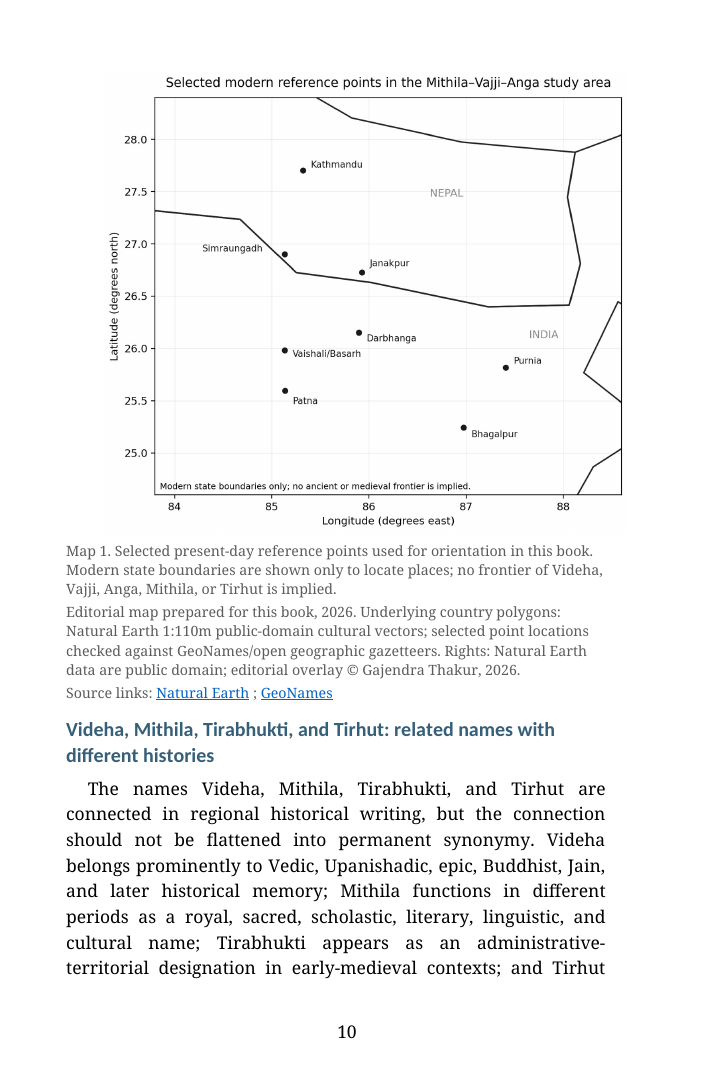
Mithila · Vajji · Anga
Chapter-specific source notes
- Primary chapter witness. Gajendra Thakur, Decoding the Panji of Mithila — Volume I, formal Chapter 12, PDF pp. 253-272; formal Chapter 12. The HTML transcription is generated from the commit-pinned source PDF and retains the chapter boundary recorded in this edition.
- Internal structure. The repository source-heading inventory records no separately encoded subordinate heading for this chapter.
- Digital editorial method. The page keeps the preserved source text distinct from generated navigational, concordance, visual, and provenance apparatus. The synthetic reconstruction is explanatory only and is not evidence for an individual lineage or a determination of social or marital status.