Decoding the Panji of Mithila · Volume II · Chapter 4
The Basic Unit of a Panji Entry
Chapter 4
The Basic Unit of a Panji Entry
1. Why the Entry Unit Matters
The first practical skill in decoding Prachin Panji is learning
to see the entry unit. The source does not always give a modern
sentence. It gives a compact register unit. If the reader cannot
identify where one unit begins, what its parts are, and where it
closes, the whole record becomes a blur of names.
A Panji entry may be as short as one ancestor and one
village. It may also run through several names, a title, a
number, a maternal link, and a closing phrase. Its length
varies, but its logic is regular. It is built from recognizable
parts: a frame, a name, a relation, a place, a connector, a
qualifier, and a closure.
This chapter establishes the working unit from which all
later decoding will proceed. It also adds an editorial rule that
will govern the whole book: the data must be enshrined before
it is interpreted. That means the original term, number, title,
village, uncertainty, and order must be preserved even when
the prose explanation becomes smoother.
2. The Minimum Entry
The minimum Panji entry contains three elements:
1. a person or ancestor;
2. a relationship marker;
3. a place or branch-identification.
For example, the opening cluster contains formulas such as:
Source example:
अथ सरिसब ग्राम: देवादित्य रत्नाकरापत्य-छादन।।
Decoding the Panji of Mithila - Volume II
This small expression contains much more than its length
suggests. It opens a village frame with अथ and ग्राम. It identifies
Sarisab as the village being treated. It gives Devanaditya and
Ratnakara through an अपत्य relationship. It links the branch to
Chhadan. A modern prose expansion must therefore say
something like: in the Sarisab village-cluster, a branch
descended from or attached to Devanaditya/Ratnakara is
associated with Chhadan. The exact relationship between the
two ancestor names must be preserved for later comparison,
not over-simplified.
The minimum unit is therefore not merely a translation. It is
a structured record.
3. The Full Entry Model
A fuller Panji entry may contain the following components:
entry opener: अथ, अपरा, एवं, एते;
village frame: ग्राम, डीह, वासी, मूलग्राम, तत्रैव;
ancestor or named person;
relationship marker: सुत, सुता, सुतो, सन्तति, अपत्य, पौत्र, प्रपौत्र,
दौहित्र;
title or rank: ठ., म. म., महामहोपाध्याय, ज्यो., वैयाकरण, कवि, पण्डित,
बाबू;
number: a parenthetical marker such as (५४//०३), (१३४/०२),
or a number with टीप;
place link: a village or settlement after सँ, dash, or direct
attachment;
inclusion marker: समेत, तत्रैव, वासी;
branch marker: अपरा, बीजी, प्र., आदिक;
closure: ।। or a phrase such as मातृक चक्रं , विवाह:, एते ... ग्राम.
Decoding the Panji of Mithila - Volume II
Not every entry has every part. The decoder must ask what
is present and what is absent. Absence is also meaningful. A
missing title, missing number, or missing village marker may
show that the entry depends on the previous phrase.
4. Frame Before Name
Modern readers often begin by looking for personal names.
In Panji reading, the frame must be identified first. If the text
says “अथ सरिसब ग्राम,” the first fact is not an individual name but a
village frame. Every following entry must be read under that
frame until another frame appears.
This is especially important because the Panji moves
through clusters. A name may not stand alone. It may be one
item within the Sarisab group, the Jajival group, the Khandbala
group, or another village group. If the frame is lost, the person
is detached from the geography that gives the entry meaning.
Therefore the first table column in every decoding
worksheet should be “Frame or Cluster.” The name comes after
the frame.
5. Names Are Not Enough
A name alone is not a data point. A name becomes useful
only when joined with relation and place.
For example, a name such as Raghunath, Ganga, Keshav, or
Govind may occur many times. The data point must be
recorded as:
name;
father or ancestor;
relation word;
place;
title;
number;
surrounding branch;
source position.
Decoding the Panji of Mithila - Volume II
If only the name is copied, the data is not preserved. It is
weakened. The Panji is full of repeated names. The safe unit is
not “Raghunath”; it is “Raghunath, son/descendant of X,
connected with Y village, in Z branch, with number N if
present.”
This is why the present book will not reduce the Panji to a
list of famous names. It will preserve the relational unit.
6. Relationship Markers as the Backbone
The backbone of an entry is the relationship marker. The
most important markers are:
सुत: son;
सुतो: son of, or register form introducing son/descendant;
सुता: offspring or sons in many contexts, but must be
read carefully;
सन्तति: descent-line or continuation of a branch;
अपत्य: offspring-line, descendant-line, or branch attached
to a named ancestor;
पौत्र: grandson;
प्रपौत्र: great-grandson;
वृद्ध प्रपौत्र: older or senior great-grandson / more distant
senior descent marker, to be read cautiously;
दौहित्र: daughter’s son;
मातृक: maternal relation;
चक्र: cycle, circuit, or closed relational cluster.
These words decide the shape of the entry. If the entry says
सुत, it likely moves vertically from father to son. If it says सन्तति,
it identifies a branch or line. If it says दौहित्र, it crosses through
the daughter’s line. If it says मातृक चक्र, it shifts to a maternal or
marriage-network logic.
Decoding the Panji of Mithila - Volume II
The decoder should mark these words before doing anything
else.
7. The Place Link
The place link is the second backbone of the entry. A Panji
record without place is often incomplete, because place is how
the lineage is located in Mithila.
A place may appear after a dash:
Source example:
ग्रहेश्वरापत्य-जोंकी।।
It may appear after सँ :
Source example:
माण्डर सँजीवधर दौ।।
It may appear with वासी:
Source example:
सनाथ सन्तति-विरनी वासी।।
It may appear as a cluster closure:
Source example:
एते गंगोली ग्राम।।
Each form must be recorded differently. A dash may attach a
branch to a place. सँ may show origin, residence, marriage link,
or affinal connection. वासी indicates residence or belonging. एते
closes a list under a village frame.
The place-link must never be silently normalized. If the
source says Mander in one form and Mandar in another, both
forms should first be recorded. Normalization belongs in the
index, not in the first transcription.
Decoding the Panji of Mithila - Volume II
8. Titles as Data, Not Ornament
Titles are part of the entry unit. They should be treated as
data, not decorative respect.
Source example:
म. म. उ. जीवनाथापत्य-दिगुन्ध।।
Even when the abbreviation is uncertain in full expansion,
the title must be preserved. It may identify a person’s scholarly
rank or distinguish him from another person of the same
name. Similarly, महामहोपाध्याय, कवि, कविराज, वैयाकरण, ज्योतिर्विद, पौराणिक,
धर्माधिकारी, पण्डित, बाबू, चौधरी, and ठाकु र should be indexed.
Critical analysis requires asking why a title appears in one
entry and not another. Does it indicate personal achievement?
Does it identify a scholarly house? Does it distinguish two
persons? Does it mark later prestige? These questions should
be kept open until the index accumulates enough evidence.
9. Numbers as Anchors
Numbers in parentheses must remain attached to the entry.
They may not be removed simply because their meaning is
difficult.
Source examples from the register include forms such as
(५४//०३), (१३४/०२), (२४/०४), and (११०/०७ टीप). Some numbers stand
beside names; others appear near marriage entries; others
appear near notes. Their exact function may vary. But their
position is always important.
The correct practice is to record:
exact number as written;
number type: single slash, double slash, zero, note-
marked, damaged;
the word or name immediately before it;
the word or name immediately after it;
Decoding the Panji of Mithila - Volume II
whether it appears in a marriage entry, maternal cycle,
village cluster, or title-bearing passage.
Only after this can patterns be studied. A number is not an
inconvenience. It is a cross-reference waiting to be understood.
10. Closure Signs
An entry often closes with punctuation or formula. The
double danda ।। may close a unit. A phrase such as “एवं ... मातृक
चक्रं ” may close a maternal cycle. A phrase such as “एते ... ग्राम”
may close a village cluster. A word such as विवाह: may open or
label a marriage event.
Closure signs are essential because the Panji does not always
use paragraphing in a modern way. If the reader misses the
closure, one entry may be incorrectly joined to the next. If the
reader creates a closure too early, one unit may be split into
two.
The safest rule is: identify closure by both punctuation and
formula. Punctuation alone is not enough. Formula alone is not
enough. The two must be compared.
11. A Worked Micro-Example
Consider the compact pattern:
Source example:
सोने सन्तति-कटमा ओ सकु री।।
This can be opened in stages.
First layer: exact transcription.
सोने सन्तति-कटमा ओ सकु री।।
Second layer: component separation.
Ancestor or branch-name: सोने
Relationship marker: सन्तति
Decoding the Panji of Mithila - Volume II
Place link: कटमा ओ सकु री
Closure: ।।
Third layer: cautious expansion.
The descendants or branch of Sone are associated with
Katma and Sakuri.
Fourth layer: critical caution.
Do not assume that Sone personally lived in both places. The
entry may mean that his descendants or branch were
associated with both. Also preserve the conjunction “ओ,”
because it shows that the two place names belong together in
the entry.
This four-layer method should be used throughout the book:
transcription, separation, expansion, caution.
12. A Worked Cluster Example
A cluster may contain several entries under one frame:
Source example:
अथ जजिबाल ग्राम-भासे सन्तति वलिया।। रातु-दिगुन्ध।। कान्ह सन्तति गोविन्द-
भड़ाम।। सोम सन्तति-नाहस।।
This should not be read as one long sentence about one
person. It is a set of entries under the Jajival village frame.
The data table would begin as follows:
Frame: Jajival village.
Entry 1: Bhase lineage or descendants - Baliya.
Entry 2: Ratu - Digaunadh/Digundh.
Entry 3: Kanh lineage; Govind - Bhadam.
Entry 4: Som lineage - Nahas.
The critical point is that the village frame governs the
entries. The entries are related by the cluster, not necessarily
by immediate father-son descent. A decoder must not invent a
direct family chain unless the relationship markers indicate it.
Decoding the Panji of Mithila - Volume II
13. A Worked Maternal-Cycle Example
A maternal-cycle passage has different logic. Consider a
passage that closes with:
Source example:
एवं गंग मातृक चक्र।
Before this closure, the text gives several relations involving
names, places, sons, and marriage-linked houses. The phrase
does not merely end a list. It identifies the preceding material
as the maternal cycle of Ganga or a Ganga-linked line.
The decoder must therefore not turn the entire preceding
passage into a simple paternal descent. Instead, the table must
include a column labelled “Maternal / affinal link.” The persons
in the passage may stand in relation through mothers,
daughters, or marriage houses.
The expansion should say: the preceding names and links
form the maternal cycle associated with Ganga. Details must
then be tabulated line by line.
14. A Worked Marriage Entry Example
A marriage entry may be explicit:
Source example:
एवं ठ. छोटकू प्र. वेदमणि विवाह:।। फाल्गुन कृ ष्ण चतुर्दश्यां बुधे।
This entry has several layers. It identifies a marriage
connected with Thakur Chhotaku and Vedamani. It then gives
a date formula: Phalguna Krishna Chaturdashi, on Wednesday.
The date must be preserved exactly. It should not be converted
into a modern date unless a full calendrical calculation is
possible and evidence supports it.
The marriage entry should be recorded with fields:
marriage label;
principal person or house;
Decoding the Panji of Mithila - Volume II
connected person or house;
date phrase;
number if present;
village links before and after the entry;
later descendants if the passage continues into issue
from the marriage.
A marriage entry is not an interruption. It is one of the core
data units of the Panji.
15. A Worked दौहित्र Example
A daughter’s-son entry must be treated differently from a
paternal entry.
Source example:
माण्डर सँहाड़ी दौहित्र दौ।।
The word दौहित्र changes the structure. The person is not
simply a son in the paternal line being discussed. He is a
daughter’s son, a maternal grandson, and therefore a bridge
between two houses.
The data table must include:
the maternal house;
the daughter’s married house if visible;
the daughter’s son;
village connection;
whether the reference is direct or through a preceding
entry.
The critical caution is that दौहित्र must not be flattened into
“son.” Doing so would destroy the maternal evidence.
16. A Worked टीप Example
A note marker appears in forms such as:
Decoding the Panji of Mithila - Volume II
Source example:
(११०/०७ टीप)
This should be preserved as a note-marked number. The
editor should not remove “टीप” or silently convert it into an
ordinary number. The table should mark it as “note reference
unresolved” until the related note is identified.
The source is telling us that this data has an annotation
layer. A full edition must keep that layer open.
17. The Data-Enshrinement Protocol
To ensure that all data are enshrined, each Panji unit should
be entered into four layers.
Layer 1: Original transcription.
This keeps the text as it appears, including spelling, number,
punctuation, joined form, and uncertainty.
Layer 2: Segmented reading.
This separates the unit into name, relation, title, number,
place, connector, and closure.
Layer 3: Normalized index form.
This creates searchable forms of names, places, titles, and
terms. Normalization is useful for indexes, but it must never
replace the original transcription.
Layer 4: Critical explanation.
This gives the expanded meaning, discusses uncertainty, and
explains why the entry has been read in that way.
No data should move directly from Layer 1 to interpretation.
The segmentation and index layers protect the evidence.
18. The Standard Panji Data Table
Every entry should ideally be entered into a standard table
with the following columns:
Decoding the Panji of Mithila - Volume II
1. Source segment.
2. Page or line location.
3. Original text.
4. Entry frame: village, maternal cycle, marriage, note,
or continuation.
5. Primary person.
6. Relation word.
7. Related person or ancestor.
8. Title or abbreviation.
9. Number exactly as written.
1. Place or village link.
2. Connector: dash, सँ, वासी, समेत, तत्रैव, etc.
3. Closure marker.
4. Probable expanded meaning.
5. Critical caution.
6. Index tags: person, village, title, marriage,
maternal, note.
Such a table may look laborious, but it saves time later. It
prevents repeated reinterpretation and makes the final index
possible.
19. Critical Analysis of the Entry Unit
The Panji entry is not neutral data in the modern sense. It is
curated memory. The record chooses what to preserve: a
lineage, a place, a marriage, a title, a note, a number. What it
leaves unstated is also part of its culture. Women often appear
through marriage and maternal links rather than biographical
narration. Villages appear as social anchors. Titles appear
Decoding the Panji of Mithila - Volume II
where prestige mattered. Numbers appear where the register
needed internal control.
Critical analysis must therefore ask:
Why is this person remembered here?
Why is the village named in this way?
Is the entry about descent, settlement, marriage, or
prestige?
Does a title shift the status of the person?
Does a number imply another layer of record?
Does a maternal marker prevent a simple paternal
reading?
Does the entry preserve a social rule rather than a
biography?
The Panji is not merely a family list. It is a social technology
for preserving lawful memory.
20. What Must Never Be Lost
In every entry, the following must never be lost:
the exact original wording;
the exact number;
the exact title or abbreviation;
the village form as written;
the relationship marker;
the distinction between paternal, maternal, affinal, and
settlement links;
the closure formula;
uncertainty;
variant spellings;
repeated names kept separate until proven identical.
This is the meaning of enshrining the data. The book may
explain and analyze, but it must not erase the register.
Decoding the Panji of Mithila - Volume II
21. Conclusion: From Unit to System
The basic Panji entry is a small system. It joins person,
lineage, place, title, number, and relation. Once the entry unit
is understood, larger structures become readable: village
clusters, descent branches, maternal cycles, marriage
networks, title histories, and regional movement.
Chapter 5 will now take up the relationship words in detail.
These words - सुत, सुता, सन्तति, अपत्य, पौत्र, प्रपौत्र, दौहित्र, and related
terms - are the grammar of genealogy. Without them, the Panji
remains closed. With them, its structure begins to open.Source structure and verification apparatus
Editorial source apparatus. This apparatus is descriptive, not interpretive. It records the source-controlled structure used to verify that this page corresponds to formal Chapter 4 of Decoding the Panji of Mithila — Volume II. The chapter text above is preserved from PDF pp. 42-55; formal Chapter 4 in the commit-pinned authoritative source. It is not merged with a neighboring chapter, appendix, annexure, or independent front/back-matter unit. The internal headings below come from the repository’s source-heading inventory and are retained as navigational and audit evidence; showing them here does not turn those headings into separate publications or add claims that are absent from the source.
Internal source headings
No subordinate heading was separately encoded in the repository source-heading inventory for this chapter.
Source-text concordance
Basic · Unit · Entry · Matters · first · practical · skill · decoding · Prachin · learning · always · give · modern · sentence · gives · compact · register · reader · cannot · identify · begins · parts · closes · whole · record · becomes · blur · names · short · ancestor · village · several · title · number · maternal · link · closing · phrase · length · varies · logic · regular · built · recognizable · frame · name · relation · place · connector · qualifier · closure · establishes · working · later · proceed · adds · editorial · rule · govern · book · data · must · enshrined · interpreted · means · original · term · uncertainty · order · preserved · even · prose · explanation · smoother · Minimum · contains · three · elements · person · relationship
Boundary verification. In the formal sequence this chapter follows Volume II Chapter 3, “Why the Panji Is Difficult to Read” and precedes Volume II Chapter 5, “Key Relationship Words”. The chapter extractor begins at the verified formal Chapter 4 marker and stops at the next verified formal chapter marker; for a final chapter it stops before recognized book-level back matter. The concordance above is generated only from distinct terms already present in this chapter’s preserved source text. It is provided for discovery, comparison, and audit, not as an automated judgment about persons, lineages, status, kinship, marriage eligibility, or historical truth.
Illustrated research apparatus
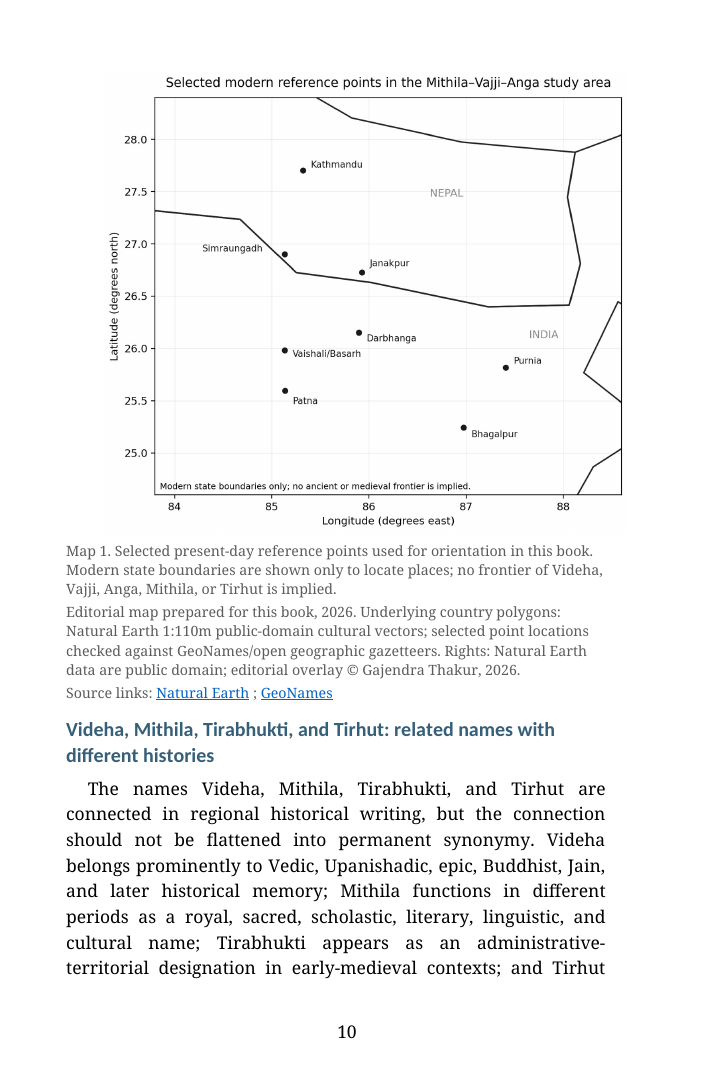
Mithila · Vajji · Anga
Chapter-specific source notes
- Primary chapter witness. Gajendra Thakur, Decoding the Panji of Mithila — Volume II, formal Chapter 4, PDF pp. 42-55; formal Chapter 4. The HTML transcription is generated from the commit-pinned source PDF and retains the chapter boundary recorded in this edition.
- Internal structure. The repository source-heading inventory records no separately encoded subordinate heading for this chapter.
- Digital editorial method. The page keeps the preserved source text distinct from generated navigational, concordance, visual, and provenance apparatus. The synthetic reconstruction is explanatory only and is not evidence for an individual lineage or a determination of social or marital status.