Decoding the Panji of Mithila · Volume II · Chapter 5
Key Relationship Words
Chapter 5

   Key Relationship Words
1. Why Relationship Words Are the Grammar of the
Panji
  The Panji is built from relationship words. Names provide
the material, villages provide the geography, numbers provide
anchors, and titles provide status, but relationship words
provide the grammar. Without them the record is only a
sequence of persons and places. With them it becomes
genealogy.
   The most important words in this chapter are सुत, सुतो, सुता,
सन्तति, अपत्य, पौत्र, प्रपौत्र, वृद्ध प्रपौत्र, दौहित्र, मातृक, चक्र, भ्राता, पुत्र, प्रवर, अपरा, and
related branch-marking expressions. Some of these words are
straightforward in general Sanskrit or Maithili usage. In Panji
usage, however, they often perform specialized archival work.
They do not merely define biological relation. They identify the
kind of data being recorded.
  This chapter therefore does not translate the words only
once. It explains how each word behaves inside the Panji, how

                 Decoding the Panji of Mithila - Volume II

it must be preserved in the data table, how it affects the
genealogical chart, and what errors must be avoided.

2. The Principle of Relational Reading
  A person in the Panji is never isolated. He or she appears
through relation. A name is connected upward to an ancestor,
downward to descendants, sideways to siblings or marriage
houses, and geographically to a village. Relationship words tell
the reader which direction to move.
   If the entry uses सुत or सुतो, the reader usually moves
vertically from father to son or son to father. If the entry uses
सन्तति or अपत्य, the reader moves from a remembered ancestor to
a branch or descendant group. If the entry uses पौत्र or प्रपौत्र, the
reader must count generational distance. If the entry uses दौहित्र,
the reader must cross through the daughter’s line. If the entry
closes with मातृक चक्र, the reader must leave the simple vertical
tree and draw a maternal-marriage circuit.
  The basic rule is simple: identify the relationship word
before identifying the final meaning of the entry.

3. सुत

   The word सुत generally means son. In Panji entries it is one of
the most common and important vertical markers. It usually
connects a person to his father or identifies a son inside a
longer chain.
   However, सुत must be read in context. Sometimes it appears
clearly between father and son. Sometimes it appears joined
with another name because of register compression.
Sometimes it is part of a title-bearing chain. Sometimes it
appears after a village frame, and the village relation must be
read together with the father-son relation.

                 Decoding the Panji of Mithila - Volume II

   Data rule: every occurrence of सुत should be recorded with
three fields: the person marked as son, the father or ancestor
connected to him, and the place or branch attached to the
statement.
  Critical caution: do not turn every nearby name into father
and son merely because सुत appears somewhere in the line. The
word must be attached to its immediate grammatical and
register context.

4. सुतो

   The form सुतो appears very frequently in the source. It often
functions like “son of” or “as son,” but in register style it may
introduce the next link in a chain. It can also appear in dense
sequences where several sons or descendants are named
quickly.
   A passage may move from one person to another with सुतो
and then immediately attach a village through सँ. The decoder
must decide whether the village belongs to the father, the son,
or the marriage/settlement link created by the phrase.
   Data rule: record सुतो exactly as written, not silently
converting it to सुत in the transcription layer. In the normalized
index layer, it may be grouped under the broader category
“son-marker,” but the original form must remain visible.
   Critical caution: because सुतो often occurs in a running chain,
it should not be decoded one word at a time without mapping
the entire chain first.

5. सुता

   The word सुता is one of the most dangerous words for the
modern reader because it may look simple but behaves flexibly
in Panji register. In Sanskrit, सुता can mean daughter in singular

                  Decoding the Panji of Mithila - Volume II

feminine contexts or sons/offspring in certain forms depending
on grammar. In the Panji, it often introduces offspring or a set
of children, and in many dense passages it functions as a
register marker for issue or descendants.
    A passage may say that a named person’s सुता are several
persons. Another passage may use सुता in a chain that links to a
village or marriage connection. The reader must not
automatically translate it as “daughter” or “sons” without
testing the context.
    Data rule: in the first transcription layer, keep सुता exactly as
written. In the segmented layer, mark it as “offspring-marker,
exact meaning context-dependent.” Only in the expanded prose
should the editor decide whether it means son, sons, daughter,
offspring, or issue.
    Critical caution: premature translation of सुता can create false
genealogy. It may turn a branch-list into daughters or turn a
daughter-line into sons. The safest first-pass rendering is “issue
of” or “offspring of,” followed by a note.

6. पुत्र

    The word पुत्र is less frequent than सुत in the compact register
but is conceptually important. It means son and is more
directly Sanskritic. Where पुत्र appears, it should usually be
treated as a clear son-marker unless the surrounding phrase
shows otherwise.
    The Panji may use पुत्र in more elaborated genealogical
descriptions, especially where the register shifts into a fuller
Sanskritic formulation. The presence of पुत्र may also help
clarify a chain in which सुत, पौत्र, and प्रपौत्र appear nearby.

    Data rule: पुत्र should be indexed together with सुत and सुतो as a
son-marker but preserved as a separate original term.

                 Decoding the Panji of Mithila - Volume II

   Critical caution: when पुत्र appears in a long generational
phrase, do not isolate it from adjacent पौत्र and प्रपौत्र markers.
The whole generational ladder must be read together.

7. सन्तति

   सन्तति is one of the main structural words of the Panji. It
means descent, progeny, continuation, or lineage. In the source
it often identifies a branch associated with an ancestor and a
place.
   When an entry says that a particular person’s सन्तति is
connected with a village, it does not necessarily mean that the
named ancestor personally lived there. It may mean that his
descendants, his recognized branch, or his lineage
continuation is known there.
   Data rule: record the ancestor or branch-name before सन्तति,
the village or place after it, and any inclusion marker such as
समेत. The entry should be tagged as a descent-line, not
automatically as a single-person biography.
   Critical caution: सन्तति should not be flattened into “children.”
In many entries it means a recognized lineage branch across
generations.

8. अपत्य

   अपत्य means offspring or descendant, but in the Panji it often
functions as a lineage-attachment marker. A name followed by
अपत्य may identify a branch descended from or attached to that
ancestor.
   In the opening pages, अपत्य appears repeatedly beside village
and branch information. This shows that अपत्य is a key device
for organizing the older village lists. It is more formal than an

                        Decoding the Panji of Mithila - Volume II

ordinary father-son statement and often points to a recognized
descent group.
   Data rule: in a table, अपत्य entries should be tagged as
“ancestor-attached branch.” The entry must preserve the name
before अपत्य, the place after it, and the surrounding village
frame.
   Critical caution: अपत्य is not always the same as a direct son.
It may mark descendants in a broader sense. If the entry gives
no immediate father-son chain, do not invent one.

9. पौत्र

   पौत्र means grandson. When this word appears, the reader
must count one generation below the son. It is a generational
marker and must not be ignored.
   In dense Panji passages, पौत्र may appear inside a longer line:
ancestor, son, grandson, great-grandson, and then a village
link. Such passages are valuable because they give more exact
generational distance than ordinary सन्तति entries.

   Data rule: whenever                 पौत्र appears, record the three-
generation structure if visible: ancestor, son, grandson. If the
father is not explicit, mark it as unresolved rather than
supplying a guessed name.
   Critical caution: do not treat पौत्र as a decorative honorific. It
is a precise genealogical term and may be decisive for
distinguishing two persons with the same name.

10. प्रपौत्र

   प्रपौत्र means great-grandson. In the Panji, it may appear in
very dense generational passages, sometimes together with पौत्र
and        पुत्र.   These   passages      are    especially         important   for
reconstruction because they provide depth.

                     Decoding the Panji of Mithila - Volume II

   A phrase may identify a person as the great-grandson of one
person, grandson of another, and son of another. Such a phrase
gives a chain of four generations. It must be preserved exactly.
    Data rule: प्रपौत्र entries should be entered into a generational
table, not merely translated in prose. The table should include
the great-grandfather, grandfather, father, and named person
if each is visible.
    Critical caution: if the OCR joins प्रपौत्र with a preceding name,
do not assume the joined cluster is one personal name.
Separate only after identifying the relation structure.

11. वृद्ध प्रपौत्र

    The phrase वृद्ध प्रपौत्र or joined forms such as वीरवृद्ध प्रपौत्र create
special difficulty. वृद्ध may mark an elder, senior, older branch,
or a generational qualifier depending on context. It may also
be affected by the joining of names and relation words.
   This term should be handled conservatively. It indicates that
the relationship is not merely a simple great-grandson
statement; the source is adding a qualifier. The qualifier may
distinguish a senior line from a junior one, or it may preserve
an older branch identity.
    Data rule: preserve वृद्ध exactly and do not omit it from the
normalized table. The entry should receive a caution tag:
“qualified great-grandson relation.”
    Critical caution: do not translate वृद्ध automatically as “old” in
a biographical sense. It may be structural rather than
descriptive.

12. दौहित्र

    दौहित्र means daughter’s son, maternal grandson. This is one of
the most important non-paternal relationship words in the
Panji. It changes the direction of reading.

                 Decoding the Panji of Mithila - Volume II

   If a person is marked as दौहित्र, he should not be placed as a
direct son in the paternal line currently being described. He
must be placed across a maternal connection. He belongs to
one house by father but carries relation to another house
through his mother.
   Data rule: every दौहित्र entry must include a maternal-link
field. The table should ask: whose daughter’s son is he? Which
house is being connected? Which village appears before and
after the marker? Is the maternal house explicit or only
implied?
   Critical caution: flattening दौहित्र into “descendant” is a serious
error. It destroys the evidence of the daughter’s line and
weakens the marriage network.

13. मातृक

   मातृक points to the maternal side. In the Panji it is most often
encountered in the compound मातृक चक्र, but it may also appear
in related phrases. It marks a shift from the direct father-line to
maternal affiliation.
   The maternal side matters because marriage regulation in
Mithila required knowledge not only of father-line descent but
also of maternal connections. A paternal tree alone cannot
explain all prohibitions and alliances. मातृक records the other
side of the social body.
   Data rule: मातृक should always trigger a change of table type.
The entry should be tagged as maternal, not only paternal.
   Critical caution: do not treat मातृक चक्र as a heading that can be
skipped after reading the names. It is the key to how the
preceding names are related.

14. चक्र

                Decoding the Panji of Mithila - Volume II

  चक्र means cycle, circle, or circuit. In the phrase मातृक चक्र, it
suggests not just a list but a relational circuit. The names
before the phrase form a connected maternal network.
   A cycle is different from a straight line. A straight line goes
ancestor, son, grandson. A cycle links houses through women,
marriages, and maternal memory. It may include several
villages and branches.
  Data rule: when चक्र closes a passage, the preceding lines
should be reviewed backward to identify the beginning of the
cycle. The table should include all names that belong to the
cycle, not only the last name before the closing phrase.
  Critical caution: if the boundary of the cycle is uncertain,
mark it as uncertain. Do not cut the cycle too short merely
because the last line is easiest to parse.

15. भ्राता and Brother Markers

  Words for brother or sibling connection, including भ्राता and
related forms, may appear less systematically than सुत or सन्तति
but remain important. Brother markers show collateral
relation. They help distinguish siblings from descendants.
  A brother relation can prevent a false vertical tree. If two
persons are brothers, one should not be made father of the
other. In a lineage chart, they belong to the same generation.
   Data rule: every brother marker should be recorded as a
lateral relation. The table should include a generation-level
field so that siblings are placed side by side.
  Critical caution: in dense Panji passages, a sequence of
names may be siblings even when modern punctuation is
weak. The relationship marker must be used to prevent false
descent.

16. अपरा

                  Decoding the Panji of Mithila - Volume II

  अपरा does not name a biological relation by itself, but it is
crucial for branch reading. It means “another,” “further,”
“other,” or “in another case.” In the Panji it often introduces
another branch, another marriage, another reading, another
line of the same person, or another related entry.
  When अपरा appears, the reader must ask: another what?
Another son? Another wife-line? Another branch? Another
village association? Another case of the same name?
  Data rule: mark अपरा as a branch divider. The table should
not merge the following data with the previous line unless the
relation is clear.
  Critical caution: ignoring अपरा may combine two separate
branches into one. Over-reading it may split one connected line
into two. The surrounding relation words must decide.

17. प्र., प्रo, and Identity Qualification

  Forms such as प्र., प्रo, or joined “प्र” appear frequently and are
not simple relationship words, but they affect identification.
They may mark “प्रसिद्ध,” “प्रवर,” “प्रभृति,” a prior name, an alias, a
title qualification, or another internal function depending on
context.
  Because the expansion is not always certain, the exact form
must be preserved. It may distinguish one individual from
another or introduce an alternate name. In some entries, it
seems to function like a qualifier before a person’s known
name.
  Data rule: record प्र. or प्रo in a separate qualifier column, not
as part of the personal name unless evidence demands it.
  Critical caution: do not erase प्र. as meaningless punctuation.
It may be one of the keys to identity.

                 Decoding the Panji of Mithila - Volume II

18. भगीनेय and Sister’s-Son Type Relations

  The source may contain terms related to nephew or sister’s-
son relations, such as भगीनेय. Such words, like दौहित्र, create a non-
direct paternal link. They show that the Panji preserves
collateral and maternal-side memory where socially relevant.
  Data rule: tag such entries as collateral or affinal-maternal,
not direct paternal. The table should ask whose sister or
daughter creates the relation.
  Critical caution: these terms are often easily missed because
they may appear within a dense line. Missing them can change
the whole genealogy.

19. Reading Relationship Chains
  Many Panji passages contain several relationship words in
one line. A phrase may move through प्रपौत्र, पौत्र, पुत्र, and सुता
before reaching a village. Such passages should be handled as
chains.
  The correct approach is to build a generational ladder. For
example:
  Generation 1: great-grandfather or earlier ancestor.
  Generation 2: grandfather.
  Generation 3: father.
  Generation 4: named person.
  Generation 5: sons or issue if listed.
   Only after this ladder is built should the passage be
translated into prose.
 Critical caution: if one link is unclear, leave that cell blank or
mark uncertain. Do not force a complete chain by guessing.

20. Relationship Words and Village Links Together
  Relationship words are never isolated from place. A son may
be linked to one village, a branch to another, a maternal

                Decoding the Panji of Mithila - Volume II

grandson to another, and a marriage house to another. The
relation word tells who is connected; the place marker tells
where or through whom.
  Therefore every relationship table must have a place
column. A genealogical chart without place will lose much of
the Panji’s meaning.
  Critical caution: a person’s village in one entry may not be
his birth-place. It may be a residence, branch-seat, marriage
house, or maternal link.

21. Relationship Words and Marriage Eligibility
  These words are not merely descriptive. They had practical
force in marriage decisions. A direct son-line, a सन्तति branch, a
maternal cycle, and a दौहित्र connection could affect whether two
houses were considered suitably distant or dangerously close.
   Thus the Panji’s relationship words are part of a social
regulatory system. They preserve the memory needed to judge
alliance.
  Critical caution: modern readers should not treat these
words only as family-history vocabulary. They belong to a
marriage-governance archive.

22. Source-Preserving Relationship Table
  For every relationship occurrence, the following fields
should be created:
  • Original phrase.
  • Relationship word exactly as written.
  • Normalized relationship category.
  • Person before the marker.
  • Person after the marker.
  • Village before the marker.
  • Village after the marker.

                   Decoding the Panji of Mithila - Volume II

  • Number if present.
  • Title if present.
   • Whether the relation is paternal, maternal, collateral,
affinal, or uncertain.
  • Expanded reading.
  • Critical caution.
 This table is the foundation of the later person index and
marriage network.

23. Common Errors in Reading Relationship Words
  The most common errors are as follows.
  First, translating सुता mechanically as daughter or sons
without context.
  Second, treating सन्तति as immediate children instead of a
descent branch.
  Third, reading अपत्य as direct sonship when it may mean
broader descendant-line.
  Fourth, ignoring पौत्र and प्रपौत्र and thereby losing generational
distance.
  Fifth, translating दौहित्र as descendant and thereby erasing the
daughter’s line.
  Sixth, treating मातृक चक्र as a decorative ending rather than a
structural category.
  Seventh, ignoring अपरा and merging separate branches.

  Eighth, erasing abbreviations such as प्र. because their
meaning is uncertain.
  Ninth, separating joined words without preserving the
original.
  Tenth, creating a modern family tree before building the
data table.

                 Decoding the Panji of Mithila - Volume II

24. Critical Analysis: What the Relationship Vocabulary
Reveals
  The relationship vocabulary of the Panji reveals the
priorities of Mithila’s genealogical culture. The record is not
satisfied with naming persons. It locates them in descent,
branch, place, maternal connection, marriage network, and
scholarly society.
  The frequent use of सन्तति and अपत्य shows the importance of
recognized branches, not merely individual biography. The use
of पौत्र and प्रपौत्र shows concern for generational precision. The
use of दौहित्र and मातृक चक्र shows that the daughter’s line and
maternal connections were socially meaningful. The use of अपरा
shows the need to preserve alternate or additional branches.
The use of titles beside relationship words shows that prestige
and descent were often recorded together.
   This vocabulary is therefore a social theory in miniature. It
tells us how Mithila remembered itself: through father, mother,
village, marriage, branch, title, and continuity.

25. Rules for Chapter 5
  The rules from this chapter may be summarized as follows.
  • Preserve every relationship word exactly as written.
  • Do not translate before segmenting.
  • Treat सुत, सुतो, and पुत्र as son-markers but preserve their
differences.
  • Treat सुता as context-dependent.

  • Treat सन्तति and अपत्य as branch and descent markers.

  • Treat पौत्र and प्रपौत्र as generational markers.

  • Treat दौहित्र as a daughter’s-son marker, never as ordinary
sonship.

                  Decoding the Panji of Mithila - Volume II

  • Treat मातृक चक्र as a maternal-marriage circuit.

  • Treat अपरा as a branch divider or alternate case marker.

  • Record every relationship word in a table before drawing a
family tree.

26. Conclusion: The Panji Opens Through Relations
   The Panji is not opened by names alone. It is opened by
relations. Once the reader understands how सुत, सुता, सन्तति, अपत्य,
पौत्र, प्रपौत्र, दौहित्र, and मातृक चक्र work, the record begins to change
from a dense list into an intelligible social map.
  Chapter 6 will now move from relationship words to village
formulae and settlement markers. It will explain how ग्राम, वासी,
डीह, मूलग्राम, तत्रैव, समेत, एते, and related expressions locate lineages
in the geography of Mithila.

                   Decoding the Panji of Mithila - Volume II
Source structure and verification apparatus
Editorial source apparatus. This apparatus is descriptive, not interpretive. It records the source-controlled structure used to verify that this page corresponds to formal Chapter 5 of Decoding the Panji of Mithila — Volume II. The chapter text above is preserved from PDF pp. 55-70; formal Chapter 5 in the commit-pinned authoritative source. It is not merged with a neighboring chapter, appendix, annexure, or independent front/back-matter unit. The internal headings below come from the repository’s source-heading inventory and are retained as navigational and audit evidence; showing them here does not turn those headings into separate publications or add claims that are absent from the source.
Internal source headings
No subordinate heading was separately encoded in the repository source-heading inventory for this chapter.
Source-text concordance
Relationship · Words · Grammar · built · Names · provide · material · villages · geography · numbers · anchors · titles · status · Without · record · sequence · persons · places · becomes · genealogy · important · related · branch-marking · expressions · straightforward · general · Sanskrit · Maithili · usage · however · often · perform · specialized · archival · work · merely · define · biological · relation · identify · kind · data · recorded · therefore · translate · explains · word · behaves · inside · Decoding · must · preserved · table · affects · genealogical · chart · errors · avoided · Principle · Relational · Reading · person · never · isolated · appears · name · connected · upward · ancestor · downward · descendants · sideways · siblings · marriage · houses · geographically · village · tell · reader · direction
Boundary verification. In the formal sequence this chapter follows Volume II Chapter 4, “The Basic Unit of a Panji Entry” and precedes Volume II Chapter 6, “Village Formulae and Settlement Markers”. The chapter extractor begins at the verified formal Chapter 5 marker and stops at the next verified formal chapter marker; for a final chapter it stops before recognized book-level back matter. The concordance above is generated only from distinct terms already present in this chapter’s preserved source text. It is provided for discovery, comparison, and audit, not as an automated judgment about persons, lineages, status, kinship, marriage eligibility, or historical truth.
Illustrated research apparatus
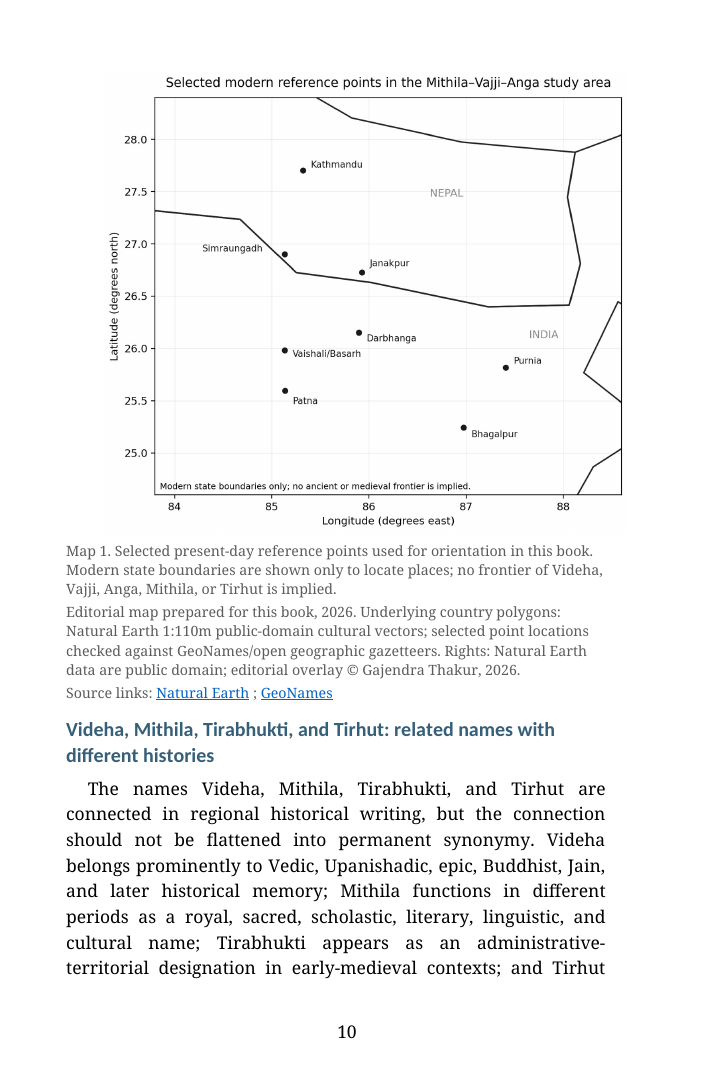
Mithila · Vajji · Anga
Chapter-specific source notes
- Primary chapter witness. Gajendra Thakur, Decoding the Panji of Mithila — Volume II, formal Chapter 5, PDF pp. 55-70; formal Chapter 5. The HTML transcription is generated from the commit-pinned source PDF and retains the chapter boundary recorded in this edition.
- Internal structure. The repository source-heading inventory records no separately encoded subordinate heading for this chapter.
- Digital editorial method. The page keeps the preserved source text distinct from generated navigational, concordance, visual, and provenance apparatus. The synthetic reconstruction is explanatory only and is not evidence for an individual lineage or a determination of social or marital status.