Decoding the Panji of Mithila · Volume II · Chapter 6
Village Formulae and Settlement Markers
Chapter 6

   Village Formulae and Settlement Markers

1. Why Village Formulae Matter
   The Panji cannot be decoded through personal names alone.
It is equally a geography of lineage. A family line is not merely
remembered through an ancestor; it is placed in a village, a
settlement, a डीह, a residence, a marriage house, or a branch-
seat. The geography is therefore not secondary. It is one of the
foundations of the record.
   In the opening pages of Prachin Panji, the source begins with
a village frame and then lists descent groups attached to it. This
arrangement tells us that the record sees genealogy through
place. A lineage is not floating in abstraction. It belongs to a
remembered village-world.
   The key village and settlement words in this chapter are ग्राम,
वासी, डीह, मूलग्राम, तत्रैव, समेत, एते, अथ, अपरा, आग्नेय, तत्र, पाली, and the
connector सँ when it joins person to place. These words must be
preserved exactly because each one marks a different kind of
geographical relation.

2. ग्राम

   ग्राम means village, but in the Panji it is also a register frame.
When a passage begins with “अथ ... ग्राम,” the text is not merely
mentioning a village. It is opening a cluster under which
several lineage entries may be placed.
   A village frame should be treated like a heading in a data
table. Every following entry belongs under that village until
another frame, closure, or transition appears. If the reader
ignores the frame, names and branches will be detached from
the place that gives them meaning.

                 Decoding the Panji of Mithila - Volume II

  Data rule: create a “village frame” column in every decoding
table. Do not record names without their governing ग्राम when
the source supplies one.
   Critical caution: a person listed under a village frame may
not personally originate there. The frame may indicate a
cluster of associated branches. The exact nature of the
association must be determined from the relation word and
connector.

3. अथ as a Village Opener

  अथ is one of the most important transition words. It means
“now,” “then,” or “next.” In the Panji, it often opens a new
village cluster or a new unit of record.
  When the source says “अथ सरिसब ग्राम” or “अथ माण्डर ग्राम,” it tells
the reader to reset the frame. The preceding cluster has ended
or shifted, and the following entries must be read under the
newly named village.
  Data rule: whenever अथ appears before a place, mark it as a
new frame unless the surrounding text clearly shows
otherwise.
  Critical caution: do not merge entries across अथ without
evidence. The word often prevents exactly that error.

4. एते as a Cluster Closure

  एते means “these.” In the Panji it often closes a group by
indicating that the preceding entries belong to the named
village cluster. A phrase such as “एते गंगोली ग्राम” should be read as
a closure: these are the entries of the Gangoli village group.
  This is important because the Panji may list many branches
before the closure. The closure tells us how far back the cluster

                 Decoding the Panji of Mithila - Volume II

probably extends. Without attention to एते, the reader may
either stop too early or carry the cluster too far.
  Data rule: record एते as a closure marker and review the
preceding entries to determine the boundary of the cluster.
 Critical caution: if the beginning boundary is uncertain,
mark the cluster boundary as probable, not absolute.

5. वासी

  वासी means resident or inhabitant. In the Panji, it marks
association with a place through residence or recognized
belonging. A person may be called वासी of one place even if his
ancestral origin lies elsewhere.
   The word is especially useful when distinguishing origin
from residence. If an entry says that a person or branch is
“वासी” of a village, the record is not necessarily saying that the
lineage began there. It is saying that the person or branch is
known as resident or associated there.
  Data rule: record वासी in a separate place-function column.
The place should be tagged as “residence/association,” not
automatically as “origin.”
  Critical caution: do not silently remove वासी in prose. It may
explain why the same branch appears in more than one
village.

6. डीह

  डीह is a crucial settlement word. It often refers to a habitation
site, an ancestral seat, a settlement mound, or a local
habitation connected with a larger village identity. In
genealogical memory, a डीह can carry the force of ancestral
location.

                     Decoding the Panji of Mithila - Volume II

   Where the Panji uses डीह, the reader should not treat it as an
ordinary village name only. It may identify the specific
settlement base of a branch. It may also help distinguish one
house from another within a larger village cluster.
   Data rule: record डीह as a settlement marker. If a phrase
contains both a village and डीह, both should be preserved.

   Critical    caution:      avoid     translating      डीह      too   narrowly.
“Ancestral site,” “settlement base,” or “habitation” may be
more accurate than simply “village,” depending on context.

7. मूलग्राम

   मूलग्राम means original village or root village. When this term
appears, it is of high genealogical value because it distinguishes
origin from later residence or marriage association.
   A branch may be found in several places, but its मूलग्राम
indicates the remembered root. This can help reconstruct
migration and branch dispersal. It can also prevent confusion
when the same family appears in multiple villages.
   Data rule: whenever मूलग्राम appears, tag the place as
“origin/root village.” It should receive higher genealogical
priority than ordinary residence unless later evidence modifies
the reading.
   Critical caution: मूलग्राम is a claim of remembered origin. It
should be preserved as source evidence, not automatically
converted into modern administrative geography.

8. तत्रैव and तत्र

   तत्रैव means “there itself” or “in that very place.” तत्र means
“there.” These words prevent unnecessary repetition of a place
already mentioned. They depend on the preceding context.

                Decoding the Panji of Mithila - Volume II

  The danger is that a modern reader may skip तत्रैव because it
looks like a small adverb. In fact, it may carry the place
reference for the entry. If the preceding village is lost, तत्रैव
becomes meaningless; if the preceding village is preserved, तत्रैव
becomes a precise pointer.
  Data rule: when तत्रैव appears, fill the place field from the
immediately preceding relevant place and mark it as “place
supplied from तत्रैव.”

  Critical caution: the antecedent of तत्रैव must be identified
carefully. If more than one place appears before it, do not
guess without noting uncertainty.

9. समेत

  समेत means “including,” “together with,” or “along with.” It
expands a place or branch. When the Panji says that a lineage
is associated with one village “समेत” another, it shows that the
entry includes more than one settlement or sub-branch.
  Data rule: every place after समेत should be recorded as part
of the same unit, not as a new independent entry unless
punctuation or formula demands it.
   Critical caution: do not drop secondary places introduced by
समेत. They may preserve branch dispersal or associated
settlements.

10. The Dash as Place Attachment
   Many entries use a dash-like structure between a lineage
marker and a place: ancestor or branch-name, relation word,
dash, village. This dash functions like an attachment marker. It
often means that the branch is associated with the named
place.

                Decoding the Panji of Mithila - Volume II

  For example, an entry of the form “X सन्तति-Y” should first be
read as “the descendants or branch of X are associated with Y.”
Only later should the editor decide whether Y is origin,
residence, or branch-seat.
  Data rule: record the dash as a connector. In the first pass,
label it “place attachment,” not “from” or “at.”
   Critical caution: do not translate every dash as “of.” The
relation may be broader than possession.

11. सँ as a Place Connector

  The word सँ is the most flexible place connector in the Panji.
It can mean from, through, with, by, or connected with. When
it links a person and a place, the exact meaning depends on the
entry type.
  If the entry is paternal, सँ may indicate origin or residence. If
the entry is marriage-related, सँ may indicate the house into
which marriage occurred. If the passage is maternal, सँ may
mark a maternal or affinal connection. If it follows a title-
bearing person, it may identify the place where that scholar or
branch was known.
  Data rule: in the segmentation layer, translate सँ only as
“linked with.” In the critical explanation layer, specify whether
the link is origin, residence, marriage, maternal, affinal, or
uncertain.
  Critical caution: early translation of सँ is one of the easiest
ways to damage the record.

12. पाली as a Settlement and Social Marker

  पाली appears frequently in the source, sometimes attached to
villages or as part of a settlement identity. It should be
preserved exactly. It may indicate a locality, subdivision,

                Decoding the Panji of Mithila - Volume II

habitation, or known social settlement within a larger village-
world.
  In some passages, a place name followed by पाली may identify
the specific locality of a branch. In other passages, पाली may be
part of a compound place-name. The editor must not separate
or normalize it too quickly.
  Data rule: record पाली exactly with the associated place. If
later evidence shows that it is a locality marker, tag it
accordingly in the gazetteer.
  Critical caution: do not treat every पाली as identical in
function. Context decides whether it                 is     a   place-name
component or a settlement-type marker.

13. आग्नेय and Directional Markers

   Occasionally, the source may include directional or
locational qualifiers such as आग्नेय. Such words are valuable
because they locate a branch more precisely inside a
settlement geography.
   A directional marker may distinguish one settlement from
another with the same or similar name. It may also preserve
local orientation known to the original community.
   Data rule: preserve directional words in the place field and
also in a separate “direction/qualifier” field.
   Critical caution: do not translate a directional marker away.
It may be essential for identifying the correct locality.

14. समेत, ओ, and Multiple Place Lists

 The Panji often links more than one place in a single entry. It
may use समेत, ओ, commas, or simple sequence. Such lists must
be preserved as lists. They may indicate multiple settlements of
the same branch, related villages, or inclusive clusters.

                 Decoding the Panji of Mithila - Volume II

  For example, if a branch is attached to “कटमा ओ सकु री,” both
Katma and Sakuri must remain attached to the same branch in
the first pass. Splitting them into two independent branches
would be premature.
  Data rule: when multiple places appear in one entry, create
a multi-place field and record the connector exactly: ओ, समेत,
comma, dash, or sequence.
  Critical caution: multiple-place lists are often evidence of
branch expansion. They should not be simplified.

15. Village Clusters and Migration
   The repeated appearance of the same village or family
across different sections suggests movement, branching, or
marriage linkage. A branch may begin in one village, appear as
resident in another, and be connected by marriage with a
third. This is not disorder. It is the social geography of Mithila.
  Migration should not be assumed in every multi-place entry,
but it should be considered. When the same ancestor-name and
branch appear with multiple locations, the editor should ask
whether the text is preserving movement, settlement
expansion, marriage connection, or variant association.
  Data rule: in the gazetteer, each village should include all
associated persons, branches, titles, and relation types. This
will allow patterns of movement to emerge from the data
rather than from guesswork.
   Critical caution: do not narrate migration unless the source
provides enough evidence. Use “associated with,” “recorded
at,” or “linked to” when the exact movement is uncertain.

16. Village Names and Variant Spellings
   Village names may appear in variant spellings because of
older orthography, local pronunciation, scribal practice, print
transmission, or OCR distortion. A single place may have more

                 Decoding the Panji of Mithila - Volume II

than one written form. Conversely, similar spellings may refer
to different places.
  The editor must therefore build a variant list. The original
form must be preserved, while the normalized form is created
only for indexing. Each normalization should carry evidence.
   Data rule: the village gazetteer should have at least four
fields: original spelling, normalized spelling, source location,
and confidence level.
  Critical caution: do not force all similar names into one
modern spelling. False normalization can corrupt the
geography of the Panji.

17. Village as Origin, Residence, Marriage House, or
Branch Seat
   A single place reference may perform different functions. It
may mark origin, current residence, marriage house, maternal
link, daughter’s married house, branch seat, title association,
or inclusion within a cluster.
   The same village may therefore appear in different columns
of the data table depending on context. If the entry is paternal,
the place may be a branch seat. If the entry is marked by विवाह,
the place may belong to the spouse’s house. If the entry
contains दौहित्र, the place may belong to the maternal link. If the
entry uses वासी, the place is residence or recognized belonging.

  Data rule: never use one generic “village” column only. Use
columns for place name and place function.
  Critical caution: a place name without a function is
incomplete data.

18. Critical Analysis: What the Village Formulae Reveal
   The village formulae show that Mithila remembered lineage
geographically. Social memory was not stored only in the body
of the family. It was stored in the relation between family and

                 Decoding the Panji of Mithila - Volume II

place. Villages were not passive backgrounds. They were
containers of lineage identity.
  The recurrence of ग्राम, वासी, डीह, समेत, तत्रैव, and multi-place lists
shows a society attentive to origin, residence, branch dispersal,
and alliance. A lineage becomes legible only when placed. The
Panji is therefore both genealogy and gazetteer.
   The village formulae also reveal the administrative and
social intelligence of the record. The Panji knew that a person
could be connected to more than one place. It preserved that
complexity instead of flattening it. A family could have a root
village, a residence, a marriage link, and a branch settlement.
All of these mattered.

19. The Village Gazetteer Protocol
  To enshrine the geographical data, a village gazetteer must
be created alongside the person index. The gazetteer should
include:

1. Original village form as written.

2. Normalized village form, if known.

3. Source segment and page or line reference.

4. Governing frame, if any.

5. Associated person or ancestor.

6. Relationship word attached to the place.

7. Connector: dash, सँ , वासी, समेत, तत्रैव, ओ, or sequence.

  8. Place function: origin, residence, marriage, maternal,
branch-seat, inclusion, closure, or uncertain.

9. Variant spellings.

10. Critical note.

                 Decoding the Panji of Mithila - Volume II

  This gazetteer will later allow the reader to see not only
where a place occurs but what role it plays in the genealogical
system.

20. Rules for Reading Village Formulae
  The rules of this chapter may be summarized as follows.
  First, identify the village frame before reading the names.
  Second, preserve ग्राम, वासी, डीह, मूलग्राम, तत्रैव, समेत, एते, and अथ
exactly.
  Third, treat सँ first as “linked with” and decide its meaning
only after structural analysis.
 Fourth, distinguish origin, residence, marriage house,
maternal link, and branch-seat.
  Fifth, record all variant spellings before normalizing.
  Sixth, do not remove secondary places introduced by समेत or
ओ.

  Seventh, treat एते as a cluster closure.

  Eighth, do not narrate migration without evidence.
  Ninth, create a gazetteer alongside the person index.
  Tenth, remember that the Panji is a social map of Mithila.

21. Conclusion: Place as Genealogical Evidence
  The Panji cannot be decoded without geography. A name
becomes meaningful when placed; a branch becomes traceable
when its villages are recorded; a marriage becomes visible
when its settlement link is understood; a maternal cycle
becomes legible when its houses are mapped.
   Chapter 7 will now return to the two great descent words,
सन्तति and अपत्य. It will explain their difference, their overlap,
and the careful method needed to interpret them without
turning branch records into false direct father-son lines.

Decoding the Panji of Mithila - Volume II

                   Decoding the Panji of Mithila - Volume II
Source structure and verification apparatus
Editorial source apparatus. This apparatus is descriptive, not interpretive. It records the source-controlled structure used to verify that this page corresponds to formal Chapter 6 of Decoding the Panji of Mithila — Volume II. The chapter text above is preserved from PDF pp. 70-82; formal Chapter 6 in the commit-pinned authoritative source. It is not merged with a neighboring chapter, appendix, annexure, or independent front/back-matter unit. The internal headings below come from the repository’s source-heading inventory and are retained as navigational and audit evidence; showing them here does not turn those headings into separate publications or add claims that are absent from the source.
Internal source headings
No subordinate heading was separately encoded in the repository source-heading inventory for this chapter.
Source-text concordance
Village · Formulae · Settlement · Markers · Matter · cannot · decoded · personal · names · alone · equally · geography · lineage · family · line · merely · remembered · ancestor · placed · residence · marriage · house · branch · seat · therefore · secondary · foundations · record · opening · pages · Prachin · begins · frame · lists · descent · groups · attached · arrangement · tells · sees · genealogy · place · floating · abstraction · belongs · village-world · words · connector · joins · person · must · preserved · exactly · marks · different · kind · geographical · relation · means · register · passage · text · mentioning · cluster · several · entries · treated · like · heading · data · table · Every · following · entry · another · closure · transition · appears · reader · ignores
Boundary verification. In the formal sequence this chapter follows Volume II Chapter 5, “Key Relationship Words” and precedes Volume II Chapter 7, “Reading “सन्तति” and “अपत्य””. The chapter extractor begins at the verified formal Chapter 6 marker and stops at the next verified formal chapter marker; for a final chapter it stops before recognized book-level back matter. The concordance above is generated only from distinct terms already present in this chapter’s preserved source text. It is provided for discovery, comparison, and audit, not as an automated judgment about persons, lineages, status, kinship, marriage eligibility, or historical truth.
Illustrated research apparatus
Mithila · Vajji · Anga
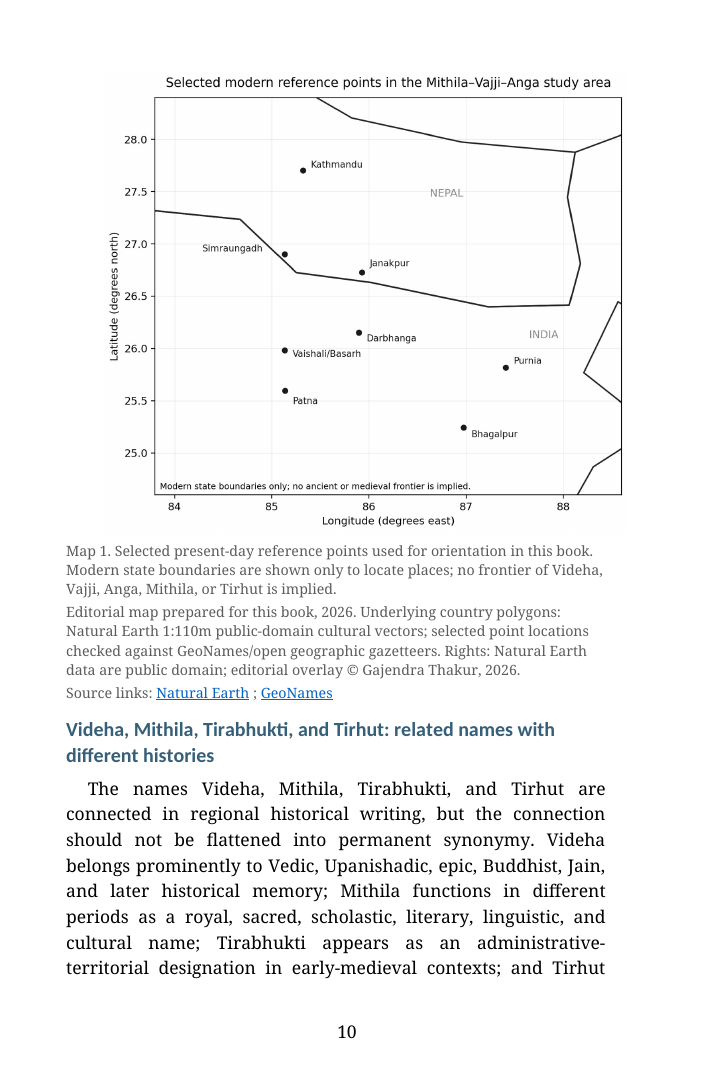
Chapter-specific source notes
- Primary chapter witness. Gajendra Thakur, Decoding the Panji of Mithila — Volume II, formal Chapter 6, PDF pp. 70-82; formal Chapter 6. The HTML transcription is generated from the commit-pinned source PDF and retains the chapter boundary recorded in this edition.
- Internal structure. The repository source-heading inventory records no separately encoded subordinate heading for this chapter.
- Digital editorial method. The page keeps the preserved source text distinct from generated navigational, concordance, visual, and provenance apparatus. The synthetic reconstruction is explanatory only and is not evidence for an individual lineage or a determination of social or marital status.