Decoding the Panji of Mithila · Volume II · Chapter 7
Reading “सन्तति” and “अपत्य”
Chapter 7

  Reading “सन्तति” and “अपत्य”
1. Why These Two Words Need a Separate Chapter
  Among the key relationship words of Prachin Panji, सन्तति
and अपत्य require separate treatment because they are not
ordinary one-generation terms. They do not always behave like
सुत, पुत्र, पौत्र, or प्रपौत्र. They often mark branch identity rather than
direct father-son sequence. They may preserve a house, a line,
a known descent-group, or an ancestor-attached village
association.
  A careless reader may translate सन्तति as “children” and अपत्य
as “son.” That would be too narrow. In many entries these
words indicate a recognized descent-line spread across a
village or settlement. They may also preserve an older ancestor
whose descendants are now known by a later place-name. The
terms therefore belong to the grammar of lineage continuity.
   This chapter explains how to read these two terms without
reducing the Panji to a false modern family tree. It also sets the
data protocol for preserving every occurrence of these words
in the manuscript, the index, and the later genealogical tables.

2. सन्तति: Continuity, Descent, and Branch

  सन्तति broadly means continuity, progeny, descendants, or
lineage. In the Panji, it often points not to one child but to the
continuation of a named ancestor through a branch. It is
therefore best understood as a lineage-continuity marker.
  When an entry says that the सन्तति of a person is attached to a
village, the safest first expansion is: “the descendant-line or
branch of this person is associated with that place.” This leaves

                Decoding the Panji of Mithila - Volume II

open whether the place is an origin, residence, branch-seat,
later settlement, or known family location.
  The word should not be flattened into “children.” Children
are one generation. सन्तति may refer to a longer continuation. It
may include sons, grandsons, later descendants, and
recognized branch-members. In a register like the Panji, सन्तति
is social and genealogical at once.

3. अपत्य: Offspring-Line and Ancestor Attachment

  अपत्य also means offspring, progeny, or descendant. In Panji
usage, however, it often functions as an ancestor-attachment
marker. A name followed by अपत्य identifies a branch as
descended from, attached to, or remembered through that
named person.
  This word is especially common in compact village-list style.
A sequence such as “X अपत्य - Y” should not be expanded too
quickly as “X’s son Y.” The form may mean that the
descendants or branch of X are associated with Y village or
locality. The person before अपत्य may be a remembered
ancestor rather than the immediate father of the next named
person.
  Thus अपत्य is genealogically important but structurally
different from सुत. सुत tends toward direct sonship. अपत्य often
marks descent-group identity.

4. The Difference Between सन्तति and अपत्य

  The difference between सन्तति and अपत्य should be understood
as a difference of emphasis, not a rigid wall.
  सन्तति emphasizes continuation. It points to the continuing
line, the descendants, the branch that proceeds from a named

                Decoding the Panji of Mithila - Volume II

person. अपत्य emphasizes offspring or descent from a named
ancestor. It attaches a branch to an ancestral source.
   In practice the two may overlap. Both can mark descent.
Both can connect an ancestor with a village. Both can be used
in compact register entries. The decoder should therefore
avoid forcing an artificial distinction. The question is not only
“What does the dictionary say?” The question is “What is the
term doing in this entry?”
  A useful working distinction is this: when सन्तति appears, first
think “continuing line”; when अपत्य appears, first think
“offspring-line attached to an ancestor.” Then refine the
interpretation by context.

5. Why They Are Not Always Direct Descent Statements
  The most serious error is to treat every सन्तति or अपत्य entry as
a direct father-son statement. These words often point to a
branch across time. A branch may be known by an ancestor,
but the entry may not give all generations between the
ancestor and the recorded settlement.
  For example, if an entry says that the सन्तति of a named
person is linked to a village, the text may be preserving the fact
that the branch continued there. It may not be naming the
immediate son. Similarly, an अपत्य entry may attach a village to
an ancestor’s offspring-line without listing each generation.
  A direct father-son relation should be drawn only where the
source gives a son-marker such as सुत, सुतो, पुत्र, or a clear
generational chain. Where only सन्तति or अपत्य appears, the chart
should show a descent-branch, not a definite father-son edge.

6. How to Enter सन्तति in a Data Table

  Every occurrence of सन्तति should be entered with the
following fields: original phrase, ancestor or branch-name

                Decoding the Panji of Mithila - Volume II

before the word, exact form of सन्तति, place or village after the
word, connector if present, number if present, title if present,
governing village frame, and critical note.
  The relationship category should be marked as “lineage-
continuity” or “descent-branch.” It should not be marked
simply as “child.” If the surrounding passage later gives sons or
grandsons, those can be linked separately.
  The critical note should ask: does this entry identify a
branch-seat, a residence, a village group, a migration trace, or
an ancestral continuity? The answer should be based on
evidence, not assumption.

7. How to Enter अपत्य in a Data Table

  Every occurrence of अपत्य should be entered with equal care.
The table should include: original phrase, ancestor-name
before अपत्य, exact attached form, place or person following the
marker, governing village frame, connector, title, number, and
uncertainty note.
   The relationship category should be marked as “ancestor-
attached offspring-line.” This phrase preserves both the
biological and archival force of the word. It says that the
branch is remembered through an ancestor, but it does not
falsely claim that the next name is necessarily the immediate
son.
  If later evidence shows a direct father-son relation, the table
can be enriched. But the first reading must remain
conservative.

8. The Dash After सन्तति or अपत्य

  Many entries attach a place after a dash or dash-like break.
The pattern may appear as “X सन्तति - Y” or “X अपत्य - Y.” In such
cases, the dash often works as a place-attachment marker. It

                Decoding the Panji of Mithila - Volume II

should not automatically be translated as “of,” “from,” or “son
of.”
   The first-pass expansion should be: “the branch or offspring-
line of X is linked with Y.” After that, the surrounding frame
may clarify whether Y is a village, locality, branch-seat,
residence, or marriage-related place.
 The dash is a connector, not an explanation. The explanation
must be supplied only after the entry has been segmented.

9. सन्तति and Village Frames

  सन्तति frequently appears under village frames. This means
that the word operates both genealogically and geographically.
It says that a branch of a named person belongs somewhere
within the village-world being described.
  If the entry appears under “अथ ... ग्राम,” the governing village
frame must be recorded before the branch place. The line may
contain more than one place: the governing village cluster and
the specific branch location. Losing either one weakens the
data.
   A decoder must therefore distinguish “frame village” from
“attached place.” The frame may be the larger cluster. The
attached place may be the branch-seat or associated
settlement.

10. अपत्य and Ancestral Prestige

  अपत्य entries often preserve the remembered importance of
an ancestor. The named ancestor may be the reason the branch
is identifiable. His name functions like an anchor. The branch
may carry his memory even when many generations have
passed.
  This is why अपत्य should be indexed by ancestor-name. A
person appearing before अपत्य may become a key to grouping

                   Decoding the Panji of Mithila - Volume II

several branches. The index should therefore allow the reader
to search not only current persons but also ancestor-
attachment names.
  Critical analysis should ask: why is this ancestor preserved?
Was the branch known through him? Did he mark a learned
house, a migration point, a village founder, or a socially
recognized line? These questions may not always be
answerable immediately, but they must be kept visible.

11. सन्तति, अपत्य, and Titles

    Sometimes a descent or offspring marker appears beside a
title-bearing person. This is especially significant. If a branch is
attached to a महामहोपाध्याय, कवि, वैयाकरण, ज्योतिर्विद, or पण्डित, the entry
may preserve not only descent but intellectual prestige.
   The title must therefore remain attached to the entry. Do not
separate title from lineage. A scholar’s title may explain why
his branch was carefully remembered, why the line appears in
a prominent position, or why later descendants used his name
as an anchor.
  Data rule: whenever सन्तति or अपत्य appears with a title, the
title should be entered in both the person index and the title
index.

12. सन्तति, अपत्य, and Numbers

  Numbers attached to सन्तति or अपत्य entries are important.
They may indicate register positions, notes, generation
references, or cross-links. Their meaning should not be
guessed, but their placement must be preserved.
  The data table should record whether the number follows
the ancestor-name, follows the relation word, follows the
branch place, or appears before a note. A number attached to a
branch may later help align the same branch with another
passage.

                 Decoding the Panji of Mithila - Volume II

   Critical caution: never remove a number from a descent
entry because it seems unexplained. The unexplained number
is part of the source’s architecture.

13. When सन्तति and अपत्य Overlap

  In some clusters, सन्तति and अपत्य appear near each other. This
does not necessarily mean two different systems are being
used. It may show that the Panji preserves both the continuity
of a branch and the ancestral attachment of another branch in
the same village group.
   The decoder should not try to standardize all such entries
into one term. If the source uses सन्तति, preserve सन्तति. If it uses
अपत्य, preserve अपत्य. The difference may matter later.

   Normalization is useful for searching, but the original
relation word is sacred data. It belongs to the source and must
remain visible.

14. False Direct Genealogy: A Warning
  Suppose a modern editor sees “X सन्तति - Y” and draws X as
father of Y. This may be wrong. Y may be a village, not a
person. Or Y may be a branch-place. Or the entry may mean
that X’s descendants are found at Y. The false father-son line
would then corrupt the genealogy.
  Similarly, if an editor sees “X अपत्य - Y” and treats Y as X’s
immediate child, the entire branch may be compressed falsely.
The Panji may be naming the ancestral source and the later
branch location, not a direct son.
   The rule is strict: direct genealogy requires direct
relationship evidence. सन्तति and अपत्य alone usually produce
branch evidence, not complete generational sequence.

15. How to Represent These Terms in Charts

                  Decoding the Panji of Mithila - Volume II

  In a genealogical chart, सुत or पुत्र can usually be drawn as a
solid vertical line from father to son. पौत्र and प्रपौत्र can be drawn
with generational distance. But सन्तति and अपत्य should often be
drawn differently.
  A सन्तति relation may be represented as a dotted descent-
branch from the ancestor to a branch box. An अपत्य relation
may be represented as an ancestor-attachment arrow from the
named ancestor to the offspring-line. These visual distinctions
prevent false precision.
  If later entries supply exact generations, the dotted line can
be replaced by a full chain. Until then, the chart should show
that the descent is real but the intermediate generations are
not fully specified in that entry.

16. Critical Analysis: What These Words Reveal
  The use of सन्तति and अपत्य reveals that the Panji is interested
in continuity more than biography. It does not always stop to
narrate each life. It preserves the line, the branch, the place,
and the ancestral attachment.
   This tells us something important about Mithila’s social
memory. A person mattered not only as an individual but as
the source of a continuing house. A village mattered not only as
a residence but as the visible location of a branch. An ancestor
mattered because his name organized later descendants.
   The Panji therefore remembers society through continuity.
सन्तति and अपत्य are the words by which continuity becomes
record.

17. Source-Enshrinement Protocol for सन्तति and अपत्य

  For every occurrence of these two terms, the book’s working
database should preserve the following: exact original phrase;
source segment; page or line; governing village frame;

                Decoding the Panji of Mithila - Volume II

ancestor-name; relation term; attached place or person;
connector; number; title; closure marker; normalized ancestor
form; normalized place form; expanded meaning; uncertainty
note; and chart recommendation.
  This protocol ensures that no data are lost when the prose
chapter is later converted into tables, indexes, appendices, or
family charts.

18. Rules for Reading सन्तति and अपत्य

  First, preserve the exact word used by the source.
  Second, read सन्तति first as lineage-continuity or branch.

  Third, read अपत्य first as ancestor-attached offspring-line.

  Fourth, do not turn either word into direct sonship without
additional evidence.
  Fifth, distinguish frame village from attached place.
  Sixth, keep titles, numbers, and connectors attached to the
entry.
  Seventh, chart uncertain branch descent with dotted or
branch-level notation.
  Eighth, index both the original form and the normalized
form.
  Ninth, preserve uncertainty openly.
   Tenth, remember that these words are the Panji’s grammar
of continuity.

19. Conclusion: Continuity as Record
  सन्तति and अपत्य show that the Panji is not merely a list of
immediate fathers and sons. It is a record of continuity. It
preserves houses, branches, settlement attachments, ancestral
names, and social memory across generations.
 To decode these words properly is to respect the Panji’s own
method. The record does not always give a modern family tree,

               Decoding the Panji of Mithila - Volume II

but it gives the evidence from which responsible family trees
can later be built. The decoder’s duty is to preserve the
evidence before drawing the tree.
  Chapter 8 will now examine the small but powerful
connector “सँ.” That word links persons to villages, houses to
houses, and paternal lines to marriage and maternal networks.
Its meaning changes with context, and therefore it requires
careful decoding.

                 Decoding the Panji of Mithila - Volume II
Source structure and verification apparatus
Editorial source apparatus. This apparatus is descriptive, not interpretive. It records the source-controlled structure used to verify that this page corresponds to formal Chapter 7 of Decoding the Panji of Mithila — Volume II. The chapter text above is preserved from PDF pp. 82-92; formal Chapter 7 in the commit-pinned authoritative source. It is not merged with a neighboring chapter, appendix, annexure, or independent front/back-matter unit. The internal headings below come from the repository’s source-heading inventory and are retained as navigational and audit evidence; showing them here does not turn those headings into separate publications or add claims that are absent from the source.
Internal source headings
No subordinate heading was separately encoded in the repository source-heading inventory for this chapter.
Source-text concordance
Reading · Words · Need · Separate · relationship · Prachin · require · treatment · ordinary · one-generation · terms · always · behave · like · often · mark · branch · identity · rather · direct · father-son · sequence · preserve · house · line · known · descent-group · ancestor-attached · village · association · careless · reader · translate · children · narrow · many · entries · indicate · recognized · descent-line · spread · across · settlement · older · ancestor · whose · descendants · later · place-name · therefore · belong · grammar · lineage · continuity · explains · read · without · reducing · false · modern · family · tree · sets · data · protocol · preserving · every · occurrence · manuscript · index · genealogical · tables · Descent · broadly · means · progeny · points · child · continuation · named
Boundary verification. In the formal sequence this chapter follows Volume II Chapter 6, “Village Formulae and Settlement Markers” and precedes Volume II Chapter 8, “Reading “सँ” in the Panji”. The chapter extractor begins at the verified formal Chapter 7 marker and stops at the next verified formal chapter marker; for a final chapter it stops before recognized book-level back matter. The concordance above is generated only from distinct terms already present in this chapter’s preserved source text. It is provided for discovery, comparison, and audit, not as an automated judgment about persons, lineages, status, kinship, marriage eligibility, or historical truth.
Illustrated research apparatus
Mithila · Vajji · Anga
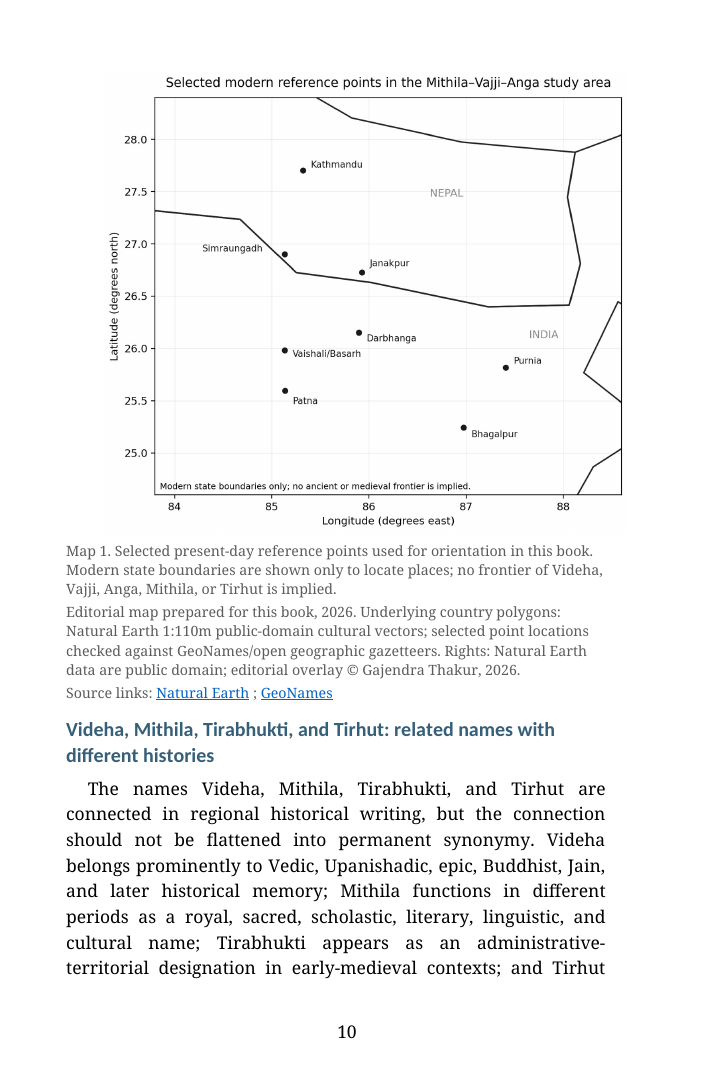
Chapter-specific source notes
- Primary chapter witness. Gajendra Thakur, Decoding the Panji of Mithila — Volume II, formal Chapter 7, PDF pp. 82-92; formal Chapter 7. The HTML transcription is generated from the commit-pinned source PDF and retains the chapter boundary recorded in this edition.
- Internal structure. The repository source-heading inventory records no separately encoded subordinate heading for this chapter.
- Digital editorial method. The page keeps the preserved source text distinct from generated navigational, concordance, visual, and provenance apparatus. The synthetic reconstruction is explanatory only and is not evidence for an individual lineage or a determination of social or marital status.