Decoding the Panji of Mithila · Volume II · Chapter 8
Reading “सँ” in the Panji
Chapter 8

  Reading “सँ” in the Panji
1. The Small Word That Opens Many Doors
  Among all the compact signs of Prachin Panji, the word “सँ”
is one of the most powerful. It is small, common, and easy to
underestimate. Yet it can decide whether an entry refers to
origin, residence, marriage connection, maternal linkage,
branch association, or social affiliation. A careless translation
of “सँ” can distort an entire genealogy.

  In ordinary Maithili, “सँ” may mean from, with, by, through,
or connected with. In the Panji, it carries all these possibilities
and more. It is not a fixed English preposition. It is a connector
whose meaning changes according to the type of entry in
which it appears.
  This chapter therefore treats “सँ” as a relational hinge. It
joins names to places, houses to houses, and paternal records
to maternal and marriage networks. The decoder must first
preserve it, then classify it, and only after that translate it.

2. Why “सँ” Cannot Be Translated Too Early

  The most common error is to translate every “सँ” as “from.”
Sometimes that is correct. Often it is not enough. A person may
be linked “सँ” a village because he came from that village,
resided there, married into that house, was connected through
his mother, or belonged to a branch known there.
  For this reason, the first-pass translation of “सँ” should be
“linked with.” This neutral phrase keeps the relation open. The
critical explanation can then decide whether the link means

                Decoding the Panji of Mithila - Volume II

from, through, at, by marriage into, by maternal connection, or
by branch association.
  Data rule: in the transcription layer, preserve “सँ” exactly. In
the segmentation layer, mark it as a connector. In the
interpretation layer, classify its function. In the prose layer,
translate it only after classification.
  Critical caution: early certainty is dangerous. If the
surrounding entry is not yet understood, leave “सँ” as “linked
with” rather than forcing “from.”

3. “सँ” as Origin

  In some entries, “सँ” does appear to indicate origin. A person
or branch may be linked with a village in a way that suggests
that the village is the source-place of the house. This is
especially likely when the entry belongs to a descent line and
no marriage or maternal marker is present.
  However, origin should not be assumed merely because a
place follows “सँ.” The Panji often preserves more than one
kind of place relation. A source-place, a residence, and a
marriage-house may all be expressed through the same
connector. Therefore the origin reading must be supported by
surrounding evidence.
  Data rule: classify “सँ” as origin only when the entry’s
structure supports that reading. If the passage uses मूलग्राम,
ancestral branch markers, or a clear village-frame relation, the
origin reading becomes stronger.
  Critical caution: origin is a high-value claim. Do not assign it
casually.

4. “सँ” as Residence or Settlement Association

  Many entries use “सँ” to show that a person or branch is
associated with a place. This may mean residence or

                Decoding the Panji of Mithila - Volume II

recognized settlement, not necessarily ancestral origin. The
Panji is concerned with where a branch is known, where it is
located, and where it participates in the social geography of
Mithila.
  If an entry contains वासी, the place function is clearer. But
even without वासी, “सँ” may still carry a settlement meaning.
The reader should ask: is the place acting as the present
location of the branch? Is the person known through that
village? Does the same line appear elsewhere with another
place, suggesting movement or branch dispersal?
  Data rule: when “सँ” appears without enough evidence for
origin or marriage, classify it first as “settlement association.”
Later comparison may refine the category.
  Critical caution: settlement association is not weaker
evidence. It is simply different from origin.

5. “सँ” as Marriage Connection

  In marriage entries, “सँ” often links one house with another.
It may indicate the village or family into which marriage
occurred. If the surrounding passage contains विवाह, पत्नी, अपरा,
मातृक चक्र, or a sequence of daughter/maternal references, the
connector should be tested as a marriage-link.
   This use is central to the Panji’s purpose. Marriage was one
of the reasons genealogy had to be remembered. A place
following “सँ” in such a passage may identify the affinal house
rather than the person’s own ancestral village.
   Data rule: in a marriage-context entry, create two place
fields: natal/lineage place and affinal/marriage place. Do not
collapse them into one village column.

                    Decoding the Panji of Mithila - Volume II

   Critical caution: translating a marriage “सँ” as simple “from”
can move a person into the wrong house and destroy the
affinal evidence.

6. “सँ” in मातृक चक्र

   When a passage belongs to a मातृक चक्र, “सँ” becomes even
more delicate. A maternal cycle does not follow the straight
line of father, son, grandson. It moves through mothers,
daughters, marriage houses, and maternal descendants. In
such passages, “सँ” may mark the place through which the
maternal connection is formed.
  The decoder must therefore change the table type. Instead of
asking only “where is this man from?” one must ask “through
which house or village does the maternal link pass?”
   Data rule: inside a मातृक चक्र, classify “सँ” as maternal or affinal
until the exact function becomes clear. The data table should
contain columns for maternal house, affinal house, and linked
village.
   Critical caution: a मातृक चक्र passage should never be read as a
simple sequence of origins.

7. “सँ” with दौहित्र

   When “सँ” appears near दौहित्र, the entry is not a simple
paternal settlement statement. दौहित्र means daughter’s son.
Therefore the place connected by “सँ” may belong to the
maternal house, the daughter’s married house, or the social
location of the daughter’s-son relation.
   A daughter’s son stands between two lineages. “सँ” may tell
us where that crossing occurs. If we translate it only as “from,”
we may place him incorrectly in a paternal tree.

                 Decoding the Panji of Mithila - Volume II

  Data rule: every “सँ ... दौहित्र” entry should be tagged as a
daughter-line or maternal-bridge entry. The table should ask:
whose daughter’s son is he, and which village is the maternal
or affinal connector?
  Critical caution: never make a दौहित्र entry into direct sonship
merely because a village follows “सँ.”

8. “सँ” with सुत and सुतो

  When “सँ” appears in a father-son chain, it may attach the
son to a place, the father to a place, or the whole branch to a
place. Dense entries often move quickly: father, son-marker,
name, place connector, another name, number, and closure.
The reader must map the chain before assigning the place.
  The safest method is to mark all names first, then all relation
words, then all place connectors. After that, test which person
the place most naturally modifies.
  Data rule: in a chain containing सुत or सुतो and “सँ,” the place
should be recorded with a provisional tag: “attached to nearest
relation, to be verified.” Only after the entire entry is
segmented should the place function be fixed.
  Critical caution: do not attach the place automatically to the
nearest name if a larger branch structure is visible.

9. “सँ” with सन्तति and अपत्य

  When “सँ” appears near सन्तति or अपत्य, it often connects a
branch or ancestor-attached line with a place. This is different
from direct personal origin. The entry may mean that the
descendants of a named ancestor are associated with a village.
  In such cases, the “सँ” relation belongs to the branch rather
than only to one individual. The branch may include many
descendants, and the place may be a branch-seat, residence, or
remembered association.

                Decoding the Panji of Mithila - Volume II

  Data rule: classify these entries as branch-place links. Record
the ancestor-name, the relation word, the place after “सँ,” and
the governing village frame.
  Critical caution: do not turn a branch-place link into a direct
biography.

10. “सँ” and Multiple Places

  Some entries contain more than one place. A line may
include a governing village frame, a branch place, a “सँ” place,
and another place introduced through ओ, समेत, or sequence. In
such cases, “सँ” is only one part of the geographical statement.

  The decoder must preserve all places and their connectors. A
place before “सँ” and a place after “सँ” may have different
functions. The first may be a frame; the second may be a link; a
third may be an included settlement.
   Data rule: do not use one undifferentiated place field. Use
separate columns for frame village, direct place attachment,
“सँ” place, included place, and normalized place.

  Critical caution: multiple-place entries often preserve
movement or network structure. Simplifying them destroys
data.

11. “सँ” and Numbers

  Numbers often appear near “सँ” links. The number may
belong to the person, the branch, the marriage, the note, or the
register position. Its relationship to the “सँ” phrase must be
preserved.
   For example, if a number appears immediately before or
after a “सँ” place, the table should record that position exactly.
Later comparison may show whether similar number-
placement carries a consistent meaning.

                   Decoding the Panji of Mithila - Volume II

  Data rule: every “सँ” entry should include a number-position
field: before connector, after connector, after linked person,
after linked place, or note-marked.
  Critical caution: do not move numbers into footnotes or
delete them from prose. They are part of the entry structure.

12. “सँ” and Titles

  When a titled person is linked with a place through “सँ,” the
entry may preserve both intellectual status and geographical
identity. A महामहोपाध्याय, वैयाकरण, ज्योतिर्विद, कवि, पण्डित, or बाबू may be
associated with a village through residence, lineage, or fame.
  The title-place relation can be historically important. It may
reveal a scholarly house, a teaching lineage, or a village known
for a learned family. Therefore the “सँ” place should be entered
not only in the person index but also in the title index.
  Data rule: every title-bearing “सँ” entry should be tagged for
the person index, village gazetteer, and title index.
  Critical caution: title plus place may be a clue to intellectual
history, not merely genealogy.

13. “सँ” and अपरा

  When अपरा introduces another branch or case, “सँ” in the
following phrase may belong to the new branch, not to the
previous one. This is a common source of error. If the reader
misses अपरा, the “सँ” place may be attached backward to the
wrong branch.
  Data rule: when अपरा appears before a “सँ” phrase, begin a
new provisional unit. Then test whether the following place
belongs to another branch, another marriage, another reading,
or another line of the same person.

                Decoding the Panji of Mithila - Volume II

  Critical caution: अपरा and “सँ” together often signal that the
source is opening another relational path.

14. “सँ” and OCR Difficulty

  In the digital files, “सँ” is sometimes joined to the preceding
or following word. This creates visual difficulty. A phrase such
as “दरिहरा सँ” may appear joined; a name may attach to the
connector; or OCR may misread the nasal sign. The editor must
therefore search for forms both with and without spaces.
  Data rule: preserve the original joined form in transcription,
but create a segmented reading in the analysis layer. If the
segmentation is uncertain, mark it.
  Critical caution: never assume that a joined form is one
word. The connector may be hidden inside it.

15. A Four-Step Method for “सँ”

  Every “सँ” entry should be decoded in four steps.

  First, preserve the original phrase exactly as written.
  Second, segment the phrase into person, relation word, title,
number, “सँ,” place, and closure.

  Third, classify the connector: origin, residence, branch-seat,
marriage, maternal link, daughter-line, title association, or
uncertain.
  Fourth, write the expanded meaning in prose, keeping
uncertainty visible.
  This method prevents the small connector from being
overtranslated.

16. Example of Neutral First-Pass Reading
  A compact phrase such as “माण्डर सँ हाड़ी दौहित्र” should not be
immediately translated as “Hadi from Mandar.” Because दौहित्र

                Decoding the Panji of Mithila - Volume II

appears, the safer first-pass reading is: “a daughter’s-son
connection linked with Mandar and Hadi.” Only after the
surrounding entry is decoded can the precise maternal relation
be stated.
  Likewise, a father-son phrase with “सोदरपुर सँ” may first be
recorded as “linked with Sodarpur.” If the passage is paternal,
it may become “from Sodarpur” or “of the Sodarpur branch.” If
it is maternal, it may become “through the Sodarpur house.”
  Neutral first-pass reading is not weakness. It is discipline.

17. Critical Analysis: What “सँ” Reveals

  The frequent use of “सँ” reveals that the Panji thinks
relationally. It is not content to name persons in isolation. It
must connect them: to villages, branches, mothers, daughters,
marriages, titles, and houses.
   This connector shows that Mithila’s genealogy was not a
static vertical ladder. It was a network. People belonged to
places, but also moved through alliances. Houses had origins,
but also residences. Daughters crossed into other houses, but
their sons remained genealogically meaningful. Scholars
carried place identities along with titles.
  “सँ” is therefore one of the words through which the Panji
becomes a social map. It records connection itself.

18. The “सँ” Data Table

  To enshrine all occurrences of “सँ,” the working table should
contain the following fields: source segment; page or line;
original phrase; word before “सँ”; word after “सँ”; relation word
nearby; title nearby; number nearby; place before connector;
place after connector; entry type; provisional meaning; final
classified meaning; uncertainty note; index tags.

                Decoding the Panji of Mithila - Volume II

  The entry type should be one of the following: paternal,
branch, village cluster, marriage, maternal cycle, दौहित्र, title-
bearing, note-linked, or uncertain.
  This table will later allow a reader to sort all “सँ” entries by
function and discover patterns of settlement, marriage, and
maternal linkage.

19. Rules for Reading “सँ”

  First, never translate “सँ” automatically as “from.”

  Second, preserve the original phrase exactly.
  Third, identify the entry type before deciding the meaning.
  Fourth, use “linked with” in the first pass.
  Fifth, classify the link as origin, residence, branch-seat,
marriage, maternal, affinal, daughter-line, title association, or
uncertain.
  Sixth, keep the place function separate from the place name.
  Seventh, treat “सँ” near दौहित्र or मातृक चक्र as a maternal or
affinal clue.
  Eighth, treat “सँ” near विवाह as a marriage-house clue.

  Ninth, record all numbers and titles near the connector.
  Tenth, do not erase uncertainty.

20. Conclusion: The Connector as Evidence
  The word “सँ” is small, but it carries major evidence. It may
mark origin, settlement, marriage, maternal crossing, branch
location, or scholarly affiliation. It is the hinge by which the
Panji joins persons to the world around them.
  To read “सँ” correctly is to resist over-simplification. The
Panji is not merely saying where someone is from. It is often
saying how one house is connected with another, how a branch

                Decoding the Panji of Mithila - Volume II

is placed, how a daughter-line is remembered, or how a
maternal cycle is completed.
  Chapter 9 will now turn to the numbers in parentheses.
These numbers are among the most difficult features of
Prachin Panji. Like “सँ,” they must be preserved before they can
be explained.

                Decoding the Panji of Mithila - Volume II
Source structure and verification apparatus
Editorial source apparatus. This apparatus is descriptive, not interpretive. It records the source-controlled structure used to verify that this page corresponds to formal Chapter 8 of Decoding the Panji of Mithila — Volume II. The chapter text above is preserved from PDF pp. 92-103; formal Chapter 8 in the commit-pinned authoritative source. It is not merged with a neighboring chapter, appendix, annexure, or independent front/back-matter unit. The internal headings below come from the repository’s source-heading inventory and are retained as navigational and audit evidence; showing them here does not turn those headings into separate publications or add claims that are absent from the source.
Internal source headings
No subordinate heading was separately encoded in the repository source-heading inventory for this chapter.
Source-text concordance
Reading · Small · Word · Opens · Many · Doors · compact · signs · Prachin · powerful · common · easy · underestimate · decide · whether · entry · refers · origin · residence · marriage · connection · maternal · linkage · branch · association · social · affiliation · careless · translation · distort · entire · genealogy · ordinary · Maithili · mean · connected · carries · possibilities · fixed · English · preposition · connector · whose · meaning · changes · according · type · appears · therefore · treats · relational · hinge · joins · names · places · houses · paternal · records · networks · decoder · must · first · preserve · classify · translate · Cannot · Translated · Early · error · every · Sometimes · correct · Often · enough · person · linked · village · came · resided · married
Boundary verification. In the formal sequence this chapter follows Volume II Chapter 7, “Reading “सन्तति” and “अपत्य”” and precedes Volume II Chapter 9, “Reading Numbers in Parentheses”. The chapter extractor begins at the verified formal Chapter 8 marker and stops at the next verified formal chapter marker; for a final chapter it stops before recognized book-level back matter. The concordance above is generated only from distinct terms already present in this chapter’s preserved source text. It is provided for discovery, comparison, and audit, not as an automated judgment about persons, lineages, status, kinship, marriage eligibility, or historical truth.
Illustrated research apparatus
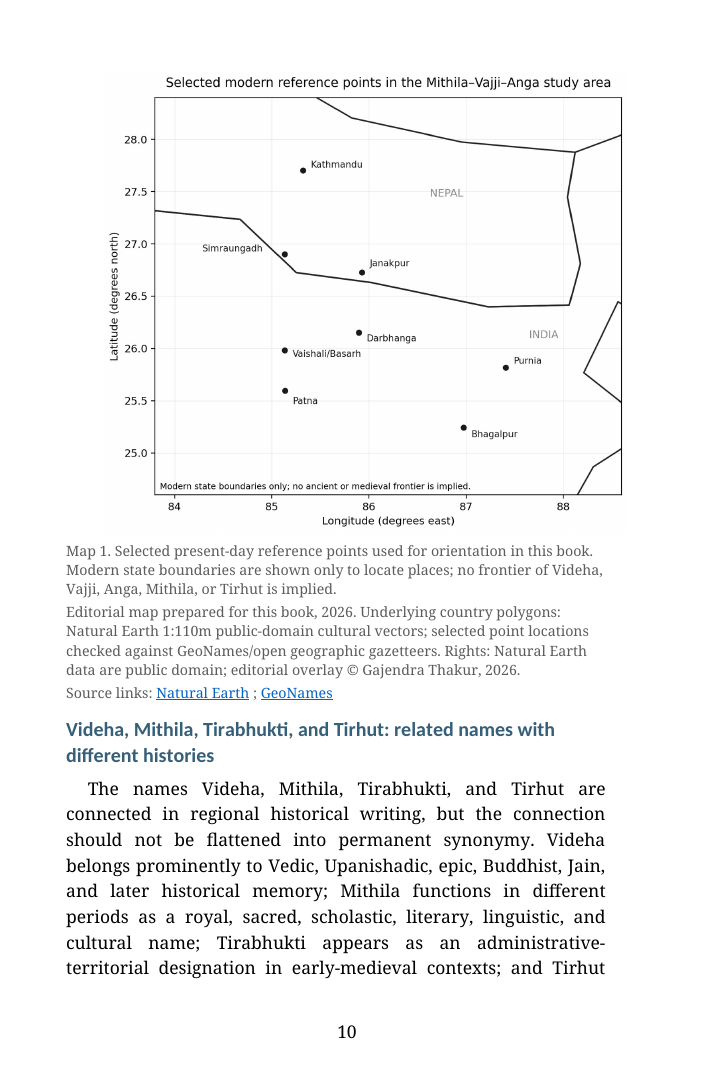
Mithila · Vajji · Anga
Chapter-specific source notes
- Primary chapter witness. Gajendra Thakur, Decoding the Panji of Mithila — Volume II, formal Chapter 8, PDF pp. 92-103; formal Chapter 8. The HTML transcription is generated from the commit-pinned source PDF and retains the chapter boundary recorded in this edition.
- Internal structure. The repository source-heading inventory records no separately encoded subordinate heading for this chapter.
- Digital editorial method. The page keeps the preserved source text distinct from generated navigational, concordance, visual, and provenance apparatus. The synthetic reconstruction is explanatory only and is not evidence for an individual lineage or a determination of social or marital status.