Decoding the Panji of Mithila · Volume II · Chapter 9
Reading Numbers in Parentheses
Chapter 9

  Reading Numbers in Parentheses
1. Why the Numbers Need Their Own Method
  The numbers in Prachin Panji are among the most difficult
features of the source. They appear in parentheses, beside
names, after relationship chains, near village links, inside
marriage entries, and beside note markers such as टीप. Some
numbers are simple. Some contain one slash. Some contain
double slashes. Some include zero. Some appear in pairs. Some
sit next to date expressions. Some seem to mark internal
references rather than genealogy itself.
   Because their function is not always obvious, the first duty is
preservation. A number must not be deleted because it is
unexplained. It must not be silently corrected because it looks
irregular. It must not be moved away from the word beside
which it appears. The number is part of the entry. It is
evidence.
   This chapter does not pretend that every number can be
fully solved at once. Instead, it gives a disciplined method:
classify the number, preserve its exact form, record its
position, compare repeated patterns, and interpret only when
the evidence is strong.

2. The Main Forms of Numbering
  The source shows several kinds of numerical forms. The
principal types are:

1. simple parenthetical numbers, such as (१३१) or (१८०);

2. single-slash numbers, such as (८७/०), (११०/०७), or (१४३/०९);

                Decoding the Panji of Mithila - Volume II

3. double-slash numbers, such as (२२७//०४), (१७//०८), or
(५४//०३);

4. numbers with zero elements, such as (५८//०) or (८७/०);

5. paired parenthetical numbers appearing near one
another;

6. numbers attached to टीप;

7. numbers appearing beside marriage entries;

8. numbers appearing inside generational chains;

9. numbers appearing beside titles or honorifics;

10. numbers appearing near village or connector
phrases.
   The variety itself is important. It warns us against one
universal explanation. A single-slash number may not perform
the same function as a double-slash number. A number beside
टीप may not behave like a number beside a son-marker. A
simple number at the beginning of a page may not have the
same role as a number inside a genealogical chain.

3. Preserve the Number Exactly
   The first rule is exact preservation. If the source writes
(२२७//०४), the editor must preserve the double slash. If the
source writes (८७/०), the zero must remain. If the source writes
(११०/०७ टीप), the word टीप must remain attached. If the number
appears before a name, it should not be moved after the name.
If it appears after a name, it should not be moved to a footnote.
  Exact preservation matters because the form may later
reveal the system. A single slash may distinguish one register

                Decoding the Panji of Mithila - Volume II

category from another. A zero may indicate absence,
continuation, or a specific internal code. Double slashes may
mark a separate layer of reference. Until the system is fully
established, the original form is the only safe evidence.
  Data rule: every number must be copied in a separate
“number as written” field. Never store only a normalized
number.
   Critical caution: do not modernize the number by changing
Devanagari numerals into Roman numerals in the source
layer. Roman equivalents may be added for searching, but the
original Devanagari form must be preserved.

4. Simple Parenthetical Numbers
  Simple parenthetical numbers such as (१३१), (१८०), or (३७६)
may appear as large sequence markers, page-linked markers,
entry numbers, or register references. Their exact function
must be determined by location and repetition.
   A simple number at the beginning of a passage may differ
from a simple number inside a genealogical entry. If two
simple numbers appear together, they may belong to different
systems: one could be a page-like marker and the other an
entry-like marker. The editor must record them separately
rather than combining them.
   Data rule: classify simple parenthetical numbers by position:
line-opening, page-opening, entry-internal, post-name, pre-
name, post-closure, or paired.
  Critical caution: never assume that a simple parenthetical
number is a generation number unless the surrounding
genealogical words prove it.

5. Single-Slash Numbers
  Single-slash forms such as (८७/०), (११०/०७), (१४३/०९), and (२५/०५)
are frequent in the source. They may represent an internal

                Decoding the Panji of Mithila - Volume II

reference divided into two parts. The first element and second
element should be recorded separately, but only after the
whole original form is preserved.
  A single-slash number may sit after a person, before a place,
beside a title, or near a marriage marker. Its position may
decide its function. A number after a named person may
identify that person or entry. A number after a relationship
phrase may identify a branch. A number near विवाह may belong
to the marriage record. A number before टीप may point to a
note.
  Data rule: store single-slash numbers in four fields: original
form, left element, right element, and position.
   Critical caution: do not treat the left element as page and
right element as line until evidence confirms that pattern. It
may be tempting, but it must be proven.

6. Double-Slash Numbers
  Double-slash forms such as (२२७//०४), (१७//०८), (५४//०३), and
(३३२//१०) require special care. The double slash is unlikely to be
accidental if it recurs consistently. It may indicate a different
reference layer, a sub-register, a copied notation, or a
structural distinction from single-slash numbers.
  The double slash must be preserved in all layers. In the
normalized search layer, the editor may also create a
searchable form without slashes, but that must not replace the
original.
   Data rule: tag double-slash numbers separately from single-
slash numbers. Record the word immediately before and after
each occurrence.
  Critical caution: if a double-slash form appears near a family
branch and a single-slash form appears near a marriage or
note, do not merge their functions without evidence.

                Decoding the Panji of Mithila - Volume II

7. Numbers with Zero
  Forms containing zero, such as (८७/०) or (५८//०), are especially
important. Zero may represent absence, continuation, null
value, register subdivision, or a legitimate numbered code. It
should never be dropped.
  In old registers, zero may be a meaningful placeholder.
Removing it could change the reference. For example, (८७/०) is
not the same as (८७), and (५८//०) is not the same as (५८). The
form with zero tells us that the source wanted two fields, even
if the second field is zero.
  Data rule: create a “zero-present” flag in the number table.
  Critical caution: do not treat zero as OCR dirt. Only page-
image verification or repeated context can justify emendation.

8. Paired Parenthetical Numbers
  Sometimes two parenthetical numbers appear close
together. They may represent two numbering systems
operating at once. One may be a page or section marker; the
other may be an entry marker. They may also indicate a cross-
reference between registers.
  The editor should not combine paired numbers into one. If
the source has (१८०) (३७६), the data table should record two
numbers with their relative order and spacing. Their relation
can be analyzed later.
  Data rule: paired numbers should be entered as Number A
and Number B, with exact sequence preserved.
  Critical caution: do not assume that the larger number is
always a page number or that the smaller number is always an
entry number. The source must decide.

9. Numbers Beside Names

                  Decoding the Panji of Mithila - Volume II

  Many numbers appear immediately after personal names.
These may identify the person, the entry, a branch, or a cross-
reference. The number should remain attached to the person
in the data table, but the interpretation should remain
cautious.
  A number after a repeated name can be especially useful. If
two persons have the same name but different numbers, the
numbers may help distinguish them. Conversely, if the same
name and same number recur in related contexts, the number
may help confirm identity.
  Data rule: every person index entry should include all
numbers found beside that person, with source locations.
  Critical caution: a number beside a name does not
automatically prove that every later occurrence of the name
without the number is the same person.

10. Numbers Beside Relationship Words
  Numbers may appear beside सुत, सुतो, सुता, पौत्र, प्रपौत्र, सन्तति, अपत्य,
or दौहित्र phrases. These numbers may identify a generational
link, entry reference, branch, or note. Their placement is
important.
   If a number appears between a father and son, it may belong
to one of them or to the relation itself. If it appears after a list
introduced by सुता, it may belong to the group. If it appears
before a place introduced by सँ, it may belong to the person or
branch before the place.
  Data rule: for every numbered relationship entry, create a
“number attachment” field: attached to person, relation,
branch, place, group, note, or uncertain.
    Critical caution: when attachment is uncertain, do not force
it. Mark “uncertain attachment” and preserve the sequence.

11. Numbers Beside Village Links

                    Decoding the Panji of Mithila - Volume II

  When numbers appear near village links, they may identify
a branch associated with that village. This is especially likely
where the entry contains a person, a relation word, a number,
and a place introduced by सँ or a dash.

   Such numbers may become valuable in the village gazetteer.
They can help distinguish one branch of a village from another.
They may also help align the same village-linked branch across
different source segments.
  Data rule: the village gazetteer should include a number
column. Every place reference should carry nearby numbers if
the source supplies them.
  Critical caution: do not strip numbers from the village index.
A place without its number may lose its connection to the
register system.

12. Numbers Beside Titles
   A number beside a title-bearing person may help identify
that scholar or official more precisely. When a title such as
महामहोपाध्याय, वैयाकरण, ज्योतिर्विद, कवि, पण्डित, बाबू, ठाकु र, or चौधरी appears
near a number, the title and number should be indexed
together.
  The same title may belong to multiple persons. The number
may help distinguish them. It may also help connect a titled
person across different passages.
  Data rule: the title index should include the exact number
near the title-bearing entry.
  Critical caution: do not separate title, number, and village.
Together they may form the identifying cluster.

13. Numbers Beside विवाह

  Marriage entries sometimes contain numbers, dates, or both.
The number must be separated from the date. A parenthetical
number is not the same as a lunar date phrase such as फाल्गुन

                      Decoding the Panji of Mithila - Volume II

कृ ष्ण   चतुर्दशी.   The   date   belongs      to    calendrical   time;   the
parenthetical number belongs to the register system unless
evidence proves otherwise.
   In a विवाह entry, the number may identify the marriage
record, the person, the branch, or a note. It may also connect
the marriage entry to a later maternal cycle.
  Data rule: marriage tables should have separate columns for
register number, date phrase, bride/groom side, village links,
and later issue.
  Critical caution: do not convert a register number into a
date. Do not convert a date phrase into a register number.

14. Numbers Beside दौहित्र

   A दौहित्र entry marks a daughter’s-son relation. If a number
appears near such an entry, it may identify a maternal or
affinal connection rather than a paternal descent-line. The
number should therefore be entered into the maternal-link
table as well as the person index.
  This is especially important because daughter’s-son entries
are bridge entries. They may connect two houses. A number
near them may later help reconstruct the maternal network.
   Data rule: all numbered दौहित्र entries should be tagged as
maternal or affinal in the number table.
  Critical caution: do not move the number into the paternal
chain unless the source clearly supports that attachment.

15. Numbers with टीप

   When a number appears with टीप, the source is pointing
toward a note, annotation, or reference layer. The word टीप
must remain attached to the number. Such entries should be
treated separately from ordinary numbered entries.

                Decoding the Panji of Mithila - Volume II

  A टीप number may indicate that the entry has an explanatory
note, correction, variant reading, or cross-reference. Even if
the note is not immediately visible, the marker proves that the
record has another layer.
  Data rule: create a “note-marked number” category. Record
the exact form, including टीप, and tag the entry for later note-
recovery.
  Critical caution: never delete टीप because the note is not yet
found. The marker itself is evidence.

16. Numbers and Page-Like Headings
   Some numbers appear in positions that look like page,
section, or printed-register headings. They may be part of the
document layout rather than a specific genealogy. These must
still be preserved, but they should be classified differently.
   A page-like heading should not be attached to the nearest
person unless the source clearly does so. The editor should
distinguish layout numbers from entry numbers.
  Data rule: create a category called “layout or section
number.” Use it when a number appears separated from the
genealogical phrase or aligned with page/section structure.
  Critical caution: do not use layout numbers as genealogical
proof.

17. Numbers and OCR Risk
  Numbers are vulnerable to OCR error. A slash may be lost. A
double slash may become a single slash. A zero may be
confused with another mark. Parentheses may disappear. A
danda may be mistaken for a slash or separator.
   Therefore number readings should be verified where
possible against page images, repeated forms, and context. If
the source has a suspicious number, the editor should preserve
it with an uncertainty mark rather than silently correcting it.

                Decoding the Panji of Mithila - Volume II

  Data rule: add a confidence field to the number table: clear,
probable, damaged, OCR-risk, or unresolved.
  Critical caution: a number that looks strange may still be
original. Do not emend without evidence.

18. The Number Table
  To enshrine the numerical data, the book should maintain a
number table with the following columns:

1. Source segment.

2. Page or line reference.

3. Original number exactly as written.
  4. Number type: simple, single-slash, double-slash, zero-
present, paired, note-marked, date-adjacent, layout, or
uncertain.

5. Word immediately before the number.

6. Word immediately after the number.

7. Person attached, if clear.

8. Relation word nearby.

9. Village or place nearby.

10. Title nearby.
   11. Entry type: paternal, branch, village, marriage, maternal,
दौहित्र, note, title, or layout.

12. Probable function.

13. Confidence level.

14. Critical note.

                 Decoding the Panji of Mithila - Volume II

  This table will later allow the numerical system to be studied
across the entire source.

19. How Numbers Help Critical Analysis
   Numbers are not merely technical clutter. They may reveal
how the Panji was organized, copied, cross-referenced,
expanded, and annotated. They may distinguish persons,
branches, titles, marriages, notes, and source layers. They may
also show that the record was not casual memory but
disciplined registration.
   The presence of varied numbering suggests that the Panji
had an internal architecture. The architecture may not be fully
visible at first, but it can be reconstructed by careful collection.
The more faithfully the numbers are preserved, the more likely
the system will become intelligible.
  Critical analysis must therefore treat numbers as a second
skeleton of the Panji. Relationship words create the
genealogical skeleton. Village markers create the geographical
skeleton. Numbers may create the archival skeleton.

20. Common Errors in Reading Numbers
  The most common errors are:
  First, deleting numbers because they are unexplained.
  Second, treating all numbers as page numbers.
  Third, treating all numbers as generation numbers.
  Fourth, ignoring the difference between single slash and
double slash.
  Fifth, dropping zeros.
  Sixth, separating टीप from the number.

  Seventh, moving numbers away from names or relations.
  Eighth, converting date phrases and register numbers into
one category.

                Decoding the Panji of Mithila - Volume II

  Ninth, failing to record numbers in the village and title
indexes.
  Tenth, correcting OCR-risk numbers without evidence.
  Each error weakens the source. The safer path is exact
preservation followed by cautious analysis.

21. Rules for Reading Numbers in Parentheses
  First, preserve every number exactly as written.
  Second, classify the form: simple, slash, double slash, zero,
paired, note-marked, date-adjacent, or layout.
  Third, record the words immediately before and after the
number.
   Fourth, keep numbers attached to persons, places, titles,
relationship words, or notes only when the attachment is clear.
  Fifth, mark uncertain attachment openly.
  Sixth, never drop zero.
  Seventh, never erase टीप.

  Eighth, do not treat a register number as a date.
  Ninth, verify doubtful numbers against images or repeated
patterns where possible.
  Tenth, build a complete number table before offering final
conclusions about the numbering system.

22. Conclusion: Numbers as Archival Memory
   The numbers in Prachin Panji are difficult because they
belong to the internal discipline of the register. They may point
to entries, notes, branches, persons, pages, sections, or another
system not yet fully decoded. Their difficulty is not a reason to
ignore them. It is a reason to preserve them more carefully.
   A name tells us who is remembered. A relationship word
tells us how that person is related. A village tells us where the
branch is placed. A title tells us social or scholarly rank. A

               Decoding the Panji of Mithila - Volume II

number may tell us how the record itself organized that
memory.
  Chapter 10 will now turn to abbreviations and titles. Like
numbers, abbreviated titles are small signs with large
importance. They identify rank, learning, office, prestige, and
sometimes the key that distinguishes one person from another.

                    Decoding the Panji of Mithila - Volume II
Source structure and verification apparatus
Editorial source apparatus. This apparatus is descriptive, not interpretive. It records the source-controlled structure used to verify that this page corresponds to formal Chapter 9 of Decoding the Panji of Mithila — Volume II. The chapter text above is preserved from PDF pp. 103-116; formal Chapter 9 in the commit-pinned authoritative source. It is not merged with a neighboring chapter, appendix, annexure, or independent front/back-matter unit. The internal headings below come from the repository’s source-heading inventory and are retained as navigational and audit evidence; showing them here does not turn those headings into separate publications or add claims that are absent from the source.
Internal source headings
No subordinate heading was separately encoded in the repository source-heading inventory for this chapter.
Source-text concordance
Reading · Numbers · Parentheses · Need · Method · Prachin · difficult · features · appear · beside · names · relationship · chains · near · village · links · inside · marriage · entries · note · markers · simple · contain · slash · double · slashes · include · zero · pairs · next · date · expressions · seem · mark · internal · references · rather · genealogy · function · always · obvious · first · duty · preservation · number · must · deleted · unexplained · silently · corrected · looks · irregular · moved · away · word · appears · part · entry · evidence · pretend · every · fully · solved · Instead · gives · disciplined · classify · preserve · exact · form · record · position · compare · repeated · patterns · interpret · strong · Main · Forms · Numbering
Boundary verification. In the formal sequence this chapter follows Volume II Chapter 8, “Reading “सँ” in the Panji” and precedes Volume II Chapter 10, “Abbreviations and Titles”. The chapter extractor begins at the verified formal Chapter 9 marker and stops at the next verified formal chapter marker; for a final chapter it stops before recognized book-level back matter. The concordance above is generated only from distinct terms already present in this chapter’s preserved source text. It is provided for discovery, comparison, and audit, not as an automated judgment about persons, lineages, status, kinship, marriage eligibility, or historical truth.
Illustrated research apparatus
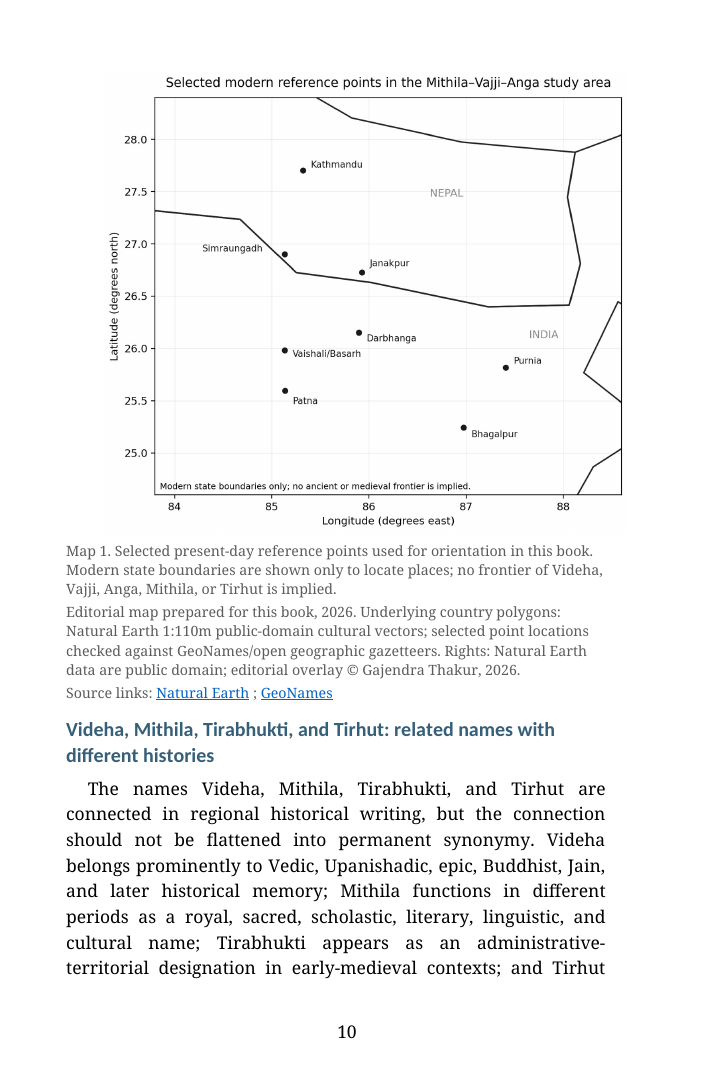
Mithila · Vajji · Anga
Chapter-specific source notes
- Primary chapter witness. Gajendra Thakur, Decoding the Panji of Mithila — Volume II, formal Chapter 9, PDF pp. 103-116; formal Chapter 9. The HTML transcription is generated from the commit-pinned source PDF and retains the chapter boundary recorded in this edition.
- Internal structure. The repository source-heading inventory records no separately encoded subordinate heading for this chapter.
- Digital editorial method. The page keeps the preserved source text distinct from generated navigational, concordance, visual, and provenance apparatus. The synthetic reconstruction is explanatory only and is not evidence for an individual lineage or a determination of social or marital status.