Decoding the Panji of Mithila · Volume II · Chapter 10
Abbreviations and Titles
Chapter 10
   Abbreviations and Titles

1. Why Abbreviations and Titles Matter
    Abbreviations and titles are small signs with large
consequences. In Prachin Panji they identify rank, learning,
office, social standing, ritual authority, literary distinction, and
sometimes the very key by which one person is distinguished
from another person of the same name. A reader who ignores
titles will miss a major part of the record.
   The Panji does not use titles only for honor. It uses them as
data. A title may show that a person belonged to a learned
house. It may mark a branch as prestigious. It may distinguish
one Raghunath from another Raghunath, one Ganga from
another Ganga, or one Harinath from another Harinath. It may
also show how intellectual authority travelled through villages
and lineages.
   This chapter explains how abbreviations and titles must be
preserved, expanded cautiously, indexed separately, and used
in critical analysis.

2. Title as Identity, Not Ornament
  In ordinary reading, one may skip an honorific because it
appears decorative. In the Panji this is unsafe. A title can be
part of the identifying cluster. The identifying cluster of a
person may include name, father, village, relationship marker,
number, and title. If the title is removed, the person may
become indistinguishable from others.
   For example, a person marked as महामहोपाध्याय or म. म. belongs
to a different evidentiary class from a person with the same
name but no title. A कविराज, वैयाकरण, ज्योतिर्विद, पण्डित, धर्माधिकारी, ठाकु र,
बाबू, or चौधरी may carry a social or intellectual marker essential
to later interpretation.

                  Decoding the Panji of Mithila - Volume II

  Data rule: every title must be transcribed exactly, indexed
separately, and attached to the person and village where it
appears.
  Critical caution: do not translate away a title. Preserve first,
expand second, interpret third.

3. Abbreviations as Compressed Authority
  The Panji frequently uses abbreviated forms. Some are
obvious after repeated comparison; others remain uncertain.
Abbreviation is not carelessness. It is part of the register style.
The original reader knew the conventions. The modern editor
must reconstruct them through repeated examples.
  Forms such as म. म., म.म.उ., महो, महामहो, ठ., प्र., ब., पं., and similar
abbreviations may appear in dense chains. Some abbreviations
are titles. Some are qualifiers. Some may mark a known alias
or explanatory label. Some may indicate social status. Some
may still be unresolved.
  Data rule: create two fields for every abbreviation: exact
form and probable expansion. If the expansion is uncertain,
mark it as probable, possible, or unresolved.
  Critical caution: an abbreviation should not be expanded
once and then applied everywhere mechanically. Its function
must be tested in each context.

4. महामहोपाध्याय and महामहो

  महामहोपाध्याय is one of the most important learned titles in the
Panji. It indicates high scholarly recognition. Abbreviated or
shortened forms such as महामहो, महो, म. म., or related forms may
appear in the register.
   When such a title appears beside a person, it should be
treated as intellectual evidence. It may show that the person
was not only genealogically remembered but scholastically
distinguished. It may also show that a branch carried learned

                   Decoding the Panji of Mithila - Volume II

prestige. If the same title appears in several generations, that
may suggest a scholarly house.
  Data rule: all महामहोपाध्याय-related forms should be indexed
under one normalized title category while preserving the
original form in each entry.
  Critical caution: महो may not always be identical in function
to महामहोपाध्याय. Preserve the shorter form and avoid over-
expansion when the evidence is incomplete.

5. म. म. and म.म.उ.

  The abbreviated forms म. म. and म.म.उ. occur in title-bearing
passages. They likely belong to the same learned-title
environment as महामहोपाध्याय, but each occurrence must be
preserved as written.
  The form म.म.उ. may contain an additional element beyond म.
म. The editor should not silently reduce it to म. म. If the source
has म.म.उ., the table should record म.म.उ. as the exact form. A
normalized title field may group it with महामहोपाध्याय-related
honorifics, but the original abbreviation must remain visible.
   Data rule: create an abbreviation table with columns for
exact form, probable expansion, person, village, number,
relation word, and confidence.
 Critical caution: the dot, spacing, and extra letter may
matter. Do not erase them for neatness.

6. ठ. and ठाकु र

  The form ठ. likely abbreviates ठाकु र in many contexts, but it
must still be handled carefully. ठाकु र may function as a social
title, a status marker, or part of a family identity in the Panji
context. It may appear beside personal names and marriage
entries.

                   Decoding the Panji of Mithila - Volume II

   When ठ. appears, it should be recorded as a title or social
designation, not merged into the name unless the source
clearly uses it as part of the name. The same person may be
searchable under the personal name and under the title-
bearing form.
   Data rule: index ठ. entries under both the exact abbreviation
and the probable expanded title ठाकु र, with confidence level.

   Critical caution: do not drop ठ. because it is short. It may
distinguish one entry from another.

7. प्र. and प्रo

   The forms प्र., प्रo, and joined प्र appear frequently and are
among the most difficult abbreviations. They may mark a
qualifier, alias, prior name, known form, branch label, title
expansion, or some other register function depending on
context. Because of this uncertainty, they should be preserved
rather than prematurely expanded.
  The safest method is to create a separate “qualifier” column.
A phrase such as “X प्र. Y” should not be simplified into one
name until the pattern is studied across many examples. The प्र.
element may be telling us that Y is an alternate identification,
known name, or explanatory label connected with X.
   Data rule: preserve प्र., प्रo, and joined प्र exactly. Mark the
function as unresolved unless the specific context makes it
clear.
   Critical caution: do not treat प्र. as meaningless punctuation.
It may be one of the keys to identity.

8. ब., बाबू, and Later Social Titles

   Forms such as ब. or बाबू may appear in later portions of the
source. These titles belong to social identification and may

                 Decoding the Panji of Mithila - Volume II

reflect later historical layers of the record. They should be
preserved because they help locate persons in status, time, and
social usage.
  A title like बाबू may distinguish later elite or administrative
families from older scholastic title patterns. It may also help
identify the historical period of an entry or the register layer in
which it was added.
  Data rule: record बाबू and related abbreviations as social-title
data. Include them in the title index and in the chronological
analysis if later dating becomes possible.
   Critical caution: do not assume that all title systems belong
to one period. The Panji may preserve layers.

9. पं ., पण्डित, and Learned Identity

  पण्डित and its abbreviated forms indicate learned identity.
The term may be broad, but in Mithila’s scholarly culture it
remains significant. A पण्डित is not merely a literate person; the
title may mark participation in ritual, scholastic, or textual
authority.
  When पण्डित appears beside a village and lineage, the entry
may help identify a learned house. When it appears beside a
number, the number may become useful for connecting that
scholar to another passage.
  Data rule: every पण्डित entry should be indexed by person,
village, title, and number.
   Critical caution: the breadth of the title does not make it
meaningless. It still belongs to the social and intellectual data
of the Panji.

10. कवि and कविराज

                Decoding the Panji of Mithila - Volume II

  The titles कवि and कविराज preserve literary identity. They show
that the Panji records not only descent and marriage but also
poetic and intellectual prestige. A कविराज may be remembered
as a poet, learned figure, or literary authority, depending on
context.
   When such a title appears in a village cluster, it should be
connected to the literary history of Mithila. It may indicate a
person whose works are known elsewhere, or it may preserve
the memory of a literary house even when no work is named
in the entry.
  Data rule: create a literary-title index including कवि, कविराज,
and related forms. Link each to person, village, relation word,
and number.
    Critical caution: do not assume that the absence of literary
biography means the title is minor. The Panji often preserves
titles without narrative explanation.

11. वैयाकरण

  वैयाकरण means grammarian. In Mithila’s intellectual world,
grammar was a major discipline. A person marked as वैयाकरण
should therefore be treated as a learned specialist.
   The title may appear inside dense genealogical passages with
numbers and village links. It may identify the person’s
intellectual field, distinguish him from others, and connect his
branch to scholastic prestige. It may also show that
grammatical learning was preserved as family memory.
  Data rule: all वैयाकरण entries should be indexed in the title
index and cross-referenced with person, village, number, and
relation chain.

                 Decoding the Panji of Mithila - Volume II

  Critical   caution:    do     not      translate     वैयाकरण   only   as
“grammarian” and move on. In the Panji, it is a social-
intellectual identifier.

12. ज्योतिर्विद, ज्यो., and Related Forms

  Titles related to ज्योतिष or ज्योतिर्विद identify persons associated
with astrology, astronomy, calendrical calculation, or ritual
time-knowledge. In a society where marriage, ritual, and
auspicious dates mattered, such expertise had practical
authority.
  If abbreviated forms such as ज्यो. appear, they should be
preserved exactly. Their expansion should be made only when
supported by repeated examples or context.
  Data rule: create a category for jyotisha-related titles. Record
exact spelling, expansion, person, village, number, and context.
   Critical caution: do not collapse all jyotisha-related forms
into one modern English label. The original form matters.

13. धर्माधिकारी and Legal-Ritual Authority

  A title such as धर्माधिकारी or धर्माधिकारणिक points toward authority
in dharma, social regulation, legal-ritual judgment, or learned
office. Such titles are especially significant in a genealogical
register because they connect family memory with social
authority.
  A धर्माधिकारी entry may show that a person or branch had
recognized decision-making status. It may also help explain
why a house was remembered with special care.
  Data rule: such titles should be indexed under ritual-legal
authority and cross-linked with villages and numbers.
  Critical caution: do not reduce dharma-authority titles to
vague honorifics. They may preserve institutional history.

                  Decoding the Panji of Mithila - Volume II

14. पौराणिक, मीमांसक, अग्निहोत्रिक, and Specialist Titles

   The Panji also preserves specialist titles connected with
textual, ritual, and philosophical traditions. पौराणिक suggests
Purana learning or narration. मीमांसक points to Mimamsa
scholarship. अग्निहोत्रिक indicates ritual fire-related identity or
sacrificial practice.
   Each of these titles opens a window into the intellectual and
ritual structure of Mithila. They should be treated as evidence
of specialization, not merely as adjectives.
  Data rule: create separate specialist-title categories and do
not merge all learned titles into one generic “scholar” label.
  Critical caution: where a title is uncertain because of OCR or
abbreviation, preserve the original and mark the reading as
probable.

15. चौधरी, ठाकु र, महाराज कु मार, and Status Titles

  Some titles indicate social or political status rather than
scholastic specialization. Forms such as चौधरी, ठाकु र, बाबू, महाराज
कु मार, and similar designations must be preserved because they
reveal later social structure, rank, patronage, or local
authority.
    These titles may also help date layers of the Panji. Scholastic
titles and later status titles may appear in different historical
strata, though this must be proven from the data rather than
assumed.
   Data rule: the title index should distinguish learned titles,
ritual titles, literary titles, administrative titles, and status titles.
  Critical caution: do not treat later titles as corruptions of
older genealogy. They may preserve the living continuation of
the register.

16. Titles with Numbers

                 Decoding the Panji of Mithila - Volume II

  A title beside a number is especially valuable. The number
may help identify the titled person or connect him to another
entry. If a वैयाकरण, कविराज, महामहोपाध्याय, or ठाकु र appears with a
parenthetical number, that number must remain attached in
the table.
  Data rule: the title index should include a number field. The
number should be copied exactly, including slash, double slash,
zero, or टीप.

  Critical caution: do not detach title and number in prose.
Together they may form the identifying unit.

17. Titles with Villages
   A title with a village is also important. It may identify a
learned village, a scholarly branch, a marriage-linked house, or
a place where a title-bearing person was remembered. A
महामहोपाध्याय of one village and a कविराज of another are not merely
individuals. They are nodes in the intellectual geography of
Mithila.
   Data rule: every title-bearing entry must be entered in the
village gazetteer as well as the title index.
  Critical caution: a title-place combination may be historical
evidence even when the source gives no biography.

18. Titles with Relationship Words
  Titles also interact with relationship words. A title may
belong to the ancestor before अपत्य, the person after सुत, a
branch marked by सन्तति, or a person inside a maternal cycle.
The title’s attachment must be determined carefully.
   If a title stands before a name, it probably belongs to that
name. If it appears between names, it may qualify the
following person or the preceding branch. If it appears in a
dense chain, the full chain must be segmented before the title
is assigned.

                 Decoding the Panji of Mithila - Volume II

  Data rule: record title attachment as clear, probable, or
uncertain.
  Critical caution: false title attachment can create false
biography.

19. Abbreviation Expansion Protocol
  Every abbreviation should be handled in four layers.
  Layer 1: exact transcription. Preserve spelling, dots, spacing,
and joined form.
    Layer 2: segmentation. Identify whether the abbreviation is
title, qualifier, relation, number marker, or unresolved sign.
  Layer 3: probable expansion. Expand only if supported by
context or repeated examples.
   Layer 4: critical note. Explain the confidence and any
alternate possibilities.
  This protocol protects both readability and evidence.

20. The Title Index
    A full title index should contain the following fields: exact
title or abbreviation; normalized title category; probable
expansion; person; relation word; village; number; source
segment; page or line; entry type; confidence level; and critical
note.
  The title index should be searchable by both original form
and normalized category. A reader should be able to find all
occurrences of म. म., all महामहोपाध्याय-related entries, all कविराज
entries, all वैयाकरण entries, and all uncertain abbreviations.

  This index will later become one of the most valuable
appendices of the book.

21. Critical Analysis: What Titles Reveal
 The titles in Prachin Panji reveal that Mithila’s genealogical
memory was also intellectual memory. The society did not

                Decoding the Panji of Mithila - Volume II

preserve only biological descent. It preserved learning, ritual
authority, literary distinction, status, and office. A family was
remembered not only because it continued but because it
carried social function.
    The repeated presence of learned titles suggests that
scholarship was embedded in lineage and place. The
appearance of literary titles suggests that the Panji can support
literary history. The appearance of administrative or status
titles suggests that the record continued to absorb later social
realities.
  Thus the title system is a historical archive within the
genealogical archive.

22. Common Errors in Reading Titles and Abbreviations
  The most common errors are:
  First, ignoring abbreviations because they are short.
  Second, expanding all similar abbreviations into one title
without evidence.
  Third, treating titles as decorative honorifics.
  Fourth, separating titles from numbers.
  Fifth, separating titles from villages.
  Sixth, attaching a title to the wrong person in a dense chain.
    Seventh, failing to distinguish learned titles from status
titles.
  Eighth, removing dots or spacing from abbreviations in the
source layer.
  Ninth, failing to index uncertain abbreviations.
  Tenth, translating a title without preserving the original.
  Each error weakens the Panji as evidence.

23. Rules for Reading Abbreviations and Titles

                 Decoding the Panji of Mithila - Volume II

  First, preserve every title and abbreviation exactly as
written.
  Second, create a normalized title category only after
preserving the original.
  Third, attach title, number, person, and village in one
identifying cluster.
  Fourth, distinguish learned, literary, ritual, administrative,
and status titles.
  Fifth, mark uncertain expansions openly.
  Sixth, index abbreviations even when unresolved.
  Seventh, do not erase dots, spacing, or joined forms.
  Eighth, do not attach a title to a person until the entry is
segmented.
  Ninth, treat      title-place     combinations             as   intellectual
geography.
  Tenth, remember that titles are historical data, not
decoration.

24. Conclusion: Titles as Social Memory
   Abbreviations and titles show that the Panji remembers
more than descent. It remembers rank, learning, office, ritual
authority, literary prestige, and social position. These small
signs help distinguish persons, trace scholarly houses, identify
learned villages, and reconstruct Mithila’s intellectual
landscape.
  The next chapter begins Part III of the book. Chapter 11 will
turn to the paternal line and explain how direct descent is
reconstructed from सुत, सुतो, पुत्र, पौत्र, प्रपौत्र, and related
generational markers without confusing them with branch
terms such as सन्तति and अपत्य.

                     Decoding the Panji of Mithila - Volume II
Source structure and verification apparatus
Editorial source apparatus. This apparatus is descriptive, not interpretive. It records the source-controlled structure used to verify that this page corresponds to formal Chapter 10 of Decoding the Panji of Mithila — Volume II. The chapter text above is preserved from PDF pp. 116-128; formal Chapter 10 in the commit-pinned authoritative source. It is not merged with a neighboring chapter, appendix, annexure, or independent front/back-matter unit. The internal headings below come from the repository’s source-heading inventory and are retained as navigational and audit evidence; showing them here does not turn those headings into separate publications or add claims that are absent from the source.
Internal source headings
No subordinate heading was separately encoded in the repository source-heading inventory for this chapter.
Source-text concordance
Abbreviations · Titles · Matter · small · signs · large · consequences · Prachin · identify · rank · learning · office · social · standing · ritual · authority · literary · distinction · sometimes · person · distinguished · another · name · reader · ignores · miss · major · part · record · honor · uses · data · title · show · belonged · learned · house · mark · branch · prestigious · distinguish · Raghunath · Ganga · Harinath · intellectual · travelled · villages · lineages · explains · must · preserved · expanded · cautiously · indexed · separately · used · critical · analysis · Identity · Ornament · ordinary · reading · skip · honorific · appears · decorative · unsafe · identifying · cluster · include · father · village · relationship · marker · number · removed · become · indistinguishable · others · example
Boundary verification. In the formal sequence this chapter follows Volume II Chapter 9, “Reading Numbers in Parentheses” and precedes Volume II Chapter 11, “The Paternal Line”. The chapter extractor begins at the verified formal Chapter 10 marker and stops at the next verified formal chapter marker; for a final chapter it stops before recognized book-level back matter. The concordance above is generated only from distinct terms already present in this chapter’s preserved source text. It is provided for discovery, comparison, and audit, not as an automated judgment about persons, lineages, status, kinship, marriage eligibility, or historical truth.
Illustrated research apparatus
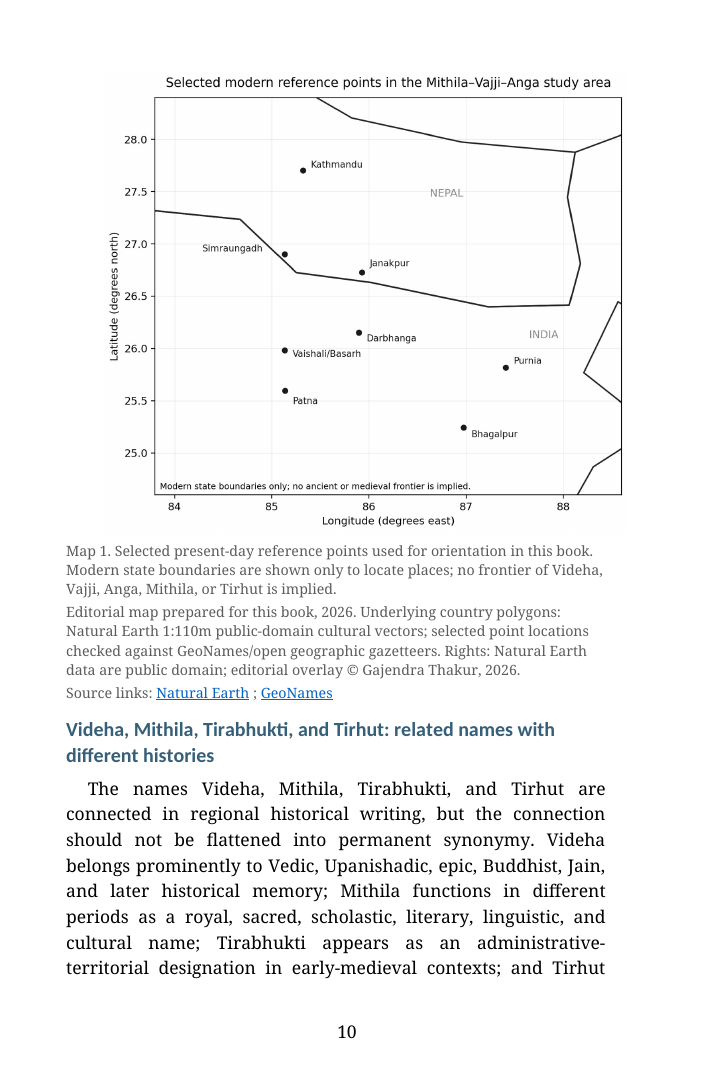
Mithila · Vajji · Anga
Chapter-specific source notes
- Primary chapter witness. Gajendra Thakur, Decoding the Panji of Mithila — Volume II, formal Chapter 10, PDF pp. 116-128; formal Chapter 10. The HTML transcription is generated from the commit-pinned source PDF and retains the chapter boundary recorded in this edition.
- Internal structure. The repository source-heading inventory records no separately encoded subordinate heading for this chapter.
- Digital editorial method. The page keeps the preserved source text distinct from generated navigational, concordance, visual, and provenance apparatus. The synthetic reconstruction is explanatory only and is not evidence for an individual lineage or a determination of social or marital status.