Decoding the Panji of Mithila · Volume II · Chapter 11
The Paternal Line
Chapter 11
The Paternal Line
1. Why the Paternal Line Must Be Reconstructed
Carefully
The paternal line is the most visible line in the Panji, but it is
not always the simplest line to reconstruct. A modern reader
may expect the text to give a neat sequence: father, son,
grandson, great-grandson. Sometimes it does. Very often it does
not. The source may compress several generations, interrupt
the chain with a village link, insert a number, include a title, or
shift from direct descent to branch descent.
The paternal line therefore cannot be built merely by
collecting male names. It must be reconstructed from
relationship markers. The main markers are सुत, सुतो, पुत्र, पौत्र,
प्रपौत्र, and related generational words. These must be
distinguished from सन्तति and अपत्य, which often mark branch
continuity rather than direct one-generation descent.
This chapter explains how to build the paternal line without
forcing the source into a false modern family tree. It also
explains how the paternal line interacts with village, title,
number, and maternal evidence.
2. The Direct Descent Markers
The strongest direct paternal markers are सुत, सुतो, and पुत्र.
These words usually indicate sonship. When the source says
that one person is the सुत of another, the reader may normally
Decoding the Panji of Mithila - Volume II
draw a direct father-son link, provided the surrounding syntax
supports that attachment.
पौत्र and प्रपौत्र are also direct generational markers, but they
require more care. पौत्र means grandson. प्रपौत्र means great-
grandson. They do not merely indicate vague descent. They
specify generational distance. If the source provides all
intermediate names, the chain can be reconstructed. If it does
not, the chart must show the distance while marking missing
links.
The first rule is this: direct paternal descent should be drawn
only when direct relationship words are present. A name
followed by a village is not enough. A name followed by सन्तति
or अपत्य may show descent, but not necessarily direct father-son
order.
3. सुत as Father-Son Evidence
सुत is the most basic paternal marker. It tells the reader that
the named person is a son. But the reader must still determine
whose son he is. In a clear phrase, the father and son stand
near each other. In a dense phrase, the marker may be joined
with the previous or following name.
A careful editor should first separate the phrase. Identify the
person before सुत, the person after सुत, the village before or
after the phrase, and any number or title attached to the chain.
Only after segmentation should the father-son link be drawn.
Data rule: every सुत entry should have columns for father,
son, village link, number, title, and certainty.
Critical caution: if the OCR has joined a name and सुत,
preserve the joined form in transcription but separate it in the
analysis layer only when the structure is clear.
4. सुतो as Chain Marker
Decoding the Panji of Mithila - Volume II
सुतो often appears in running genealogical chains. It may
function like “son of” or may introduce the next generation.
Because it frequently appears in dense passages, it must be
read in relation to the entire chain rather than one word at a
time.
For example, a passage may move: X सुतो Y, village सँ Z,
number, then Y सुता A B C. Here सुतो identifies a vertical link, but
the following सुता may list the issue of that person. If the reader
stops too early, the chain becomes confused.
Data rule: mark सुतो as a direct son-marker but attach it only
after the full phrase has been segmented.
Critical caution: do not normalize सुतो into सुत in the source
layer. The exact form may help later pattern analysis.
5. पुत्र as Formal Sonship
पुत्र is a formal Sanskritic son-marker. When it appears, it
generally offers strong evidence of direct paternal descent.
However, it may occur inside longer generational phrases with
पौत्र and प्रपौत्र, and therefore it must not be isolated from the full
ladder.
A phrase containing प्रपौत्र, पौत्र, and पुत्र may give a four-
generation structure. In such a case, पुत्र identifies the
immediate father-son link closest to the named person, while
पौत्र and प्रपौत्र identify higher generational levels.
Data rule: when पुत्र appears with पौत्र or प्रपौत्र, build a
generation table before writing prose.
Critical caution: do not translate पुत्र separately and leave the
rest of the generational expression unexplained.
6. पौत्र and the Grandson Level
Decoding the Panji of Mithila - Volume II
पौत्र means grandson. It is a precise marker. If the text says
that a person is the पौत्र of another, there is one generation
between them. Sometimes the intervening father is named;
sometimes he is not. If he is not named, the chart should show
an unknown intermediate generation.
This is important because a false direct father-son line may
compress the genealogy by one generation. If A is called the पौत्र
of B, A should not be drawn as B’s son unless another passage
proves that the term is being used differently.
Data rule: पौत्र entries should be entered with three fields:
grandparent, missing or named intermediate parent, and
grandson.
Critical caution: never erase the generational distance
created by पौत्र.
7. प्रपौत्र and the Great-Grandson Level
प्रपौत्र means great-grandson. It indicates a distance of three
generations below the ancestor: ancestor, son, grandson, great-
grandson. When the source provides all names, the chain is
exceptionally valuable. When it does not, the chart must
preserve the distance without inventing missing names.
A dense phrase may contain प्रपौत्र, पौत्र, पुत्र, and सुता together.
Such a phrase is a genealogical ladder. It should be copied,
segmented, tabled, and only then explained.
Data rule: प्रपौत्र entries must be tagged as four-generation
evidence.
Critical caution: do not collapse प्रपौत्र into vague
“descendant.” It is more precise than सन्तति or अपत्य.
8. वृद्ध प्रपौत्र and Qualified Generational Terms
Decoding the Panji of Mithila - Volume II
Sometimes the source includes qualified forms such as वृद्ध
प्रपौत्र. The word वृद्ध may mark seniority, elder branch, older line,
or another qualifier. It should not be translated casually as “old
great-grandson” in a modern biographical sense.
Such phrases may distinguish senior and junior branches.
They may also preserve a technical register distinction. The
safest reading is to preserve the qualifier and mark the
relationship as a qualified great-grandson relation.
Data rule: enter वृद्ध and similar qualifiers in a separate field.
Critical caution: do not omit qualifiers because they are
difficult. They may distinguish branches.
9. सुता in Paternal Reconstruction
सुता appears frequently and may introduce issue or offspring.
In paternal reconstruction, it can be very useful, but it is also
risky. It may list sons or descendants, but its exact function
depends on context.
If the passage says “X सुता A B C,” it may indicate that A, B,
and C are the issue of X. But the editor must still check whether
the passage belongs to a paternal line, a maternal cycle, a
marriage entry, or a branch list. If it belongs to a maternal
cycle, the reading changes.
Data rule: classify every सुता occurrence as issue-marker, son-
list, daughter-line, group-marker, or uncertain.
Critical caution: never translate सुता mechanically without
context.
10. Distinguishing Direct Line from Branch Line
The most important distinction in paternal reconstruction is
between direct line and branch line. Direct line is marked by
Decoding the Panji of Mithila - Volume II
सुत, सुतो, पुत्र, पौत्र, प्रपौत्र. Branch line is often marked by सन्तति and
अपत्य.
A direct line can be drawn as a vertical genealogical chain. A
branch line should often be drawn as a branch box or dotted
descent link until intermediate generations are known. This
prevents false precision.
For example, “X सुत Y” usually allows a direct edge from X to
Y. But “X सन्तति - Y village” should usually be drawn as
“descendants of X associated with Y,” not as “X father of Y.”
Data rule: use different chart symbols for direct descent and
branch descent.
Critical caution: never use the desire for a neat family tree to
override the actual wording of the source.
11. Paternal Line and Village Attachment
The paternal line in the Panji is almost always tied to place.
A father-son chain may be followed by a village introduced by
सँ. The village may belong to the son, the branch, the marriage
link, or the residence. Therefore the paternal chart should not
be drawn separately from the village gazetteer.
Each person in the paternal line should have a place field.
But the place function must be identified: origin, residence,
branch-seat, marriage connection, maternal link, or uncertain.
Data rule: every paternal-line entry should carry both
person data and place-function data.
Critical caution: a village near a son-marker is not always
the son’s birthplace.
12. Paternal Line and Numbers
Numbers appear frequently in paternal chains. A number
may follow a father, son, grandson, title, or place link. It may
identify the entry, branch, person, or register location. The
Decoding the Panji of Mithila - Volume II
number should remain attached to its exact position in the
chain.
When building the paternal line, numbers can help
distinguish repeated names. If two men named Ganga occur in
similar contexts but carry different numbers, they may be
different persons. If the same number recurs with the same
name and village, it may help confirm identity.
Data rule: paternal charts should include numbers in note
fields, not omit them for visual simplicity.
Critical caution: do not use numbers as proof of identity
until the numbering system is better understood.
13. Paternal Line and Titles
Titles can help identify persons in the paternal chain. A
महामहोपाध्याय, कविराज, वैयाकरण, पण्डित, or ठाकु र may be distinguished
from another person with the same name by title. The title may
also show that the paternal line carried scholarly or social
prestige.
A chart that records only names loses this evidence. Every
titled person in the paternal line should have the title
preserved beside the name. The title should also be indexed
separately.
Data rule: title-bearing persons in paternal charts should
appear with exact title, normalized title, village, and number.
Critical caution: do not move titles into footnotes only. They
are part of identity.
14. Paternal Line and Maternal Interruption
A paternal passage may be interrupted by maternal or
marriage information. This is not an error in the source. It
reflects the fact that the Panji records social genealogy, not
merely biological descent.
Decoding the Panji of Mithila - Volume II
When मातृक चक्र, विवाह, दौहित्र, or another affinal marker appears,
the editor should pause the paternal chain and open a separate
maternal or marriage table. After that unit closes, the paternal
chain may resume.
Data rule: do not force maternal material into the paternal
chart. Use linked tables.
Critical caution: maternal interruption often explains why a
paternal branch is connected to another village.
15. Repeated Names in the Paternal Line
Repeated names are a constant difficulty. A paternal line
may contain several persons with the same name across
generations. The name alone is never enough. Identification
requires father, son, village, number, title, and entry context.
When the same name appears repeatedly, create separate
provisional identities: Ganga-1, Ganga-2, Ganga-3, or similar
working labels. Merge them only when evidence confirms that
they are the same person.
Data rule: use provisional identifiers during reconstruction.
Critical caution: premature merging is one of the most
damaging errors in Panji work.
16. Paternal Line and Chronology
The paternal line can suggest chronology, but it does not
automatically provide dates. Generational sequence is relative
time, not calendar time. A father precedes a son, a grandfather
precedes a grandson, but the exact year requires additional
evidence.
If a marriage entry gives a date phrase, or a title suggests a
historical layer, chronology may become more precise. But the
paternal line alone should not be converted into exact dates
without support.
Decoding the Panji of Mithila - Volume II
Data rule: distinguish generational order from calendar
date.
Critical caution: do not assign modern years merely by
counting generations unless the method is openly stated and
marked as approximate.
17. Building the Paternal Table
A paternal-line table should include the following fields:
1. Source segment.
2. Page or line.
3. Original phrase.
4. Generation level.
5. Person.
6. Father.
7. Grandfather.
8. Great-grandfather.
9. Relation word.
10. Village link.
11. Place function.
12. Number.
13. Title.
14. Whether the link is direct, branch, inferred, or
uncertain.
15. Critical note.
Such a table is more reliable than immediate chart-making.
The chart should come after the table.
Decoding the Panji of Mithila - Volume II
18. Charting the Paternal Line
A responsible chart should use different line types:
solid line for direct sonship explicitly marked by सुत,
सुतो, or पुत्र;
stepped line for पौत्र or प्रपौत्र when intermediate
generations are partly missing;
dotted line for सन्तति or अपत्य branch descent;
side link for भाई or collateral relation;
separate linked box for मातृक चक्र or दौहित्र.
This visual discipline prevents the chart from claiming more
certainty than the source gives.
19. Critical Analysis: What the Paternal Line Reveals
The paternal line reveals continuity, inheritance of name,
branch formation, scholarly houses, and village affiliation. But
it also reveals the limits of purely male-line reading. The Panji
records paternal descent carefully, yet it repeatedly connects
that descent with villages, numbers, titles, marriages, and
maternal cycles.
This means that the paternal line is central but not solitary.
It is one strand in a larger social fabric. To study it properly, we
must reconstruct it with precision while keeping its links to
other strands visible.
The Panji’s paternal data show how Mithila remembered
house continuity. The same house could be remembered
through sons, grandsons, great-grandsons, titles, villages, and
branch settlements. The paternal line therefore carries social,
intellectual, and geographical meaning.
20. Common Errors in Reconstructing the Paternal Line
The common errors are:
First, treating every male name as part of one direct chain.
Decoding the Panji of Mithila - Volume II
Second, converting सन्तति and अपत्य into immediate sonship.
Third, ignoring पौत्र and प्रपौत्र distances.
Fourth, translating सुता mechanically.
Fifth, detaching villages from the paternal line.
Sixth, dropping numbers from charts.
Seventh, removing titles from names.
Eighth, merging repeated names too early.
Ninth, forcing maternal-cycle data into paternal descent.
Tenth, assigning exact dates without evidence.
21. Rules for Reconstructing the Paternal Line
First, build the data table before drawing the chart.
Second, use direct sonship only where direct markers
appear.
Third, preserve generational distance for पौत्र and प्रपौत्र.
Fourth, treat सन्तति and अपत्य as branch markers unless
further evidence supplies direct links.
Fifth, keep village, number, and title attached to each
person.
Sixth, mark uncertain links openly.
Seventh, use provisional identities for repeated names.
Eighth, separate paternal, maternal, and affinal data into
linked tables.
Ninth, never erase the original wording.
Tenth, allow the source to remain more complex than a neat
modern tree.
22. Conclusion: The Paternal Line as the Spine, Not the
Whole Body
Decoding the Panji of Mithila - Volume II
The paternal line is the spine of the Panji, but it is not the
whole body. It gives continuity and generational order. It
shows fathers, sons, grandsons, and great-grandsons. It
preserves the movement of houses across time. Yet the spine is
joined to villages, titles, marriages, maternal cycles, numbers,
and notes.
A responsible reconstruction must therefore be both firm
and humble: firm where the source gives direct relationship
words, humble where the source gives only branch evidence or
uncertain attachment.
Chapter 12 will now turn to the maternal line and the मातृक
चक्र. That chapter will show why the Panji cannot be understood
through paternal descent alone and how maternal circuits
preserve the marriage memory of Mithila.
Decoding the Panji of Mithila - Volume IISource structure and verification apparatus
Editorial source apparatus. This apparatus is descriptive, not interpretive. It records the source-controlled structure used to verify that this page corresponds to formal Chapter 11 of Decoding the Panji of Mithila — Volume II. The chapter text above is preserved from PDF pp. 128-140; formal Chapter 11 in the commit-pinned authoritative source. It is not merged with a neighboring chapter, appendix, annexure, or independent front/back-matter unit. The internal headings below come from the repository’s source-heading inventory and are retained as navigational and audit evidence; showing them here does not turn those headings into separate publications or add claims that are absent from the source.
Internal source headings
No subordinate heading was separately encoded in the repository source-heading inventory for this chapter.
Source-text concordance
Paternal · Line · Must · Reconstructed · Carefully · visible · always · simplest · reconstruct · modern · reader · expect · text · give · neat · sequence · father · grandson · great-grandson · Sometimes · often · compress · several · generations · interrupt · chain · village · link · insert · number · include · title · shift · direct · descent · branch · therefore · cannot · built · merely · collecting · male · names · relationship · markers · main · related · generational · words · distinguished · mark · continuity · rather · one-generation · explains · build · without · forcing · false · family · tree · interacts · maternal · evidence · strongest · usually · indicate · sonship · says · person · another · normally · Decoding · draw · father-son · provided · surrounding · syntax · supports · attachment
Boundary verification. In the formal sequence this chapter follows Volume II Chapter 10, “Abbreviations and Titles” and precedes Volume II Chapter 12, “The Maternal Line: मातृक चक्र”. The chapter extractor begins at the verified formal Chapter 11 marker and stops at the next verified formal chapter marker; for a final chapter it stops before recognized book-level back matter. The concordance above is generated only from distinct terms already present in this chapter’s preserved source text. It is provided for discovery, comparison, and audit, not as an automated judgment about persons, lineages, status, kinship, marriage eligibility, or historical truth.
Illustrated research apparatus
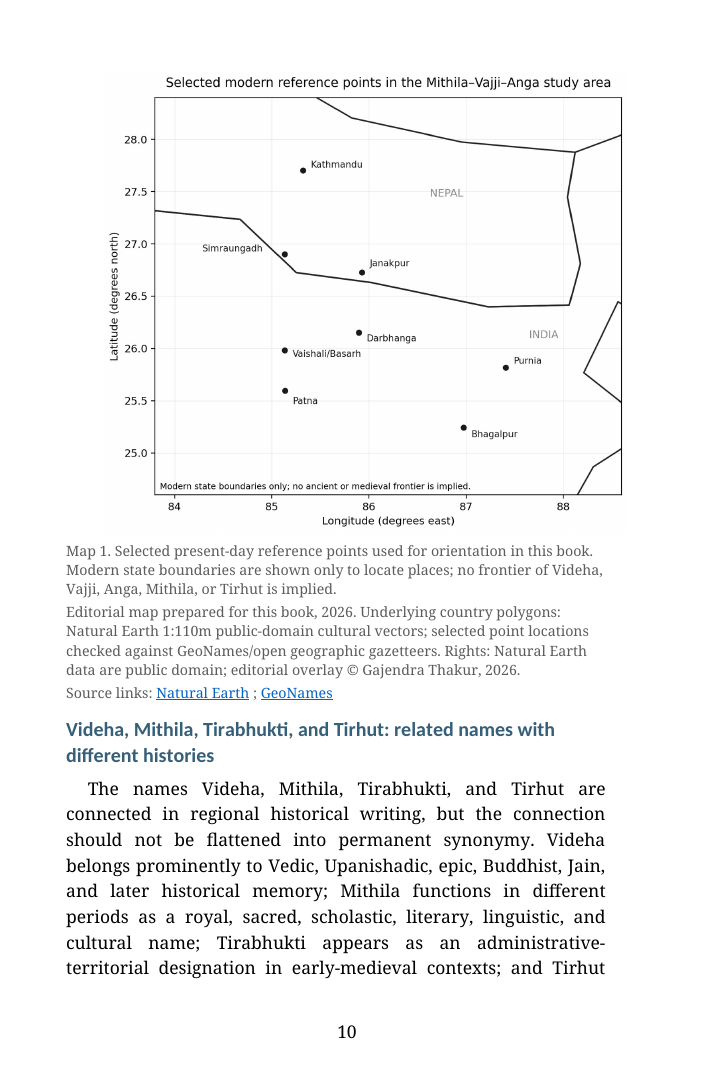
Mithila · Vajji · Anga
Chapter-specific source notes
- Primary chapter witness. Gajendra Thakur, Decoding the Panji of Mithila — Volume II, formal Chapter 11, PDF pp. 128-140; formal Chapter 11. The HTML transcription is generated from the commit-pinned source PDF and retains the chapter boundary recorded in this edition.
- Internal structure. The repository source-heading inventory records no separately encoded subordinate heading for this chapter.
- Digital editorial method. The page keeps the preserved source text distinct from generated navigational, concordance, visual, and provenance apparatus. The synthetic reconstruction is explanatory only and is not evidence for an individual lineage or a determination of social or marital status.