Decoding the Panji of Mithila · Volume II · Chapter 12
The Maternal Line: मातृक चक्र
Chapter 12
The Maternal Line: मातृक चक्र
1. Why the Maternal Line Needs Its Own Method
The Panji cannot be understood through paternal descent
alone. The father-line gives the spine of genealogy, but the
maternal line gives the network through which houses are
joined, marriages are remembered, and future marriage
eligibility is judged. This is why the source repeatedly closes
dense passages with expressions such as “एवं कमलापति मातृक चक्रं ,”
“एवं गंग मातृक चक्र,” “एवम् ठ. रामभद्र मातृक चक्रं ,” and many similar forms.
A मातृक चक्र is not a decorative ending. It is a structural label. It
tells the reader that the preceding names, villages, numbers,
and relationship words belong to a maternal or affinal circuit.
If this label is ignored, the whole passage may be forced into a
false paternal chain.
The maternal line therefore requires its own table, its own
charting method, and its own cautions. The decoder must ask
not only “Who is whose son?” but also “Through which mother,
daughter, marriage house, or daughter’s-son connection is this
house linked?”
2. What “मातृक” Means in the Panji
मातृक means maternal, mother-related, or connected with the
mother’s side. In the Panji, it usually appears in the phrase मातृक
चक्र. This phrase signals that the passage is not simply a vertical
line of fathers and sons. It is a network of maternal relations.
A maternal relation may arise through a mother, daughter,
wife, daughter’s son, marriage house, or affinal branch. The
source may not always spell out the woman’s name. Often the
Decoding the Panji of Mithila - Volume II
maternal relation is preserved through the houses and villages
connected by marriage. This is one of the difficulties of the
Panji: women may be structurally central even when not
named biographically.
Data rule: every occurrence of मातृक must be tagged as
maternal evidence and separated from ordinary paternal
descent.
Critical caution: do not read मातृक as an ornamental word. It
changes the logic of the entry.
3. What “चक्र” Means
चक्र means circle, cycle, circuit, or connected round. In the
phrase मातृक चक्र, it suggests that the maternal links form a
circuit rather than a straight line. This is the key difference
between paternal descent and maternal network.
A paternal line may be charted vertically: father, son,
grandson, great-grandson. A मातृक चक्र must be charted
relationally: house A is connected to house B through a
woman; house B is linked to village C; a daughter’s son appears
through house D; a later marriage or branch closes the circuit.
The word चक्र therefore warns the reader not to draw only a
straight line. The passage must be mapped as a network.
Data rule: when a passage closes with चक्र, review the
preceding lines backward to find the beginning of the cycle.
Critical caution: if the starting point of the cycle is uncertain,
mark the boundary as probable rather than absolute.
4. The Closing Formula “एवं … मातृक चक्र”
Many maternal-cycle passages close with “एवं” followed by
the named person or branch and “मातृक चक्र.” The word एवं means
Decoding the Panji of Mithila - Volume II
“thus” or “in this way.” In this context, it often signals that the
preceding relation-set is now complete.
For example, a passage ending “एवं कमलापति मातृक चक्रं ” should
be read as: “Thus ends or thus is formed the maternal cycle of
Kamalapati.” The preceding names and links should be
collected into a maternal table before the next entry is read.
Data rule: treat “एवं … मातृक चक्र” as a closure formula. It does
not merely comment on the last name; it often governs the
preceding cluster.
Critical caution: do not attach the phrase only to the
immediately preceding person unless the passage clearly
supports that narrow reading.
5. मातृक चक्र and सुता
The word सुता frequently appears before or inside maternal-
cycle passages. In paternal contexts, सुता may introduce issue or
offspring. In maternal contexts, it may help list the persons
whose connections lead into the maternal circuit. The exact
function must be tested carefully.
A passage may say that a named person’s सुता are linked
through several villages, followed by “एवं … मातृक चक्र.” In such a
case, the सुता list is likely part of the cycle. It should not be
treated as a simple list of sons without examining the maternal
closure.
Data rule: every सुता inside or near a मातृक चक्र should be
marked as “issue-list within maternal context” until classified.
Critical caution: do not translate सुता mechanically in
maternal passages. It may be the hinge by which the cycle is
formed.
6. मातृक चक्र and “सँ”
Decoding the Panji of Mithila - Volume II
The connector “सँ” becomes especially important in
maternal-cycle passages. In a paternal entry, it may sometimes
mean origin or residence. In a maternal cycle, it may point to
the house through which a marriage or maternal link is made.
For this reason, “सँ” inside a मातृक चक्र should first be read
neutrally as “linked with.” Only after the maternal structure is
mapped should it be translated as from, through, married into,
connected with, or belonging to.
Data rule: in मातृक चक्र entries, every “सँ” place should be
entered in a maternal-place column, not only in the general
village column.
Critical caution: do not turn a maternal “सँ” into a birth-place
without evidence.
7. मातृक चक्र and दौहित्र
दौहित्र means daughter’s son. It is one of the clearest signs that
the Panji is preserving maternal memory. A daughter’s son
belongs to his father’s line, but he also carries the blood and
alliance of his mother’s house. Therefore he becomes a bridge
between two lineages.
When दौहित्र appears near a village connector, the passage
must be read as a maternal bridge. The village may identify the
maternal house, the daughter’s married house, or the location
through which the daughter’s-son relation is remembered.
Data rule: every दौहित्र entry should be cross-indexed under
person, maternal house, affinal house, and village.
Critical caution: never place a दौहित्र as a direct son in the
paternal line being discussed unless another independent
phrase proves direct sonship. The word itself says that the
relation passes through a daughter.
Decoding the Panji of Mithila - Volume II
8. मातृक चक्र and Marriage Memory
The Panji preserved maternal cycles because marriage
memory mattered. Marriage was not only a private event. It
created social relation between houses. Future marriages
depended on knowing these relations. A house could not be
judged only by its paternal descent; it had to be seen through
maternal and affinal links as well.
A मातृक चक्र therefore functions as a marriage-memory device.
It helps preserve which houses have already been joined and
through whom. It may also explain why a branch is associated
with a village that does not belong to its direct paternal line.
Data rule: the maternal-cycle table should be linked to the
marriage table.
Critical caution: do not separate maternal cycles from
marriage analysis. They are structurally connected.
9. Women in the Panji: Presence Through Structure
A modern reader may notice that women are not always
named in the same way as men. Yet the maternal cycle shows
that women are structurally essential. The Panji may preserve
a woman through her son, her father’s house, her husband’s
village, or her daughter’s son rather than through a full
biographical name.
This creates an interpretive responsibility. The absence of a
personal female name does not mean the absence of female
agency in the record. The maternal cycle exists because women
connect houses. Marriage moves women between lineages, but
memory brings those connections back into the genealogical
register.
Critical analysis must therefore read the maternal line as a
record of women’s structural role in Mithila’s social order.
10. Boundaries of a मातृक चक्र
Decoding the Panji of Mithila - Volume II
One of the hardest tasks is identifying where a maternal
cycle begins. The closure is often visible: “एवं … मातृक चक्र.” The
beginning may be less obvious. It may start after an अपरा
marker, after a सुता list, after a marriage-like village link, or
after a shift from direct paternal descent into relational
connections.
The decoder should work backward from the closure. Look
for the last clear paternal chain, then identify where the
maternal or affinal links begin. If the boundary is uncertain,
record a probable boundary and a wider possible boundary.
Data rule: every maternal-cycle table should have two
boundary fields: strict boundary and possible extended
boundary.
Critical caution: cutting the cycle too narrowly may omit
important links; extending it too far may absorb unrelated
paternal material.
11. मातृक चक्र and अपरा
The word अपरा often introduces another branch or case.
When it appears near a maternal cycle, it may mark another
marriage line, another maternal connection, or another
version of the relational circuit.
A passage may move through one set of relations, then use
अपरा to open another. If the whole passage later closes as a मातृक
चक्र, both parts may belong to the maternal network, or the
second may be an alternate branch. This must be decided from
structure.
Data rule: in maternal-cycle passages, mark every अपरा as a
possible sub-cycle or alternate maternal branch.
Critical caution: do not merge अपरा material into the
preceding line without analysis.
Decoding the Panji of Mithila - Volume II
12. मातृक चक्र and Numbers
Maternal cycles often contain many parenthetical numbers.
These numbers may belong to persons, branches, marriage
links, or internal notes. They must remain in the maternal
table.
If a number appears beside a person inside a maternal cycle,
it may later help identify the same person elsewhere in a
paternal line. If a number appears beside a village link, it may
help map the affinal connection. If it appears near दौहित्र, it may
become important for daughter-line reconstruction.
Data rule: the maternal-cycle table must include number
fields, not only names and villages.
Critical caution: do not drop numbers from maternal charts
because the chart is already complex. The numbers may be the
key to later verification.
13. मातृक चक्र and Titles
Titles also appear inside or near maternal-cycle passages. A
title-bearing person may be part of a maternal network. This
means that the maternal line can preserve intellectual and
social prestige as well as marriage relation.
If a महामहोपाध्याय, वैयाकरण, कविराज, ठाकु र, बाबू, or other titled person
appears inside a maternal cycle, the title must be preserved in
the maternal table and cross-indexed in the title index.
Data rule: titles in maternal-cycle passages must be indexed
under both title and maternal network.
Critical caution: do not assume titles only matter in paternal
descent. Marriage networks also carried prestige.
14. How to Chart a मातृक चक्र
A मातृक चक्र should not be charted as a simple vertical tree. A
better method is to use a network chart:
Decoding the Panji of Mithila - Volume II
paternal house as one node;
maternal house as another node;
marriage link as a bridge;
daughter or wife connection as the crossing line;
दौहित्र as a bridge-person;
villages as place nodes;
numbers as note anchors;
titles as identity labels.
If the woman’s name is not given, the chart may mark
“unnamed daughter/wife linking House A and House B.” This is
better than erasing the female link.
Data rule: maternal charts should include unnamed
structural women where the relation requires them.
Critical caution: do not invent names for unnamed women.
Mark the role, not a false name.
15. मातृक चक्र and Marriage Eligibility
The practical value of the मातृक चक्र lies partly in marriage
regulation. A future marriage depends not only on the father’s
line but also on remembered maternal and affinal connections.
The maternal cycle helps prevent marriages that would be too
close by remembered social relation.
Thus the maternal line is not secondary evidence. It is part
of the social mechanism for judging marriage. The Panji
preserves these cycles because they mattered in real decisions.
Critical analysis should therefore read मातृक चक्र as part of the
legal-social function of the Panji, not merely as family memory.
16. The Maternal-Cycle Data Table
A full मातृक चक्र table should include:
1. Source segment.
2. Page or line reference.
Decoding the Panji of Mithila - Volume II
3. Original text of the cycle.
4. Closure phrase exactly as written.
5. Named person whose cycle is marked.
6. Strict beginning boundary.
7. Possible wider boundary.
8. Persons named inside the cycle.
9. Relation words.
10. Villages and place functions.
11. “सँ” connectors and their classified meaning.
12. दौहित्र entries.
13. विवाह or marriage-related clues.
14. Titles.
15. Numbers.
16. अपरा sub-branches.
17. Probable maternal house.
18. Probable affinal house.
19. Unnamed female link, if required.
20. Critical note and confidence level.
Such a table allows the maternal data to be preserved
without forcing premature interpretation.
17. Critical Analysis: What Maternal Cycles Reveal
The repeated use of मातृक चक्र reveals that Mithila’s
genealogical culture did not depend on paternal descent alone.
It recognized that marriage creates durable social memory. It
preserved the daughter’s line, the mother’s house, and the
affinal village because these shaped future relationships.
This is historically significant. It shows that the Panji is not a
patriarchal list in the narrow sense of only naming fathers and
sons. It is a wider social archive. It records how houses are
joined through women even when women are not always
individually named.
Decoding the Panji of Mithila - Volume II
The maternal cycle also shows the sophistication of the
Panji’s method. It knew that descent and marriage are different
but connected. It created a technical structure for preserving
that connection.
18. Common Errors in Reading मातृक चक्र
The common errors are:
First, treating मातृक चक्र as a decorative phrase.
Second, reading the whole passage as a paternal line.
Third, ignoring सुता inside maternal contexts.
Fourth, translating “सँ” as origin without considering
marriage or maternal link.
Fifth, placing दौहित्र as a direct son.
Sixth, cutting the cycle boundary too narrowly.
Seventh, extending the cycle boundary without evidence.
Eighth, removing numbers from the maternal table.
Ninth, ignoring titles inside the cycle.
Tenth, erasing unnamed women instead of marking their
structural role.
19. Rules for Reading मातृक चक्र
First, treat मातृक चक्र as a structural category.
Second, work backward from the closure formula.
Third, identify the strict and possible wider boundaries.
Fourth, read “सँ” neutrally until the maternal relation is
clear.
Fifth, treat दौहित्र as daughter’s-son evidence.
Sixth, preserve सुता carefully and do not translate it
mechanically.
Decoding the Panji of Mithila - Volume II
Seventh, mark अपरा as possible sub-branch or alternate
maternal line.
Eighth, keep numbers, titles, and villages attached.
Ninth, chart the cycle as a network, not a vertical tree.
Tenth, preserve unnamed female roles without inventing
names.
20. Conclusion: The Maternal Line as the Social Web
The paternal line gives the Panji its spine, but the maternal
line gives it a web. Through मातृक चक्र, the Panji records how
houses meet, how marriages create memory, how daughters
connect villages, how daughter’s sons preserve relation, and
how future alliances are judged.
To decode the Panji responsibly, one must read the maternal
line with the same seriousness as the paternal line. Without
मातृक चक्र, the record becomes a list of male descent. With मातृक
चक्र, it becomes the social map of Mithila.
Chapter 13 will now turn to marriage records directly. It will
explain how विवाह entries are structured, how dates and
numbers should be preserved, and how marriage entries
connect paternal lines with maternal cycles.
Decoding the Panji of Mithila - Volume IISource structure and verification apparatus
Editorial source apparatus. This apparatus is descriptive, not interpretive. It records the source-controlled structure used to verify that this page corresponds to formal Chapter 12 of Decoding the Panji of Mithila — Volume II. The chapter text above is preserved from PDF pp. 140-151; formal Chapter 12 in the commit-pinned authoritative source. It is not merged with a neighboring chapter, appendix, annexure, or independent front/back-matter unit. The internal headings below come from the repository’s source-heading inventory and are retained as navigational and audit evidence; showing them here does not turn those headings into separate publications or add claims that are absent from the source.
Internal source headings
No subordinate heading was separately encoded in the repository source-heading inventory for this chapter.
Source-text concordance
Maternal · Line · Needs · Method · cannot · understood · paternal · descent · alone · father-line · gives · spine · genealogy · network · houses · joined · marriages · remembered · future · marriage · eligibility · judged · repeatedly · closes · dense · passages · expressions · many · similar · forms · decorative · ending · structural · label · tells · reader · preceding · names · villages · numbers · relationship · words · belong · affinal · circuit · ignored · whole · passage · forced · false · chain · therefore · requires · table · charting · cautions · decoder · must · whose · mother · daughter · house · daughter’s-son · connection · linked · Means · mother-related · connected · mother’s · side · usually · appears · phrase · signals · simply · vertical · fathers · sons · relations · relation
Boundary verification. In the formal sequence this chapter follows Volume II Chapter 11, “The Paternal Line” and precedes Volume II Chapter 13, “Marriage Records”. The chapter extractor begins at the verified formal Chapter 12 marker and stops at the next verified formal chapter marker; for a final chapter it stops before recognized book-level back matter. The concordance above is generated only from distinct terms already present in this chapter’s preserved source text. It is provided for discovery, comparison, and audit, not as an automated judgment about persons, lineages, status, kinship, marriage eligibility, or historical truth.
Illustrated research apparatus
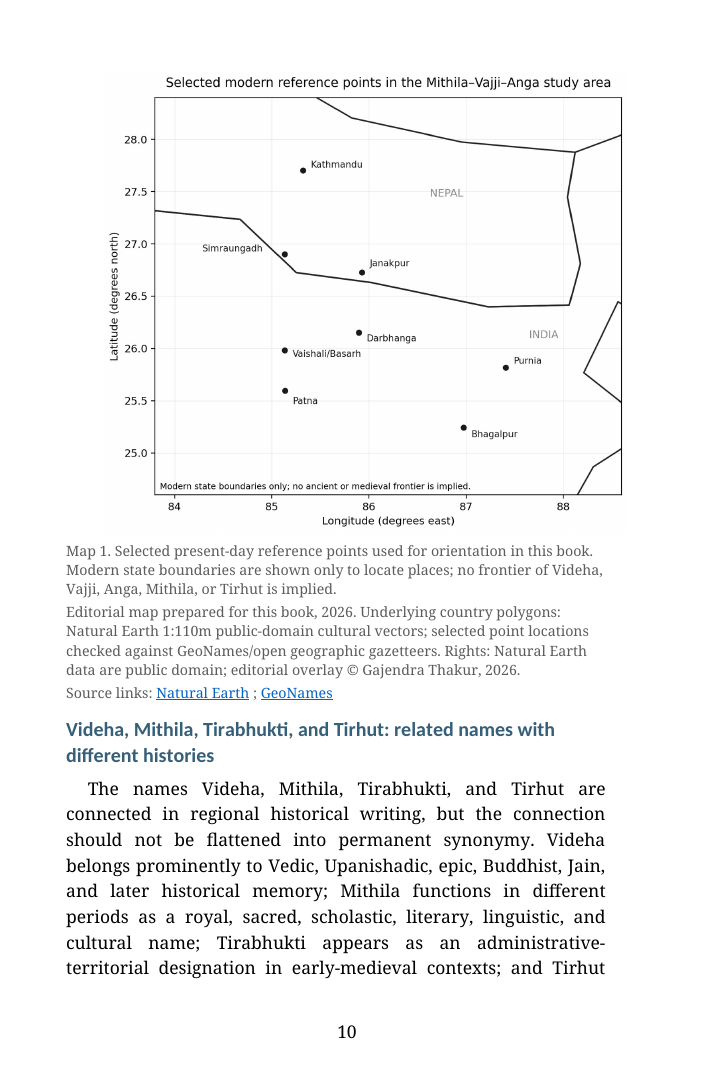
Mithila · Vajji · Anga
Chapter-specific source notes
- Primary chapter witness. Gajendra Thakur, Decoding the Panji of Mithila — Volume II, formal Chapter 12, PDF pp. 140-151; formal Chapter 12. The HTML transcription is generated from the commit-pinned source PDF and retains the chapter boundary recorded in this edition.
- Internal structure. The repository source-heading inventory records no separately encoded subordinate heading for this chapter.
- Digital editorial method. The page keeps the preserved source text distinct from generated navigational, concordance, visual, and provenance apparatus. The synthetic reconstruction is explanatory only and is not evidence for an individual lineage or a determination of social or marital status.