Decoding the Panji of Mithila · Volume II · Chapter 13
Marriage Records
Chapter 13
  Marriage Records
1. Why Marriage Records Are Central to the Panji
  Marriage records are not incidental notes in the Panji. They
are one of the central reasons the Panji existed. Genealogy in
Mithila was not preserved only to remember ancestors. It was
preserved so that marriage could be judged, regulated, and
socially recognized. A lineage without marriage memory is
incomplete, because every marriage joins two houses and
creates future restrictions, permissions, and remembered
obligations.
 The source makes this clear through repeated entries
marked by विवाह. These entries do not merely announce that a
marriage took place. They often stand inside dense networks of
names, villages, titles, numbers, date phrases, and later issue. A
marriage entry may close one relational unit and open
another. It may explain why a branch is linked with a village
outside its direct paternal line. It may lead into a मातृक चक्र. It
may also distinguish first, second, or later marriages.
  To decode the Panji fully, every विवाह entry must be treated as
a structural record.

2. The Word विवाह

  विवाह means marriage. In the Panji, the word usually marks a
formal marriage record, not a casual biographical detail. When
it appears after the name of a person, often with a title such as
ठo, the entry identifies a marriage event or marriage-context
connected with that person.
  The simplest first-pass rule is this: wherever विवाह appears,
pause the paternal line and open a marriage table. The

                  Decoding the Panji of Mithila - Volume II

surrounding names and villages must be checked to determine
the two houses being connected. The phrase before विवाह may
identify the principal person. The lines after it may identify the
spouse’s house, date, issue, or later branch.
  Data rule: every विवाह occurrence should be indexed under
person, title, village, date, number, spouse-side clues, and
following issue.
  Critical caution: do not read विवाह as a paragraph heading
only. It is a data-bearing event marker.

3. Marriage as Bridge Between Houses
   A marriage entry joins two houses. One house belongs to the
principal person or branch. The other belongs to the spouse’s
side. The Panji may not always state the bride and groom in
modern prose, but it gives clues through names, villages, titles,
and connectors.
   A phrase may say that a titled person’s marriage is being
recorded. The following lines may then mention a date, a
village introduced by सँ, a father or son marker, and later
descendants. The decoder must identify which elements belong
to the principal side and which belong to the affinal side.
  Data rule: the marriage table should contain two separate
house columns: principal house and affinal house.
   Critical caution: if only one side is clear, mark the other side
as uncertain. Do not invent a spouse’s name or house.

4. विवाह and सँ

  The connector सँ becomes especially important in marriage
entries. In a direct paternal line, सँ may indicate origin,
residence, or branch association. In a marriage entry, it may
indicate the house into which marriage occurred or the village
through which the affinal relation is established.

                Decoding the Panji of Mithila - Volume II

  For this reason, all सँ-phrases near विवाह must be classified
carefully. A place following सँ after a marriage marker may not
be the principal person’s origin. It may be the spouse’s house
or another marriage-linked village.
  Data rule: inside a marriage entry, classify सँ first as
“marriage/affinal link” until context proves otherwise.
  Critical caution: translating marriage-context सँ as simple
“from” can place the marriage in the wrong house.

5. विवाह and Date Phrases

   Some marriage entries include date phrases. A date may be
given in the traditional lunar calendar, naming the month,
fortnight, tithi, and weekday. Such phrases are extremely
valuable and must be preserved exactly.
  For example, a marriage entry may include a phrase such as
Phalguna Krishna Chaturdashi on Wednesday. This is not the
same as a register number in parentheses. The date belongs to
calendrical time. The parenthetical number belongs to the
register’s internal system unless proven otherwise.
  Data rule: the marriage table should have separate columns
for traditional date phrase, modern converted date if safely
calculable, register number, and date-confidence level.
  Critical caution: do not convert a traditional date into a
modern date unless the year, calendar system, and calculation
basis are clear.

6. विवाह and Parenthetical Numbers

 Marriage entries often contain parenthetical numbers. These
may appear before the विवाह phrase, after it, near a date, beside
the principal person, or beside later issue. Their function may
differ from entry to entry. The number may identify the

                    Decoding the Panji of Mithila - Volume II

marriage record, the person, the branch, the note, or a related
register position.
  The number must be preserved exactly, including slash,
double slash, zero, and spacing. If the number appears
immediately after विवाह, record that position. If it appears
before the date, record that. If it appears after the later issue,
record that separately.
  Data rule: every marriage record should include a number-
position field.
   Critical caution: do not treat all numbers near विवाह as dates.
They are separate categories unless the source clearly joins
them.

7. प्रथम विवाह and द्वितीय विवाह

   The source contains entries marked as first marriage or
second marriage. These are especially important because
multiple marriages create multiple affinal networks. A second
marriage can generate another set of maternal links, another
village connection, and another branch of issue.
   When द्वितीय विवाह appears, the decoder must not treat it as a
repetition of the first marriage. It is a separate marriage event.
The persons and villages following it may belong to a different
spouse-side. If issue follows, the children must be attached to
the correct marriage where the source permits.
  Data rule: every marriage event should receive a marriage-
order field: first, second, later, unspecified, or uncertain.
  Critical caution: do not merge issue from different marriages
unless the source proves the attachment.

8. Marriage Entries and अपरा

   अपरा often appears near marriage entries. It may introduce
another marriage, another branch, another spouse-line,

                    Decoding the Panji of Mithila - Volume II

another reading, or another set of issue. In marriage contexts,
अपरा deserves special attention.

  If a विवाह entry is followed by अपरा, the following material may
belong to another marriage-related branch. It may also
distinguish children of another wife, another house, or another
version of the record. The only safe method is to create a sub-
entry and test the relation.
  Data rule: in marriage tables, अपरा should open a new
provisional marriage sub-unit.
  Critical caution: ignoring अपरा can merge separate marriages
or branches into one false family unit.

9. विवाह and सुता

  The word सुता appears frequently after or near marriage
entries. In such contexts it may list issue from the marriage,
children of a named person, or persons connected through the
affinal branch. Because सुता is already context-sensitive, the
marriage context makes it even more delicate.
  A passage may record a marriage and then list सुता. The
reader must ask: are these the issue of the marriage? Are they
issue of the principal person? Are they children of a person in
the spouse’s house? Or does the list belong to the next branch
after the marriage marker?
  Data rule: सुता near विवाह should be marked as “issue-list in
marriage context” until further segmentation clarifies the
attachment.
  Critical caution: do not automatically assign all following सुता
names to the marriage just because they appear after विवाह.

10. विवाह and मातृक चक्र

                   Decoding the Panji of Mithila - Volume II

  Marriage entries and मातृक चक्र are closely connected. A
marriage creates the maternal link that may later be preserved
as a cycle. When a विवाह entry appears before or near a
maternal cycle, it may explain how the cycle is formed.
  The Panji often records social relation through houses rather
than full narrative. A marriage entry can therefore be the key
that makes a later मातृक चक्र intelligible. The marriage joins two
houses; the maternal cycle preserves the continuing relational
consequences of that joining.
  Data rule: every विवाह entry should be cross-linked to nearby
मातृक चक्र passages.

  Critical caution: do not analyze marriage entries in isolation.
They often explain maternal networks.

11. विवाह and दौहित्र

  दौहित्र means daughter’s son. Where marriage creates the
crossing between houses, दौहित्र preserves one result of that
crossing. A daughter’s son belongs to another paternal line but
carries the maternal connection of his mother’s house.
  If a marriage entry is followed by or associated with a दौहित्र
entry, the two should be studied together. The marriage may
explain the daughter-line. The daughter’s son may preserve the
later memory of that marriage connection.
  Data rule: link marriage records with all nearby दौहित्र entries
in the maternal-affinal table.
  Critical caution: do not treat दौहित्र as ordinary paternal issue.
It belongs to the daughter-line created by marriage.

12. विवाह and Titles

                Decoding the Panji of Mithila - Volume II

  Many marriage entries involve titled persons: ठo, महाराज, बाबू,
वैयाकरण, कवि, पण्डित, or other learned and status designations. The
title must remain attached to the marriage record. It may
identify the social rank of the house involved, distinguish the
person from another with the same name, or mark a later
historical layer of the Panji.
   A marriage involving a titled person may have special social
significance. It may show alliance between prestigious houses
or the continuation of a learned lineage through marriage.
    Data rule: every marriage record should be indexed in the
title index when a title appears.
  Critical caution: do not remove title markers from विवाह
entries for smoother prose. They are evidence.

13. विवाह and Village Networks

  Marriage entries often contain several villages. One village
may belong to the principal line, another to the spouse’s house,
another to the residence of issue, and another to a maternal or
daughter-line connection. The Panji preserves this complexity
through सँ, place sequences, and branch names.

   The marriage table must therefore be joined to the village
gazetteer. A village mentioned in a marriage entry should be
tagged by function: principal house, spouse house, affinal
village, issue residence, maternal link, or uncertain.
  Data rule: every village in a marriage entry should receive a
place-function tag.
  Critical caution: do not put               all   villages   into   one
undifferentiated “place” column.

14. Marriage and Chronology
  Marriage entries can sometimes give chronological evidence.
A date phrase, a reference to a year, or a later modern-style

                Decoding the Panji of Mithila - Volume II

date may help place the entry in time. Some later records may
include explicit year-like forms or modern-style dates. These
should be preserved in a separate chronological field.
   However, not every marriage entry gives a date. Even where
a date is given, the conversion may be difficult. The traditional
calendar phrase may need a known year and calendar
convention before it can be converted into a modern Gregorian
date.
 Data rule: distinguish traditional date phrase, explicit year,
modern date, and inferred chronology.
  Critical caution: do not convert or infer more than the
source allows.

15. Marriage-Order and Issue Assignment
  When multiple marriages are recorded, issue assignment
becomes one of the most difficult tasks. Children following a
second-marriage entry may belong to the second marriage, but
the source may not always make the attachment explicit.
Sometimes the structure is clear; sometimes it is only probable.
  The data table should therefore mark each child or issue-list
with an attachment level: certain, probable, possible, or
uncertain. This is better than forcing a clean family tree.
 Data rule: use confidence levels for issue assignment in all
marriage-context entries.
  Critical caution: incorrect issue assignment can corrupt both
paternal and maternal reconstruction.

16. Marriage Entry Table
  A full marriage-entry table should include:

1. Source segment.

2. Page or line reference.

3. Original phrase.

                  Decoding the Panji of Mithila - Volume II

4. Marriage marker exactly as written.

5. Principal person.

6. Title of principal person.

7. Marriage order: first, second, later, unspecified,
uncertain.

8. Principal house or village.

9. Affinal house or village.

10. Date phrase.

11. Register number.

12. Number position.

13. सुता or issue-list after the entry.

14. Issue attachment confidence.

15. अपरा sub-entry.

16. Related मातृक चक्र.

17. Related दौहित्र.

18. Titles.

19. Village-function tags.

20. Critical note.
  This table will later become one of the most important
appendices of the book.

17. Critical Analysis: What Marriage Records Reveal
  The marriage records reveal the Panji’s social purpose. The
record is not merely preserving descent for memory. It is

                 Decoding the Panji of Mithila - Volume II

preserving descent for regulation. Marriage required
knowledge of paternal line, maternal line, village affiliation,
title, prior alliance, and issue. The Panji stores these elements
together.
  The presence of first and second marriage entries shows that
the record could handle complexity. It did not treat marriage
as a single decorative event. It recorded multiple alliances
because each alliance changed the social map.
   The presence of dates in some entries shows that marriage
records could also carry chronological precision. The presence
of numbers shows archival organization. The presence of titles
shows status and prestige. The presence of villages shows
alliance geography.
  Marriage records therefore reveal the Panji as a working
social instrument.

18. Common Errors in Reading Marriage Records
  The common errors are:
  First, treating विवाह as a casual note.

  Second, failing to open a separate marriage table.
  Third, translating सँ as simple origin in marriage context.

  Fourth, confusing register numbers with date phrases.
  Fifth, ignoring first and second marriage distinctions.
  Sixth, merging issue from separate marriages.
  Seventh, ignoring अपरा near marriage entries.

  Eighth, failing to connect विवाह with मातृक चक्र.

  Ninth, failing to connect विवाह with दौहित्र.

  Tenth, dropping titles and villages from marriage records.

19. Rules for Reading विवाह Entries

                  Decoding the Panji of Mithila - Volume II

  First, treat every विवाह marker as a structural event.

  Second, pause the paternal line and open a marriage table.
  Third, identify principal house and affinal house separately.
  Fourth, classify सँ as marriage or affinal link until proven
otherwise.
  Fifth, preserve date phrases exactly.
  Sixth, preserve register numbers separately from dates.
  Seventh, mark marriage order when प्रथम or द्वितीय appears.

  Eighth, treat अपरा as a possible new marriage sub-unit.

  Ninth, assign issue with confidence levels.
  Tenth, cross-link विवाह with मातृक चक्र and दौहित्र.

20. Conclusion: Marriage as the Engine of the Social Map
   Marriage is the engine that turns genealogy into social map.
Through marriage, one house joins another. Through
daughters, maternal cycles are formed. Through daughter’s
sons, cross-line memory is preserved. Through villages,
alliances are located. Through titles, prestige is carried into
networks. Through numbers and dates, the register anchors
the event.
  To decode the Panji without decoding marriage records
would be to miss the force of the whole system. The Panji
remembers fathers and sons, but it also remembers the
marriages that made future social life possible.
   Chapter 14 will now examine daughter’s-son and affinal
links in detail. It will show how दौहित्र, भगीनेय, marriage houses,
and related terms preserve the crossings between families.

Decoding the Panji of Mithila - Volume II

                 Decoding the Panji of Mithila - Volume II
Source structure and verification apparatus
Editorial source apparatus. This apparatus is descriptive, not interpretive. It records the source-controlled structure used to verify that this page corresponds to formal Chapter 13 of Decoding the Panji of Mithila — Volume II. The chapter text above is preserved from PDF pp. 151-163; formal Chapter 13 in the commit-pinned authoritative source. It is not merged with a neighboring chapter, appendix, annexure, or independent front/back-matter unit. The internal headings below come from the repository’s source-heading inventory and are retained as navigational and audit evidence; showing them here does not turn those headings into separate publications or add claims that are absent from the source.
Internal source headings
No subordinate heading was separately encoded in the repository source-heading inventory for this chapter.
Source-text concordance
Marriage · Records · Central · incidental · notes · reasons · existed · Genealogy · preserved · remember · ancestors · judged · regulated · socially · recognized · lineage · without · memory · incomplete · every · joins · houses · creates · future · restrictions · permissions · remembered · obligations · makes · clear · repeated · entries · marked · merely · announce · took · place · often · stand · inside · dense · networks · names · villages · titles · numbers · date · phrases · later · issue · entry · close · relational · unit · open · another · explain · branch · linked · village · outside · direct · paternal · line · lead · distinguish · first · second · marriages · decode · fully · must · treated · structural · record · Word · means · usually · marks · formal
Boundary verification. In the formal sequence this chapter follows Volume II Chapter 12, “The Maternal Line: मातृक चक्र” and precedes Volume II Chapter 14, “Daughter’s-Son and Affinal Links”. The chapter extractor begins at the verified formal Chapter 13 marker and stops at the next verified formal chapter marker; for a final chapter it stops before recognized book-level back matter. The concordance above is generated only from distinct terms already present in this chapter’s preserved source text. It is provided for discovery, comparison, and audit, not as an automated judgment about persons, lineages, status, kinship, marriage eligibility, or historical truth.
Illustrated research apparatus
Mithila · Vajji · Anga
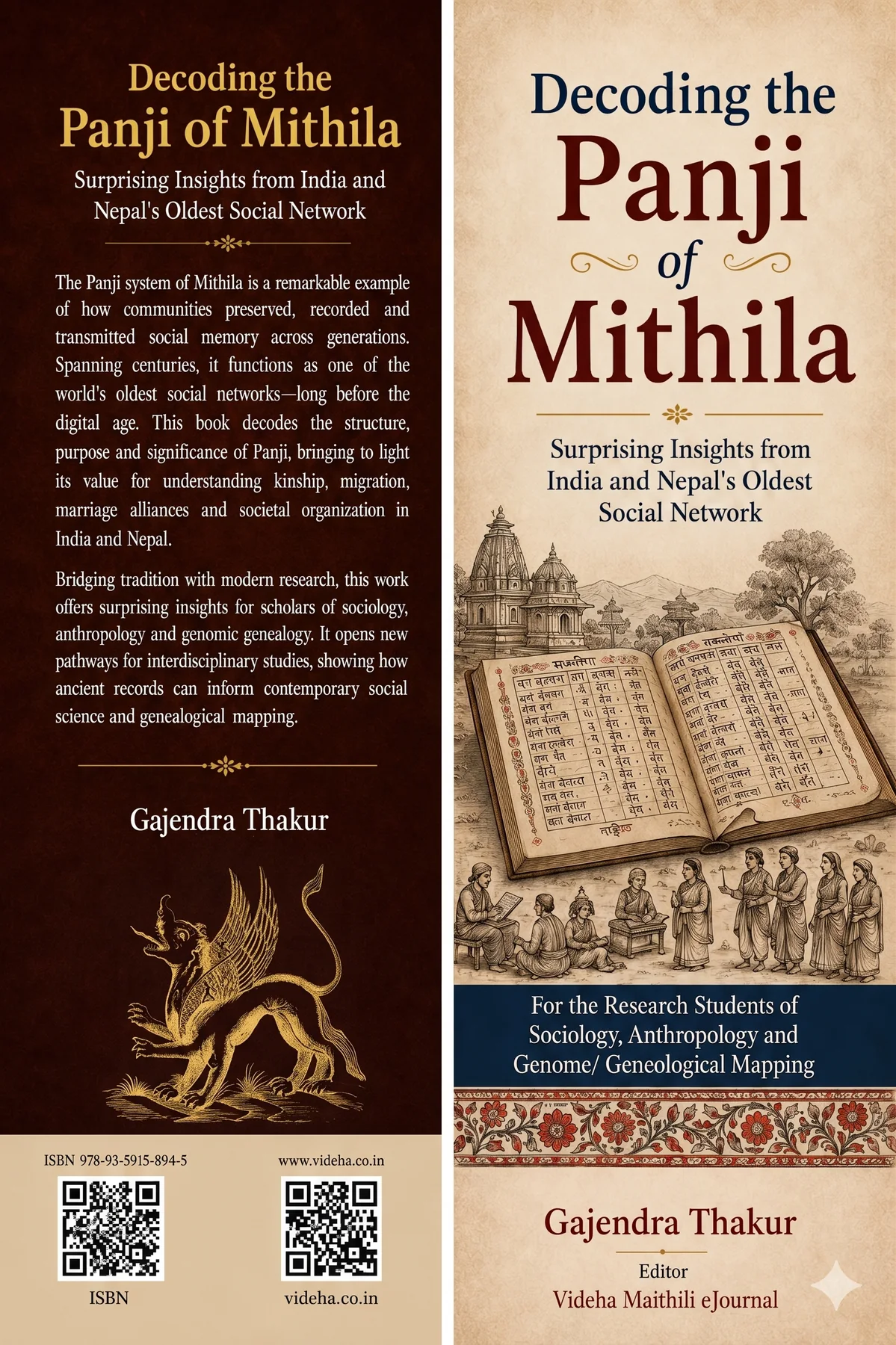
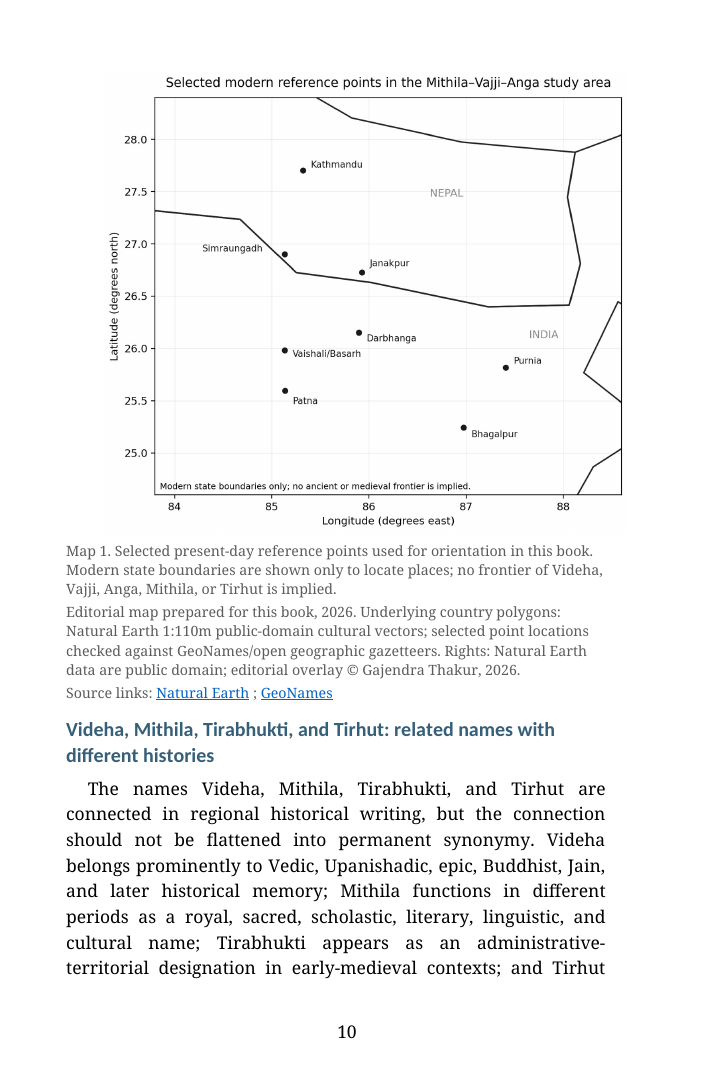
Chapter-specific source notes
- Primary chapter witness. Gajendra Thakur, Decoding the Panji of Mithila — Volume II, formal Chapter 13, PDF pp. 151-163; formal Chapter 13. The HTML transcription is generated from the commit-pinned source PDF and retains the chapter boundary recorded in this edition.
- Internal structure. The repository source-heading inventory records no separately encoded subordinate heading for this chapter.
- Digital editorial method. The page keeps the preserved source text distinct from generated navigational, concordance, visual, and provenance apparatus. The synthetic reconstruction is explanatory only and is not evidence for an individual lineage or a determination of social or marital status.