Decoding the Panji of Mithila · Volume II · Chapter 32
Errors, Variants, and Editorial Discipline
Chapter 32

 Errors, Variants,                              and             Editorial
Discipline
1. Why Editorial Discipline Is Necessary
  Every decoding project reaches a point where the reader
must confront error. The Panji contains difficult names, variant
spellings, damaged readings, repeated persons, unclear
numbers, uncertain titles, broken punctuation, and passages
where the same word may function differently in different
contexts. These difficulties do not weaken the source. They
prove that the source is a living archive, transmitted through
writing, copying, memory, and later handling.
  Editorial discipline is the method by which the decoder
respects this condition. The editor must preserve the original

                Decoding the Panji of Mithila - Volume II

reading, identify possible errors, distinguish source variation
from modern transcription error, mark uncertainty, and avoid
replacing difficulty with false certainty. A clean modern text is
useful only if it remains accountable to the source.
  This chapter completes Part VII by explaining how to handle
errors, variants, and uncertainty while preserving all data.

2. Preserve Before Correcting
   The first rule is preservation. A doubtful form should be
copied exactly before it is corrected, normalized, or explained.
If a village appears in an unusual spelling, preserve that
spelling. If a title abbreviation is unclear, preserve it. If a
number is damaged or ambiguous, preserve it as written and
mark the uncertainty.
   Correction may be necessary, but it should never replace the
source form. The corrected or normalized form belongs in a
separate field. This protects the original evidence and allows
later readers to review the editorial decision.
  Data rule: every correction must have an original reading,
normalized reading, reason, and confidence level.
  Critical caution: do not silently repair the Panji.

3. Types of Error and Variation
  Errors and variants are not all the same. Some are source
variants. Some are scribal or typographical mistakes. Some are
OCR damage. Some are modern transcription errors. Some are
genuine older spellings. Some are local village forms. Some are
abbreviations that look like errors but are actually register
conventions.
  The editor should classify each case before changing it. A
variant spelling of a village is different from an OCR mistake. A
repeated name may be a second person, not a duplicate error.
A strange abbreviation may be meaningful.

                Decoding the Panji of Mithila - Volume II

   Data rule: classify the issue type: source variant, scribal
error, print error, OCR error, transcription error, abbreviation,
local form, duplicate, or uncertain.
  Critical caution: not every unusual form is an error.

4. Variant Spellings of Names
    Names may vary across the Panji. A person may appear with
a full name in one passage and a shortened form in another. A
Sanskritized form may appear beside a Maithili-like form. A
title may be attached in one occurrence and absent in another.
Spelling variation may also come from transcription.
  The person index must preserve all such forms. Only after
comparison of father, branch, village, title, number, marriage
context, and source position should variants be grouped into
one identity.
   Data rule: use variant-name records and alias-confidence
fields.
  Critical caution: do not merge names only because they look
similar.

5. Variant Spellings of Villages
   Village names are especially vulnerable to variation. A
village may appear in joined form, with suffix, with पाली, with
changed vowel, with nasal difference, or in a damaged OCR
form. A modern gazetteer may use another spelling.
  The village index should preserve the original form,
normalized form, possible modern form, and confidence. If two
forms may be the same place, mark them as possible variants
rather than merging them silently.
   Data rule: every village variant must remain searchable in
its original form.
  Critical caution: premature village merging creates false
geography.

                Decoding the Panji of Mithila - Volume II

6. Repeated Names Are Not Always Duplicates
   The Panji contains repeated personal names. A repeated
name may indicate the same person, a namesake in another
branch, a person in another generation, or a different person
in the same village. Repetition is not automatically duplication.
  To decide identity, compare relationship word, father or
branch, village, title, number, marriage role, maternal role, and
source segment. If the evidence is insufficient, keep the
occurrences separate.
   Data rule: repeated names should be grouped only with
stated evidence.
  Critical caution: never remove a repeated name as duplicate
without proof.

7. Duplicate-Looking Village Occurrences
   A village may appear more than once in the same cluster.
This may not be accidental. The place may function differently
in each occurrence: frame village, branch-seat, joined place,
included place, residence, maternal village, or spouse-side
village.
  The village index should therefore be occurrence-based. A
repeated village should receive multiple rows if it occurs in
multiple functions.
  Data rule: one source occurrence equals one village-index
row.
  Critical caution: do not collapse repeated villages into one
entry before classifying function.

8. Damaged Readings and Illegible Forms
  Some readings may be damaged, incomplete, or unclear. The
editor should not guess without marking the guess. Use
brackets, question marks, or uncertainty fields according to the

                Decoding the Panji of Mithila - Volume II

editorial system. If a word is partly readable, preserve the
visible part and mark the damaged part.
  Where possible, compare the form with nearby entries,
repeated patterns, title lists, village gazetteer, and relationship
grammar. But comparison should support a suggestion, not
erase the damaged reading.
  Data rule: every damaged reading must have a damage note
and confidence value.
  Critical caution: an elegant reconstruction is not evidence
unless the source supports it.

9. OCR and Transcription Errors
  Modern OCR can damage Devanagari, especially in dense
genealogical text. It may split joined words, misread
punctuation, confuse numerals, distort abbreviations, and
damage village names. Transcription can create similar
problems.
  The editor should compare OCR text with page image
whenever a reading affects genealogy, village identity, title,
number, or marriage interpretation. If the image is
unavailable, mark the reading as transcription-dependent.
   Data rule: mark whether a reading is image-verified,
transcription-only, or OCR-suspect.
  Critical caution: do not build final genealogy on unchecked
OCR.

10. Abbreviation Uncertainty
  Abbreviations such as ठo, प्रo, म. म., म.म.उ., महो, and related
forms must be handled carefully. Some expansions are
familiar; others may depend on context. The editor should
preserve the abbreviation exactly and give the expansion
separately.

                Decoding the Panji of Mithila - Volume II

  If an expansion is uncertain, mark it as probable or possible.
Do not expand silently in the main transcription.
 Data rule: abbreviation-as-written and expansion-confidence
must be separate fields.
   Critical caution: silent expansion can create false titles or
false identity.

11. Number Uncertainty
  Parenthetical numbers may be clear in form but uncertain
in function. A number may be a register number, branch
number, page-like reference, marriage marker, note number,
or another internal anchor. Its exact purpose may not be
known.
  The correct method is to preserve the number exactly and
record its position. Only later comparison should determine
function.
  Data rule: number-as-written, number-position, and
number-function-confidence must be recorded separately.
  Critical caution: do not convert uncertain numbers into
dates.

12. Punctuation and Boundary Problems
  The Panji often uses punctuation in ways that differ from
modern prose. Double danda, dash, colon, commas, and
spacing may divide units or may be inconsistent. A missing
punctuation mark may cause two units to appear joined. An
extra mark may split a continuous phrase.
  The editor should not rely on punctuation alone. Boundaries
should be confirmed by relationship words, village frames,
marriage markers, मातृक चक्र formulae, and closure signs.

  Data rule: every boundary decision in a difficult passage
should have a boundary-confidence field.

                Decoding the Panji of Mithila - Volume II

  Critical caution: punctuation helps, but it does not replace
grammar.

13. Joined Words and Split Words
  Panji entries often contain joined forms: village plus ग्राम,
name plus अपत्य, title plus name, or relationship plus suffix. OCR
or transcription may also split words incorrectly. The editor
must preserve the source form but may add segmented
analysis.
   For example, a joined form should appear in the original
field, while the analysis field may separate village, suffix, and
function. This allows the reader to see both source and
interpretation.
  Data rule: keep original            joined      form      and   editorial
segmentation separately.
   Critical caution:    segmentation         is    interpretation,     not
transcription.

14. Conflicting Reconstructions
   Sometimes two plausible reconstructions exist. A name may
be person or place. A village may be residence or spouse-side
village. A सुता list may belong to one marriage or another. A
number may belong to the preceding or following unit.
  In such cases, the editor should not force a single answer
unless evidence supports it. Record both possibilities, explain
the evidence, and assign confidence.
  Data rule: conflicting interpretations should be preserved in
an alternatives field.
  Critical caution: uncertainty should be documented, not
hidden.

               Decoding the Panji of Mithila - Volume II

15. Editorial Symbols
  A project of this kind needs editorial symbols. Brackets may
show supplied text. Question marks may mark uncertainty.
Dotted lines may show probable relationships. Square brackets
may identify editorial expansions. Parentheses from the source
should not be confused with editorial parentheses.
  The book should define these symbols in an appendix and
use them consistently. Every symbol must mean one thing.
  Data rule: maintain an editorial-symbol key.
  Critical caution: inconsistent symbols create new confusion.

16. Normalization Policy
  Normalization makes the data searchable. But normalization
must follow a policy. The policy should state how to normalize
names, villages, titles, numbers, punctuation, joined words,
Sanskrit endings, Maithili forms, and modern spellings.
  The policy should also state what will not be normalized.
Terms such as डीह, पाली, मातृक चक्र, अपत्य, सन्तति, and source
abbreviations should remain visible.
  Data rule: every normalized field must be traceable to
original source form.
  Critical caution:    normalization        should         never   become
replacement.

17. When to Emend
   Emendation means correcting the source reading. It should
be rare and explicit. Emend only when the source form is
clearly damaged and the correction is strongly supported by
grammar, repeated occurrence, image comparison, or parallel
entry.
  Even then, the emended form belongs in an editorial field.
The source reading remains in the transcription field. The note
should explain why the emendation was made.

                 Decoding the Panji of Mithila - Volume II

  Data rule: every emendation requires a reason and
confidence level.
  Critical caution: do not emend merely because a form is
unfamiliar.

18. Handling Missing Data
  Missing data must remain visible. If a father is not named,
write “not supplied,” not a guessed father. If a spouse is
unnamed, record spouse-name not supplied and spouse-side
house if given. If a woman is implied but unnamed, record an
implied female link.
  Missing data is not empty data. It tells us the limits of the
source.
  Data rule: distinguish not supplied, illegible, damaged,
implied, and unknown.
  Critical caution: do not fill gaps silently.

19. Revision Logs
   Every major reconstruction should have a revision log. If a
person identity is merged, split, corrected, or reclassified, the
change should be recorded. If a village is normalized
differently, record why. If a marriage issue assignment
changes, record the old and new interpretation.
  Revision logs protect the integrity of the work. They also
help later researchers understand how the reconstruction
developed.
  Data rule: every corrected table should preserve date of
correction, reason, and affected records.
 Critical caution: overwriting old decisions without record
makes the project unreviewable.

                Decoding the Panji of Mithila - Volume II

20. Critical Notes
   Critical notes are not optional. A critical note should explain
difficult readings, uncertain identifications, variant spellings,
boundary problems, title expansions, number functions, and
alternate reconstructions. It should state what is certain, what
is probable, and what remains unresolved.
   A good critical note makes the editor’s work transparent. It
allows disagreement without destroying the source.
  Data rule: every difficult entry should have a critical note.
  Critical caution: conclusions without critical notes may
appear stronger than the evidence allows.

21. Editorial Ethics
  Editorial discipline is also ethical discipline. The Panji is not
merely data. It is family memory, social memory, village
memory, and intellectual memory. Wrong merging, false
correction, or careless deletion can distort that memory.
  The editor must therefore prefer honesty to neatness. Where
the source is uncertain, say so. Where a reading is damaged,
say so. Where two possibilities remain, keep both. Where the
source does not give a fact, do not invent it.
  Data rule: uncertainty must be preserved as part of the
record.
  Critical caution: the editor’s confidence should never exceed
the evidence.

22. The Error-and-Variant Table
  A complete error-and-variant table should include: record
identifier; source phrase; issue type; original reading;
normalized reading; proposed correction; evidence for
correction; related person; related village; related term; related
number; source image status; variant group; confidence level;
editorial note; date of decision; and revision history.

                Decoding the Panji of Mithila - Volume II

   This table should link to the person index, village index,
term glossary, title index, family tree, marriage table,
maternal-cycle table, and number table.
  Data rule: every correction should be tabled, not hidden in
prose.
   Critical caution: undocumented correction is invisible
alteration.

23. Common Errors in Editorial Handling
  The common editorial errors are: correcting before
preserving; merging repeated names; merging village variants
too early; expanding abbreviations silently; treating all
numbers as dates; ignoring OCR risk; deleting punctuation;
over-trusting punctuation; failing to mark damaged readings;
erasing unnamed women; forcing a single reconstruction;
using inconsistent symbols; and failing to keep a revision log.
   Each of these errors makes the Panji easier to read but less
faithful.

24. Rules for Editorial Discipline
  First, preserve the source form.
  Second, classify the difficulty.
   Third,   separate      transcription,         normalization,   and
interpretation.
  Fourth, mark uncertainty visibly.
  Fifth, never merge without evidence.
  Sixth, never emend silently.
  Seventh, verify OCR against image where possible.
  Eighth, record alternatives when evidence remains divided.
  Ninth, keep revision logs.
  Tenth, prefer faithful complexity to false simplicity.

                Decoding the Panji of Mithila - Volume II

25. Conclusion: Discipline as Preservation
   Editorial discipline is the final tool of decoding. Without it,
family trees become guesses, village indexes become
modernized lists, person indexes merge names falsely, and
glossaries flatten technical terms. With it, even difficult
readings remain useful because their uncertainty is preserved.
  The Panji deserves this discipline. It is a layered archive of
Mithila: genealogical, social, intellectual, geographical,
maternal, and ritual. Its data must be enshrined, but not
beautified into false certainty.
Source structure and verification apparatus
Editorial source apparatus. This apparatus is descriptive, not interpretive. It records the source-controlled structure used to verify that this page corresponds to formal Chapter 32 of Decoding the Panji of Mithila — Volume II. The chapter text above is preserved from PDF pp. 362-373; formal Chapter 32 in the commit-pinned authoritative source. It is not merged with a neighboring chapter, appendix, annexure, or independent front/back-matter unit. The internal headings below come from the repository’s source-heading inventory and are retained as navigational and audit evidence; showing them here does not turn those headings into separate publications or add claims that are absent from the source.
Internal source headings
- 1. Why Editorial Discipline Is Necessary
- 2. Preserve Before Correcting
- 3. Types of Error and Variation
- 4. Variant Spellings of Names
- 5. Variant Spellings of Villages
- 6. Repeated Names Are Not Always Duplicates
- 7. Duplicate-Looking Village Occurrences
- 8. Damaged Readings and Illegible Forms
- 9. OCR and Transcription Errors
- 10. Abbreviation Uncertainty
- 11. Number Uncertainty
- 12. Punctuation and Boundary Problems
- 13. Joined Words and Split Words
- 14. Conflicting Reconstructions
- 15. Editorial Symbols
- 16. Normalization Policy
- 17. When to Emend
- 18. Handling Missing Data
- 19. Revision Logs
- 20. Critical Notes
- 21. Editorial Ethics
- 22. The Error-and-Variant Table
- 23. Common Errors in Editorial Handling
- 24. Rules for Editorial Discipline
- 25. Conclusion: Discipline as Preservation
Source-text concordance
Errors · Variants · Editorial · Discipline · Necessary · Every · decoding · project · reaches · point · reader · must · confront · error · contains · difficult · names · variant · spellings · damaged · readings · repeated · persons · unclear · numbers · uncertain · titles · broken · punctuation · passages · word · function · differently · different · contexts · difficulties · weaken · prove · living · archive · transmitted · writing · copying · memory · later · handling · method · decoder · respects · condition · editor · preserve · original · reading · identify · possible · distinguish · variation · modern · transcription · mark · uncertainty · avoid · replacing · difficulty · false · certainty · clean · text · useful · remains · accountable · completes · Part · explaining · handle · preserving · data · Correcting · first
Boundary verification. In the formal sequence this chapter follows Volume II Chapter 31, “Creating a Term Glossary” and precedes Volume II Chapter 33, “Volume II and the Khand 1 Index Protocol”. The chapter extractor begins at the verified formal Chapter 32 marker and stops at the next verified formal chapter marker; for a final chapter it stops before recognized book-level back matter. The concordance above is generated only from distinct terms already present in this chapter’s preserved source text. It is provided for discovery, comparison, and audit, not as an automated judgment about persons, lineages, status, kinship, marriage eligibility, or historical truth.
Illustrated research apparatus
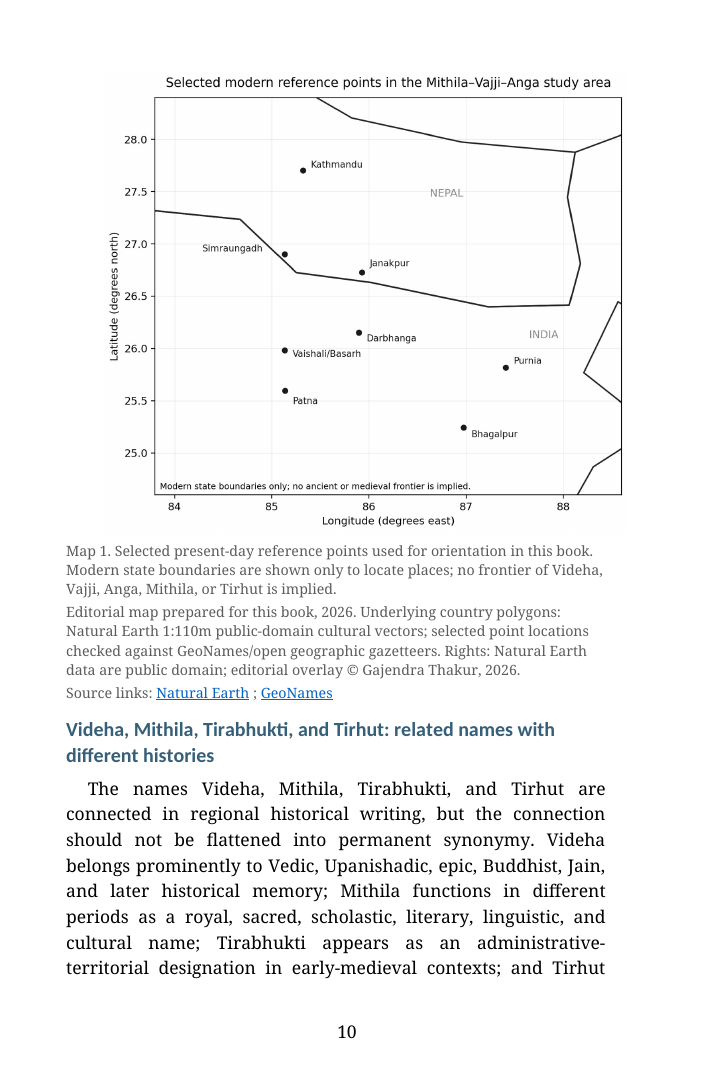
Mithila · Vajji · Anga
Chapter-specific source notes
- Primary chapter witness. Gajendra Thakur, Decoding the Panji of Mithila — Volume II, formal Chapter 32, PDF pp. 362-373; formal Chapter 32. The HTML transcription is generated from the commit-pinned source PDF and retains the chapter boundary recorded in this edition.
- Internal structure. The repository source-heading inventory records 25 subordinate headings for this chapter: “1. Why Editorial Discipline Is Necessary”; “2. Preserve Before Correcting”; “3. Types of Error and Variation”; “4. Variant Spellings of Names”; “5. Variant Spellings of Villages”; “6. Repeated Names Are Not Always Duplicates”; “7. Duplicate-Looking Village Occurrences”; “8. Damaged Readings and Illegible Forms”; ….
- Digital editorial method. The page keeps the preserved source text distinct from generated navigational, concordance, visual, and provenance apparatus. The synthetic reconstruction is explanatory only and is not evidence for an individual lineage or a determination of social or marital status.