Decoding the Panji of Mithila · Volume III · Chapter 12
Entries 41-51 - Digaunth, Gangoli, Navtol, Batouri, Bairi, Bhattpura, and Kachhua Index Link Box
Chapter 12
 Entries 41-51 - Digaunth, Gangoli, Navtol, Batouri,
Bairi, Bhattpura, and Kachhua
  Index Link Box
Index cluster: दिगउन्ध / गंगोली / नवटोल / बटूरी / बैरी / भट्टपुरा / कछु आ.

Khand 2 source entries decoded: 41-51.
Principal source heading forms: “पुवारिपार उप.टीप दिगउन्ध सँ”; “अथ दिगउन्ध सोदरपुर

ग्रामारम्भ”; “उ.टी. दिगउन्ध सँ गंगोली”; “उप.टीप-दिगउन्ध सँ नवटोल”; “हरिअम्ब सँ दिगउन्ध
सँ बटूरी उ.टी.”; “उ.टी. दिगउन्ध सँ बइरी, सनकोर्थु”; “उ.टी. दिगउन्ध सँ भट्टपुरा”; and “उ.टी.
दिगउन्ध सँ कछु आ / कछु वा.”
Index roots and routes: सोदरपुर-root controls the Digaunth opening; internal movements pass

through पाली, खण्डबला, नरउन, घोसौत, करमहा, पवौली, सुरगन, बुधवाल, लोहना-सकराढ़ी,

माण्डर, दरिहरा, कु जौली, वलियास, खौआल, हरिअम्ब, बटूरी, बइरी, सनकोर्थु, भट्टपुरा, कछु आ,
गंगोली, नवटोल, and related marriage/status routes.
Coverage status: Entries 41-51 decoded in this chapter. Entry 52 begins the next cluster, Kanhauli-
Ujan, and is not decoded here.

Chapter 11 closed the Sarisab-Soderpur-Lalganj route and
recorded Entry 40 as a bare or unexpanded Lalganj heading.
Chapter 12 begins a new movement: the Puwaripar Uptip of
Digaunth. This is the first major point after the early Sarisab
and Badhiyam expansions where the book must show how
one Index root opens into a dense network of scholarly
figures, daughter-lines, regional movement, and cross-
referenced settlement routes.

    The method remains unchanged. Every name is read
through descent, place, marriage, title, and branch-continuity.
The heading supplies the entry field; the person-name
supplies the genealogical point; the father or son formula
supplies descent; सुता and दौहित्र-style movement supply
marriage or maternal continuity; the village after सँ supplies

                        Decoding the Panji of Mithila, Volume III | Page 145
                       Decoding the Panji of Mithila Volume III

the relational location; and titles such as वैयाकरण, ज्योतिर्विद, महो,
म.म., आचार्य, प्रो., महाराज, वावू, राजा, and चौधरी supply scholarly or social
identification.

   The Digaunth cluster is especially important because it
combines old-style scholarly identifiers with wide village
movement. It does not remain inside Digaunth. The lines run
toward Soderpur, Pali, Khandbala, Naruan, Ghosaut,
Karamha, Pabouli, Surgan, Budhwal, Lohna-Sakaradhi,
Mandar, Darhara, Kujouli, Valias, Khoaāl, Harianb, Bhattpura,
Batouri, Bairi, Sankorthu, and Kachhua. This is why the
chapter must be read as a route chapter, not as a single-place
chapter.

  Chapter overview
   Entries 41-51 form the Digaunth-centered cluster. Entry 41
opens the Puwaripar Uptip from Digaunth and explicitly
begins the Digaunth-Soderpur village record. Entry 42 moves
from Digaunth to Gangoli. Entries 43-44 move toward Navtol
and contain modern scholarly markers such as professor and
Maithili writer alongside older Panji formulae. Entry 45
moves through Harianb, Digaunth, and Batouri. Entry 46
carries Digaunth into Bairi and Sankorthu. Entries 47-48 open
Bhattpura. Entries 49-51 close the chapter through Kachhua /
Kachhuwa and keep several major branch-routes active.

   The governing feature of these entries is repeated
movement through daughter-linked and collateral lines. A line
may begin with a scholar, move through a daughter, reach a
village, reopen through अपरा, attach to a title-bearing house,
and then pass by cross-reference into another root. This does
not make the record disorderly. It makes the record
genealogically compressed. The decoder’s task is to keep each
route visible without forcing it into a false straight line.

                   Decoding the Panji of Mithila, Volume III | Page 146
                      Decoding the Panji of Mithila Volume III

  Entry 41: The Puwaripar Digaunth-Soderpur opening
   Entry 41 begins as “पुवारिपार उप.टीप दिगउन्ध सँ” and then states
“अथ दिगउन्ध सोदरपुर ग्रामारम्भ.” This opening is structurally
important. It tells the reader that Digaunth is being opened
through Soderpur, but the presence of Puwaripar shows that
the route belongs to a wider regional field. The chapter
therefore begins with geography and genealogy together.

   Jiveshwar’s daughter-linked group includes Jyotirvid
Bhavnath, Vaiyakarana Shyamnath, Mahamahopadhyaya
Shrinath, and Vaiyakarana Shobhnath. The cluster
immediately establishes the learned character of the entry.
These are not ornamental titles. Jyotirvid and Vaiyakarana
identify learned functions; महो / म.म. marks high scholarly
status; and Shobhnath and Shrinath must be read through
both name and scholarly designation.

   The first route moves through Pali-Dharadhar-Devkrishna
and then toward Khandbala-Devkrishna. Jyotirvid Bhavnath’s
daughter-link reaches Naruan-Jatesh-Pauranik Manbodh. The
word Pauranik is another status marker: it identifies a learned
or textual specialization inside the branch. The अपरा from
Manbodh then moves through Ghosaut-Hari-Hemkar,
Khandbala-Balbhadra, and Karamha-Umāpati.

   Vaiyakarana Shyamnath produces more than one path.
One daughter-linked route points back toward Naruan-
Manbodh and Pabouli-Parmanand. Another route from
Shyamnath’s son Bholanath moves toward Surgan-Rai
Chandranarayan and Pabouli-Raghunandan. A further
Shyamnath daughter-line moves through Karamha-Bhavdev-
Chhotakani and Darhara-Vidhu. These repeated routes show
why the same person can open several branches.

                  Decoding the Panji of Mithila, Volume III | Page 147
                     Decoding the Panji of Mithila Volume III

   Bholanath’s sons Kishor and Keshav lead toward Alay-Babu
Harilal Singh and Khandbala-Krishnaram. Another Bholanath
son, Baidyanath, moves through Budhwal-Parshuram-Pathak
Vishnudatt, then toward Lohna-Sakaradhi-Raghupati-Khedan.
The Pathak and Babu markers must be retained because they
identify status-bearing and learned families inside the same
genealogical movement.

   The later part of Entry 41 brings in Mishra Kishor,
Budhwal-Brajnath-Rajnath, Khoaāl-Nanu-Gangadatt,
Soderpur-Hari-Ramanand, Karamha-Murli, Darhara-Jayanath,
and Mahamahopadhyaya Shrinath’s son Thithar/Shaktinath.
The line then reaches Darhara-Aniruddha-Keshav, Pabouli-
Tengari-Survai, Budhwal-Kamalnayan, Soderpur-Chhabnu,
Naruan-Bhavnath-Mitranath, Harianb-Babu Dullah, and a
Vaiyakarana-linked Devanath/Nena/Fuchchi/Mangi/Kari
group. Entry 41 is therefore a whole Digaunth-Soderpur map
in miniature.

  Entry 42: Digaunth to Gangoli
   Entry 42 carries the heading “उ.टी. दिगउन्ध सँ गंगोली.” The route
begins with Mishrakari’s sons Govind/Ganganath and
Adyanath. Valias-Thengni-Bachche/Ugrapati and Soderpur-
Kari appear early, showing that Gangoli is not isolated. It is
part of a wider Digaunth route whose persons are constantly
identified by other village fields.

   Ganganath’s daughter-line reaches Naruan-Radhanath-
Yadunath, then Khandbala-Raghunandan-Yadunandan and
Pabouli-Goshain. Another Ganganath daughter-line moves to
Pali-Harshi-Bachchan and Khandbala-Shrinandan. Adyanath’s
line similarly returns to Naruan-Radhanath-Yadunath, while
an अपरा route moves through

                 Decoding the Panji of Mithila, Volume III | Page 148
                    Decoding the Panji of Mithila Volume III

Budhwal-Mohan-Nakchhedi/Dharmanath and Pabouli-Pandit
Babuan.

   The same entry preserves Vaiyakarana Shobhnath’s lines.
One daughter-route moves through Mandar-Vishnupati-
Bechan and Khandbala-Premanidhi. Another Shobhnath
daughter-route returns through Darhara-Aniruddha-Keshav
and Soderpur-Chhabnu. These routes confirm that the
scholarly identity of Shobhnath must not be separated from
his marriage and village links.

   A later section of Entry 42 carries Shubhankar, Jagdish,
Mannu, Darhara-Krishnadev, Budhwal-Krishnapati, Mandar-
Bhavesh, Sarisab-Sonai, Pali-Vidyadhar, Mahamahopadhyaya
Vamdev, Ghusaut-Hari-Ram, Khandbala-Devkrishna,
Karamha-Jagannath-Venidatt, and several अपरा branches. The
entry is a lesson in reading repeated names: Ganganath,
Jagdish, Vamdev, Badri, and Manhar become clear only when
their village and reference-number contexts are preserved.

  Entries 43-44: Digaunth to Navtol and the modern scholarly
layer
   Entry 43 opens “उप.टीप-दिगउन्ध सँ नवटोल.” Goshain’s daughter-
line moves through Pali-Ramkrishna-Jaykrishna and Sarisab-
Ganesh. An अपरा route from Goshain moves to
Mahamahopadhyaya Devendra/Balkrishna and Mahendra
through Karamha-Keshav-Lanhi and Pabouli-Dharmanand.
The title M.M. shows that the scholarly layer is not incidental;
it identifies the branch among many repeated names.

   The Devendra/Balkrishna daughter-linked group -
Lekhadatt, Gopidatt, Vachaspati, Duna/Murari - moves
through Kujouli-Bucha/Kishornath. Kishornath’s son Dinanath
connects to Khandbala-Babu Girijadatt Singh and Mandar-
Khadgi. Lekhadatt then moves through Karamha-Kalyan-
                Decoding the Panji of Mithila, Volume III | Page 149
                    Decoding the Panji of Mithila Volume III

Nityanath and Valias-Modpati. Gopidatt’s sons Hira and Vinod
move through Sakaradhi-Brajmohan-Ram and Kujouli-
Indukar. Vinod’s daughter-line reaches Pude-Naruan and
Acharya Ramanath.

   The entry then becomes particularly valuable for modern
intellectual history. Vachaspati’s sons Jivesh and Rajesh are
linked with Bhadpura/Valias/Harianb and a partly blank
route, while Jivesh’s son Ashutosh reaches Pahitola, Mahishi-
Pali, Sitanath, Hiranath, and Raima. Murari/Tuna’s sons Vijay
and Ajay are connected with Bhattpura-Harianb and
Khandbala-Babu Ganapati Singh. Mahindra/Mahi’s sons
Professor Govind and Professor Jagdish are explicitly marked
as Maithili writers. These modern titles must be read as
documentary status signs within the Panji, not as later
commentary detached from genealogy.

   Entry 44 continues Navtol. It opens from an अपरा line of
Jhingur into Jibach and Chiranjeev, then moves through
Khoaāl-Venidatt, Khandbala-Gopinath, Pali-Parivaya-
Purandar, and Oini-Maharaj Shridhar Narayan. Jibach’s
daughter-linked group - Satish Chandra, Harishchandra, and
Ganeshchandra - moves through Naruan-Ghonghi-Gaurinath
and Khoaāl-Matinath. These names show a transition toward
modern personal-name style while retaining the old Panji
grammar.

   Ganeshchandra’s daughter-linked group includes
Yogeshchandra, Shaileshchandra, Ashokchandra,
Dineshchandra, and Amareshchandra. The route passes
through Harianb-Kamalnath-Muktinath, Mandar-Mukund
Singh, Harianb-Shashinath-Teknath, and Mandar-Naiya
Durgadhar. Chiranjeev’s line brings Lakshmidhar, Yogmani,
Vaiyakarana Lakshmidhar, Darhara-Yadunath-Hridaynath,

                Decoding the Panji of Mithila, Volume III | Page 150
                   Decoding the Panji of Mithila Volume III

Karamha-Shyam, Valias-Ishwaridatt-Madhusudan, Soderpur-
Nena, and several daughter-linked Valias and Pali routes. The
entry must therefore be decoded as a Navtol scholarly and
marriage network.

  Entry 45: Harianb-Digaunth-Batouri
   Entry 45 is headed through Harianb, Digaunth, and
Batouri. Bachharu’s sons Hridaynath and related lines move
through Darhara-Mahadev-Bandhu, Soderpur-Ghanshyam,
and then through Vaiyakarana Hridaynath’s son Narhari.
Narhari reaches Karamha-Mahamahopadhyaya Subodh and
Darhara-Mansukh. An अपरा line from Hridaynath’s son
Sadanand moves through Pali-Modnath and Darhara-
Sanphool. The entry therefore combines Digaunth with
Harianb, Pali, Darhara, and Karamha from the beginning.

   Narhari’s daughter-line reaches Harianb-Sachal-Durgadatt
and Khandbala-Maharaj Chhatra Singh. Sadanand’s sons
Pritinath and Nena/Shivanandan move through Karamha-
Brajlal and Soderpur-Shrinath. Sadanand’s daughter-line
reaches Harianb-Vaiyakarana Mahamahopadhyaya Mohan-
Siddhinath and Naruan-Jankinath. These title clusters show
why Chapter 12 must follow scholarship and status along with
descent.

   The entry then follows Pritinath’s daughter-linked group -
Balbhadra, Rambhadra, and Virabhadra - into Pali-Hemnath-
Shrinath and Khandbala-Maharaj Rudra Singh. Balbhadra’s
son Shaktinath moves through Darhara-Manbharan-
Vishwanand and Sarisab-Gunapati. Shaktinath’s daughter-
linked group - Lakshminath, Bhavnath, Jayanath, Premnath,
Somnath, and Tuna - reaches Harianb-Revati Raman-Pritinath
and Khandbala-Brajnandan Singh.

               Decoding the Panji of Mithila, Volume III | Page 151
                      Decoding the Panji of Mithila Volume III

   The latter part of Entry 45 continues through
Rambhadra/Buddhinath/Harinarh, Mandar-Vacha-Narpati,
Pabouli-Narayanadatt, Karamha-Mahadev-Markandey,
Naruan-Girdhar, Sachinath-Pitambar, and multiple branch
movements through Budhwal, Valias, Khandbala, and
Darhara. The significant point is that Batouri does not replace
the earlier villages; it becomes another route inside the
Digaunth field.

  Entry 46: Bairi, Sankorthu, and densely layered daughter-
lines
   Entry 46 is headed “उ.टी. दिगउन्ध सँ बइरी, सनकोर्थु.” It continues
from Shivanandan/Nena to Mahavir, who is linked with Pali-
Hemnath-Shrinath and Khandbala-Maharaj Rudra Singh.
Mahavir’s daughter-linked group includes Vishwanath,
Baidyanath, Harshnath, and Modnath, moving through
Budhwal-Vacha-Manishwar and Darhara-Manbharan. The
formula keeps descent and marriage in tight compression.

   Baidyanath’s sons Vipin Bihari and linked branches move
through Sihauli-Mandar, Nilkanth Singh, Paddanand Singh
Jha, Pabouli, and Motinandan Jha. Vishwanath’s sons
Indranath and Adityanath move through Naruan-Jagannath-
Khadganath and Harianb-Shambhunath. Indranath’s
daughter-linked group reaches Ghusaut-Madhusudan-Munar.
Harshnath’s daughter-linked group reaches Surgan-
Durganarayan-Vedanand Narayan and Khoaāl-Jankinath. This
shows Bairi/Sankorthu as a gateway to several Index roots.

   The Madhupati section in Entry 46 adds Chintamani,
Bachchi, Goshain, Kanhai, Pali-Ram-Chhotakani, Soderpur-
Shatanjiv, Parshamani, Amritnath, Karamha-Ramadatt-
Brajlal, Mandar-Khushihal-Bhavanidatt, Darhara-Nityanand-
Maniknandan, and Alay-Raja Lilanand Singh. The repeated

                  Decoding the Panji of Mithila, Volume III | Page 152
                    Decoding the Panji of Mithila Volume III

अपरा structure prevents closure and must be read as active
branch expansion.

   The latter part of Entry 46 gives Tirthamani, Yogmani,
Govardhan, Raghumani, Tekmani, Yogananand, Vikal,
Baidyanath, Ratnanath, Hiranath, and Taranath. Many
daughter-linked lines are left with blank persons, but they still
preserve the route shape. The correct decoding is to say that
the source records the connection type and the probable
branch point, while leaving missing names as missing.

  Entries 47-48: Bhattpura and the Babu-linked branches
   Entry 47 opens Digaunth to Bhattpura. Yari’s sons include
Shivanand and Dullah/Punyanand, linked through Mandar-
Harihar-Bhiravani and Pabouli-Krishnapati. Shivanand’s
daughter-linked group - Bholanand, Jhotan/Kamalanand,
Kari/Krishnanand - moves through Darhara-Nityanand-
Motinandan and Soderpur-Bandhu. Another daughter-line
reaches Sakaradhi-Chhatrapati-Prannath and Budhwal-Lala.

   Bholanand’s lines move toward Naruan-Lakshminath-
Bauku and Darhara-Devidatt; another route reaches
Karamha-Teknath-Babu Nenu/Bodhnath and Khoaāl-Gorbul.
Jhotan/Kamalanand’s routes pass through Pali-Modnath-
Durivaya, Khandbala-Theghi, Sakaradhi-Dullah-Devidatt, and
Pali-Durivaya. The repetition of Pali-Durivaya is meaningful
because it shows branch reinforcement rather than careless
repetition.

   Entry 48 continues Bhattpura. Satyanarayan’s line moves
through Karamha-Jagdhar-Dharmadatt and Soderpur-
Girdhari. Harinarayan moves through Darhara-Bhavnath-
Kumudnath, then Kumudnath’s daughter-line reaches
Sarisab-Jivanath-Rupnath and Mandar-Kashinath.
Harinarayan’s daughter-line reaches Mandar-Thengni-

                Decoding the Panji of Mithila, Volume III | Page 153
                      Decoding the Panji of Mithila Volume III

Hanumandatt and Khandbala-Babu Ganeshdatt Singh. The
Babu marker here ties the route to a status-bearing Khandbala
house.

   Harinarayan’s son Vilat leads through Karamha-Mahadev-
Baldev; Baldev’s daughter-line reaches Naruan-Gopal-Adinath
and Harianb-Loknath. Another Harinarayan son, Vishwanath,
moves through Darhara-Phanindranandan-Mana and
Soderpur-Luchai. Vilat’s daughter-line moves through
Karamha-Lanhi-Nilambar; Nilambar’s son Ranath moves
through Naruan-Manhar-Duni and Pali-Rajje. The closing lines
contain Ramanand/Balbhadra, Yoganand, Mokshanand, and
Kevalanand routes, several of which are partly blank but
structurally clear.

  Entries 49-51: Kachhua / Kachhuwa closing sequence
   Entry 49 is headed “उ.टी. दिगउन्ध सँ कछु आ.” Kari/Krishnanand’s
sons Kaushalyanand/Dularnath and Damodar are linked
through Pali-Modnath-Durivaya and Khandbala-Theghi. Kari’s
daughter-line reaches Chummananand, Dinanand, and
Ugranand through Khoaāl-Balah-Dharmanath and Budhwal-
Parshamani. Kaushalyanand’s daughter-line moves through
Mandar-Chitru-Gapi and Khandbala-Maharaj Chhatra Singh.

   The entry continues through Nikanand, Ramanand,
Durganand, Karamha-Krishnadatt-Gopinath, Mandar-Thithar,
Kujouli-Amritkar-Son, Khandbala-Babu Punyapati Singh, and
Karamha-Kunjran-Khelanand. Damodar’s line brings
Vishwanand and Siddhinandan through Budhwal-
Parshamani-Kantu, Soderpur-Chitradhar, Kujouli-Amritkar-
Manmohan, and Khandbala-Maharaj Kumar Vasudev Singh.
Again, Kachhua is not isolated; it is a confluence.

   The latter half of Entry 49 gives Vishwanand’s
Vilat/Sherwanand/Jivanand and Shyam/Chudanand lines;

                Decoding the Panji of Mithila, Volume III | Page 154
                    Decoding the Panji of Mithila Volume III

Siddhinandan’s sons Chandranand/Jagdish/Tirthanand; Pali-
Shrinath-Jagannath; Khandbala-Babu Vanshdhari Singh;
Karamha-Bholi-Bhaiyan; Khandbala-Babu Bhaveshwar Singh;
Tirthanandan’s daughter-linked group; and Chaudhary
Tanknath-Rudranath through Karamha and Mahua-Khoaāl.
This is a dense Kachhua route into title-bearing and collateral
branches.

   Entry 50 continues Kachhua through Chummananand,
Dinanand, Ugranand, Yashodanand, Lilanand,
Punyanand/Dullah, Mandhan, Raghunandan, and related
lines. The source connects Sakaradhi, Naruan, Soderpur,
Karamha, Khandbala, Kujouli, Sarisab, Darhara, Valias, and
Ravandbala. The route to Raja Teknath Chaudhary and
Maharaj Maheshwar Singh marks a status layer that must be
retained beside the descent line.

   Entry 51 closes the Digaunth-Kachhuwa cluster. Mahavir’s
daughter-linked group - Vidyanand, Jivanand, and Shivanand
- moves through Valias-Damodar-Punyapati and Khandbala-
Babu Khelapati Singh. Vidyanand and Jivanand have blank
daughter-linked continuations, while Motinandan’s son
Panchanand and Devkinandan’s sons Chhatrānand and
Harinandan continue the route through Valias-Bhaiyo-
Krishneshwar, Sarisab-Phalahari, Karamha-Keshav-
Ramnarayan, Naruan-Damodar, and a final Satīnandan
daughter-link to Phanipati Jha. This closes the chapter but
does not close the wider network.

  Cross-reference and route map for Entries 41-51
   The chapter’s main route is Digaunth-Soderpur. From this
root, the chapter branches to Gangoli, Navtol, Batouri, Bairi,
Sankorthu, Bhattpura, and Kachhua. Repeated cross-links also
connect the chapter to Pali, Khandbala, Naruan, Karamha,
Darhara, Mandar, Harianb, Ghosaut, Budhwal, Pabouli, Valias,
                Decoding the Panji of Mithila, Volume III | Page 155
                        Decoding the Panji of Mithila Volume III

Khoaāl, Sakaradhi, Surgan, Alay, Kujouli, Oini, Raima,
Pahitola, Mahishi, and Ravandbala. These places should be
recorded in the Place Index with their roles: heading-place,
internal route-place, marriage-place, scholarly-branch place,
or status-house place.

   The title map is unusually rich. The chapter contains
Jyotirvid, Vaiyakarana, Pauranik, Pathak,
Mahamahopadhyaya, M.M., Babu, Maharaj, Raja, Acharya,
Professor, Maithili writer, Chaudhary, and Singh markers.
Some titles identify scholarship; some identify public or estate
standing; some identify family status inside a dense branch.
None should be separated from the name to which it belongs.

   The reference map contains many उ.टी., शा., slash-number,
double-slash, and irregular reference forms. Examples include
१८३/०९, ११७/०८, १२३/०३, १०५/१०१२, २९४/०९, १०४/०९, ७६/०९, ३२/०२, ७५/०४,
५६//०७, ५९//०७, and ९०/१०८. The correct editorial rule is to
preserve these forms exactly in transcription and use them as
navigation markers, not to standardize them silently.

  Important uncertainties
   Several entries contain visible gaps. These gaps occur
inside daughter-linked lines, son-lines, and place-linked
segments. A blank after सुता does not permit the editor to
invent a spouse, child, or village. It only tells us that the source
preserves the route-form but not all personal data. Each such
gap must remain marked as a gap in the decoded prose and in
the later registers.

   The chapter also contains variant forms: दिगउन्ध / दिगउन्घ, बटूरी,
बइरी, सनकोर्थु, भट्टपुरा / भदपूरा, कछु आ / कछु वा, खौआल / खोआल, हरिअम्ब / हरिअम,
सरिसब / सरिसव, and पबौली / पवौली. These variations should be kept

                    Decoding the Panji of Mithila, Volume III | Page 156
                    Decoding the Panji of Mithila Volume III

visible in the source-based notes, while the contents and index
may use a stable navigation form.

  Research summary
   Entries 41-51 are the first large Digaunth-centered
decoding unit. They show how a new heading expands into a
full network: scholarly branches, Puwaripar orientation,
daughter-linked movement, estate-linked Khandbala lines,
Naruan and Pali cross-routes, modern scholarly titles,
professor and Maithili-writer markers, and several blank but
structurally meaningful continuations.

   For researchers, this chapter teaches a practical rule. Do
not begin by drawing a family tree. Begin by listing the
heading, the persons, the titles, the villages, the daughter-
links, and the reference numbers. Then attach each village to
the nearest genealogical unit. Only after that should a route
chart be made. This prevents Digaunth, Gangoli, Navtol,
Batouri, Bairi, Bhattpura, and Kachhua from being mistaken
for unrelated places.

   The next chapter begins with Entry 52, “उपटीप कन्हौलीसँ उजान,”
and opens the Kanhauli-Soderpur village record. Chapter 13
will therefore move from the Digaunth cluster into Kanhauli,
Ujan, Mangrauni, Mani, Sarisab, and Bhattpura. The method
will remain the same: descent, place, marriage, title, and
branch-continuity must be read together.

                Decoding the Panji of Mithila, Volume III | Page 157
                             Decoding the Panji of Mithila Volume III
Source structure and verification apparatus
Editorial source apparatus. This apparatus is descriptive, not interpretive. It records the source-controlled structure used to verify that this page corresponds to formal Chapter 12 of Decoding the Panji of Mithila — Volume III. The chapter text above is preserved from PDF pp. 146-159; formal Chapter 12 in the commit-pinned authoritative source. It is not merged with a neighboring chapter, appendix, annexure, or independent front/back-matter unit. The internal headings below come from the repository’s source-heading inventory and are retained as navigational and audit evidence; showing them here does not turn those headings into separate publications or add claims that are absent from the source.
Internal source headings
- Index Link Box
- Chapter overview
- Entry 41: The Puwaripar Digaunth-Soderpur opening
- Entry 42: Digaunth to Gangoli
- Entries 43-44: Digaunth to Navtol and the modern scholarly layer
- Entry 45: Harianb-Digaunth-Batouri
- Entry 46: Bairi, Sankorthu, and densely layered daughter-lines
- Entries 47-48: Bhattpura and the Babu-linked branches
- Entries 49-51: Kachhua / Kachhuwa closing sequence
- Cross-reference and route map for Entries 41-51
- Important uncertainties
- Research summary
Source-text concordance
Entries · 41-51 · Digaunth · Gangoli · Navtol · Batouri · Bairi · Bhattpura · Kachhua · Index · Link · cluster · Khand · decoded · Principal · heading · forms · roots · routes · र-root · controls · opening · internal · movements · pass · नरउन · करमह · related · marriage · status · Coverage · Entry · begins · next · Kanhauli · Ujan · closed · Sarisab-Soderpur-Lalganj · route · recorded · bare · unexpanded · Lalganj · movement · Puwaripar · Uptip · first · major · point · early · Sarisab · Badhiyam · expansions · book · must · show · root · opens · dense · network · scholarly · figures · daughter-lines · regional · cross · referenced · settlement · method · remains · unchanged · Every · name · read · descent · place · title · branch-continuity · supplies · field · person-name
Boundary verification. In the formal sequence this chapter follows Volume III Chapter 11, “Entries 25-40 - Sarisab, Bhaduar, Chapahi, Soderpur, Lalganj, and Ramnagar Index Link Box Index cluster: सरिसब / भदुआर / चपाही / सोदरपुर / बेहट / लालगंज / तारनगर / रामनगर” and precedes Volume III Chapter 13, “Entries 52-58 - Kanhauli, Ujan, Mangrauni, Mani, Sarisab, and Bhattpura Index Link Box”. The chapter extractor begins at the verified formal Chapter 12 marker and stops at the next verified formal chapter marker; for a final chapter it stops before recognized book-level back matter. The concordance above is generated only from distinct terms already present in this chapter’s preserved source text. It is provided for discovery, comparison, and audit, not as an automated judgment about persons, lineages, status, kinship, marriage eligibility, or historical truth.
Illustrated research apparatus
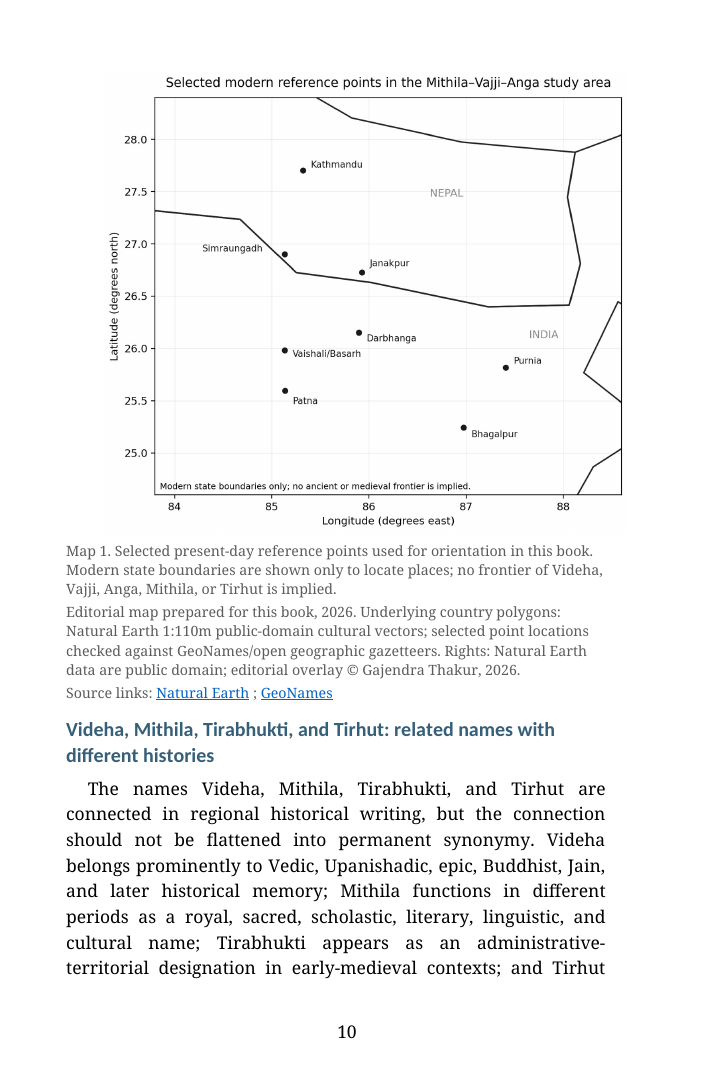
Mithila · Vajji · Anga
Chapter-specific source notes
- Primary chapter witness. Gajendra Thakur, Decoding the Panji of Mithila — Volume III, formal Chapter 12, PDF pp. 146-159; formal Chapter 12. The HTML transcription is generated from the commit-pinned source PDF and retains the chapter boundary recorded in this edition.
- Internal structure. The repository source-heading inventory records 12 subordinate headings for this chapter: “Index Link Box”; “Chapter overview”; “Entry 41: The Puwaripar Digaunth-Soderpur opening”; “Entry 42: Digaunth to Gangoli”; “Entries 43-44: Digaunth to Navtol and the modern scholarly layer”; “Entry 45: Harianb-Digaunth-Batouri”; “Entry 46: Bairi, Sankorthu, and densely layered daughter-lines”; “Entries 47-48: Bhattpura and the Babu-linked branches”; ….
- Digital editorial method. The page keeps the preserved source text distinct from generated navigational, concordance, visual, and provenance apparatus. The synthetic reconstruction is explanatory only and is not evidence for an individual lineage or a determination of social or marital status.