Decoding the Panji of Mithila · Volume III · Chapter 14
Entries 59-61 - Hati, Teterihar, Soderpur, Sarisab, and Mahiya Index Link Box
Chapter 14
Entries 59-61 - Hati, Teterihar, Soderpur, Sarisab, and
Mahiya
Index Link Box
Index cluster: हाटी / तेतरिहार / सोदरपुर / सरिसब / महिया / कटका.
Khand 2 source entries decoded: 59-61.
Principal source heading forms: “हाटी सोदरपुर-उप-टीप”; “उपटीप हाटीसँ सोदरपुर”; “अथ
हाटी सोदरपुर ग्राम”; “अथ तेतरिहार सोदरपुर ... ग्रामरम्भ”; “उ.टी. तेवरिहार सँ सरिसब”;
“उपटीप महिया”; “अथ महिया सोदरपुर”; and the closing movement into “अथ सोदरपुर
कटका ग्रामारम्भ.”
Index roots and routes: सोदरपुर-root controls the Hati, Teterihar, Mahiya, and Katka openings;
internal routes pass through दरिहरा, करमहा, पाली, नरउन, माण्डर, बुधवाल, जजिवाल,
उगही/वलियास, तिलय, रूचौली-एकहरा, खण्डबला, घुसौत, विट्ठो, कु जौली, खौआल, तरौनी-
करमहा, महिषी-पाली, गंगाधर-मंगरौनी, बेलउँ च, सुरगन, and linked status houses.
Coverage status: Entries 59-61 decoded in this chapter. Entry 62 opens the Mahishi-Pali cluster
and belongs to Chapter 15.
Chapter 13 ended when the Mani-Bhattpura route reached the
threshold of the Hati-Soderpur section. Chapter 14 now
continues from that subsequent section. The line moves into
additional settlements, scholarly and ritual branches,
daughter-linked routes, and marriage networks. The chapter
is shorter than some preceding chapters, but it is structurally
important because it shows how one Soderpur-root cluster
can pass rapidly through Hati, Teterihar, Sarisab, Mahiya, and
Katka before the larger Mahishi-Pali sequence begins.
The method remains the same. Every name is read through
descent, place, marriage, title, and branch-continuity. A name
standing alone is never enough. The decoder must ask: whose
son or daughter is this person, which village or house is
attached by सँ, what title or status marker helps identify the
Decoding the Panji of Mithila, Volume III | Page 172
Decoding the Panji of Mithila Volume III
branch, and whether the line is being continued by an अपरा, a
daughter-link, a register number, or a new ग्रामारम्भ.
Entries 59-61 are valuable because they show the Panji in a
transitional mode. The record does not pause to explain why
Hati, Teterihar, Sarisab, Mahiya, and Katka appear together. It
assumes that the trained reader will follow the formulae. This
chapter therefore unfolds that compressed transition into
prose while preserving the uncertainty and density of the
source.
Chapter overview
Entry 59 opens the Hati-Soderpur record and then moves
directly into Teterihar-Soderpur. The entry shows a dense
network of daughter-lines, Vedic and Pathak identifiers,
repeated Pali and Naruan links, and the appearance of
Ruchouli-Ekhara and Khandbala. Entry 60 continues Teterihar
toward Sarisab, adding Ghusaut, Vittho-Kujouli, Tarouni-
Karamha, Mahishi-Pali-Mangrauni, and related learned or
professional markers. Entry 61 opens the Mahiya-Soderpur
section and then moves into Soderpur-Katka.
This cluster therefore acts as a hinge. It closes the
Kanhauli-Mani material of Chapter 13 and prepares the
Mahishi-Pali expansion of Chapter 15. The same Soderpur-root
remains active, but the entries introduce new relational fields.
Hati and Teterihar are not accidental place names; they are
part of the Soderpur network. Mahiya is not a stray heading; it
opens another Soderpur branch before Katka appears.
Entry 59: Hati-Soderpur as a Vedic and daughter-linked
opening
Entry 59 begins with the Hati-Soderpur heading and then
formally opens with “अथ हाटी सोदरपुर ग्राम.” The word अथ marks a
Decoding the Panji of Mithila, Volume III | Page 173
Decoding the Panji of Mithila Volume III
new beginning, and ग्राम indicates that the source is opening a
village-based record. The first visible figure is Vaidik Soni. The
title वैदिक is essential. It identifies a ritual or learned status
within the entry, and the line must be read as both
genealogical and scholarly-ritual.
Vaidik Soni’s daughter-linked group is given as Kulmani,
Vanshmani, Kamalmani, Parshamani, and Harshamani.
Because the word सुता governs this group, the reader must not
read the sequence as a simple line of sons. It is a daughter-
linked or marriage-mediated group. The route immediately
moves through Darhara-Jivanath and Karamha-Bhavdev. This
is the first sign that Hati-Soderpur is only the doorway, not the
boundary.
Kulmani’s son Bammola moves through Pali-Devanath and
Naruan-Hasnu. Bammola’s daughter-line moves through
Karamha-Dharmadatt and Soderpur-Girdhari. An अपरा then
opens another Bammola daughter-line through Karamha-
Lanhi and Pali-Dharmanand. These repetitions show how the
source treats the same branch through several routes. The
decoder must separate the repeated routes instead of
flattening them into one sentence.
The Vanshmani and Kamalmani sections continue the
same pattern. Vanshmani’s daughter-line again goes toward
Pali-Devanath and Naruan-Hasnu. Kamalmani’s daughter-line
goes toward Karamha-Dharmadatt, and another Kamalmani
route passes through Mandar-Bagdu and Karamha-
Chandradev. The repeated appearance of Pali, Naruan,
Karamha, and Mandar shows a stable network of marriage
and branch relations around the Hati-Soderpur heading.
Decoding the Panji of Mithila, Volume III | Page 174
Decoding the Panji of Mithila Volume III
Parshamani’s son Pashupati is linked with Naruan-
Lakshminath and Pali-Jagannath. The source then passes to
Devanand’s sons Khushi and Nena. Khushi’s son Bhaiya
moves through Budhwal-Balakrama-Hridayram and Jajival-
Hirphul. Here Budhwal and Jajival become route places inside
a Soderpur-related entry. Again the heading is not a wall; the
genealogy travels where the relationship demands.
Bhaiya’s son Rajivan/Nayan/Babua-like line then leads into
Ugahi-Valiyas, Jayanath, Girijanath, and Pathak Dūbh. The
Pathak title should be preserved because it marks learned or
ritual identity. An अपरा from Bhaiya opens Kalikant and
Ramakant through Ugahi-Valiyas and Pathak Dunn, again
showing a learned-house route. Babua’s own line moves to
Bhagavati and Kunkun through Ruchouli-Ekhara, and then
toward Khandbala. This is significant because Ekhara and
Khandbala are separate index roots but appear here inside
the Soderpur-controlled movement.
The closing line of the Hati portion returns to Nena’s
daughter-line through Budhwal-Hridayram and Jajival-
Hirphul. This confirms that Entry 59 is not only a Hati record.
It is a route map in which Hati, Soderpur, Pali, Naruan,
Karamha, Mandar, Budhwal, Jajival, Valiyas, Ruchouli-Ekhara,
and Khandbala are bound through descent and daughter-
linked movement.
Entry 59 continued: Teterihar-Soderpur begins inside the
same chapter
After the Hati material, the same entry opens Teterihar-
Soderpur. The source states “अथ तेतरिहार सोदरपुर ... ग्रामरम्भ,” which
means that another Soderpur-linked village beginning is
introduced before a new numbered entry appears. This is why
Chapter 14 must read Entry 59 as a compound section: Hati-
Decoding the Panji of Mithila, Volume III | Page 175
Decoding the Panji of Mithila Volume III
Soderpur opens first, then Teterihar-Soderpur begins inside
the same numbered field.
The Teterihar opening begins with Mehesh and a daughter-
linked group: Manikrishna, Devkrishna, Shrikrishna, and
Anathi. The route moves through Pali-Ramdev and Soderpur-
Mitrakar. Manikrishna’s line moves through Mandar-
Ghananand and Naruan-Sadhu Shadhar. Devkrishna’s son
Manik, also called Tirthakrishna in the source, moves through
Mandar-Manbodh and Harianb-Narayan.
Manik/Tirthakrishna’s sons Vaidyanath and Thithar are
connected with Pali-Devanath and Naruan-Hasnu.
Vaidyanath’s daughter-line then moves to Alay-Raja Dular
Singh and Kujouli-Kulpati. The title Raja attached to Dular
Singh adds a status layer to the branch. It must not be dropped
from the decoding because it explains the public or estate
identity through which the connection is remembered.
Several further Vaidyanath daughter-lines are partially
incomplete but still structurally clear. One route moves
toward Ravāal-Hardatt and Karamha-Neya; another toward
Pandua-Pandit Ratanmani and Ravandbala-Nidhi; another
toward Harianb-Dullah-Lanha and Darhara-Vishnudatt. The
blank or uncertain portions must not be invented. What can
be said with confidence is that the entry preserves a sequence
of marriage routes attached to Vaidyanath’s line.
Thithar’s son Girdhar/Babujan moves through Pali-
Lakshmidhar and Sakaradhi-Nakdu. The next part takes
Fekan/Thakkan through Budhwal-Keshav-Sadashiv/Gosain
and Khoaāl-Shrinath. A further Fekan/Thakkan daughter-line
moves through Harianb-Loknath-Yadunath and Darhara-
Nanu. Then an अपरा opens Gaurinath and the line returns to
Budhwal-Gosain, Ravaal-Shrinath, Ekhara-Indranath, and Rai
Decoding the Panji of Mithila, Volume III | Page 176
Decoding the Panji of Mithila Volume III
Bahadur Shrinath, before closing through Naruan-Mahadev.
The title Rai Bahadur is another status marker that must
remain attached to the route.
Entry 60: Teterihar to Sarisab
Entry 60 is headed “उ.टी. तेवरिहार सँ सरिसब.” The spelling
appears as तेवरिहार in the source, but the plan and surrounding
context identify the cluster with Teterihar. The editor should
preserve the source form in transcription and use Teterihar as
the normalized search form in the index.
The entry begins from Gaurinath’s daughter-linked group:
Shankar, Damodar, and Durgadhar. Their route goes through
Ghusaut-Parmeshwar-Markandey and Soderpur-
Mahamahopadhyaya Jagdish. The title Mahamahopadhyaya
marks a high scholarly status. This is a key example of the
chapter’s method: the name is meaningful only when read
with descent, place, scholarly title, and branch route.
Shankar’s sons Raghavendra and Madhavendra move
through Vittho-Kujouli-Khelanath-Lekhnath and Khoaāl-
Umanath. This line is important because it connects the
Teterihar-Sarisab heading to Kujouli, a separate Index root.
The connection is not accidental; it is produced by descent and
route within the entry.
Damodar’s daughter-line includes Manish and a partly
incomplete route through Tarouni-Karamha-Mandhan and
Doctor Badrinath. The source also gives C.S.M.B.B.S. after
Doctor Badrinath. Rather than modernizing or removing this,
the decoding should treat it as a professional-identifying layer.
The route then moves to Khandbala-Babu Vishweshwar Singh.
A modern medical-professional identifier and a
Babu/Khandbala status route appear in the same compressed
formula.
Decoding the Panji of Mithila, Volume III | Page 177
Decoding the Panji of Mithila Volume III
Durgadhar’s daughter-line moves through Mahishi-Pali
toward Mangrauni and Gangadhar’s son Chandradhar, then to
Khandbala-Chandrakant. This prepares the reader for the
next large cluster. Even before Chapter 15 begins formally,
Mahishi-Pali-Mangrauni is already appearing as a route inside
Teterihar-Sarisab.
The later part of Entry 60 returns to Shrikrishna. His sons
Anand and Janaki are linked with Budhwal-Shatanjiv-Bhaiyan
and Darhara. Anand’s daughter-line moves through Pali-
Mohan and Soderpur-Rudranath. Janaki’s daughter-line
moves through Karamha-Govind and Soderpur-Dhir. Anathi’s
daughter-line moves through Darhara-Mansukh and
Khandbala-Jagannath. The entry thus ends by binding
Teterihar-Sarisab back to the same matrix of Pali, Soderpur,
Karamha, Darhara, Budhwal, and Khandbala.
Entry 61: Mahiya-Soderpur and the move toward Katka
Entry 61 opens “उपटीप महिया” and then states “अथ महिया सोदरपुर.”
This is another formal village opening under the Soderpur
field. Ratnapati’s sons Mauj and Durgadatt are linked with
Pali-Moti and Soderpur-Narayan. An अपरा then opens Dhir and
Kant through Mandar-Jaydev and Karamha-Krishnanand.
Another branch moves through Budhwal-Ram and Darhara-
Mahamahopadhyaya Thedh. The entry therefore begins with
descent but quickly becomes a route through scholarly and
regional markers.
Mauj’s son Nena/Hridaynath/Harinaath is linked with
Budhwal-Devanath and Soderpur-Damodar. Hridaynath’s son
Gosain moves through Mandar-Khagpati and Pabouli-Kavi
Bholan. The Kavi title, like Vaidik, Pathak,
Mahamahopadhyaya, Doctor, Babu, Raja, and Rai Bahadur in
Decoding the Panji of Mithila, Volume III | Page 178
Decoding the Panji of Mithila Volume III
the preceding entries, must be retained as identifying
evidence.
Gosain’s daughter-line moves through Belauch-Bhushan
and Budhwal-Krishnapati. Harinath’s daughter-line moves
through Khoaāl-Kavi Hemnath and Sarisab-Pandit Hireshwar.
Another Harinath daughter-line goes through Karamha-Fakir-
Yoganand and Darhara-Chitreshwar. A further line moves
through Valiyas-Mani-Son and Khandbala-Thakur
Indreshwar. Another moves through Sakaradhi-Krishnadas
and Surgan-Rai Uttamnarayan. These lines show the full range
of the Panji’s memory: village, scholarship, title, status, and
route are all interwoven.
The Dhir line moves through Khoaāl-Ghanshyam-Pitambar
and Soderpur-Ramchandra, with an अपरा through Ekhara-
Dularaiya. Kant’s son Gauri returns to Budhwal-Devanath and
Soderpur-Damodar. Gauri’s daughter-line moves through
Naruan-Sona-Chan. A further Umapati-Sona line moves
through Soderpur-Dhanshyam and Darhara-Vishwanath.
Sona’s son Chan then returns through Soderpur-Rojhan and
Darhara-Babu. The cluster therefore repeatedly returns to
Soderpur while branching outward through other roots.
Chan’s sons Parshamani and Udaymani move through
Mandar-Shobhakar-Hiyan and Budhwal-Bhaiyan. This closes
the Mahiya portion with the same pattern seen throughout the
chapter: a person-line is identified through father, village,
daughter-connection, title, and external route. No single
element is sufficient by itself.
Entry 61 closing: Soderpur-Katka as transition
The end of Entry 61 opens another formal village
beginning: “अथ सोदरपुर कटका ग्रामारम्भ.” This is not a new numbered
chapter in the source, but it is a clear internal transition.
Decoding the Panji of Mithila, Volume III | Page 179
Decoding the Panji of Mithila Volume III
Ganoli/Krishnapati’s son Lakshmipati moves through
Darhara-Yajnanarayan-Bachharan and
Pali-Dullah/Dharanidhar. Lakshmipati’s son Jivach moves
through Mandar-Ratnapati-Damodar and Khandbala-Babu
Ganeshdatt Singh. The Katka route therefore extends
Soderpur into another village field.
Jivach’s sons Anant, Shripati, Ratnapati, and Umapati move
through Budhwal-Mahamahopadhyaya Manishwar and
Darhara-Manran. Anant’s daughter-linked group - Shripati,
Lalan, Vino, Manoj - moves through Mandar-Nilkanth Singh-
Duginand Singh. A final Anant daughter-line moves through
Valiyas-Damodar-Lakshmipati and Karamha-Dinanand. These
closing lines show why the chapter stops here: the next
numbered entry, 62, opens the Mahishi-Pali cluster and begins
a much larger section.
Cross-reference and route map for Entries 59-61
The principal route is Soderpur-root: Hati-Soderpur,
Teterihar-Soderpur, Teterihar-Sarisab, Mahiya-Soderpur, and
Soderpur-Katka. Secondary routes include Darhara, Karamha,
Pali, Naruan, Mandar, Budhwal, Jajival, Ugahi-Valiyas, Tilay,
Ruchouli-Ekhara, Khandbala, Ghusaut, Vittho, Kujouli, Khoaāl,
Tarouni-Karamha, Mahishi-Pali, Mangrauni, Belauch,
Sakaradhi, and Surgan.
The title map is especially rich for a short chapter. It
includes Vaidik, Pathak, Raja, Rai Bahadur,
Mahamahopadhyaya, Doctor, Babu, Kavi, Pandit, Thakur, and
Rai. These markers show that scholarly, ritual, professional,
and landed status are not outside the genealogy. They help
identify persons inside crowded name sequences and should
remain in the decoded prose.
Decoding the Panji of Mithila, Volume III | Page 180
Decoding the Panji of Mithila Volume III
The branch map depends heavily on सुता and अपरा. सुता
introduces daughter-linked or marriage-mediated movement;
अपरा opens another line from the same or related branch. The
chapter also contains several partial or blank formulas. These
are to be preserved as signs of incomplete data, not repaired
by conjecture.
Important uncertainties
The source spelling varies: हाटी / हाटी, तेतरिहार / तेवरिहार, वबुआजी /
बाबूजी-like forms, रवौआल / रवण्डबला, सोदरपुर / सोदर, and several names
with uncertain scanning or scribal forms. The edition should
preserve the source form in detailed transcription and use
standardized forms only in the index.
The Hati and Teterihar sections are closely joined inside
Entry 59. The reader should not assume that the Teterihar
material belongs to a completely separate register simply
because it has its own ग्रामरम्भ. It is a new internal village
opening within the same numbered cluster and must be read
as part of the Soderpur-root transition.
Entry 61 also introduces Soderpur-Katka before Entry 62
begins. This means Chapter 14 should include Katka as a
closing transition, even though the approved chapter title
emphasizes Hati, Teterihar, Soderpur, Sarisab, and Mahiya.
Katka is part of the closing movement and prepares the source
for the Mahishi-Pali opening.
Research summary
Entries 59-61 show how a small chapter can carry a wide
social map. Hati and Teterihar introduce Vedic, Pathak, Raja,
Rai Bahadur, Mahamahopadhyaya, Doctor, Babu, and Kavi
identifiers. Mahiya adds Kavi Hemnath, Pandit Hireshwar,
Thakur Indreshwar, Rai Uttamnarayan, and other status-
Decoding the Panji of Mithila, Volume III | Page 181
Decoding the Panji of Mithila Volume III
marked connections. These titles are not decorative; they are
part of the branch record.
The chapter also demonstrates why the Index must remain
the control register. Soderpur is the governing root, but the
chapter reaches Sarisab, Pali, Naruan, Karamha, Mandar,
Budhwal, Khoaāl, Ekhara, Kujouli, Khandbala, Valiyas,
Surgan, and Katka. Without the Index, the reader would see
only a crowded string of names. With the Index, the route
becomes readable.
For the family researcher, the rule is simple but strict: do
not detach a person from the route. Vaidik Soni, Vaidyanath,
Gaurinath, Shankar, Damodar, Durgadhar, Ratnapati, Mauj,
Harinath, Dhir, Kant, Gauri, Sona, Chan, Lakshmipati, and
Jivach are all meaningful only when read through their
descent, attached place, marriage or daughter-route, title, and
branch-continuity.
The next chapter begins with Entry 62, “उपटीप महिषी सँ मङ् गदपट्टी
पाली दुर्गागंज कटिहार,” and opens “अथ महिषी पाली ग्रामारम्भ.” That section
is larger and will be treated as Chapter 15: Mahishi, Pali,
Ishahpur, Gangoli, Hatadh, Lohna, Pahitola, and Mangrauni.
Decoding the Panji of Mithila, Volume III | Page 182
Decoding the Panji of Mithila Volume IIISource structure and verification apparatus
Editorial source apparatus. This apparatus is descriptive, not interpretive. It records the source-controlled structure used to verify that this page corresponds to formal Chapter 14 of Decoding the Panji of Mithila — Volume III. The chapter text above is preserved from PDF pp. 173-184; formal Chapter 14 in the commit-pinned authoritative source. It is not merged with a neighboring chapter, appendix, annexure, or independent front/back-matter unit. The internal headings below come from the repository’s source-heading inventory and are retained as navigational and audit evidence; showing them here does not turn those headings into separate publications or add claims that are absent from the source.
Internal source headings
- Index Link Box
- Chapter overview
- Entry 59: Hati-Soderpur as a Vedic and daughter-linked opening
- Entry 59 continued: Teterihar-Soderpur begins inside the same chapter
- Entry 60: Teterihar to Sarisab
- Entry 61: Mahiya-Soderpur and the move toward Katka
- Entry 61 closing: Soderpur-Katka as transition
- Cross-reference and route map for Entries 59-61
- Important uncertainties
- Research summary
Source-text concordance
Entries · 59-61 · Hati · Teterihar · Soderpur · Sarisab · Mahiya · Index · Link · cluster · Khand · decoded · Principal · heading · forms · र-उप-ट · closing · movement · roots · routes · र-root · controls · Katka · openings · internal · pass · करमह · नरउन · एकहर · धर-म · linked · status · houses · Coverage · Entry · opens · Mahishi-Pali · belongs · ended · Mani-Bhattpura · route · reached · threshold · Hati-Soderpur · section · continues · subsequent · line · moves · additional · settlements · scholarly · ritual · branches · daughter-linked · marriage · networks · shorter · preceding · chapters · structurally · important · shows · Soderpur-root · rapidly · larger · sequence · begins · method · remains · Every · name · read · descent · place · title · branch-continuity · standing · alone · never
Boundary verification. In the formal sequence this chapter follows Volume III Chapter 13, “Entries 52-58 - Kanhauli, Ujan, Mangrauni, Mani, Sarisab, and Bhattpura Index Link Box” and precedes Volume III Chapter 15, “Entries 62-78 - Mahishi, Pali, Ishahpur, Gangoli, Hatadh, Lohna, Pahitola, and Mangrauni Index Link Box Index cluster: महिषी / पाली / इशहपुर / गंगोली / हटाढ़ / लोहना / पाहीटोल / मंगरौनी /”. The chapter extractor begins at the verified formal Chapter 14 marker and stops at the next verified formal chapter marker; for a final chapter it stops before recognized book-level back matter. The concordance above is generated only from distinct terms already present in this chapter’s preserved source text. It is provided for discovery, comparison, and audit, not as an automated judgment about persons, lineages, status, kinship, marriage eligibility, or historical truth.
Illustrated research apparatus
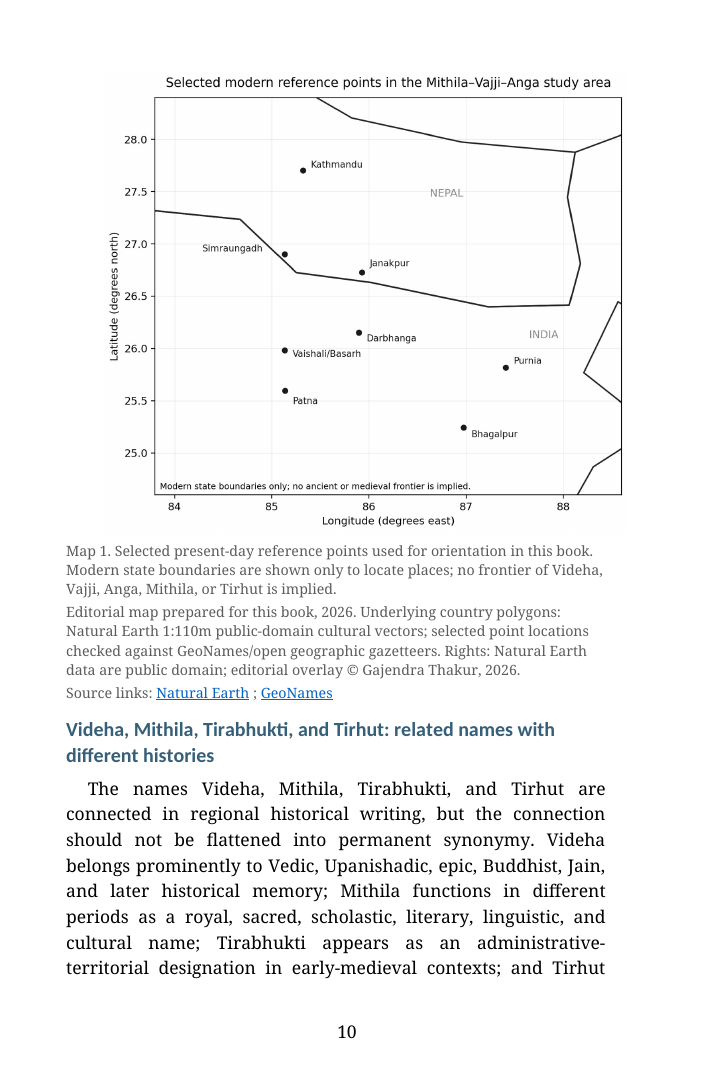
Mithila · Vajji · Anga
Chapter-specific source notes
- Primary chapter witness. Gajendra Thakur, Decoding the Panji of Mithila — Volume III, formal Chapter 14, PDF pp. 173-184; formal Chapter 14. The HTML transcription is generated from the commit-pinned source PDF and retains the chapter boundary recorded in this edition.
- Internal structure. The repository source-heading inventory records 10 subordinate headings for this chapter: “Index Link Box”; “Chapter overview”; “Entry 59: Hati-Soderpur as a Vedic and daughter-linked opening”; “Entry 59 continued: Teterihar-Soderpur begins inside the same chapter”; “Entry 60: Teterihar to Sarisab”; “Entry 61: Mahiya-Soderpur and the move toward Katka”; “Entry 61 closing: Soderpur-Katka as transition”; “Cross-reference and route map for Entries 59-61”; ….
- Digital editorial method. The page keeps the preserved source text distinct from generated navigational, concordance, visual, and provenance apparatus. The synthetic reconstruction is explanatory only and is not evidence for an individual lineage or a determination of social or marital status.